


A safe portable EV charger is not proven by a CE logo, a TÜV name, or an IP67 claim alone. The useful question is whether the exact charger configuration has the right standard, test boundary, electrical protection, market documentation, and traceable evidence behind each claim.
That distinction matters because a portable charger can draw substantial current for several hours. A control box may pass an enclosure test while the plug, cable, connector, household socket, or installation still creates a different risk. This guide turns certification language into a practical verification process for drivers, installers, distributors, and product buyers. If you are still comparing charger types, start with this guia de carregador portátil de VE before checking certificates.
Índice
- What standard applies to a portable EV charger?
- How are IEC 62752 and IEC 61851-1 different?
- What is the difference between CE, TÜV, UL, ETL, UKCA, and RCM?
- What should an EV charger Declaration of Conformity include?
- How can you verify an EV charger test report?
- What does IP67 cover, and what does it not cover?
- Is an IP67 portable EV charger safe in rain?
- What RCD and DC leakage protection should a portable charger have?
- Can you use an extension cord with a portable EV charger?
- Which certifications should be checked in the EU, UK, US, Australia, and China?
- What evidence should a buyer request before approving a portable EV charger?
- Conclusion: What should a buyer do before approving a portable EV charger?
- Perguntas Frequentes
- Referências
What standard applies to a portable EV charger?
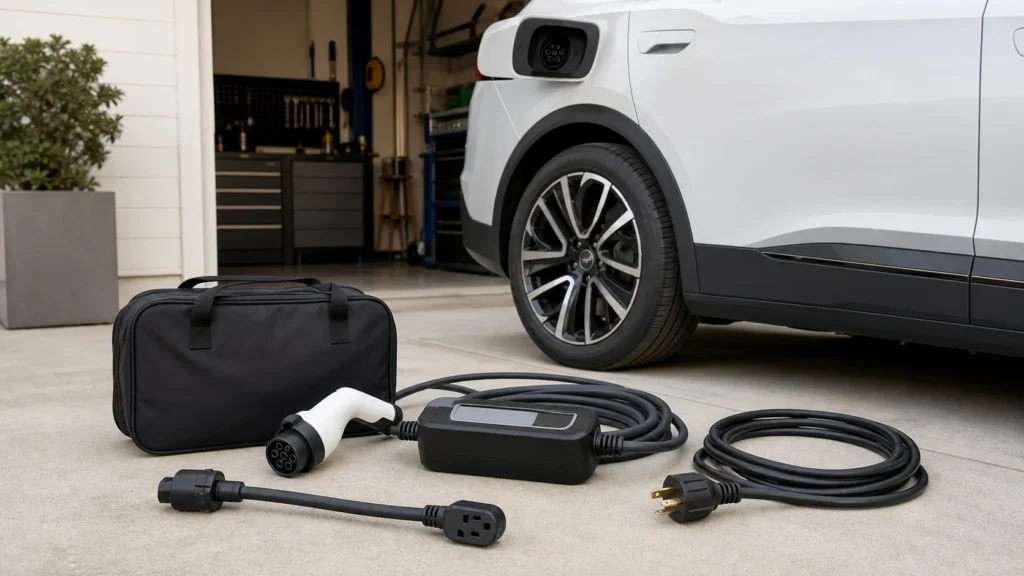
For a cord-and-plug portable AC charger, first identify whether the product is a Mode 2 EV charging device. Mode 2 equipment normally includes an in-cable control and protection device between the vehicle and a household or industrial supply plug.
The applicable route depends on the complete design and destination market. Record the exact model, current rating, supply plug, vehicle connector, cable, control box, protection functions, enclosure being tested, and supplied accessories. IEC 62752:2024 is particularly important for Mode 2 in-cable control and protection devices, including safety functions and household-plug temperature control 2. Do not present one generic standards list as if every portable charger uses the same route.
How are IEC 62752 and IEC 61851-1 different?
IEC 61851-1 is a broad conductive charging system standard. IEC 62752 is more specific to the in-cable control and protection device used for Mode 2 charging, so the two labels are related but not interchangeable.
Check the product classification, standard edition, IEC 61851-1 functions tested, and whether the report covers the actual current, plug, connector, cable, adapter, and firmware. A shared control-box platform may still need different evidence when the plug or connector changes.
This matters for both safety and product returns. A Type 2 unit sold in Europe, a Type 1 unit sold in North America, and a unit with a replaceable household plug may share a control-box platform while requiring different test evidence. A related EV charging cable and connector types guide helps separate connector compatibility from control-box compliance.
What is the difference between CE, TUV, UL, ETL, UKCA, and RCM?
These names do not all describe the same thing. Some are regulatory marks, some identify third-party assessment, and some refer to a standard or certification route.
| Mark or name | What it generally tells you | What it does not prove by itself |
|---|---|---|
| CE | Manufacturer declaration that the final product meets applicable EU requirements | Not automatically government approval or a third-party certificate |
| TÜV | A named TÜV body tested or certified a defined product and scope | A logo without certificate number, model, scope, and issuer is insufficient |
| UL / ETL | A North American body evaluated the EVSE to an applicable standard such as UL 2594 | The logo alone does not cover every variant or market |
| UKCA | A Great Britain marking route where applicable | Not automatically the only current GB route |
| RCM | An Australian or New Zealand compliance pathway where applicable | Does not replace checking the product standard and importer duties |
CE is the manufacturer’s declaration that the final product meets applicable EU requirements; third-party assessment depends on the applicable legislation 1. For the UK, current guidance allows CE or UKCA routes for certain electrical equipment in Great Britain, so UKCA should not be described as universally mandatory 4.
UL 2594 is an EVSE safety standard, not proof that every portable charger is legally required to carry a UL mark in every sales channel. Ask whether an authority, retailer, insurer, or customer requires NRTL listing or another accepted evaluation 5.
What should an EV charger Declaration of Conformity include?
An EU Declaration of Conformity should identify the final product clearly enough to connect the document to the physical charger. A logo or marketing certificate is not a substitute for that traceability.
Check whether the DoC includes:
- manufacturer’s legal name and address;
- exact product name, model, variant, and rated voltage/current;
- the complete product description, including plug, cable, connector, and adapters;
- applicable EU legislation and standards, with editions where relevant;
- notified-body name and identification number if one was used;
- authorized signatory, date, document version, and relationship to the test reports.
The final product is the important boundary. A CE-marked plug, cable, or power module does not automatically prove that the assembled charger satisfies the final-product obligations. The model on the report, DoC, label, packaging, and purchase sample should match.
How can you verify an EV charger test report?
Treat certification review as a document-matching exercise rather than a logo check:
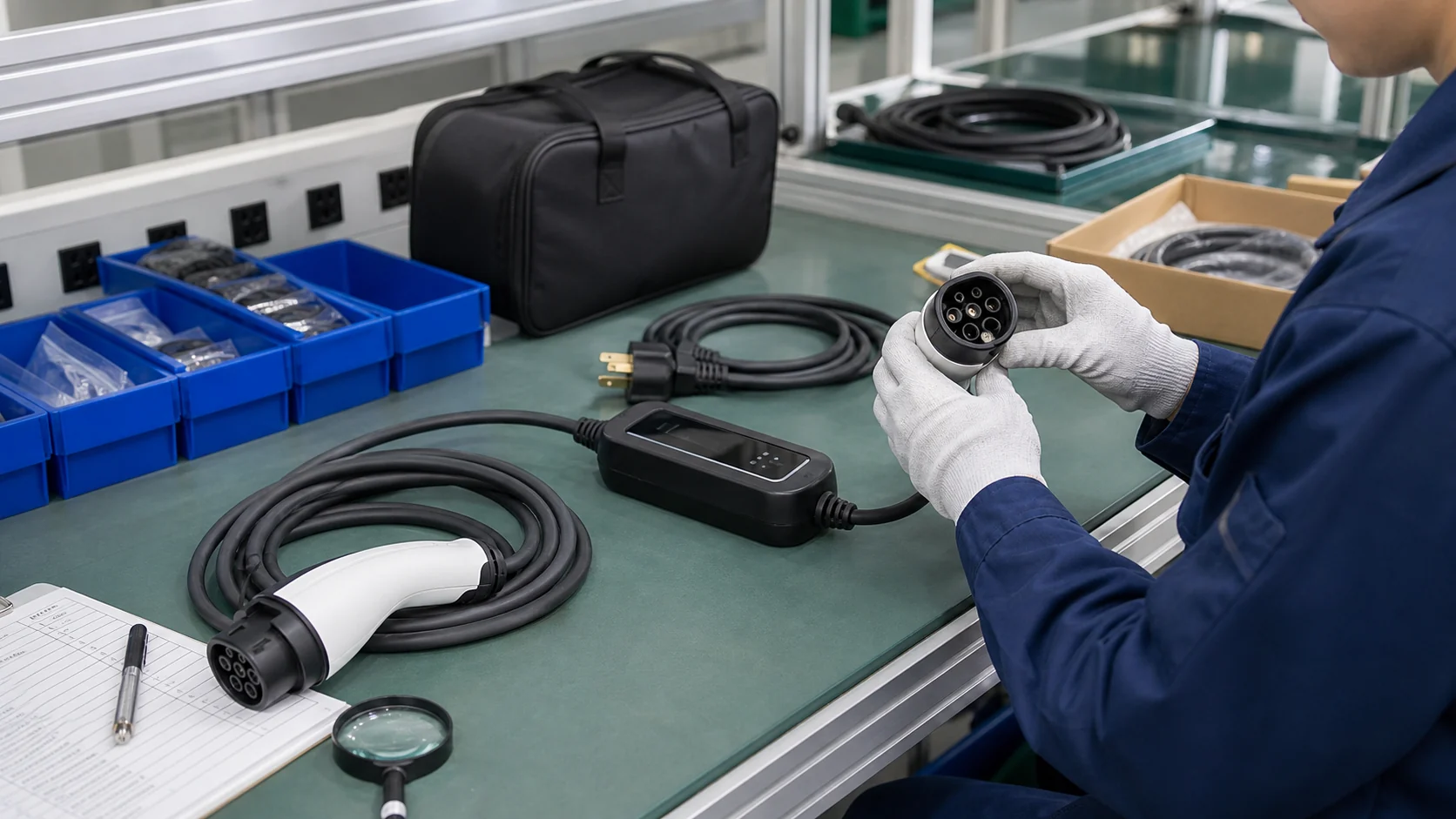
- Record the physical configuration. Photograph the control box label, supply plug, vehicle connector, cable markings, rating plate, adapters, and batch information.
- Match model identity. Compare the model and revision in the report, DoC, label, packaging, datasheet, and sample.
- Check the standard, boundary, and conditions. Record the edition, laboratory, report number, date, product boundary, current, duty cycle, voltage, temperature, plug, cable, and accessories.
- Check protection and exclusions. Request evidence for leakage, temperature, voltage, control-pilot, and reset behavior, then record exclusions such as extension leads, replacement plugs, or outdoor use.
- Verify the issuing body. Use the laboratory or certification body’s own certificate search when available instead of relying only on a supplier PDF.
What does IP67 cover, and what does it not cover?
IP67 is an enclosure classification under IEC 60529. The first digit relates to dust protection; the second relates to temporary immersion under specified test conditions 3.
The claim must identify which enclosure was tested. For a portable EV charger, that may be the control box, a connector cap, or another housing. It does not automatically cover the wall socket, vehicle inlet, cable insulation, extension cord, plug-to-socket connection, or the complete charging setup.
IP67 does not by itself prove:
- salt-spray, corrosion, UV, vibration, impact, or thermal-cycling resistance;
- cable bending, pulling, or gland fatigue;
- safe operation while submerged or while connectors are wet;
- protection with an open cover, incomplete plug insertion, or changed accessory.
Replace broad outdoor-safety promises with the exact enclosure, test configuration, and use limitations.
Is an IP67 portable EV charger safe in rain?
IP67 can support outdoor use when the charger is installed and operated according to its instructions, but it is not permission to charge in standing water or expose every connection to rain. The outlet, adapter, plug face, vehicle inlet, and cable connection may have different protection levels.
Before approving outdoor use, verify:
- whether rain use is permitted and under what conditions;
- whether the control box must be suspended, covered, or kept off the ground;
- whether the outlet and upstream protection are suitable;
- whether disconnected connectors, drainage, condensation, cable loops, and final cable glands are addressed.
An IP rating is one input to an outdoor-use decision. It does not replace installation instructions, local electrical rules, or a complete-product test report.
What RCD and DC leakage protection should a portable charger have?
The useful question is not simply “Does it have a Type B RCD?” Ask how the complete system detects and interrupts AC and DC residual current, and which protection is inside the charger versus upstream.
Ask for a wiring diagram and test evidence that identifies:
- the internal residual-current device or sensor, AC trip threshold, and response time;
- the method for detecting DC leakage, such as 6 mA DC detection where applicable;
- upstream breaker/RCD assumptions and behavior after a trip, power interruption, over-temperature event, or unplugging;
- the standard clause or local rule supporting the architecture.
The protection choice varies by market and installation. “Type B mandatory” without the tested design, standard, and installation assumptions is too broad to support a purchase.
Can you use an extension cord with a portable EV charger?
An extension cord is not a neutral accessory for a long, high-current charging session. Extra plugs, sockets, cable length, contact quality, and coiling can change temperature and voltage drop.
If an extension lead is considered, obtain written guidance for the exact charger and market. Check conductor size, continuous-current rating, plug and socket temperature, outdoor rating, length, and certification exclusions. Set current for the weakest part of the circuit, not the maximum shown on the charger.
For adjustable-current products, request a tested current-setting table and temperature data for the supplied plug and cable. The related adjustable-current portable EV charger guide explains why current selection is part of the safety decision.
Which certifications should be checked in the EU, UK, US, Australia, and China?
No single global certificate replaces every local market requirement. Use this as a verification map, then confirm the product category, importer role, plug configuration, and current rules before shipment.
| Mercado | O que verificar | O que não assumir |
|---|---|---|
| EU / EEA | CE, EU DoC, applicable legislation and standards, technical file, and notified-body role where required | CE is not a universal third-party certificate |
| Great Britain | Current CE or UKCA route, GB importer, and documentation duties | UKCA is not automatically the only route |
| Estados Unidos / Canadá | Applicable EVSE standard, NRTL or other accepted listing if required, plug and installation rules | UL 2594 does not make listing universally mandatory |
| Austrália / Nova Zelândia | RCM route, applicable electrical standards, importer duties, and plug configuration | RCM alone does not describe every test |
| China | Current CCC scope, catalogue, plug, marking, and importer requirements | Do not state one universal CCC date for every portable charger |
Connector selection is part of this review. Use a focused Comparação entre carregador EV Tipo 1 vs Tipo 2 rather than treating the connector as cosmetic.
What evidence should a buyer request before approving a portable EV charger?
The strongest differentiator for this topic is a claim-verification matrix. It turns certification language into a pass, hold, or reject decision.
| Alegação | Applicable standard or rule | Limite do produto | Test condition to record | Evidência a solicitar | Verification source | Failure mode to watch |
|---|---|---|---|---|---|---|
| CE compliant | Applicable EU legislation and harmonized standards | Final charger configuration | Rated current, voltage, plug, cable, and variant | EU DoC, test reports, technical file index | Manufacturer and notified-body records where applicable | DoC names a different model or component |
| Mode 2 protection | IEC 62752 or justified national route | IC-CPD, supply plug, cable, vehicle connector | Current, temperature, residual current, reset behavior | Full report and wiring diagram | Issuing laboratory or certification portal | Only a generic IEC 61851 reference is supplied |
| IP67 enclosure | IEC 60529 | Named housing, covers, glands, and production configuration | Dust test, immersion condition, sample state | IP report and sample photos | Accredited lab or certification body | Cable and socket are assumed to share the rating |
| Outdoor charging | Product instructions and local installation rules | Charger, outlet, adapter, vehicle inlet | Rain, drainage, connector state, operating restrictions | Installation instructions and exclusions | Manufacturer plus local electrician or authority | “Waterproof” is used without conditions |
| Residual-current protection | Applicable EVSE and electrical rules | Internal protection plus upstream device | AC/DC leakage, trip threshold, response time | Test record, circuit diagram, protection assumptions | Test lab and local authority | Type B is claimed without architecture or report |
| Thermal safety | Applicable product standard and design limits | Household plug, cable, terminals, control box | Continuous load, ambient temperature, current setting | Temperature-rise data and cutoff behavior | Test report and production QC record | Maximum current is advertised without plug-temperature data |
For a supplier or distributor, this matrix creates a better sample-approval process. Check the sample, label, datasheet, certificate, and batch as one evidence set. If the next step is a product range, review related Acessórios de carregamento de VE only after the technical boundaries are clear; connected variants can then be compared through the carregadores EV portáteis inteligentes guide.
Conclusion: What should a buyer do before approving a portable EV charger?
Approve the product only when the exact commercial configuration connects to a standard, test condition, and traceable document. Start with the intended market and Mode 2 classification, then verify the DoC, IEC 62752 or justified alternative route, RCD/DC protection, IP boundary, plug-temperature data, connector, and outdoor-use limits.
Instead of asking whether a charger is “CE and TÜV certified,” ask which model was tested, by whom, to which edition, with which plug and cable, under what conditions, and what the report excludes. Sample checks, label review, connector fit, document matching, and batch consistency are more useful than unsupported logos.
Perguntas Frequentes
Is CE certification the same as TÜV certification?
No. CE is a regulatory conformity marking based on the manufacturer’s declaration. TÜV refers to testing or certification by a named third-party organization, whose scope must be checked.
Does every portable EV charger need IEC 62752?
Not every product follows the same national route, but IEC 62752 is a key standard to check for cord-and-plug-connected Mode 2 equipment. The report should explain why the selected standard applies.
Does IP67 mean a portable charger can be used underwater?
No. IP67 describes a defined enclosure test under IEC 60529. It does not approve energized underwater use or prove that the complete charging setup has the same protection.
Is Type B RCD always required for a portable EV charger?
Not as a universal statement. Protection depends on device design, DC leakage detection, upstream protection, local rules, and the product standard. Request the circuit architecture and test results.
What is the most important document to request from a supplier?
Request the DoC and complete test report for the exact model and configuration. The model, current, plug, cable, connector, label, and report should match the sample.
Can an EV charger certificate cover a replacement plug or adapter?
Not automatically. A replacement plug or adapter can change the electrical and thermal boundary. Check whether it is listed in the report and DoC.
Referências
[1] European Commission. (2026). CE marking.
[2] IEC. (2024). IEC 62752:2024 — In-cable control and protection device for Mode 2 charging of electric road vehicles.
[3] IEC. (2013). IEC 60529:1989+A1:1999+A2:2013 — Degrees of protection provided by enclosures (IP Code).
[4] GOV.UK. (2026). Product regulations and current approaches to UKCA and CE regimes.
[5] UL Solutions. (2026). Automotive and mobility standards and certification services.