



Mud flaps vs splash guards comes down to size, material and fit: splash guards are usually small, rigid molded plastic parts shaped to one vehicle, while mud flaps are larger, flexible rubber or plastic sheets that hang lower behind the tire. Both stop tires from throwing mud, water, salt and stones onto the body and other road users.
Scope: this guide compares the two part types and explains how to choose them for cars, pickups and EVs, including the rules that apply to trucks. For other pickup add-ons, see Running Boards vs Nerf Bars vs Power Steps; for Model Y parts in general, see Tesla Model Y Accessories.
What is the difference between mud flaps and splash guards?
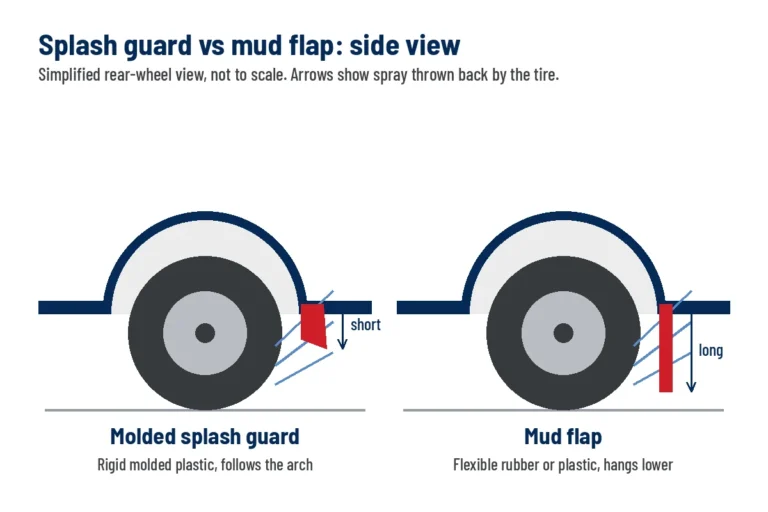
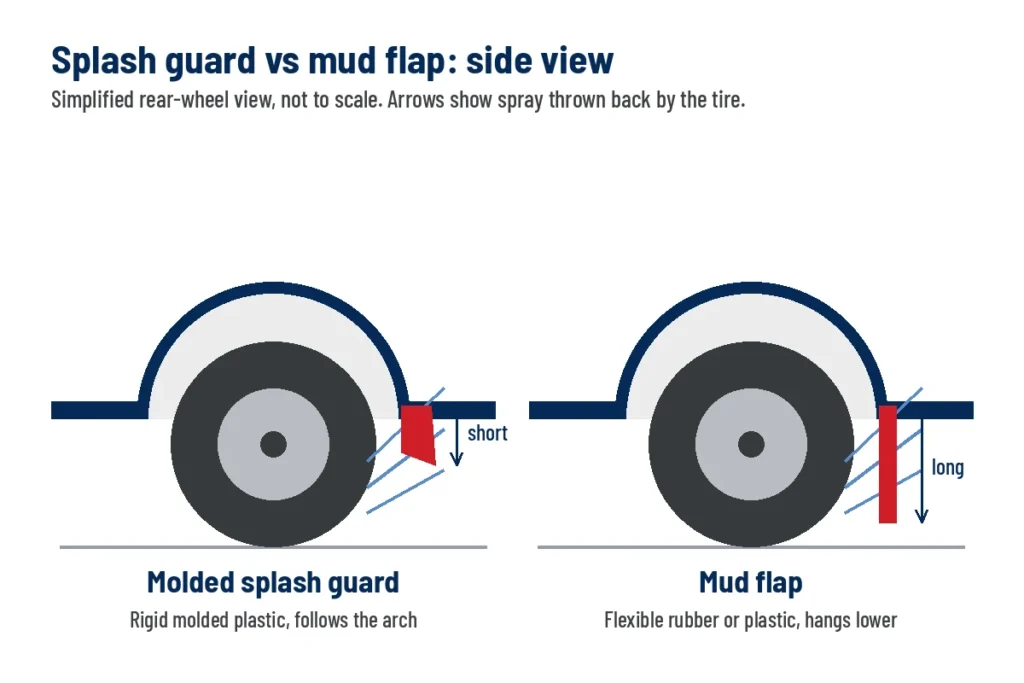
A resposta curta: a splash guard is a compact, contoured part that follows the shape of the wheel arch, and a mud flap is a longer, flatter and usually more flexible sheet that hangs closer to the road. In everyday use the two names overlap, and many brands sell the same product under both. Still, buyers searching each term tend to expect different things.
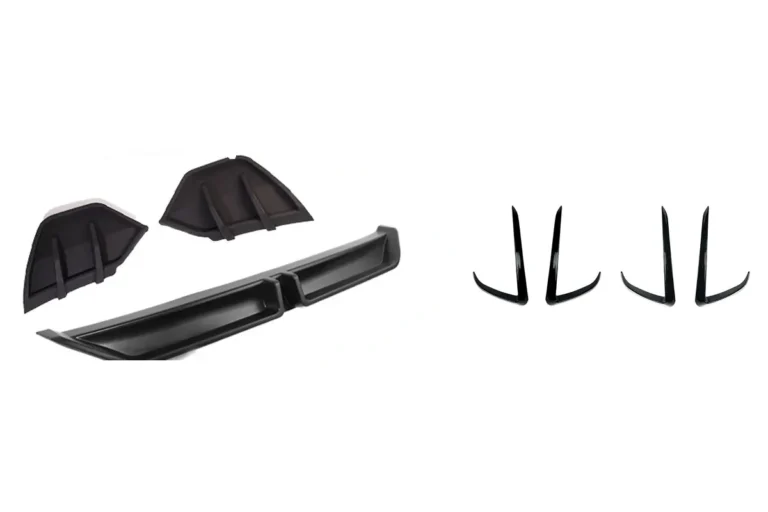
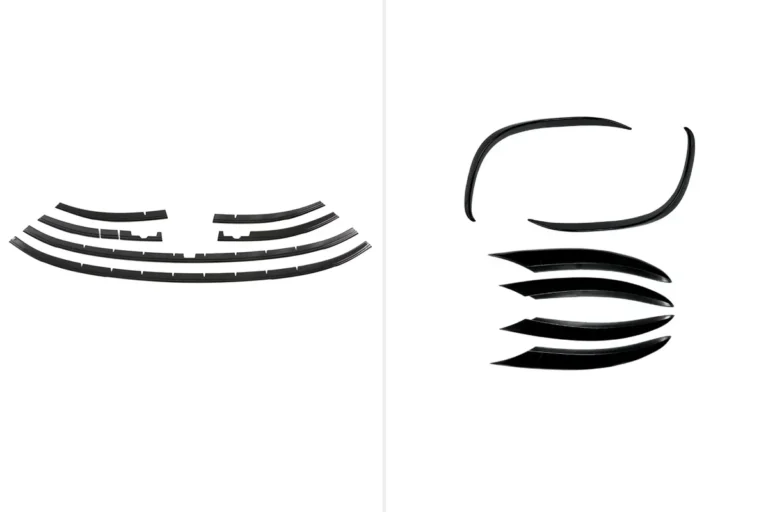
Splash guards are what most carmakers offer as a factory accessory for sedans, hatchbacks, crossovers and EVs. They are usually injection-molded from plastic, colored or textured to match the lower body, and screwed into existing holes in the wheel-arch liner or bumper. Because they are short, they protect the rocker panel and the lower doors from grit without changing the look of the car very much.
Mud flaps are the classic choice for pickups, lifted vehicles, trailers and commercial trucks. They are typically cut or molded from rubber or a rubber-like plastic, hang lower, and are built to flex when they hit a curb, a rut or deep snow. Their job is broader: they protect the vehicle and also the vehicles behind it from spray and thrown stones.
| Característica | Splash guard (molded) | Mud flap (flat or semi-molded) |
|---|---|---|
| Typical size | Short; follows the arch edge | Longer; hangs closer to the road |
| Material típico | Rigid or semi-rigid molded plastic | Rubber, TPE or flexible plastic sheet |
| Encaixe | Vehicle-specific shape | Vehicle-specific or universal (cut to fit) |
| Main protection | Paint on rocker panels and lower doors | Body, trailer, following traffic |
| Common on | Cars, crossovers, EVs | Pickups, lifted trucks, trailers, commercial trucks |
| Aspeto | Close to factory styling | More visible, utility look |
Are mudguards, mud flaps and splash guards the same thing?
Not quite. In British and Commonwealth English, a mudguard often means the fender or wheel arch itself, the curved panel over the wheel. European type-approval law uses a similar idea: Regulation (EU) No 1009/2010 requires passenger cars to have a “wheel guard” over every wheel, which may be part of the bodywork or a separate mudguard, to protect other road users from thrown stones, mud, ice, snow and water 1. That rule is about the fender, not an add-on flap.
For trucks and trailers, the EU uses the term spray-suppression device. Regulation (EU) No 109/2011 sets out rain flaps, outer valances and other parts for certain goods vehicles and trailers 2. In US state law the words vary again. Arizona’s statute speaks of “rear fender splash guards” 3, while Colorado’s legislative staff describe its splash guard rule as covering what people call mud flaps 4.
So when you write a product listing or a request for quote, describe the part by shape, material and mounting position rather than relying on the name alone. “Front and rear molded splash guards, set of four” is clearer than “mudguards”.
What types of mud flaps and splash guards are there?
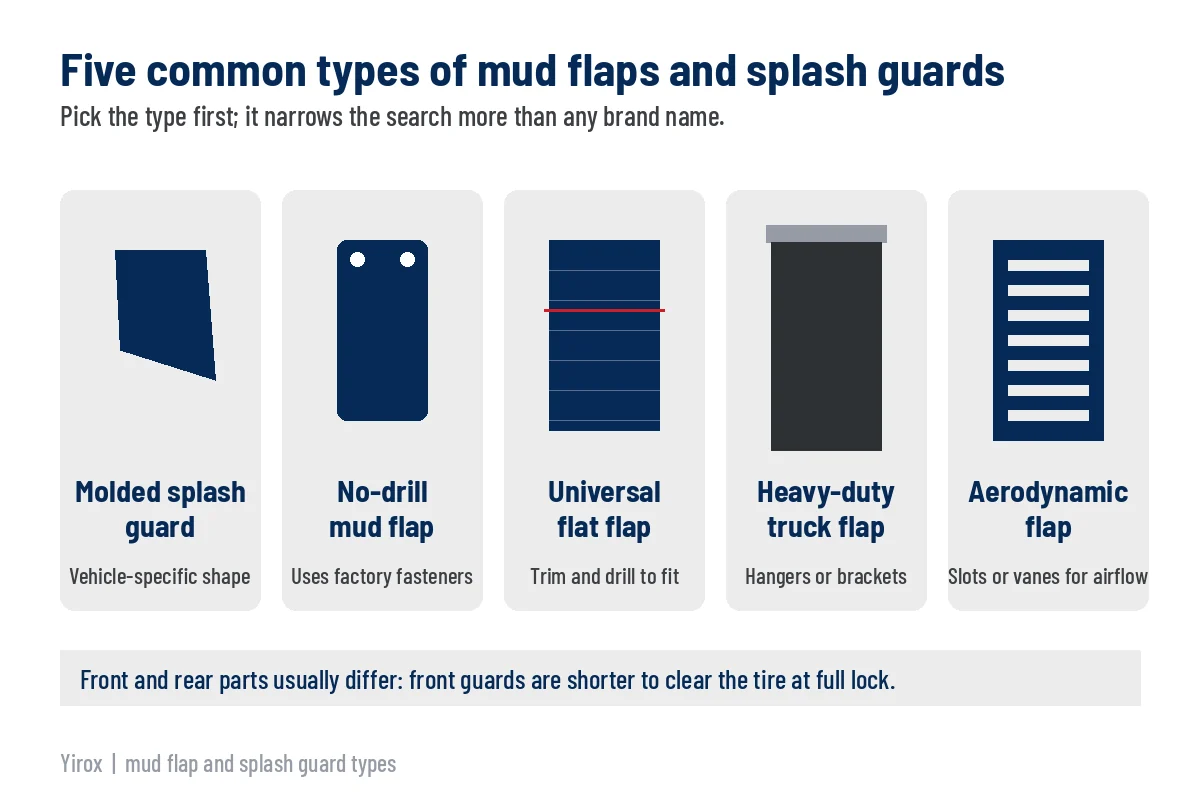
Most products on the market fall into five groups. Knowing which group a buyer needs narrows the search more than any brand name.
- Molded, vehicle-specific splash guards. Shaped to one model’s arch and bumper. They often reuse factory screw points, so no drilling is needed.
- No-drill mud flaps. Flat or gently shaped flaps that bolt to existing fasteners on a given model. Common for pickups and crossovers.
- Universal flat mud flaps. Sheets in standard widths and lengths that are trimmed and drilled to fit. Cheaper to stock, more work to install.
- Heavy-duty truck and trailer flaps. Thick rubber or plastic flaps with hangers or brackets, built to meet state or national rules for commercial vehicles.
- Aerodynamic or louvered flaps. Flaps with slots or vanes that let air through while still catching spray. These are mainly used on long-haul trucks and trailers.
Front and rear parts are usually different. Front guards are often shorter so they do not touch the tire at full steering lock, while rear guards can be longer. Some vehicles only get front guards from the factory; Tesla’s own mud flap kit for the current Model Y, for example, contains two front flaps and installation hardware 5.
Which material is best: rubber, TPE or molded plastic?
There is no single best material. The right choice depends on how much the part needs to bend, how cold it gets, and how close it must match the body styling. The table below summarizes typical trade-offs that buyers and product managers weigh. It is a general guide, not test data for any specific product.
| Material | Typical form | Pontos fortes | Watch-outs |
|---|---|---|---|
| Natural or synthetic rubber | Flat or semi-molded flaps | Very flexible, absorbs hits, quiet | Heavier; can sag at speed if not braced; may crack with age and ozone |
| TPE / TPO (rubber-like plastics) | Molded flaps, no-drill kits | Flexible but holds a shape; can be injection-molded with texture | Grade choice matters for cold flexibility and UV stability |
| Polypropylene (PP) | Molded splash guards | Tough, low density, good chemical resistance | Stiffer; needs a design that tolerates curb strikes |
| ABS or ASA | Painted or gloss black splash guards | Crisp shape and good surface finish; ASA adds weathering resistance | Rigid; can crack on impact if too thin |
For EVs and modern crossovers, molded plastic splash guards are common because they keep the factory look and can carry the same texture or gloss as nearby trim. For pickups that see gravel, snow or off-road use, a thicker flexible flap usually lasts longer because it bends instead of breaking.
Whatever the material, ask the supplier how it handles sun and cold. A part that turns chalky or brittle after a few seasons is the most common complaint in reviews. For molded exterior parts, a weathering test report is a reasonable document to request before a large order.
Which should you choose for a car, pickup or EV?
Match the part to how the vehicle is used. The comparison below is our own buyer guide based on the part types above; it does not replace the vehicle maker’s accessory list or local rules.
| Vehicle and use | Usual best fit | Por quê | Check before buying |
|---|---|---|---|
| Sedan, hatchback, crossover (daily driving) | Molded splash guards, front and rear | Protects rocker paint, keeps factory look | Exact model years and bumper version |
| Stock pickup (road and some gravel) | No-drill molded or semi-flexible mud flaps | Covers a wider tire, simple install | Fender flares, running boards, step clearance |
| Lifted pickup or larger tires | Longer flexible mud flaps, often with brackets | Tires throw debris higher and farther | Local laws for raised vehicles; tire width coverage |
| Pickup that tows | Rear mud flaps sized for the tire tread | Protects the trailer and its tongue area | Clearance to the hitch and the trailer coupler |
| EV or electric crossover | Vehicle-specific molded guards or flaps | Fits tight arch shapes, keeps underbody airflow tidy | Sensors, aero wheel covers, version changes |
| Commercial truck or trailer | Heavy-duty or aerodynamic flaps with hangers | Required in many places; reduces spray | State or national height and width rules |
EVs deserve a closer look. Many electric models have smooth underbodies and carefully shaped wheel arches, and some body versions change during a model’s life. Tesla, for instance, lists its current Model Y mud flaps as compatible only with Model Y built from February 24, 2025 onward 5. A flap made for an earlier car may not line up with the new arch liner. For sellers, that means separate listings by build date, not just by model name.
Are mud flaps worth it, and do they cost fuel or range?
For most drivers who see rain, snow, salted roads or gravel, yes. The main payoff is fewer stone chips and less salt build-up on the rocker panels, lower doors and rear bumper, which are the areas where corrosion and paint damage usually start. Tesla describes its Model Y flaps simply as protection from snow, salt, sand and small debris 5. For pickups that tow, rear flaps also protect the trailer.
The cost is drag. Any part that hangs into the airflow behind a wheel adds some resistance. The best public data comes from heavy trucks. The US EPA’s SmartWay program has a category for verified aerodynamic splash guards, also called tire mud flaps 6. In one verification letter, EPA rated a slotted aerodynamic flap in its 1% fuel-saving category (1% to 3.9%) when it replaced conventional solid 24 x 28 inch splash guards on a 53-foot trailer, based on SAE J2978 coastdown testing 7.
Two points follow from that. First, conventional flaps on a large truck create enough drag that redesigning them can save measurable fuel. Second, that result is for long-haul trailers at highway speed, so it cannot be copied over to a sedan or an EV. We found no public, independent figure for passenger cars. Short molded splash guards that sit inside the body outline will usually matter far less than large flat flaps, but if range is a selling point for an EV accessory, ask for the supplier’s own test data rather than quoting a number.
Are mud flaps required by law?
For private passenger cars in the US, generally no. The rules focus on trucks, trailers and sometimes lifted pickups, and they are set by each state. The National Truck Equipment Association’s guide notes that there is no federal mud flap requirement in the US or Canada, and that most states have their own rule 8. Here is how two state laws look in practice.
| Rule | Who it covers | Key requirements |
|---|---|---|
| Arizona, ARS 28-958.01 | Trucks, trailers, semitrailers and buses | Rear splash guards no more than 8 inches from the ground, wide enough to cover the full tread, may be flexible rubberized material. Pickups with a GVWR of 10,000 lb or less are exempt, unless modified to raise the center of gravity 3. |
| Colorado, CRS 42-4-1407.5 | Large trucks on Colorado highways | Flaps must be fitted and working at all times; torn or damaged flaps must be replaced at the first reasonable and safe opportunity 4. |
| EU, Regulation (EU) No 109/2011 | Certain goods vehicles and trailers | Spray-suppression systems, including rain flaps that cover at least the tire tread width and sit within set distances of the road and the tire 2. |
The Arizona text shows a pattern that appears in several states: a lifted pickup can lose the exemption that a stock pickup has. If you sell lift kits or larger tires, it is worth reminding buyers to check their state’s rule. Always read the current statute of the state where the vehicle is registered and driven, because limits on height and coverage differ.
How do you install mud flaps?
Most vehicle-specific kits install with hand tools in under an hour, but the method depends on the product. A typical no-drill install goes like this:
- Clean and check. Wash the wheel arch and confirm the kit matches the vehicle version, side and position (front or rear).
- Turn or lift for access. For front flaps, turn the steering to open space behind the tire; for rear flaps, some installers remove the wheel.
- Remove the factory fasteners at the points shown in the kit’s guide, usually screws or clips in the arch liner.
- Offer up the flap and line it up with the existing holes. Do not force it; a part that needs bending to fit is likely the wrong version.
- Fit the supplied hardware and tighten evenly. Over-tightening can crack molded plastic.
- Verifique a folga. Turn the wheel to full lock both ways and, if possible, compress the suspension to make sure the tire never touches the flap.
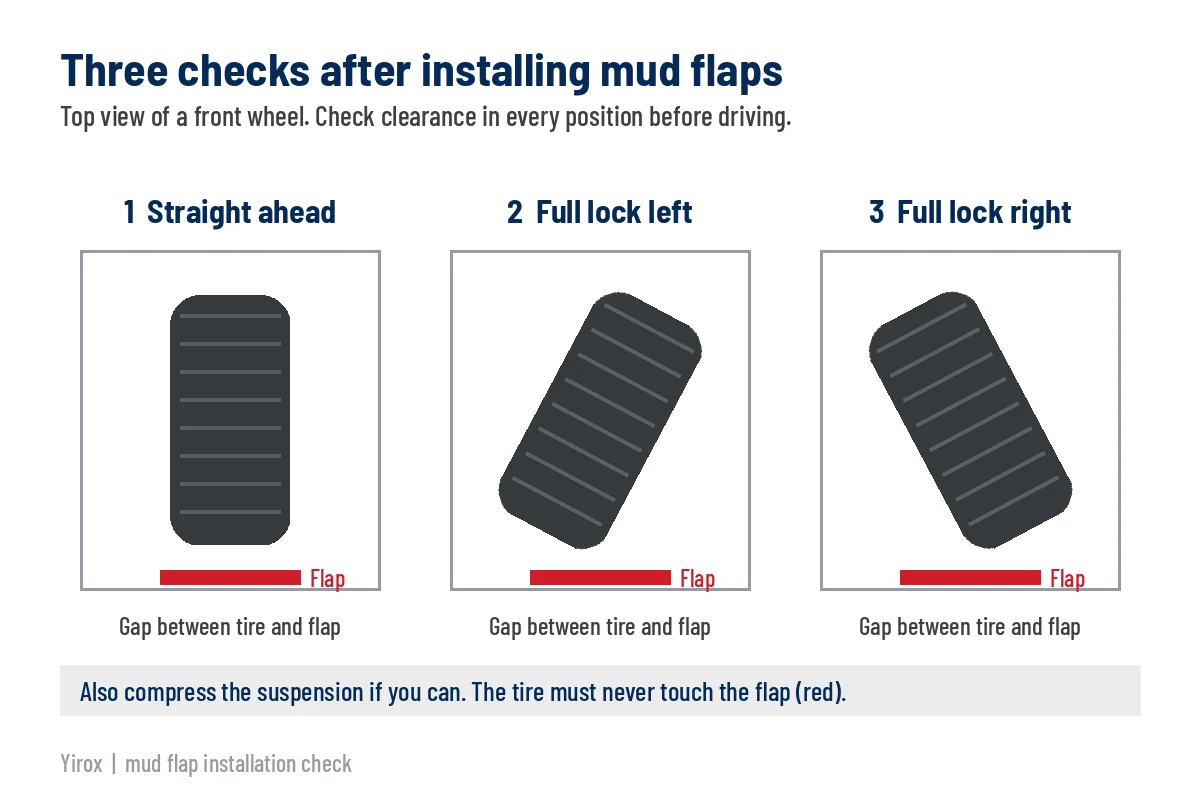
Universal flaps need more work: marking, trimming, drilling and sometimes brackets. Any drilled hole in metal should be sealed or treated to prevent rust. Tesla, for example, links an installation guide for its Model Y flaps from the product page 5; sellers should supply clear instructions with every kit as well.
Quais são os riscos e exceções?
- Tire contact. A flap that is too long or mounted too close can rub at full steering lock or under load. This wears the flap and can damage the tire.
- Curbs, ramps and deep snow. Rigid splash guards can crack on curb strikes. Low flexible flaps can fold under and tear in deep ruts.
- Trapped dirt. Grit and salt can collect behind a flap. Rinse the area during winter washes.
- Drilling. Drilled holes in body metal can rust if left untreated, and some owners prefer not to drill at all.
- Version changes. Facelifts and redesigns can move fasteners. A kit for an older body may not fit, as with Model Y build-date compatibility 5.
- Legal limits. Commercial and lifted vehicles may need flaps of a set height and width, and some states require replacement of damaged flaps 34.
For most cars, crossovers and stock pickups, these risks are small and are handled by choosing a vehicle-specific part and checking clearance once after installation.
What should a mud flap RFQ include?
For distributors, wholesalers and online stores, the details that cause returns are fit and finish. A clear request for quote saves sampling rounds. Inclua:
- Vehicle make, model, body version and build-date range, plus front, rear or both
- Part type: molded splash guard, no-drill flap or universal flat flap
- Material and finish: texture, matte or gloss black, or paint-ready primer
- Target market and climate, so the material grade suits heat, cold and UV
- Hardware and instructions required in each set
- Packaging: retail box, polybag or bulk, and labels or barcodes
- Documents needed: weathering test reports, recycled-content statements or PPAP for programs that require them
- Annual volume, first-order quantity and sample needs
Ask for a fitted sample on the actual vehicle before mass production, and photograph clearance at full steering lock. That one check prevents most complaints.
How we put this together
The comparison, material and vehicle tables in this article are our own summaries. We based them on the legal texts and EPA documents listed in the references, Tesla’s accessory listing, and the typical part types used in the aftermarket. They are buyer guides, not test results. Laws change, so check the current text before relying on any limit.
Conclusão
Splash guards and mud flaps do the same basic job. The difference is in the shape and the material: splash guards are short, molded and styled to the car, and mud flaps are longer, more flexible and built for tougher use. The best choice follows the vehicle and how it is driven, from molded guards for cars and EVs to longer flexible flaps for lifted, towing and commercial trucks.
Before buying, confirm the exact vehicle version, check tire clearance, and pick a material that suits the climate. For commercial vehicles, and lifted pickups in some states, the law sets the height and coverage, so read the local rule first.
Próximo passo
Yirox makes Tesla Model Y-specific mud flaps and injection-molds exterior parts at its Wuxi factory, so we can quote vehicle-specific guards and flaps with the documents your program needs. Browse our acessórios externos automotivos e EV car exterior accessories, or use the Consultor de Sourcing to send your vehicle list and target market.
Perguntas frequentes
Os protetores contra respingos são necessários em um carro?
Não, eles são opcionais em carros particulares na maioria dos lugares. Vale a pena instalá-los se você dirige em estradas de cascalho, salgadas ou molhadas, porque eles reduzem lascas de pedra e acúmulo de sal na parte inferior da carroceria.
Qual é a diferença entre um para-lama e um guarda-lama?
No inglês britânico, um para-lama geralmente significa o próprio para-lama ou caixa de roda. Um defletor de lama é a chapa adicional que fica atrás do pneu para capturar respingos e detritos.
Do mud flaps hurt gas mileage?
They add some drag. EPA data for long-haul trailers shows that aerodynamic flaps can save fuel compared with solid flaps, but there is no public figure for passenger cars, where short molded guards have a much smaller effect.
Why don’t most new cars come with mud flaps?
Modern cars have wheel arches and liners that already contain much of the spray, and carmakers offer splash guards as optional accessories instead of standard parts.
Are mud flaps required on pickup trucks?
It depends on the state. Many state rules target trucks and trailers. Arizona, for example, exempts pickups with a GVWR of 10,000 lb or less unless they have been modified to raise the center of gravity.
Can I install mud flaps without drilling?
Yes, if you buy a vehicle-specific no-drill kit that uses the factory fastener points. Universal flaps usually need drilling and trimming.
Referências
[1] EUR-Lex. “Commission Regulation (EU) No 1009/2010 concerning type-approval requirements for wheel guards of certain motor vehicles.” Wheel guard requirements for passenger cars.
[2] EUR-Lex. “Commission Regulation (EU) No 109/2011 concerning type-approval requirements for certain categories of motor vehicles and their trailers as regards spray-suppression systems.” Rain flap and valance requirements.
[3] Arizona State Legislature. “ARS 28-958.01 Rear fender splash guards.” Height, coverage and pickup exemption.
[4] Colorado General Assembly. “Mud Flap Laws.” Summary of the splash guard requirement for large trucks.
[5] Tesla Shop. “Model Y Mud Flaps.” Contents, purpose and build-date compatibility.
[6] U.S. EPA. “Learn About SmartWay Verified Aerodynamic Devices.” Device categories, including aerodynamic splash guards.
[7] U.S. EPA. “SmartWay verification letter for Eco Flaps (October 2016).” Test method, baseline guard and fuel-saving category.
[8] National Truck Equipment Association. “U.S./Canada Mud Flap Requirements Guide.” Overview of state and provincial rules.