





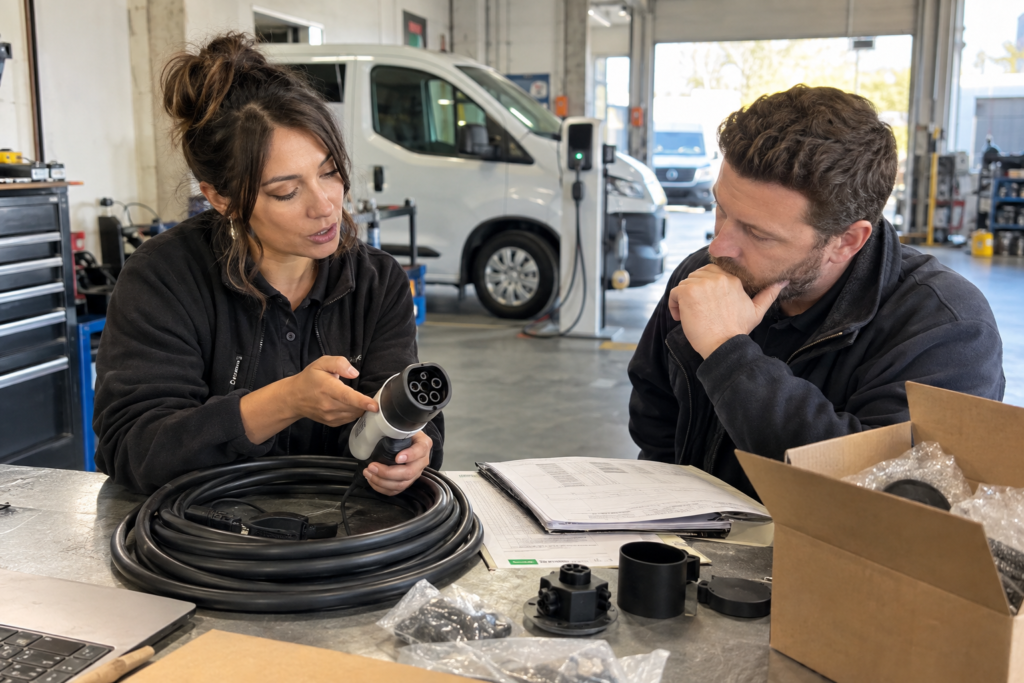
EV charging accessory warranty and after-sales terms should define the coverage period, exact products and revisions, exclusions, claim evidence, response times, repair or replacement route, spare-stock responsibilities, transport costs, and change-control duties. Buyers should align these terms with actual charging environments, installation conditions, fleet uptime needs, and the promises they make to their own customers.
A warranty is only useful when a buyer can turn a customer complaint into a clear operating decision. The supplier needs to know which product was sold, how it was used, what evidence is required, who pays for the next shipment, and how quickly a safe replacement can reach the site. These details belong in the quotation and supply agreement, not only in a generic warranty PDF. The broader guía de compra de accesorios de carga de VE helps establish the product and market context before service terms are finalized.
Cuando el tiempo de inactividad importa, la guía del costo total de propiedad de los accesorios de carga de vehículos eléctricos ayuda a comparar los límites de garantía con la frecuencia de fallas, el costo de reemplazo, el inventario de repuestos y el retraso del servicio.
Tabla de contenido
- What Should an EV Charging Accessories Warranty Cover?
- How Should Exclusions and Misuse Be Written?
- When Should Buyers Choose Replacement Instead of Repair?
- What Claim Evidence Should a Buyer Request?
- What Response Time and Spare Stock Commitments Matter?
- How Should Private-Label Buyers Allocate Responsibilities?
- What Should Buyers Ask Before Ordering?
- Example Warranty and After-Sales Service Matrix
- Conclusion: Make Service Terms Operational
- Preguntas frecuentes
- Referencias
What Should an EV Charging Accessories Warranty Cover?
An EV charging accessory warranty should clearly identify the covered product, revision, start date, coverage period, covered failure modes, remedy, claim process, and responsible party. “Quality guaranteed” is not a service term until the buyer can determine what happens after a cable, connector, cap, holder, or mounting accessory fails.
Define the scope in a warranty schedule rather than relying on one sentence for every accessory:
| Term to define | Buyer should confirm | Useful record |
|---|---|---|
| Covered product | Exact SKU, connector or accessory type, cable length, variant, revision, and bundle contents | Approved specification and sales order |
| Coverage start | Shipment, delivery, installation, commissioning, or end-customer sale | Contract definition and invoice or delivery record |
| Covered failure | Manufacturing defect, material failure, assembly defect, premature loss of function, or another agreed condition | Claim classification and inspection result |
| Use conditions | Indoor/outdoor use, rated current and voltage, temperature, UV, water, dust, chemicals, cleaning, storage, and handling | Installation and operating record |
| Remedy | Repair, replacement, credit, spare part, rework, or another agreed remedy | RMA decision and shipment record |
| Cost ownership | Product, labor, diagnosis, return freight, replacement freight, customs, reinstallation, and disposal | Claim settlement record |
| Trazabilidad | Serial, lot, date code, production site, revision, and customer order | Label, ERP, and QC record |
Coverage should also distinguish the accessory from the complete charging system. A cable supplier may be responsible for the cable assembly and its workmanship, while the installer, station owner, vehicle manufacturer, or site operator controls other parts of the system. IEC 62196-1:2025 covers EV plugs, socket-outlets, vehicle connectors, vehicle inlets, and cable assemblies within its scope, but a standard reference does not decide commercial warranty responsibility for every installation or market.3
Ask the supplier to state whether the warranty is transferable through a distributor, fleet operator, installer, or private-label brand. Also confirm whether a replacement carries the original remaining coverage or starts a new period. These details affect the buyer’s customer promise and should not be left to case-by-case negotiation.
How Should Exclusions and Misuse Be Written?
Exclusions should describe a real risk, the evidence needed to establish it, and the fair handling of ambiguous cases. Broad wording such as “all misuse, improper installation, or environmental damage” can make a warranty impossible to administer because almost every field failure involves some uncertainty.
Separate the most common boundaries:
| Possible exclusion | What to clarify | Fair evidence or handling |
|---|---|---|
| Mechanical abuse | Crushing, vehicle run-over, sharp bending, impact, forced removal, or connector drop | Photos, inspection notes, and a defined abuse threshold |
| Electrical misuse | Overcurrent, wrong voltage, unauthorized modification, damaged protection, or incompatible equipment | Installation context, ratings, test data, and product history |
| Installation error | Incorrect wiring, mounting, torque, sealing, routing, or unsupported extension | Installation instructions, site photos, and installer statement |
| Environment outside rating | Flooding, chemicals, extreme heat, salt, UV, dust, or storage outside the agreed range | Site conditions and a comparison with the rated environment |
| Wear or consumables | Expected wear of protective caps, clips, seals, or replaceable parts | Published service interval and visual condition criteria |
| Transport or handling damage | Damage before delivery, at the warehouse, during installation, or after customer receipt | Packaging photos, carrier record, receiving inspection, and timing |
The supplier should not use an exclusion to avoid investigating a product defect. Require a triage step that separates visible misuse, installation or system causes, shipping damage, and suspected manufacturing failure. If the evidence is inconclusive, define whether the supplier will inspect the unit, provide a paid diagnostic, issue a conditional replacement, or escalate to a joint review.
Warranty terms are also market-dependent. The FTC’s Businessperson’s Guide to Federal Warranty Law explains US federal warranty rules for consumer products, but it is not a universal rulebook for every B2B contract, country, or private-label arrangement.2 Buyers should have local counsel review customer-facing promises, disclaimers, liability caps, mandatory remedies, and importer responsibilities before release.
When Should Buyers Choose Replacement Instead of Repair?
Replacement is usually the safer and faster route when the accessory carries charging current, has an uncertain internal fault, has damaged sealing or contacts, or cannot be returned to a controlled condition through an approved process. Repair may be appropriate only when the part, method, technician qualification, and post-repair test are defined.
Use an explicit decision table:
| Field condition | Preferred first response | Release condition |
|---|---|---|
| Damaged connector housing, latch, seal, or contact area | Quarantine and replace | Replacement identity and compatibility confirmed |
| Cable jacket cut, crush, burn, or severe bend | Quarantine and replace | No field splice or cosmetic repair unless formally approved |
| Missing cap, clip, or mounting part | Replace the approved part if function and protection remain verifiable | Correct part number, fit, and installation instruction |
| Packaging or label error with usable product | Hold or relabel under controlled instruction | Correct artwork, traceability, and customer communication |
| Suspected intermittent or thermal issue | Stop use, capture evidence, and replace or inspect | Root-cause decision and safe release record |
| Cosmetic issue with no functional or claim impact | Review against agreed appearance standard | Documented acceptance or credit decision |
Do not encourage customers to open or repair energized equipment. For cables and connectors, the supplier should state whether field repair is prohibited, restricted to authorized service channels, or supported with a defined kit and test method. If a repair is allowed, specify the replacement component, workmanship standard, insulation or continuity checks, dielectric or functional checks where applicable, and the person authorized to sign off.
Replacement also needs compatibility control. A newer connector, cable length, firmware-linked accessory, or label revision may not be interchangeable with the original unit. The buyer’s EV charging accessories change-control requirements should define whether a replacement can cross revisions, which customer records must be updated, and how the service team recognizes a superseded SKU.
For fleet operations, the EV charging accessories fleet stocking and replacement guide connects warranty triggers to spare categories, inspection routines, min/max stock, and response ownership.
What Claim Evidence Should a Buyer Request?
A claim packet should be sufficient to identify the unit, reconstruct the use conditions, describe the failure, and choose the next action without repeated requests for basic information. Evidence requirements should be proportionate to the product risk and the cost of delaying a safe replacement.
Request these fields:
- customer, distributor, fleet, or site reference;
- purchase order, invoice, delivery date, installation date, and operating hours if available;
- exact SKU, revision, serial or lot code, production date, and packaging label;
- connector type, cable length, accessory variant, charger or vehicle reference, and intended use;
- failure symptom, first occurrence, frequency, error code, temperature, load, and environmental conditions;
- clear photos of the complete assembly, connector face, latch, seal, cable jacket, label, and packaging;
- installation, storage, cleaning, routing, and handling information;
- test or inspection result, including who tested it and with what equipment;
- requested remedy, urgency, site downtime, and whether the unit has been quarantined;
- disposition of the returned part, retained sample, or failed component.
The supplier should provide a case number, initial classification, evidence gap list, containment action, proposed remedy, and target date for the next decision. A photo-only claim may be enough for obvious shipping damage or a missing part. It may not be enough for an intermittent charging or thermal complaint that could involve the vehicle, EVSE, cable, connector, or installation.
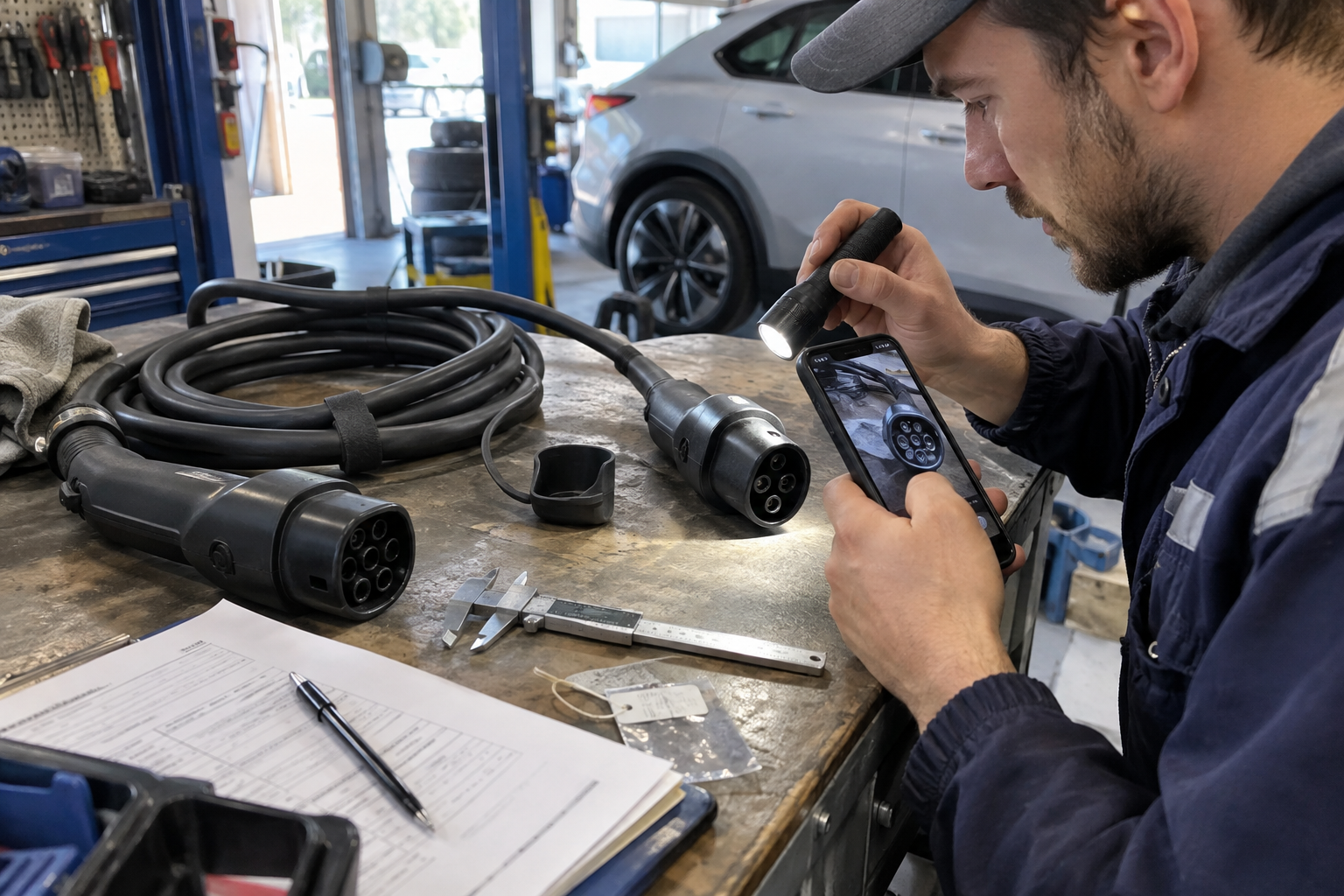
Track claims by failure mode and revision, not only by customer name. A rise in returns after a connector, material, factory, or packaging change may indicate a systemic issue. The lista de verificación de proveedores de accesorios de carga para VE helps buyers check whether a supplier can connect complaints to QC records, corrective action, traceability, and repeat-supply controls.
Claim evidence should also be compared with the Lista de verificación de inspección de calidad del cable de carga de VE so the service team can distinguish connector fit, jacket, strain relief, markings, packaging, and handling failures.
What Response Time and Spare Stock Commitments Matter?
Response terms should separate acknowledgement, technical triage, warranty decision, replacement dispatch, root-cause feedback, and final closure. A supplier that says “fast support” has not yet committed to a usable service level.
Define service stages like this:
| Etapa | Buyer should specify |
|---|---|
| Acknowledgement | Maximum business hours or days to confirm receipt and assign a case owner |
| Safety triage | Time to advise quarantine, stop-use, inspection, or temporary workaround |
| Initial decision | Time to request missing evidence, approve replacement, reject with reason, or escalate |
| Replacement dispatch | Stock location, dispatch time, carrier option, packaging, tracking, and customs owner |
| Root-cause response | When the supplier must provide inspection findings, containment, or corrective action |
| Closure | Required settlement, returned-part disposition, revised documents, and claim trend update |
Spare stock should be designed around the customer’s consequence of downtime, not only the supplier’s average claim rate. A home accessory may need a normal replacement shipment. A fleet or installer program may need a defined local buffer, advance replacement, mixed-SKU control, and a replenishment trigger.

Confirm who owns the spare inventory, who pays to hold it, which revisions may be mixed, and how stock is replenished. Also ask what happens when the supplier is temporarily out of stock: expedited production, an approved substitute, customer credit, loaner equipment, or another remedy. If a substitute is proposed, treat it as a controlled product change rather than an informal service gesture.
ISO 10004:2018 provides guidance for defining and implementing processes to monitor and measure customer satisfaction.1 Buyers can apply the same discipline to warranty data: define the measures, review trends by SKU and revision, and turn repeated claims into corrective action instead of treating each RMA as an isolated event.
How Should Private-Label Buyers Allocate Responsibilities?
Private-label warranty programs need a written split between the factory, brand owner, importer, distributor, installer, and end customer. The consumer or fleet operator should not have to discover the responsibility map through a long email chain after a failure.
Clarify who owns each task:
| Responsibility | Questions to settle before launch |
|---|---|
| Warranty issuer | Whose name appears on the warranty, and who makes the final claim decision? |
| Customer contact | Does the buyer, distributor, installer, or factory receive the first report? |
| Technical triage | Who checks fitment, ratings, installation, environment, and system compatibility? |
| Replacement stock | Where is stock held, who funds it, and which SKU or revision may be shipped? |
| Documentos | Who maintains the manual, label, service bulletin, claim form, and language versions? |
| Field communication | Who informs customers about safety notices, product changes, or replacement compatibility? |
| Data and reporting | Who owns claim history, photos, returned units, failure codes, and corrective-action records? |
| Liability and local rules | Which contract, importer, product-safety, and consumer requirements apply in the target market? |
Align the warranty with the bundle actually sold. If a dealer bundle includes a cable, holder, cap, mounting hardware, and branded manual, state whether one missing or failed component affects the whole bundle or only the affected line item. Buyers planning channel programs can use EV charging accessories bundles for dealers and private-label programs to connect bundle contents and branding with support, replacement, and document responsibilities.
The private-label brand should also control changes after launch. A supplier may change a component, label, manual, packaging, or factory for valid reasons, but the brand owner needs notice and an impact decision before the customer-facing promise changes. This is where EV charging accessories change-control requirements becomes part of after-sales management rather than a separate engineering topic.
For distributor-led programs, the EV charging accessories distributor onboarding checklist helps turn those responsibilities into launch training, return instructions, claim routing, and a support contact process that sales and service teams can actually follow.
What Should Buyers Ask Before Ordering?
Before comparing quotes, buyers should ask suppliers to answer the same warranty and service questions in the same format. That makes commercial assumptions visible and prevents the cheapest unit price from hiding diagnosis, freight, replacement, or downtime costs.
| Pregunta | Por qué es importante |
|---|---|
| Which exact SKUs, revisions, and bundle contents are covered? | Prevents a generic warranty from covering the wrong variant. |
| When does coverage start, and how is the date proven? | Aligns distributor stock, installation, and end-customer promises. |
| What failures are covered and what evidence is required? | Makes claims faster and exclusions reviewable. |
| Which conditions are excluded? | Exposes installation, environment, misuse, wear, and transport boundaries. |
| Is repair permitted, and who may perform it? | Prevents unsafe field work and inconsistent remedies. |
| Who pays diagnosis, return freight, replacement freight, customs, and labor? | Reveals the real service cost before ordering. |
| What are the acknowledgement, decision, dispatch, and RCA targets? | Converts “support” into measurable commitments. |
| Where is replacement stock held, and what is the replenishment rule? | Shows whether the supplier can protect uptime. |
| Can old and new revisions be used as replacements? | Prevents an unapproved compatibility or document mismatch. |
| How are claims tracked by lot, revision, and failure mode? | Helps detect systemic problems and change-related returns. |
| Who owns customer communication for a private-label program? | Avoids gaps between factory, importer, distributor, and brand. |
| What happens if the product is discontinued or changed? | Links after-sales support to change control and last-time-buy planning. |
Put the answers into the plantilla de RFQ de accesorios de carga para vehículos eléctricos so each supplier quotes the same scope. Request a redacted claim record or service report when possible. It can hide customer information, but it should still show the evidence requested, response stages, remedy decision, and closure path.
Example Warranty and After-Sales Service Matrix
The following matrix can be copied into a sourcing brief or supplier agreement. Replace the example timing with the service level that fits the target market and customer consequence of downtime.
| Scenario | Initial evidence | Supplier action | Buyer or channel action | Target decision |
|---|---|---|---|---|
| Connector housing or latch damaged on arrival | Packaging photos, delivery record, SKU and lot | Confirm transport or product cause and ship approved replacement if applicable | Quarantine unit and retain packaging | Dentro de 1 día hábil |
| Cable fails during normal rated use | Product identity, use conditions, photos, test result, charger/vehicle context | Triage, issue RMA, inspect returned unit, and determine remedy | Stop use if safety is uncertain and provide site details | Triage within 2 business days |
| Intermittent charging complaint | Error history, setup, temperature, cable movement, and comparative test | Separate accessory, EVSE, vehicle, and installation causes | Test only under safe, defined conditions | Action plan within 3 business days |
| Missing or incorrect bundled component | Packing list, carton label, order, and photos | Ship missing part or correct package contents | Hold customer installation if the part is essential | Dispatch target agreed in quote |
| Repeated claims after a product revision | Claim trend, affected revision, lots, and customer sites | Contain stock, review change record, and issue corrective action | Segregate affected inventory and notify customers when needed | Containment immediately |
| Urgent fleet downtime | Case number, asset/site, spare requirement, and urgency | Use defined advance replacement or local buffer process | Confirm installation and return of failed unit | Dispatch against fleet SLA |
Use the matrix to expose missing decisions. If a supplier leaves “who pays freight,” “which revision is a replacement,” or “when is a root-cause report due” blank, the warranty program is not ready for a production order. Buyers should resolve those blanks before launch, not after the first high-priority claim.
If you are setting warranty and after-sales terms for EV charging accessories, share the product revisions, use conditions, claim evidence, response-time needs, spare-stock plan, and target market. We can help structure service terms that suppliers, distributors, and customers can follow.
Conclusion: Make Service Terms Operational
Strong EV charging accessories warranty and after-sales requirements connect coverage, exclusions, evidence, replacement, response time, spare stock, private-label ownership, and change control. They give each party a repeatable answer to the same questions: what happened, which product is involved, what is safe to do next, who pays, and how quickly the customer can return to service.
Include the service matrix in the quotation request and supply agreement, then test it with one realistic claim scenario before launch. Buyers can request a warranty and after-sales review with the target market, product list, revisions, expected use, response-time needs, spare-stock plan, and customer-support model. That gives suppliers enough context to quote a workable service commitment instead of a vague warranty headline.
Preguntas frecuentes
What should an EV charging accessory warranty include?
It should identify the covered SKU and revision, coverage start and period, covered failures, use conditions, exclusions, claim evidence, remedy, response times, freight and labor responsibility, spare-stock rules, traceability, and change-control obligations.
Are EV charging cables usually repaired or replaced under warranty?
Replacement is generally the safer default when a cable or connector has damaged insulation, contacts, sealing, latch components, or an uncertain internal fault. Repair should only be offered when the supplier defines an approved method, qualified service route, and post-repair verification.
Who should pay shipping for a warranty replacement?
The quotation or supply agreement should state responsibility for diagnosis, return freight, replacement freight, customs, labor, reinstallation, and disposal. The answer depends on the contract, market, failure cause, and applicable law; it should not be left to an informal case-by-case decision.
What evidence is needed for an EV charging accessory claim?
A useful claim includes the exact SKU and revision, serial or lot, order and installation context, charger or vehicle reference, failure symptom, operating conditions, photos, test results where safe, packaging evidence, and the requested remedy. The supplier may request the failed unit for inspection.
Can a supplier change a product during the warranty period?
The supplier may need to change a product for supply, engineering, or compliance reasons, but changes affecting fitment, ratings, materials, documents, packaging, or replacement compatibility should be notified and assessed through the agreed change-control process. A replacement should not silently become a different configuration.
Referencias
[1] Organización Internacional de Normalización. “ISO 10004:2018 Quality management — Customer satisfaction — Guidelines for monitoring and measuring.” 2018.
[2] Federal Trade Commission. “Businessperson’s Guide to Federal Warranty Law.” 2015.
[3] International Electrotechnical Commission. “IEC 62196-1:2025 Plugs, socket-outlets, vehicle connectors and vehicle inlets — General requirements.” 2025.







