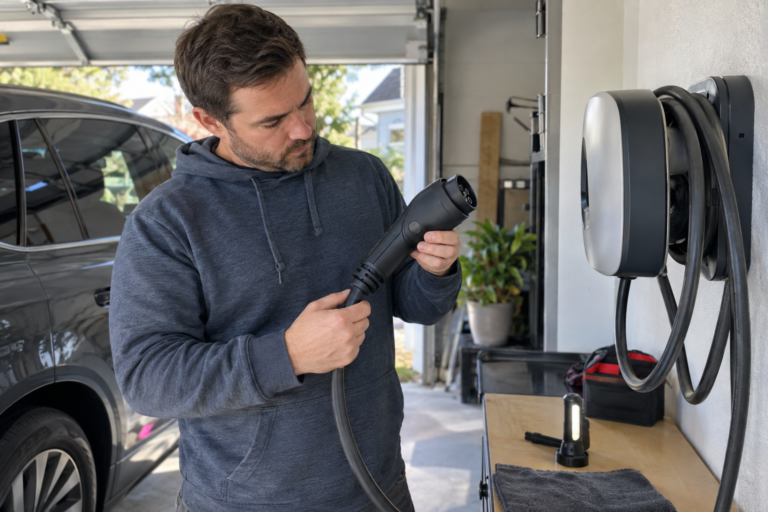




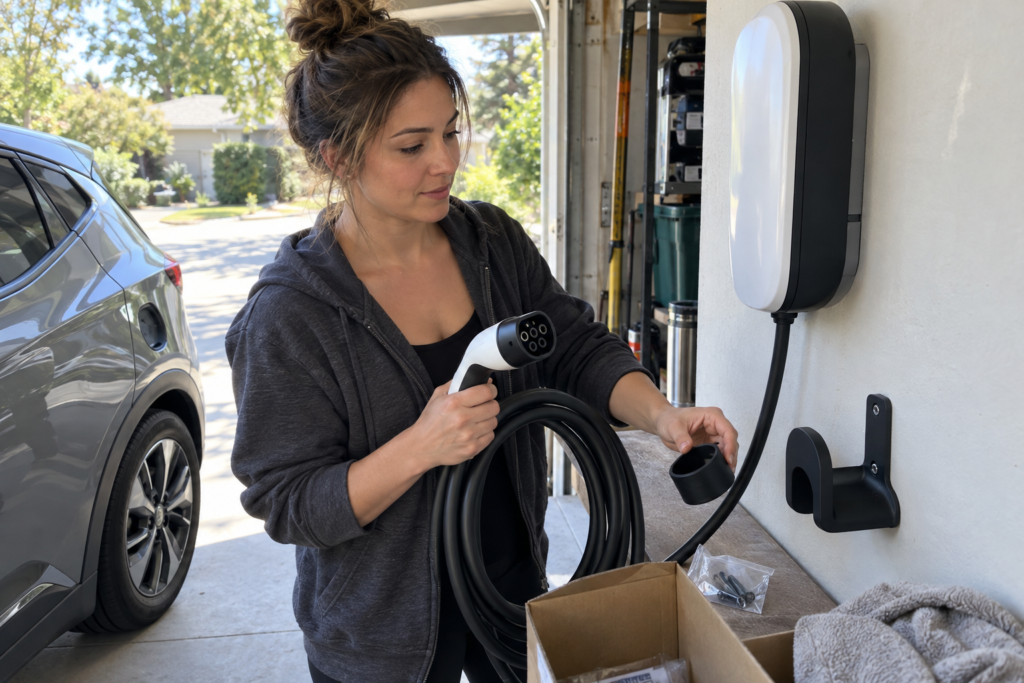
EV charging accessories are supporting products that help users connect, protect, store, mount, inspect, and manage charging equipment. The right choice depends on the vehicle inlet, charger connector, AC or DC use, current and voltage limits, site environment, target market, and evidence for the exact product configuration—not on connector shape alone.
Comience la comparación de equipos confirmando qué es una estación de carga para VE y qué ruta de carga se adapta al vehículo, al sitio y al tiempo de estacionamiento.
Choosing an accessory can look simple until a cable does not fit the vehicle, an adapter connects mechanically but is not approved for the intended charging mode, or a holder is installed without considering cable weight and bend radius. Home users, fleet operators, installers, distributors, and private-label buyers may all need EV charging accessories, but they do not need the same shortlist.
This guide gives you a practical sequence for choosing the right accessory, checking compatibility, reviewing documents, comparing site requirements, approving samples, and preparing a supplier request. It covers everyday home charging as well as fleet, workplace, installer, dealer, and B2B procurement decisions.
Tabla de contenido
- What Are EV Charging Accessories? Start With the Charging Setup
- How Do You Build an EV Charging Accessories Shortlist?
- What Is the Five-Gate EV Charging Accessory Buying Model?
- How Do You Verify Compatibility Before You Buy?
- What Ratings, Certifications, and Documents Should You Verify?
- Which Accessories Fit Home, Fleet, Installer, and Dealer Use?
- What Should B2B Buyers Verify Before Ordering?
- How Should You Plan Samples, Bundles, MOQ, Lead Time, and Replacements?
- What Should an EV Charging Accessories RFQ Include?
- A Step-by-Step EV Charging Accessories Buying Workflow
- Conclusion: How to Choose EV Charging Accessories With Fewer Surprises
- Preguntas frecuentes
- Referencias
What Are EV Charging Accessories? Start With the Charging Setup
Los accesorios de carga de VE son los productos de apoyo en torno a una conexión de carga. Pueden transportar energía, adaptar una conexión, proteger un conector desconectado, almacenar un cable, asegurar el equipo o ayudar a un comprador a inspeccionar y gestionar un programa de productos. Un punto de partida útil es comprender dónde se ubica cada accesorio en la configuración de carga. Para comparar productos por la función que desempeñan antes de elaborar una lista corta, consulte la guía de accesorios de carga de VE por función, que agrupa los accesorios en torno a la conexión, protección, almacenamiento, montaje y mantenimiento de equipos de carga.
Vehicle inlet and charger connection
La entrada del vehículo es la interfaz en el automóvil. El cargador o la estación de carga puede tener un cable fijo, una toma de corriente o una conexión de cable separada. Un accesorio puede ubicarse entre estos puntos, apoyarlos o protegerlos cuando no estén en uso. Confundir la entrada del vehículo con la toma del lado de la estación es una de las formas más rápidas de pedir el cable o adaptador incorrecto. Si aún está separando las categorías de equipos, la guía de cable de carga de VE vs. cargador vs. estación de carga explica cómo el cable, el equipo de carga y la estación encajan en la ruta de conexión.
The U.S. Department of Energy Alternative Fuels Data Center distinguishes a charging port from the connector that plugs into the vehicle. It also explains that charging time depends on the vehicle, its internal charger, the charging equipment, power output, and electrical service—not simply on the name of a connector.1 That distinction matters when a buyer is comparing cable or adapter options.
Five practical accessory groups
| Accessory group | Common examples | Primary job |
|---|---|---|
| Connection | Charging cables, adapters, connector assemblies | Connect compatible equipment |
| Protection | Plug caps, inlet covers, dust covers | Protect disconnected interfaces |
| Storage | Cable holders, holsters, hangers, docks | Support safe and organized handling |
| Instalación | Mounting plates, brackets, cable glands, support hardware | Secure and route charging equipment |
| Operaciones | Inspection tools, spare parts, bundles, packaging | Support maintenance and repeat supply |
Connection accessories deserve the most careful technical review because they may carry electrical current or affect communication and locking behavior. Passive products still require fitment and environmental review. A holder that cannot support the cable or a cap that does not retain correctly can create handling problems even though neither product supplies power.
For a visual overview of available product types, buyers can start with the gama de accesorios para carga de VE, then return to the decision steps below before requesting a quote or sample.
Do you need a charger or an accessory?
This guide focuses on accessories, not on designing an electrical installation or replacing a charger. A mounting bracket does not replace a charger, a cable holder does not increase charging power, and a protective cap does not make every wet or contaminated charging condition safe. If the installation itself needs electrical design, a qualified installer should define that part of the project.
How Do You Build an EV Charging Accessories Shortlist?
Build the shortlist from the charging problem and the operating environment, not from a product photo. A good shortlist identifies the problem, names the accessory class, records the compatibility boundary, and states what evidence must be checked before purchase.
Match the problem to the accessory
| Charging or handling problem | Possible accessory direction | Questions to ask |
|---|---|---|
| The vehicle and charger connections do not match | Adapter or alternative cable | Are the connectors, charging mode, ratings, communication, and approved use compatible? |
| The cable is difficult to store | Holder, holster, hanger, or wall mount | What are the cable diameter, weight, bend radius, and mounting surface? |
| The connector is exposed when disconnected | Plug cap or vehicle-inlet cover | Is the fit exact, and what protection is actually supported? |
| The charging unit needs installation support | Mounting plate, bracket, post mount, cable gland | Does the hardware fit the charger model and site structure? |
| A fleet handles cables repeatedly | Protection, storage, inspection, and replacement accessories | What is the duty cycle, environment, and spare-stock policy? |
| A dealer wants a retail-ready offer | Compatible accessory bundle and private-label packaging | What belongs in the bundle, and how will it be labeled and replenished? |
| A procurement team needs comparable quotations | Specification brief, samples, QC evidence, and RFQ | Can suppliers quote the same scope and acceptance criteria? |
Start with a minimum viable shortlist
For a home user, the first shortlist may contain one compatible cable or adapter, one storage solution, and one protection solution. For a fleet, it may contain multiple cable variants, a standardized holder, connector covers, inspection supplies, and replacement stock. For a distributor, the shortlist may be a product family with a controlled connector mix rather than a single SKU.
Avoid adding every possible accessory before the use case is clear. More SKUs do not automatically create a better program. A broad range can create slow-moving inventory, labeling confusion, and compatibility returns if the buyer cannot explain which product fits which vehicle, charger, or market.
Record the decision in a product brief
Before asking for prices, write down:
- Vehicle or charger reference
- Vehicle-side and infrastructure-side connectors
- AC or DC charging use
- Current and voltage requirements
- Cable length, diameter, and weight where relevant
- Indoor or outdoor exposure
- Mounting surface or installation condition
- Target country or market
- Sample quantity and test conditions
- Packaging, language, barcode, and branding needs
- Initial quantity and expected reorder quantity
This short brief reduces clarification cycles. It also gives multiple suppliers the same information, which makes quotations easier to compare.
What Is the Five-Gate EV Charging Accessory Buying Model?
The five-gate model turns an accessory shortlist into a controlled approval sequence: Fitment → Electrical and communication limits → Evidence → Operations → Supply. A product should move to the next gate only when the previous assumptions are recorded. This keeps a low price or attractive product photo from hiding a compatibility, safety, handling, or replenishment problem.
| Gate | Decisión a tomar | Minimum record | Hold the decision when |
|---|---|---|---|
| 1. Fitment | Does the accessory connect to the intended vehicle, charger, or mounting point? | Vehicle or charger reference, both connector ends, product direction, and key dimensions | The buyer knows only the connector name or product photo, but not the exact equipment combination |
| 2. Electrical and communication limits | Can the configuration operate within its intended AC/DC mode, voltage, current, phase, signaling, and locking boundaries? | Rated values, charging mode, communication requirements, temperature limits, and approved-use statement | The product fits mechanically but the exact electrical or communication boundary is unclear |
| 3. Evidence | Do the documents support this exact SKU, revision, configuration, claim, and destination market? | Datasheet, label, manual, declaration, certificate or listing, test report, and revision record | The supplier provides generic documents that do not identify the shipped product or test scope |
| 4. Operations | Can users install, handle, store, inspect, clean, and replace the accessory in the real environment? | Cable weight and bend radius, mounting surface, exposure, duty cycle, inspection points, and replacement trigger | The accessory works in a test but creates a handling, storage, service, or maintenance problem |
| 5. Supply | Can the approved configuration be sampled, produced, packaged, traced, and reordered consistently? | Approved sample, MOQ, lead-time stages, packaging, traceability, change notice, spare SKU, and reorder plan | The supplier cannot separate sample approval from production or cannot control revisions and replacements |
Use the model as a Pass / Hold / Clarify worksheet. A home buyer may complete it in one page. A fleet or dealer should complete one row for each vehicle group, charger combination, or bundle variant. The model does not replace electrical installation design or local compliance review; it makes the assumptions visible before money and inventory are committed.
How Do You Verify Compatibility Before You Buy?
Compatibility is the first two gates of the buying model: confirm fitment, then confirm electrical and communication limits. The remaining gates—evidence, operations, and supply—determine whether a technically compatible accessory is actually ready for use or purchase. A connector that fits physically is only the first gate, not the final approval.
1. Confirm the vehicle inlet
Start with the vehicle’s actual inlet, not a generic model name or an online image. Confirm the connector family, the vehicle model and model year when relevant, and whether the inlet is intended for AC charging, DC charging, or both through different portions of the interface.
For a mixed fleet, record the inlet for every vehicle group. A fleet that includes several connector families may need a controlled adapter or cable assortment, while a single-model fleet may benefit from standardization. The U.S. Department of Energy advises consumers to ask the vehicle manufacturer about charger compatibility and lists different connector patterns by charging level and use case.2
2. Confirm the charger-side connection
Next, identify what the accessory connects to on the infrastructure side:
- A fixed charging cable
- A socket-outlet on a wallbox
- A portable EVSE unit
- A workplace or depot charging station
- A standard household or industrial outlet
The same vehicle may require different accessories in different environments. A cable used with a dedicated AC charging station is not automatically interchangeable with a portable unit connected to a household outlet. The equipment-side connection, current limit, and control function all matter.
3. Check mechanical fit
Mechanical fit includes more than the pin arrangement. Check:
- Mating geometry
- Keying and orientation
- Locking mechanism
- Connector housing clearance
- Cable exit direction
- Strain-relief shape
- Insertion and removal behavior
- Holder or cap retention
For holders and mounts, mechanical fit also includes the cable’s outside diameter, connector weight, bend radius, and the available mounting space. A wall holder that is technically the right shape may still be unsuitable if the cable pulls downward, twists at the connector, or cannot be removed without excessive force.
4. Check electrical fit
El accesorio debe ser adecuado para las condiciones eléctricas previstas. Registre la tensión nominal, la corriente nominal, la fase, el modo de carga, la construcción del cable y las limitaciones de temperatura o ambientales. No asuma que un número aparentemente más alto es automáticamente más seguro o mejor. La configuración completa del producto y las condiciones de instalación determinan si la clasificación es apropiada. Para interpretar los valores eléctricos en un cable o accesorio, amperios, voltios y kilovatios de carga de VE explicados aclara cómo se relacionan la corriente, la tensión, la fase y la potencia, sin tratar los kW como sustituto de la corriente nominal.
For an adapter, ask what it changes and what it does not change. An adapter may alter the physical connection while leaving the vehicle, charger, cable, current limit, communication protocol, and safety behavior unchanged. It cannot turn an incompatible charging mode into a compatible one simply because both ends can be connected.
When an adapter is the proposed solution, the adapter direction and safe-use guide helps separate physical mating from approved AC or DC use, ratings, locking, communication, and manufacturer limitations. That is the right next check when a supplier answers “yes, it fits” but has not defined the complete connection path.
5. Check communication and locking behavior
Algunas interfaces de carga de VE utilizan señalización y comportamiento de control que deben permanecer compatibles entre el vehículo, el equipo de carga y el cable o adaptador. Los compradores deben preguntar si el producto está aprobado para la combinación prevista y si el bloqueo, la liberación, el monitoreo de temperatura u otras funciones de control se ven afectadas. Si el comportamiento de bloqueo o liberación es parte de la cuestión de compatibilidad, cómo funcionan los mecanismos de bloqueo del conector de carga de VE explica las funciones de retención y control que los compradores deben distinguir.
The IEC 62196 family covers plugs, socket-outlets, vehicle connectors, vehicle inlets, and cable assemblies for conductive EV charging systems.3 That standard scope shows why a connector should be evaluated as part of a charging system rather than as an isolated shape. For adapters, the buyer should also identify whether the relevant technical requirements apply to the exact adapter type. IEC TS 62196-7:2026, for example, addresses specified DC vehicle adapters and explicitly distinguishes them from other adapter categories.4
6. Check the target market and product revision
A product may be suitable for one market, label set, or configuration and not for another. Add these fields to the compatibility record:
- Destination country or region
- Applicable connector and plug convention
- Product SKU
- Product revision
- Label and marking
- Manual language
- Test boundary
- Manufacturer or vehicle approval where required
- Packaging and import requirements
Never describe an accessory as “universal” unless the supplier can define exactly what universal means and provide product-level evidence. A safer statement identifies the supported vehicle, connector, charging mode, electrical range, and exclusion conditions.
A practical compatibility gate
Before ordering, every connection accessory should pass this sequence:
- Vehicle inlet confirmed.
- Charger or outlet confirmed.
- Connector ends matched.
- AC or DC use confirmed.
- Voltage, current, and phase confirmed.
- Communication and locking behavior reviewed.
- Environmental and installation conditions reviewed.
- Exact SKU, revision, label, and documents matched.
- Sample tested under intended conditions.
If one of these fields is unknown, the product is not ready for final approval. It may be suitable for an initial inquiry, but it should not be treated as an approved fitment.
Your next step: build the fitment record
If the vehicle inlet, charger-side connection, or market variant is still uncertain, move from a broad shortlist to a row-by-row fitment review. The vehicle-to-accessory fitment checklist gives buyers a practical record for vehicle groups, connector ends, AC or DC use, electrical limits, communication, locking, evidence, and Pass/Hold/Clarify decisions. Complete that row before comparing price or approving a sample.
What Ratings, Certifications, and Documents Should You Verify?
The right question is not “Does this product have a certificate?” It is “Does the available evidence match this product, this configuration, this claim, and this destination market?” Certification, declaration, test report, label, datasheet, and manual serve different purposes.
Once the product scope is fixed, use the EV charging accessories product specification sheet checklist to verify product identity, revision, fitment, ratings, dimensions, documents, packaging, and traceability.
Product ratings and operating limits
Para cables y adaptadores, solicite las clasificaciones indicadas y utilice la EV charging cable markings explained guía para interpretar las etiquetas y la taquigrafía de las hojas de datos:
- Rated voltage
- Rated current
- Charging mode or intended use
- Cable length and construction
- Operating temperature range
- Environmental or ingress claim, when applicable
- Connector and housing specification
- Storage and handling limitations
For holders, mounts, and support hardware, also request:
Para programas de marca privada, el private-label EV charging accessories document pack checklist maps labels, manuals, declarations, test reports, barcodes, and release ownership to the exact SKU and revision.
- Rated or tested load
- Suitable cable diameter
- Suitable connector weight
- Superficie de montaje
- Hardware included or excluded
- Corrosion or outdoor-use information
- Clearance and service-access requirements
No transfiera una clasificación de una configuración a otra. La longitud de un cable, la carcasa del conector, la disposición de refrigeración, la cubierta del adaptador o el sistema de montaje pueden cambiar el límite del producto. Cuando un proveedor hace una declaración de IP, qué significa una clasificación IP de carga de VE ayuda a distinguir un código de protección contra el ingreso de afirmaciones más amplias sobre clima, corrosión o idoneidad del sitio.
Certification, declaration, and test report
These terms should not be treated as interchangeable:
| Evidencia | What it generally helps establish | What the buyer still needs to check |
|---|---|---|
| Certification or listing | A product or family was evaluated under a defined scheme | Exact product, variant, conditions, and current validity |
| Declaration of conformity | The responsible party declares conformity with named requirements | Applicable legislation, product identity, revision, and supporting file |
| Test report | A defined sample or configuration was tested | Laboratory, test scope, sample identity, date, and conclusions |
| Ficha Técnica | Product characteristics and stated limits | Whether the shipped SKU matches the sheet |
| Label and marking | Product identity, ratings, and required information | Legibility, revision, language, and consistency with documents |
| Manual | Intended use, warnings, installation, and limitations | Whether the manual covers the exact product and market |
For European Union sales, CE marking is not a universal quality logo. Your Europe explains that CE marking is required only for products covered by harmonized EU rules that specifically mandate it, and that the manufacturer is responsible for meeting the applicable requirements and maintaining supporting documentation.5 A buyer should therefore identify which EU product rules apply to the exact accessory instead of requesting “CE” as a standalone checkbox.
Electrical products versus passive accessories
Electrical connection products may require more detailed evidence about current, voltage, insulation, continuity, temperature, and functional behavior. Passive caps, covers, holders, and brackets may require a different evidence set focused on material, dimensions, retention, load, environmental exposure, and installation.
This distinction is commercially useful. A supplier that sends the same generic certificate for every accessory has not necessarily answered the buyer’s question. A stronger document pack maps each SKU to its intended use, claims, test boundary, label, manual, and revision.
For a market-specific review, buyers can compare a supplier’s available product-specific certification and compliance support with their own target-market requirements. The document request should still name the exact product and destination rather than relying on a general company statement.
The document-control checklist
Before sample approval, ask for a controlled pack containing, where relevant:
- Product specification sheet
- Connector and fitment information
- Rated electrical parameters
- Environmental and installation limits
- Applicable certificate or listing
- Declaration of conformity
- Test report or test summary
- Product label and marking artwork
- User or installation manual
- Packaging artwork and barcode information
- Product revision and change history
- Traceability or batch information
Keep the approved pack with the approved sample. If the supplier later changes the connector housing, cable construction, label, manual, packaging, or test boundary, ask for a change notice and decide whether the sample or documents need revalidation.
Your next step: test the evidence chain
When a supplier sends a certificate, declaration, or test report, the document evidence checklist helps you match the issuer, scope, exact SKU, product revision, label, manual, environmental claim, and destination market. Use that review before treating a logo or generic family certificate as approval for the item you will actually buy.
Which Accessories Fit Home, Fleet, Installer, and Dealer Use?
El mejor accesorio depende de con qué frecuencia se manipula, dónde se instala, quién lo usa y qué sucede cuando falla. Los usuarios domésticos normalmente priorizan la simplicidad y la organización; los operadores de flotas priorizan la repetibilidad, la inspección, el reemplazo y el tiempo de actividad; los distribuidores priorizan la lógica de surtido y el embalaje. La guía de accesorios de carga de VE por sitio de estacionamiento compara cómo las condiciones del hogar, el lugar de trabajo, el público y el depósito cambian las prioridades para el almacenamiento, la protección, la inspección y el reemplazo.
Carga en casa
Home buyers should begin with the vehicle and charger connection, then decide how the cable will be stored between sessions. A short, light cable used in a dry garage may need only a simple holder and connector protection. A heavier cable used across a driveway or carport may require a stronger mount, better routing, and a location that prevents the connector from resting on the ground.
Home selection questions include:
- Does the cable fit the vehicle inlet and charger?
- Can the user reach the vehicle without stretching the cable?
- Where will the connector rest when disconnected?
- Is the holder suitable for the cable weight?
- Will rain, sunlight, dust, or washing affect the storage location?
- Can the user remove the connector without twisting the cable?
- Is the mounting surface strong and suitable for the hardware?
The simplest good solution is usually better than a complex bundle that adds unused adapters. If the user changes vehicles or charging equipment, the compatibility record should be updated before buying replacement accessories.
If the main problem is where to park the cable after charging, use the holder and wall-mount site-selection guide to compare a holster, hanger, dock, or fixed mount by cable weight, bend radius, mounting surface, weather exposure, and handling frequency. This turns “I need a wall holder” into a site-specific choice.
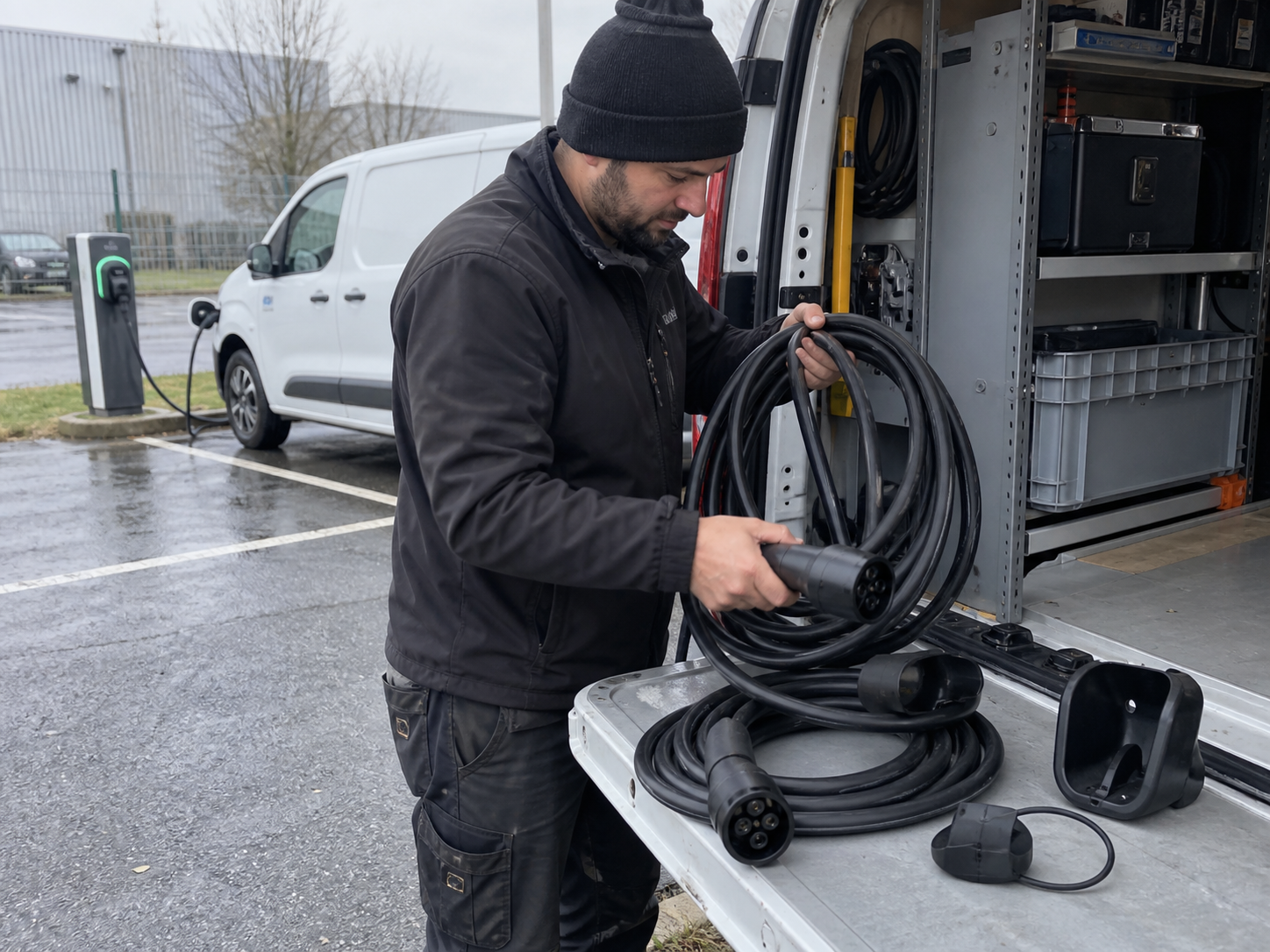
Fleet and workplace charging
Los accesorios de flota apoyan un proceso operativo repetido. El problema no es solo si un cable funciona el primer día; es si los usuarios pueden manipular, almacenar, inspeccionar, limpiar, reemplazar y volver a pedir el accesorio de manera consistente en muchos puntos de carga. Debido a que la rutina operativa incluye la limpieza, la guía de limpieza y cuidado de accesorios de carga de VE ayuda a definir métodos de limpieza seguros, intervalos de inspección y prácticas que se deben evitar para cada tipo de accesorio.
A fleet shortlist may include:
- Standardized charging cables by vehicle group
- Holders or docks that keep connectors off the floor
- Protective caps for disconnected connectors
- Mounting and cable-routing hardware
- Daily or weekly inspection points
- Spare cables and high-wear replacement parts
- Reorder triggers based on damage or usage
- Packaging that identifies the correct replacement SKU
Record duty cycle, climate, vehicle turnover, depot layout, charging-point spacing, and maintenance ownership. A fleet that operates outdoors in winter needs a different protection and inspection plan from a workplace garage with low daily handling. The buyer should also consider how a replacement is identified: by vehicle group, connector type, station, cable length, or internal SKU.
Your next step: convert fleet needs into an operating standard
For a multi-bay or multi-shift operation, the fleet stocking and replacement guide helps turn those assumptions into daily inspection points, cleaning rules, spare-part categories, min/max stock logic, and replacement triggers. Use it when the buying decision must protect uptime after installation, not only select the first accessory.
Fleet sites may also need connector-specific protection. If caps or covers are part of the standard bay setup, the connector cap protection and maintenance guide helps define plug-side versus inlet-side fit, retention, cleaning, drainage, and replacement conditions before the spare SKU is approved.
Installers and site operators
Installers need fitment information that can be used on a real site. A product description should show which charger or enclosure it fits, what mounting surfaces are acceptable, what hardware is included, how cable entry is supported, and how much clearance is required for service.
Important questions include:
- Is the bracket designed for this charger model or enclosure?
- Is the load carried by masonry, metal, a post, or another structure?
- Does the cable gland or entry component match the cable diameter?
- Is strain relief provided where the cable changes direction?
- Will water, UV exposure, salt, or cleaning chemicals affect the installation?
- Can a technician remove the charger or cable without dismantling the entire support system?
- Are drawings, mounting holes, fasteners, and instructions available?
Mounting hardware should not be presented as a substitute for electrical installation design. The accessory can support the equipment, but the site’s electrical protection, circuit design, and local installation requirements need their own qualified review.
When the site requires a plate, bracket, post mount, cable gland, or support point, the station mounting and installation accessory guide provides the next specification layer: charger-model fit, hole pattern, substrate, fasteners, cable entry, corrosion exposure, service clearance, and handover documents. That is the useful path for an installer who already knows the charger but not the supporting hardware.
Dealers and private-label brands
Dealers need a coherent offer rather than a random list of parts. A bundle might group a cable, adapter, connector cover, holder, storage case, or installation accessory around a defined use case. Every item in the bundle should be compatible with the stated vehicle, charger, market, and package contents.
Before approving a dealer bundle, confirm:
- The target customer and use case
- Vehicle and connector mix
- Exact contents and exclusions
- Sample quantity and approval process
- Logo, color, carton, barcode, and label requirements
- Manual language and warning requirements
- MOQ for each component and for the assembled bundle
- Replacement and reorder logic
Private-label packaging should not hide technical boundaries. If an adapter works only with a specified charging mode or product family, the instructions and packaging should say so clearly. Clear boundaries reduce returns and protect the dealer’s sales team from making universal claims.
Your next step: design a controlled dealer bundle
For a retailer or private-label brand, the dealer bundle and private-label guide helps turn this shortlist into a master SKU with defined component contents, connector variants, packaging, barcode, manual language, MOQ, sample approval, and reorder controls. Use that path when the commercial question is no longer “which accessory?” but “which compatible set can we sell and replenish without mix-ups?”
Dealers also need a launch process. The EV charging accessories distributor onboarding checklist connects the catalog to fitment files, samples, pricing, MOQ, training, warranty, and supplier contacts.
What Should B2B Buyers Verify Before Ordering?
B2B buyers should evaluate a product program in four layers: fitment, evidence, supply execution, and post-sale support. A low unit price does not compensate for a wrong connector mix, missing documents, uncontrolled revisions, or a replacement process that cannot identify the right SKU.
If the decision depends on production consistency rather than a supplier claim, the EV charging accessories factory audit checklist helps buyers review incoming materials, testing, capacity, traceability, and corrective action.
Fitment and product scope
Ask the supplier to state the product boundary in writing:
- What vehicle or charger interface is supported?
- What is the connector combination?
- Is the product for AC, DC, or a defined use only?
- What current, voltage, phase, and temperature limits apply?
- What cable length, diameter, housing, and mounting dimensions are included?
- What is excluded from the quotation?
If the request contains several connector families, ask for a matrix rather than a paragraph. A matrix makes missing combinations visible and helps the buyer compare suppliers on the same basis.
Sample validation
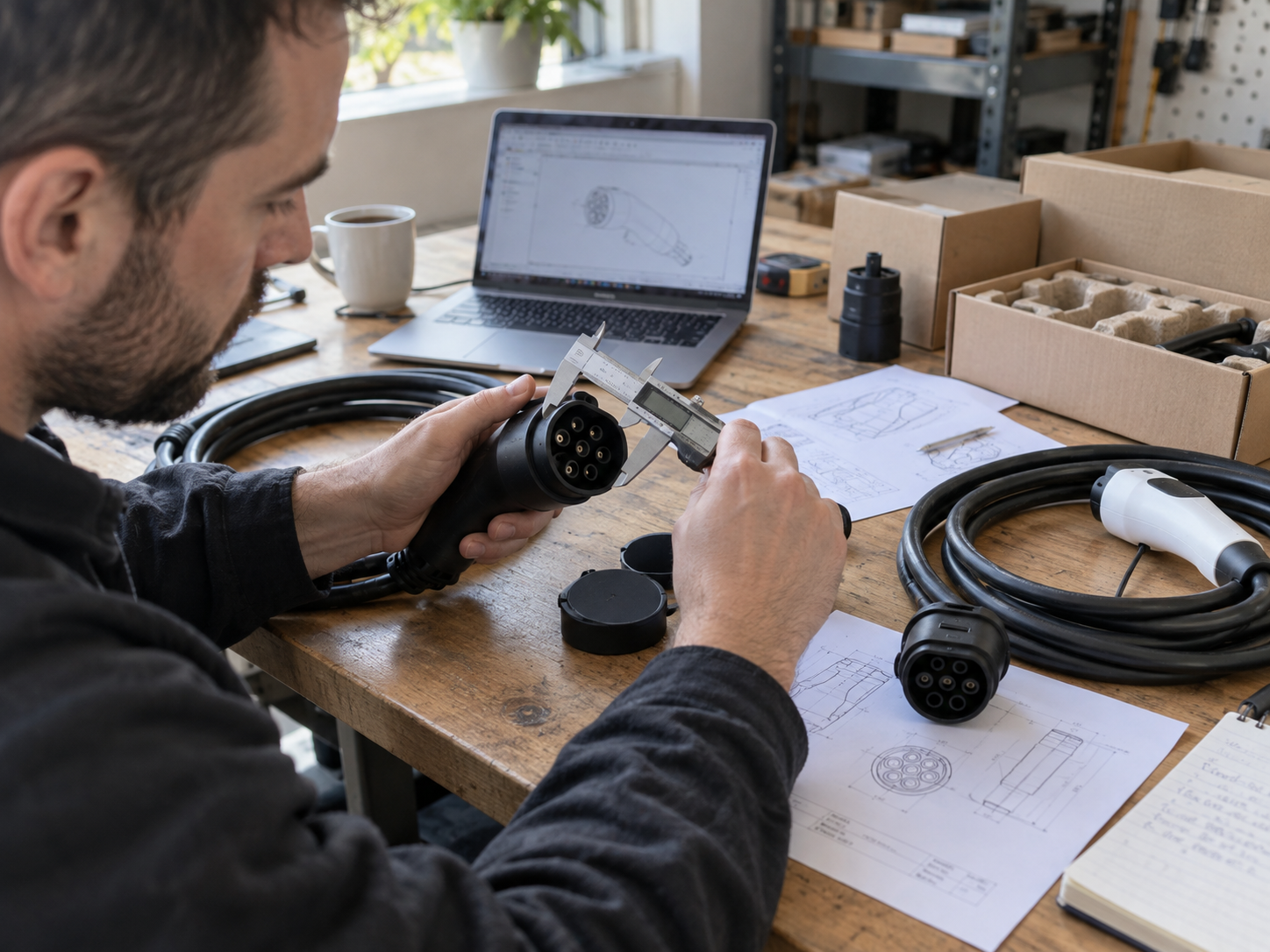
The approved sample should be a controlled reference, not an informal photograph. Record:
- SKU and revision
- Sample date
- Connector and fitment result
- Dimensions and weight where relevant
- Visual condition and finish
- Cable jacket, strain relief, and terminal condition
- Markings and labels
- Packaging and manual
- Test conditions and acceptance criteria
- Approval owner and approval date
For a cable or adapter, fitment and functional checks should be performed under the intended equipment combination. For a holder or mount, confirm load, installation surface, retention, and removal behavior. For a cap or cover, confirm fit, retention, cleaning, and the exact environmental claim.
Your next step: define sample approval
If the first order depends on cable performance or repeatable sample approval, continue with the cable sample-approval checklist. It separates identity, connector fit, terminals, jacket, flexibility, strain relief, markings, documents, packaging, retained control samples, incoming inspection, and pre-shipment release so “sample approved” has a reproducible meaning.
What does a simple buyer matrix look like?
Use una fila para cada combinación real en lugar de marcar toda una familia de productos como compatible. El siguiente ejemplo es intencionalmente simple; reemplace los campos entre corchetes con la información verificada del comprador.
| Caso de uso | Vehicle or equipment side | Accessory and operating boundary | Evidence required | Operational check | Supply decision |
|---|---|---|---|---|---|
| Inicio | [vehicle model/year + inlet] y [wallbox model + connector] | [AC mode], [current/voltage], [cable length]; cable, holder, and cap | Exact SKU datasheet, fitment statement, manual, label, and environmental limits | Cable weight, bend radius, wall material, outdoor exposure, connector retention | Approve one sample; record replacement SKU and packaging |
| Fleet | [vehicle group A/B + inlet] y [station type] | [AC or DC mode], [rating]; standardized cable, holder, cap, and spare | Vehicle-to-accessory matrix, test record, revision, inspection criteria, and traceability | Daily handling, cleaning, weather, depot layout, damage trigger, and spare location | Approve representative samples by vehicle group; define reorder trigger |
| Dealer or private label | [supported connector family] y [defined charger-side use] | [defined mode and rating]; bundle contents and exclusions | Product pack, labels, manuals, declarations, packaging artwork, and variant matrix | Retail handling, barcode scan, language, carton protection, and return identification | Confirm MOQ per component, bundle MOQ, lead-time stages, and change notice |
If a cell cannot be completed, mark the row Retenido o Clarify. That is more useful than forcing a premature “universal” claim.
Quality and traceability
Request a concise explanation of incoming material control, in-process inspection, final inspection, and batch traceability. Ask which checks are performed on every unit and which are performed by sampling. If a supplier uses third-party testing, confirm that the report identifies the tested product or configuration.
The goal is not to demand the longest possible quality document. The goal is to prove that the delivered product can be compared against an approved specification and sample. A short, product-specific report is often more useful than a generic presentation full of quality slogans.
Packaging and channel readiness
Packaging affects more than appearance. It protects connectors and cables, communicates the correct use, identifies the SKU, supports warehouse handling, and helps a dealer sell the right variant. Confirm carton dimensions, inner protection, barcode, language, manual, marks, palletization, and whether the packaging is standard or customized.
For distributors and private-label brands, ask how the supplier controls packaging revisions. A changed label, instruction, barcode, or warning can create a mismatch between the physical product and the sales channel even when the hardware itself has not changed.
An approved accessory can still create risk if a supplier changes a connector, material, label, or manual without approval. Use the EV charging accessories change-control guide to define notification, revalidation, stock transition, and document release.
Supplier capability and service
Ask for evidence of:
- Relevant product coverage
- Engineering or specification support
- Sample handling
- Document control
- Batch or shipment traceability
- Realistic MOQ and lead-time separation
- Replacement-part availability
- Warranty and claims process
- Change notification
- Export and packaging support
Buyers evaluating a broader automotive product program may also review the OEM EV charging accessories supplier overview, but the final decision should remain tied to the exact product, target market, evidence pack, and acceptance criteria.
Your next step: qualify the supplier, not only the product
When several suppliers can quote a similar cable, adapter, holder, or bundle, use the supplier qualification and RFQ checklist to compare product coverage, fitment evidence, samples, QC and traceability, compliance documents, OEM/private-label packaging, MOQ, lead-time stages, spare parts, warranty, and change control. The goal is to identify who can reproduce the approved configuration on the next order.
How Should You Plan Samples, Bundles, MOQ, Lead Time, and Replacements?
Samples, customization, packaging, production, shipping, and replenishment are separate stages. Treating them as one vague “lead time” makes it difficult to plan a launch or compare quotations.
If the project includes logo, packaging, color, tooling, or engineering changes, the custom EV charging accessories OEM and private-label brief helps separate cosmetic customization from engineering approval.
Define the sample stage
State whether the sample is for:
- Connector fitment
- Functional or charging evaluation
- Visual and finish approval
- Packaging review
- Installation trial
- Fleet handling trial
- Document and label review
If several variants are involved, request enough samples to represent the actual range. A single connector sample does not prove that every connector, cable length, housing, or adapter configuration will behave the same way.
For a sample order, define quantity and variants before asking for price. The Lista de verificación de pedido de muestra de accesorios de carga para vehículos eléctricos helps record fitment, function, appearance, packaging, evidence, and approval results.
Separate standard and customized supply
Standard products may need only selection, sampling, and packaging review. Customized products may add artwork, color, cable length, housing changes, tooling, testing, document revision, and new approval steps. Ask the supplier to separate these stages in the quotation instead of combining them into one delivery promise.
Ask for a lead-time breakdown
A useful schedule separates:
- Specification review
- Sample preparation
- Sample shipping
- Buyer testing and approval
- Artwork or document approval
- Material preparation
- Production
- Final inspection
- Embalaje
- Shipping
The timing will vary by product, quantity, customization, market, and supplier schedule. The point is not to demand a universal number; it is to make assumptions visible.
Plan bundles and replenishment
For a bundle, calculate the MOQ and replenishment logic for each component. If one cap or adapter has a longer lead time than the cable, it may become the constraint on the complete package. If a dealer sells multiple connector variants, the package should identify each version clearly enough for warehouse and customer-service teams to avoid mix-ups.
MOQ and lead time should begin after the real approval events are known. The EV charging accessories MOQ and lead-time planning guide separates samples, tooling, production, packaging, shipping, and reorder timing.
For a fleet, define replacement triggers such as damaged housing, unreliable locking, cable jacket damage, missing cap, failed inspection, or a change in the vehicle group. The trigger should identify the replacement SKU and the responsible person, not merely say “replace when worn.”
Replacement planning is incomplete without service terms. The EV charging accessories warranty and after-sales requirements guide helps define exclusions, claim evidence, response time, spare support, and private-label responsibilities.
What Should an EV Charging Accessories RFQ Include?
An effective RFQ gives every supplier the same technical, commercial, and market information. It should allow a supplier to say what is included, what is excluded, what evidence is available, and which assumptions affect price or lead time.
To turn these requirements into a supplier-ready request, use the plantilla de RFQ de accesorios de carga para vehículos eléctricos so every supplier receives the same fitment, electrical, document, quantity, packaging, and change-control fields.
| Campo de la RFQ | Information to provide |
|---|---|
| Caso de uso | Home, fleet, workplace, installer, dealer, or private label |
| Vehicle or charger reference | Vehicle model, inlet, charger model, outlet, or station reference |
| Tipo de producto | Cable, adapter, holder, cap, mount, bundle, or replacement part |
| Connector details | Vehicle-side and infrastructure-side connector requirements |
| Electrical details | AC or DC, current, voltage, phase, charging mode, and cable length |
| Entorno | Indoor, outdoor, UV, rain, dust, corrosion, temperature, or cleaning exposure |
| Mechanical details | Cable diameter, connector weight, mounting surface, load, bend radius, and clearance |
| Documentos | Datasheet, manual, declaration, certificate, test report, label, and traceability needs |
| Cantidad | Sample quantity, first order, annual forecast, and reorder expectation |
| Embalaje | Retail box, bulk carton, barcode, language, pallet, and carton marks |
| Personalización | Logo, color, cable length, connector mix, bundle contents, or artwork |
| Commercial terms | MOQ, sample cost, tooling, lead-time stages, warranty, spare parts, and shipping assumptions |
Copyable RFQ template
Buyers can copy the following fields into an email or sourcing form. Asking suppliers to return the same structure makes quotations comparable and exposes missing assumptions early.
| Campo de la RFQ | Buyer input or supplier response |
|---|---|
| Project / use case | Home, fleet, workplace, installer, dealer, private label, or OEM |
| Target country or market | Destination country, region, and sales channel |
| Vehicle groups and inlet references | Vehicle model or group, model year when relevant, and inlet type |
| Charger, outlet, or station-side references | Charger model, outlet type, station reference, or fixed-cable details |
| Accessory type and intended function | Cable, adapter, cap, holder, mount, bundle, or replacement part; state the job it must perform |
| AC or DC charging mode | Charging mode and defined use; do not leave this as “universal” |
| Electrical requirements | Voltage, current, phase, cable length, charging mode, and temperature range |
| Mechanical requirements | Connector dimensions, cable diameter, weight, bend radius, load, clearance, and mounting surface |
| Entorno | Indoor or outdoor use, UV, rain, dust, corrosion, cleaning, and temperature exposure |
| Required documents | Datasheet, label, manual, declaration, certificate or listing, test report, revision, and traceability |
| Sample and test plan | Sample quantity, equipment combination, test conditions, acceptance criteria, and approval owner |
| Quantity and forecast | First order quantity, annual forecast, reorder expectation, and spare-stock requirement |
| Packaging and bundle contents | Barcode, language, branding, carton, pallet, bundle contents, exclusions, and labeling |
| Personalización | Logo, color, cable length, connector mix, tooling, artwork, or document changes |
| Supplier response required | Exact SKU, inclusions and exclusions, MOQ, sample cost, lead-time stages, warranty, spare parts, change-control process, and quotation validity |
Do not ask only for “best price.” Ask suppliers to quote the same scope and state the commercial assumptions. If a product is not yet fully specified, request two or three clearly separated options instead of allowing the supplier to choose an unspoken configuration.
Buyers can also use Yirox’s soluciones de abastecimiento de productos automotrices to organize vehicle or connector references, electrical requirements, sample counts, market documents, packaging, and quotation needs before contacting a supplier.
A Step-by-Step EV Charging Accessories Buying Workflow
Use this seven-step workflow for a home purchase, fleet program, dealer bundle, or OEM request.
Step 1: Define the use case
State who will use the product, where it will be used, how often it will be handled, and what failure would cost. A home garage, fleet depot, installer project, and retail bundle should not begin with the same assumption.
Step 2: Identify both sides of the connection
Record the vehicle inlet and the charger, outlet, or station-side connection. Add the actual vehicle or equipment reference and the product revision where available.
Step 3: Confirm electrical and communication boundaries
Confirm AC or DC, current, voltage, phase, cable length, charging mode, communication, locking, and temperature limits. If an adapter is involved, define exactly what it adapts and what it does not change.
Step 4: Match the site and handling environment
Elija el almacenamiento, la protección y el montaje según el peso del cable, el radio de curvatura, la superficie de montaje, la exposición interior o exterior, la limpieza, la corrosión, el acceso de servicio y la frecuencia de manipulación. Para las decisiones de enrutamiento y soporte del cable, la guía de radio de curvatura y alivio de tensión del cable de carga de VE explica por qué los límites aprobados de curvatura y terminación importan al elegir un punto de almacenamiento o montaje.
Step 5: Request product-specific evidence
Request the datasheet, label, manual, declaration, certificate or listing, test report, revision, packaging files, and traceability information that apply to the exact product and destination market.
Step 6: Approve representative samples
Pruebe la configuración real en las condiciones previstas. Registre el ajuste, la función, la apariencia, el embalaje, los documentos y los criterios de aceptación. Conserve la muestra aprobada o un registro controlado para la comparación de producción. Durante la revisión de muestras y la inspección rutinaria, utilice la guía de señales de advertencia de accesorios de carga de VE para definir cuándo el calor, el daño, la humedad o un ajuste deficiente deben desencadenar una decisión de retención o suspensión de uso.
Step 7: Release the order with visible assumptions
Separate sample timing, approval timing, production, packaging, shipping, MOQ, warranty, replacement parts, and change-control requirements. A clear order is easier to produce, inspect, receive, and reorder.
Conclusion: How to Choose EV Charging Accessories With Fewer Surprises
The best EV charging accessory is not simply the one with the most connectors, the highest-looking rating, or the lowest unit price. Apply the five gates in order: Compatibilidad, Electrical and communication limits, Evidencia, Operaciones, y Suministro. The approved product is the one that passes all five for the intended vehicle, site, market, and replenishment plan.
For home users, start with fitment, handling, storage, and protection. For fleets, add duty cycle, inspection, replacement, and reorder planning. For installers, confirm mounting, cable entry, service access, and site conditions. For dealers and B2B buyers, add samples, document control, packaging, MOQ, lead time, and supplier capability.
If you are preparing an EV accessory shortlist or RFQ, request a buyer-specific EV accessory review with the vehicle or charger reference, connector details, target market, sample quantity, packaging needs, and expected volume. That information gives the supplier enough context to discuss fitment, documents, samples, and quotation assumptions before an order is released.
Preguntas frecuentes
What are the most important EV charging accessories for home use?
Most home users should first confirm the correct cable or adapter, then consider a cable holder and connector protection. The exact shortlist depends on the vehicle inlet, charger or outlet, cable weight, storage location, indoor or outdoor exposure, and how far the vehicle is parked from the charging point.
What is the five-gate EV charging accessory buying model?
It is a reusable approval sequence: Fitment → Electrical and communication limits → Evidence → Operations → Supply. Buyers first confirm the exact equipment combination, then verify operating boundaries, product documents, real-world handling, and repeatable supply conditions. If any gate is unknown, the row should be held or clarified before final approval.
Do EV charging accessories fit every electric vehicle?
No. Compatibility depends on the vehicle inlet, charger-side connector, charging mode, current and voltage limits, communication or locking behavior, market requirements, and product revision. A connector that fits physically is not enough evidence that an accessory is approved or suitable for every vehicle.
How do I check EV charging cable compatibility?
Record the vehicle inlet, charger or outlet, AC or DC use, current, voltage, phase, cable length, and target market. Then compare those details with the exact product datasheet, label, manual, and supplier evidence. For mixed fleets, create a vehicle-to-cable fitment matrix before ordering.
Can an EV charging adapter change AC charging into DC charging?
An adapter generally changes a physical connection between defined compatible equipment; it does not automatically convert AC power to DC or create compatibility that the vehicle, charger, cable, or communication system does not support. Confirm the exact adapter type, charging mode, ratings, approved use, and documentation.
What documents should I request from an EV charging accessory supplier?
Request a product specification sheet, connector and fitment details, electrical and environmental ratings, applicable certification or listing, declaration, test report, product label, manual, revision information, packaging files, and traceability information. The documents should identify the exact SKU and configuration rather than only the supplier’s product family.
Do connector caps make EV charging safe in wet conditions?
Caps and covers can help protect disconnected plug or inlet surfaces from dust, dirt, moisture, and handling damage. They do not automatically prove that charging is safe in every wet or contaminated condition. Select the correct fit and use only the environmental claims supported by the specific product evidence.
What accessories do EV fleets need?
Fleet programs commonly need standardized cables or adapters, holders or docks, connector protection, mounting support, inspection points, spare parts, replacement SKUs, and reorder rules. The right mix depends on duty cycle, vehicle groups, depot layout, weather, cleaning, handling behavior, and the operator’s maintenance process.
What should be included in an EV charging accessory bundle?
A bundle should group compatible products around a defined use case, such as home charging, travel, workplace charging, or fleet maintenance. Define the vehicle and connector fit, exact package contents, labels, manual languages, packaging, MOQ, sample approval, replacement logic, and exclusions before approving the bundle.
What should I include in an EV charging accessories RFQ?
Include the use case, vehicle or charger reference, connector combination, AC or DC use, current and voltage, cable or mounting dimensions, environmental conditions, documents, sample quantity, first order, forecast, packaging, customization, MOQ, lead time, warranty, spare parts, and target-market requirements. A complete RFQ makes supplier quotations comparable.
Referencias
[1] U.S. Department of Energy Alternative Fuels Data Center. “Electric Vehicle Charging Stations.” 2026.
[2] U.S. Department of Energy Alternative Fuels Data Center. “Electric Vehicles for Consumers.” 2026.
[3] International Electrotechnical Commission. “IEC 62196-1:2022 Plugs, Socket-Outlets, Vehicle Connectors and Vehicle Inlets.” 2022.
[4] International Electrotechnical Commission. “IEC TS 62196-7:2026 Vehicle Adapters.” 2026.
[5] European Union Your Europe. “CE Marking – Obtaining the Certificate and EU Requirements.” 2026.