





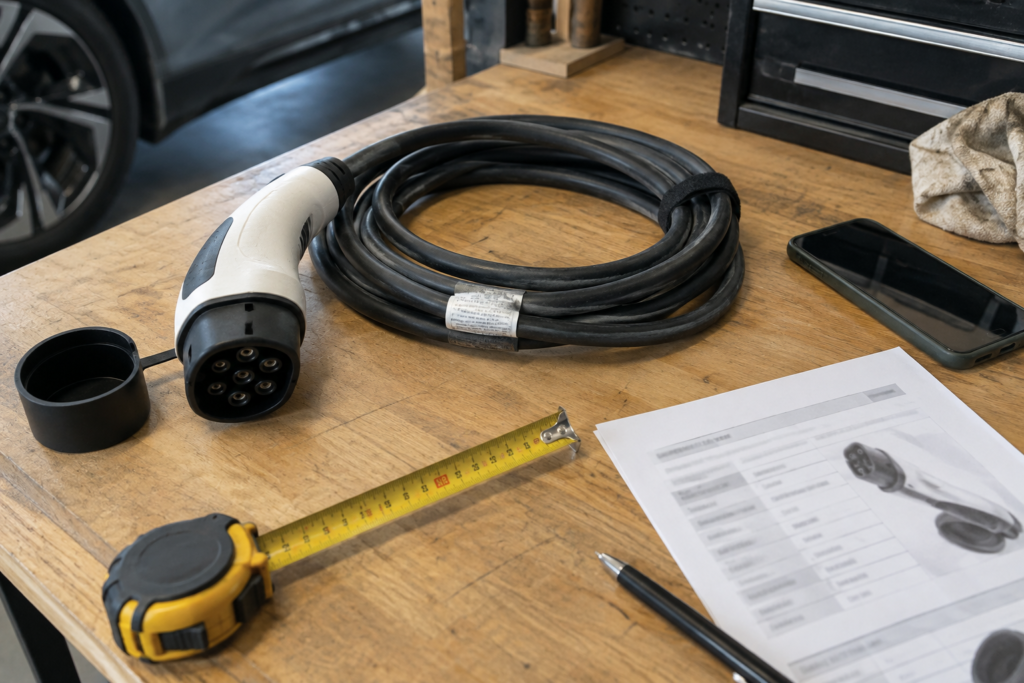
EV charging cable markings explained on the product label identify important information such as current and voltage ratings, connector type, cable construction, temperature limits, and traceability. A marking is a starting point; confirm the exact rating, test basis, and use conditions in the manufacturer documentation before treating the cable as compatible or suitable for a site.
The label is often the first thing a buyer sees, but it is only one layer of product evidence. A cable jacket may show a model code or electrical value, while the connector body, packaging, datasheet, drawing, declaration, and test report provide the context needed to interpret that value. The goal is not to memorize every symbol. It is to follow each marking to the evidence that supports it.
This guide is written for EV owners, installers, service teams, distributors, and purchasing staff who need to read an existing cable or review a new sample. If the equipment boundary is still unclear, start with the cable versus charger versus station explainer before deciding which label or datasheet fields matter.
Tabla de contenido
- Where do EV charging cable markings appear?
- How should you read current, voltage, phase, and temperature terms?
- How do markings identify connectors and cable fitment?
- What do manufacturer and traceability markings tell you?
- What can a cable label not prove?
- What should buyers verify in a datasheet before approval?
- Conclusion: Treat the Label as an Evidence Trail
- Preguntas frecuentes
- Referencias
Where do EV charging cable markings appear?
EV charging cable markings can appear on the cable jacket, connector housing, control box, label wrap, packaging, and datasheet. The most reliable reading starts by recording every visible identifier and then matching it to the exact product documentation.
Look in these locations:
| Location | Information often found there | Por qué es importante |
|---|---|---|
| Cable jacket | Manufacturer, cable type, conductor or construction code, voltage, temperature, or certification-related marks | Helps identify the cable assembly and its basic construction |
| Connector housing | Connector family, part number, polarity or interface reference, locking or retention details | Helps distinguish vehicle-side, supply-side, and station-side interfaces |
| In-cable control box | Product model, electrical input/output, indicators, warnings, or serial information | May identify an EVSE function rather than a passive cable alone |
| Product label or tag | SKU, model, batch, date, barcode, QR code, and rating summary | Supports inventory, traceability, and sample-to-order matching |
| Packaging and manual | Included parts, use conditions, installation instructions, languages, and warnings | Defines the marketed configuration and intended use |
| Datasheet or drawing | Full ratings, dimensions, cable length, bend radius, environment, test basis, and revisions | Supplies the context a short jacket mark cannot provide |
Do not photograph only the connector face. Capture the full cable, both ends, the control box if present, the jacket marking, the label, and the package or document revision. For a commercial sample, save the photos with the SKU and sample date so the record can be compared with a later batch.
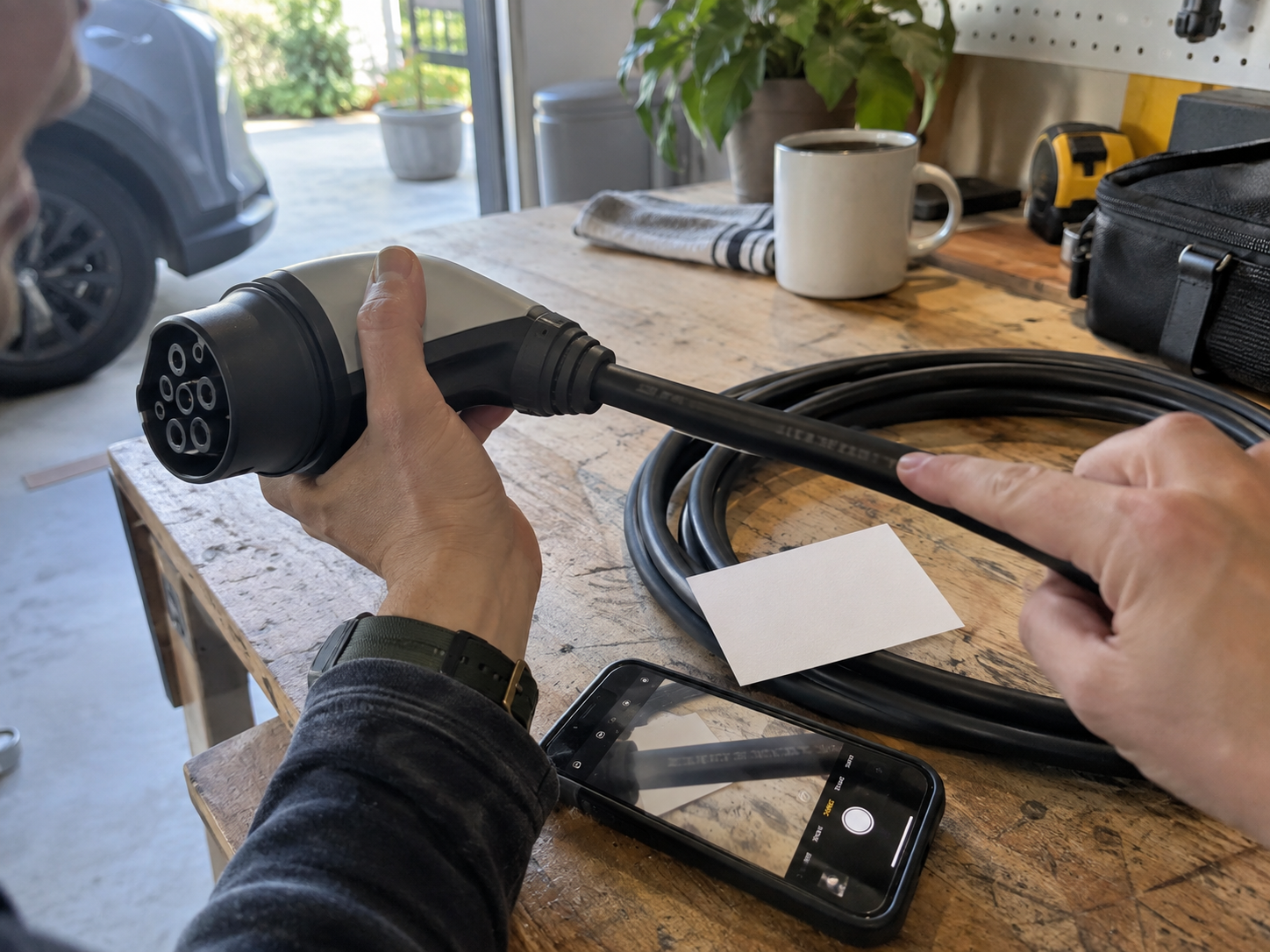
A mark that is worn, covered, inconsistent with the package, or different from the approved drawing should be treated as a discrepancy to investigate. It is not automatically a defect, because some products use separate cable and assembly identifiers, but it should be explained before approval.
How should you read current, voltage, phase, and temperature terms?
Current, voltage, phase, and temperature markings describe operating limits or conditions, but they do not independently determine charging speed or system compatibility. Read the values together with charging mode, connector, vehicle, EVSE, and installation requirements.
| Campo | What it describes | Qué comparar | Error común |
|---|---|---|---|
| Current, in A | The stated current capacity or operating value under defined conditions | Cable, connector, EVSE, supply, and vehicle limits | Assuming the highest amp number controls the whole system |
| Voltage, in V | The stated electrical potential or range | AC or DC mode, system design, insulation, and equipment ratings | Treating a voltage mark as proof that the cable fits every vehicle |
| Phase | The intended single-phase or multi-phase supply context where specified | Outlet, EVSE, installation, and regional configuration | Ignoring phase when comparing otherwise similar cable listings |
| Power, in kW | A power value or product-level rating when provided | Voltage, current, vehicle acceptance, and charging control | Treating a kW number as a guaranteed charging result |
| Temperature, in °C | Permitted storage, operating, ambient, or conductor-related condition | Exact definition, duty cycle, installation, and thermal test basis | Assuming one temperature field represents every condition |
| AC or DC | The charging architecture or current type | Vehicle inlet, EVSE or station, connector, and cable construction | Using an AC cable in a DC application because the connector looks similar |
The U.S. Department of Energy uses Level 1 and Level 2, SAE J1772, CCS, CHAdeMO, and NACS as examples in its consumer charging guidance, but the applicable connector and charging arrangement still depend on the vehicle, equipment, and market 1. A label helps identify a product; it does not grant permission to combine unrelated components.
Use a simple reading sequence:
- Write the unit exactly as shown. Distinguish A from V, kW from kWh, and an operating temperature from a storage temperature.
- Identify whether the value applies to the cable assembly, connector, control box, or complete EVSE product.
- Check the charging mode and interface at both ends.
- Compare the cable value with the lowest relevant system limit and the manufacturer instructions.
- Record the document revision or test condition supporting the value.
IEC 61851-1 addresses general requirements for conductive EV charging systems, including operating conditions, connection, and electrical safety considerations 3. That does not make a single printed rating sufficient for every installation. The rating must be read within the complete product and site context.
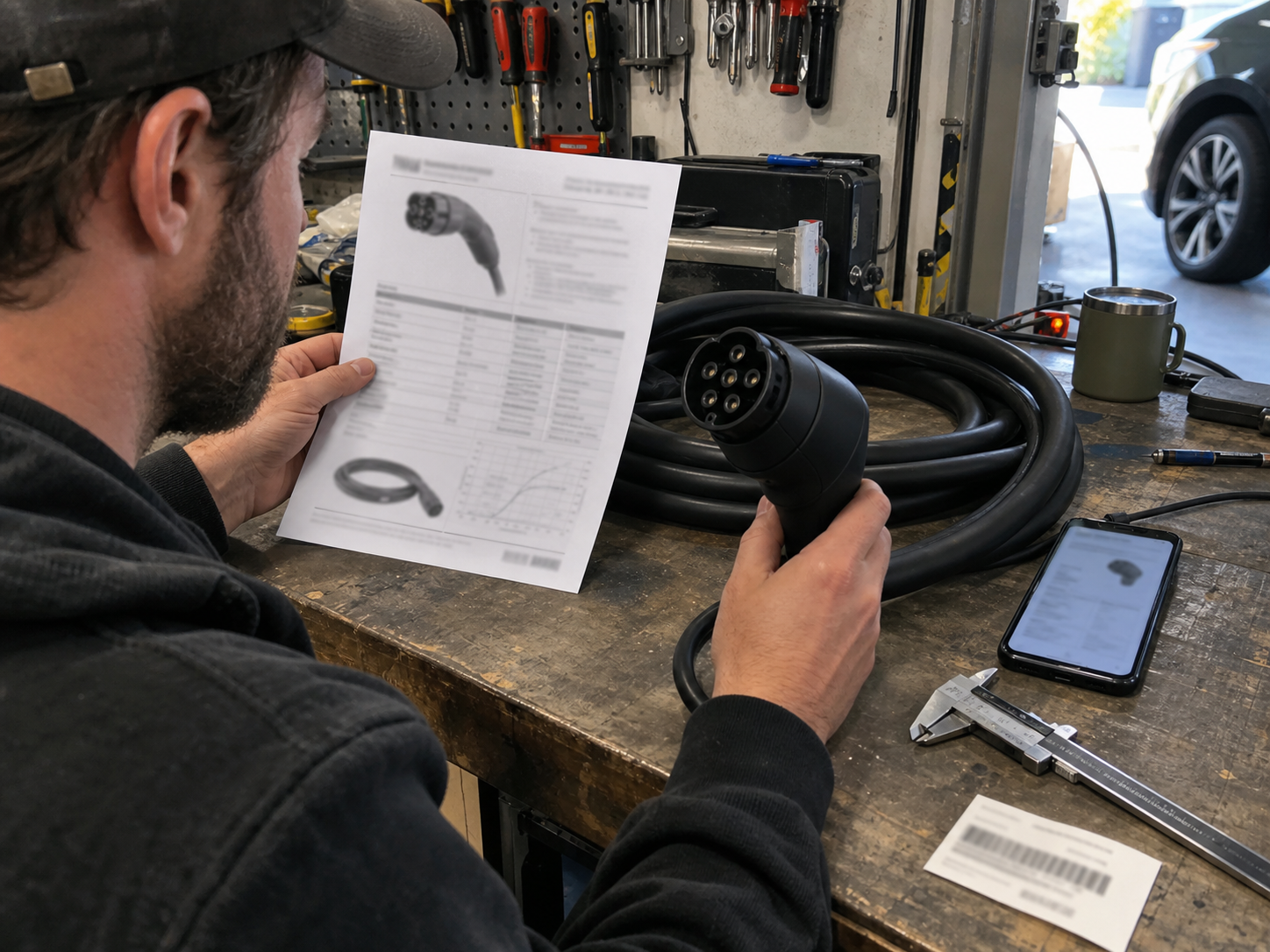
If a datasheet shows multiple current or temperature values, ask the supplier to define each one. “Rated current,” “maximum current,” “continuous current,” and “derated current” may not mean the same thing. A buyer should never fill an ambiguity with the most favorable interpretation.
How do markings identify connectors and cable fitment?
Connector and cable markings help identify the physical interface, but fitment requires more than a connector name. Confirm which side connects to the vehicle, EVSE, outlet, or station, then match the electrical, communication, mechanical, and market requirements.
Record at least these fitment fields:
- Vehicle inlet or vehicle group.
- EVSE, charger, outlet, or station-side interface.
- Connector family and exact part or model reference.
- Vehicle-side versus supply-side orientation.
- AC or DC charging mode.
- Cable length, outer diameter, flexibility, and bend radius.
- Locking, retention, keying, latch, and strain-relief details.
- Target country or market, labeling language, and permitted application.
IEC 62196-1 covers plugs, socket-outlets, vehicle connectors, vehicle inlets, and cable assemblies, with general requirements that include mechanical, thermal, and contaminant-related considerations 4. A connector family reference is therefore useful, but it still needs to be tied to the exact assembly and intended use.
| Marking or claim | What it can help identify | What it still cannot answer alone |
|---|---|---|
| Connector family name | General interface family | Exact vehicle, station, revision, rating, or communication behavior |
| Part number or SKU | Product identity for a supplier or manufacturer | Whether the sample, cable length, and package contents match the quotation |
| Current and voltage | A stated electrical value | Complete system capability, derating, installation, or charging speed |
| Longitud del cable | Reach and routing expectation | Whether the cable is suitable for the site’s bend, weight, and storage routine |
| Temperature mark | A defined thermal condition if the definition is known | UV, rain, dust, corrosion, impact, flex cycles, or every installation exposure |
| Compliance symbol or standard reference | A claim that may lead to supporting documents | Whether the claim applies to this exact SKU, revision, market, and configuration |
La Lista de verificación de compatibilidad de accesorios de carga de VE helps turn these fields into a repeatable vehicle, connector, charger, and market check. This is particularly important for adapters and replacement cables, where a familiar interface can conceal a different electrical or communication requirement.
What do manufacturer and traceability markings tell you?
Manufacturer and traceability markings connect a physical cable to a responsible party, product identity, production record, and revision history. They make investigation and replacement easier, but traceability is evidence of identity, not proof that every performance claim is correct.
Useful fields include:
- Manufacturer or responsible brand.
- Exact model, part number, or SKU.
- Cable assembly revision or drawing number.
- Batch, lot, date code, or serial number.
- Barcode or QR code that resolves to a controlled record.
- Country or site information where required by the target market.
- Document revision, approval date, and change-control reference.
For a distributor or fleet, these fields support more than warranty administration. They help separate an approved sample from a later substitute, match a replacement to the correct revision, and investigate a complaint without guessing which cable was installed. If a supplier changes the connector source, jacket material, mold, label artwork, or cable construction, the identity record should show how the change was evaluated.
Ask for a traceability example rather than accepting the word “traceable.” The example may show how a printed batch code connects to a production record, inspection result, material lot, final test, and packed SKU. A QR code that only opens a general home page is not the same as product-level traceability.
For a sample or incoming-goods process, the Lista de verificación de inspección de calidad del cable de carga de VE helps connect marking checks with visible condition, dimensions, fitment, packaging, and approval records.
What can a cable label not prove?
A cable label cannot prove live compatibility, internal condition, complete environmental performance, or current certification status by itself. It is a useful identifier and screening tool, not a substitute for a datasheet, drawing, test report, declaration, sample inspection, or qualified installation review.
Do not treat the following as proven merely because a marking appears:
- That the cable will fit every vehicle or station using the same broad connector family.
- That a higher current mark will produce faster charging.
- That a temperature mark covers UV, rain, salt, impact, flexing, or cleaning exposure.
- That an IP or weather-related claim applies to the complete installed setup.
- That a compliance logo applies to the exact SKU, revision, market, and bundle.
- That a used cable has no internal damage because the jacket looks clean.
- That the label is genuine, current, or unchanged after a supplier revision.
When a purchasing decision depends on a certification, listing, declaration, or test result, the EV charging certifications and test-document checklist provides the more appropriate evidence path. The buyer should request the document number, issuing body or laboratory where applicable, scope, model coverage, revision, date, and relationship to the supplied product.
This distinction also protects owners. If a cable has heat discoloration, a burning odor, cracks, exposed conductors, a loose connection, or severe moisture intrusion, stop using it and follow the manufacturer or site procedure. A label cannot clear a visibly damaged product for continued use.
What should buyers verify in a datasheet before approval?
Buyers should treat the datasheet as a controlled companion to the physical marking. Approval is stronger when the label, SKU, drawing, sample, test conditions, and quotation all describe the same configuration.
| Verification area | Fields to record | Evidencia a solicitar |
|---|---|---|
| Identidad | Manufacturer, SKU, model, cable assembly, revision, batch or serial | Label photo, controlled datasheet, drawing, and traceability example |
| Interface | Vehicle-side and supply-side connectors, inlet or outlet references, locking and retention | Connector drawing, compatible model list, and fitment notes |
| Electrical | AC or DC, voltage, current, phase, power context, control or communication | Rating table, test basis, manual, and system-use instructions |
| Thermal and environment | Operating/storage temperature, UV, rain, dust, corrosion, cleaning, and exposure limits | Product-specific test evidence, declaration, or documented conditions |
| Mechanical | Length, diameter, weight, bend radius, strain relief, mounting or storage assumptions | Dimensional drawing, material information, and handling instructions |
| Quality and evidence | Inspection points, sample criteria, final test, changes, and traceability | QC record, sample report, revision history, and certificate or listing where applicable |
| Commercial configuration | Packaging, barcode, languages, branding, bundle contents, warranty, spare parts | Quotation, artwork, packing list, warranty terms, and change-control process |
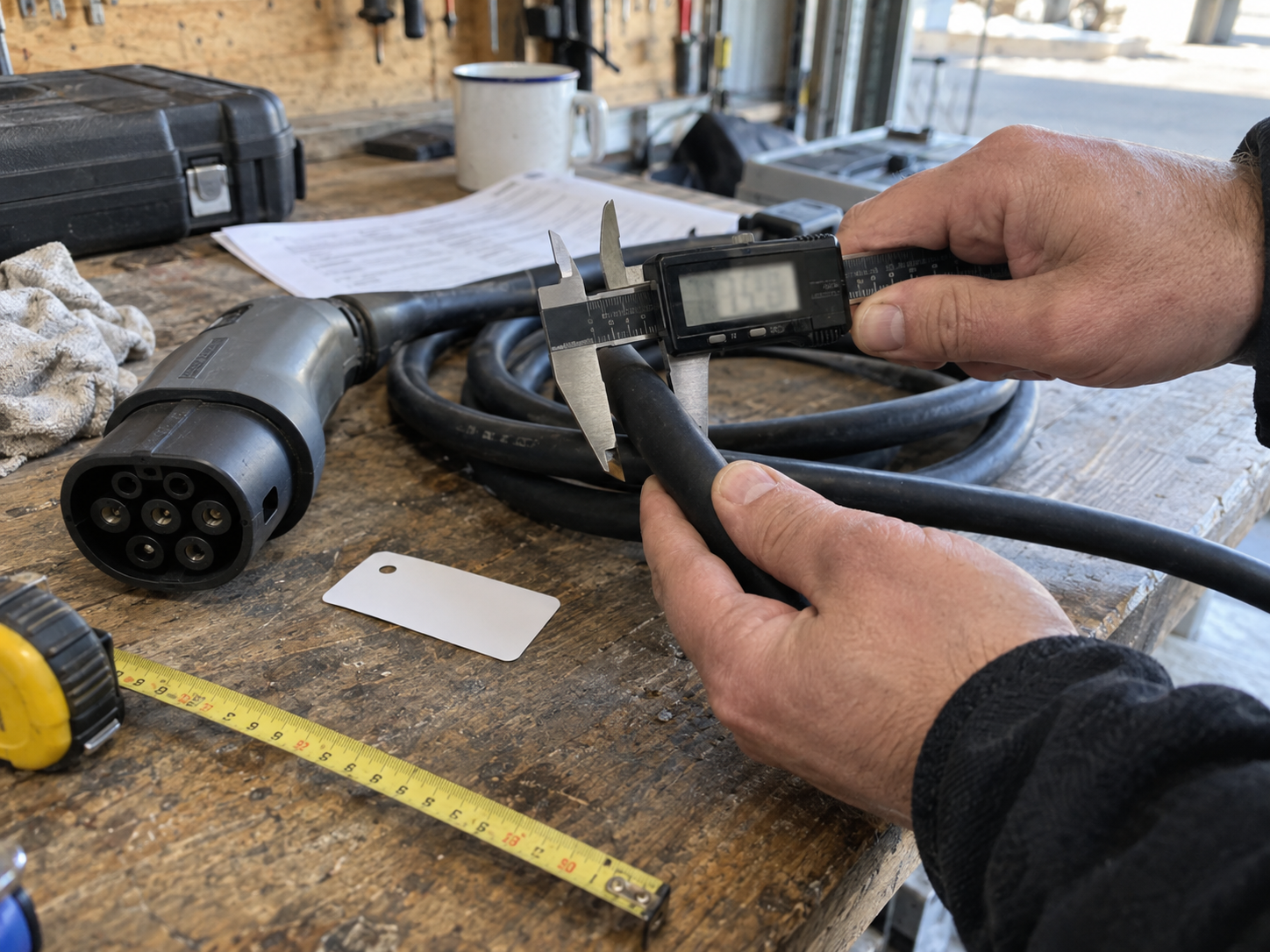
Use this seven-step label-reading worksheet for a first review:
- Capture: Photograph the whole cable, both connector ends, control box, jacket marks, packaging, and document revision.
- Transcribe: Copy the model, SKU, units, symbols, batch, and date exactly. Do not silently correct an unclear character.
- Define: Ask what each value applies to: cable, connector, control box, EVSE, or complete assembly.
- Compare: Match the vehicle inlet, charger or station, charging mode, electrical limits, and market configuration.
- Measure: Check length, diameter, connector dimensions, locking features, bend radius assumptions, and weight where relevant.
- Evidence-link: Tie each important claim to a datasheet row, drawing, declaration, test report, or inspection result.
- Record: Save the accepted revision, sample condition, approval date, packaging, and change-control expectation.
For a larger sourcing program, ask suppliers to return the same worksheet with the exact SKU and explicit inclusions or exclusions. If the supplier cannot connect a visible marking to a controlled document, treat the missing link as an open item rather than assuming the label is sufficient.
If you need a datasheet or product-marking review, share the target market, vehicle or charger references, connector ends, AC or DC mode, required current and voltage, temperature and environmental conditions, and the exact label or SKU available. We can help organize the fields for comparison without replacing the applicable installation and safety review.
Conclusion: Treat the Label as an Evidence Trail
EV charging cable markings are valuable because they give buyers a starting identity: connector, current, voltage, temperature, construction, manufacturer, model, and traceability clues. Their value increases when every important mark is matched to the correct datasheet, drawing, test basis, sample, and intended charging setup.
Read the label in context. Name the equipment, confirm the complete energy and communication path, compare the lowest relevant limit, check the site conditions, and preserve the revision record. For a wider selection sequence, use the guía de compra de accesorios de carga de VE after the label review has defined what the cable is and what it is expected to do.
Preguntas frecuentes
Where can I find the amp rating on an EV charging cable?
The amp rating may appear on the cable jacket, connector or control-box label, packaging, manual, or datasheet. Record the exact unit and confirm whether it applies to the cable assembly, connector, control box, or complete EVSE product.
Does a higher amp rating mean an EV will charge faster?
No. Charging speed depends on the vehicle, EVSE or station, supply, settings, connector, cable, and installation. A higher cable rating does not increase the capability of lower-rated equipment or guarantee a particular charging result.
What does a temperature marking on an EV cable mean?
It identifies a defined storage, operating, ambient, or conductor-related condition, depending on the product documentation. Ask the supplier to define the field and its test basis; do not assume it also proves UV, rain, corrosion, flex-cycle, or cleaning resistance.
How can I check whether an EV cable label is genuine and current?
Match the label to the exact SKU, drawing, datasheet revision, package, batch or serial record, and supplier traceability example. Check that the markings are legible and consistent across the cable, connector, control box, and documents. Escalate unexplained differences before approval.
Can an EV charging cable label prove certification?
Not by itself. A label may show a claim or symbol, but buyers should verify the document number, scope, issuing body or laboratory where applicable, covered model and revision, date, and relationship to the supplied configuration.
Referencias
[1] U.S. Department of Energy, Alternative Fuels Data Center. “Electric Vehicles for Consumers.” n.d.
[2] U.S. Department of Energy, Alternative Fuels Data Center. “Charging Electric Vehicles at Home.” n.d.
[3] International Electrotechnical Commission. “IEC 61851-1:2017, Electric vehicle conductive charging system — Part 1: General requirements.” 2017.
[4] International Electrotechnical Commission. “IEC 62196-1:2022, Plugs, socket-outlets, vehicle connectors and vehicle inlets — General requirements.” 2022.







