



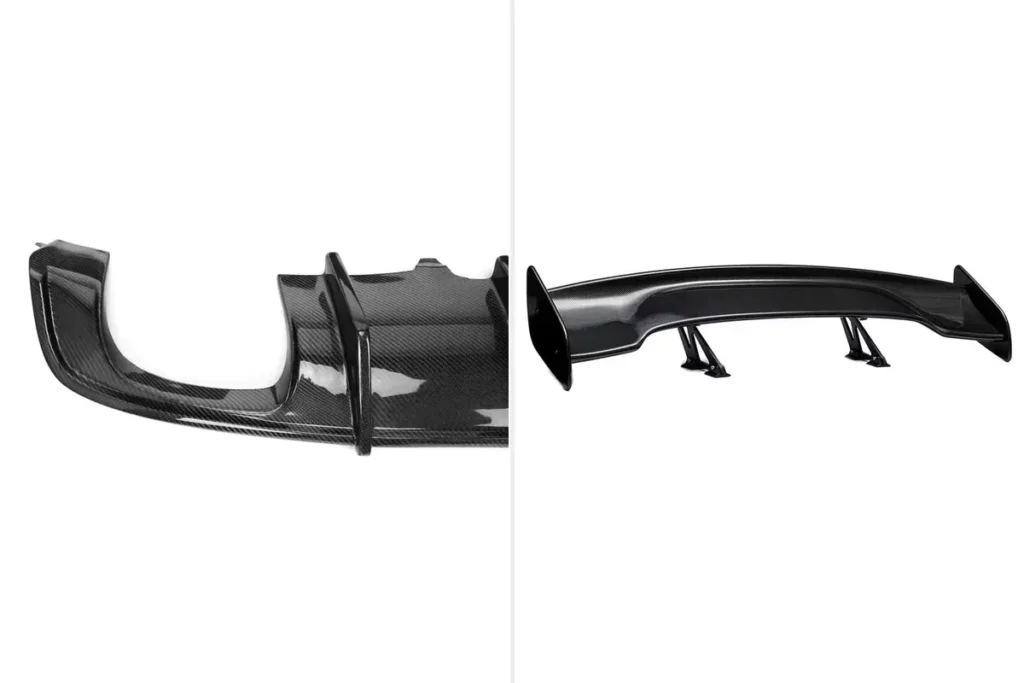
Um spoiler de fibra de carbono é um compósito de tecido de fibra de carbono fixado em resina; um spoiler de ABS é plástico moldado por injeção; um spoiler de fibra de vidro é fibra de vidro em resina. A fibra de carbono é a mais leve e rígida das três e custa mais. O ABS é o mais barato e o mais consistente em volume. A fibra de vidro fica no meio e adequa-se a pequenas séries e formas personalizadas.
Âmbito: este guia compara apenas materiais de spoilers. O que um spoiler faz e os principais tipos de spoiler são abordados em O que é um spoiler traseiro?, incluindo como verificar a compatibilidade de um spoiler universal.
Como se comparam os spoilers de fibra de carbono, ABS e fibra de vidro?
Cada material vence num ponto diferente: a fibra de carbono no peso e rigidez, o ABS no preço e repetibilidade, e a fibra de vidro no baixo custo de moldes para pequenas séries. A tabela compara spoilers típicos de porta-malas e de teto do mercado de acessórios do mesmo tamanho e forma. Descreve a prática comum, não um produto específico.
| Fator | Fibra de carbono | plástico ABS | Fibra de vidro (FRP) |
|---|---|---|---|
| What it is | Tecido de fibra de carbono em epóxi ou resina semelhante | Termoplástico, moldado por injeção | Manta ou tecido de fibra de vidro em poliéster, éster de vinilo ou resina epóxi |
| Processo típico | Pré-impregnado ou infusão a vácuo num molde, depois verniz de acabamento | Molde de aço numa máquina de injeção, depois pintura ou acabamento em película | Laminação manual ou por projeção num molde aberto, depois lixagem e pintura |
| Peso (mesmo design) | Mais leve | Leve a médio; depende da espessura da parede | O mais pesado dos três para a mesma rigidez |
| Stiffness | Mais elevada; mantém a forma em lâminas longas e finas | Mais baixa; lâminas longas precisam de nervuras ou paredes mais espessas | Médio |
| Comportamento ao impacto | Pode rachar ou delaminar | Normalmente flexiona ou amolga; pode rachar com frio | Pode rachar ou mostrar fissuras em teia na pintura |
| Principal ponto fraco ao ar livre | A resina precisa de um verniz resistente aos UV | O ABS não pintado desbota e esbranquiça à luz solar | O gel coat ou a pintura podem esbranquiçar e fissurar com o tempo |
| Repair | Trabalho especializado; a trama visível é difícil de reparar de forma invisível | Pequenos riscos podem ser repolidos; rachaduras normalmente significam substituição | Fácil de reparar com resina e massa, depois repintar |
| Custo de moldes | Médio a alto | Mais alto (molde de injeção em aço) | Mais baixo (moldes abertos) |
| Preço por peça | Mais alto | Mais baixo em volume | Médio |
| Melhor aplicação | Estilo premium, carros de exposição, projetos focados no peso | Programas de volume, condutores diários, acabamentos pintados ou com aspeto de carbono | Peças de baixo volume, personalizadas, réplicas e de corrida |
Two other materials appear in the same listings. Polyurethane (PU) and PP are used for flexible parts such as bumper lips and some trunk lip spoilers, because they bend instead of cracking. Flexible PVC is used for thin stick-on lip strips. A lip spoiler is a small, low profile part, so its material choice is driven more by flexibility and adhesive mounting than by stiffness.
De que é feito um spoiler de fibra de carbono?
A real carbon fiber spoiler is made of layers of woven or unidirectional carbon fiber bonded with resin, usually epoxy, and cured in a mold. The fiber gives the strength and stiffness, and the resin holds the fibers in place and gives the part its shape.
Typical production for carbon fiber exterior parts involves one of three routes:
- Prepreg: carbon cloth already impregnated with resin is laid into a mold, vacuum-bagged and cured with heat, sometimes under pressure in an autoclave. Parts made this way are often sold as “dry carbon” and are the lightest and most consistent.
- Vacuum infusion: dry carbon cloth is laid in the mold and resin is drawn through it under vacuum. It uses less expensive equipment than prepreg and still controls the resin content well.
- Wet lay-up: resin is brushed or rolled onto the cloth by hand. It is the cheapest carbon route, but the resin content varies more, so parts tend to be heavier.
Most visible-weave parts then get several coats of clear coat, which protects the resin from sunlight and gives the gloss finish. “Forged carbon” is a different look: chopped carbon fiber is pressed with resin, which gives a marbled pattern instead of a regular weave.
The fiber itself is what makes carbon so stiff. Hexcel’s data sheet for its widely used HexTow AS4 fiber lists a density of 1.79 g/cm³ and a tensile modulus of 231 GPa 2. Owens Corning lists standard E-glass fiber, the usual fiberglass reinforcement, at a density of 2.60 to 2.62 g/cm³ and a Young’s modulus of 78 to 79 GPa 3. We compare those numbers in the fiberglass section below.
É fibra de carbono real ou aspeto de carbono?
Many “carbon fiber” spoilers are not carbon fiber at all; they are ABS or PP parts with a carbon-pattern finish. The pattern is usually applied with water transfer printing (also called hydro dipping) or a printed film, then clear coated.
Carbon-look is not a defect. It is a legitimate, lower-cost finish, and it is what most buyers of a “carbon fiber spoiler” under a modest budget actually receive. The problem is only when a listing does not say which one it is. On many listings, including some of ours, “carbon fiber” names the finish option, while the datasheet’s material line names the substrate. Always read the material line.
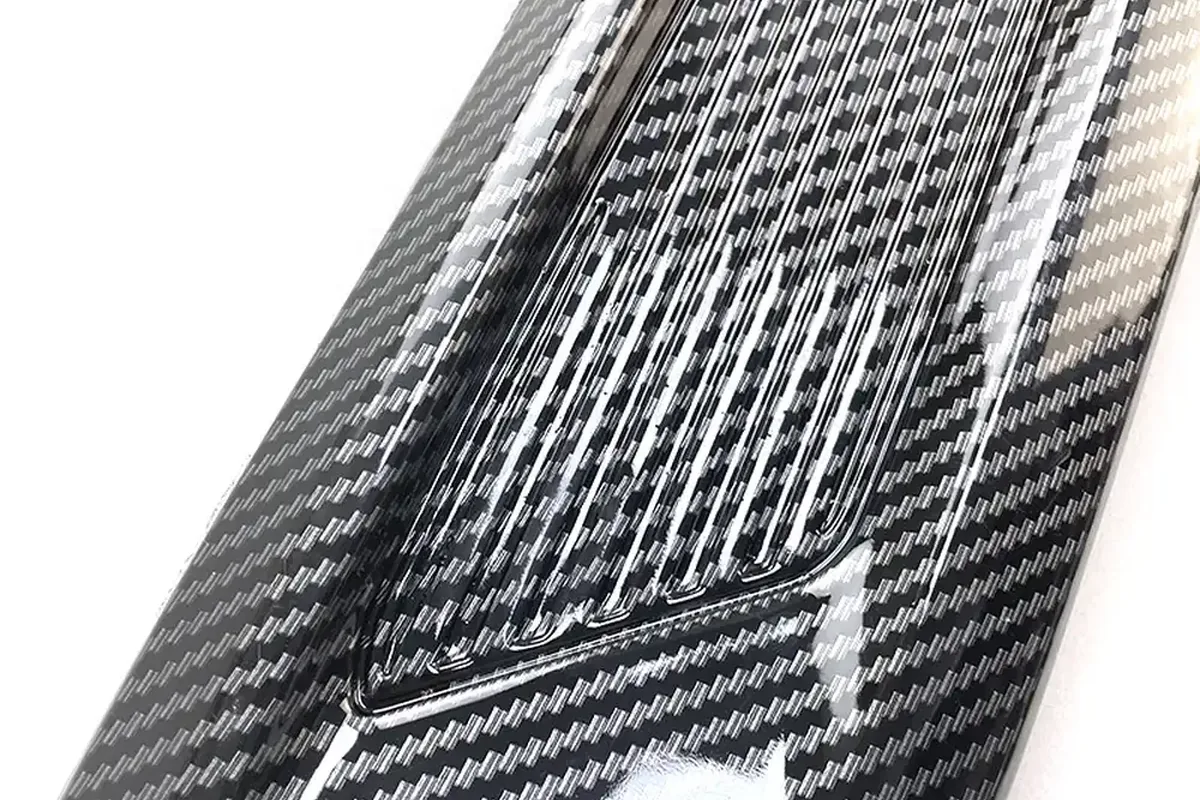
Use these checks when a sample or a product photo arrives:
- Read the material line. “ABS”, “PP” or “PVC” with a “carbon pattern” or “carbon texture” finish means carbon-look. Real carbon is listed as carbon fiber with a resin type, and often a weave such as 3K twill.
- Look at the back. An injection-molded part has molded ribs, mounting bosses and a smooth plastic back. A real carbon part shows the weave or a matte resin surface on the inside.
- Follow the weave over edges and curves. Real woven fiber bends around radii and the tows change direction slightly. A printed pattern can stretch, blur or repeat in a visible tile.
- Check the cut edges and holes. Drilled or trimmed real carbon shows layered black fiber at the edge. Carbon-look plastic shows solid plastic under the print.
- Compare the weight and price. A real carbon part that weighs the same as the ABS version, or costs about the same, deserves a closer look.
Porque é que a maioria dos spoilers do mercado de acessórios é de ABS?
Most aftermarket spoilers are ABS because injection molding makes identical parts quickly and cheaply once the mold exists. ABS (acrylonitrile butadiene styrene) is easy to mold, takes paint well and holds its shape at normal outdoor temperatures.
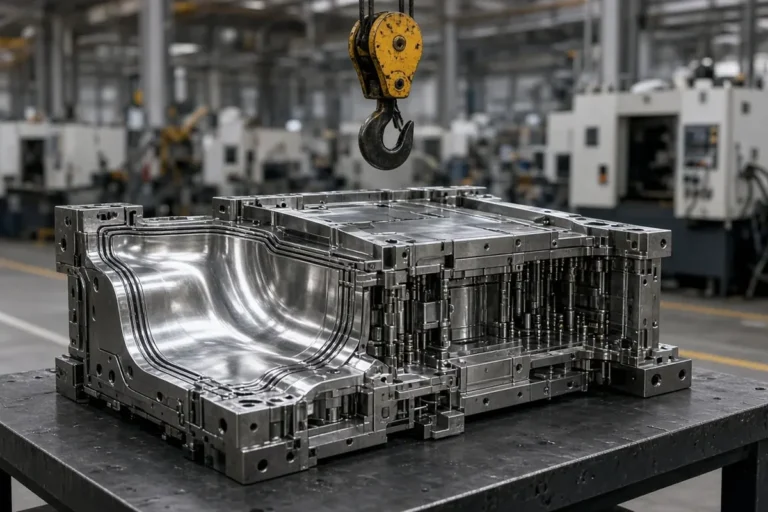
Typical production for ABS and PP exterior parts involves injection molding in a steel mold, then deburring, sanding, painting or a gloss-black or carbon-pattern finish, and a trial fit on the vehicle. Typical inspection points are color difference, gloss, sink marks, mounting-hole positions and the fit gap after trial fitting. The mold is the big fixed cost. After that, each part takes minutes and comes out with the same shape and the same mounting points, which is exactly what a distributor needs for a repeatable SKU.
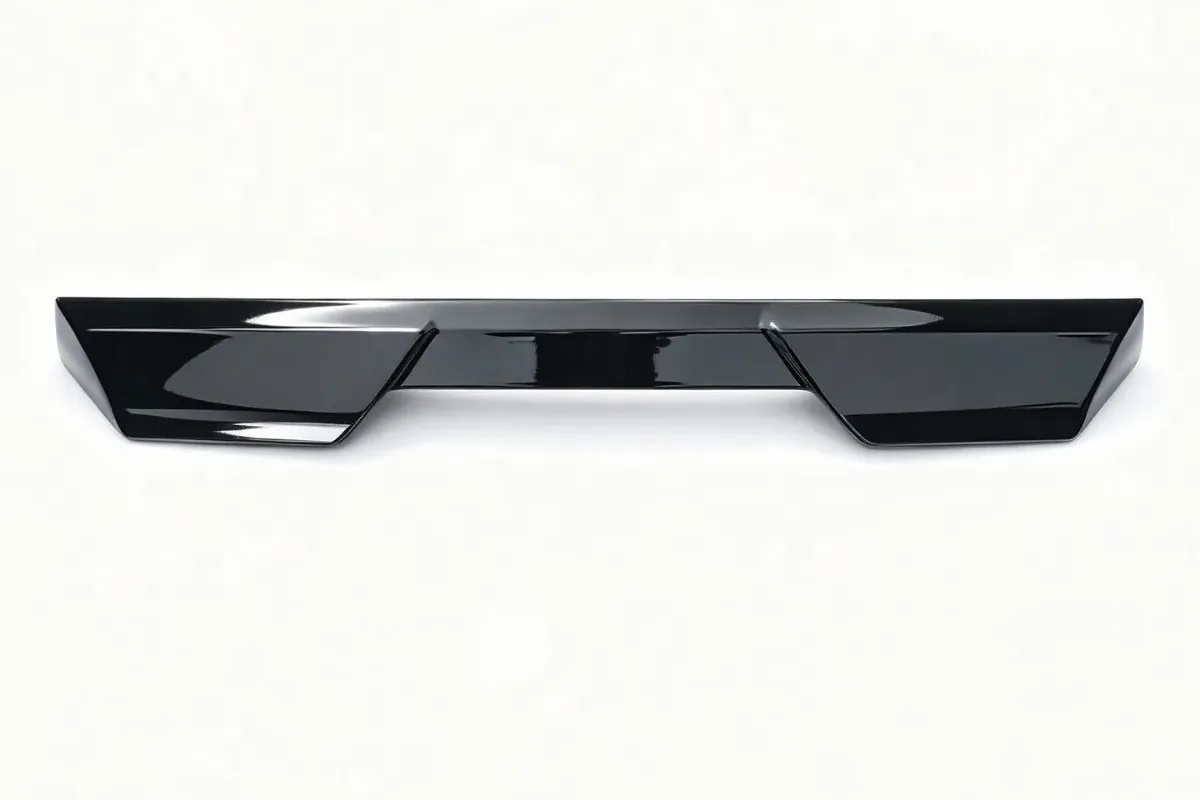
The weak point of plain ABS is sunlight. INEOS Styrolution, a major styrenics producer, positions its ASA (acrylonitrile styrene acrylate) grades as the weather-resistant option for automotive exterior parts such as grilles and mirror housings, citing UV resistance and color fastness 4. For an ABS spoiler, the paint or clear coat is the UV protection, so the quality of that finish matters as much as the plastic. Some OEM spoilers skip paint entirely by using ASA: INEOS reports that BYD selected its Luran S SPF 30 ASA grade for the rear spoiler of the Dolphin EV, for its UV resistance and paint-free high-gloss look 5.
ABS also has practical advantages for the installer. It can be drilled for bolts, it bonds well with automotive double-sided tape, and a scratched part can be scuffed and repainted like a bumper. Its limits are stiffness and cold: a long, thin ABS wing needs internal ribs or a thicker wall to avoid flexing, and plastic becomes more brittle in very cold weather.
Fibra de vidro vs fibra de carbono: onde é que a fibra de vidro ainda se adequa?
Fiberglass is heavier and less stiff than carbon fiber, but it is much cheaper to tool and easy to repair, so it still makes sense for small batches, custom shapes and replica or race parts. Carbon fiber is the better material when weight, stiffness or a visible weave matter more than cost.
The fiber data shows why carbon wins on stiffness. The table uses the manufacturer figures quoted above. These are fiber-only properties; a finished spoiler laminate is much lower, because resin makes up a large share of the part and the fibers do not all run in one direction.
| Fiber property | Carbon fiber (HexTow AS4) | E-glass fiber | O que significa |
|---|---|---|---|
| Densidade | 1.79 g/cm³ 2 | 2.60–2.62 g/cm³ 3 | Carbon fiber is about 31% less dense |
| Stiffness (tensile / Young’s modulus) | 231 GPa 2 | 78–79 GPa 3 | Carbon fiber is about 3 times stiffer |
| Stiffness per unit density (our calculation) | about 129 | about 30 | Carbon fiber gives about 4.3 times the stiffness per gram |
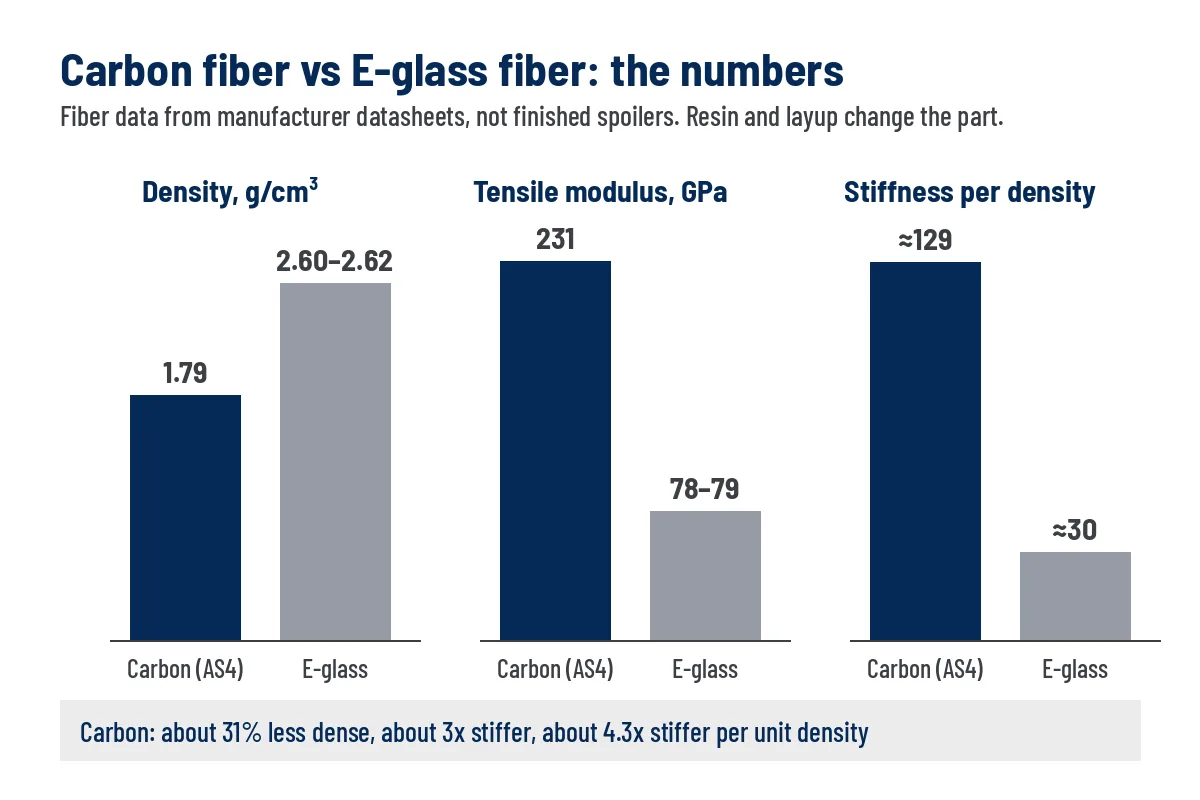
Stiffness per gram is the number that matters for a spoiler blade, because a long blade must resist bending and flutter without becoming heavy. That is why a carbon blade can be thinner than a fiberglass one of the same stiffness. The U.S. Department of Energy makes a similar point for vehicle structures: in its comparison of lightweight materials, carbon fiber composites can cut component mass by 50 to 70%, against 25 to 35% for glass fiber composites 1.
Fiberglass has its own advantages:
- Low tooling cost: an open fiberglass mold costs far less than a steel injection mold, so a short run or a one-off design is affordable.
- Easy repair: cracks can be ground out, filled with resin and glass, sanded and repainted.
- Paint-ready: fiberglass parts are normally painted, so the surface does not need a cosmetic weave.
Its drawbacks are weight, more hand labor per part and more variation between parts. Fiberglass parts usually need surface prep before paint, such as filling pinholes and sanding, and fitment depends heavily on how carefully the mold was made.
O material mais leve faz realmente diferença?
For a road car, the weight saved by a carbon spoiler is too small to change fuel economy in a measurable way. It matters more for mounting loads, for trunk lids with gas struts, and for big wings on track cars.
Here is a worked example. The numbers are hypothetical, except where a source is given.
- One of our injection-molded PP trunk spoilers for a mid-size sedan lists an approximate weight of 3 kg on its datasheet.
- Assume a carbon version of the same shape weighs half that, 1.5 kg, so it saves 1.5 kg.
- On an 1,800 kg car, 1.5 kg is about 0.08% of the vehicle’s weight.
- DOE says a 10% reduction in vehicle weight can improve fuel economy by 6% to 8% 1. Scaled down, a 0.08% cut works out to roughly 0.05% to 0.07%.
That is far too small to notice at the pump, so fuel economy is not a reason to choose carbon. Weight does matter in three practical cases:
- Trunk lids: a heavy wing on a lid held up by gas struts can make the lid drop or close on its own.
- Adhesive mounting: tape-mounted spoilers rely on the bond area; a heavier part puts more load on the tape, especially at speed and in heat.
- Track use: on a race car, weight high and at the rear affects balance, and a stiff blade keeps its angle under aerodynamic load.
Qual material de spoiler dura mais tempo ao ar livre?
Durability depends more on the finish than on the base material. A well-painted ABS spoiler, a carbon spoiler with a good UV clear coat and a properly finished fiberglass spoiler can all last for years; a poor finish fails early on any of them.
- Carbon fiber: epoxy resin is sensitive to UV light, so a visible-weave part depends on its clear coat. When the clear coat breaks down, the surface turns hazy or yellow. Re-clearing is possible but needs careful sanding so the weave is not damaged.
- ABS: painted ABS behaves much like a painted bumper. Unpainted or poorly coated ABS can fade, chalk and turn brittle in strong sun. ASA or a UV-stabilized grade is the better choice for unpainted black parts 4.
- Fiberglass: the gel coat or paint protects the laminate. Impacts can leave fine spider cracks in the paint, and moisture can get in through deep chips if they are left unrepaired.
The fair way to compare finishes is an accelerated weathering test. SAE J2527 is the standard performance-based method for accelerated exposure of automotive exterior materials using a xenon-arc apparatus 6. When a supplier claims UV resistance, ask which test method was used, for how long, and how gloss and color were measured before and after.
O que determina o custo de cada material?
Carbon fiber costs the most per part because both the material and the labor are expensive; ABS costs the least per part at volume because the steel mold spreads its cost over many parts. Fiberglass is cheaper to start but needs more hand work for every part.
| Fator de custo | Fibra de carbono | ABS (injection molded) | Fiberglass |
|---|---|---|---|
| Up-front tooling | Medium to high (composite or metal molds) | High (steel mold) | Low (open molds) |
| Raw material per part | Alta | Baixo | Baixo a médio |
| Labor per part | High (lay-up, bagging, trimming, clear coat) | Low (machine cycle, then finishing) | High (lay-up, sanding, filling, paint) |
| Part-to-part variation | Low with prepreg, higher with wet lay-up | Mais baixo | Mais alto |
| Cosmetic rejects | Weave defects, dry spots, pinholes in the clear coat | Sink marks, flow lines, paint defects | Pinholes, print-through, waviness |
| Volume where it fits best | Low to medium, premium price points | Medium to high, repeat orders | Very low to low, custom or replica designs |
A practical rule follows from the table. If you expect to reorder the same spoiler many times, an injection-molded design is usually the lowest total cost, even after paying for the mold. If you need ten pieces of a custom shape, fiberglass is usually the realistic choice. Carbon fiber is a premium product decision first and a cost decision second.
Qual material de spoiler deve escolher?
Choose by use and by the price point your customers expect, not by material reputation alone.
- Daily driver, styling upgrade: painted ABS, ASA, or ABS with a carbon-pattern finish. It is affordable, repeatable and easy to repaint.
- Premium look, visible weave: real carbon fiber with a UV-resistant clear coat. Buyers paying for carbon expect to see it described as such.
- Track or time-attack builds: real carbon or a well-made fiberglass blade, with bolt-on mounting rated for the load. Stiffness and secure mounting matter more than gloss.
- Custom, low-volume or replica parts: fiberglass, painted to match.
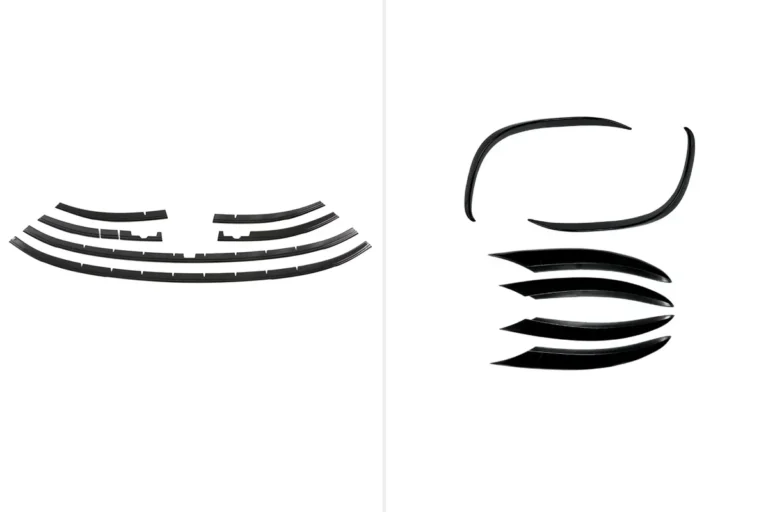
- Small lip spoilers: flexible PU, PP or PVC strips, mounted with adhesive tape, where flexibility matters more than stiffness.
Whatever the material, fit comes first. A carbon spoiler that does not follow the trunk lid curve looks worse than a well-fitted ABS one. The universal spoiler fitment section of our rear spoiler guide covers how to measure the lid and check the curve before buying.
Quais são os riscos e exceções?
The biggest risks are mislabeled materials, finishes that fail early and mounting that does not suit the part’s weight. Watch for these exceptions:
- Mislabeling: “carbon fiber” in a product title may describe a finish, as explained above. For resale, describe the substrate and the finish separately so your own customers are not misled.
- Carbon skin over fiberglass: some parts use one cosmetic layer of carbon over a fiberglass core. That is a valid construction, but the part will not have full carbon weight or stiffness.
- Cold-weather cracking: rigid plastics and composites can crack if a part is forced onto a lid with the wrong curve, especially in cold weather.
- Mounting: heavy wings should be bolted through the lid with backing plates; tape alone is meant for light parts. Drilling a trunk lid also needs sealing to keep water out.
- Repairs: a cracked visible-weave carbon part rarely repairs invisibly, while fiberglass and painted ABS do.
- Integrated brake lights: some spoilers include a third brake light. That turns the part into an electrical component with its own rules, which is outside the scope of this materials guide.
O que devem os distribuidores verificar ao adquirir spoilers?
A distributor should pin down the substrate, the finish, the fit and the packaging in writing before the first sample, because those four points cause most returns. Use this checklist in an RFQ and at sample approval:
- Substrate: ABS, ASA, PP, PVC, fiberglass or carbon fiber, named on the datasheet. For carbon, ask for the construction (prepreg, infusion or wet lay-up) and whether there is a fiberglass core.
- Acabamento: paint type and color code, gloss black, carbon-pattern print, or real weave with clear coat. Ask for a color or gloss reference sample.
- Weathering evidence: the test method, such as SAE J2527 6, the exposure time and the before-and-after gloss and color readings.
- Fitment data: vehicle, model years and body style for model-specific parts; length, width and curve for universal parts. A trial fit photo on the target vehicle helps.
- Mounting: tape type and coverage, or bolt kit, backing plates and gaskets, plus the installation instructions that ship in the box.
- Weight: the actual part weight, which also exposes “carbon” parts that weigh like plastic.
- Cosmetic acceptance criteria: what counts as a reject for color difference, gloss, sink marks, pinholes and weave defects.
- Embalagem: foam or film protection on the finished face, edge protection and carton strength for long blades.
Ask the supplier to confirm drawings, the vehicle list and mounting details before sampling. Doing that check up front is cheaper than discovering a curve mismatch on the first shipment.
Conclusão
Carbon fiber, ABS and fiberglass each answer a different question. Carbon fiber gives the most stiffness for its weight and the premium look of a visible weave, at the highest price. ABS gives repeatable, affordable parts once the mold is made, and with a good paint or a UV-stable grade it lasts well outdoors. Fiberglass keeps tooling costs low for small runs and custom shapes, and it repairs easily.
The material name on a listing is only the start. The finish decides how long the part looks good, the fit decides whether it looks right at all, and the datasheet decides whether “carbon fiber” means carbon fiber or a carbon pattern. A buyer who checks those three points will pick the right spoiler far more often than one who chooses on material reputation alone.
Próximo passo
Decide which price point and use you are buying for, then list the vehicles and the finishes you need. That short list is enough to compare suppliers on the same terms.
Yirox injection-molds ABS and PP spoilers in its own factory in gloss black, carbon-pattern and primer finishes. Primer is the choice when the parts will be painted to match the body color after delivery. If a program needs real carbon fiber or fiberglass spoilers, we supply them through audited partner factories and tell you up front which one makes them. Send your vehicle list through our Veja soluções de sourcing. page, or browse the spoilers e aerofólios range.
Perguntas frequentes
Is a carbon fiber spoiler better than ABS?
It is lighter and stiffer, but not better for every buyer. ABS costs much less, is easy to repaint and is consistent in volume, so it suits most daily drivers and styling upgrades.
Is carbon fiber stronger than fiberglass?
Carbon fiber is much stiffer for its weight. Manufacturer data lists carbon fiber at about 231 GPa modulus and 1.79 g/cm³, against about 78 GPa and 2.6 g/cm³ for E-glass, so a carbon part can be lighter for the same stiffness.
How can I tell if a spoiler is real carbon fiber?
Verifique a linha do material na folha de dados, olhe para a parte de trás da peça e siga a trama sobre as bordas. Uma parte de trás de plástico moldado, um padrão impresso repetido ou plástico visível numa borda cortada significa aspeto de carbono.
Você pode pintar um spoiler de fibra de carbono?
Sim. O verniz está lixado, com primer e pintado como outras peças compostas, embora a pintura esconda a trama pela qual a maioria dos compradores paga.
Os spoilers de ABS desbotam ao sol?
ABS não pintado ou mal revestido pode desbotar e criar pó branco sob luz solar forte. Um bom acabamento de pintura ou um material estável aos UV, como o ASA, previne a maior parte disso.
Qual é a desvantagem da fibra de carbono?
Custa mais, precisa de um bom verniz UV e é difícil de reparar de forma invisível após uma rachadura. Para um carro de rua, a economia de peso num spoiler é pequena demais para afetar o consumo de combustível.
Referências
[1] U.S. Department of Energy, Vehicle Technologies Office. “Lightweight Materials for Cars and Trucks.” Weight reduction and fuel economy; mass-reduction table by material.
[2] Hexcel Corporation. “HexTow AS4 Carbon Fiber Product Data Sheet.” Typical fiber properties: density and tensile modulus.
[3] Owens Corning. “Higher Performance Composites, Fiber and Bulk Glass Properties.” E-glass fiber density and Young’s modulus.
[4] INEOS Styrolution. “Luran S (ASA) product family.” UV resistance and automotive exterior applications.
[5] INEOS Styrolution. “Luran S selected by BYD Auto for rear spoiler application.” News release on the BYD Dolphin rear spoiler.
[6] SAE International. “SAE J2527 (September 2017): Performance Based Standard for Accelerated Exposure of Automotive Exterior Materials Using a Controlled Irradiance Xenon-Arc Apparatus.” Standard scope.