






A Type 1 to Type 2 EV charging cable connects a car’s Type 1 (J1772) AC inlet to a charging station’s Type 2 socket. The Type 1 end goes into the car; the Type 2 end goes into the station. It is a detachable AC cable, not a DC fast-charging converter. 1
Before ordering, identify both ends of the connection, check the car’s onboard AC charging limit, and choose a cable rating and length that suit the parking space. For distributors, those same details belong in the product listing and purchase specification.
Índice
- Which Way Does a Type 1 to Type 2 Cable Connect?
- Will It Fit Your Car and Charging Station?
- Should You Choose a 16A or 32A Cable?
- What Cable Length and Construction Should You Check?
- What Documents Should a Cable Supplier Provide?
- How Should Distributors Specify Customisation and Orders?
- Conclusion: Match Both Ends Before Ordering
- Perguntas Frequentes
- Referências
Which Way Does a Type 1 to Type 2 Cable Connect?
The intended connection is Type 2 station socket → cable → Type 1 vehicle inlet. Retailers may call the same arrangement “Type 1 to Type 2” or “Type 2 to Type 1,” so the order of the words alone is not a compatibility check.
| Connection point | What you need | O que verificar |
|---|---|---|
| Car | Type 1/J1772 vehicle connector | The car’s actual AC inlet, model, market and onboard charging limit |
| Station | Type 2 infrastructure plug | An available Type 2 socket, rather than an attached charging cable |
| Complete assembly | A detachable Mode 3 AC cable | A drawing and datasheet identifying the vehicle connector and station plug separately |
Phoenix Contact describes its Type 1/Type 2 mobile assembly specifically as a Type 1 vehicle connector paired with a plug for Type 2 infrastructure sockets. This is a useful way to specify the product without relying on an ambiguous “adapter” name. 1
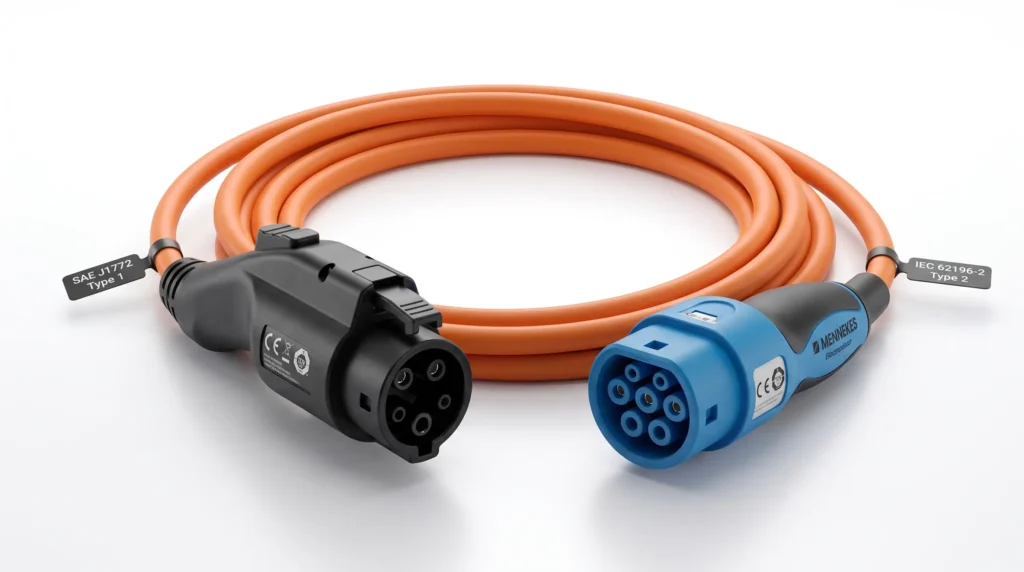
If you are still identifying the ports, compare the EV charging connector types before selecting a cable. Do not choose from the vehicle brand or country of manufacture alone.
Will It Fit Your Car and Charging Station?
Check the exact vehicle inlet and the actual station connection. A car with a Type 2 AC inlet needs a different vehicle-side connector; a station with a permanently attached cable presents a different connection from a socket-only station.
| Your setup | Decisão |
|---|---|
| Type 1 car + compatible Type 2 AC socket | This is the connection to assess for a Type 1/Type 2 detachable cable. |
| Type 2 car + Type 2 AC socket | Compare a Type 2 to Type 2 cable, with the vehicle’s phase and current requirements. |
| Type 1 car + tethered Type 2 connector | Do not assume this detachable cable is an extension. Obtain explicit vehicle, station and accessory approval for any proposed alternative. |
| CCS or CHAdeMO DC fast charger | Use the vehicle’s supported DC charging system. This AC cable does not convert the interface or charging mode. |
| Household socket | A separate, suitable EVSE portátil is needed; this station-to-car cable does not contain that supply control equipment. |
For an imported or used car, ask for its manual and inlet identification rather than accepting “fits all Leaf models” or “for Japanese EVs.” Record the model year, original market, AC inlet and onboard charging specification. The charging accessory compatibility checklist helps keep these checks separate.
AC and DC charging use different power paths. DC fast charging bypasses the car’s onboard AC charger; an AC connector cable does not create that capability. 2
Should You Choose a 16A or 32A Cable?
Choose the cable rating against the vehicle’s AC capability and the stations you expect to use. A higher cable rating provides capacity, but it does not force the car or station to charge faster.
| Cable rating | Illustrative power at 230 V, single phase | Selection check |
|---|---|---|
| 16 A | 230 × 16 ÷ 1,000 = 3.68 kW | Does that cover the vehicle’s supported AC rate and your usual charging window? |
| 32 A | 230 × 32 ÷ 1,000 = 7.36 kW | Can both the vehicle and the station provide/use the extra current? |
These figures are voltage/current calculations, not measured results or guaranteed battery charging rates. Check the cable’s rated voltage, current and intended use on its datasheet. A “7.4 kW” listing should state the supply assumptions rather than imply that every car will achieve that output.
For example, a vehicle limited to 3.3 kW AC will not gain a 7.4 kW onboard charger when you buy a 32 A cable. Conversely, a compatible vehicle capable of about 6.6 kW AC needs an appropriately rated connection to use that capability. These are specification examples, not a claim about every Nissan Leaf or a reported customer test.
Can a 22 kW Type 2 Station Make This Cable Charge at 22 kW?
A single-phase Type 1/Type 2 cable does not turn its vehicle connection into three-phase charging. Confirm the station’s available single-phase current, not just its advertised total power. Phoenix Contact’s referenced 32 A assembly is specified for single-phase AC. 1
When actual charging is slow, check the vehicle’s AC limit, cable rating, station allocation and charge settings. Battery state of charge and temperature can also affect the result. Compare actual kW or energy delivered over time, rather than relying only on an estimated range added per hour. 2
What Cable Length and Construction Should You Check?
Measure the route from the station socket to the car’s inlet in the parking positions you actually use. Choose enough reach without tension, then check whether the cable can be stored and handled conveniently.
- Length: confirm whether the quoted length covers the full assembly or the cable between housings. For a coiled design, request its usable reach as well as its stored dimensions.
- Connector handling: compare the drawings, latch or retention arrangement, grip, protective caps and strain relief against the approved sample.
- Jacket and environment: request the actual material grade, operating temperature range and supporting evidence. TPU or TPE alone does not establish the performance of a finished cable.
- Ingress protection: ask which connector state was assessed—mated, capped or disconnected. Do not interpret a quoted IP rating as permission to use damaged or contaminated contacts.
- Identification: match model, current, voltage, length and connector configuration across the cable label, carton, datasheet and instructions.
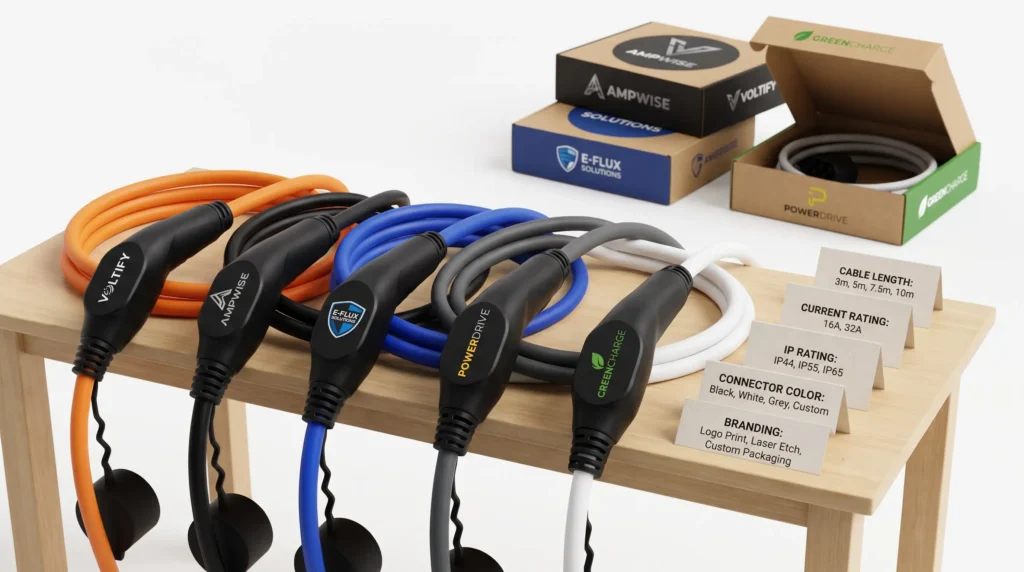
Before each use, check for damaged insulation, distorted housings, contamination, poor retention or heat damage. If anything is suspect, stop and follow the equipment instructions; use the charging accessory warning-sign checklist to document the issue.
What Documents Should a Cable Supplier Provide?
Request evidence for the exact cable configuration and destination market. A logo, factory management certificate or report for another model does not establish conformity of the assembly you are buying.
- A controlled datasheet and drawing identifying both ends, current, voltage, phase, length, materials and operating limits.
- The applicable declaration of conformity and supporting technical documents, with matching model identity and manufacturer details.
- Any claimed third-party certificate or report, including its scope, issuer, model list, issue date and status.
- Instructions covering connection, disconnection, storage, inspection and any installation or use restrictions.
- A sample approval record, batch identification and a process for notifying buyers of component or specification changes.
Is CE Marking the Same as a Third-Party Certificate?
No. CE marking concerns the manufacturer’s conformity responsibilities under applicable EU rules. It is not a certificate awarded by a central EU authority. Check the required assessment route and declaration; third-party involvement depends on the applicable rules. 3
Is UKCA the Only Route for Great Britain?
No. Current UK guidance continues to recognise CE marking alongside or in place of UKCA for covered product regimes. Confirm the rules for the specific product and market, and distinguish Great Britain from Northern Ireland. 4
For other destinations, have the importer or compliance specialist identify the product classification and applicable obligations. Do not replace that assessment with a blanket country-to-logo table.
How Should Distributors Specify Customisation and Orders?
Separate a standard cable, branding changes and an engineering change in the request for quotation. Each needs a defined specification, approval scope and delivery commitment.
| Order scope | Confirm before approval |
|---|---|
| Existing configuration | Model, ratings, length, documents, sample availability, packaging and quoted MOQ. |
| Logo or packaging | Approved artwork, warning text, language, traceability, setup costs and whether the change affects the technical file. |
| Length, material or connector change | Revised drawing, evidence scope, validation required, sample timing and production release conditions. |
| New design or tooling | Design ownership, tooling responsibility, development stages, applicable assessment and replacement-part plan. |
Terms such as OEM and ODM do not settle design ownership or conformity responsibilities. Write those responsibilities into the agreement. If the buyer sells a product under its own brand, EU guidance treats that buyer as the manufacturer for the relevant product obligations. 3
Ask for MOQ by configuration, separate sample and production lead times, and the event that starts the delivery clock. Confirm whether different lengths or packaging versions can share a quantity tier. Avoid promising customers a dispatch date before artwork, sample and required document approvals are complete.
A guia de compra de acessórios de carregamento de VE covers the wider supplier and sample-review workflow. For a Type 1/Type 2 enquiry, keep the configuration specific: station socket, vehicle inlet, market, current, voltage, length, handling environment, quantity and packaging.
Conclusion: Match Both Ends Before Ordering
Start with a Type 1 AC vehicle inlet and a compatible Type 2 station socket. Then match the cable’s current rating and reach to the vehicle and parking setup. Confirm the document scope and any customisation before approving a distributor order. For a configuration quotation, send Yirox the vehicle-side connector, station-side connection and required specifications.
Perguntas Frequentes
Um cabo Tipo 1 para Tipo 2 é o mesmo que um cabo J1772 para Mennekes?
Usually, those names describe the same connection: a J1772/Type 1 vehicle connector paired with a Type 2 station plug. However, “SAE J1772 to IEC 62196” is too broad to identify every connector detail, and retailers may reverse the Type 1/Type 2 wording. Check the connector drawing and the labelled car and station ends, rather than treating the name alone as proof of fit. The referenced mobile assembly identifies both interfaces explicitly. 1
Um cabo Tipo 1 para Tipo 2 pode suportar carregamento trifásico?
No. A single-phase Type 1/Type 2 assembly does not give a Type 1 vehicle three-phase charging capability. A 32 A cable at 230 V corresponds to about 7.36 kW before other limits; this is a calculation, not a guaranteed speed. A three-phase station’s total rating does not describe the current available to this single-phase connection. Confirm the vehicle’s onboard AC limit and the station’s single-phase output before comparing options.
Que certificações devo procurar num fornecedor de cabos Tipo 1 para Tipo 2?
Ask for the applicable conformity declaration, supporting reports and any claimed third-party certificates for the exact cable model and destination. CE marking is not a central EU-issued certificate, and third-party involvement depends on the relevant rules. 3 Great Britain continues to recognise CE under covered regimes; UKCA is not a blanket requirement for every UK sale. 4 For other markets, have the importer confirm the classification and obligations. A factory management certificate alone does not approve the cable.
Qual é o MOQ para cabos Tipo 1 para Tipo 2 no atacado?
MOQ should be confirmed in a written quotation for the exact configuration. Give the supplier the current rating, length, connector pair, quantity, branding and packaging requirements, then request separate minimums for standard stock, artwork changes and engineering changes. Also ask whether variants can share a quantity tier. Yirox’s confirmed MOQ and delivery terms belong in that quotation; do not treat a generic industry range as an agreed order condition.
Que opções de comprimento de cabo estão disponíveis para distribuidores?
Ask which lengths are available for the selected model and which require a revised specification. Measure the socket-to-inlet route for the vehicles and parking positions you serve, including a comfortable handling allowance. Confirm how the supplier measures assembly length and, for a coiled cable, its usable reach. List each length and rating clearly rather than assuming one catalogue option covers every version.
Qual é a diferença entre cabos Tipo 1 para Tipo 2 de 16A e 32A?
At 230 V single phase, the voltage/current calculations are about 3.68 kW for 16 A and 7.36 kW for 32 A. These describe the electrical capacity under those assumptions, not guaranteed power into the battery. A higher-rated cable does not upgrade a lower-powered onboard charger or station. Check the car’s supported AC current, station output and cable rating together. For distributors, base the range on verified customer setups rather than claiming that one rating is universally better.
How do I verify that a supplier’s certifications are genuine?
Obtain the full document and check the issuer, certificate or report number, model scope, ratings, issue date and current status. Verify any claimed third-party certificate through the issuer’s official service and compare it with the actual cable configuration. For CE, review the signed declaration and supporting technical file; there is no central EU authority awarding a CE certificate. NANDO identifies notified bodies and their authorised scope, not a registry of every CE-marked product. 3 A genuine document for a different model still does not establish evidence for your order.
Why is my 32A Type 1 to Type 2 cable charging slowly?
Check the vehicle’s onboard AC charging limit first, then the cable rating and the station’s configured or shared output. A 32 A cable does not cause a vehicle limited to a lower AC rate to draw 32 A. Vehicle charge settings, battery temperature and state of charge may also affect the session. 2 Record the actual kW or delivered energy over a known period; an estimated range increase alone can make comparisons misleading.
Referências
[1] Phoenix Contact. “EV-TAG3PK-1AC32A-5,0M6,0ESBK11: mobile Type 1/Type 2 AC charging cable.” Accessed October 12, 2026.
[2] Agência de Proteção Ambiental dos Estados Unidos. “Plug-in Electric Vehicle Charging: The Basics.” Accessed October 12, 2026.
[3] European Union, Your Europe. “CE marking.” Checked July 17, 2026; accessed October 12, 2026.
[4] UK Government. “Placing UKCA or CE marked products on the market in Great Britain.” Updated August 21, 2026; accessed October 12, 2026.







