


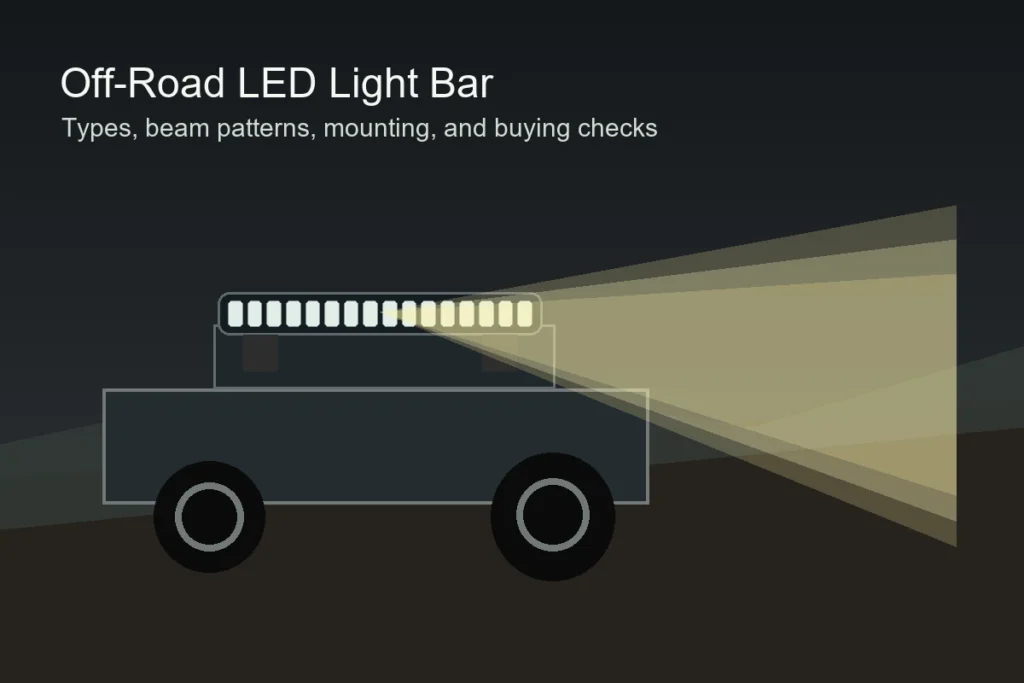
An off-road LED light bar is an auxiliary lamp with LEDs and optics arranged in an elongated housing. Choose it for the required beam coverage, mounting space, electrical supply, and exposure. Its length, row count, or lumen claim alone does not establish useful range, safe aiming, or permission for public-road use.
Para uma análise mais detalhada das alegações de saída, consulte como ler as classificações de lúmens LED e como lúmens, candela e lux ajudam a comparar um feixe off-road.
Isso importa porque as barras de luz são frequentemente vendidas por tamanho ou potência primeiro, enquanto o problema real do comprador é mais simples: qual a distância que a luz deve alcançar, qual a largura que deve espalhar, onde pode ser montada e se vai sobreviver a vibração, água, poeira e calor?
Specify the task before comparing products: forward reach, trail-side coverage, close work, or rear loading. Then compare beam data and the complete mounting and wiring kit under the same conditions.
Índice
- O que é uma barra de luz LED off-road?
- Quais tipos de barras de luz LED off-road estão disponíveis?
- Qual padrão de feixe uma barra de luz LED off-road deve ter?
- Onde você deve montar uma barra de luz LED off-road?
- Como tamanho, potência e lúmens afetam o desempenho real?
- Uma barra de luz LED off-road é legal em vias públicas?
- O que os compradores devem verificar antes de escolher uma barra de luz?
- Conclusão: Escolha o padrão de feixe antes do tamanho maior
- Perguntas Frequentes
- Referências
O que é uma barra de luz LED off-road?
Uma barra de luz LED off-road é uma lâmpada auxiliar estilo fileira projetada para adicionar iluminação frontal ou de área mais forte além dos faróis de fábrica. É comumente montada em um para-choque, grade, teto, quebra-mato, santantônio ou rack traseiro, dependendo se o motorista precisa de visibilidade de longa distância, espalhamento de trilha, iluminação de trabalho ou luz de ré.
O design básico é simples: os LEDs ficam atrás de refletores ou lentes dentro de uma carcaça de alumínio, geralmente com lente de policarbonato, tampas laterais, suportes de montagem e chicote elétrico. A carcaça ajuda a proteger a eletrônica e afastar o calor dos LEDs. A óptica molda o feixe em um padrão spot, flood, combo, driving ou scene.
Housing length, row count and curve affect packaging and mounting. Delivered output and coverage depend on the actual LEDs, drive conditions and optics, so compare the named configuration rather than treating a double row or curved housing as an automatic performance upgrade.
Para leitores comparando opções de produtos, uma categoria de barra de luz LED off-road é o lugar natural para olhar o lado do hardware depois que o básico estiver claro. A partir das verificações de amostras da Equipe Yirox, a comparação útil não é "qual barra é mais brilhante", mas qual barra se adapta ao veículo, necessidade de feixe, plano de fiação, promessa de embalagem e mercado de vendas.
Quais tipos de barras de luz LED off-road estão disponíveis?
As barras de luz LED off-road são geralmente agrupadas por formato, número de fileiras, comprimento, padrão de feixe e estilo de montagem. O tipo certo depende do veículo, terreno, velocidade de condução e se a luz é usada para condução em trilha, iluminação de trabalho, recuperação, camping ou visibilidade traseira.
| Tipo | O que significa | Melhor aplicação | Cuidado com |
|---|---|---|---|
| Barra de luz de fileira única | Uma fileira horizontal de LEDs | Montagem fina em grade ou para-choque | Compare measured complete-lamp output |
| Barra de luz de fileira dupla | Duas fileiras de LEDs em uma carcaça | A compact package for two rows; compare actual output | Verify dimensions, heat behavior and operating current |
| Barra de luz reta | Carcaça plana atravessando o veículo | Para-choques, grades, racks, configurações de trabalho | O espalhamento do feixe depende muito da óptica |
| Barra de luz curva | A carcaça segue um arco raso | Montagem no teto ou frontal larga | Pode criar ofuscamento no capô se montada mal |
| Mini barra de luz ou barra tipo pod | Barra compacta com menos de 12 polegadas | ATVs, UTVs, posições estilo neblina, espaços apertados | Range depends on the exact optic and measured beam |
| Barra de luz traseira ou de cena | Iluminação de trabalho de área ampla | Acampamentos, recuperação, carregamento, iluminação de ré | Não projetada para condução frontal em alta velocidade |
Compare single- and double-row designs by available mounting depth, aiming adjustment, measured output and actual operating load. Row count does not establish which complete lamp produces more useful light.
A curved housing changes the package and may change the direction of individual optics. Inspect the exact beam map rather than assuming a wider useful beam. Check driver-visible reflections from the proposed position before accepting the installation.
Mini barras e pods servem a um propósito diferente. Elas podem iluminar acostamentos escuros, iluminar um acampamento, apoiar condução lenta em trilha ou ajudar um veículo de trabalho a ver ao redor de equipamentos. Quando a Equipe Yirox ajuda clientes a pensar em uma linha de produtos, a faixa mais útil geralmente não é um SKU heroico superdimensionado; é uma mistura de barras, pods, chicotes, suportes e opções de interruptores para diferentes problemas de trabalho.
Qual padrão de feixe uma barra de luz LED off-road deve ter?
O padrão de feixe deve corresponder ao problema de condução: spot para distância, flood para largura, combo para uso misto em trilha e iluminação de cena para trabalho lento ao redor do veículo. O padrão de feixe é geralmente mais importante que números brutos de lúmens porque o brilho descontrolado pode criar ofuscamento em vez de visão utilizável.
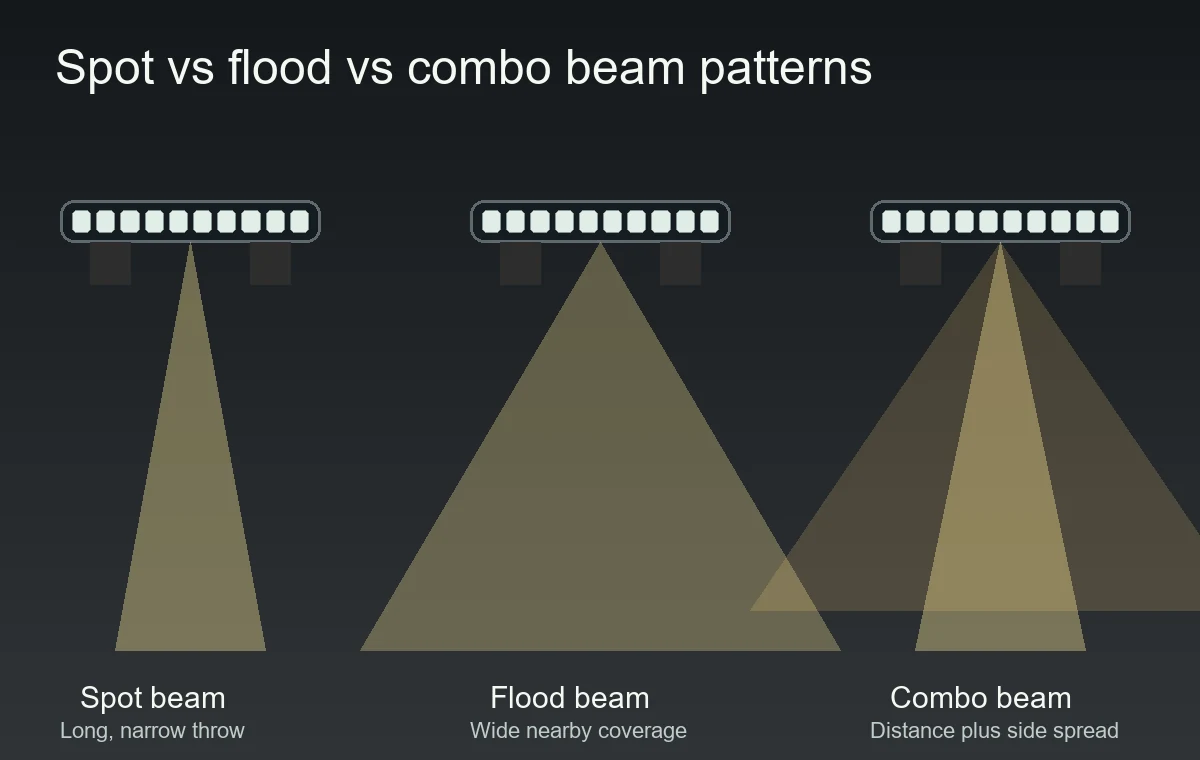
A feixe spot é estreito e longo. Ajuda os motoristas a ver mais longe em uma trilha, através de terreno aberto ou ao longo de pistas rurais onde a velocidade é maior. A desvantagem é que não ilumina tão bem os acostamentos.
A feixe flood espalha a luz de forma ampla e curta. É útil para trilhas lentas, áreas de trabalho, recuperação, carregamento e acampamentos. A desvantagem é a distância mais curta e mais brilho refletido se mal direcionado.
A feixe combo combina óptica de spot no centro com óptica de flood nas laterais. Esta é frequentemente a escolha mais prática para uma barra de luz off-road geral, porque oferece alcance frontal e preenchimento lateral em uma única unidade.
Driving, fog, and scene labels refer to different intended functions; they are not interchangeable just because the housing is a bar. For markets using UN approvals, road-illumination and light-signalling functions are covered by different requirements. Verify the applicable function and regulation series on the actual documentation.34
A pergunta do comprador deve ser: para onde vai a luz, e isso torna a condução mais fácil? Uma barra que lança um blob brilhante no primeiro plano pode parecer dramática numa foto de produto, mas demasiada luz de primeiro plano pode reduzir a visão noturna do condutor à distância. Em análises de amostras, isto é fácil de perder quando os compradores apenas verificam os lúmens.
Onde você deve montar uma barra de luz LED off-road?
Choose the mount from clearance, aiming, a secure bracket, unobstructed output and the driver’s view. Roof height does not by itself establish more range or coverage; compare the actual lamp and check hood reflection, wind noise and applicable installation rules.
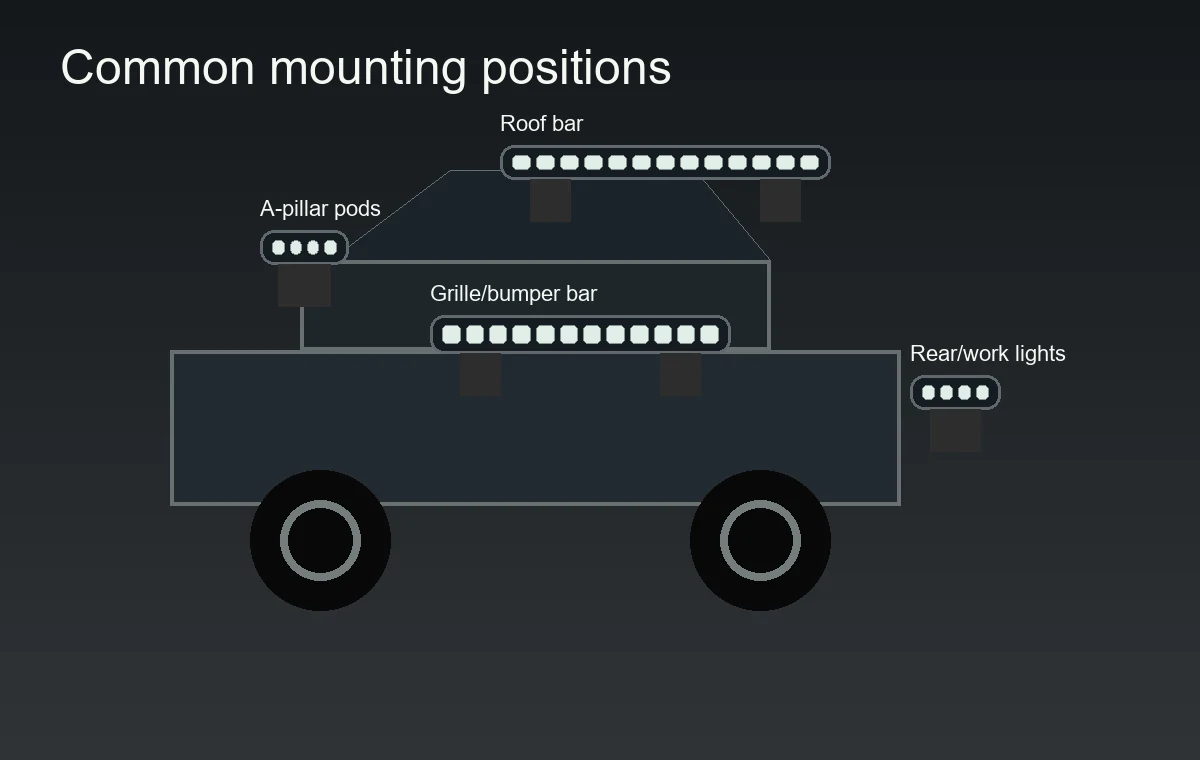
A barra de luz montada no para-choques é comum porque fica baixa, mantém a fiação relativamente curta e evita grande parte do reflexo no capô que acontece com luzes de teto. É útil para condução em trilhas, uso off-road geral e camiões com para-choques ou bull bars de pós-venda.
A barra de luz montada na grelha proporciona uma aparência mais limpa e é frequentemente protegida dentro da estrutura frontal. A limitação é o fluxo de ar, o espaço e o design do suporte. Os compradores devem verificar se a barra bloqueia o fluxo de ar de arrefecimento ou interfere com sensores.
A roof mount changes the source position and the potential for reflection, obstruction, wind noise, and restricted road use. It does not by itself establish a longer beam range. Check the same lamp from the proposed driver viewpoint for hood reflection and glare before approving that position.
A rear-mounted work light serves reversing, loading, or another defined work area. Keep its operation separate from forward-driving illumination and assess glare toward people behind the vehicle.
Uma boa montagem não é apenas sobre a localização. O suporte deve resistir à vibração, a fiação deve evitar partes quentes ou móveis, o interruptor deve ser fácil de identificar e o feixe deve ser direcionado após a instalação. A Equipa Yirox trata o suporte e o chicote como parte do produto porque um corpo de lâmpada forte ainda frustra os clientes se o suporte tremer, o fio for demasiado curto ou a etiqueta do interruptor for pouco clara. Uma barra de luz potente direcionada demasiado alto pode cegar outros condutores e reduzir a própria visibilidade do utilizador em poeira ou nevoeiro.
Como tamanho, potência e lúmens afetam o desempenho real?
Tamanho, potência e lúmens importam, mas não contam a história completa. O desempenho real depende do design óptico, controlo do feixe, eficiência dos LEDs, gestão de calor, estabilidade elétrica e quão honesta é a classificação do produto.
Uma barra de luz mais longa pode conter mais LEDs e espalhar luz por uma área mais ampla. Isso não significa automaticamente que seja a melhor escolha. Uma barra de teto de 50 polegadas pode parecer impressionante, mas uma barra de para-choques menor com melhor óptica pode dar mais luz de trilha utilizável e menos brilho.
A potência indica quanta energia elétrica a luz pode consumir, não exatamente quão útil será o feixe. Alta potência pode significar mais luz, mas também significa mais calor e mais exigência sobre o chicote, relé, fusível, interruptor e sistema elétrico do veículo.
Os lúmens são fáceis de comercializar e fáceis de mal-entender. Alguns anúncios mostram lúmens teóricos dos LEDs, enquanto outros mostram saída medida. Os lúmens teóricos podem ser muito mais altos do que a saída real após perdas ópticas e calor. Um fornecedor útil explica se o número é bruto, efetivo ou testado, protegendo os compradores de promessas exageradas.
A temperatura de cor também afeta a visibilidade. Luz muito fria pode parecer brilhante, mas pode criar reflexos agressivos em poeira, chuva, nevoeiro ou neve. Muitos utilizadores práticos de off-road preferem uma saída branca controlada em vez de perseguir o feixe mais azul possível. Coberturas âmbar ou barras âmbar podem ajudar em poeira ou mau tempo, embora não sejam uma cura para má mira.
Which output data can you actually compare?
Compare the same optic, operating mode, and test conditions. A published product table can separate measured lumens, raw LED lumens, peak candela, and lux at a stated distance; these answer different questions.5
| Claim or record | O que solicitar |
|---|---|
| Lúmens | Measured complete-lamp output or raw LED total; identify the method and mode |
| Distance or spot performance | Beam intensity and illuminance at a stated distance, with aiming and threshold explained |
| Coverage | A beam map or comparable photographs showing the useful width and foreground |
| Electrical load | Supply voltage and steady operating current for the named mode |
| Warm operation | Measurement timing and whether output changes as the lamp heats |
| Installation result | The intended height, driver viewpoint, bracket adjustment, and reflections |
Do not rank two lamps from photographs with different camera exposure, or compare one lamp’s raw output with another’s measured output. Record the product code, optic, mode, and conditions with any acceptance decision.
Uma barra de luz LED off-road é legal em vias públicas?
Uma barra de luz LED off-road frequentemente não é legal de usar em vias públicas, a menos que cumpra a função de lâmpada relevante, montagem, mira e regras locais de veículos. Os compradores devem tratar muitas barras de luz como equipamento off-road ou auxiliar, não como substituto legal de faróis, luzes de neblina ou luzes de condução aprovadas.
In the United States, NHTSA’s supplemental-lighting interpretation discusses whether additional equipment impairs required lighting. Commercial-vehicle requirements in 49 CFR 393.24 have a specific scope; they are not a universal rule for every passenger-car installation.12 Confirm the applicable vehicle and local installation rules before making a road-use claim.
Para redação prática de produtos, isto significa que os vendedores devem ter cuidado com alegações como "street legal" ou "DOT approved". Uma barra de luz pode ser excelente para uso off-road, mas ainda não aprovada para uso como farol de estrada. Se um produto se destina a uso auxiliar na estrada, o fornecedor deve fornecer a norma relevante, marcação, função do feixe e documentação de mercado.
A regra diária segura é simples: use barras de luz off-road apenas onde são permitidas, reduza ou desligue-as perto de outros usuários da via e cubra-as se a lei local exigir. A conformidade com vias públicas deve ser verificada no mercado-alvo antes que embalagens, textos de catálogo ou alegações publicitárias sejam finalizados.
O que os compradores devem verificar antes de escolher uma barra de luz?
Os compradores devem verificar o padrão do feixe, tamanho, qualidade da carcaça, classificação IP, controle de calor, chicote elétrico, suportes, faixa de tensão, certificações, embalagem e consistência de lote. Uma boa barra de luz LED off-road é um produto elétrico e óptico, não apenas um tubo de alumínio brilhante.
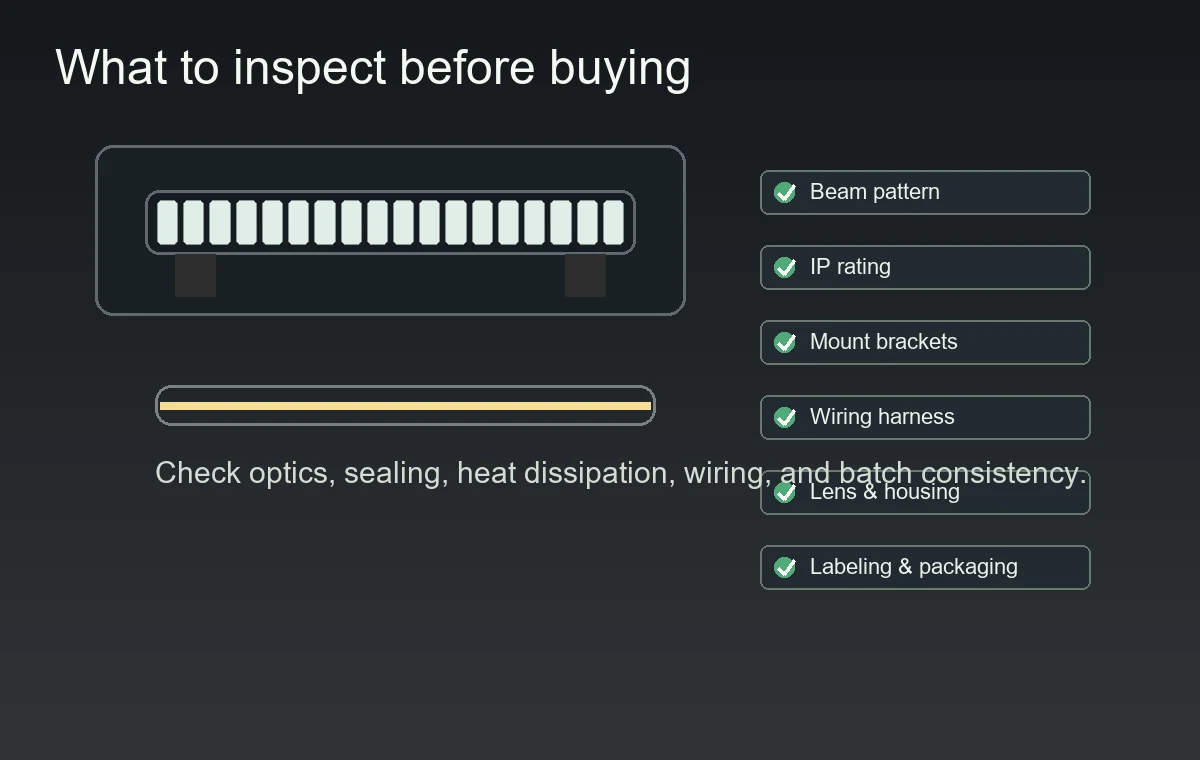
Comece pelo feixe. Pergunte se a barra é spot, flood, combo, driving, estilo neblina ou iluminação de cena. Depois pergunte onde o feixe é útil: distância, preenchimento lateral, trabalho próximo, visibilidade traseira ou iluminação ampla de acampamento.
Em seguida, verifique a construção. Carcaças de alumínio, lentes de policarbonato, suportes de aço inoxidável ou revestidos, conectores vedados e roteamento limpo de cabos são todos importantes porque as luzes off-road enfrentam vibração, água, lama, lavagem com pressão, calor e impactos de detritos. O guia relacionado sobre classificação IP para luzes LED automotivas explica por que IP67, IP68 ou IP69K devem ser combinados com a exposição real em vez de tratados como uma simples escala de bom-melhor-ótimo.
O chicote elétrico merece atenção especial. Um chicote adequado deve corresponder ao consumo de corrente e incluir bitola de fio adequada, relé, fusível, interruptor, conectores e instruções. Fiação ruim pode tornar uma boa luz não confiável e pode criar riscos reais de segurança.
Para compradores de produtos e programas de marca, a lista de verificação deve proteger o usuário final em primeiro lugar. Nas verificações de amostras da equipe Yirox, o risco comum é um grupo de pequenas incompatibilidades: redação pouco clara do feixe, suportes fracos, fiação curta, cor de LED inconsistente ou embalagem que promete mais do que o produto pode entregar com segurança.
Verificar:
- Documentação do feixe: nomes dos padrões de feixe, diagramas e fotos de uso realistas.
- Classificação elétrica: faixa de tensão, potência, consumo de corrente, recomendação de fusível e especificação do chicote.
- Carcaça e lente: corpo de alumínio, clareza da lente, método de vedação e resistência à corrosão.
- Design térmico: formato do dissipador de calor, saída estável e temperatura operacional realista.
- Kit de montagem: resistência do suporte, acabamento do hardware, faixa de ajuste e resistência à vibração.
- Documentação de mercado: rotulagem, idioma do manual, texto de aviso, alegações de conformidade e precisão da embalagem.
- Consistência de lote: cor de LED repetível, óptica, impermeabilização, comprimento do cabo e conteúdo do pacote de acessórios.
Conclusão: Escolha o padrão de feixe antes do tamanho maior
Uma barra de luz LED off-road adiciona visibilidade auxiliar para trilhas, canteiros de obras, recuperação, camping e veículos utilitários, mas a melhor escolha nem sempre é a maior ou a opção com mais lúmens. Uma maneira mais útil de escolher é começar pelo problema real do motorista: ver mais longe, ver mais amplo, trabalhar ao redor do veículo ou reduzir reclamações em uma linha de produtos.
Choose the required distance and coverage, then verify the actual optic and mounting result. A spot, flood or combo label is a starting point for comparison, while measured beam data and the driver viewpoint establish suitability. Check roof or bumper positions for reflections and clearance rather than assuming one height provides greater range.
Antes de escolher uma linha de produtos, os compradores devem definir o veículo-alvo, o caso de uso, o padrão de feixe, o tamanho, o chicote elétrico, o conjunto de suportes, a embalagem e o texto de conformidade. O conselho prático da Equipe Yirox é escolher o produto que ainda fará sentido após a instalação, após a primeira trilha na chuva e depois que os clientes lerem o rótulo. Se o próximo passo for comparar modelos para uma linha de varejo ou de marca, a categoria de barra de luz LED é o lugar mais relevante para continuar.
Perguntas Frequentes
Qual é o melhor padrão de feixe para uma barra de luz LED off-road?
Um feixe combo geralmente é a melhor escolha para uso geral porque oferece distância central e dispersão lateral. Um feixe spot é melhor para trilhas longas e abertas, enquanto um feixe flood é melhor para trilhas lentas, áreas de trabalho e visibilidade de curto alcance.
Uma barra de luz LED curva é melhor que uma barra de luz reta?
Not automatically. The housing curve does not establish the delivered beam pattern or range. Compare the exact optics, measured beam data, aiming clearance, and reflection from the proposed mounting position. A straight or curved bar can suit the job when that complete configuration meets the intended coverage.
Posso usar uma barra de luz LED off-road na rodovia?
Muitas barras de luz LED off-road não são legais para uso em rodovias, a menos que atendam às regras relevantes de iluminação naquele mercado. Em muitos lugares, elas devem ser desligadas ou cobertas em vias públicas, especialmente perto de outros veículos.
Qual é o melhor lugar para montar uma barra de luz em uma caminhonete?
Choose a position with adequate space, aiming adjustment, secure mounting, and a clear beam without obstructing sensors or cooling. Bumper or grille positions can reduce some hood reflection, while a roof position can introduce it. Mounting height alone does not guarantee greater reach, so inspect the actual driver view before deciding.
Lúmens ou watts são mais importantes para uma barra de luz?
Nenhum dos números é suficiente por si só. Lúmens descrevem a saída de luz e watts descrevem o consumo de energia, mas controle de feixe, óptica, gerenciamento de calor e testes honestos determinam quanta luz útil chega à trilha.
Qual tamanho de barra de luz LED off-road devo escolher?
Escolha o tamanho depois de decidir o local de montagem e o objetivo do feixe. Uma barra de para-choque de 20 polegadas pode ser melhor para muitas caminhonetes do que uma barra de teto grande, se oferecer o feixe certo sem ofuscamento ou instalação complicada.
Barras de luz LED off-road precisam de relé?
Muitas barras de luz de maior potência devem ser ligadas com um relé, fusível e chicote adequado dimensionado para o consumo de corrente. Sempre siga as instruções do produto e evite conectar uma luz de alta corrente diretamente através de um interruptor ou fio subdimensionado.
O que os distribuidores devem verificar antes de encomendar barras de luz em massa?
Os distribuidores devem verificar consistência de feixe, qualidade da carcaça, impermeabilização, suportes, conteúdo do chicote elétrico, rótulos, manuais, embalagem, alegações de conformidade e consistência entre amostra e lote. O produto deve ser testado como um kit completo, não apenas como um corpo de lâmpada.
Referências
[1] NHTSA. “FMVSS No. 108 interpretation: supplemental lighting and impairment.”
[2] eCFR. “49 CFR 393.24: commercial-vehicle headlamps and auxiliary lamps.”
[3] UNECE / EUR-Lex. “UN Regulation No. 149: road illumination devices.”
[4] UNECE / EUR-Lex. “UN Regulation No. 148: light-signalling devices.”
[5] Diode Dynamics. “SS3 Yellow Max LED Pod: optic-specific photometric data.”