





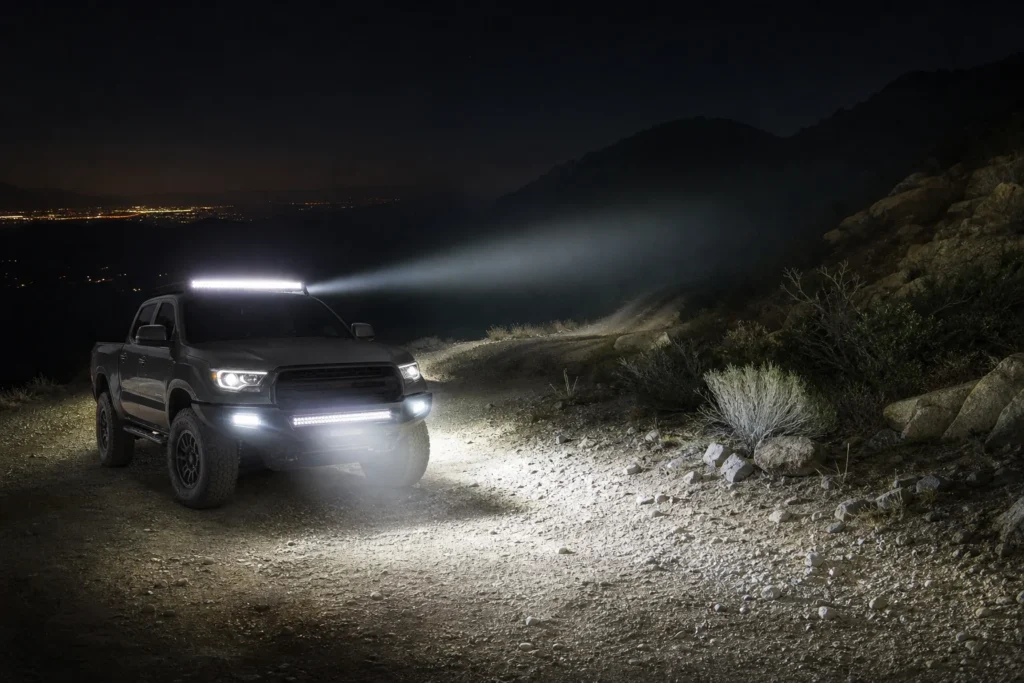
Barras de luz LED spot, flood e combo diferem na forma como moldam a luz: um feixe spot alcança muito à frente, um feixe flood se espalha amplamente a curta distância, e um feixe combo combina ambos em uma única carcaça. A melhor escolha não é o anúncio mais brilhante; é o padrão que coloca luz utilizável onde o motorista realmente precisa.
Essa diferença importa porque muitas barras de luz parecem semelhantes em uma foto de produto. Duas barras podem ter o mesmo comprimento, potência e reivindicação de lúmens, mas uma pode iluminar uma trilha enquanto a outra apenas ilumina os acostamentos e o primeiro plano.
Para motoristas off-road, instaladores, varejistas e compradores de acessórios, o padrão de feixe é uma das primeiras decisões a tomar. Escolha o errado e o resultado pode ser ofuscamento, cantos escuros, saída desperdiçada ou clientes decepcionados.
Índice
- Qual é a diferença entre barras de luz LED spot, flood e combo?
- Quando você deve escolher uma barra de luz LED com feixe spot?
- Quando uma barra de luz LED com feixe flood faz mais sentido?
- Uma barra de luz LED combo é a melhor escolha para a maioria dos motoristas?
- Como você escolhe o padrão de feixe certo para o seu veículo?
- A posição de montagem muda qual padrão de feixe funciona melhor?
- O que os compradores devem verificar além de spot, flood ou combo?
- Conclusão: Combine o feixe com a tarefa antes de buscar mais lúmens
- Perguntas Frequentes
- Referências
Qual é a diferença entre barras de luz LED spot, flood e combo?
Uma barra de luz LED spot é feita para distância, uma barra de luz LED flood é feita para largura, e uma barra de luz LED combo usa ambos os estilos de feixe para cobrir áreas próximas e distantes juntas. A diferença vem da óptica na frente ou ao redor dos LEDs, não simplesmente do número de LEDs na barra.
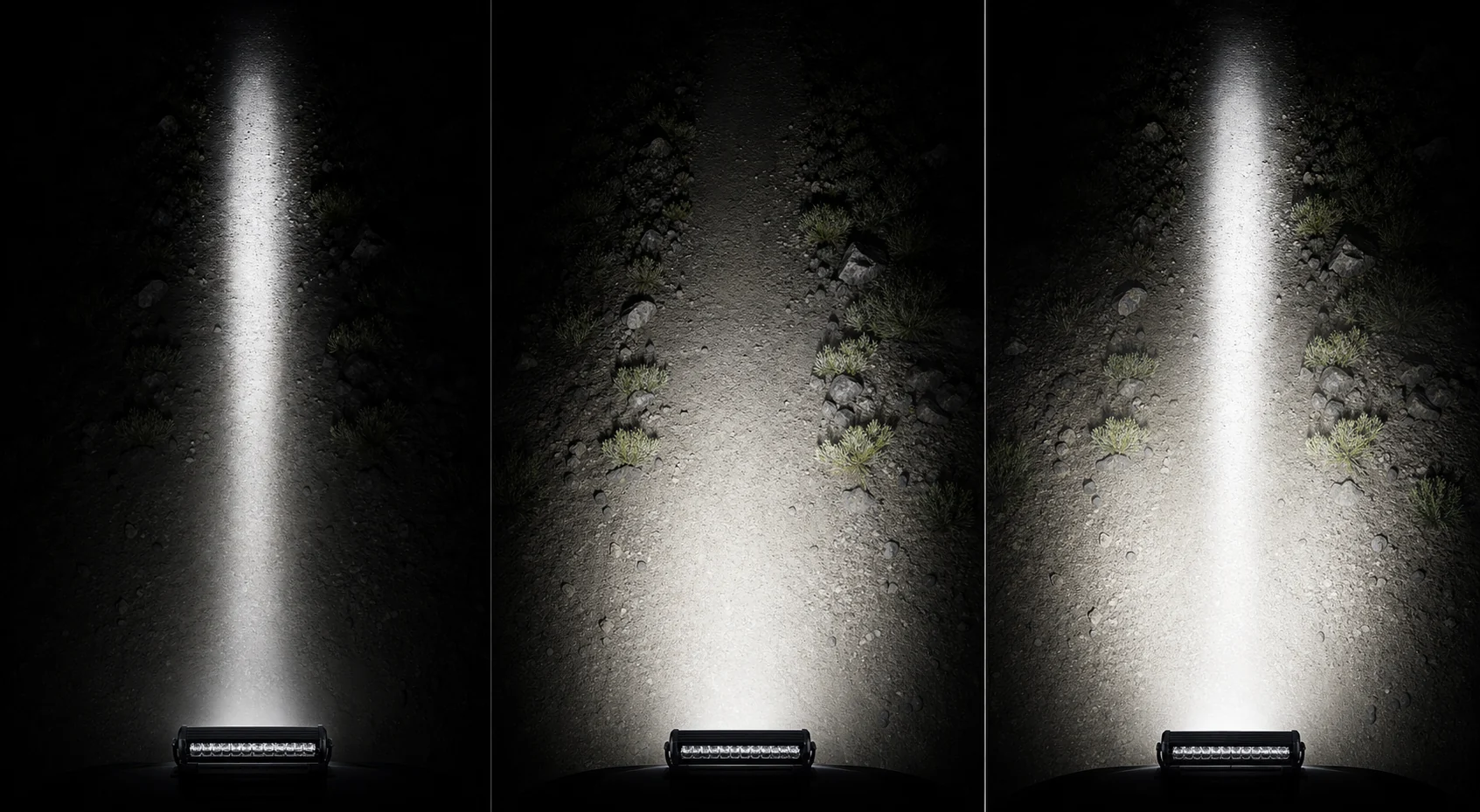
Em uma feixe spot, refletores ou lentes concentram a luz em um cone frontal mais estreito. Isso cria maior intensidade no centro da trilha, mas as laterais podem permanecer mais escuras a menos que o veículo também tenha luzes de vala, pods ou um feixe secundário mais amplo.
Em uma feixe flood, a óptica espalha a luz por uma área mais ampla. Isso é útil para condução técnica lenta, locais de trabalho, iluminação de ré, acampamentos, áreas de carregamento e bordas de trilha. Como a mesma saída é espalhada por um ângulo maior, o feixe geralmente não alcança tão longe quanto um feixe spot com potência similar.
A feixe combo mistura ópticas spot e flood em uma barra. Muitas barras combo colocam ópticas spot perto do centro e ópticas flood perto das seções externas. Isso dá ao motorista algum alcance frontal mais espalhamento lateral, razão pela qual barras de luz combo são comuns em caminhões, Jeeps, ATVs, UTVs, veículos agrícolas e construções off-road em geral.
| Padrão de feixe | Função principal | Força típica | Principal trade-off | Melhor uso |
|---|---|---|---|---|
| À vista | Visibilidade frontal de longa distância | Alcance maior e intensidade central mais forte | Cobertura lateral mais estreita | Trilhas rápidas, terreno aberto, estradas rurais, aproximações longas |
| Inundação | Visibilidade ampla de curta distância | Melhor cobertura de acostamento, área de trabalho e campo próximo | Alcance mais curto e mais ofuscamento em primeiro plano se mal direcionado | Trilhas lentas, recuperação, luzes de trabalho, camping, iluminação de ré |
| Combo | Cobertura mista equilibrada | Uma barra cobre tanto a distância central quanto o espalhamento lateral | A qualidade varia conforme o layout óptico e a proporção spot/flood | Condução off-road geral, configurações de barra única, terreno misto |
É também por isso que os números de lúmens podem ser enganosos. Lúmens descrevem a saída total de luz, mas não explicam onde a luz incide. Uma barra flood de alto lúmen pode parecer extremamente brilhante na frente do para-choque, mas falhar em mostrar perigos muito à frente. Uma barra spot de menor lúmen com melhor óptica pode parecer mais eficaz em velocidade porque sua luz é concentrada onde o motorista precisa de tempo de reação.
Regulamentações e uso em vias também importam. Nos Estados Unidos, as regras para veículos motorizados comerciais dizem que faróis auxiliares de condução e faróis de neblina dianteiros podem ser usados apenas em conjunto com os faróis exigidos, não como substitutos 1. A NHTSA também discutiu como a iluminação suplementar não deve prejudicar o equipamento de iluminação exigido 2, então barras off-road devem ser selecionadas, conectadas e direcionadas com controle de ofuscamento em mente.
Quando você deve escolher uma barra de luz LED com feixe spot?
Escolha uma barra de luz LED com feixe spot quando o principal problema é ver mais longe à frente, especialmente em trilhas abertas, propriedades rurais, pistas no deserto, seções off-road de alta velocidade ou aproximações longas e retas. Um feixe spot é sobre alcance, tempo de reação e visibilidade da linha central.
Feixes spot são úteis quando o motorista precisa identificar depressões, rochas, erosões, portões ou direção da trilha antes de alcançá-los. O melhor feixe spot é controlado, não apenas intenso; boa óptica mantém o feixe mais limpo e previsível, o que reduz a fadiga visual durante longas conduções noturnas.
Feixes spot funcionam especialmente bem nestas situações:
- Terreno aberto: Desertos, trilhas largas, fazendas, estradas de rancho e rotas de serviço rural se beneficiam de maior alcance.
- Velocidades mais altas: Quanto mais rápido o veículo se move, mais distância o motorista precisa ver.
- Montagem no para-choque ou grade: Uma montagem frontal mais baixa pode reduzir o ofuscamento no capô em comparação com uma barra alta no teto.
- Sistemas de iluminação emparelhados: Barras spot combinam bem com pods flood, luzes de vala ou lâmpadas estilo neblina que preenchem o campo próximo.
The weakness is side visibility. A pure spot bar can make the center of the trail bright while leaving corners, ruts, and tree lines less visible. Spot beams can also be uncomfortable around reflective signs, dust, fog, snow, or traffic, so public-road buyers should look for lamps designed and marked for the intended legal function instead of assuming any off-road spot bar is street-ready 3.
Quando uma barra de luz LED com feixe flood faz mais sentido?
A flood beam LED light bar makes more sense when the driver needs broad close-range visibility instead of long-distance throw. It is the better pattern for slow trails, work lighting, reverse lighting, recovery, loading, camping, and any situation where seeing the edges matters more than seeing far down the road.
Flood beams are helpful because off-road problems are often close to the vehicle: a rock beside the tire, a rut near the shoulder, a hitch during trailer hookup, or tools at a night work site. The wide spread is also useful for ATVs, UTVs, farm vehicles, and service trucks that move slowly around dark areas.
Flood beams are usually a poor choice for fast driving as the only forward light. Because the light spreads wide, intensity drops more quickly with distance. The foreground may look bright while the far trail remains underlit. That bright foreground can even make the driver's pupils adapt to nearby light, making distant hazards harder to see.
Fog, dust, rain, and snow need extra care. A wide beam mounted high can reflect light back into the driver's eyes. This is why a real fog lamp pattern is not the same thing as any flood light. Front fog lamps have their own performance expectations and aiming requirements under standards such as SAE J583 4, while many off-road flood bars are designed for trail or work use rather than public-road fog use.
For buyers, the practical rule is simple: choose flood when the job is width, area, and low-speed control. Do not choose flood just because the product photo looks bright against a wall; trail usefulness depends on where the beam lands after installation.
Uma barra de luz LED combo é a melhor escolha para a maioria dos motoristas?
A combo LED light bar is often the best single-bar choice for mixed off-road use because it gives some distance and some side coverage in one product. It is not automatically the best choice for every vehicle, but it is the most forgiving option when the driver wants one bar for several conditions.
Most combo bars combine center spot optics with outer flood optics. The important detail is the spot-to-flood balance: some combo bars lean toward faster open terrain, while others lean wider for slower crawling and tighter trails.
Combo bars are strongest when the buyer wants:
- One main front light bar: A combo beam gives a more complete view than a pure spot or pure flood bar in many one-bar setups.
- Mixed trail speeds: Drivers moving between open tracks and slower technical sections benefit from balanced coverage.
- Simpler inventory: Retailers and distributors can offer combo bars as a practical default while still carrying spot and flood options for specialized builds.
- Cleaner installations: One bar may be easier to mount and wire than separate spot and flood lamps.
The downside is compromise. A combo bar will not throw as far as a dedicated spot bar of similar quality, and it will not spread as evenly as a dedicated flood or scene light. During Yirox Team sample evaluation, the useful question is not whether the label says spot, flood, or combo; it is whether the beam is repeatable, aimable, and matched to the promised use case.
Como você escolhe o padrão de feixe certo para o seu veículo?
Choose the beam pattern by starting with speed, terrain, mounting position, and the lighting already on the vehicle. Once those are clear, size and lumen output become easier to judge.
For fast open trails, a spot or spot-heavy combo usually makes the most sense. The driver needs more forward throw and less wasted foreground brightness. For tight wooded trails, rocky crawling, recovery work, and campsites, flood or flood-heavy combo lighting may be more useful. For most general trucks and SUVs with only one added front bar, a balanced combo beam is usually the safest first choice.
Use this practical selection table before comparing wattage:
| Driving or work situation | Better beam choice | Por que se encaixa |
|---|---|---|
| Fast open trail or desert route | Spot or spot-heavy combo | More distance gives more reaction time |
| Mixed trail driving | Combo | Covers center distance and side terrain together |
| Slow rock crawling | Flood or flood-heavy combo | Side visibility and close obstacles matter more |
| Campsite, work site, loading area | Inundação | Wide area lighting is more useful than throw |
| Rear reverse or trailer hookup light | Inundação | The task happens close to the vehicle |
| One light bar for a retail-friendly truck build | Combo | Easier to recommend for broad use cases |
If the next step is comparing actual hardware, the related gama de produtos de barras de luz LED off-road is the natural place to look at sizes, housings, and accessory configurations after the beam-pattern decision is clear.
Vehicle type also matters. A roof-mounted 50-inch combo bar can look impressive, but a smaller bumper-mounted bar plus side floods may give more usable visibility with less glare. Electrical capacity should be checked too: harness quality, relay rating, fuse protection, wire routing, waterproof connectors, and charging-system capacity all affect long-term reliability.
A posição de montagem muda qual padrão de feixe funciona melhor?
Mounting position changes beam performance because the same light behaves differently on a bumper, grille, roof rack, A-pillar, rear rack, or work bracket. The higher and wider the mount, the more carefully the buyer must think about glare, aim, shadows, and reflected light.
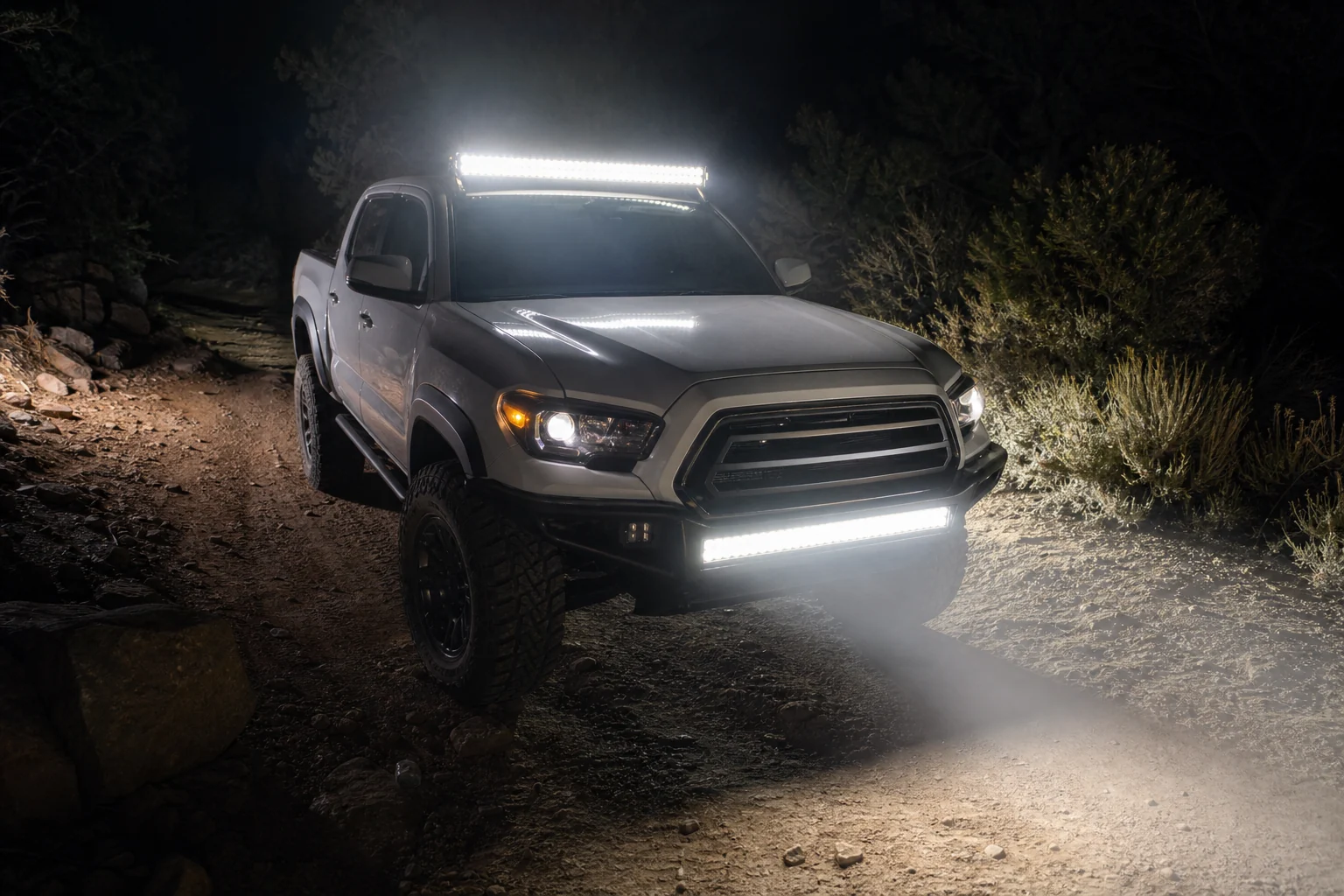
Bumper and grille mounts are popular for forward driving because they keep the light lower and closer to the factory headlamp axis. This can reduce hood glare and make a spot or combo bar easier to aim.
Roof mounts can provide a wide view and help light beyond dips or obstacles, but they can also reflect off the hood, dust, rain, snow, or windshield edge. A flood-heavy roof bar may look spectacular from outside the vehicle and frustrating from the driver's seat. If a roof bar is used, aiming and beam control become especially important.
A-pillar or ditch lights are often used to fill the side zones that a spot bar misses, while rear mounts usually favor flood patterns for reverse, loading, and work lighting. Both need careful aiming so the useful light does not become distracting spill.
Mounting security is more than convenience. Regulations for commercial motor vehicles require auxiliary driving lamps and front fog lamps to be mounted so the beams are aimable and the mounting prevents aim from being disturbed while the vehicle operates on public roads 1. Even outside commercial use, that principle is practical: a loose bracket can turn a well-designed beam into uncontrolled glare.
O que os compradores devem verificar além de spot, flood ou combo?
Buyers should check optic quality, housing durability, sealing, heat control, wiring, brackets, packaging, and batch consistency before trusting any beam-pattern claim. Beam labels are useful only when the product can deliver that pattern repeatedly.
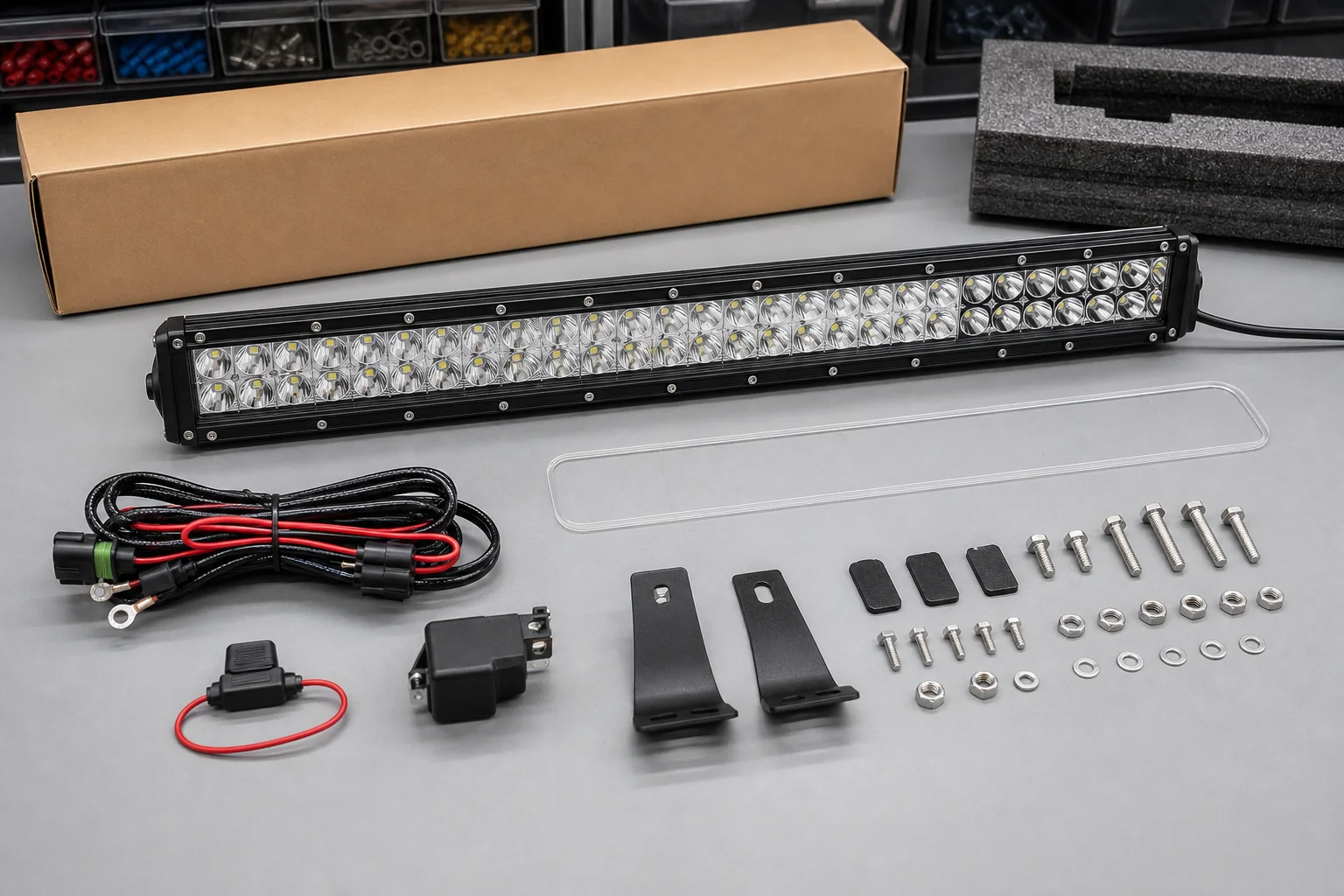
Optics come first. Reflector depth, lens shape, LED placement, and surface finish all affect the beam. A bar with fewer LEDs and better optical control may outperform a brighter bar that scatters light into glare.
Sealing is next. Off-road lights face water, mud, dust, pressure washing, temperature swings, and vibration. Buyers should look at IP ratings, lens sealing, breather design, connector quality, and whether the housing can manage heat without cooking the LEDs or driver circuit. Heat control matters because LED output and lifespan suffer when thermal design is weak.
The harness and bracket system deserve the same attention as the bar itself. Thin wiring, weak hardware, vague instructions, or poor packaging can create returns even if the lamp looks good in a test photo.
This is where Yirox Team product evaluation is practical rather than decorative. Sample checks should include beam appearance, bracket fit, connector quality, label consistency, carton protection, and whether the delivered batch matches the approved sample. Buyers building a broader accessory line can also review related branded automotive and NEV accessories to plan packaging, branding, and fitment expectations customers will actually see.
For public-road use, do not assume an off-road light bar is legal just because it is bright or professionally packaged. Many auxiliary lamps are intended for off-road use only, and responsible off-highway use includes respecting trail rules, other drivers, nearby communities, and land-management guidance 5.
The final check is customer honesty. Spot is not flood, flood is not fog, and combo is not magic. Clear beam descriptions reduce wrong purchases, installation complaints, and unsafe use.
Conclusão: Combine o feixe com a tarefa antes de buscar mais lúmens
Spot, flood, and combo LED light bars are different tools. A spot beam reaches farther down the trail, a flood beam spreads light across nearby areas, and a combo beam gives a balanced mix for drivers who want one main auxiliary bar. The best choice depends on terrain, speed, mounting position, wiring, and whether the vehicle needs distance, width, or both.
For most general off-road builds, a quality combo bar is a sensible starting point. For faster open routes, a dedicated spot or spot-heavy setup can give better reaction distance. For slow trails, recovery, reverse lighting, and work areas, flood lighting is often more useful than raw forward throw.
The smartest buyers look past the label. They check beam control, glare, bracket stability, sealing, heat management, wiring, packaging, and batch consistency. That is especially important for retailers, installers, and distributors because a light bar does not succeed in a catalog; it succeeds after it is mounted, aimed, wired, used, washed, and used again.
Perguntas Frequentes
Which is better, spot or flood LED light bar?
Neither is better for every job. A spot LED light bar is better for long-distance forward visibility, while a flood LED light bar is better for wide close-range lighting around trails, worksites, campsites, or reverse areas.
Is a combo beam LED light bar good for off-roading?
Yes, a combo beam LED light bar is a good choice for many off-road vehicles because it combines forward reach with side spread. It is especially useful when the driver wants one main light bar for mixed terrain instead of separate spot and flood lights.
Can I use a flood light bar as a fog light?
You should not assume a flood light bar is a legal or effective fog light. A real fog lamp pattern is designed and aimed differently, while many flood light bars are meant for off-road, work, or scene lighting.
Why does my LED light bar look bright but not shine far?
It may have a wide flood pattern, weak optics, poor aiming, or inflated lumen claims. Bright foreground light can look impressive near the vehicle while still failing to project enough useful intensity farther down the trail.
Where should a combo LED light bar be mounted?
A combo LED light bar is commonly mounted on the bumper, grille, bull bar, or roof rack. Bumper and grille mounts usually reduce hood glare, while roof mounts need more careful aiming because they can reflect light from the hood, dust, rain, or snow.
Do more lumens mean a better LED light bar?
No. Lumens describe total light output, but beam pattern and optic control decide how much of that light becomes useful visibility. A lower-lumen bar with better optics can outperform a brighter bar that scatters light into glare.
What beam pattern should I choose if I only install one light bar?
For one front light bar, a good combo beam is usually the most practical choice. It gives more balanced coverage than a pure spot or pure flood beam, especially for drivers who use the same vehicle across different trails and speeds.
Referências
[1] U.S. Electronic Code of Federal Regulations. (2026). *[49 CFR 393.24 Requirements for head lamps, auxiliary driving lamps and front fog lamps](https://www.ecfr.gov/current/title-49/section-393.24)*.
[2] National Highway Traffic Safety Administration. (2019). *[FMVSS No. 108 interpretation on supplemental beam auxiliary lighting](https://www.nhtsa.gov/interpretations/571108-supplement-beam-boykin-16-0884)*.
[3] SAE International. (2020). *[SAE J581: Auxiliary Upper Beam Lamps](https://www.sae.org/standards/content/j581_202009/)*.
[4] SAE International. (2020). *[SAE J583: Front Fog Lamp](https://www.sae.org/standards/content/j583_202009/)*.
[5] U.S. Forest Service. (2026). *[Responsible Off-Highway Vehicle Use](https://www.fs.usda.gov/visit/know-before-you-go/off-highway-vehicle-use)*.







