





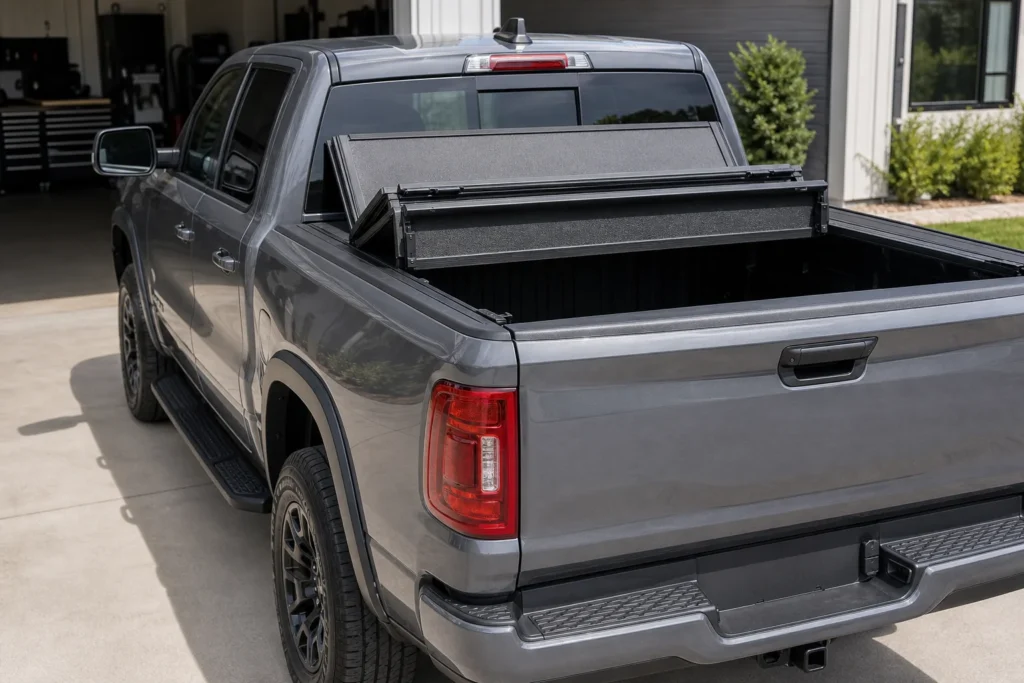
Uma capota tonneau tri-fold é uma capota de caçamba de picape dividida em três painéis conectados. Os painéis dobram em direção à cabine a partir da tampa traseira, para que o motorista possa abrir parte da caçamba sem remover a capota inteira.
A decisão importante não é simplesmente se uma capota tem três painéis. Os compradores também precisam adequar a capota à caçamba da picape, à carga, à exposição climática, às necessidades de acesso e à configuração de instalação. Uma tri-fold macia geralmente prioriza menor peso e custo; uma tri-fold rígida geralmente prioriza rigidez e maior dissuasão contra furtos de carga.
Índice
- O que é uma capota tonneau tri-fold?
- Como funciona uma capota tonneau tri-fold?
- Quais tipos de capotas tonneau tri-fold estão disponíveis?
- Como uma tri-fold se compara com outros estilos de capota?
- Quais são os prós e contras de uma capota tonneau tri-fold?
- Quais são os melhores usos para uma capota tonneau tri-fold?
- O que os compradores devem verificar antes de escolher uma capota tri-fold?
- Como é uma verificação prática de encaixe de uma tri-fold?
- Conclusão: As capotas tri-fold são o meio-termo prático
- Perguntas Frequentes
- Referências
O que é uma capota tonneau tri-fold?
Uma capota tonneau tri-fold é uma capota dobrável de caçamba de picape feita de três seções conectadas. Dobradiças ou juntas flexíveis permitem que as seções se dobrem uma sobre as outras, enquanto trilhos, braçadeiras, vedações e travas mantêm a capota na posição sobre a caçamba da picape.
“Tri-fold” descreve a geometria de abertura, não o material. Versões macias comumente usam tecido revestido de vinil sobre uma estrutura leve. Versões rígidas usam alumínio, compósito ou painéis reforçados. Montagem superior, perfil baixo e compatibilidade com caixa de ferramentas são escolhas de encaixe ou configuração que devem ser verificadas separadamente.
Se o comprador está comparando todos os estilos de capota, o guia completo de capotas tonneau é o ponto de partida certo. Ele separa a construção do material dos mecanismos de abertura, como enrolar, dobrar, retrátil e designs com dobradiças.
A guia de materiais de capota tonneau aborda vinil, alumínio, fibra de vidro, vedações e construção de painéis com mais profundidade. Esta página deve permanecer focada em como o sistema de três painéis afeta o acesso, o encaixe e a decisão de compra.
Como funciona uma capota tonneau tri-fold?
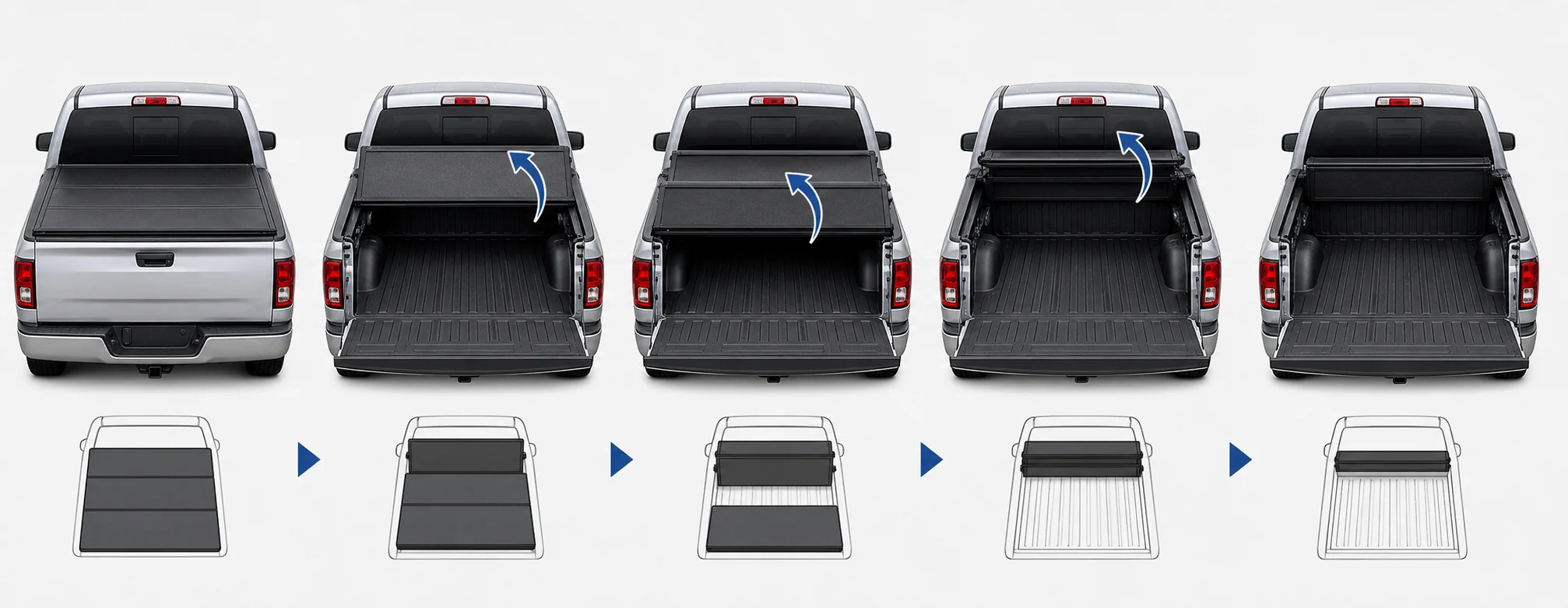
Uma capota tri-fold típica abre da tampa traseira em direção à cabine. A operação exata varia por modelo, mas a sequência geralmente é:
- Abra a tampa traseira e solte as travas ou braçadeiras traseiras.
- Dobre o painel da extremidade da tampa traseira sobre o painel do meio.
- Dobre os painéis conectados em direção à cabine para maior acesso à caçamba.
- Prenda a pilha dobrada com as correias ou ferragens de suporte fornecidas antes de dirigir.
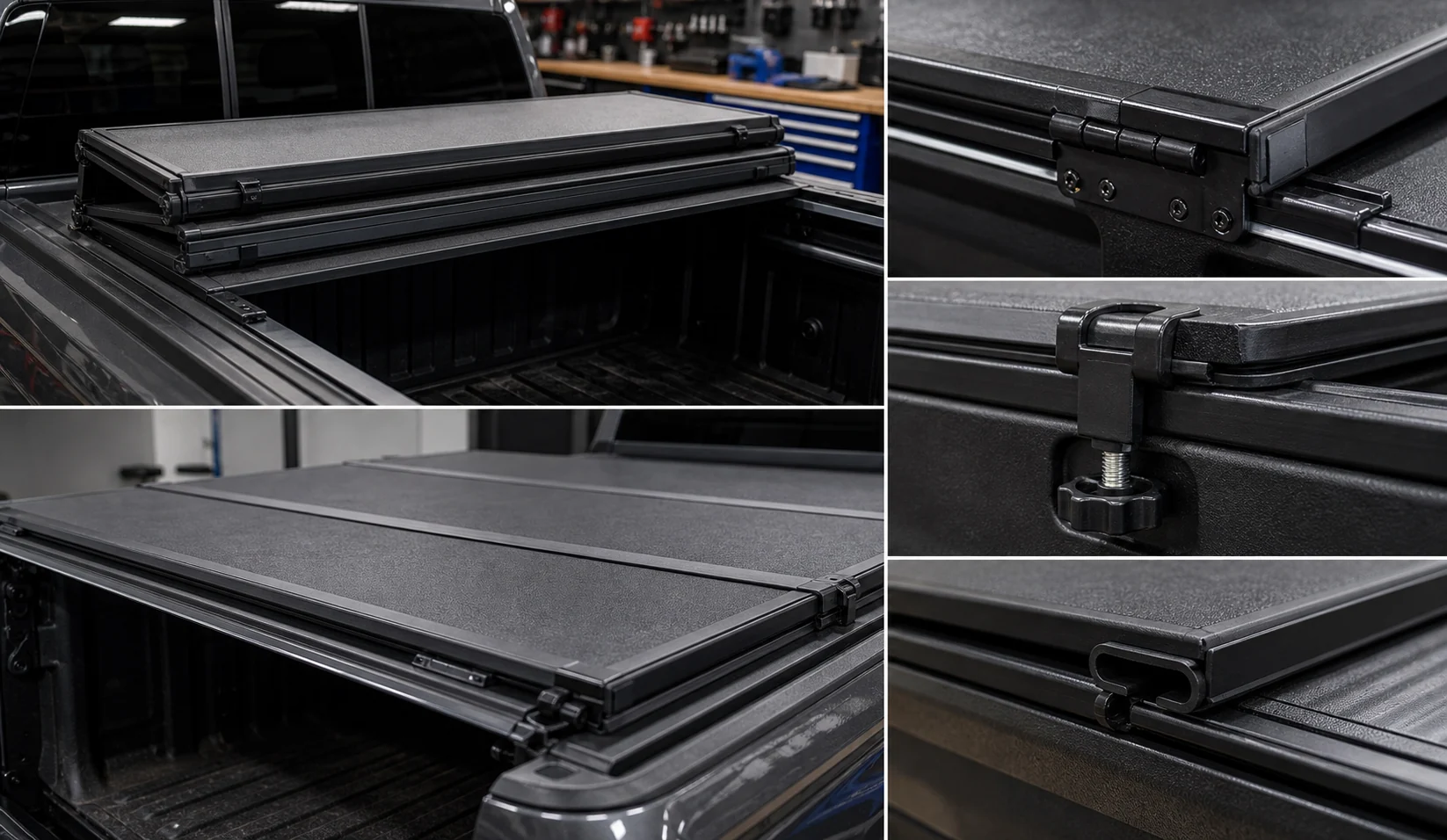
Algumas capotas ficam acima dos trilhos da caçamba, enquanto outras usam um sistema de montagem de perfil mais baixo. A trava traseira normalmente funciona com a área da tampa traseira, então a capota fechada e a tampa traseira travada podem reduzir o acesso casual à carga. Isso é privacidade e dissuasão, não uma garantia contra roubo.
O alinhamento das dobradiças afeta a suavidade da dobra, as folgas entre painéis e a gestão de água. A posição das braçadeiras afeta a estabilidade dos trilhos e o encaixe. Uma boa trava deve soltar limpidamente e manter o painel traseiro abaixado sem forçar o usuário a bater a capota.
As vedações reduzem a entrada de água nas juntas dos painéis, trilhos laterais, anteparo frontal e área da tampa traseira, mas uma capota tri-fold normalmente deve ser descrita como resistente ao clima, e não como um porta-malas completamente selado.
Quais tipos de capotas tonneau tri-fold estão disponíveis?
A principal distinção de produto é macia versus rígida. O perfil de montagem e a compatibilidade com acessórios são decisões separadas, não materiais adicionais. Essa classificação de tipo de capota também segue o agrupamento comum de varejo usado em guias de capotas tonneau [2].
| Configuração | O que muda | Melhor aplicação | Principal trade-off |
|---|---|---|---|
| Tri-fold macia | Tecido revestido de vinil sobre uma estrutura leve | Programas econômicos, motoristas diários, manuseio mais leve | Menor rigidez e resistência a cortes |
| Tri-fold rígida | Alumínio rígido, compósito ou painéis reforçados | Ferramentas, bagagem, varejo premium, maior dissuasão contra furtos de carga | Mais peso, custo e risco de embalagem |
| Montagem superior | A capota fica visivelmente acima dos trilhos da caçamba | Instalação simples e um perfil de capota pronunciado | Aparência menos rente |
| Perfil baixo | A capota fica mais próxima da linha do trilho da caçamba | Aparência limpa e perfil visual mais baixo | Encaixe e alinhamento de vedação mais precisos |
| Compatível com caixa de ferramentas | A folga do trilho e do painel é projetada em torno de uma caixa de ferramentas selecionada | Picapes de trabalho com uma configuração de caixa de ferramentas confirmada | A compatibilidade é limitada a dimensões específicas |
O relacionado comparação entre capota tonneau rígida e macia ajuda os compradores a decidir se menor custo e peso ou estrutura mais forte importa mais. Uma capota não deve ser chamada de compatível com caixa de ferramentas ou universal sem verificar as dimensões reais da caçamba da picape e dos acessórios.
Como uma tri-fold se compara com outros estilos de capota?
A tri-fold is usually chosen because it balances simple operation with structured coverage. The comparison below is a decision aid, not a promise that one style is best for every truck.
| Cover style | Bed access | Força típica | Melhor para | Common limitation |
|---|---|---|---|---|
| Enrolável macia | High when rolled | Lightweight and flexible | Price-sensitive daily use | Fabric can sag, crease, or age under UV |
| Tri-fold rígida | Partial access in panels | Rigid structure and fast opening | Daily cargo and premium retail | Folded panels occupy space near the cab |
| Retrátil | Flexible sliding access | Premium rails and slat structure | Users wanting a compact opening motion | Higher complexity, cost, and possible canister space loss |
| One-piece hinged | Large opening after lifting | Strong, clean exterior finish | Security-focused lifestyle trucks | Less convenient for tall or oversized cargo |
For the retractable alternative, see the guia de capota retrátil para caçamba. The key question is how often the truck needs full-bed access, how much cargo remains in the bed, and how much installation complexity the buyer will accept.
Quais são os prós e contras de uma capota tonneau tri-fold?
The main advantages are quick partial access, simple operation, broad retail familiarity, and a useful middle ground between flexible soft covers and more complex retractable systems. The main limitations are the space occupied by folded panels, hinge and latch wear, and the fact that full-bed access may require upright securing or removal.
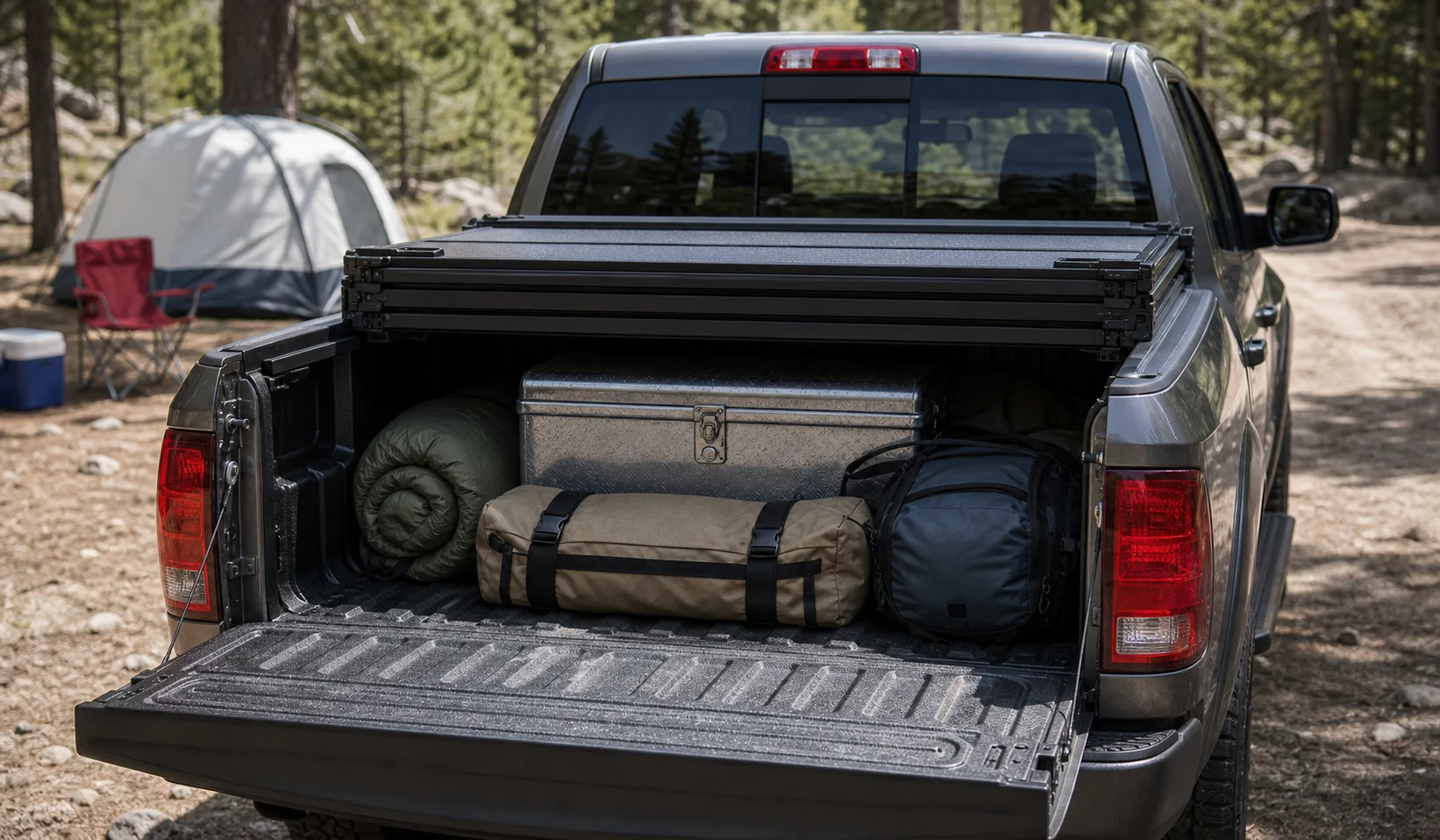
- Good fit: daily drivers, family pickups, moderate work cargo, camping gear, luggage, and buyers who want a cover that is easy to explain.
- Less suitable: drivers who load motorcycles, tall appliances, or oversized materials every day and need the entire bed open without moving panels.
- Weather limitation: water can enter through panel joints, rail gaps, tailgate gaps, or incorrect installation. Use weather-resistant wording unless a specific test supports a stronger claim.
- Security limitation: a hard panel can make casual access more difficult, but neither a soft nor hard cover replaces a locked vehicle, proper cargo restraint, or a tested theft-resistance claim.
Photos should show the closed, partially folded, and fully folded positions honestly. If the folded cover blocks the rear window or part of the bed, that trade-off belongs in the product explanation.
Quais são os melhores usos para uma capota tonneau tri-fold?
A tri-fold cover works well when the truck owner wants routine cargo protection but still needs quick access several times a week. Soft versions are often practical for lower-cost programs; hard versions are a better starting point when panel rigidity, visual quality, and cargo deterrence matter more.
For a wholesale or private-label program, the use case should be translated into product requirements: target pickup models, bed lengths, cover material, mounting profile, hardware kit, sealing expectation, packaging method, and expected order volume.
O que os compradores devem verificar antes de escolher uma capota tri-fold?
Fitment is more than the pickup name. Before requesting a sample or comparing a quotation, confirm the following details:
- Vehicle: make, model, model year, cab type, market, and exact bed length.
- Bed setup: spray-in or drop-in liner, rail caps, tailgate design, stake pockets, and bed-rail condition.
- Accessory clearance: sports bar, roll bar, rack, toolbox, bed extender, camera, and tie-down locations.
- Cover structure: soft or hard construction, panel material, hinge style, frame, clamp reach, latch type, and folded height.
- Water management: side seals, front seal, panel joints, tailgate gap, and any drainage route.
- Order and packaging: carton size, corner protection, anti-scratch layers, hardware bags, instructions, labels, and private-label requirements.
For sample review, check whether the panels sit flat, the hinges fold without twisting, the clamps hold the rails without damaging them, the latch releases cleanly, and the folded stack can be secured according to the instructions.
After installation, repeat the check after a short road test. Vibration can expose loose clamps, latch noise, panel movement, wind lift, or uneven gaps that are not visible while the truck is parked.
Como é uma verificação prática de encaixe de uma tri-fold?
A useful Yirox sourcing example involved a soft tri-fold cover for a 2023–2025 Ford Ranger double cab with an approximately 5-foot bed for the Australian market. The initial vehicle information included both standard cargo-bed and sports-bar configurations, so treating them as one universal SKU could have caused clamp interference, incorrect hardware, or rail damage.
The review path was to confirm the model year, bed length, liner, rail, sports-bar, and mounting area; compare rail length and clamp positions; then check folding clearance with a physical sample before planning the commercial order. This is the practical reason a product photo or pickup model name alone is not enough for a reliable quotation. More pickup-cover options are available in the pickup tonneau covers category.
For private-label orders, the same logic applies to batch consistency. Review panel gaps, fabric tension, latch location, hinge finish, logo placement, carton layout, and hardware completeness against the approved sample.
Cargo still needs to be secured separately from the cover. NHTSA load-securing guidance is a useful reference because a tonneau cover hides and protects cargo but does not replace proper tie-downs [1].
For care and long-term use, follow the cover maker’s cleaning and maintenance instructions, especially around seals, fabric tension, hinges, and mounting hardware. The Access Cover maintenance guidance provides a useful general reference [3].
If you are comparing tri-fold covers for a specific pickup or sourcing a soft or hard program, share the vehicle make, model year, bed length, bed liner or rail setup, sports-bar or toolbox details, target volume, and packaging needs. We can help you prepare a focused fitment and sample-review request.
Conclusão: As capotas tri-fold são o meio-termo prático
A tri-fold tonneau cover is a practical choice when a pickup owner or accessory buyer needs quick partial access, a structured cover, and a simpler mechanism than a retractable system. Soft and hard versions solve different problems, so the right selection depends on cargo value, budget, climate, access frequency, and fitment details.
For a consumer, the first question is whether the folded panels leave enough usable bed space. For a distributor, importer, or private-label brand, the first question is whether the cover fits the target vehicle list consistently and can be shipped with the right hardware, seals, instructions, and protection.
Use as linha de capotas tonneau para picapes to compare cover systems, then confirm the vehicle and bed configuration before standardizing a SKU.
Perguntas Frequentes
Is a tri-fold tonneau cover good?
Yes, when the buyer needs easy partial access, routine cargo protection, and a simpler system than a retractable cover. It is not automatically the best option for daily full-bed loading.
Can you drive with a tri-fold tonneau cover folded open?
Only when the folded panels are secured exactly as the product instructions require. Unsecured panels can move, create wind noise, damage the cover, obstruct visibility, or become unsafe.
Is a hard tri-fold better than a soft tri-fold?
A hard tri-fold generally offers more rigidity and stronger cargo deterrence. A soft tri-fold generally offers lower weight, easier handling, and a lower price. The better choice depends on cargo, climate, budget, and storage habits.
Does a tri-fold cover give full bed access?
Usually not without folding the panels upright, securing them near the cab, or removing the cover. Check the folded height, rear-window clearance, and removal process before buying.
Are tri-fold tonneau covers waterproof?
They are usually weather-resistant rather than fully waterproof. Hinges, rails, tailgate gaps, seals, bed-liner interference, and installation quality determine how much water reaches the cargo area.
What details are needed for a tri-fold cover quote?
Send the pickup make, model, year, cab type, bed length, liner and rail setup, sports-bar or toolbox details, preferred soft or hard construction, target quantity, destination market, packaging needs, and private-label requirements.
Referências
[1] NHTSA. Securing Your Load.
[2] RealTruck. Types of Tonneau Covers.
[3] Access Cover. Tonneau Cover Care and Maintenance.







