



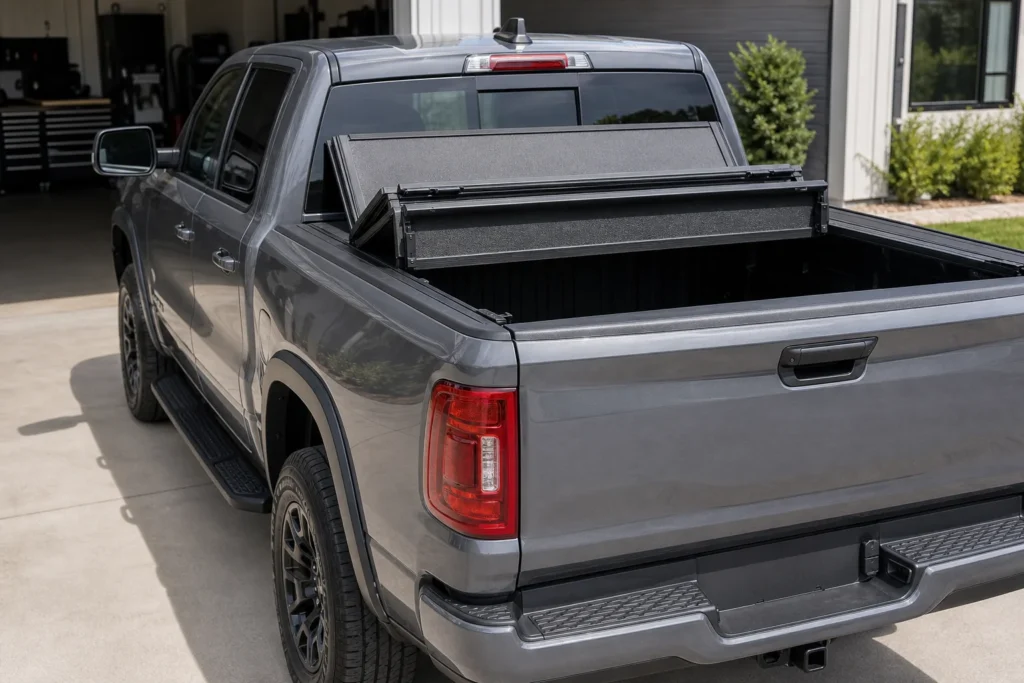
A tri-fold tonneau cover is a pickup-bed cover divided into three connected panels. The panels fold toward the cab from the tailgate, so the driver can open part of the bed without removing the entire cover.
The important decision is not simply whether a cover has three panels. Buyers also need to match the cover to the truck bed, cargo, weather exposure, access needs, and installation setup. A soft tri-fold usually prioritizes lower weight and cost; a hard tri-fold usually prioritizes rigidity and stronger cargo deterrence.
Table of Contents
- What is a tri-fold tonneau cover?
- How does a tri-fold tonneau cover work?
- What types of tri-fold tonneau covers are available?
- How does a tri-fold compare with other cover styles?
- What are the pros and cons of a tri-fold tonneau cover?
- What are the best uses for a tri-fold tonneau cover?
- What should buyers check before choosing a tri-fold cover?
- What does a practical tri-fold fitment check look like?
- Conclusion: Tri-fold covers are the practical middle ground
- Frequently Asked Questions
- References
What is a tri-fold tonneau cover?
A tri-fold tonneau cover is a folding pickup-bed cover made from three connected sections. Hinges or flexible joints allow the sections to fold over one another, while rails, clamps, seals, and latches hold the cover in position on the truck bed.
“Tri-fold” describes the opening geometry, not the material. Soft versions commonly use a vinyl-coated fabric over a lightweight frame. Hard versions use aluminum, composite, or reinforced panels. Top-mount, low-profile, and toolbox-compatible are fitment or configuration choices that must be checked separately.
If the buyer is comparing all cover styles, the complete tonneau cover guide is the right starting point. It separates material construction from opening mechanisms such as roll-up, folding, retractable, and hinged designs.
The tonneau cover materials guide covers vinyl, aluminum, fiberglass, seals, and panel construction in more depth. This page should stay focused on how the three-panel system affects access, fitment, and the buying decision.
How does a tri-fold tonneau cover work?
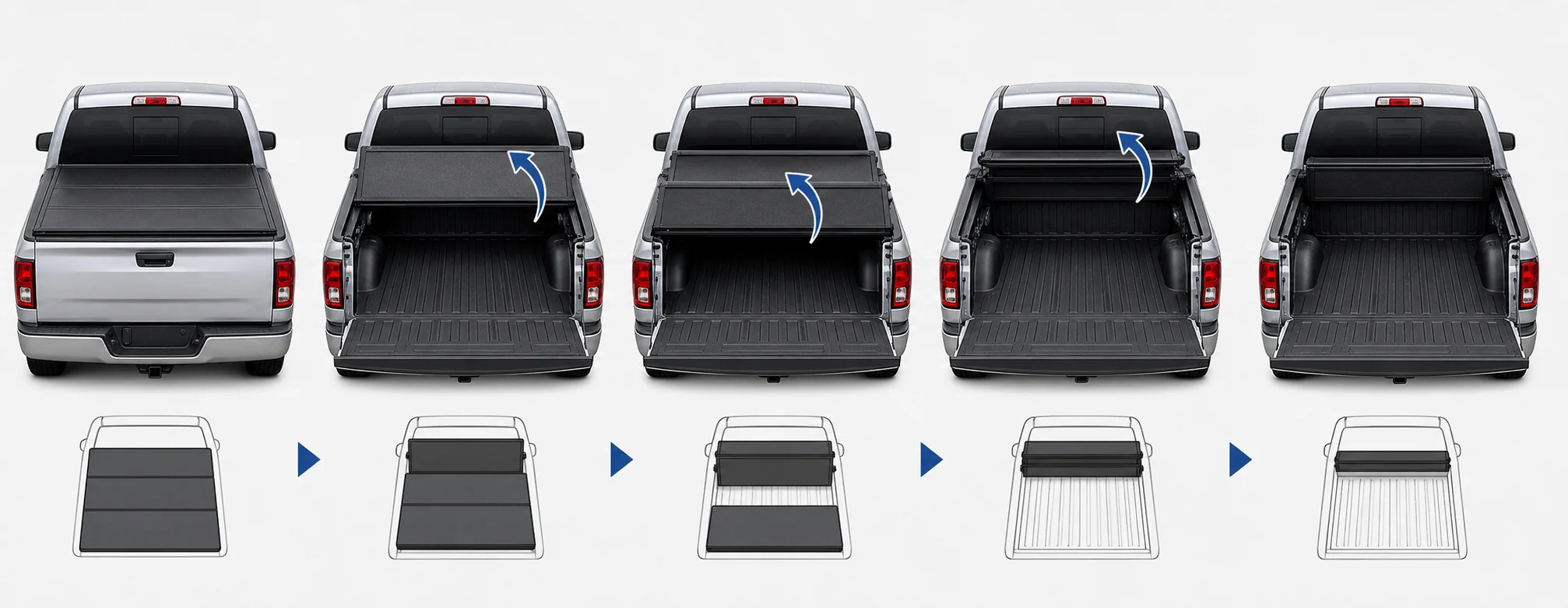
A typical tri-fold cover opens from the tailgate toward the cab. The exact operation varies by model, but the sequence is usually:
- Open the tailgate and release the rear latches or clamps.
- Fold the tailgate-end panel over the middle panel.
- Fold the connected panels toward the cab for wider bed access.
- Secure the folded stack with the supplied straps or support hardware before driving.
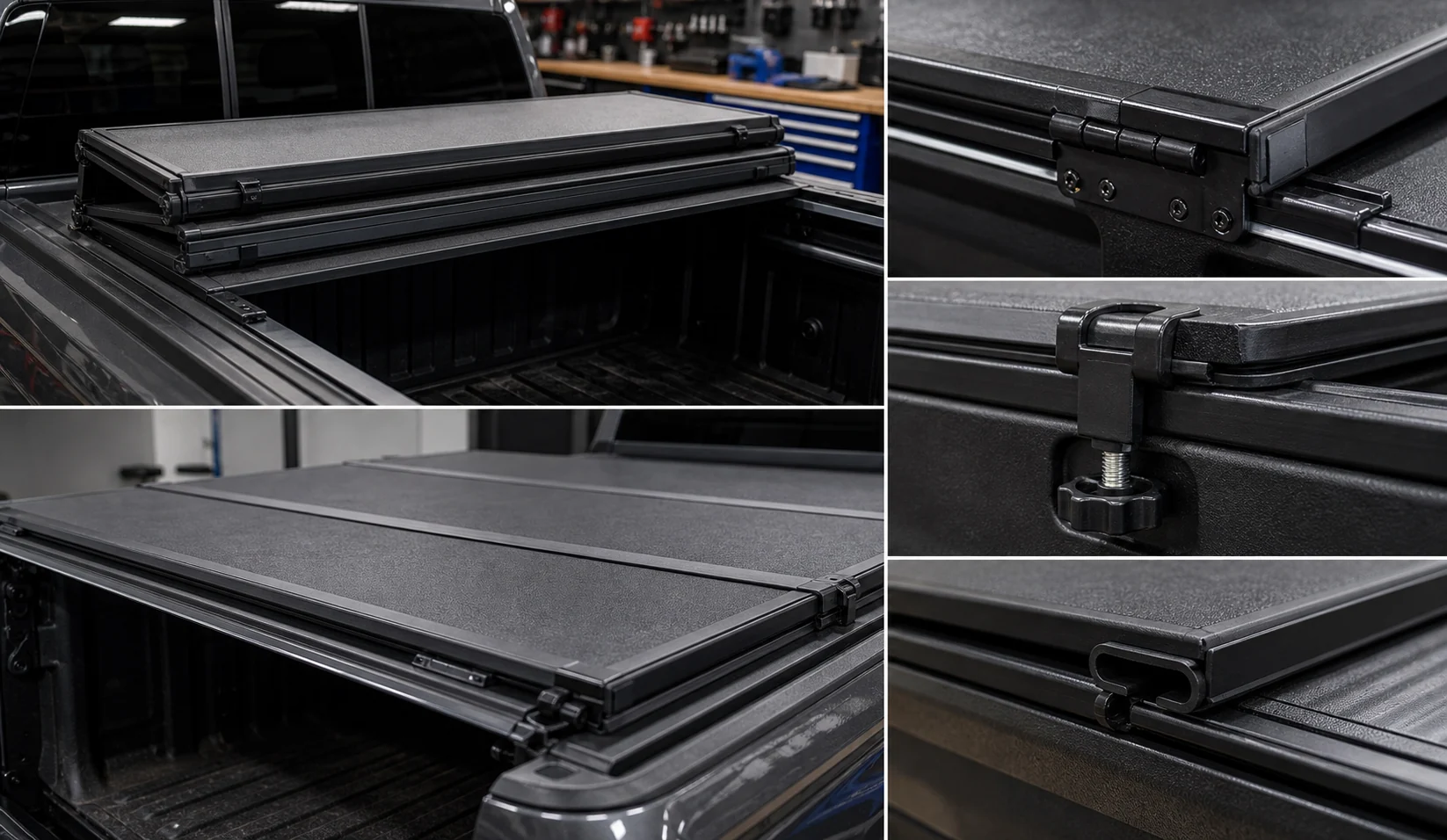
Some covers sit above the bed rails, while others use a lower-profile mounting system. The rear latch normally works with the tailgate area, so the closed cover and locked tailgate can reduce casual access to cargo. That is privacy and deterrence, not a guarantee against theft.
Hinge alignment affects folding smoothness, panel gaps, and water management. Clamp position affects rail stability and fitment. A good latch should release cleanly and hold the rear panel down without forcing the user to slam the cover.
Seals reduce water entry at the panel joints, side rails, front bulkhead, and tailgate area, but a tri-fold cover should normally be described as weather-resistant rather than a completely sealed trunk.
What types of tri-fold tonneau covers are available?
The main product distinction is soft versus hard. Mounting profile and accessory compatibility are separate decisions, not additional materials. This cover-type classification also follows the common retail grouping used in tonneau cover guides [2].
| Configuration | What changes | Best fit | Main trade-off |
|---|---|---|---|
| Soft tri-fold | Vinyl-coated fabric over a light frame | Budget programs, daily drivers, lighter handling | Lower rigidity and cut resistance |
| Hard tri-fold | Rigid aluminum, composite, or reinforced panels | Tools, luggage, premium retail, stronger cargo deterrence | More weight, cost, and packaging risk |
| Top-mount | Cover sits visibly above the bed rails | Simple installation and a pronounced cover profile | Less flush appearance |
| Low-profile | Cover sits closer to the bed-rail line | Clean appearance and lower visual profile | More precise fitment and seal alignment |
| Toolbox-compatible | Rail and panel clearance is designed around a selected toolbox | Work trucks with a confirmed toolbox setup | Compatibility is limited to specific dimensions |
The related hard vs soft tonneau cover comparison helps buyers decide whether lower cost and weight or stronger structure matters more. A cover should not be called toolbox-compatible or universal without checking the actual truck-bed and accessory dimensions.
How does a tri-fold compare with other cover styles?
A tri-fold is usually chosen because it balances simple operation with structured coverage. The comparison below is a decision aid, not a promise that one style is best for every truck.
| Cover style | Bed access | Typical strength | Best for | Common limitation |
|---|---|---|---|---|
| Soft roll-up | High when rolled | Lightweight and flexible | Price-sensitive daily use | Fabric can sag, crease, or age under UV |
| Hard tri-fold | Partial access in panels | Rigid structure and fast opening | Daily cargo and premium retail | Folded panels occupy space near the cab |
| Retractable | Flexible sliding access | Premium rails and slat structure | Users wanting a compact opening motion | Higher complexity, cost, and possible canister space loss |
| One-piece hinged | Large opening after lifting | Strong, clean exterior finish | Security-focused lifestyle trucks | Less convenient for tall or oversized cargo |
For the retractable alternative, see the retractable tonneau cover guide. The key question is how often the truck needs full-bed access, how much cargo remains in the bed, and how much installation complexity the buyer will accept.
What are the pros and cons of a tri-fold tonneau cover?
The main advantages are quick partial access, simple operation, broad retail familiarity, and a useful middle ground between flexible soft covers and more complex retractable systems. The main limitations are the space occupied by folded panels, hinge and latch wear, and the fact that full-bed access may require upright securing or removal.
- Good fit: daily drivers, family pickups, moderate work cargo, camping gear, luggage, and buyers who want a cover that is easy to explain.
- Less suitable: drivers who load motorcycles, tall appliances, or oversized materials every day and need the entire bed open without moving panels.
- Weather limitation: water can enter through panel joints, rail gaps, tailgate gaps, or incorrect installation. Use weather-resistant wording unless a specific test supports a stronger claim.
- Security limitation: a hard panel can make casual access more difficult, but neither a soft nor hard cover replaces a locked vehicle, proper cargo restraint, or a tested theft-resistance claim.
Photos should show the closed, partially folded, and fully folded positions honestly. If the folded cover blocks the rear window or part of the bed, that trade-off belongs in the product explanation.
What are the best uses for a tri-fold tonneau cover?
A tri-fold cover works well when the truck owner wants routine cargo protection but still needs quick access several times a week. Soft versions are often practical for lower-cost programs; hard versions are a better starting point when panel rigidity, visual quality, and cargo deterrence matter more.
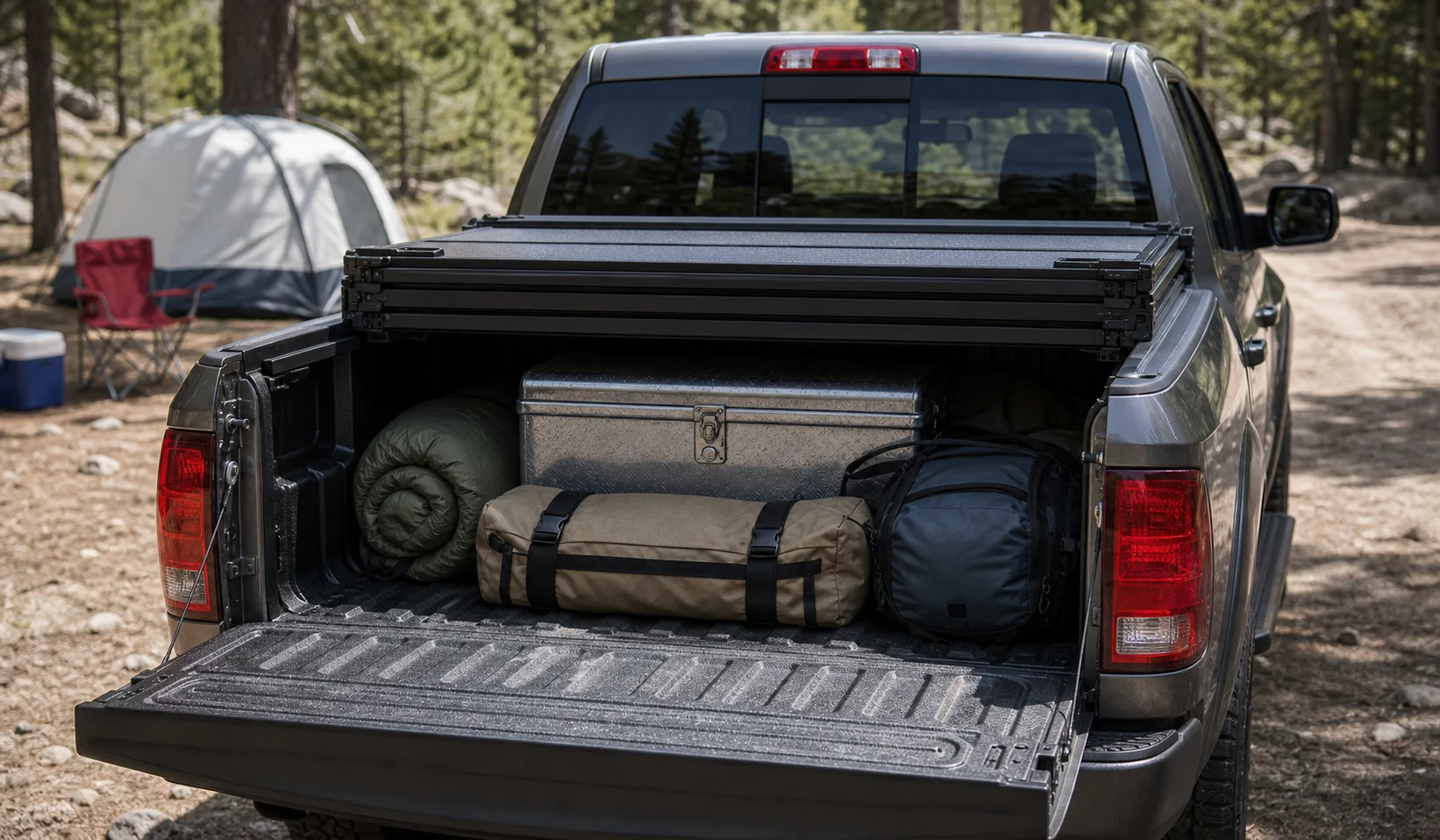
For a wholesale or private-label program, the use case should be translated into product requirements: target pickup models, bed lengths, cover material, mounting profile, hardware kit, sealing expectation, packaging method, and expected order volume.
What should buyers check before choosing a tri-fold cover?
Fitment is more than the pickup name. Before requesting a sample or comparing a quotation, confirm the following details:
- Vehicle: make, model, model year, cab type, market, and exact bed length.
- Bed setup: spray-in or drop-in liner, rail caps, tailgate design, stake pockets, and bed-rail condition.
- Accessory clearance: sports bar, roll bar, rack, toolbox, bed extender, camera, and tie-down locations.
- Cover structure: soft or hard construction, panel material, hinge style, frame, clamp reach, latch type, and folded height.
- Water management: side seals, front seal, panel joints, tailgate gap, and any drainage route.
- Order and packaging: carton size, corner protection, anti-scratch layers, hardware bags, instructions, labels, and private-label requirements.
For sample review, check whether the panels sit flat, the hinges fold without twisting, the clamps hold the rails without damaging them, the latch releases cleanly, and the folded stack can be secured according to the instructions.
After installation, repeat the check after a short road test. Vibration can expose loose clamps, latch noise, panel movement, wind lift, or uneven gaps that are not visible while the truck is parked.
What does a practical tri-fold fitment check look like?
A useful Yirox sourcing example involved a soft tri-fold cover for a 2023–2025 Ford Ranger double cab with an approximately 5-foot bed for the Australian market. The initial vehicle information included both standard cargo-bed and sports-bar configurations, so treating them as one universal SKU could have caused clamp interference, incorrect hardware, or rail damage.
The review path was to confirm the model year, bed length, liner, rail, sports-bar, and mounting area; compare rail length and clamp positions; then check folding clearance with a physical sample before planning the commercial order. This is the practical reason a product photo or pickup model name alone is not enough for a reliable quotation. More pickup-cover options are available in the pickup tonneau covers category.
For private-label orders, the same logic applies to batch consistency. Review panel gaps, fabric tension, latch location, hinge finish, logo placement, carton layout, and hardware completeness against the approved sample.
Cargo still needs to be secured separately from the cover. NHTSA load-securing guidance is a useful reference because a tonneau cover hides and protects cargo but does not replace proper tie-downs [1].
For care and long-term use, follow the cover maker’s cleaning and maintenance instructions, especially around seals, fabric tension, hinges, and mounting hardware. The Access Cover maintenance guidance provides a useful general reference [3].
If you are comparing tri-fold covers for a specific pickup or sourcing a soft or hard program, share the vehicle make, model year, bed length, bed liner or rail setup, sports-bar or toolbox details, target volume, and packaging needs. We can help you prepare a focused fitment and sample-review request.
Conclusion: Tri-fold covers are the practical middle ground
A tri-fold tonneau cover is a practical choice when a pickup owner or accessory buyer needs quick partial access, a structured cover, and a simpler mechanism than a retractable system. Soft and hard versions solve different problems, so the right selection depends on cargo value, budget, climate, access frequency, and fitment details.
For a consumer, the first question is whether the folded panels leave enough usable bed space. For a distributor, importer, or private-label brand, the first question is whether the cover fits the target vehicle list consistently and can be shipped with the right hardware, seals, instructions, and protection.
Use the pickup tonneau cover range to compare cover systems, then confirm the vehicle and bed configuration before standardizing a SKU.
Frequently Asked Questions
Is a tri-fold tonneau cover good?
Yes, when the buyer needs easy partial access, routine cargo protection, and a simpler system than a retractable cover. It is not automatically the best option for daily full-bed loading.
Can you drive with a tri-fold tonneau cover folded open?
Only when the folded panels are secured exactly as the product instructions require. Unsecured panels can move, create wind noise, damage the cover, obstruct visibility, or become unsafe.
Is a hard tri-fold better than a soft tri-fold?
A hard tri-fold generally offers more rigidity and stronger cargo deterrence. A soft tri-fold generally offers lower weight, easier handling, and a lower price. The better choice depends on cargo, climate, budget, and storage habits.
Does a tri-fold cover give full bed access?
Usually not without folding the panels upright, securing them near the cab, or removing the cover. Check the folded height, rear-window clearance, and removal process before buying.
Are tri-fold tonneau covers waterproof?
They are usually weather-resistant rather than fully waterproof. Hinges, rails, tailgate gaps, seals, bed-liner interference, and installation quality determine how much water reaches the cargo area.
What details are needed for a tri-fold cover quote?
Send the pickup make, model, year, cab type, bed length, liner and rail setup, sports-bar or toolbox details, preferred soft or hard construction, target quantity, destination market, packaging needs, and private-label requirements.
References
[1] NHTSA. Securing Your Load.
[2] RealTruck. Types of Tonneau Covers.
[3] Access Cover. Tonneau Cover Care and Maintenance.