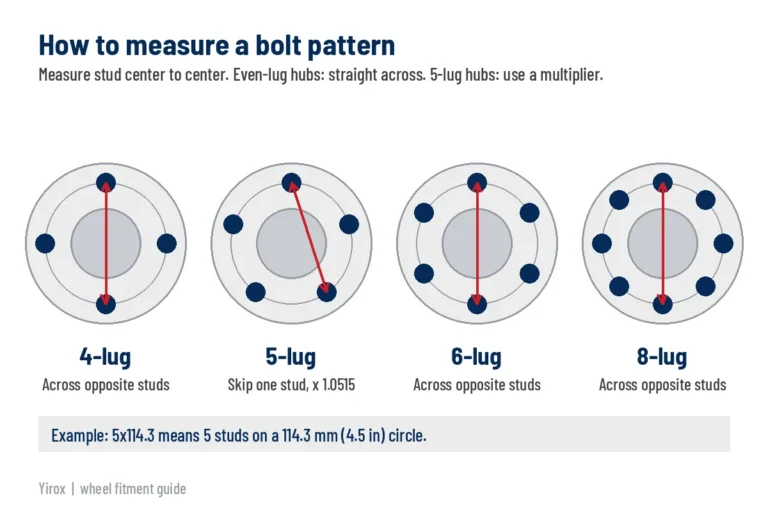




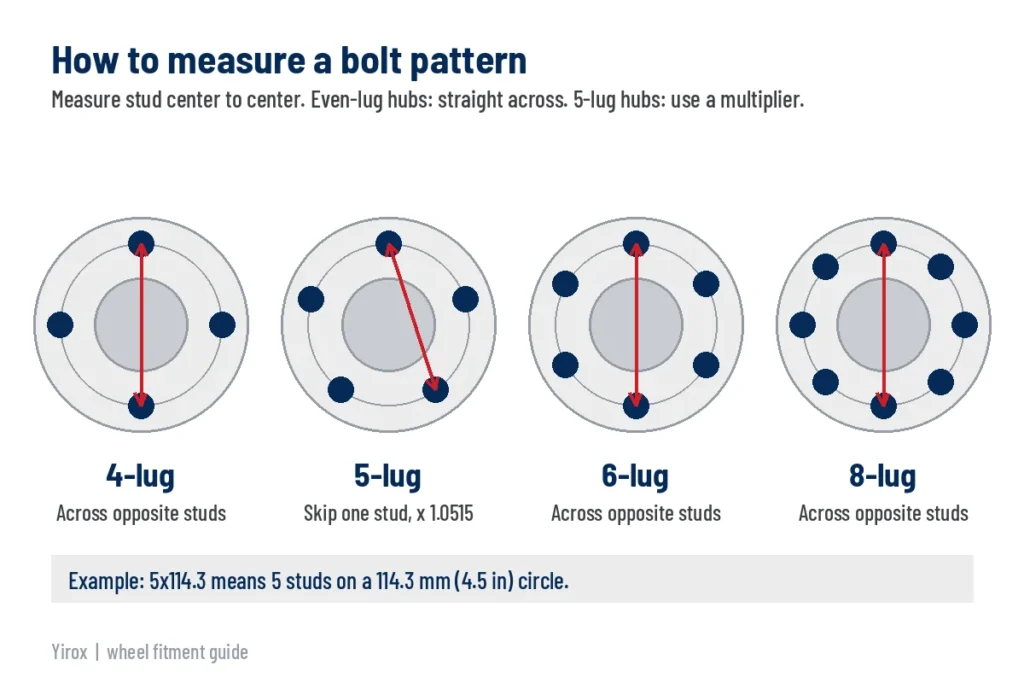
To measure a bolt pattern, count the lug studs and find the diameter of the circle through their centers: on 4, 6 and 8-lug hubs measure center to center across opposite studs; on 5-lug hubs measure between non-adjacent studs and multiply by 1.0515. Then check the center bore before ordering.
Scope: this guide covers bolt pattern (PCD), center bore and hub-centric rings, the fit checks that come before any wheel order. Offset and backspacing are covered in What Is Wheel Offset?, wheel materials in Alloy vs Steel Wheels, and center caps in Wheel Center Caps.
What is a bolt pattern, and how is it written?
A bolt pattern is the number of wheel studs or bolts and the diameter of the imaginary circle that runs through their centers. That circle is called the pitch circle diameter, or PCD. A pattern written as 5×114.3 means five studs on a 114.3 mm circle. The same pattern is often written in inches as 5×4.5, because 114.3 mm is exactly 4.5 inches.
The bolt pattern is one of the measurements that defines whether a wheel can be fitted at all. European rules for replacement wheels treat the wheel attachment holes as an essential characteristic of a wheel type, and they require a pattern-part replacement wheel to match the original wheel’s fixing PCD and spigot mounting diameter 1. In plain terms: if the bolt pattern or hub bore is wrong, the wheel is wrong, whatever its size or style.
Some carmakers do not print the bolt pattern in the owner’s manual. Tesla’s Model Y manual, for example, lists factory wheel sizes, offsets and lug nut torque, but not the bolt pattern 2. That is one reason why buyers end up measuring, and why a careful measurement method matters.
What do you need to measure a bolt pattern?
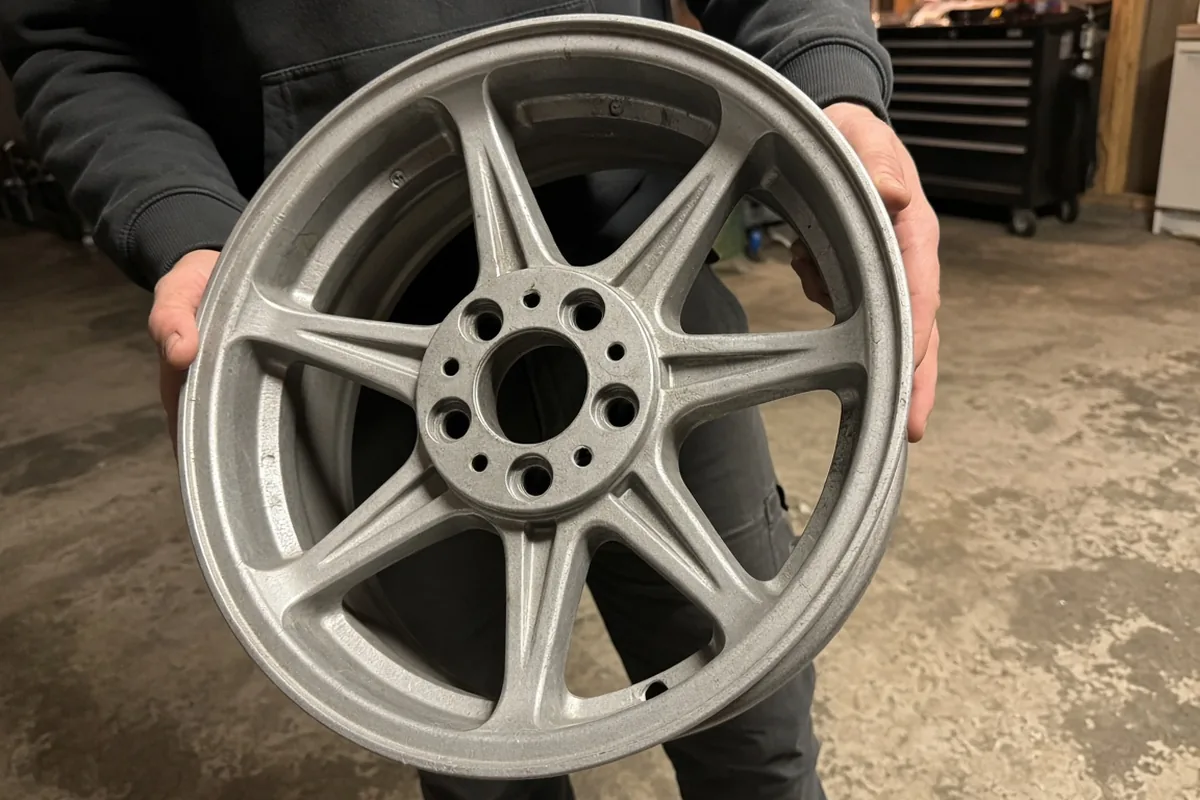
You can measure on the vehicle hub with the wheel removed, or on the back of a bare wheel. Hub studs are easier to measure accurately than wheel holes, because you can see their centers.
- A digital or dial caliper, ideally 200 mm (8 in) or longer. A caliper is far more accurate than a tape measure.
- A steel ruler as a backup, marked in millimeters.
- A bolt pattern gauge, a plastic or metal template with holes for common patterns. It is quick, but only covers the patterns printed on it.
- Chalk or a marker to mark which studs you measured.
- A notepad to record the number of studs, the measurement, the center bore and the stud thread.
Measure in millimeters if you can. Many wheel catalogs list patterns in millimeters, and some patterns that look alike in inches are different by less than a millimeter.
How do you measure a 4, 6 or 8-lug bolt pattern?
On a hub with an even number of studs, each stud has another stud directly opposite it. The distance from the center of one stud to the center of the stud directly across is the PCD.
- Count the studs and write the number down.
- Pick any stud and find the stud directly opposite it, passing through the hub center.
- Measure from the center of the first stud to the center of the opposite stud.
- If finding centers is hard, measure from the near edge of one stud to the far edge of the other, then subtract one stud diameter.
- Repeat on a second pair of studs and compare. The two readings should agree within a fraction of a millimeter.
A useful cross-check is the distance between two neighboring studs. On a 6-lug hub, neighbors sit exactly half the PCD apart. On a 4-lug hub, the neighbor distance is the PCD multiplied by 0.7071, and on an 8-lug hub, by 0.3827. If your direct and cross-check readings point to different patterns, measure again.
How do you measure a 5-lug bolt pattern?
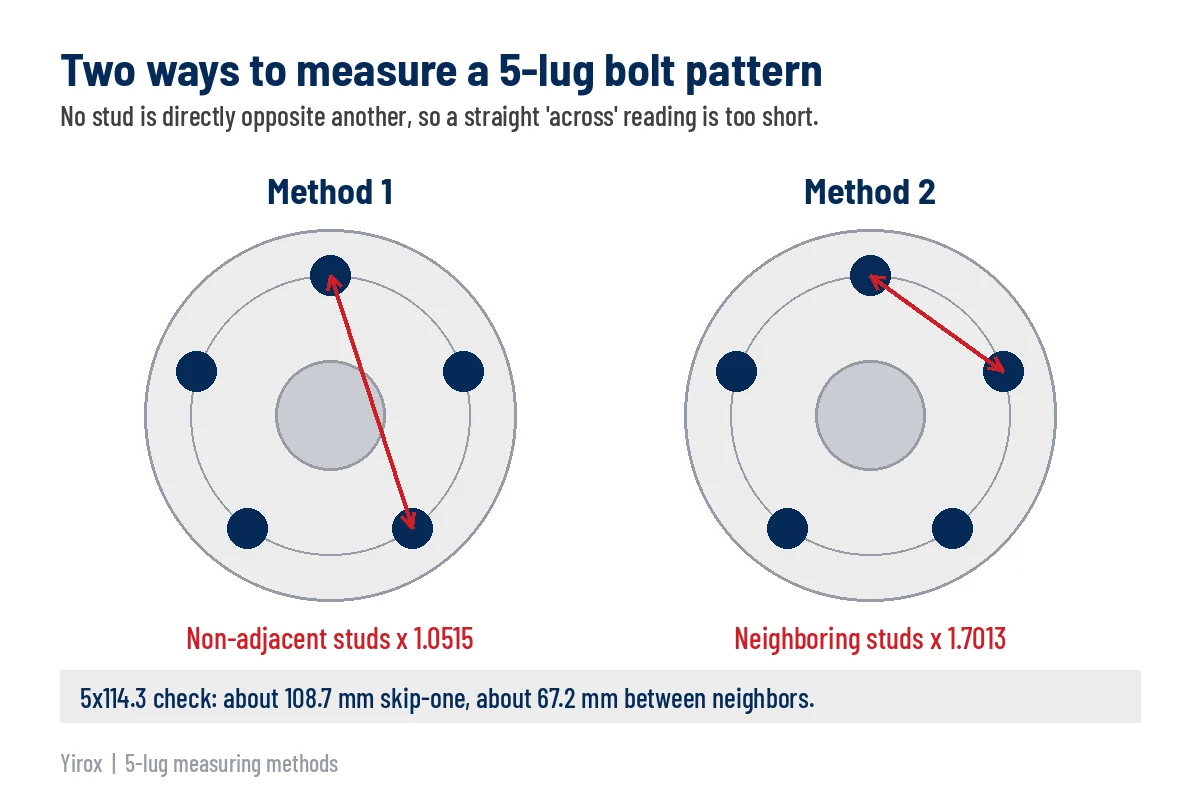
Five-lug hubs are where most measuring mistakes happen, because no stud is directly opposite another. Measuring “across” a 5-lug hub gives a number that is shorter than the real PCD. There are two reliable ways to get it right.
Method 1: two non-adjacent studs. Skip one stud and measure center to center between the first and third studs. Multiply the result by 1.0515. For example, a reading of 108.7 mm gives a PCD of about 114.3 mm.
Method 2: two neighboring studs. Measure center to center between two studs that sit side by side and multiply by 1.7013. For a 5×114.3 hub you should read about 67.2 mm.
A common shortcut is to measure from the back edge of one stud to the center of a non-adjacent stud. This gives an estimate, but it can be off by a millimeter or more, which is enough to confuse close patterns such as 5×112 and 5×114.3. Use the multiplier methods above, or a gauge, when the exact pattern matters.
The multipliers come from simple circle geometry. The distance between two studs on the same circle is the PCD multiplied by the sine of half the angle between them. Five studs sit 72 degrees apart, so neighbors are PCD x sin 36 degrees (0.5878) apart, and non-adjacent studs are PCD x sin 72 degrees (0.9511) apart.
| Number of studs | What to measure | Multiply the reading by |
|---|---|---|
| 4 | Center to center, opposite studs | 1 (reading is the PCD) |
| 4 | Center to center, neighboring studs | 1.4142 |
| 5 | Center to center, non-adjacent studs (skip one) | 1.0515 |
| 5 | Center to center, neighboring studs | 1.7013 |
| 6 | Center to center, opposite studs | 1 (reading is the PCD) |
| 6 | Center to center, neighboring studs | 2 |
| 8 | Center to center, opposite studs | 1 (reading is the PCD) |
| 8 | Center to center, neighboring studs | 2.6131 |
What do common bolt patterns measure in inches and millimeters?
The table below converts common PCDs between millimeters and inches and shows the neighbor-stud distance you should read for each lug count. It is pure geometry, so it works as a check on any hub. It does not say which vehicles use which pattern; always confirm the pattern for the exact vehicle.
| PCD (mm) | PCD (in) | 4-lug neighbor distance (mm) | 5-lug neighbor distance (mm) | 6-lug neighbor distance (mm) | 8-lug neighbor distance (mm) |
|---|---|---|---|---|---|
| 100 | 3.94 | 70.7 | 58.8 | 50.0 | 38.3 |
| 108 | 4.25 | 76.4 | 63.5 | 54.0 | 41.3 |
| 112 | 4.41 | 79.2 | 65.8 | 56.0 | 42.9 |
| 114.3 | 4.50 | 80.8 | 67.2 | 57.1 | 43.7 |
| 120 | 4.72 | 84.9 | 70.5 | 60.0 | 45.9 |
| 127 | 5.00 | 89.8 | 74.6 | 63.5 | 48.6 |
| 139.7 | 5.50 | 98.8 | 82.1 | 69.8 | 53.5 |
| 165.1 | 6.50 | 116.7 | 97.0 | 82.5 | 63.2 |
| 170 | 6.69 | 120.2 | 99.9 | 85.0 | 65.1 |
Notice how close some neighbors are. A 5×112 hub reads 65.8 mm between neighboring studs and a 5×114.3 hub reads 67.2 mm, a gap of only 1.4 mm. Patterns such as 5×114.3 and 5×115 differ by 0.7 mm in PCD, which a ruler cannot reliably separate. When two patterns are this close, do not guess; confirm with the vehicle maker’s data or a precise gauge. Bolting a wheel onto a pattern that is “nearly right” puts side load on the studs.
What is the center bore, and how do you measure it?
The center bore is the large hole in the middle of the wheel that fits over the hub’s raised center pilot. The matching part on the vehicle is the hub bore or spigot. European replacement wheel rules list the spigot mounting diameter alongside PCD as a dimension that a replacement wheel must match 1, and the ISO standard for commercial vehicle wheel-hub attachments sets PCD and center bore together for 6, 8 and 10-stud wheels 3.
To measure the hub, remove the wheel and close the outside jaws of a caliper over the hub pilot, taking two readings at right angles. To measure a wheel, use the inside jaws across the bore on the back (mounting) side. Record both to one decimal place in millimeters.
- Wheel bore smaller than the hub pilot: the wheel will not sit flat and must not be fitted. Do not attempt to open it up yourself.
- Wheel bore equal to the hub pilot: a hub-centric fit, the ideal case.
- Wheel bore larger than the hub pilot: the wheel can fit, but should be centered with a hub-centric ring or by correctly seated lug nuts.
When do you need hub-centric rings?
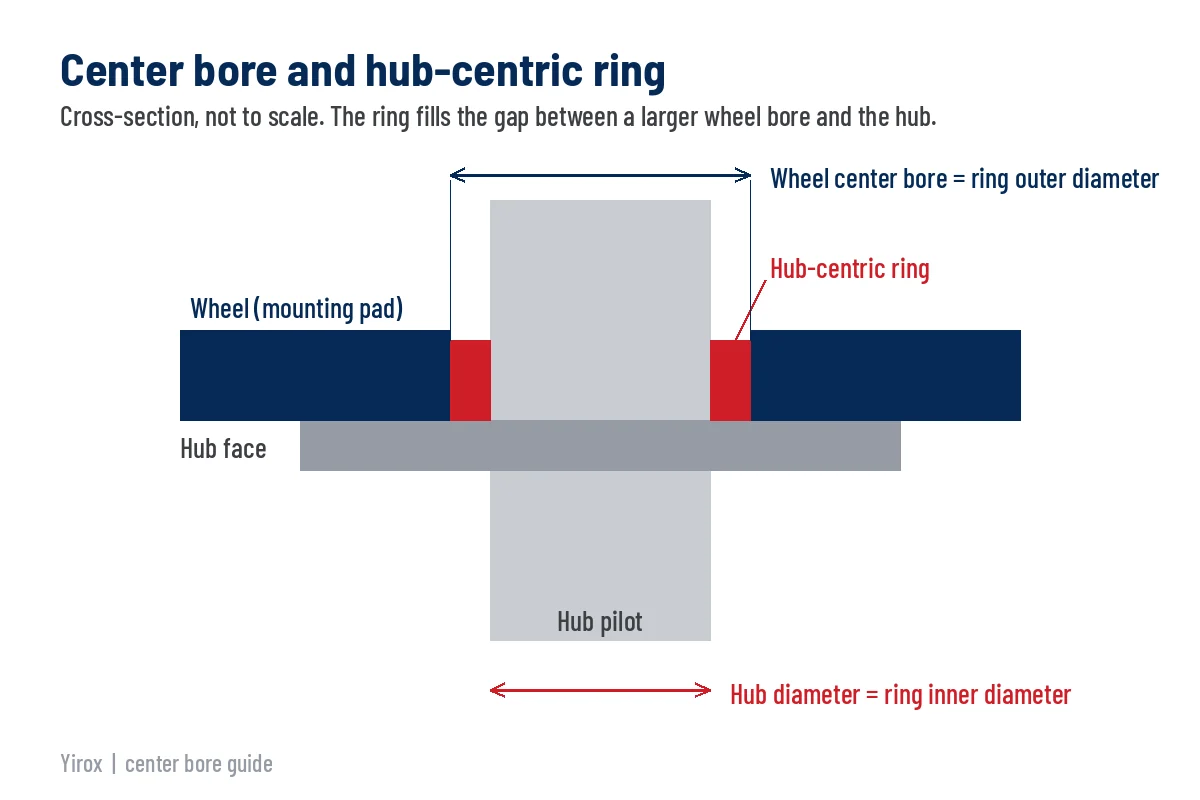
Hub-centric rings are spacer rings that fill the gap between a larger wheel bore and a smaller hub pilot, so the hub carries and centers the wheel. Aftermarket wheels are often made with a large bore so one design can fit several vehicles, which is why rings are common.
| Situation | Ring needed? | What to order |
|---|---|---|
| Wheel bore equals hub pilot | No | Nothing extra |
| Wheel bore larger than hub pilot | Recommended | Ring with outer diameter = wheel bore, inner diameter = hub pilot |
| Wheel bore smaller than hub pilot | Not possible | Choose a different wheel or one made with the correct bore |
| Lug-centric wheel with conical seats | Often optional | Rings still help centering during mounting and reduce vibration complaints |
A ring is described by two numbers: its outer diameter, which must match the wheel bore, and its inner diameter, which must match the hub. A ring sold as 73.1 to 67.1, for example, fits a 73.1 mm wheel bore on a 67.1 mm hub. Rings are made in plastic or aluminum; both locate the wheel, and the choice is mostly about heat and durability. Without rings, a wheel with an oversize bore relies on the lug nut seats for centering, which works only when the nuts are tightened evenly in a star pattern.
What else must match besides bolt pattern and bore?
Bolt pattern and center bore get a wheel onto the hub. These checks make sure it is safe and clears everything:
- Lug seat type. Conical (tapered), ball (radius) and flat seats are not interchangeable. The nut or bolt must match the seat in the wheel.
- Stud or bolt thread. Record the thread size and pitch, such as M14 x 1.5, and whether the car uses studs with nuts or bolts.
- Offset and width. These set where the wheel sits in the arch; see our wheel offset guide.
- Load rating. The wheel’s rated load must cover the vehicle’s axle load.
- Brake clearance. Larger calipers need room behind the spokes.
- Torque value. Use the vehicle maker’s figure. Tesla, for instance, gives 129 lb-ft (175 Nm) for Model Y lug nuts 2.
What are the risks and exceptions?
- “Close enough” patterns. A wheel forced onto a pattern that differs by a millimeter loads the studs sideways. It may feel tight but can loosen or crack studs over time.
- Wobble or dual-drilled wheels. Some wheels have slotted or double sets of holes to fit several patterns. Check the maker’s approved patterns and the correct hardware.
- Adapters and spacers. Bolt pattern adapters change the pattern but also move the wheel outward, which changes offset and loads. Quality and installation matter a great deal.
- Measuring a worn or dirty hub. Rust on the hub pilot gives a false bore reading. Clean it first.
- Mixed axles. Some vehicles use different sizes front and rear, and a few use different hub specifications. Tesla’s manual lists different front and rear sizes and offsets for some Model Y wheels 2.
- Commercial vehicles. Truck wheels follow their own standards, such as ISO 4107 for center-bore-centered wheels with 6, 8 or 10 studs, so passenger-car rules of thumb do not carry over 3.
What should a wheel order or RFQ specify?
For distributors, tire shops and wholesale buyers, most wheel returns trace back to one missing number. A complete fitment line prevents that. List each item for every vehicle you want to cover:
- Vehicle make, model, years and body version, front and rear if different
- Bolt pattern in millimeters, for example 5×114.3
- Center bore in millimeters, and whether hub-centric rings should be included
- Wheel diameter, width and offset
- Lug seat type and stud or bolt thread
- Required load rating per wheel
- Material and finish: steel or alloy, color, machined or painted face
- Center cap type and size, if caps are needed
- Packaging, labels and target market
- Annual volume, first-order quantity and sample requirements
Ask the supplier to put the PCD, center bore, offset and load rating on the drawing and on each carton label. Then check the first samples on the real hub before approving production.
How we put this together
The multiplier table and the neighbor-distance chart in this guide are our own calculations from circle geometry (distance between studs = PCD x sin of half the angle between them), rounded to one decimal place. Inch values are exact conversions at 25.4 mm per inch, rounded to two decimals. We did not list vehicle applications because they vary by year and market; check the vehicle maker’s data for those.
Conclusion
Measuring a bolt pattern is simple once you know the trick for each lug count. On 4, 6 and 8-lug hubs, measure center to center across opposite studs. On 5-lug hubs, measure between non-adjacent studs and multiply by 1.0515, or between neighbors and multiply by 1.7013. Cross-check with a second reading, and confirm close patterns with the vehicle maker’s data.
Then measure the center bore. A wheel bore that is equal to or larger than the hub is usable, with hub-centric rings filling any gap; a smaller bore is not. Add the seat type, thread, offset and load rating, and you have everything needed to order wheels that fit the first time.
Next step
Yirox makes steel and alloy wheels, so we can build to the PCD, center bore and offset in your fitment list. Browse our alloy wheels and wheels and tire accessories, or send your vehicle list through the Sourcing Advisor.
Frequently asked questions
How do you measure a 5-lug bolt pattern with a tape measure?
Measure center to center between two non-adjacent studs and multiply by 1.0515. A tape measure is only accurate enough to tell apart patterns that differ by several millimeters; use a caliper for close patterns.
Is 5×114.3 the same as 5×4.5?
Yes. 114.3 mm equals exactly 4.5 inches, so 5×114.3 and 5×4.5 describe the same bolt pattern.
Can I use a wheel with a bigger center bore than my hub?
Yes, if the bolt pattern, seat type and offset are correct. Fit hub-centric rings that match the wheel bore outside and the hub inside, so the hub centers the wheel.
Where can I find my car’s bolt pattern?
Check the vehicle maker’s specifications, the original wheel’s markings or a trusted fitment database. If none is available, measure the hub with a caliper using the methods in this guide.
Do hub-centric rings affect safety?
Correctly sized rings help center the wheel and reduce vibration. The lug nuts still hold the wheel on, so they must match the wheel seat and be tightened to the specified torque.
References
[1] EUR-Lex. “UN Regulation No 124: Uniform provisions concerning the approval of wheels for passenger cars and their trailers.” Official Journal L 70, 2007. Wheel type characteristics and pattern-part replacement wheel requirements.
[2] Tesla. “Model Y Owner’s Manual: Wheels and Tires.” Factory wheel sizes, offsets and lug nut torque.
[3] ISO. “ISO 4107:2023 Commercial vehicles: Wheel-hub attachment dimensions.” PCD and center bore dimensions for 6, 8 and 10-stud wheels.