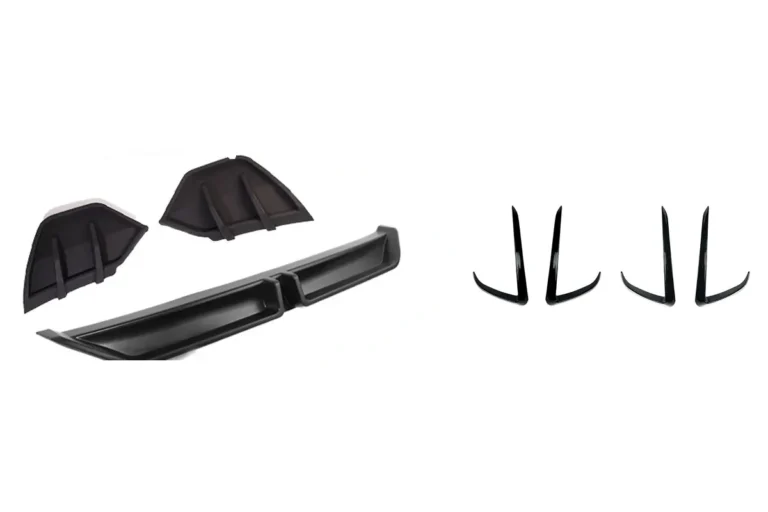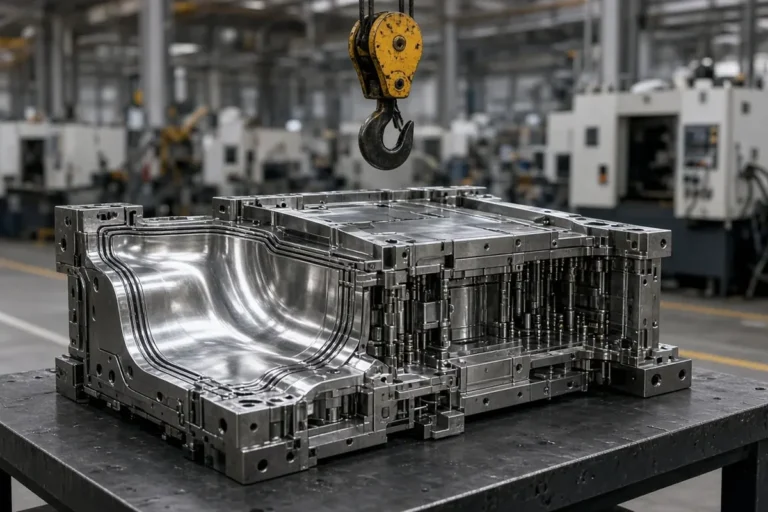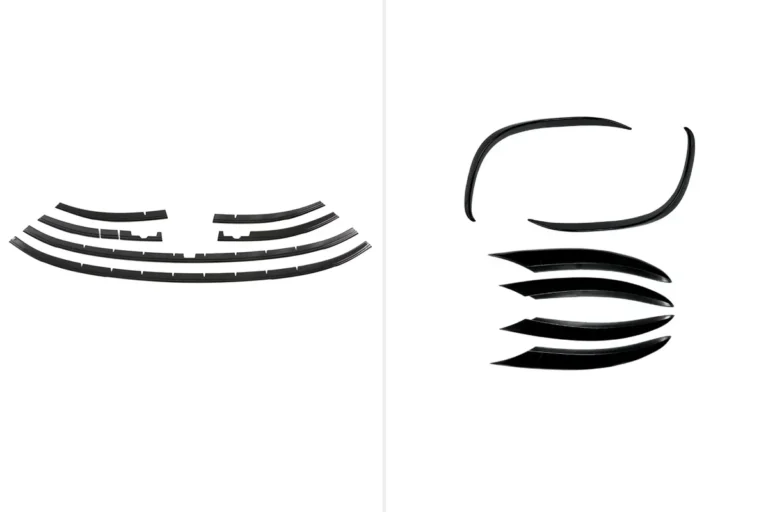




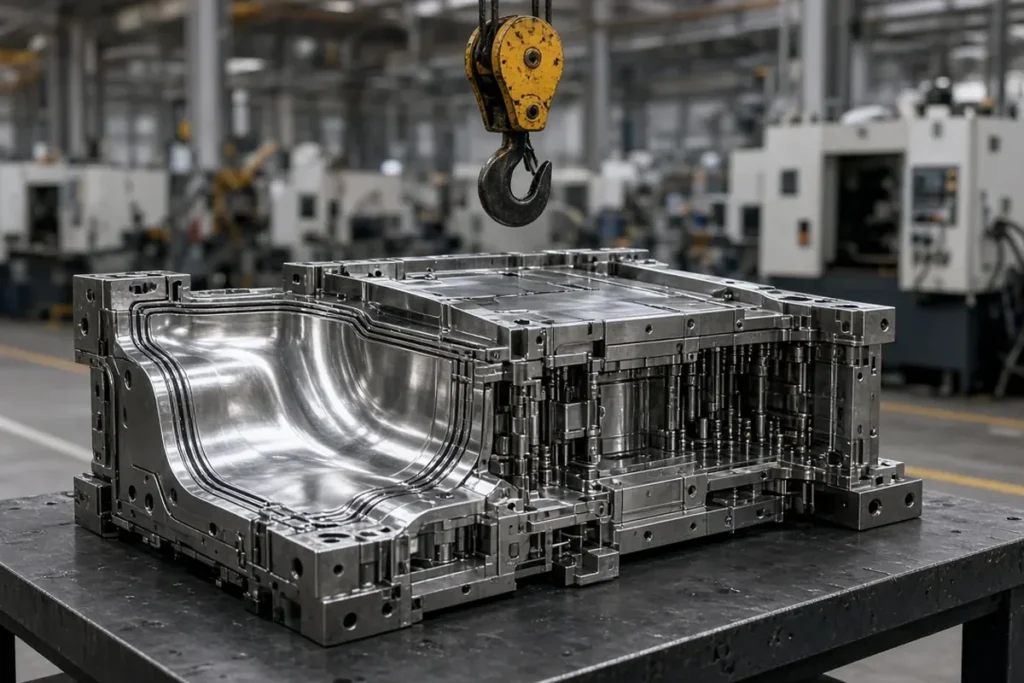
Automotive injection molding is the process of melting plastic pellets and injecting them under pressure into a steel mold to make car parts with the same shape every cycle. Most plastic car accessories, from front lips and grille trims to wheel covers, are made this way. For buyers, the mold, the material and the inspection plan decide quality.
Scope: this guide explains how injection-molded car accessories are made and what a buyer should check before sampling and mass production. How to start a custom project with Yirox is covered on our custom automotive plastic parts page, and real carbon fiber and fiberglass parts are compared in carbon fiber vs ABS vs fiberglass spoilers.
What is automotive injection molding?
Automotive injection molding is a high-volume process for making plastic car parts. A molding machine melts thermoplastic pellets, injects the melt into a closed steel mold, holds it under pressure while it cools, then opens the mold and ejects a finished part. The mold is a negative of the part, so every detail the buyer cares about, such as the curve of a front lip, the position of a clip or the texture on a trim, is cut into the steel first.
The process suits car accessories because they are sold by vehicle model in repeatable shapes. Once the mold is approved, a factory can make the same part again next month or next year with the same mounting points. That repeatability is the reason most plastic exterior trims, wheel covers and interior storage parts are injection molded rather than hand-made.
It is not the only way to make a plastic car part. The table compares injection molding with the other processes buyers often hear about when they ask for quotes.
| Process | How it works | Tooling | Best fit | Typical limits |
|---|---|---|---|---|
| Injection molding | Molten plastic injected into a closed steel mold | Highest upfront cost; long tool life | Repeat production of trims, lips, canards, wheel covers, clips, storage boxes | Tool changes are slow and costly; part design must allow ejection |
| Vacuum forming (thermoforming) | Heated plastic sheet pulled over a single-sided form | Lower tooling cost | Large, simple shapes and liners in lower volumes | Only one side is formed accurately; less detail, no clips molded in |
| Hand lay-up fiberglass or carbon fiber | Fiber layers and resin built up in an open mold | Low-cost molds | Low-volume body kits and real carbon parts | Labor-intensive; thickness and finish vary more between parts |
| 3D printing | Part built layer by layer from a digital model | None | Prototypes and fit-check samples | Slow and costly per part; surface and strength differ from molded parts |
For a buyer, the practical rule is simple: injection molding pays off when a part will be ordered again, and other processes make sense for prototypes, very large panels or small runs.
Which car accessories are injection molded?
Most rigid plastic accessories on a modern car are injection molded. That includes exterior styling parts, many replacement body parts, wheel accessories and a large share of interior storage and trim parts. Typical examples include:
- Exterior styling parts: front lips and splitters, bumper canards, side skirt extensions, rear diffusers, trunk and roof spoilers, mirror caps, fender trims and window louvers. Many of the parts in our body kits and aero parts range are made in ABS or PP this way.
- Replacement body parts: bumper covers, grilles, grille trims and lower bumper trims, usually in modified PP for impact resistance.
- Wheel accessories: full wheel covers, hubcaps and center caps. A snap-on wheel cover needs its retaining ring, clip tabs and spoke design molded accurately to stay on the rim.
- Interior and cargo parts: front trunk and rear trunk storage boxes, console trays, door sill strips and trim panels.
- Small functional parts: clips, brackets, caps and fastener covers that hold larger parts in place.
Some parts that look similar are made differently. Large soft cargo liners may be thermoformed, and real carbon fiber parts are laid up by hand or pressed in compression molds rather than injection molded. A “carbon fiber look” part is often an injection-molded ABS or PP part with a carbon-pattern finish, so the material line on the quote matters more than the product photo.
How is a plastic car accessory made, step by step?
A new injection-molded accessory moves from drawing to shipment in a fixed order, and each step has a sign-off that the buyer can ask to see. Typical production for an exterior styling part involves the following steps:
- Input check. The factory reviews the buyer’s 3D file, 2D drawing, sample part or vehicle scan, together with the vehicle list, target material, finish and mounting method.
- Design for manufacturing (DFM) review. Engineers check wall thickness, draft angles, rib design, undercuts and gate positions, then flag areas likely to show sink marks or warp. Changes are agreed before any steel is cut.
- Mold design and machining. The mold is designed with its parting line, cooling channels, ejector pins and any slides or lifters needed for undercuts, then machined from tool steel.
- First trial (often called T1). The mold is run on a molding machine and the first parts are checked for fill, dimensions and appearance. Most new molds need one or more rounds of adjustment.
- Sample approval. Samples are measured, test-fitted on the vehicle and finished in the agreed color or texture. The buyer approves a sample, and that sample becomes the reference for production.
- Production molding. Parts are molded with stable process settings. A take-out robot often removes parts so the cycle stays consistent.
- Finishing. Gates are trimmed and edges deburred. Parts that need paint get surface preparation, primer and paint, or a piano black or carbon-pattern finish.
- Inspection and test fit. Finished parts are checked against the approved sample for color, gloss, defects and fitting points, and samples from each batch are test-fitted.
- Packing. Parts are wrapped with protective film and packed so long parts do not bend in transit.
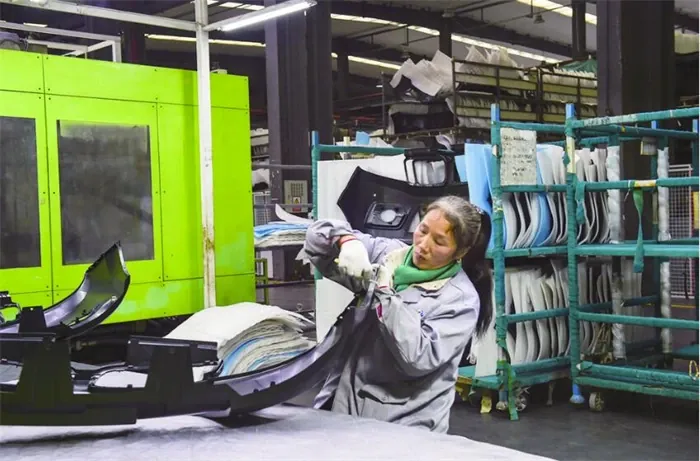
The two steps buyers most often skip are the DFM review and the sample sign-off. Skipping DFM is the most common reason a new tool needs costly changes later, because problems like a thick boss behind a show surface are much easier to fix on screen than in hardened steel.
Which plastics are used, and why?
Most car accessories use a small group of thermoplastics, and each one is chosen for a reason. ABS is the usual choice for painted and gloss black styling parts, PP for flexible impact parts, and ASA where a part must hold its color in the sun without paint. The table summarizes the common choices.
| Material | Why it is used | Typical accessories | What to watch |
|---|---|---|---|
| ABS | Rigid, takes paint and gloss finishes well, easy to mold with fine detail | Front lips, canards, spoilers, mirror caps, grille trims, wheel covers | Needs paint or a UV-stable coating outdoors; can crack if mounting is too stiff |
| PP (often talc- or rubber-modified) | Flexible, good impact resistance, low density | Bumper covers, lower lips, diffusers, wheel arch trims, storage boxes | Harder to paint; needs surface treatment and primer for adhesion; shrinks more than ABS |
| ASA | Weather and UV resistance with color molded in | Unpainted black exterior trims, louvers, pillar trims | Grade selection matters for deep black and gloss |
| PC/ABS | Higher heat and impact resistance than ABS | Interior trim, parts near heat sources | Higher material cost |
| TPE / TPO | Soft, flexible, rubber-like feel | Mats, liners, seals, soft edges | Odor and material grade should be checked for interior use |
| PA (nylon) | Tough and wear-resistant | Clips, brackets, fasteners | Absorbs moisture, which changes size and stiffness |
Material suppliers back these uses. INEOS Styrolution, for example, promotes its ASA grade for unpainted exterior parts that need UV resistance and a deep black color 5. Ask for the exact resin grade on the quote, not just “ABS” or “PP”, because grades of the same plastic can differ in impact strength, UV resistance and paint adhesion.
Recycled or regrind content is another point to agree in writing. Some regrind is normal in many factories, but the share should be agreed for show surfaces and parts that carry load. A capable supplier can put this in a recycled-content statement for each part; Yirox provides one on request.
What does the mold decide?
The mold decides most of what a buyer sees and feels in the finished part. Its design fixes where gates, parting lines and ejector marks appear, how evenly the part cools and how many parts each cycle produces. These are the mold decisions worth asking about:
- Gate location: where the plastic enters the cavity. A gate on a show surface leaves a visible mark, so gates are usually placed on hidden edges or the back side.
- Parting line: the seam where the two mold halves meet. On a styling part it should follow an edge, not cross the visible face.
- Draft and texture: walls need a slight taper (draft) to release from the mold. Textured or grained surfaces need more draft than polished ones.
- Slides and lifters: moving mold parts that form clips, hooks and undercuts. They add cost and maintenance but let clips be molded in.
- Cavities: a mold can make one part per cycle, a left-and-right pair, or several parts at once. More cavities raise tooling cost and lower part cost.
- Cooling: uneven cooling is a main cause of warp on long parts such as lips and side skirt extensions.
- Steel choice: harder steels resist wear and suit long runs and polished surfaces; softer steels are quicker to machine for shorter runs.
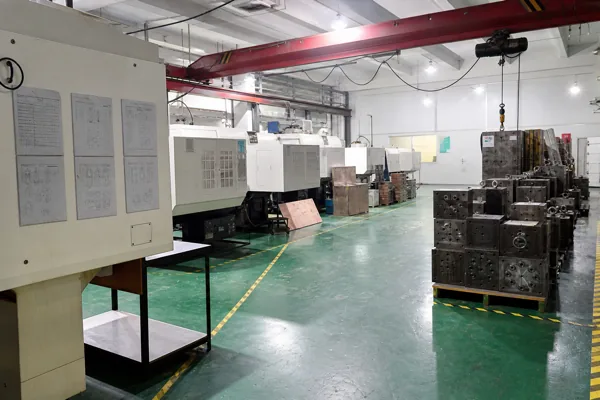
Mold cost is driven by part size, the number of cavities, slides and lifters, surface finish and steel type. Because these vary so much, compare quotes by asking what each mold includes, such as cavities, slides, texture and the number of trial rounds, rather than comparing one total figure.
Agree on mold ownership and storage before paying for a tool. The contract should state who owns the mold, where it is stored, whether it can be used for other customers and what happens if orders stop.
What defects should buyers look for?
Most injection molding defects can be seen with the eye or found with a simple fit and measurement check. The table lists the common ones, what causes them and how a buyer can check a sample.
| Defect | What it looks like | Usual cause | How to check a sample |
|---|---|---|---|
| Sink marks | Shallow dents on the show surface, often opposite ribs or bosses | Thick sections shrinking as they cool | View the surface at a low angle under even, bright conditions |
| Short shot | Incomplete part, missing edges or clips | Melt did not fill the cavity | Check all clips, tabs and thin edges are complete |
| Flash | Thin extra plastic along seams or holes | Worn mold, too much pressure or poor clamping | Run a finger along parting lines and mounting holes |
| Weld (knit) lines | Fine lines where two melt fronts met | Flow around holes or from more than one gate | Look near holes and openings; check strength at clip areas |
| Flow lines | Wavy patterns or streaks on the surface | Melt cooling unevenly as it flows | Most visible on gloss black and unpainted parts |
| Warpage | Part twists or bows; gaps when fitted | Uneven cooling or wall thickness | Lay long parts on a flat table; test-fit on the vehicle |
| Splay (silver streaks) | Silvery streaks fanning out from the gate | Moisture in the resin | Check near the gate area |
| Ejector marks | Round marks or shine changes | Ejector pins pushing the part out | Confirm marks are only on hidden faces |
| Color or gloss variation | Parts in one order do not match | Resin, colorant or paint batch differences | Compare against the approved sample side by side |
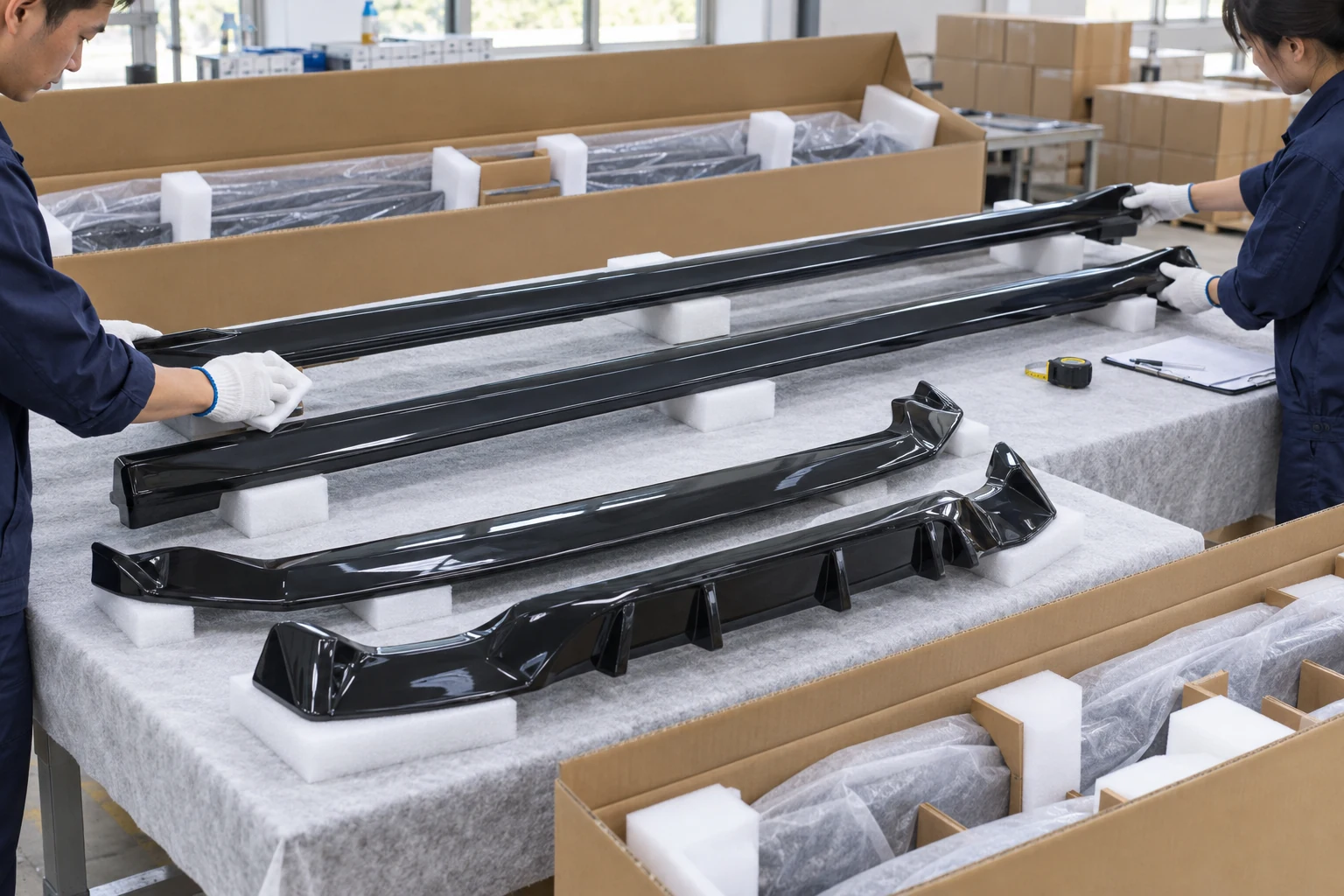
Gloss black parts show defects that a textured part would hide, so sink marks and flow lines matter much more on piano black trims than on grained black plastic. If the product will be sold as gloss black, approve the sample in gloss black, not in raw plastic.
How we put this together: the defect list and causes follow common industry practice for injection-molded parts, and the checks are the visual and fit checks a buyer can do without a lab. Standards cited below are listed in the references.
How should tolerances and appearance be specified?
Tolerances for plastic parts should be set on the features that affect fit, and appearance should be agreed with physical reference samples. Plastics shrink, warp and change with temperature far more than metals, so copying metal-part tolerances onto a plastic drawing usually raises cost without improving the part.
The main international reference is ISO 20457, “Plastics moulded parts — Tolerances and acceptance conditions.” Its second edition, ISO 20457:2026, was published in August 2026 and replaces the 2018 edition 1. It covers general and direct tolerances and acceptance conditions for injection-molded thermoplastic parts, and it notes that moldings can vary more than metal parts because of shrinkage, cooling and warpage. ISO also states that the standard does not address surface imperfections such as sink marks, flow structures and joint lines 1.
That gap is important for accessory buyers. Because cosmetic defects are not covered by the tolerance standard, appearance has to be agreed separately, usually with boundary samples and a written cosmetic standard that defines show surfaces, viewing distance and what is acceptable.
- Fit features: put direct tolerances on clip positions, mounting holes, tape surfaces and the edges that meet the vehicle body.
- Gloss: gloss can be measured with a gloss meter to ASTM D523 at a stated angle 3. Agree the target and range against the approved sample.
- Color: color difference can be measured to ASTM D2244, which calculates color differences from instrument readings 4. Agree the acceptable difference with the supplier.
- Weathering: for exterior parts, ask whether the material or finish has been tested to an automotive weathering method. SAE J2527 is a performance-based standard for accelerated exposure of automotive exterior materials in a xenon-arc apparatus 2. The test duration and pass criteria come from the buyer’s or material specification, not from the method itself.
Not every aftermarket accessory needs every test. A simple trim sold in small batches may only need a fit check and agreed boundary samples, while a private-label program sold across many markets justifies written color, gloss and weathering targets.
What should buyers check before sampling and mass production?
A buyer should check the inputs before sampling, the sample before tooling is final, and the first production run before full volume. The checklist below is the order we recommend for an injection-molded accessory.
Before sampling (RFQ stage)
- 3D file, 2D drawing or a physical sample, with show surfaces marked.
- Vehicle list with model, generation and year range, plus OEM part numbers where they exist.
- Material grade, color and finish (raw, painted, gloss black, carbon pattern or textured).
- Mounting method: clips, screws, automotive tape or a mix, and whether drilling is allowed.
- Target market and any test or labeling requirements.
- Packaging: retail box, bulk, private label, protective film.
- Mold ownership, storage terms and the number of sample rounds included.
At sample approval
- DFM report signed off, with any design changes recorded.
- Dimension report on fit features, measured against the drawing.
- Test fit on the actual vehicle, with photos of gaps and mounting points.
- Appearance check in the final finish, plus boundary samples for color, gloss and defects.
- Material certificate for the resin grade.
- Paint adhesion or weathering results where the specification calls for them. Yirox can supply weathering test reports for exterior materials and finishes.
- Two or more approved samples, one kept by the buyer and one by the factory.
Before full production
- A pilot run made with production settings, checked against the approved sample.
- For OEM-level programs, the documentation set the customer requires. In the automotive supply chain this is often the Production Part Approval Process (PPAP), which AIAG describes as the industry standard for confirming that engineering design record and specification requirements are consistently met 6. Yirox can prepare PPAP documents for programs that require them.
- An agreed pre-shipment inspection plan, including sample size, the defects to check and who signs off.
- A change-control rule: no change to mold, material, color or process after approval without written notice and a new sample.
The change-control rule protects buyers more than any single test, because many quality problems start when a resin, colorant or mold insert changes quietly after the first order.
What are the risks and exceptions?
Injection molding is the right process for most repeat accessories, but it has limits that buyers should plan around.
- Low volumes: a steel mold may not pay off for a part that will sell only a few hundred units. Vacuum forming, fiberglass or an existing catalog part may be a better start.
- Model refreshes: when a carmaker redesigns a bumper or tailgate, the old mold no longer fits the new vehicle. Check the generation and the remaining selling life before tooling for a model that is due for a refresh.
- Large panels: very large parts need large machines and molds. Confirm the supplier can mold the part in one piece, or plan joints and their position.
- Real carbon fiber: structural carbon parts are not injection molded. A carbon-pattern finish on ABS is a different product at a different price, and listings should say which it is.
- Finish matching: gloss black, paint and carbon-pattern finishes can vary between batches. Keep the approved sample and compare each batch against it.
- Quality certificates: ISO 9001 and IATF 16949 certify a supplier’s quality management system 7. They are not product certificates, and they do not replace a sample approval for your part.
How should distributors and brands work with a molding supplier?
Distributors and aftermarket brands get the best results when they treat the supplier’s existing molds and new tooling as two different routes. An existing catalog part can be sampled and ordered quickly, while a new part needs DFM, tooling time and sample rounds before the first shipment.
- Start with existing tools where you can. Ask which catalog parts already have approved molds for your target vehicles. Many suppliers, Yirox included, offer low MOQ on selected items.
- Use new tooling for parts that will sell repeatedly. Private-label exterior trims and wheel covers for popular models are typical candidates.
- Bundle by vehicle. A front lip, canards and a rear diffuser for the same model can share finish standards, packaging and test-fit photos.
- Keep one specification sheet per part. It should list the vehicle list, material grade, finish, mounting method, packaging and the approved sample reference.
- Ask how parts outside the molding process are handled. Metal brackets, fasteners or other products are often sourced from partner factories, and a good supplier says which route each part takes before the order.
For buyers comparing suppliers, the OEM vs aftermarket exterior accessories guide explains how fit and finish expectations differ between the two markets.
Conclusion
Automotive injection molding turns a part design into a steel mold that can make the same accessory for years. That is why it is the standard process for front lips, canards, trims, wheel covers and storage boxes, and why the early steps, from the design review to the approved sample, decide how good every later shipment will be.
For buyers, the most useful habits are practical ones. Ask for the exact resin grade, agree tolerances on the features that affect fit, settle appearance with boundary samples because the tolerance standard does not cover cosmetic defects, and require written notice before anything changes after approval. Those checks cost little compared with a container of parts that do not fit or match.
Next step
Pick one accessory you plan to add and write down its vehicle list, finish and mounting method. With that and a drawing or sample, a supplier can tell you whether an existing mold fits or a new tool is needed.
Yirox molds exterior styling parts and wheel covers in its own injection molding factory of about 20,000 m² in Wuxi, and can provide PPAP documents, weathering test reports and recycled-content statements with your samples. It checks drawings, vehicle lists and bracket specifications with you before sampling. Send your part details through our sourcing solutions page, or see how a project runs on the Yirox homepage.
Frequently asked questions
What is automotive injection molding?
It is a process that melts plastic pellets and injects them under pressure into a steel mold to make car parts. It is used for trims, lips, wheel covers, clips and many interior parts because each cycle produces the same shape.
What plastics are used for injection-molded car parts?
ABS, PP, ASA, PC/ABS, TPE and nylon are the most common. ABS suits gloss and painted styling parts, PP suits flexible impact parts, and ASA suits unpainted exterior trim that must resist UV.
How can you tell if a car part is injection molded?
Look for a thin parting line along an edge, small gate marks, round ejector pin marks and molded-in clips or ribs on the back side. Hand-laid fiberglass parts usually have uneven thickness and no molded clips.
What are the most common injection molding defects?
Sink marks, short shots, flash, weld lines, flow lines, warpage, splay and color variation. Gloss black parts show sink marks and flow lines more clearly than textured parts.
Who owns the injection mold?
It depends on the contract. When a buyer pays for a custom mold, the agreement should state ownership, storage location, whether others may use it and what happens if orders stop.
Is IATF 16949 a product certification?
No. IATF 16949 is a quality management system standard for automotive suppliers. It shows how the supplier manages quality, but each part still needs its own sample approval.
References
[1] ISO. “ISO 20457:2026 Plastics moulded parts — Tolerances and acceptance conditions.” Edition 2, published 2026-08; scope and exclusions.
[2] SAE International. “SAE J2527_201709: Performance Based Standard for Accelerated Exposure of Automotive Exterior Materials Using a Controlled Irradiance Xenon-Arc Apparatus.”
[3] ASTM International. “ASTM D523-14(2018) Standard Test Method for Specular Gloss.”
[4] ASTM International. “ASTM D2244-23 Standard Practice for Calculation of Color Tolerances and Color Differences from Instrumentally Measured Color Coordinates.”
[5] INEOS Styrolution. “Luran S SPF60 selected for automotive application.” ASA for UV-resistant, unpainted exterior parts.
[6] AIAG. “PPAP-4 Production Part Approval Process.” Purpose and scope of PPAP.
[7] IATF. “About IATF 16949:2016.” Automotive quality management system standard.