



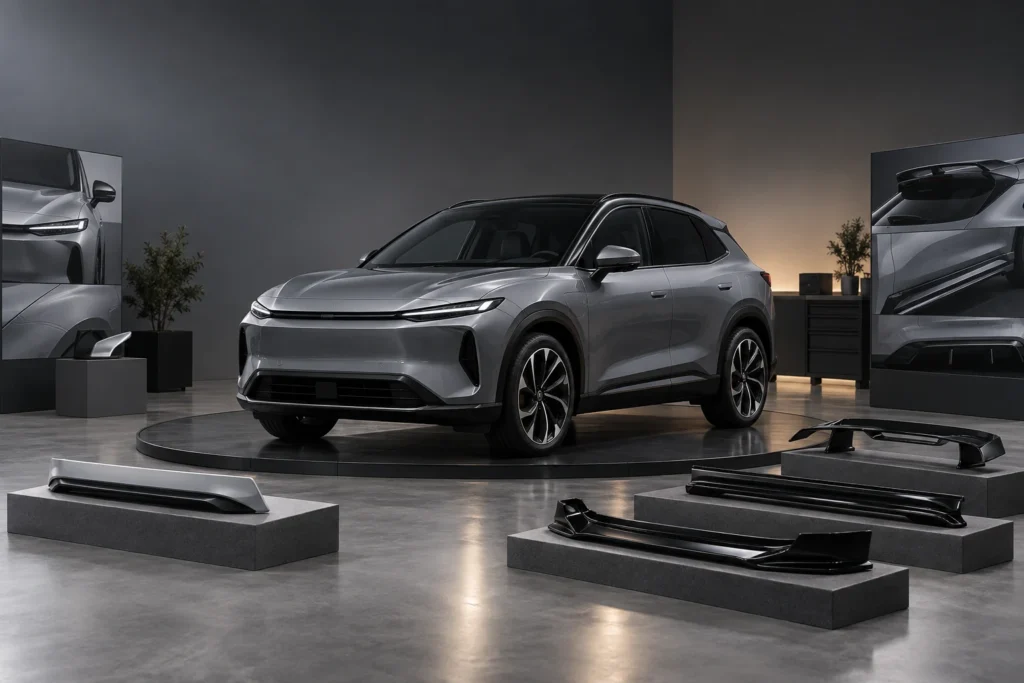
Neither OEM nor aftermarket car parts are universally better for a buying program. OEM vs aftermarket car parts is a choice between a factory-channel part and a part made outside that channel; the safer route depends on fitment risk, documentation and total cost, not unit price alone.
For procurement, sourcing and import teams, “OEM vs aftermarket” is still too broad on its own. A replacement bumper cover, a front lip, a long side skirt and a small mirror cover do not carry the same installation, finish or shipping risks. For side skirt types, materials and fitment checks, see what are side skirts on a car. A quote that looks cheaper at the unit level can become expensive after samples, tooling, freight, returns, rework, damaged cartons and slow repeat supply are included.
The comparison below separates genuine OEM, qualified aftermarket and private-label options, then gives a category-by-category validation workflow, including buyer checks for bumpers and other body-adjacent parts. It is written for buyers preparing an RFQ, requesting samples or shortlisting a supplier for a specific target market. Online sellers can also see how we work with e-commerce sellers.
Scope: this page is the OEM vs aftermarket car parts buying comparison, with fitment, warranty, cost and RFQ checks that include bumpers and body parts. It does not explain the difference between a bumper cover and the bumper beam; that anatomy is in bumper cover vs bumper. Front lips, splitters and rear bumper diffusers are treated here as high-fitment exterior parts, with the front lips and splitters and rear bumper diffuser category pages as starting points, not fitment proof.
Table of Contents
What Is the Difference Between OEM and Aftermarket Car Parts?
The important difference in OEM vs aftermarket car parts is not simply who made the part. It is whether the part has a verified relationship to the vehicle program, whether its fit and finish are documented, and whether the supplier can support the buyer’s volume, branding and market requirements.
Genuine OEM car parts are sold through the vehicle brand’s original-equipment or approved accessory channel and are normally identified by the vehicle maker’s part number, packaging or distribution system. Buyers should still verify the exact vehicle version, because a genuine part for one year, trim or body style may not fit another.
Aftermarket car parts are made by a company other than the vehicle manufacturer. “Aftermarket” describes the supply route, not a guaranteed quality level. An aftermarket part may be a basic styling add-on, a high-quality model-specific replacement, a flexible universal product or a poorly documented item that only resembles the intended application.
Private-label car parts are aftermarket products sold under the buyer’s brand. They may come from an existing SKU, a modified design or a new development based on a drawing, physical sample or vehicle reference. Private label is therefore a commercial and branding model, not proof that the product is equivalent to a genuine OEM part.
The term OEM is also used loosely in international sourcing. Ask what it means in the quotation and request evidence for vehicle coverage, material, finish, installation, sample status, packaging and documentation. The useful question is not “Is this labeled OEM?” but “Which requirements are verified, project-specific or still awaiting a sample?”
Which Option Is Better? Use This Decision Matrix
OEM is the better procurement choice when the cost of a fitment, brand or documentation failure is higher than the premium paid for the original channel. Qualified aftermarket or private-label sourcing is often the better choice when the buyer needs a broader supplier base, custom branding, alternative materials or a target price that the original channel cannot support.
| Buying factor | Genuine OEM route | Qualified aftermarket or private-label route | What the buyer should verify |
|---|---|---|---|
| Fitment consistency | Defined vehicle program | Depends on data, tooling and sample | Model/year/trim/mounting/sample fit |
| Material and finish | Original or approved specification | More choices may be available | Substrate, coating, gloss, color and limits |
| Customization | Usually limited | Logo, packaging, color, bundle or specification changes | Drawing, artwork, MOQ, tooling and approval |
| Durability evidence | Original-channel documentation may exist | Varies by product and supplier | Test scope, sample result and inspection record |
| Availability | Channel or model dependent | More supplier options, but continuity varies | SKU status, replenishment and repeat route |
| Lead time | Predictable if stocked | May include sampling, tooling or production | Sample, production, packing and shipping dates |
| Unit cost | Often higher | More price positions | Landed cost, not quote price alone |
| Branding | Vehicle-brand presentation | Strong for private label | Labels, manuals, cartons and trademark limits |
| Supplier choice | Usually concentrated | Multi-source or consolidated programs | Capability, partner control and batch consistency |
| Verification status | Defined part identity | Proof must be separated from sales language | Specification, sample approval and document list |
This matrix is a starting point, not a universal scorecard. A genuine OEM spoiler may suit a dealer-aligned program, while a qualified private-label side-skirt line may suit a distributor that needs branded cartons, a specific finish and repeatable mixed-SKU supply.
Which Car Parts Need the Strictest Fitment Validation?
The strictest validation is needed for parts with many mounting points, large visible surfaces, close cosmetic interfaces, vehicle-specific contours or high shipping risk. Buyers should choose the accessory category before comparing quotations because a supplier’s sample checklist should change with the part.
| Accessory category | Typical validation pressure | Checks before bulk approval |
|---|---|---|
| Front lips and splitters, plus replacement front bumper covers | Visibility, clearance, sensor or grille openings, and multiple mounting interfaces | Vehicle version, gap, holes, sensor/grille clearance, hardware and scrape risk. Separate a styling add-on from a replacement cover; see the bumper checks below. |
| Rear bumper diffusers, plus replacement rear bumper covers | Rear design, exhaust or EV layout, fins and sensors may differ | Vehicle version, shape, exhaust opening, sensor zones, finish and edges. For cover versus beam, use bumper cover vs bumper. |
| Side skirts and rocker extensions | Long parts can bend, scratch or mix left/right | LH/RH, straightness, curve, mounting points, carton length and support |
| Spoilers and wings | Cosmetic impact and installation reliability | Body style, curve, adhesive/drilling route, edge protection and claim wording |
| Exterior trim and covers | Curvature and adhesive preparation can fail | Contact area, finish, vehicle-year coverage and separation packing |
| Guards, steps and running boards | Mounting and load expectations can be demanding | Mounting points, hardware, clearance, intended load and documents |
| Racks and protective accessories | Interface, clearance and use conditions affect risk | Roof/bed type, mounting, clearance, material, load instructions and rules |
For category-specific comparison, start from Yirox’s auto exterior accessories category and narrow the request to front lips and splitters, rear bumper diffusers, body kits and aero parts, side skirt programs or spoilers and wings. A category page is a starting point, not fitment proof.
How should buyers compare OEM vs aftermarket bumpers and body parts?
Treat a replacement bumper cover or body part as a different decision from a bumper-area styling part. The first has to match the original opening, gaps, attachments and any sensor or camera cutouts. The second is an add-on at the front or rear bumper area, such as a lip, splitter or diffuser. Bumper cover vs bumper explains the visible cover and the structural beam; this table is only the buying check.
| Decision point | Replacement bumper cover or body part | Bumper-area styling part (lip, splitter, diffuser) | What the buyer should verify |
|---|---|---|---|
| Part role | A visible cover or related body part that has to follow the original interface | An add-on at the front or rear bumper area | State in the RFQ whether you are replacing a body part or adding a styling part. |
| Fitment evidence | Make, model, year, trim, body style, holes, brackets and sensor or camera openings | Vehicle version, gap, ground clearance, grille or exhaust opening, and mounting method | Trial-fit the exact vehicle version. Do not treat a catalog photo as approval. |
| Quality evidence | Specified material and finish, plus any applicable certification for that replacement part | Material, gloss, edge quality and installation method | Ask for the product scope, method and record. For certified replacement bumper or plastic body parts, CAPA publishes standards, including CAPA 501 for bumper parts and CAPA 201 for plastic parts,2 and a vehicle test fit that checks gap, flush, holes and brackets.3 That is a document check, not a claim that a given aftermarket part is certified. |
| Where to start | Use bumper cover vs bumper for the cover-versus-beam distinction | Review the front lips and splitters and rear bumper diffuser categories | Match the RFQ to the correct category. A styling catalog is not a crash-part catalog. |
When Is OEM the Safer Choice?
OEM is usually safer when the buyer must preserve a factory appearance, match a known part number, maintain a vehicle-brand sales promise or minimize uncertainty around a critical interface. It is also more defensible when the target market or channel requires documentation that only the original program can provide.
Choose the genuine OEM route first when:
- Exact factory integration matters. The accessory must align with existing body contours, sensors, lamps, grilles, trim lines or factory mounting points with minimal interpretation.
- The sales channel depends on brand alignment. A dealer, fleet program or vehicle-brand-adjacent retailer may need the original packaging, part number or approved distribution path.
- The failure cost is unusually high. A visible mismatch can create installation labor, customer complaints, lost channel trust and expensive returns that outweigh a lower aftermarket price.
- The program is small and customization is unnecessary. Buying a verified genuine part may be more efficient than developing samples, tooling, branded packaging and a new approval file.
- The accessory is safety-adjacent or use-sensitive. For steps, racks, guards or other parts with structural, clearance or load implications, the buyer should select the route with the clearest product-specific evidence, not simply the lowest quote.
OEM does not remove the need for checking. Model years, trim packages, regional versions and body styles can change. A genuine part also may be unavailable, discontinued, expensive to replenish or unsuitable for the buyer’s packaging and margin model. Record the exact part identity and intended application rather than using “OEM” as a substitute for a specification.
Warranty is a related reason to be precise, not a reason to assume that every aftermarket part is forbidden. For U.S. consumer auto warranties, the Federal Trade Commission says a manufacturer’s warranty stays in effect if you use aftermarket or recycled parts, but a defective part or an incorrect installation that damages a covered part can lead to a denial for that damage; the manufacturer or dealer must prove the aftermarket or recycled part caused the damage before denying that coverage.1 Contract wording, destination-market rules and B2B supply terms can differ, so verify the applicable warranty language for the program before making a promise to a customer.
When Can Qualified Aftermarket or Private Label Be Better?
Aftermarket or private-label sourcing can be better when the buyer needs a differentiated product line, more control over finish and packaging, a broader supplier route or a staged sample-to-volume process. The condition is that the supplier can prove the required fitment and manage the changes that make the program commercially useful.
This route is often practical when:
- The buyer needs a specific assortment. Single parts, partial kits and full exterior packages can be combined around a vehicle model instead of following the original channel’s fixed range.
- Brand presentation matters. Retail cartons, labels, manuals, barcodes and product naming can be planned as one private-label specification.
- The target market wants a different material or finish. Gloss black ABS, matte finishes, carbon-look surfaces, primer-ready parts or selected color routes may support different price positions. Carbon-look should not be described as real carbon fiber unless the exact material is verified.
- The buyer wants supplier flexibility. A qualified source can support standard products, sample evaluation, tooling, packaging review and repeat supply without forcing every SKU through one vehicle-brand channel.
- The buyer is testing demand. A representative sample or small trial can reveal fitment, installation and customer-response issues before a large branded commitment.
Private label still requires boundaries. Confirm whether a change is cosmetic or structural, whether it requires a new mold, whether the artwork affects packaging lead time, and whether the supplier can keep a reference sample or approved specification for future batches. Yirox’s OEM and private-label service describes a route from drawings or samples through branding, production coordination and document review; the final feasibility, MOQ and lead time remain product-specific.
How Should Buyers Verify Materials, Finish, Installation, and Compatibility?
Buyers should verify the vehicle identity first, then the physical specification, then the installation and finish. A product photograph can confirm style, but it cannot confirm that a part clears the correct bumper, follows the correct curve or arrives with the right hardware.
Use this compatibility checklist before approving a quote:
- Vehicle identity: make, model, production year, trim, body style and regional or EV/fuel version.
- Reference identity: OE part number, vehicle photos, measurements, 3D data, drawing or physical sample when available.
- Mounting location: front, side, rear, roof, trunk, mirror, handle, window, pillar, bed or frame.
- Part definition: lip, splitter, diffuser, bumper, side skirt, spoiler, wing, trim cover, guard, step, rack or protective accessory.
- Installation route: tape, screws, clips, brackets, existing holes, drilling or a SKU-specific no-drill method.
- Material: ABS, PP, PU, FRP, verified carbon fiber, carbon-look material or another defined substrate; include thickness or construction details when relevant.
- Finish: gloss black, matte black, chrome or bright finish, carbon look, primer-ready or painted; define color references and acceptable variation.
- Hardware and instructions: mounting kit, adhesive, clips, brackets, installation sheet, left/right identification and replacement-part policy.
- Use and claim limits: styling-oriented language versus verified structural, aerodynamic, load or safety claims.
Ask the supplier to mark every field as confirmed, sample to be checked, document available, project-dependent or not applicable. That simple status column prevents a general capability statement from being mistaken for proof about a specific SKU.
Verification only helps if it is measured the same way on every batch. Our page on quality inspection with CMM and first article checks shows what is checked on exterior parts and what records a buyer can request.
How Should Sample and Pre-Production Approval Work?
A sample process should produce a recorded decision, not just a package that was opened and photographed. Fitment-sensitive or cosmetic parts should be trial-fitted on the intended vehicle version before the buyer commits to a bulk program. In OEM supply chains, the formal version of that record is a PPAP; our guide to PPAP levels and elements shows how aftermarket buyers can scope one.
Use a staged approval workflow:
- Freeze the sample brief. Record vehicle identity, part position, material, finish, installation route, hardware, packaging and sales channel.
- Check the sample. Confirm dimensions, surface condition, left/right marking, accessories, carton condition and visible defects against the quotation.
- Run a fitment trial. Install it on the target vehicle or a validated reference body. Check gaps, curves, mounting points, clearance and alignment.
- Test installation. Verify adhesive preparation, screw or clip access, bracket position, drilling and whether instructions are usable without improvisation.
- Review finish and material. Compare gloss, color, texture, carbon-look pattern, edges and thickness with the approved reference. Do not turn a visual claim into a material claim.
- Approve packaging and the production standard. Confirm support, surface protection, carton strength, labels, left/right identification, approved photos, measurements, drawing revisions and inspection points.
For a multi-piece kit, approve both each part and the visual continuity of the complete set. Individually acceptable parts can still look mismatched when installed together.
What Is the Total Sourcing Cost Beyond Unit Price?
The relevant comparison is total landed and failure-related cost, not the number printed beside one unit in a quotation. A lower unit price is useful only if the part arrives in saleable condition, fits the intended vehicle and can be reordered with similar quality.
| Cost factor | Questions to include in the comparison |
|---|---|
| Quoted product price | Is the price for a genuine part, standard aftermarket SKU, modified SKU or new development? |
| Tooling and engineering | Are molds, fixtures, drawings, scans, samples or engineering changes included or charged separately? |
| Sampling and approval | How many samples are needed, who pays freight and what happens if fitment fails? |
| Packaging | Does the carton protect long parts, glossy surfaces, fins, corners and LH/RH pairs? |
| Freight and dimensional weight | Will oversized cartons, mixed SKUs or protective inserts change the landed cost? |
| Defects and rework | Who pays for incorrect holes, poor finish, warped parts, missing hardware or rework? |
| Returns and installation | What labor, replacement freight, customer refund or installer support follows a fitment failure? |
| Supply continuity | Can the approved material, finish, packaging and hardware be repeated in the next batch? |
| Documentation and labeling | Are target-market labels, manuals, product records or inspection documents part of the project? |
What Supplier Documents Should Buyers Request?
Request documents by product and destination market, separating mandatory evidence from helpful evidence and unverified claims. Exterior accessories do not all require the same certificates or tests.
| Evidence group | What may belong here | Buyer action |
|---|---|---|
| Target-market requirements | Safety, chemical, labeling, packaging, installation or import rules | Confirm for the exact category and destination |
| Customer-requested evidence | Material declaration, test, inspection, drawing, BOM, packing or batch record | State format and revision before sampling |
| Supplier-claimed evidence | “OEM quality,” “universal fit,” “no drill,” “real carbon” or “certified” | Ask for product, scope, method and validity |
| Awaiting verification | Fitment, finish, tolerance, lead time, MOQ, documents or warranty | Keep it open in the RFQ |
Useful records include the drawing, material and finish specification, installation method, hardware list, sample photos, fitment record, inspection checklist, packaging diagram, carton dimensions, labels and batch traceability. For a replacement bumper cover or other body part, ask whether a relevant certification or test record applies to that exact part — CAPA, for example, publishes standards for replacement bumper parts and plastic body parts and a vehicle test fit process.23 Do not treat the word “certified” or “OEM quality” as a substitute for the document. Yirox’s product-specific compliance support can help organize the request, but the set must match the exact product and market.
> 2026 verification note: Fitment logic, material selection, sample approval and total-cost analysis remain stable decision criteria. Reconfirm the current product specification, documentation requirements, warranty implications, certifications, lead times, MOQ, packaging and commercial terms for the exact SKU and destination market before placing an order.
What Should an OEM vs Aftermarket Parts RFQ Include?
An RFQ should give the supplier enough information to check feasibility before quoting. Identify the vehicle, part, market, material, finish, packaging, quantity and timeline instead of sending only a product photo.
| RFQ field | Example information to provide |
|---|---|
| Product/application | Replacement bumper cover, front lip, side-skirt pair, diffuser, spoiler or trim set |
| Vehicle identity | Make, model, year, trim, body style, regional version and EV/fuel configuration |
| Part position and scope | Front, side, rear, roof, trunk, mirror or trim; single SKU, partial kit or full kit |
| Fitment reference | OE number, drawing, dimensions, photos, 3D data or sample |
| Material and finish | ABS, PP, FRP, verified carbon fiber or carbon look; gloss, matte, chrome, primer-ready or painted |
| Installation | Tape, screws, clips, brackets, existing points, drilling, hardware and instruction requirements |
| Target market | Destination country or region, sales channel, installer expectations and relevant document needs |
| Quantity | Sample quantity, trial quantity, first order estimate and expected repeat volume |
| Packaging | Retail carton, master carton, long-part support, surface protection, labels, barcodes and mixed-SKU packing |
| Timeline | Sample deadline, approval date, first shipment target and replenishment expectation |
| Brand program | Logo, label, manual, carton artwork, color, private-label scope and approval owner |
Buyers who are still defining their category can use Yirox’s automotive sourcing solutions as a structure for organizing product, vehicle, market, quantity and packaging inputs. A clear brief makes it easier to compare OEM, standard aftermarket and private-label routes on the same basis.
If you are sourcing OEM vs aftermarket car parts or exterior accessories for a specific vehicle and market, share the vehicle make, model, year, trim, required material or fitment, estimated quantity, and timeline. We can help you prepare a focused specification, sample, and quotation request.
The right route also depends on how you sell: an importer, a private brand and an online seller each need a different mix of fitment data, packaging and order size. Our overview of solutions for aftermarket parts buyers matches each buyer type to its own program.
Before you send an RFQ, check what the factory does in-house. Our auto parts manufacturing capabilities page lists molding, painting, chrome plating, inspection and 3D scanning in one IATF 16949 certified factory.
Conclusion: Choose the Lowest-Risk Fit for the Program
The better choice in OEM vs aftermarket car parts depends on the part and the business model. Genuine OEM is strongest when exact factory integration, channel alignment or documented original specification outweighs price and customization. Qualified aftermarket or private-label supply is stronger when the buyer needs differentiated packaging, a broader assortment, flexible material and finish choices, supplier diversity or a staged route from sample to volume.
The decision should be made in this order: define the part category, confirm the vehicle version, identify fitment and cosmetic risk, lock material and finish, verify installation, approve a sample, review packaging and documents, then compare total landed and failure-related cost. For bumpers, decide first whether the part is a replacement cover or a styling add-on, and keep that check separate from the cover-versus-beam anatomy. That order protects the buyer from treating a catalog claim or low unit price as a complete sourcing decision.
Next step
Yirox, an auto parts and accessories supplier in Wuxi, China, with its own injection molding factory, can support qualified aftermarket and private-label programs for exterior styling parts and replacement body parts. Share the vehicle, part, market and quantity, then request verified specifications and a quote; for bumper-area styling parts, review the front lips and splitters and rear bumper diffuser categories.
Frequently asked questions
What is the difference between OEM and aftermarket car parts?
Genuine OEM parts are sold through the vehicle brand’s original-equipment or approved channel and are usually identified by the original part number or packaging. Aftermarket parts are made by a company other than the vehicle manufacturer; private-label parts are aftermarket products sold under the buyer’s brand. Aftermarket describes the supply route, not a guaranteed quality level.
Are aftermarket car parts as good as OEM parts?
Not automatically, and not never. Quality varies by part, supplier and the evidence behind the fit, finish and documentation. Compare a qualified aftermarket or private-label part against a written specification and a sample, rather than against the word “OEM quality.”
When is OEM the safer choice, and when is qualified aftermarket better?
Choose genuine OEM when factory integration, brand-channel alignment or original documentation outweighs price and customization. Choose a qualified aftermarket or private-label route when validated fitment plus packaging, supplier choice, material options or a target price matter more.
Do aftermarket car parts void the warranty?
Not automatically. For U.S. consumer auto warranties, the Federal Trade Commission says coverage stays in effect if you use aftermarket or recycled parts, but a defective or incorrectly installed part that damages a covered part can affect coverage for that damage, and the manufacturer or dealer must prove the aftermarket or recycled part caused it.1 Verify local and contract rules before promising coverage.
How should buyers compare OEM vs aftermarket bumpers?
First decide whether you need a replacement bumper cover or a bumper-area styling part such as a lip, splitter or diffuser, then validate the exact vehicle version, gaps, attachments and any sensor openings. Use bumper cover vs bumper for the cover-versus-beam distinction, and start styling add-ons from the front lips and splitters or rear bumper diffuser categories.
Which car parts need the strictest fitment validation?
Front lips, bumpers, rear diffusers, side skirts and spoilers usually deserve close attention because they are visible, model-specific or exposed to mounting and shipping risks. When the rear part is a low trunk spoiler versus a raised wing, spoiler vs wing separates the shapes. For side steps, running boards vs nerf bars vs power steps compares the three styles. For front guards, bull bars vs grille guards covers mounting, sensor and spec checks.
What should an RFQ and sample approval include?
Send make, model, year, trim, body style, regional or EV/fuel version, part position, reference photos or drawings, material, finish, installation method, packaging, target market, quantity and timeline. Compare the sample with that brief, trial-fit it on the intended vehicle, check gaps and mounting points, review packaging and record the approved reference before a bulk order.
What documents should buyers request from a supplier?
Ask for documents that apply to the exact product and destination: drawings, material and finish details, installation instructions, inspection records, packaging specifications, labels, manuals, batch records and any applicable test or certification documents. Separate mandatory evidence from supplier claims such as “OEM quality” or “certified.”
References
[1] Federal Trade Commission. “Auto Warranties and Auto Service Contracts.”
[2] Certified Automotive Parts Association. “What We Certify.”
[3] Certified Automotive Parts Association. “The CAPA Vehicle Test Fit (VTF).”