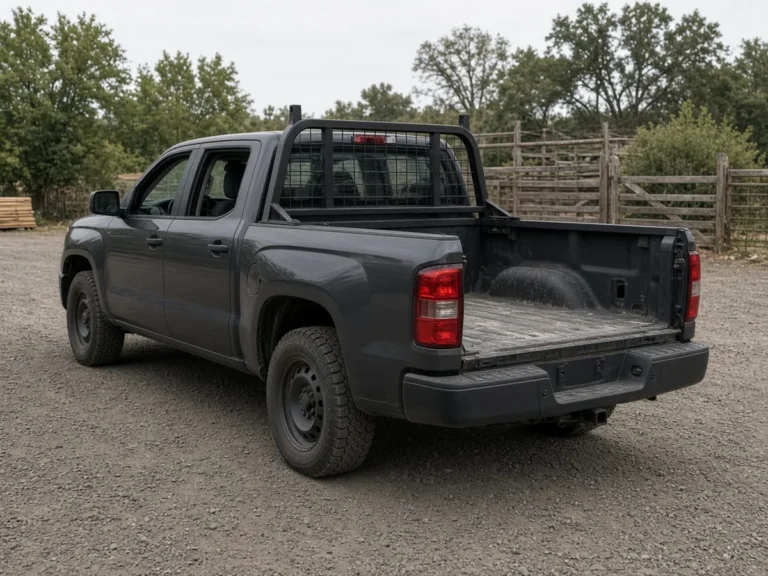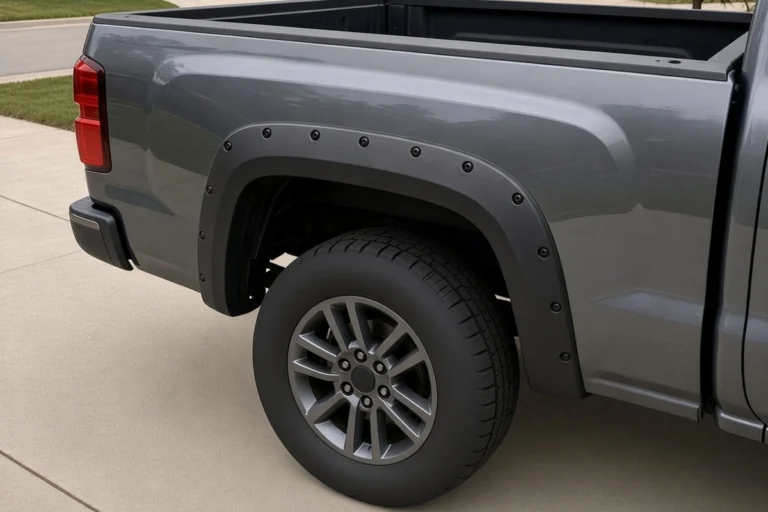




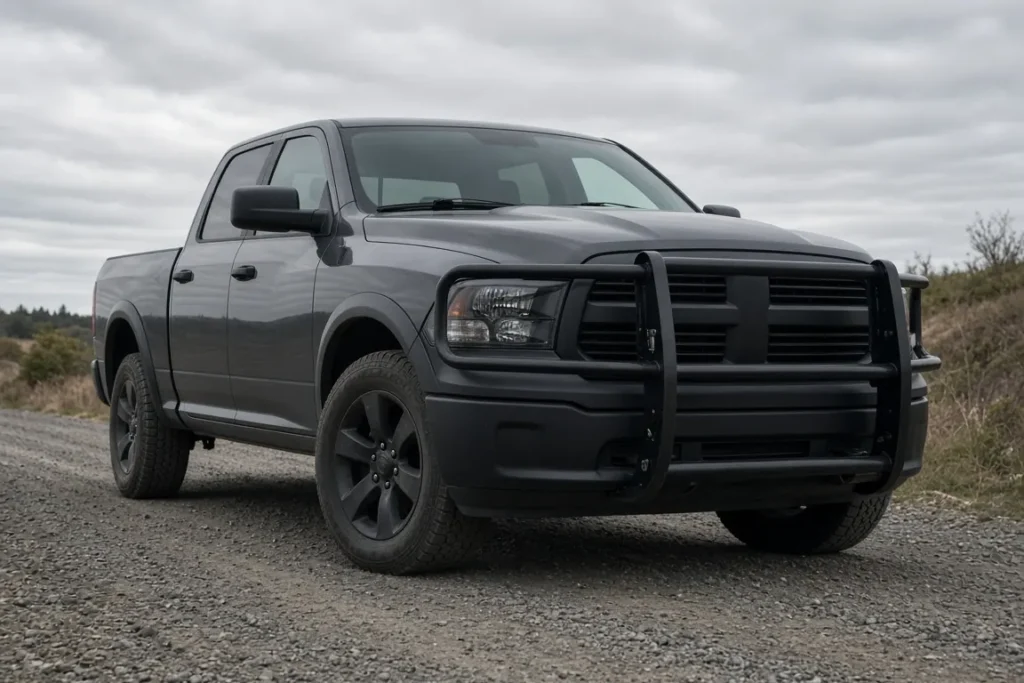
In the bull bar vs grille guard choice, the difference is coverage: a bull bar is a short tubular bar that protects the center of the front end, while a grille guard is a larger frame that covers the whole grille and usually the outer front corners. “Bumper guard” can mean either one. A grille guard covers the grille opening; for mesh, honeycomb and OEM-style grille types and how to choose a replacement, see car grille types.
Scope: this guide covers bolt-on front guards for pickups and SUVs. Full replacement steel bumpers are compared where they overlap. Rules on mounting and legality differ by country and by vehicle, so check the instructions for your exact model and local rules before you buy or fit one.
What are a bull bar, a grille guard and a bumper guard?
These names get mixed up in forums, on marketplaces and even in some product listings. One owner calls a part a brush guard, the next calls the same part a grill guard, and a seller lists it as a bumper guard. Before comparing them, it helps to pin down what each name usually means in the North American truck market.
Brush guard is the name that causes the most mix-ups. Some sellers use it as another word for a grille guard. Others use it for the side wings that wrap toward the headlights on a full grille guard.
Some trail parts sold as brush guards are lighter tube sets meant for branches and brush, with less frame coverage than a heavy grille guard. Before you compare price or weight, confirm what the part actually covers: the center of the bumper only (typical bull bar), the grille plus the outer corners and lamps (typical grille guard), or a lighter brush-oriented design.
- Bull bar: a tubular hoop, often with a center skid plate, that sits in front of the middle of the bumper. It mounts to the frame or to the factory tow-hook points and covers the lower grille and the area around the license plate. Smaller versions in the same family are called A-bars, sport bars or nudge bars.
- Grille guard: a full-height frame with vertical uprights and crossbars over the whole grille. Most designs add wrap-around side hoops, often called wings, that cover the outer front corners. The name “brush guard” is commonly used for the same product, because it was first built to push through brush on ranch and utility trucks.
- Push bar: a heavy upright frame, common on police and fleet vehicles, built to push another vehicle or an object at low speed. It looks like a narrow grille guard but its job is pushing, not covering.
- Bumper guard: the vaguest of the three. Search results for this term mix steel truck guards with rubber or plastic strips that protect a car’s bumper while parking, and with plastic guards that clip over a truck’s front bumper.
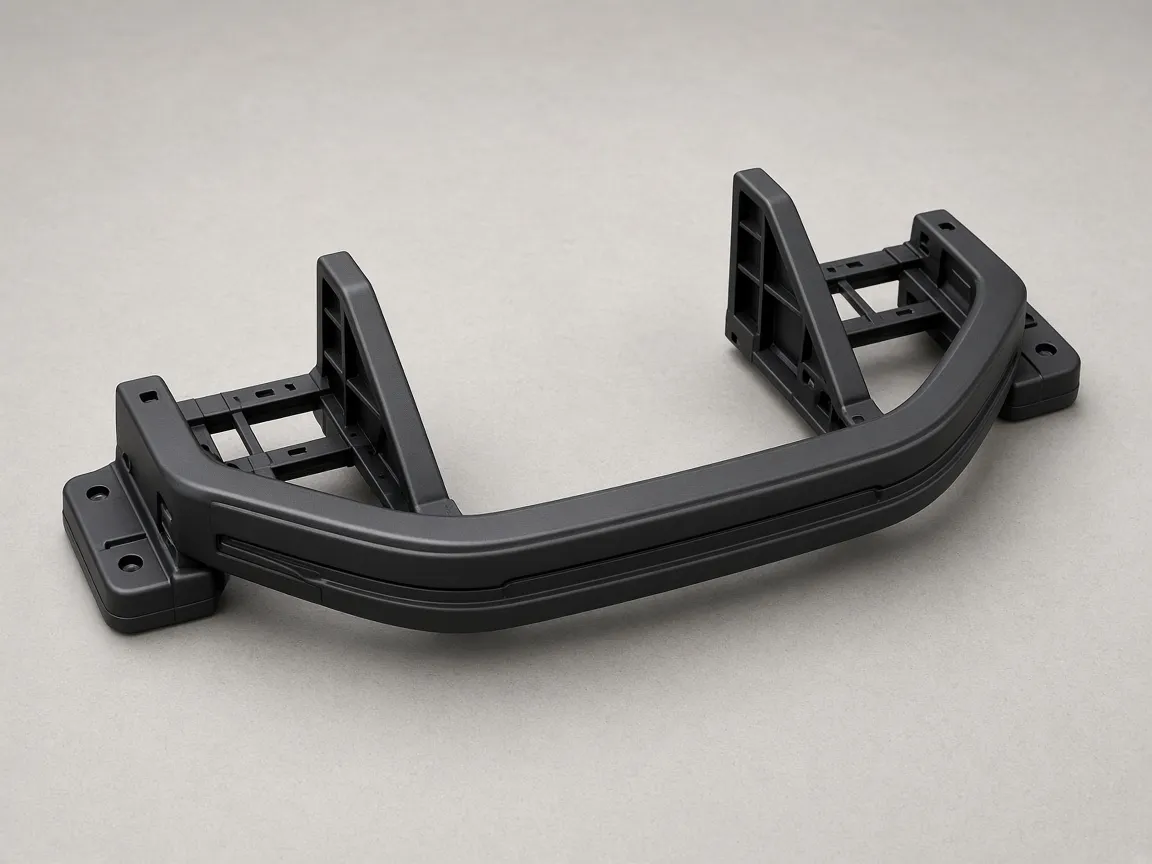
That last point matters if you are buying, selling or writing a listing. Someone who searches “bumper guard” may want a cosmetic protector for a city car, not a frame-mounted steel part. For pickups, the useful split is between three things: an add-on guard that bolts in front of the factory bumper (bull bar or grille guard), a replacement bumper that removes the factory bumper and takes its place, and a basic protector that only stops scuffs.
The rest of this guide focuses on the first group, with replacement bumpers mentioned where buyers weigh them against a guard. If you want a refresher on how the factory bumper itself is built, see bumper cover vs bumper.
How do they compare on coverage, weight and mounting?
The table below compares the common front-end options side by side. Coverage is the main difference; weight, mounting and price follow from it. A bigger frame protects more of the front, but it also adds more metal hanging in front of the axle.
Two rows in that table deserve a closer look. First, coverage at the corners: a bull bar leaves the outer front corners and the sides of the grille open, which is where brush, gate posts and parking-lot posts often hit. A grille guard with wings covers those areas.
Second, the skid plate: many bull bars carry a small plate under the center hoop that protects the lower valance from rocks, but it is not a full underbody skid plate and should not be treated as one.
For accessory mounting, both guard types can carry tabs for add-ons such as recovery gear or a small winch on dedicated designs. A standard bull bar or grille guard is not a winch bumper unless the maker says it is; a winch needs a plate that is rated and tied into the frame.
How does each one mount, and how hard is the install?
A guard is only as strong as its brackets. Most bolt-on bull bars and grille guards use vehicle-specific brackets that reach back to the frame rails, often using the factory tow-hook holes or other holes the vehicle maker left in the frame. That is why a guard sold for one model year often does not fit the next one: a new bumper shape, a moved sensor or a changed frame horn can all change the brackets.
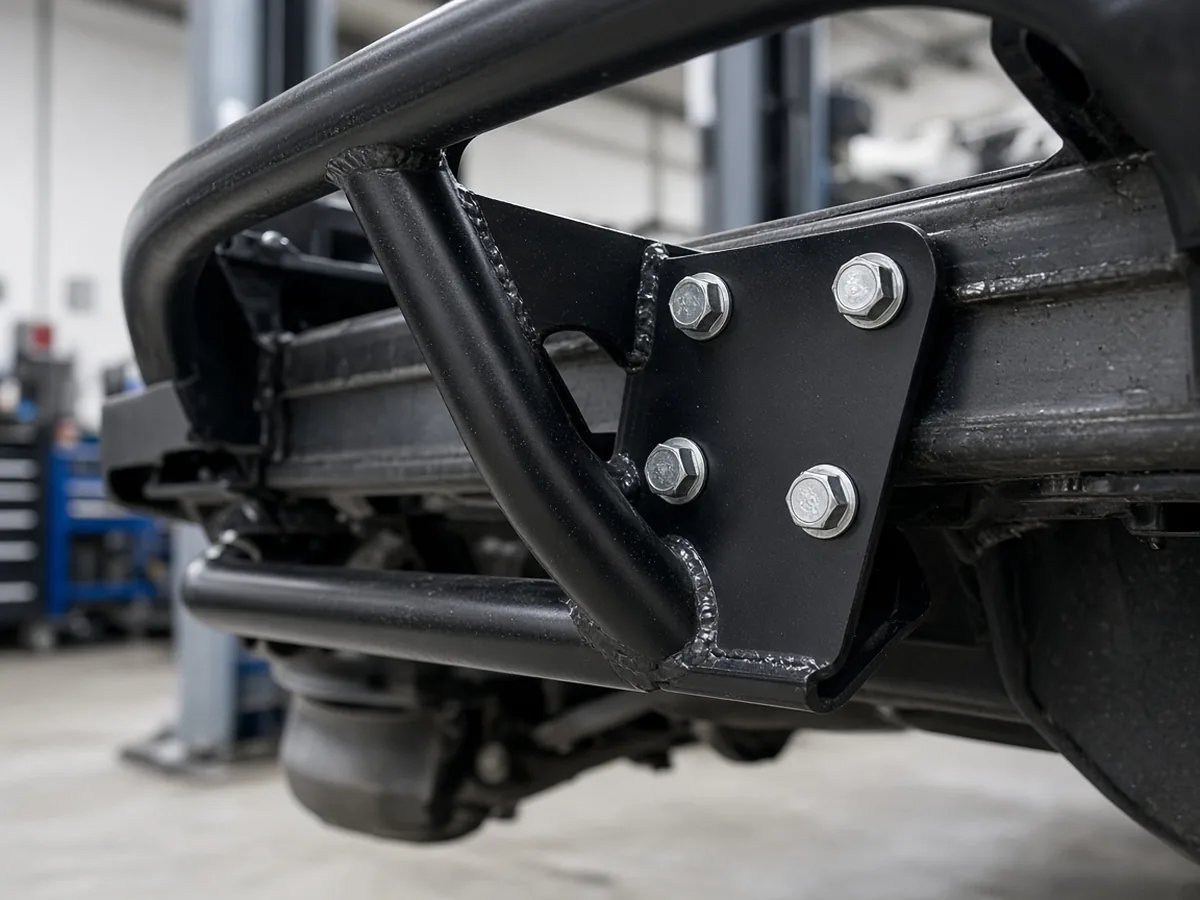
A typical bolt-on install looks like this, though the exact steps vary by kit:
- Check the fitment list for year, cab, trim and package, including whether the truck has front parking sensors, a front camera or adaptive cruise radar.
- Remove the parts the instructions call out, such as tow hooks or a small section of the lower fascia, and trim only where the template shows.
- Bolt the brackets to the frame first, leaving them loose.
- Lift the guard onto the brackets with a helper, align the gaps to the bumper and grille, then torque all bolts to the stated values.
- Check that sensors, the camera view and the license plate are not blocked, and recheck bolt torque after the first drive.
Many owners can fit a bull bar at home with hand tools. A grille guard is heavier and wider, so a second person makes the job safer. Replacement bumpers are a bigger job because the factory bumper comes off.
Regulators that publish rules for these parts focus on where the loads go. The Victorian guidance for bull bars in Australia is a good example. It asks that bars attach to the vehicle maker’s own attachment points, that the mounting does not change how crash loads reach the vehicle’s structure or how the airbag system senses a crash, and that the bar’s attachment points stay clear of airbag sensors 1.
It also limits how far the bar may sit forward of the bumper, at 75 mm or a 9-degree angle, and says the extra weight must not push the front axle above its rated load. It requires that driver-assistance sensors such as autonomous emergency braking and adaptive cruise keep working with the bar fitted 1. These are Australian rules, not U.S. law, but they describe the checks any careful buyer should make.
Which materials and finishes are used?
Most bull bars and grille guards are made from steel tube, with formed steel plate for the brackets and center plates. Mild steel is the most common, manganese steel is used where more strength is needed, and stainless steel is chosen when a polished look and corrosion resistance matter more than cost. Aluminum guards exist and weigh less, but they are usually built for smaller loads than a steel frame of the same size.
Typical production for steel truck guards involves cutting and bending steel tube or manganese steel, welding the frame and brackets, then powder coating or e-coating. Inspection usually covers the welds, coating adhesion and salt-spray resistance, and the position of the bracket holes. The bracket-hole check is the one that most often decides whether a guard fits without forcing it.
The finish is the part buyers see first. Black powder coat is the default, because it hides scratches better than paint and can be touched up. Textured coats hide small chips, gloss coats look cleaner on a show truck, and polished stainless needs no coating at all. Whatever the finish, look at the inside of the tubes and the weld seams: rust tends to start where coating is thin, at welds, drain holes and cut edges.
Weight is the trade-off. More tube and thicker walls add strength and coverage but also load the front axle and the front springs. A grille guard with wings adds noticeably more weight than a bull bar, so if your truck already carries a winch, a heavier bumper or a snow plow mount, check the front axle rating before adding more.
Which one should you choose for your truck?
Choose by what you hit, where you drive and what the truck already carries. The short version:
- Mostly road and highway driving, some gravel: a bull bar gives center protection with the least weight, and many owners choose it partly for the look.
- Ranch, farm, utility or brush work: a grille guard with wings protects the grille and corners from branches, fence posts and livestock bumps at low speed.
- Fleet or patrol work that involves pushing: a push bar built and rated for that job.
- Serious off-road use, recovery and winching: a replacement steel bumper is usually the better base, because a winch plate and recovery points need a stronger frame connection than most bolt-on guards provide.
- City parking scuffs only: a plastic or rubber bumper guard is enough; a steel guard is not needed.
Also think about the vehicle you have. A truck with front sensors, a front camera and radar-based cruise control needs a guard designed around those parts, with cut-outs or relocation brackets. If no design exists for your trim level, waiting is usually better than drilling or forcing a part from another trim.
Finally, look at total cost, not just the part price. A guard that needs fascia trimming or sensor relocation adds labor, and a heavy guard may need upgraded front springs. For a wider view of when a non-factory part is a good fit, see our guide to OEM vs aftermarket exterior accessories. If the truck also runs larger tires, check rear spray coverage too; mud flaps vs splash guards covers sizing and state rules.
Risks and exceptions: what a front guard will not do
A guard is not a crash structure. Owners on truck forums repeat the same point: a guard bolted low on the frame and reaching high in front of the grille acts like a lever. In a solid hit, a bent guard can be pushed back into the parts it was meant to protect, so damage can be similar or larger than without it. Guards work best against brush, debris, small animals and low-speed bumps.
Animal strikes are a real reason people buy guards, especially in rural areas. U.S. data from the Insurance Institute for Highway Safety shows 210 deaths in crashes with animals in 2024, up from 89 in 1975, and a review of fatal animal crashes in nine states found that 77% involved deer 2.
A grille guard can reduce damage from a deer strike at moderate speed, but no guard makes a high-speed collision with a large animal safe, and swerving to avoid an animal is itself a common cause of serious crashes.
There are also safety trade-offs for other people. The Victorian guidance notes that laboratory testing shows most bull bars increase the risk of injury to pedestrians, and it recommends them mainly for rural and off-road use 1. Some designs are built to a pedestrian-safety clause of the Australian standard and do better in those tests 1.
On legality, there is no single U.S. rule that bans bull bars or grille guards. The federal bumper standard, 49 CFR Part 581, is about reducing damage in low-speed collisions, and it applies to passenger cars, not to multipurpose passenger vehicles such as pickups and SUVs 3. That means there is no federal low-speed bumper test for most trucks that carry these guards.
State rules on things like license plate visibility and how far parts may stick out still apply, and other countries, such as Australia, have their own rules. Check locally before fitting one.
- Do not drill into airbag sensor areas or relocate sensors without the vehicle maker’s instructions.
- Do not use a guard as a jack point or a recovery point unless the maker rates it for that.
- Check insurance terms; some insurers ask to be told about front-end modifications.
What should B2B buyers put in a guard specification?
For distributors, truck accessory shops and private-label brands, most problems with guards come from fit and finish, not from the design idea. A clear specification avoids most of them. Here is a checklist to send with a request for quotation: For guard programs, see our auto parts manufacturing services.
- Vehicle list: year, make, model, cab, trim and package, and whether the truck has front sensors, a front camera or a radar module behind the grille.
- Bracket design: which factory holes it uses, whether drilling is needed, and a drawing of the bracket-hole positions to check against a real vehicle.
- Material: tube diameter, wall thickness, and steel grade for tube, plate and brackets; stainless or aluminum if required.
- Welds: how welds are inspected and what defects are rejected.
- Coating: powder coat or e-coat, color and texture, coating thickness, and the test methods used for adhesion and corrosion.
- Weight: finished weight per unit, so you can judge the load on the front axle.
- Packaging: protection for coated surfaces and corners, hardware kits bagged and labeled, and printed instructions with torque values.
The coating line is where quotes are hardest to compare. Many suppliers quote a salt-spray figure in hours, such as “500 hours,” but the test method behind it does not set those hours or how to judge the result. ASTM B117 defines how to run the salt fog, but it does not prescribe the type of test panel, the exposure time or how to interpret the results 4.
So ask for the hours together with how the panel was prepared, whether it was scribed and how the result was rated. Pair that with a tape adhesion test under ASTM D3359, which uses Method A for coatings thicker than 125 µm and Method B for thinner films 5. Asking which method was used is a quick way to check that the report matches the coating.
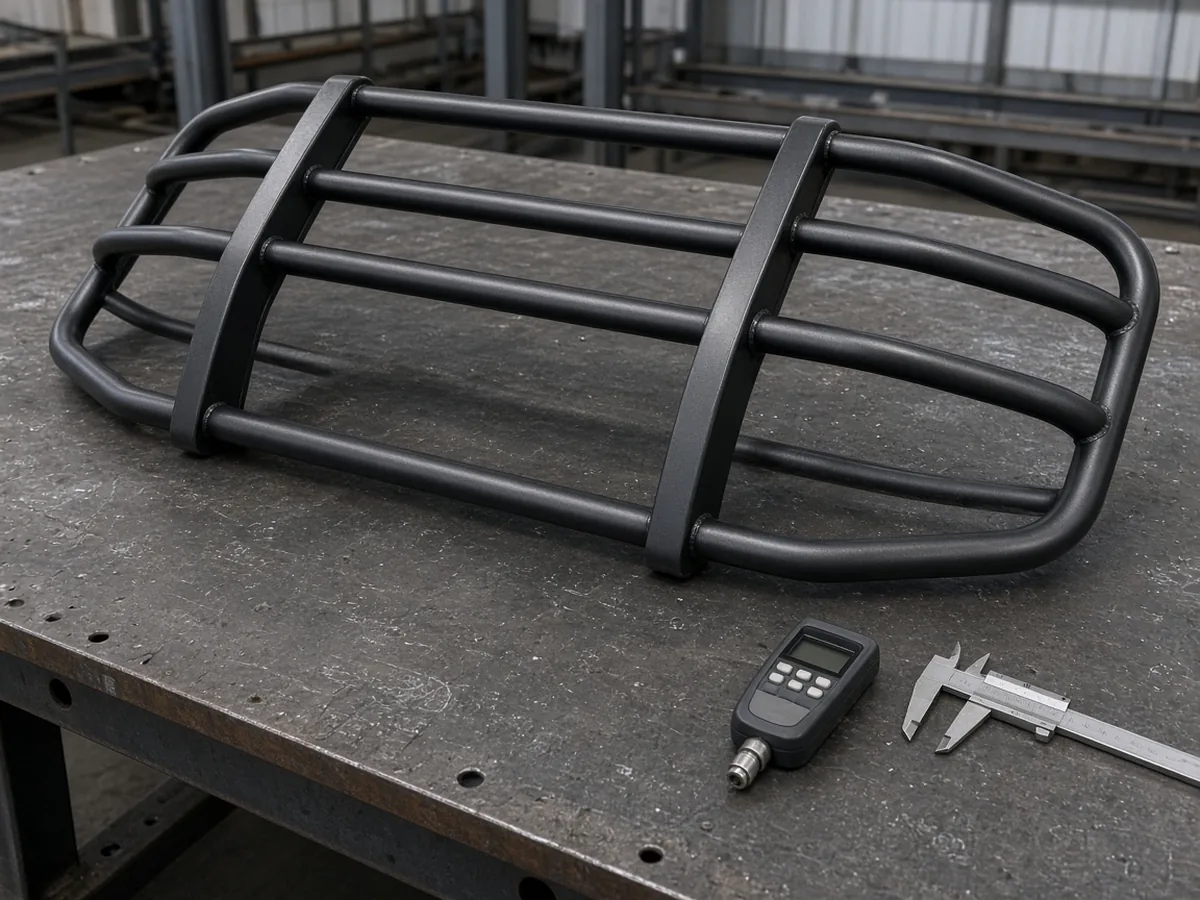
Finally, agree how a sample will be approved: fit-tested on the actual vehicle, with photos of the gaps, sensor clearance and plate visibility. If you need a design for a model nobody covers yet, vehicle-specific development usually starts with measuring a real vehicle.
Conclusion
A bull bar and a grille guard are both bolt-on front guards, but they solve different problems. A bull bar protects the center of the front end with less weight. A grille guard covers the whole grille and usually the corners, which suits brush, ranch and utility work. “Bumper guard” can mean either, or a simple parking protector, so it is worth asking what the buyer actually needs.
Whichever you choose, the details decide whether it works: brackets that use the right frame points, room for sensors and the airbag system, a front axle that can carry the weight, and a coating that is tested in a way you can compare. A guard helps with brush, debris and low-speed bumps; it does not turn a truck into a crash barrier.
Next step
Yirox makes bull bars and grille guards, and we check drawings, bracket specs and your vehicle list with you before sampling. Browse our truck bumper guards and wider truck exterior accessories, or send us your model list.
Frequently asked questions
Is a grille guard the same as a bull bar?
No. A bull bar covers the center of the front end, while a grille guard covers the whole grille and usually the outer corners. Some sellers use the names loosely, so check the photos and the coverage before you buy.
Will a bull bar stop a deer?
It can reduce damage to the center of the front end in a moderate-speed deer strike, but it does not cover the corners and will not prevent damage at highway speed. A grille guard with wings covers more of the front.
Are bull bars legal in the US?
There is no federal ban, and the federal bumper standard does not apply to pickups and SUVs. State rules on plate visibility and protruding parts still apply, so check your state’s rules.
Can I install a grille guard myself?
Usually yes, with hand tools and a helper, if it is a bolt-on design made for your exact vehicle. Follow the torque values and do not drill near airbag sensors.
Does a grille guard affect parking sensors or cruise radar?
It can if it blocks them. Choose a design made for your trim with the right cut-outs or relocation brackets, and test the sensors after fitting.
What is the difference between a brush guard and a grille guard?
The names overlap. Some listings use “brush guard” as another word for a grille guard. Others use it for the side wings that protect the headlights, or for a lighter tube set meant for branches and brush. Confirm the coverage: center only, grille plus corners and lamps, or a lighter brush-oriented design. A bull bar typically covers less of the outer front corners than a full grille guard.
References
[1] Department of Transport and Planning, Victoria. “Vehicle Standards Information 1: Bull bars.” October 2021.
[2] Insurance Institute for Highway Safety. “Fatality Facts 2024: Collisions with fixed objects and animals.”
[3] U.S. Code of Federal Regulations. “49 CFR Part 581 – Bumper Standard.” eCFR.
[4] ASTM International. “ASTM B117-19: Standard Practice for Operating Salt Spray (Fog) Apparatus.”
[5] ASTM International. “ASTM D3359-23: Standard Test Methods for Rating Adhesion by Tape Test.”