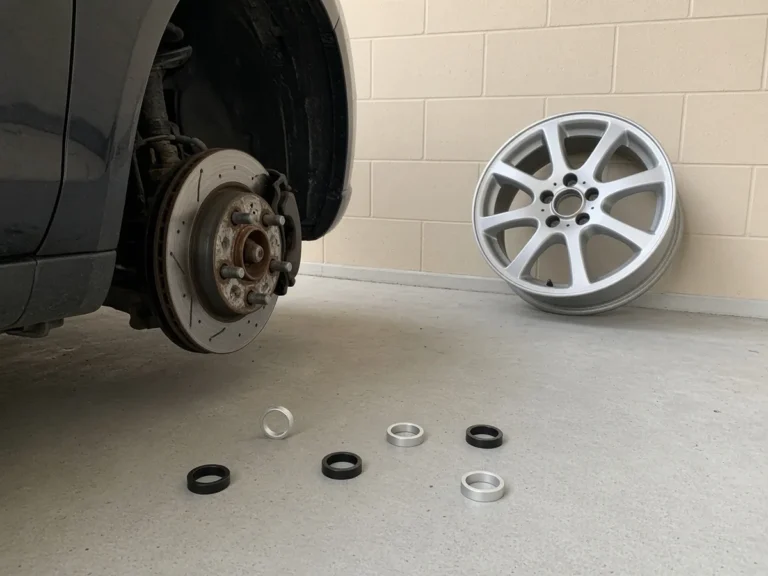




Hub centric rings are thin rings that fill the gap when a wheel’s center bore is larger than the vehicle hub, so the wheel is centered on the hub as the lugs are tightened. You need them when that gap exists and you want a hub-centric fit. You do not need them when the bore already matches the hub.
Scope: this article explains what hub centric rings are, how hub-centric and lug-centric wheels differ, and when a ring is the right part.
How to measure bolt pattern and center bore is in how to measure bolt pattern. What offset and ET mean is in what wheel offset means. Wheel spacers, which change how far the wheel sits outboard, are covered in what wheel spacers are.
What are hub centric rings?
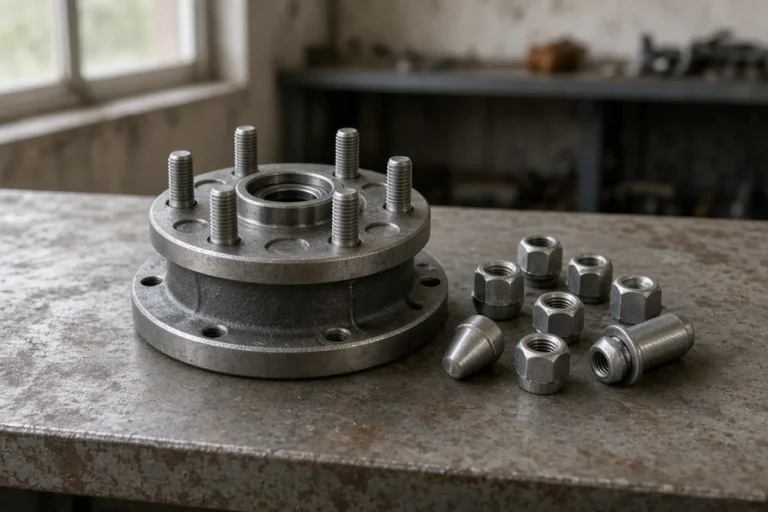
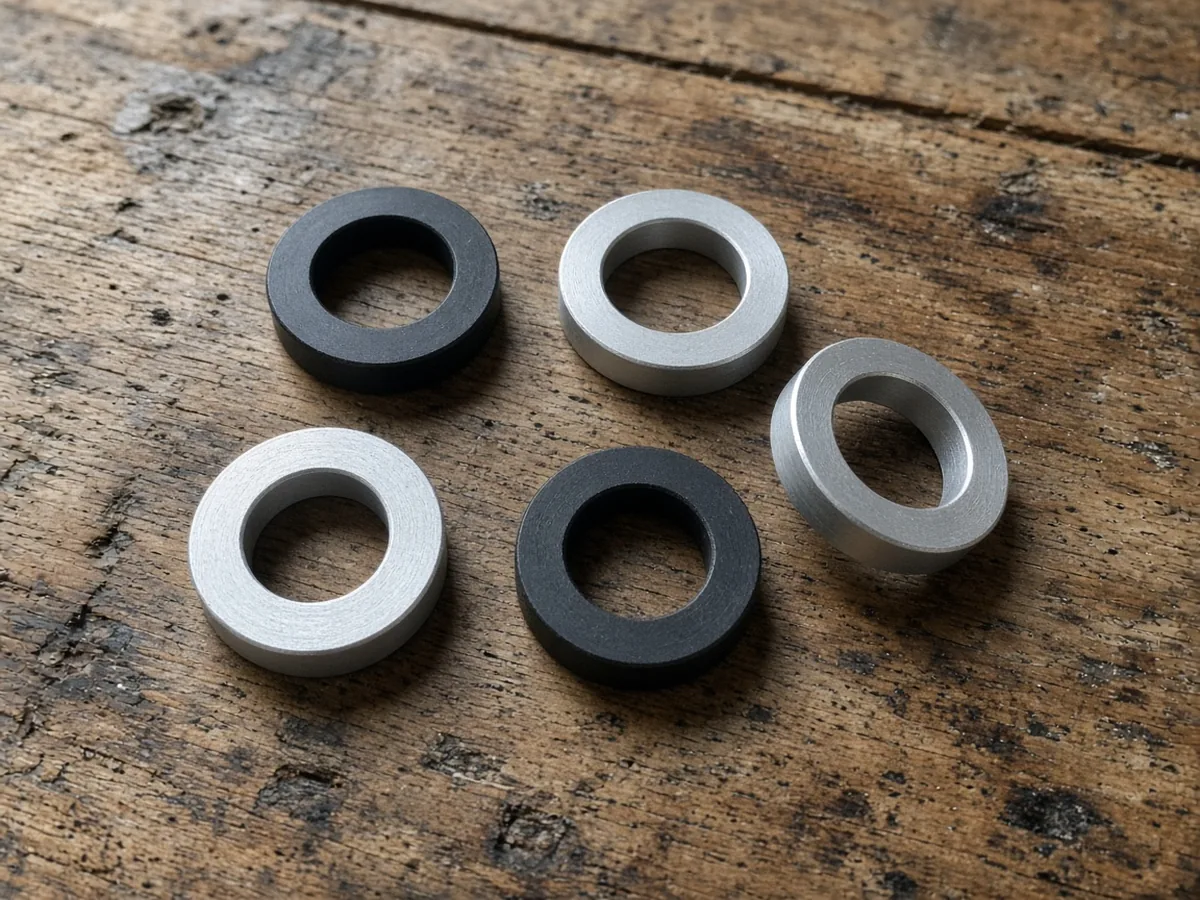
Hub centric rings, also called hub rings or centering rings, sit in the wheel’s center bore and over the hub pilot so they fill the gap between those two diameters 2 4.
Most aftermarket wheels are bored larger than any one vehicle hub, so the same wheel can be offered for more than one car or truck. The ring reduces that larger bore down to the hub diameter so the wheel is located on the hub, not only by the lug nuts 1 5.
Touren, a wheel manufacturer, describes the ring as an installation tool that helps hold the wheel centered. Proper tightening and torque sequence are still required, with or without a ring 5.
The ring’s job is centering, not carrying the vehicle. KMC states that the rings do not carry any load. Circuit Performance says the same: hub rings are not load bearing; they center the wheel on the hub 2 7.
A ring that fits can make it easier to keep the wheel from shifting while the lugs are snugged down, which is the usual reason people use one to reduce vibration after an aftermarket wheel install 3 4.
What is the difference between hub-centric and lug-centric wheels?
The difference is how the wheel is centered on the hub: a hub-centric wheel matches the hub diameter, and a lug-centric wheel has a larger center bore and is centered by the lug nuts 1 3.
On a hub-centric wheel, the center bore is a close match to the hub, sometimes called a hub pilot. Discount Tire calls this the most accurate way to center the wheel and tire assembly. Most original-equipment wheels are made this way because they are designed for one vehicle 1 3.
On a lug-centric wheel, the center bore is larger than the hub. That gap is what lets one aftermarket wheel fit a wider range of vehicles. The wheel is centered by the lug seats as you tighten the nuts or bolts 1 3.
A larger bore can go over a smaller hub. A smaller bore cannot go over a larger hub, and that wheel should not be forced on 1. The same rule is already stated on the alloy wheels category: if the bore is smaller than the hub, the wheel will not seat.
Lug-centric is a fitment style, not a defect. Discount Tire states that lug-centric wheels can be installed safely. KMC adds that tightening in a star pattern reduces movement during installation, provided the tire and wheel are also balanced correctly 1 3.
If you want that same hub-centered location on a larger-bore wheel, a correctly sized hub centric ring fills the gap and makes the wheel hub-centric on that vehicle 1 3.
When do you need hub centric rings?
You need a hub centric ring when the wheel’s center bore is larger than the hub and the wheel is meant to use a ring to restore a hub-centric fit. You do not need one when those two diameters already match 2 4.
KMC’s wording is usefully cautious: in most cases rings are not necessary, and they are not required if you are not seeing a ride disturbance. If the bore already matches the hub, the wheel is already hub-centric. If the bore is larger, a ring may prevent vibration by filling that gap and keeping the wheel from shifting during installation 2.
Discount Tire makes the same optional point: hub rings are not required, but they can help with high-speed vibration by centering the wheel on the hub rather than only on the lugs 1.
Summit Racing recommends rings on aftermarket aluminum wheels that will accept them, because a slightly off-center mount can vibrate, and a ring makes a centered install easier. It also lists wheels that should not get a ring at all, which belong in the exceptions section below 4.
A ring is the wrong first fix for every vibration. KMC notes that not every ride disturbance comes from whether the wheel is hub-centric. Balance, a dirty or rusty hub face, the wrong lug seat, or a damaged wheel can cause the same symptom 2.
How do you know what size hub centric rings you need?
A hub centric ring is defined by two measurements: the outer diameter must match the wheel’s center bore, and the inner diameter must match the vehicle’s hub pilot 4 7.
Those numbers are almost always given in millimeters. A common way to write them is wheel bore first, then hub size, for example 73.1 → 67.1.
Those figures are an example of the notation, not a measurement of a specific vehicle.
Get the two diameters from the wheel maker and the vehicle specification, or measure them. The method for measuring bolt pattern and center bore, including the hub lip, is in the bolt-pattern and center-bore guide. Summit’s practical advice for the hub pilot is to measure each hub with dial calipers rather than guessing 4.
The size has to be exact. Circuit Performance states that if the ring is off by even a fraction of a millimeter, it may not fit or may not work, and that you should not buy a “close” size to try it 7.
Two mistakes show up often enough to call out. The first is reversing the numbers, so the inner and outer diameters are swapped. The second is assuming one “standard” ring fits every 5-lug aftermarket wheel. Hub diameters vary by vehicle, and some wheel styles are offered with more than one center bore.
Offset and bolt pattern still have to be right on their own. A ring does not correct the wrong PCD or the wrong ET. Those checks are in how to measure bolt pattern and what wheel offset means.
Should you choose plastic or aluminum hub rings?
Both plastic (or nylon) and aluminum rings can be used when the size is exact; the better choice depends on climate and how hard the wheels are used, not on a single “stronger is always safer” rule 4 7.
Summit recommends plastic rings for street cars in rain, snow, and road salt, because metal rings can corrode and make the wheel hard to remove. It recommends metal rings for race cars and other vehicles that are driven harder and create more heat, because plastic can melt 4.
Circuit Performance draws a similar line. Aluminum is more durable and is a common upgrade when wheels come off often, but it can corrode in road salt and moisture. Nylon will not rust or corrode, and Circuit notes its low-friction behavior. Because the ring is not load bearing, Circuit treats both materials as acceptable when they fit 7.
Material does not fix a wrong size. A durable ring that is loose on the hub, or tight in only one of the two bores, will not center the wheel.
How should hub centric rings be installed?
Install the ring in the back of the wheel first, confirm that it sits flush and does not protrude, then mount the wheel and tighten it in a star pattern to the vehicle maker’s torque. The ring is a centering aid; it does not replace correct hardware or a calibrated torque wrench 6 5.
The SEMA Wheel & Tire Council aftermarket-wheel installation guidelines, hosted by NHTSA, give a three-point fit check before the wheel goes on 6:
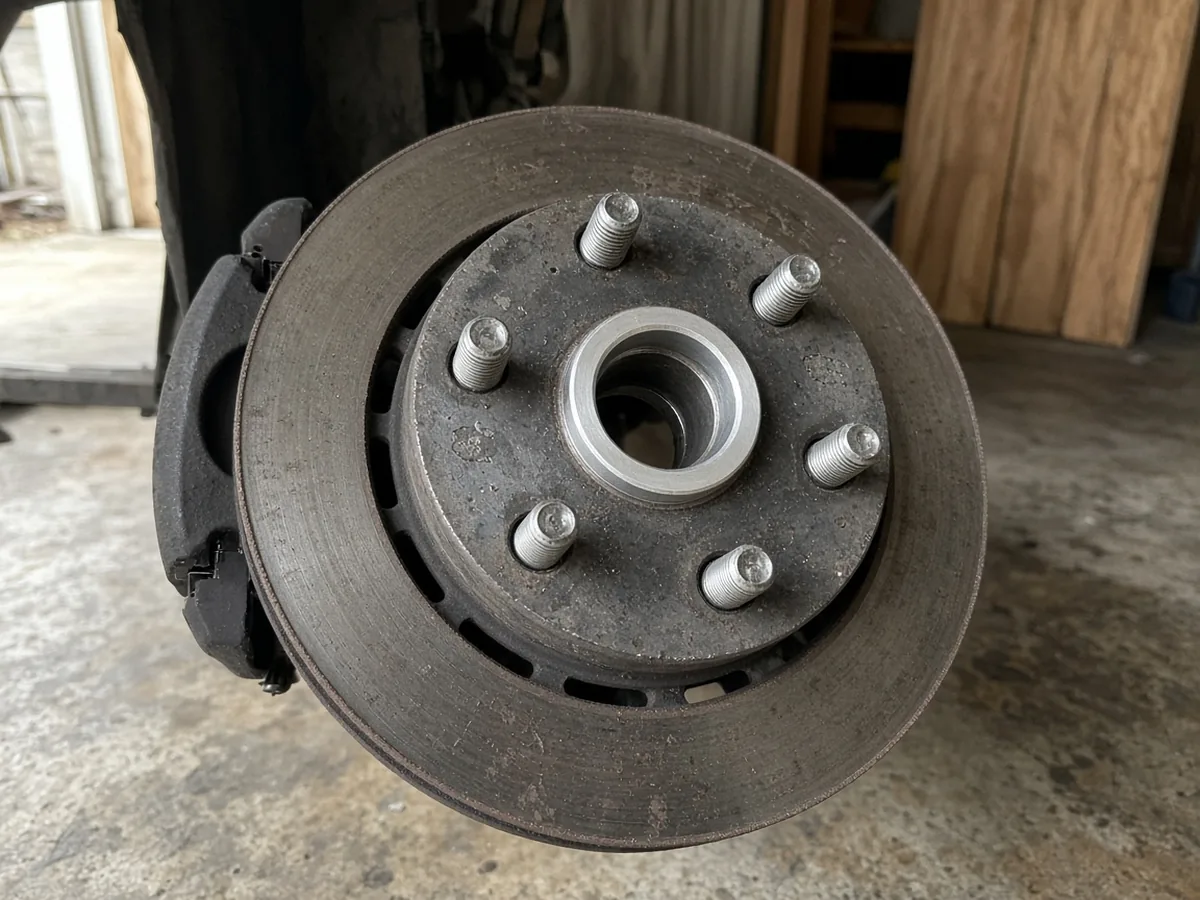
- Place the ring on the vehicle hub and push it on until it touches the base of the hub at the mounting surface. A good fit is snug on the hub diameter and flush against that surface 6.
- Push the ring into the back of the wheel by hand. It should be snug against the wall of the center hole. When it is fully seated, the face of the ring must be flush with, or slightly below, the wheel’s mounting pad. The ring must not protrude beyond that pad, or the wheel will not sit flat on the hub 6.
- With the ring in the center hole on the backside of the wheel, mount the wheel to the vehicle 6.
If either dry fit is loose, tight only on one side, or leaves the ring standing proud of the pad, stop and get the correct size. Do not hammer a “close” ring in, and do not stack two rings to make up a mismatch. Circuit’s rule still applies: the size has to be the one you actually measured 7.
The same guidelines warn that gravity will let a hanging wheel rest on the highest stud. If you clamp it down in that off-center position, the assembly can be damaged over time. Support and center the wheel before the first tightening pass; do not let it hang on the studs 6.
Use a calibrated torque wrench, and use the vehicle manufacturer’s torque value. The guidelines require a torque check within the first 100 miles or two to three days. They also require the fastener seat, thread diameter, and pitch to match the wheel. A ring does not correct the wrong lug seat 6. How to identify those seats, thread sizes and re-check intervals is in what lug nuts are.
KMC’s advice for lug-centric wheels is to tighten in a star pattern so the wheel is less likely to shift while the nuts are coming down 3. That sequence still matters after a ring is in place, because the ring only locates the bore; the clamp load still comes from the fasteners.
What risks and exceptions should you watch for?
The main risks are a ring that is the wrong size, a ring that stands proud of the wheel pad, a wheel that cannot accept a ring, and blaming a ring for vibration that has another cause. None of those is fixed by tightening harder 6 2 4.
Summit lists three wheel types that will not accept a hub centric ring: steel wheels with a thinner mounting surface, wheels that use a push-through center cap, and wheels with an as-cast, non-machined center bore (Summit’s example is a Cragar S/S). KMC adds that rings may not be available for every application 4 2.
KMC also distinguishes a standard hub ring from a spigot ring. In its own family, most brands use a standard ring, while Black Rhino, TSW, and Petrol may use a spigot ring. If you are buying rings for a branded wheel, confirm the ring type with that brand rather than assuming every ring is interchangeable 2.
A protruding or dirty ring is as much of a problem as a missing one. If the ring stands above the wheel’s mounting face, the wheel cannot clamp flat, and the guidelines treat a proud cap or ring as a source of false torque and loosening 6. The hub face and the wheel pad still have to be clean and rust-free for that flat contact.
Aluminum rings can corrode and seize, which shows up later as a wheel or ring that will not come off cleanly 4 7. That is a service issue, not a reason to skip the exact-size check at install.
A wheel spacer is a different part. It is a disc that moves the wheel outboard and changes effective offset; a hub centric ring only fills a bore gap and adds no meaningful track width.
If you use a spacer, the ring has to seat on the spacer’s own centering lip the same way it would on a hub: snug, flush, and not proud. A ring that spins on that lip, or sits on a bevel instead of a piloting diameter, is not centered.
The spacer checks themselves — thickness, bolt pattern, and thread engagement — are in what wheel spacers are.
Do not use a ring to disguise a wheel that should not be on the vehicle. A bore that is smaller than the hub will not seat. The wrong bolt pattern will not be saved by a ring. Those are ordering errors, not ring problems 1.
What should distributors and importers specify when they order rings?
Specify both diameters, the ring type, the material, and the wheels the ring must actually fit before you treat “hub rings included” as a complete line on a packing list.
Aftermarket wheel programs often ship one bore size across several vehicles, then rely on a ring to restore a hub-centric fit. That only works if the OD, ID, and ring style are written down for each vehicle on the list, and if the wheel itself can accept a ring 4 2.
Use this checklist when you request a quote or check a shipment of alloy wheels and the rings that go with them:
- Wheel-side outer diameter (the wheel’s center bore) and hub-side inner diameter (the hub pilot), both in millimeters, for every vehicle the wheel is sold against 4.
- Whether the wheel uses a standard hub ring or a spigot ring, confirmed with the wheel brand when that brand offers more than one style 2.
- Material, chosen for the market: plastic or nylon where road salt and seized rings are the bigger service risk; aluminum where heat or frequent removal is the bigger concern 4 7.
- A fit rule in the install sheet: the ring must be snug on both diameters, sit flush or slightly below the wheel pad, and must not protrude 6.
- Wheels that should not be packed with a ring: steel wheels with a thin pad, push-through-cap designs, and as-cast bores 4.
- Labeling and packing so each OD/ID pair stays together and is not mixed with a nearby size. Circuit’s warning about “close” sizes applies to warehouse picks as well as to retail orders 7.
- Lug seat type, bolt pattern, and offset as separate line items. A ring does not correct those 6.
- If the program also includes spacers, specify them as a different part, with their own hub-side and wheel-side bores, thickness, and hardware length. Do not write a ring in as a substitute for a spacer.
Yirox produces alloy wheels and related wheel accessories. A quote can be built from the same list — center bore, hub diameter, ring type and material, and the vehicle set — rather than from a generic “rings included” note.
Conclusion
Hub centric rings are a small centering part for a specific gap: a wheel center bore that is larger than the hub. They make a lug-centric aftermarket wheel sit on the hub the way a hub-centric wheel already does. They are not a load-carrying part, and they are not required on every wheel.
The decision is straightforward once both diameters are known. If the bore already matches, skip the ring. If the bore is larger and the wheel can accept a ring, use the exact OD and ID, confirm a flush, non-proud fit, and still torque the lugs in a star pattern to the vehicle specification. If the wheel is a steel, push-through-cap, or as-cast design, a ring may not belong there at all.
A ring will not fix the wrong bolt pattern, the wrong offset, a dirty mounting face, or a tire that is out of balance. Those are separate checks. Get the two measurements right, install the ring so the wheel can still sit flat, and treat vibration that remains as a reason to inspect the rest of the assembly, not to stack another ring.
Next step
Write down the wheel’s center bore and the vehicle’s hub diameter, then confirm whether that wheel can accept a ring, before you order or install one.
Yirox produces alloy wheels and wheel-related accessories and can work from that same brief for a wheel program. Send the vehicle list and the two bore sizes through the contact page, or start from the alloy wheels category.
Frequently asked questions
Do all aftermarket wheels need hub centric rings?
No. Many aftermarket wheels are lug-centric and can be installed safely when the lugs are tightened correctly. A ring is useful when the center bore is larger than the hub and you want the wheel centered on the hub, and only if that wheel will actually accept a ring 1 2 4.
Can I drive without hub centric rings?
Yes, if the wheel is already hub-centric, or if a lug-centric wheel has been centered and torqued correctly and there is no ride disturbance. A ring is an installation aid, not a legal requirement in the sources cited here 1 2 5.
How do I tell if my wheels are already hub-centric?
Measure the wheel’s center bore and the hub pilot in millimeters. If those diameters match and the wheel slides onto the hub with a snug, even fit, the wheel is already hub-centric and does not need a ring 2 4.
Are plastic hub centric rings safe?
They can be, when the size is exact and the ring is being used only to center the wheel. KMC and Circuit both state that the ring is not a load-bearing part. Summit prefers plastic for street use in corrosive climates and prefers metal where heat is higher 2 7 4.
What is the difference between a hub centric ring and a wheel spacer?
A hub centric ring is a thin ring that fills a gap when the wheel’s center bore is larger than the hub. A wheel spacer is a disc that sits between the hub and the wheel to move the wheel outboard; it changes effective offset and has its own hardware checks, which are explained in what wheel spacers are.
Can I use hub centric rings on steel wheels?
Usually not. Summit states that steel wheels have a thinner mounting surface and are too thin to accommodate a hub centric ring. Confirm the wheel design before you order a ring for a steel wheel 4.
References
- Discount Tire — Hub-Centric vs. Lug-Centric Wheels. Hub-centric bore matches the hub (hub pilot); most OE wheels are hub-centric; most aftermarket wheels are lug-centric with a larger bore; a larger bore can fit a smaller hub, not the reverse; rings are not required but can help with high-speed vibration.
- KMC Wheels — What are hub centric rings? Do I need them? (updated 2025-12-12). Rings are optional plastic or metal locators; they adapt a larger bore to the hub; they do not carry load; need depends on whether the bore already matches and whether there is a ride disturbance; standard versus spigot ring types; vibration has other causes.
- KMC Wheels — What is the difference between hub centric and lug centric wheels? (2025-11-21). Hub-centric versus lug-centric definitions; star-pattern tightening to reduce shift during installation; rings adapt the bore; rings may not be available for every application.
- Summit Racing knowledge base SR-04638 — Do I need hub centric rings for my new wheels? Rings fill the gap between the wheel bore and the hub pilot; they make a centered install easier; OEM wheels, thin steel wheels, push-through center caps, and as-cast bores do not take rings; plastic versus metal guidance; measure the hub with dial calipers.
- Touren Wheels — FAQ, General Wheel Information. Center bore defined in millimeters; hub-centric versus lug-centric machining; a hub-centric ring is an installation tool; proper installation and torque sequence are required with or without a ring.
- SEMA Wheel & Tire Council — Aftermarket Wheel Installation Guidelines (PDF hosted by NHTSA ODI as recall document 18E065; industry guideline, not an FMVSS). Hub-centering-ring fit check (snug on the hub, snug in the wheel, must not protrude); do not hang the wheel on the studs during initial tightening; calibrated torque device and the vehicle manufacturer’s torque; torque recheck within 100 miles or 2 to 3 days; matched fastener seat, diameter, and pitch.
- Circuit Performance — Hub Centric Rings, Aluminum (Set of 4). Rings fill the gap so the wheel is centered; nylon versus aluminum trade-offs; rings are not load bearing; size must be exact — a fraction of a millimeter off may not work; do not buy a “close” size to try it.