



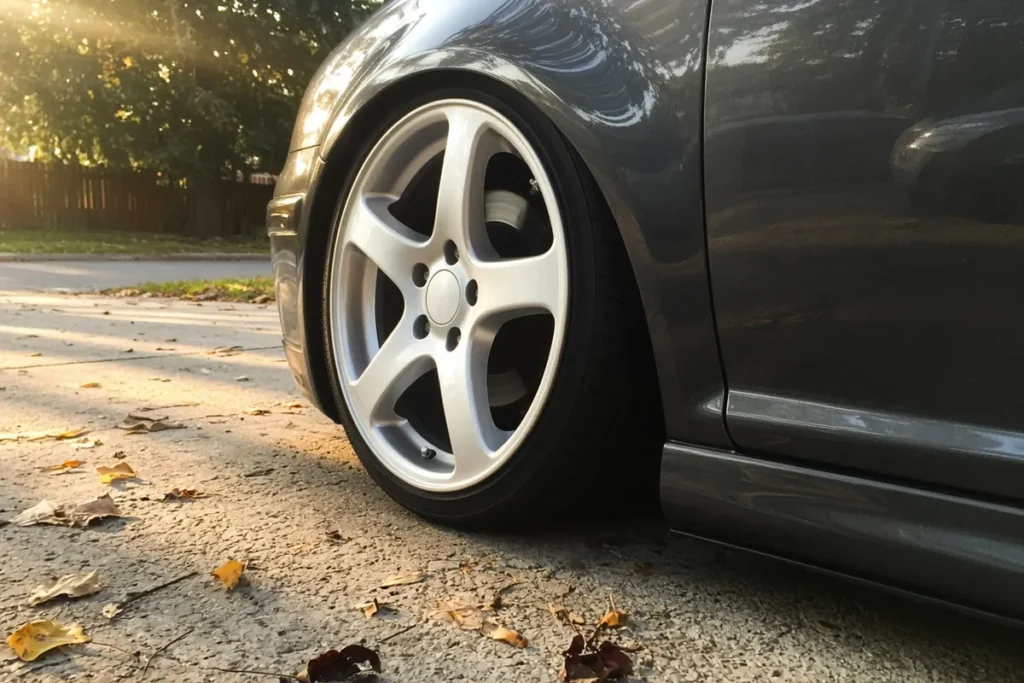
Wheel offset is the distance, in millimeters, between a wheel’s mounting face (the flat pad that bolts to the hub) and the centerline of the rim. It decides how far in or out the wheel and tire sit in the wheel well. Positive offset pulls the wheel inward, negative offset pushes it outward, and zero offset centers the mounting face on the rim.
Scope: this guide explains what offset is, how to read and measure it, and how to judge a new offset before you buy. Bolt pattern and center bore are covered in a separate guide; wheel covers and hubcaps are covered in our hubcaps vs rims explainer.
How does wheel offset work?
Offset works by moving the rim relative to a fixed point: the hub face on the car. The hub does not move when you change wheels, so any change in offset moves the whole wheel and tire, inner edge and outer edge together, by the same amount.
The international standard ISO 3911 and the SAE nomenclature standard J1982 both define this geometry using the rim centerplane and the wheel’s attachment face [1][2]. The rim centerplane is an imaginary plane halfway between the two bead seats. The attachment face is the surface that touches the hub or brake rotor. Offset is the distance between those two planes.
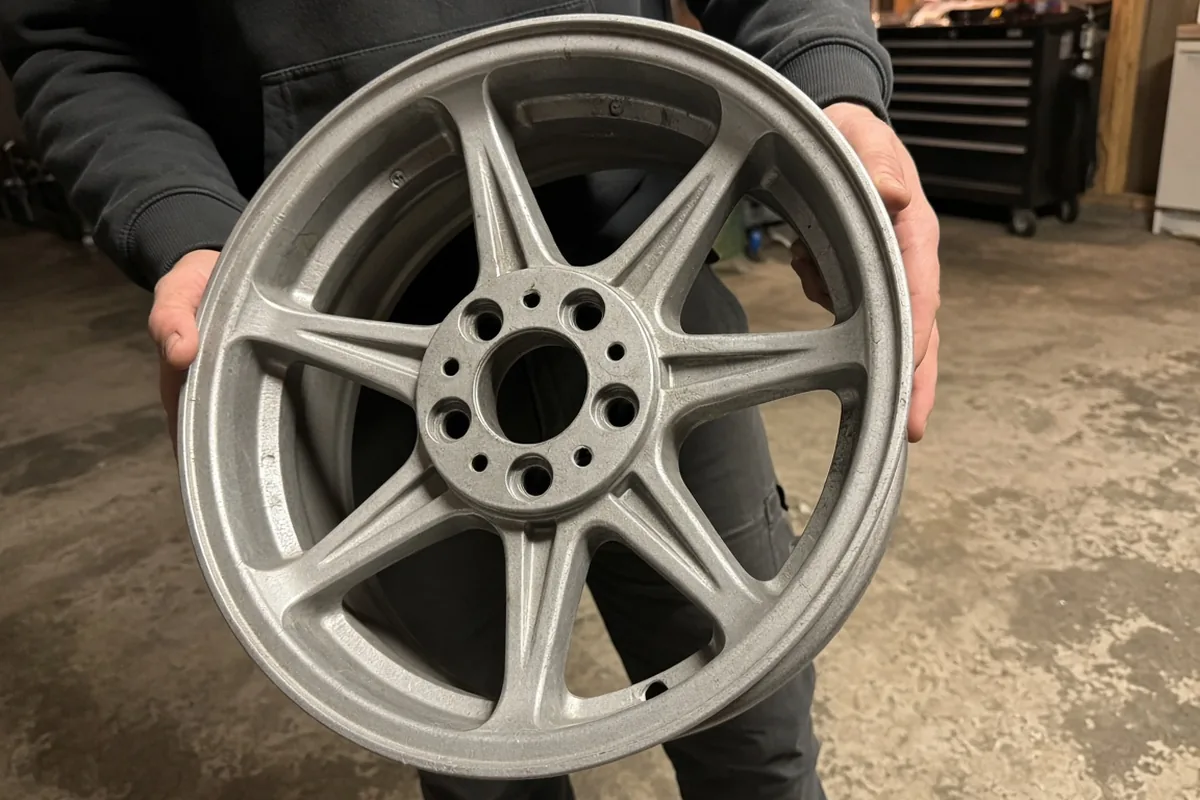
- Positive offset: the mounting face sits toward the street (outer) side of the centerline. The wheel is tucked inward toward the suspension. Most modern front-wheel-drive and all-wheel-drive cars use positive offset.
- Zero offset: the mounting face lines up exactly with the centerline.
- Negative offset: the mounting face sits toward the brake (inner) side of the centerline. The wheel sticks outward, which gives a deeper “dish” look. It is common on lifted trucks and off-road builds.
ISO 3911 adds one useful note: track width, the distance between the tire centerlines on an axle, increases as the wheel moves outward [1]. That is why offset changes affect stance, steering feel and fender clearance at the same time.
What do ET, inset and outset mean on a wheel?
They are different names for the same measurement, and which one you see depends on the market and the document. This is one of the most common sources of ordering mistakes, because a spec sheet from Europe, a US catalog and a Japanese wheel can describe one wheel in three ways.
| Term you see | Where it is common | What it means | Equivalent in US offset terms |
|---|---|---|---|
| Offset +45 or “45 mm offset” | US catalogs, retail listings | Mounting face 45 mm outboard of the rim centerline | Positive offset, +45 |
| ET45 | European and many Asian wheels (from German Einpresstiefe, “press-in depth”) | Same as offset; ET values can be negative, such as ET-12 | +45 (ET-12 = −12) |
| Inset 45 | ISO 3911, UNECE R124, OEM drawings | Rim centerplane 45 mm inboard of the attachment face | Positive offset, +45 |
| Zeroset | ISO 3911, SAE J1982 | Centerplane and attachment face coincide | 0 offset |
| Outset 20 | ISO 3911, SAE J1982, truck and commercial wheels | Rim centerplane 20 mm outboard of the attachment face | Negative offset, −20 |
The standards define inset and outset this way [1][2], and UNECE Regulation No. 124 uses “inset” as one of the required markings on approved replacement wheels [3]. The practical rule: “inset” and ET both read like US positive offset, and “outset” is the US negative number.
A note on dual rear wheels: on heavy-duty trucks, the inner and outer wheels of a dual pair are built with a large outset or inset so the two tires sit side by side with a set gap. ISO 3911 calls this dual spacing [1]. Those wheels are designed as a matched system, so do not treat their offset like a passenger-car styling choice.
Where is the offset number on a wheel?
On most alloy wheels the offset is cast or stamped on the back of a spoke, on the inner barrel, or on the mounting pad next to the center bore. Look for a number with “ET”, “+” or “OFFSET” in front of it, usually near the size marking, for example “8J x 18 ET45”.
UNECE Regulation No. 124, which covers replacement wheels for passenger cars in the markets that apply it, requires the wheel to carry permanent marks for the manufacturer, the rim contour designation, the inset, the date of manufacture and the part number, and those marks must be readable with the tire mounted [3]. Its sample marking, “5½ J x 14 FH 36”, includes a 36 mm inset. In markets where R124 does not apply, markings vary by maker, so a wheel without a visible offset is not automatically non-compliant, but it is a reason to ask the seller for a drawing or spec sheet.
If there is no marking, check these places in order:
- The vehicle maker’s parts catalog or wheel drawing for the original wheel.
- The wheel manufacturer’s spec sheet or packing label.
- A direct measurement, described in the next section.
How do you measure wheel offset?
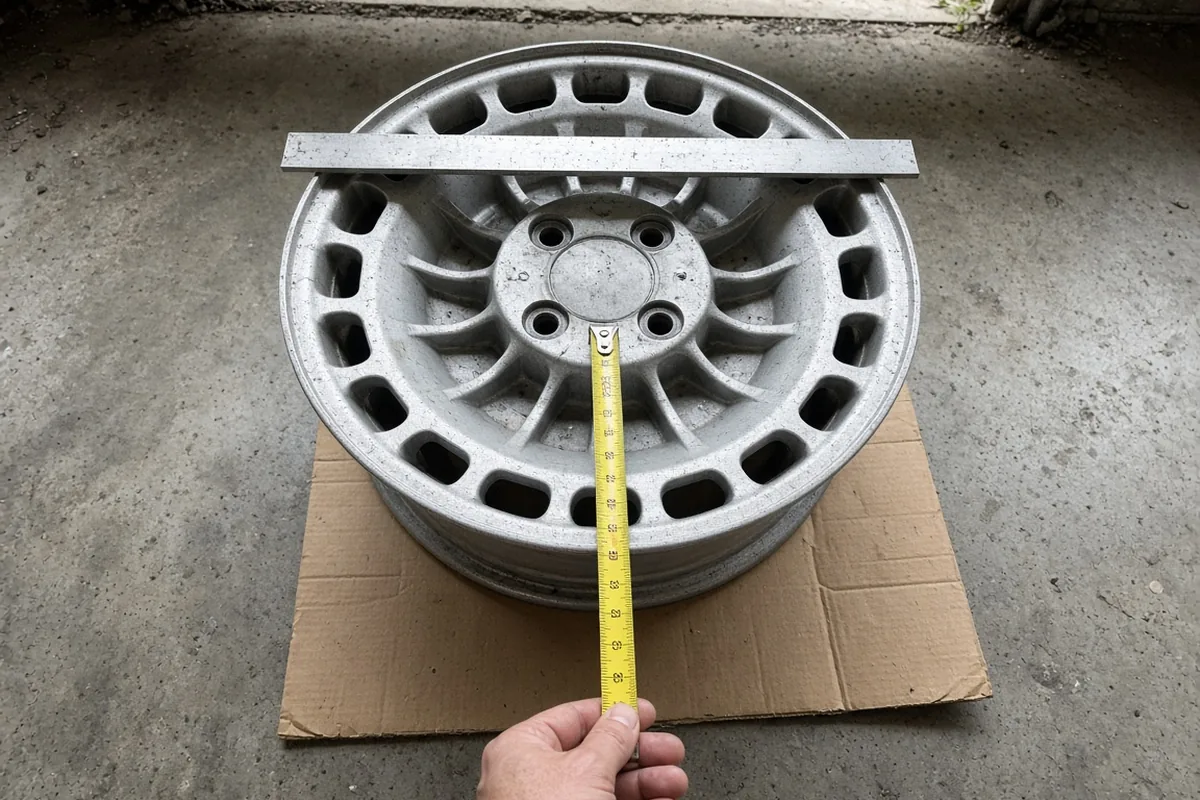
You can measure offset with the tire off, a straightedge and a tape measure. Measure in inches if that is what your tape reads, then convert to millimeters at the end (1 inch = 25.4 mm).
- Lay the wheel face down on a flat surface, or remove the tire so you can reach both rim flanges.
- Measure overall width. Lay a straightedge across the back flange and measure from the ground (or a second straightedge across the front flange) to it. This is flange-to-flange width, which is usually wider than the nominal size on the wheel. An “8J” wheel is 8 inches between the bead seats, and the flanges add width on top of that.
- Measure backspacing. With the straightedge across the back flange, measure straight down to the mounting pad.
- Find the centerline. Divide the overall width by 2.
- Calculate offset. Offset = backspacing − (overall width ÷ 2). Multiply by 25.4 for millimeters.
Worked example (hypothetical numbers): overall width 9.0 in, backspacing 6.2 in. Half the width is 4.5 in. Offset = 6.2 − 4.5 = 1.7 in, or about +43 mm. If the backspacing were 3.5 in, offset would be 3.5 − 4.5 = −1.0 in, or about −25 mm.
Home measurements are good for a rough check, accurate to a few millimeters. They are not a substitute for the maker’s figure when you are close to a clearance limit, because how you place the straightedge on a curved flange changes the reading.
What is the difference between offset and backspacing?
Offset is measured from the rim centerline; backspacing is measured from the back edge of the wheel. Both describe where the mounting pad sits, but backspacing changes with wheel width while offset does not.
That difference matters when you compare two wheels of different widths. A 9-inch-wide wheel and a 10-inch-wide wheel can both be +18 offset, yet the wider wheel has about half an inch more backspacing, so its inner edge sits half an inch closer to the suspension. Truck and off-road sellers often quote backspacing because inner clearance to control arms and leaf springs is the limit on those vehicles. Car sellers more often quote offset.
| Offset | Backspacing | |
|---|---|---|
| Measured from | Rim centerline to mounting face | Back flange to mounting face |
| Usual unit | Millimeters (+, 0 or −) | Inches (always positive) |
| Changes with wheel width? | No | Yes |
| Most useful for judging | Overall position and how far the face moves | Inner clearance to suspension and brakes |
| Where you see it | Wheel marking, car catalogs | Truck and off-road catalogs |
To convert: backspacing = (overall width ÷ 2) + offset, using the same unit for both.
What happens when you change offset?
Lower offset moves the wheel outward and higher offset moves it inward, and the effects reach well beyond appearance.
- Fender and inner clearance. Too low, and the tire can rub the fender lip or stick past the body. Too high, and the inner edge can hit the strut, spring perch, control arm or brake caliper.
- Brake caliper clearance. The caliper sits close to the spoke backs. A high-offset wheel with flat spokes may clear the rim barrel but still touch the caliper. Fit charts often call this “spoke clearance”.
- Steering and scrub radius. Moving the tire’s contact patch away from the steering axis changes scrub radius, which can make steering heavier, increase kickback over bumps and make the car pull more under uneven braking. How much depends on the suspension design.
- Load on hub bearings. A wheel that sits farther out acts on a longer lever, which increases the bending load on the hub bearing and suspension parts.
- Track width and handling. A wider track can add stability, but it also changes how the suspension was tuned to behave.
- Legal and inspection rules. Some markets do not allow tires to extend beyond the body. Rules differ by country and state, so check the local requirement.
Most of these effects are small for a change of a few millimeters and grow quickly after that. That is why many vehicle makers approve only a narrow offset range for each model, and why the original equipment offset is the safest starting point.
How do you check a new wheel’s fit before buying?
Compare the new wheel to your current wheel at two points: the outer lip (does it poke?) and the inner lip (does it hit suspension?). Both can be worked out from width and offset alone.
- Outer lip change = (new width − old width) ÷ 2 + (old offset − new offset)
- Inner lip change = (new width − old width) ÷ 2 − (old offset − new offset)
Convert widths to millimeters first (1 inch = 25.4 mm, so a 1-inch-wider wheel adds 12.7 mm on each side). A positive result means that edge moves toward the fender (outer) or toward the suspension (inner).
| Example (hypothetical, current wheel 18 x 8 +45) | Outer lip moves out | Inner lip moves in | What to check |
|---|---|---|---|
| 18 x 8 +35 | +10 mm | −10 mm (moves away) | Fender lip, tire poke |
| 18 x 9 +45 | +12.7 mm | +12.7 mm | Strut and spring perch |
| 18 x 9 +35 | +22.7 mm | +2.7 mm | Fender lip first |
| 18 x 9 +52 | +5.7 mm | +19.7 mm | Strut, control arm, caliper |
| 18 x 8.5 +40 | +11.4 mm | +1.4 mm | Mostly a fender check |
How we put this together: these rows are our own calculation from the width and offset geometry defined in ISO 3911 and SAE J1982 [1][2]. They show wheel position only. Tire width, tire shape, ride height and suspension travel change the real clearance, so treat the numbers as a screening step, not a guarantee.
A screening routine that works for most passenger cars:
- Write down the original wheel’s width and offset from the wheel marking, and the tire size from the Tire and Loading Information Label on the driver’s door edge or post. NHTSA advises staying with the original tire size or another size the vehicle maker recommends [4].
- Measure the current gap from the tire to the fender lip and from the tire to the nearest suspension part, at the tightest point.
- Use the two formulas above for the new wheel and compare the results to those gaps.
- Add margin for the tire. A wider tire grows on both sides, and tires bulge past the rim width.
- Check steering lock and full suspension compression. Clearance at ride height is not clearance over a bump at full lock.
- Test-fit one wheel with the tire mounted before you mount a full set, if the seller allows it.
What is a good wheel offset?
A good offset is the one that keeps the tire inside the fender, clears the suspension and brakes with margin, and stays close to what the vehicle maker approved. There is no single “good” number, because +45 can be correct on a compact car and wrong on a pickup.
| Vehicle type | Typical factory offset direction | What usually limits a change |
|---|---|---|
| Front-wheel-drive and AWD cars, crossovers | Positive, often high | Strut clearance inside; fender lip outside |
| Rear-wheel-drive performance cars | Positive, often lower than FWD cars; front and rear may differ | Fender lip, especially at the rear |
| Half-ton pickups and body-on-frame SUVs | Positive or near zero | Fender, mud flaps and steering lock when going negative |
| Lifted trucks and off-road builds | Zero or negative (aftermarket) | Bearing load, fender coverage and local rules |
| Dual rear wheel trucks | Large inset/outset designed as a pair | Dual spacing; follow the vehicle maker only |
Buyers often ask what a specific number means. A +35 offset means the mounting face sits 35 mm outboard of the rim centerline. Compared with a +45 wheel of the same width, a +35 wheel sits 10 mm farther out on both edges. A +40 offset is 40 mm outboard, and it sits 5 mm inward of a +35 wheel. Whether either one is “good” depends entirely on the original offset and the gaps you measured.
Can wheel spacers fix the wrong offset?
A spacer lowers effective offset by its thickness, so a 10 mm spacer on a +45 wheel makes it behave like +35. It cannot fix a wheel that sits too far outward, and it adds a part that has to be installed correctly.
Spacers are only as good as their design and installation. Hub-centric spacers that locate on the hub, correct thread engagement for the studs or bolts, and torque checks after the first drive all matter. Some vehicle makers advise against spacers altogether. If a wheel needs a thick spacer to clear the suspension, a wheel with the right offset is usually the better fix.
What are the risks and exceptions?
Offset is only one of several measurements that have to match. Check these before you trust an offset number:
- Bolt pattern and center bore. Offset says nothing about whether the wheel bolts on. Pitch circle diameter, stud count and the center hole must also match, or you need correct hub-centric rings.
- Seat type. Lug nuts and bolts come with conical, ball (radius) or flat seats. The wheel’s seat must match the hardware.
- Load rating. The wheel must be rated for the vehicle’s axle load. This matters most on trucks, SUVs and heavy EVs.
- Staggered fitments. Some cars use different widths and offsets front and rear. Rotating wheels front to rear may not be possible.
- Brake upgrades and model years. A wheel that fits one trim may not clear a larger brake package on another trim or year. Check by trim, not just by model name.
- Hubcaps and covers. Steel wheels with full covers depend on the wheel’s face shape; changing to a different steel wheel can change cover fit even at the same offset.
- Balancing. A new offset does not change how the wheel is balanced, but a different spoke design changes where adhesive weights can go. See where balancing weights go on a rim.
Rules about tires extending past the fender, and approval schemes like UNECE R124 [3], differ by country. When the rule is unclear, follow the vehicle maker’s approved sizes.
What should wheel buyers specify on an RFQ?
For distributors, importers and aftermarket brands, offset errors usually come from incomplete specs, not from the factory. A complete request for quotation removes most of the guesswork.
Include these items for each wheel size in an inquiry:
- Diameter and width, written as on the drawing (for example 18 x 8J)
- Offset with sign and convention stated (for example “+45 / ET45 / inset 45”)
- Bolt pattern (PCD and stud count), center bore, and whether hub rings are supplied
- Seat type for the lug hardware
- Load rating per wheel and target vehicle list by model, year and trim
- Brake clearance requirement or the largest caliper the wheel must clear
- Finish, center cap style and packaging labels
- Markings required for the destination market, such as offset and size cast on the wheel
Typical production for cast alloy wheels involves low-pressure casting or flow forming, heat treatment, CNC machining of the mounting face, bolt holes and bead seats, then coating. Factories in this category usually check runout, balance, bolt-hole position and offset on machined parts, and a buyer can ask to see those records for the sample lot. When reviewing samples, measure offset yourself using the steps above and compare it to the drawing.
Conclusion
Wheel offset is the distance from the rim centerline to the mounting face, and it is the single number that decides where a wheel sits in the fender. A higher positive offset tucks the wheel toward the suspension, while a lower or negative offset pushes it out. ET and inset describe the same number as positive offset; outset is the negative side.
Because offset ignores width, it is only half of a fit check. Pair it with width or backspacing, work out how far the outer and inner lips move compared with your current wheel, and stay close to the factory offset unless you have measured the gaps. Spacers can move a wheel outward, but they cannot fix a wheel that already sits too far out.
Offset is also only one of several measurements that must match. Bolt pattern, center bore, seat type, load rating and brake clearance all have to be right before a wheel is safe to fit, which is why a complete spec sheet matters as much for a single set as for a wholesale order.
Next step
Pull the width and offset off your current wheel, measure the tightest fender and suspension gaps, and run the new size through the two formulas above. If you are building a wheel and tire range, the wheel balance weights guide and the guide to stick-on weights for alloy wheels cover the balancing side.
Yirox makes alloy wheels and wheel-related parts such as wheel covers and balancing weights in-house, and the few models we cannot produce come from audited partner factories. Before samples are made, we confirm the size, offset and bolt pattern against your drawing, so you can request alloy wheels and their accessories in one inquiry.
Planning a wheel program or need a quote on a specific size and offset? Send the RFQ items listed above through our sourcing solutions page.
Frequently asked questions
Does higher offset stick out more?
No. A higher positive offset moves the wheel inward, toward the suspension. A lower or negative offset makes the wheel stick out more.
How far will a 12 mm offset change move the wheel?
If the width stays the same, a 12 mm lower offset moves both the outer and inner edges 12 mm outward, which is about 0.47 inches. A width change adds or subtracts half the width difference on each side.
Is ET the same as offset?
Yes. ET is the European marking for offset in millimeters. ET45 equals +45 offset, and a negative ET value equals negative offset.
Can I use a different offset than my factory wheels?
Often a few millimeters is fine, but it depends on your clearances, tire size and local rules. Use the outer and inner lip formulas and a test fit before buying a full set.
Is negative offset bad?
Negative offset is not bad in itself; it is designed into many truck and off-road wheels. It increases bearing load and tire poke, so it should be matched to the vehicle and the tire coverage rules where you drive.
Where do I find my car’s factory offset?
Check the marking on the back of the original wheel, then the vehicle maker’s parts catalog. The door-jamb placard lists the tire size but usually not the offset.
References
[1] ISO. “ISO 3911:2021 Wheels and rims for pneumatic tyres: Vocabulary, designation and marking.” Edition 4, 2021 (confirmed 2026). Definitions of inset, zeroset, outset and dual spacing.
[2] SAE International. “SAE J1982 (2023): Nomenclature, Wheels for Passenger Cars, Light Trucks, and Multipurpose Vehicles.” Recommended practice.
[3] UNECE. “Regulation No. 124: Uniform provisions concerning the approval of wheels for passenger cars and their trailers.” Definitions (para. 2.6) and marking requirements.
[4] NHTSA. “Tire Safety Ratings and Awareness (TireWise).” U.S. Department of Transportation. Tire size and the Tire and Loading Information Label.