



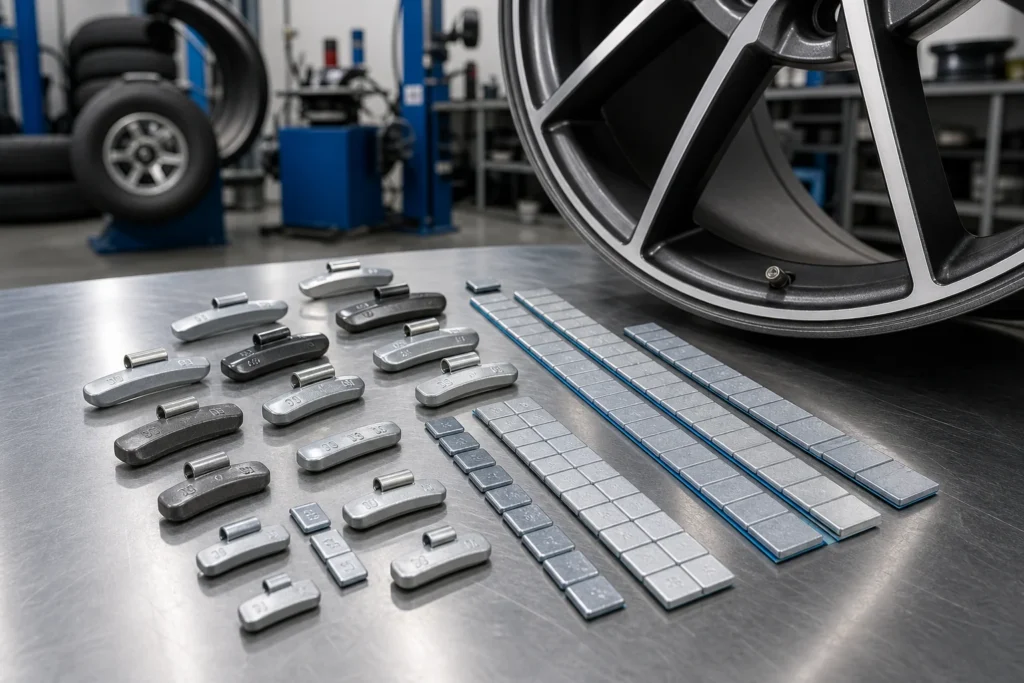
Wheel balance weights are small metal weights attached to a wheel rim or placed inside a tire to correct uneven mass distribution in the tire and wheel assembly. They help the wheel rotate smoothly, reduce vibration, protect tires and suspension parts, and give installers a precise way to balance wheels after mounting, repair, rotation, or replacement.
For drivers, wheel weights are usually invisible until a steering wheel starts shaking at highway speed. For tire shops and distributors, they are a small product category with a surprisingly large number of decisions: clip-on or stick-on, steel or zinc, grams or ounces, rim flange fit, adhesive tape quality, corrosion resistance, local lead restrictions, packaging, and batch consistency.
This guide explains the wheel balance weights category at a practical level, from basic purpose and common types to material choices, size systems, fitment, quality checks, and sourcing decisions for global buyers.
This is our complete reference on wheel balance weights: types, materials, sizes and buying. For a short beginner definition, read what are wheel weights; for how the balancing service itself works, see wheel weights vs tire balancing; for exact gram and ounce sizes, use the wheel weight size chart.
Table of Contents
- What are wheel balance weights and why are they used?
- How does tire and wheel imbalance happen?
- What are the main types of wheel balance weights?
- How do lead, steel, and zinc wheel weights compare?
- Why are lead-free wheel weights important for export markets?
- Which wheel weight fits steel wheels, alloy wheels, trucks, and EVs?
- What wheel weight sizes and specifications matter most?
- How are wheel balance weights made and checked?
- What should buyers check before ordering wheel balance weights?
- Conclusion: Build the category around fit, compliance, and repeatable supply
- Frequently Asked Questions
- References
What are wheel balance weights and why are they used?
Wheel balance weights are correction weights used after a tire and wheel assembly is measured on a balancing machine. The machine identifies where the assembly is too heavy or too light, then the technician applies weights at the required positions so the rotating assembly runs more evenly.
A tire and rim may look perfectly round, but the mass around the assembly is rarely distributed with perfect symmetry. Rubber thickness, wheel casting tolerances, valve stems, repairs, wear patterns, and small manufacturing differences can all shift mass away from the rotational center. At low speed, a small imbalance may go unnoticed. At highway speed, that same imbalance can create vibration, steering wheel shake, uneven tire wear, and extra stress on suspension components.
Wheel weights solve this by adding a precise amount of mass at a precise location. Readers who first need the physical part explained can use how correction weights work in a balanced assembly before they compare formats or materials. In a shop, the process usually works like this:
Terminology also affects catalog and RFQ clarity. Buyers comparing supplier language can review how rim weights relate to wheel balance weights before standardizing product names, labels, and quotation fields.
- The tire is mounted on the rim.
- The assembly is placed on a wheel balancer.
- The balancer spins the assembly and measures imbalance.
- The machine shows the required weight amount and location.
- The technician installs clip-on, stick-on, or another balancing solution.
- The assembly is spun again to confirm the result.
For a consumer, the visible result is a smoother ride. For a buyer or distributor, the product requirement is more detailed: the wheel weight must fit the target wheel, meet local material rules, remain attached, resist corrosion, match the local size system, and arrive in packaging that tire shops can use without confusion.
That is why wheel balance weights should not be treated as one generic SKU. A good product range usually includes several weight increments, two unit systems, more than one application type, and a material strategy that fits the target market.
How does tire and wheel imbalance happen?
Tire and wheel imbalance happens when the mass of the rotating assembly is not evenly distributed around the axis of rotation. When that uneven mass spins, it can create periodic forces that show up as vibration, ride disturbance, or steering shake, especially as speed increases 3.
There are two basic ideas behind balancing:
- Static imbalance: The assembly has a heavy spot in one plane. If left uncorrected, it can cause an up-and-down hop or vibration.
- Dynamic imbalance: The assembly is uneven across the width of the wheel. This can create side-to-side wobble or steering wheel vibration.
Modern wheel balancers commonly detect the amount and location of imbalance for both inner and outer planes. That is why a vehicle may require weights on different sides of the rim, not just one visible outside location. On many alloy wheels, installers prefer adhesive weights placed inside the wheel barrel because the visible rim face stays clean and undamaged. When a workshop is planning its consumable range, separating the balancing service from the weight used in it helps distinguish machine capability from the physical products that must be stocked.
Common causes include manufacturing variation, valve stem weight, uneven tread wear, tire repairs, curb impact, wheel deformation, old weights falling off, improper mounting, or debris stuck to the wheel or tire.
For buyers, it helps to separate wheel weights from tire balancing. Tire balancing is the service process; wheel weights are the physical correction products used during that process. That distinction matters when comparing shop demand, product packaging, installer habits, and the type of product a distributor should stock.
How do balancing method and machine program affect placement?
The machine's measurement comes before the choice of weight format. Buyers and technicians who need to understand one-plane and two-plane balancing requirements can see why a correction may be requested at one location or at separate inner and outer planes. That decision then determines machine-led weight placement on the rim, rather than leaving the installer to copy the position of an old weight or choose a convenient surface.
The selected program also matters. A balancer mode and approved mounting plane must agree with the actual wheel design so that the machine's correction instructions can be carried out with a suitable clip-on or adhesive format. For a service range, this means stocking decisions should follow the wheel types and locations the shop can genuinely balance, not a generic list of weight sizes.
What are the main types of wheel balance weights?
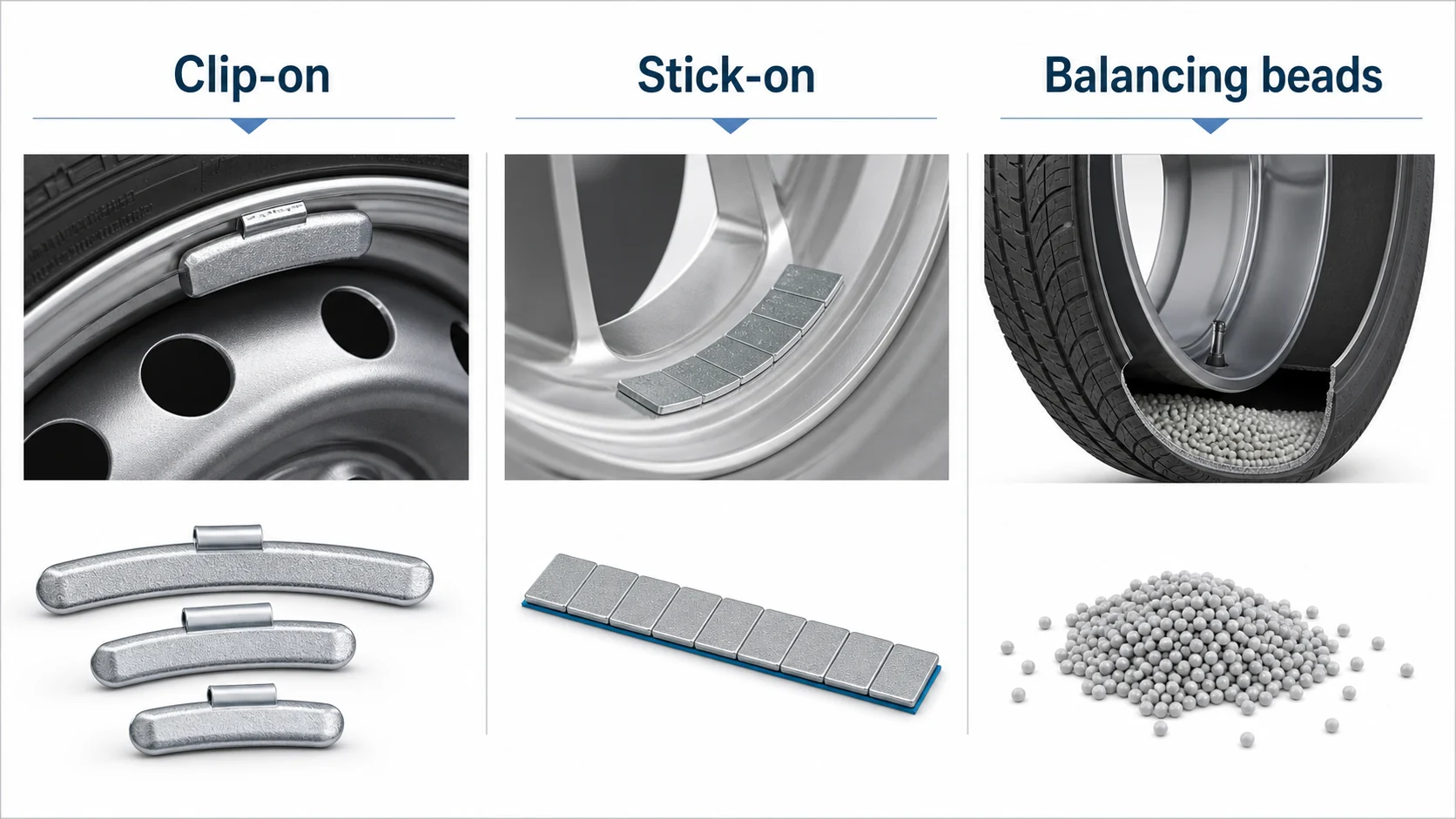
The three common balancing solutions are clip-on wheel weights, stick-on wheel weights, and balancing beads. Clip-on weights fasten to a rim flange, stick-on weights attach to the inner wheel barrel with adhesive tape, and balancing beads sit inside the tire to create a self-adjusting dynamic balancing effect.
Attachment method is only the starting point for a purchasing decision. Buyers building a mixed service assortment can use an attachment and application map for wheel-weight types to connect clip-on and adhesive formats with rim geometry, appearance requirements, balancing location, material choice, and the workshop workflow they need to support.
Clip-on wheel weights
Clip-on wheel weights use a metal clip to attach to the wheel rim flange. They are fast to install and are common on steel wheels, commercial vehicles, and cost-sensitive tire service applications. The key is flange compatibility. A clip that does not match the rim profile can install poorly, lose holding force, or damage the wheel finish. Buyers who have already confirmed a rim-flange application can review clip-on wheel-weight options for that fitment as a product-family next step.
Once a buyer has selected a clip-on format, the next question is whether the proposed profile seats securely on the actual rim. A rim-flange matching process compares the flange lip, gap, depth, and accessible mounting surface before an order is approved. Labels can organize an assortment, but buyers also need to interpret P, C, T, and MC clip labels as starting points for sample validation rather than universal vehicle-fit claims.
For recurring steel-wheel demand, buyers can build a clip-on wholesale assortment around validated profiles, increments, material, and carton logic rather than selecting a broad catalog without matching the rim-flange applications they actually serve.
Clip-on weights are useful when:
- the target market still uses many steel wheels
- shops want fast installation
- visible weights are acceptable
- rim flange profiles are known
- lower unit cost matters
The limitation is appearance and surface risk. On alloy wheels, a metal clip can scratch the rim coating, which is why many passenger car and premium wheel applications use adhesive weights.
Stick-on wheel weights
Stick-on wheel weights, also called adhesive wheel weights, use pre-applied tape on the back of a segmented metal strip. They are typically installed on the inside barrel of alloy wheels. The installation looks cleaner, avoids clamping onto the visible flange, and allows installers to cut or break the strip into the needed weight amount. Where a clean inner-barrel installation has been specified, adhesive wheel-weight formats for that mounting method give buyers a relevant product route after tape and segment requirements are clear.
For wholesale adhesive programs, buyers should compare tape, liner, strip format, packaging, and sample conditions before setting the bulk assortment. This keeps adhesive performance and installation conditions inside the sourcing decision instead of treating them as post-delivery problems.
Stick-on weights are useful when:
- the wheel is alloy or aluminum
- appearance matters
- the rim flange should not be scratched
- the installer needs flexible weight placement
- the product line serves passenger cars, EVs, or premium wheels
The biggest risk is adhesion. Tape quality, surface cleaning, moisture, low temperature, brake dust, and pressure washing can all affect performance. A buyer comparing adhesive weights should ask about tape type, backing liner, surface preparation instructions, and packaging that keeps the adhesive clean.
What makes an adhesive installation reliable?
Adhesive retention is an installation result, not a tape-only claim. Buyers who need to diagnose adhesive-weight loss in service should check the wheel surface, temperature, application pressure, liner handling, and whether the strip conforms to the intended mounting area. When a replacement is needed, technicians should remove old weight residue before reinstallation so oil, silicone, dirt, or remaining tape does not compromise the new bond.
Before approving a stick-on program for a specific market or wheel finish, buyers should validate adhesive samples under local service conditions. Testing against the actual wheel coating, cleaning method, temperature range, pressure, and dwell time creates a more useful approval decision than a generic demonstration of tape strength.
For alloy-wheel programs, the adhesive side of the product range deserves more detail than a simple "stick-on" label. Buyers comparing adhesive wheel weights should look at tape type, backing liner, surface preparation, installation temperature, and packaging protection. If the market uses segmented formats, wheel weight strips should also be compared by segment size, total strip weight, strip width, and carton labeling.
When the market uses different adhesive supply formats, buyers can choose between wheel weight rolls and pre-cut strips based on installation speed, segment control, packaging, inventory handling, and the type of tire shops they serve.
Some alloy wheels, EV wheels, and premium applications also need thinner formats. In those cases, low profile wheel weights help buyers solve clearance and appearance issues that standard adhesive strips may not handle well.
Balancing beads
Balancing beads are small ceramic or glass beads installed inside the tire. As the tire rotates, the beads move dynamically and can help counter imbalance. They are more common in truck, bus, off-road, and heavy-duty applications than in ordinary passenger car retail service.
Balancing beads may be useful for tubeless heavy-duty tires, long service intervals, exterior appearance concerns, and applications that suit dynamic internal balancing.
They are not a universal replacement for wheel weights. They require the right tire type, installation method, and service expectations. For many passenger vehicle and tire shop applications, clip-on and stick-on weights remain the normal daily-use products.
For most product ranges, the first real selection question is choosing between clip-on and adhesive attachment. Clip-on weights fit many steel wheel and commercial applications, while stick-on weights are usually better for alloy wheels, cleaner visual results, and flexible placement inside the wheel barrel.
How do lead, steel, and zinc wheel weights compare?
Lead, steel, and zinc wheel weights differ by density, cost, corrosion behavior, compliance profile, and target application. Lead is dense and compact but restricted or discouraged in many markets. Steel is the mainstream economical lead-free option. Zinc is a higher-cost option often used where appearance, corrosion resistance, or premium positioning matters. For a range decision rather than a single product substitution, material trade-offs in a wheel-weight range help buyers compare the choices before they specify Fe, zinc, or legacy lead alternatives.
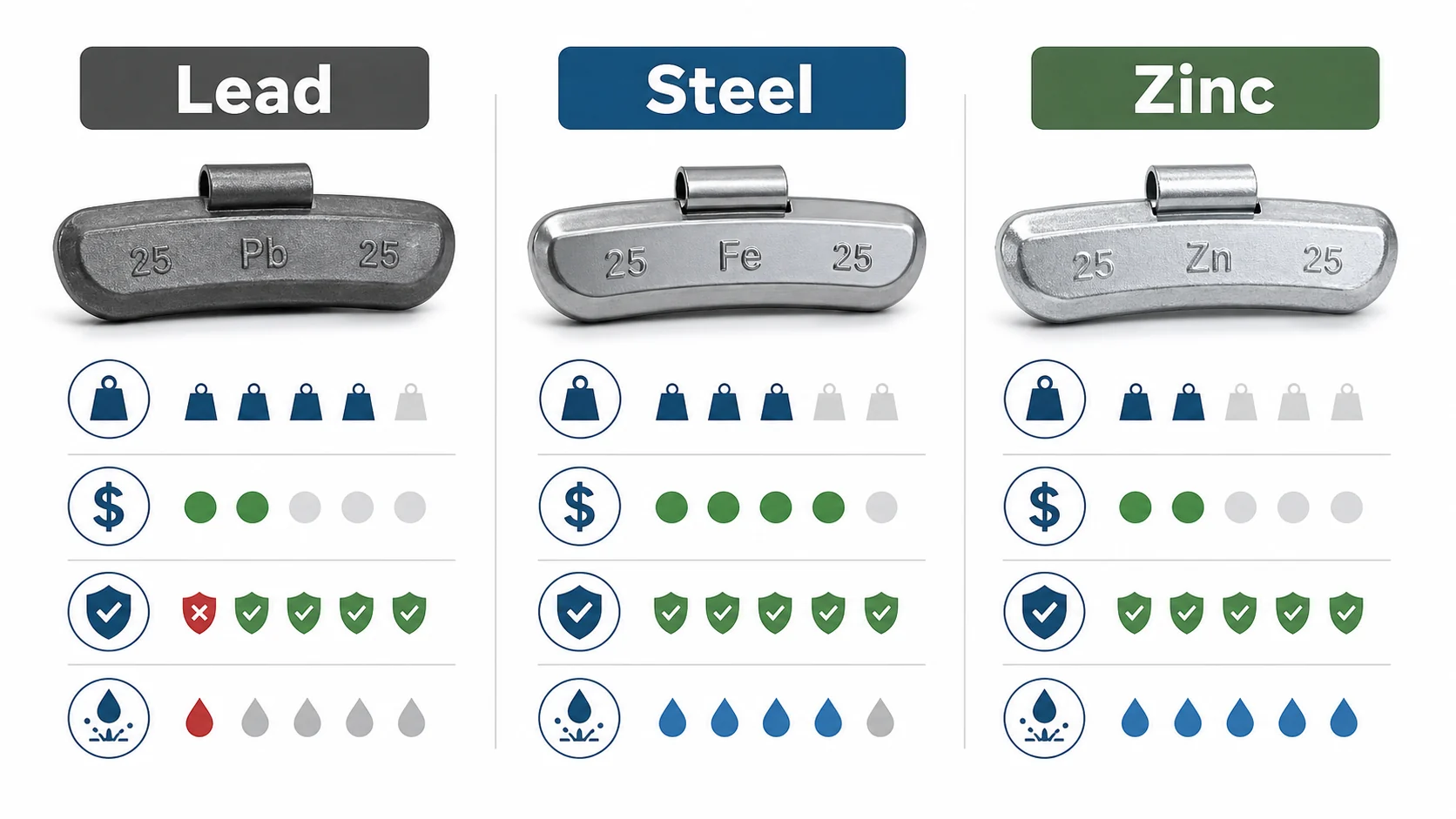
| Material | Main advantage | Main limitation | Common buyer fit |
|---|---|---|---|
| Lead (Pb) | High density, compact size, easy forming | Environmental and regulatory concern in many markets | Legacy or limited markets only; verify rules before ordering |
| Steel (Fe) | Lead-free, economical, recyclable, stable supply | Larger volume than lead; needs coating against rust | Broad aftermarket, distributors, shops, export-friendly product ranges |
| Zinc (Zn) | Good corrosion resistance and premium appearance | Higher cost than steel; slightly lower density than steel | Premium alloy wheels, OEM-style programs, corrosion-sensitive markets |
Lead wheel weights
Lead was historically common because it is dense, soft, and easy to form. A 25g lead weight can be smaller than a 25g steel or zinc weight, which makes installation convenient where space is tight. That was a real advantage when the market cared mostly about fit and low-cost production.
The problem is that lead is a heavy metal. When wheel weights fall off, road debris can enter the environment. The European End-of-Life Vehicles Directive addresses hazardous substances in vehicles and identifies lead among substances to be restricted, with Annex II handling exemptions and reviews 1. In the United States, lead wheel weight restrictions are not one uniform federal rule, but several states and market participants have moved away from lead. Buyers should confirm the target jurisdiction before ordering.
For global buyers, the practical takeaway is simple: do not treat lead as a default export material. If the destination is Europe, North America, an OEM supply chain, or a retailer with environmental requirements, confirm the accepted material before purchase.
Steel wheel weights
Steel wheel weights are now the workhorse option for many aftermarket and export programs. Steel is lead-free, widely available, recyclable, and cost-stable compared with more specialized materials. The trade-off is density. Steel is less dense than lead, so the same weight usually needs more volume.
That trade-off is manageable in most applications. A well-designed steel wheel weight can work effectively when the part shape, coating, clip strength, and adhesive backing are matched to the use case. Steel products normally need corrosion protection such as zinc plating, paint coating, or another surface treatment. Without suitable finishing, exposed steel can rust in wet, salty, or coastal environments.
For distributors replacing a legacy material line, why steel is moving into lead replacement programs explains the fitment, coating, documentation, and stock-planning checks behind that shift. Once the steel route is approved, buyers can review Fe wheel-weight options for a steel-based range alongside the required increments and attachment formats.
For buyers using material codes in quotations, Fe usually refers to an iron or steel-based wheel weight option. A dedicated Fe wheel weights guide helps clarify when steel is the right lead-free route, what coating details matter, and why the same nominal weight may look larger than a legacy lead product.
Steel is a strong choice for:
- distributors that need broad coverage
- tire shops serving mixed passenger cars and light trucks
- buyers replacing lead in mainstream programs
- export markets where lead-free supply is expected
- cost-sensitive product lines
Zinc wheel weights
Zinc wheel weights serve a different position. Zinc has good natural corrosion resistance and can produce a clean, premium appearance, especially for alloy wheel and OEM-style applications. It is typically more expensive than steel, so it is not always the best choice for a broad economy line.
Zinc makes sense when:
- the product is aimed at premium alloy wheels
- corrosion resistance is a strong selling point
- appearance matters
- the buyer wants a higher-value lead-free option
- the target market accepts the cost difference
For a product catalog, steel and zinc should not compete as if one is always better. Steel is often the volume choice. Zinc is often the premium or corrosion-focused choice. A strong buying program may include both. When the range calls for zinc rather than steel, buyers can compare zinc wheel-weight options for the approved material route against the same fitment and unit requirements.
Zinc should be treated as a premium material choice rather than a default replacement for every market. Buyers comparing zinc wheel weights should look at corrosion resistance, finish expectations, cost tolerance, and whether the target customer values appearance enough to justify the higher material cost.
Why are lead-free wheel weights important for export markets?
Lead-free wheel weights matter because many buyers cannot rely on lead products across all destination markets, retail channels, and OEM-style supply chains. Even where lead is not banned nationally, importers may still need steel or zinc alternatives to satisfy local laws, customer policies, sustainability requirements, and documentation expectations.
The European ELV framework is one reason buyers pay attention to material restrictions. Article 4 of Directive 2000/53/EC requires Member States to ensure that vehicles put on the market after 1 July 2003 do not contain lead, mercury, cadmium, or hexavalent chromium except in listed exemptions and conditions 1. The same source also shows that lead in balance weights was an explicit item considered under the Annex II exemption review process 1.
For the United States, the picture is different. There has been EPA guidance encouraging best management practices around lead wheel weights, and several states have enacted their own restrictions or phase-outs, but buyers should avoid saying "the United States bans lead wheel weights" as a blanket statement. That would be too broad. A safer buyer position is: check the state, customer, and channel requirements before supplying lead-containing wheel weights.
RoHS is another term buyers sometimes mention. RoHS is primarily an electrical and electronic equipment directive, not a wheel weight regulation. Still, buyers may request RoHS-style material declarations as part of a broader restricted-substance review. The right response is to provide clear material documentation and confirm what the buyer's market actually requires 4.
For B2B sourcing, this creates three practical rules:
- Do not assume lead is acceptable just because the buyer did not ask. Ask the destination market.
- Do not assume one certificate covers every regulation. Match documents to the buyer's actual requirement.
- Do not sell material compliance as a slogan. Provide material, coating, and test documentation where needed.
For export buyers, lead-free requirements that must be verified by destination are often the safer starting point when the market, retail channel, or customer policy is unclear. Steel and zinc options make it easier to build a product range that can serve more markets without repeatedly redesigning packaging, documents, and catalog language. Once the product requirement is clear, compliance documentation for the destination and customer requirement helps buyers organize the declarations or records they need to request.
Lead-free sourcing should be supported by product-level evidence, not a generic claim. Buyers comparing a lead-free wheel weight supplier's material and documentation controls should match steel or zinc declarations, labels, lot records, and destination-market requirements before issuing commercial approval.
For a broader material decision, buyers can compare non-lead wheel weight options for steel, zinc, and export buying against destination rules, density, corrosion protection, cost, and the application range they need to support.
Which wheel weight fits steel wheels, alloy wheels, trucks, and EVs?
The right wheel weight depends first on wheel type, then material, coating, size system, installation method, and service environment. Steel wheels usually accept clip-on weights well, alloy wheels often use stick-on weights, trucks may use clip-on weights or balancing beads, and EVs usually need clean lead-free products with reliable fit and appearance.
For passenger-car service, passenger-car range planning and sample approval turns recorded correction values into a testable SKU range without borrowing truck or commercial-vehicle assumptions.
Steel wheels
Steel wheels are the classic application for clip-on weights. The rim flange can provide a strong mechanical attachment point, and the visible weight is usually not a major styling issue. For buyers, the key is matching the clip profile and flange thickness.
Common buying checks include:
- rim flange type
- weight increments
- gram or ounce system
- coating for rust prevention
- clip retention strength
- packaging by weight size
For buyers serving repair shops, rim-flange matching for clip-on steel-wheel service should be specified by clip style, unit system, coating, and packaging count. A low price is not useful if the clip does not hold correctly on the local rim profile.
If a steel wheel uses a full wheel cover, check the cover’s fit and seating separately from balance-weight selection. The wheel-cover fitment and replacement guide explains diameter, rim geometry, retaining clips, valve access, and checks for replacing one missing cover.
Alloy wheels
Alloy wheels usually favor stick-on weights because the visible face is more important and the rim coating can be damaged by clips. Adhesive weights can be hidden inside the barrel, giving a cleaner appearance.
Buyers should focus on:
- adhesive tape performance
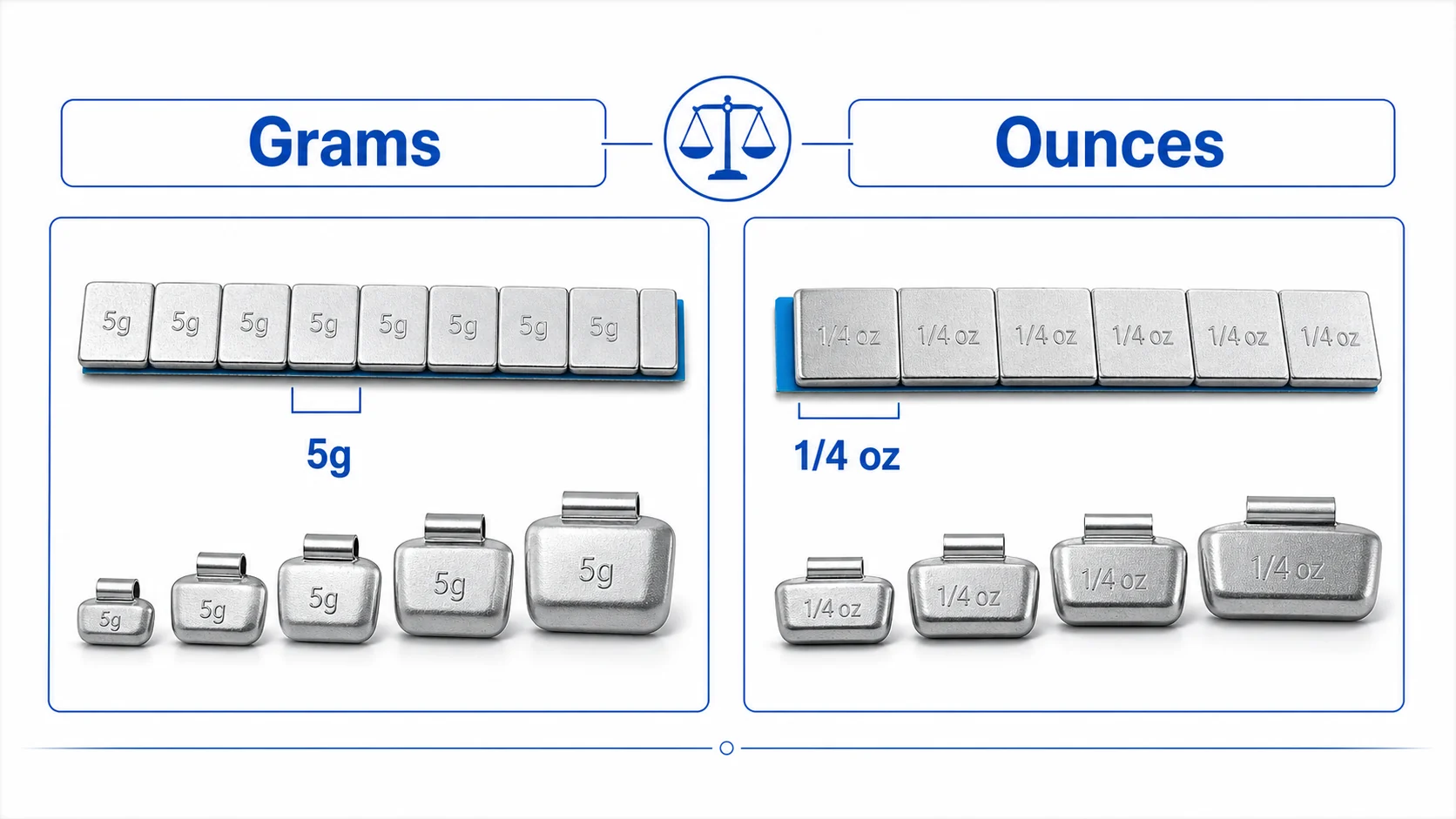
- segment format, such as 5g x 12 or 1/4 oz strips
- coating color and finish
- backing liner quality
- packaging that prevents dust and moisture contamination
- installation instructions for cleaning and temperature
For buyers serving passenger cars, EVs, or premium wheels, tape and segment choices for alloy-wheel programs should be judged by tape quality, strip flexibility, coating finish, liner cleanliness, and real installation performance after the wheel surface is cleaned.
Trucks and commercial vehicles
Commercial vehicle applications can involve heavier weights, larger wheel assemblies, and different service expectations. Clip-on weights are still common, but balancing beads may also be considered for certain tubeless truck, bus, and off-road applications.
The buyer question is not "which is best?" It is "which service model does the customer use?" A distributor selling to tire shops may need clip-on truck sizes. A buyer serving fleets may ask about internal balancing solutions. A mixed product line may require both.
Truck applications usually need a separate selection path because wheel assemblies are larger, service conditions are heavier, and stocking requirements may differ from passenger car programs. Buyers comparing truck wheel weights should confirm weight range, rim compatibility, coating durability, and whether the customer uses clip-on weights, adhesive formats, or internal balancing solutions.
For fleet, bus, and heavier service channels, the question expands from one truck SKU to a full application range. Commercial vehicle wheel weights should be reviewed by vehicle type, service workflow, packaging clarity, corrosion exposure, and batch consistency because downtime and shop complaints are more expensive in commercial maintenance.
EVs and newer passenger vehicles
EVs do not require a separate wheel weight technology, but they do intensify expectations around low vibration, corrosion resistance, clean appearance, sustainability language, and lead-free positioning. Alloy wheels and premium styling are common, so stick-on steel or zinc weights often fit better than visible clip-on weights. For EV-related programs, confirm wheel material, visibility after installation, lead-free documentation, branding, and packaging needs. Buyers can assess clearance and adhesive fit for EV wheel programs when low-profile strip thickness, inner-barrel space, approved balancing locations, and tape performance need to be evaluated on the actual wheel design.
What wheel weight sizes and specifications matter most?
Wheel weight specifications usually start with unit system, weight increment, product type, material, coating, and fitment. Metric markets commonly use grams, while the United States and some North American channels often use ounces, so an export-ready range may need both systems.
Metric gram system
Metric wheel weights are common in China, Europe, and many international markets. Common single weights include 5g, 10g, 15g, 20g, 25g, 30g, 35g, 40g, 50g, and 60g. Adhesive strips often use repeatable segments, such as 5g x 12 pieces for a 60g strip or mixed 5g and 10g formats.
Metric programs are useful when:
- the target market uses gram-based wheel balancers
- the product is sold internationally
- shops want easy segmenting
- packaging and labels need clear size identification
Imperial ounce system
Ounce-based wheel weights are common in the United States and Canada. Typical sizes include 1/4 oz, 1/2 oz, 3/4 oz, 1 oz, 1.25 oz, and 1.5 oz. A buyer serving North American tire shops should not assume gram labels are enough.
Useful conversion references:
| Ounce size | Approximate grams |
|---|---|
| 1/4 oz | 7.09g |
| 1/2 oz | 14.17g |
| 3/4 oz | 21.26g |
| 1 oz | 28.35g |
These conversions help buyers compare systems, but product selection should still follow the balancing machine output and the market's normal ordering language.
Clip-on fitment specifications
Clip-on weights need more than weight size. The clip shape must match the rim flange. If a buyer is not sure, they should send rim samples, flange measurements, or target vehicle information before confirming bulk orders.
Stick-on strip specifications
Stick-on weights need a different set of details:
- segment size
- total strip weight
- tape type
- tape color
- strip width and thickness
- coating color
- packaging quantity
- liner and adhesive storage conditions
For ordering work, using grams, ounces, and strip increments to build coverage helps buyers compare carton labels with the way local shops actually request replacement stock. The chart should be treated as a buying reference, not just a technical appendix.
How are wheel balance weights made and checked?
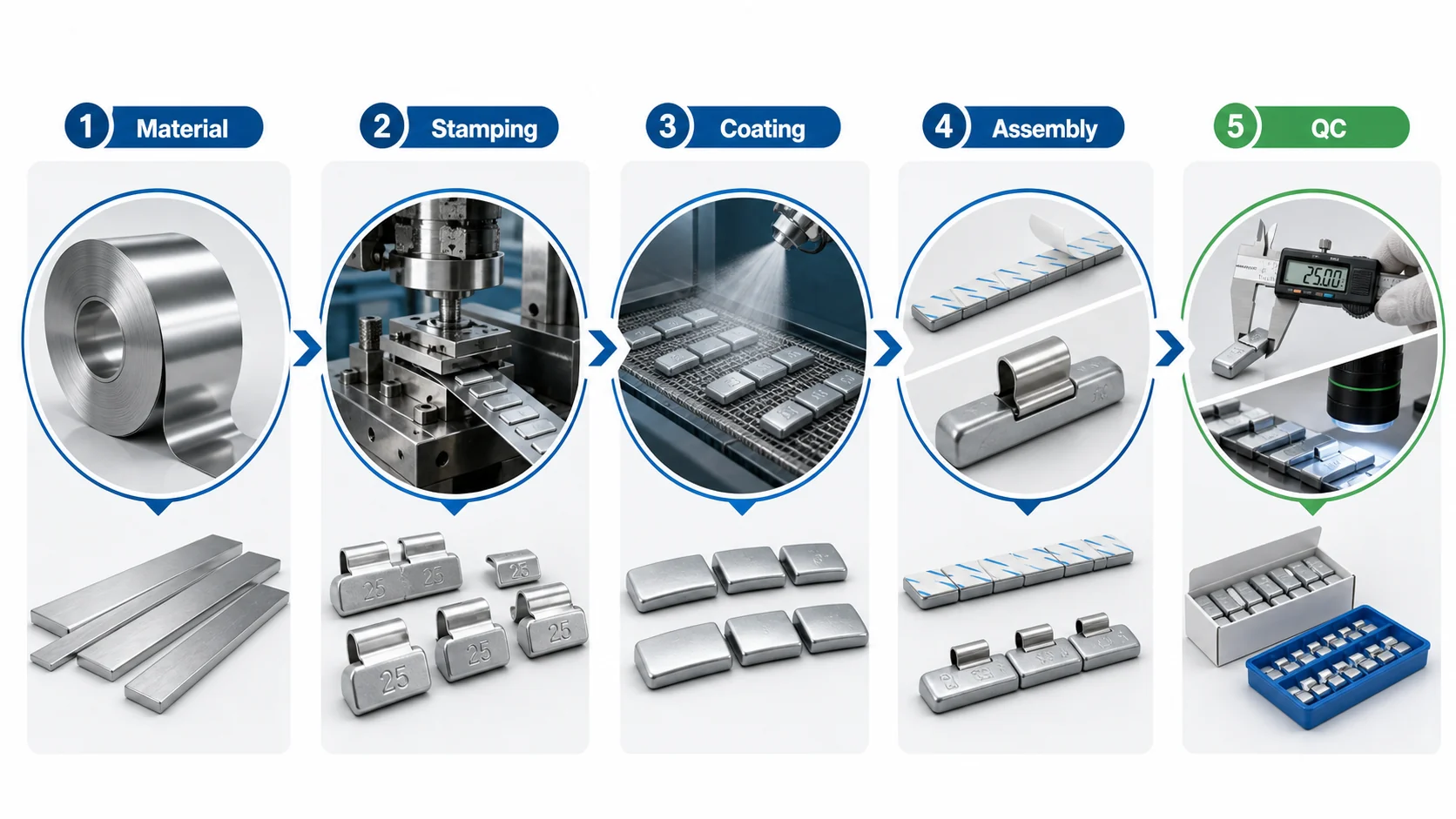
Wheel balance weights are commonly made through material inspection, forming or stamping, trimming, surface treatment, clip riveting or adhesive tape lamination, quality inspection, and packaging. For buyers, the most important checks are weight accuracy, coating durability, adhesive strength, clip retention, and consistent labeling.
Raw material and forming
Steel wheel weights often start from steel strip or steel blanks. The material must be consistent enough for stamping, forming, and long-run production. Zinc weights may be die-cast or otherwise formed depending on design. In every case, the target is repeatability: the same nominal weight should stay within tolerance from batch to batch.
Trimming and surface finishing
After forming, parts may need trimming, deburring, or edge cleanup. Sharp burrs are not just a cosmetic issue. They can affect handling, packaging, rim contact, and perceived quality.
Surface treatment matters most for steel weights. Common finishes include zinc plating, paint coating, or epoxy-style coatings depending on the product and target market. The finish should protect against corrosion without interfering with clip function or adhesive bonding.
Surface finish is not only a cosmetic detail. For steel weights, coating quality affects corrosion resistance, handling, storage, and customer perception after installation. Buyers comparing coated wheel weights should check whether the finish matches the target climate, road-salt exposure, packaging method, and expected shelf life.
Clip and tape assembly
Clip-on weights require clip forming or riveting that holds reliably during installation and service. Poor clip geometry can create returns even when the metal weight itself is correct.
Stick-on weights require adhesive tape lamination. This is where many low-quality products fail. Buyers should care about tape consistency, liner removal, adhesive surface cleanliness, and whether the strip bends properly to match the wheel barrel.
Quality control
Useful QC checks include weight accuracy, visual finish, burr control, clip retention, adhesive bonding, corrosion resistance where relevant, packaging count, and label accuracy.
Use the wheel weight QC checklist and batch record fields to document nominal and measured weight, dimensions, retention-test conditions, finish, labels, and lot traceability. Agree product-specific limits before inspection and hold unresolved failures until the corrective action or authorized disposition is recorded.
How should buyers approve performance before production?
A successful sample should become a written production standard, not just a visual reference. Before confirming a larger order, buyers can approve representative wheel weight samples against fitment, tape, finish, and packaging criteria so the products tested reflect the SKU mix that will actually be supplied.
For coated steel products, the approval process should also establish how surface protection will be assessed. Buyers that need evidence suited to their storage and service environment can compare coating specifications and corrosion-test conditions before accepting steel weights rather than relying on a general rust-resistance claim.
Before requesting a larger sample set, buyers should define the representative SKUs, wheel applications, documents, and packaging evidence to request. A focused request keeps sample testing connected to the range that may actually be ordered.
Manufacturing consistency has direct commercial value. A distributor may accept a slightly higher unit price when the product reduces shop complaints, installation failures, mislabeled cartons, and inconsistent batches. For that reason, the production controls behind repeatable wheel weights should be part of supplier comparison, not an afterthought.
Supplier evaluation should be separated from simple product comparison. A wheel weights manufacturer should be judged by material control, coating consistency, adhesive or clip quality, packaging accuracy, documentation support, and repeatable batch supply.
Buyers who need a broader aftermarket view can compare automotive wheel weight supplier product range and quality checks before narrowing the shortlist to a specific factory or sourcing model.
How should buyers choose a sourcing route before comparing quotes?
Before comparing individual companies, buyers should decide whether the order needs direct factory control, broader sourcing coordination, or local stock support. The sourcing-model comparison for manufacturers, trading companies, and distributors helps define that route before a shortlist is built.
When repeat production, customized specifications, or controlled packaging matter, buyers should assess the product and process capability behind a wheel weight factory rather than assuming every seller has the same technical control. A structured supplier scorecard for product fit, evidence, commercial support, and delivery risk then makes the shortlist comparable before quotations begin.
An audit is the next step after a supplier enters the shortlist. Buyers can use a factory-audit checklist for materials, tooling, process controls, records, packaging, and corrective actions to verify that an approved product can be reproduced and investigated when discrepancies occur.
What should buyers check before ordering wheel balance weights?
Buyers should check target market, wheel type, weight system, material, coating, installation method, packaging, certifications, and sample performance before placing a larger order. A wheel weight is a small part, but the wrong selection creates shop complaints, fitment trouble, corrosion problems, and regulatory risk.
Start with the market and application:
- Destination market: Does the buyer need lead-free steel or zinc, and are there local rules or customer policies?
- Wheel type: Is the main application steel wheels, alloy wheels, trucks, EVs, or mixed aftermarket service?
- Installation method: Does the customer prefer clip-on, stick-on, or balancing beads?
- Unit system: Does the shop order in grams or ounces?
- Material and finish: Is the program economy, mainstream lead-free, premium, galvanized, painted, or epoxy-style?
- Attachment quality: Will the tape or clip stay attached in real service?
- Packaging and documents: Are weights sorted, labeled, boxed, and supported by required material or compliance documents?
- Samples: Has the buyer tested installation before ordering full volume?
How should buyers build a market-ready SKU and packaging program?
A product range should reflect the wheel mix and service workflow of the target market, not simply the supplier's longest catalog. Buyers can build a practical SKU mix around wheel type, attachment format, material, and gram or ounce coverage before deciding carton quantities or requesting a quotation.
For a branded program, the product decision must carry through to the carton. Teams preparing an OEM or distributor launch should define private-label artwork, label content, approvals, and repeat-order controls before printing packaging.
The final packaging specification should make type, size, material, quantity, and batch details easy for warehouse teams and tire shops to verify. Buyers can set carton-label and packing requirements that protect wheel weights and simplify SKU handling before production begins.
Not every range needs a custom development path. When a functional requirement cannot be met by a standard SKU, buyers should separate genuine application requirements from cosmetic customization before development begins. Brand owners that need repeatable specification, packaging, document, and revision control should also define the manufacturer responsibilities behind an OEM wheel weight program before treating an initial sample as final approval.
Private-label economics should be estimated before artwork and packaging are finalized. Buyers can plan MOQ and pricing for a private-label launch around SKU count, packaging setup, artwork, and standard-versus-custom products before committing to a branded range that is too broad for the first order.
How should buyers turn an approved range into a first order?
An approved assortment still needs a commercial structure before it can become an order. Buyers can use a wheel weight catalog to compare available formats, increments, materials, and packaging fields to identify which products belong in the request and which details remain unclear.
For distributor programs, wholesale and bulk order planning connects that SKU list to carton quantities, replenishment logic, and market coverage. Buyers should then confirm which product, packaging, profile, and customization choices determine MOQ before treating a low opening quantity as commercially realistic.
For readers building or refreshing a product range, the wheel-weight formats that match an approved specification become useful after type, material, size system, and market documents have been defined. That gives a buyer a focused product review before requesting a catalog or quotation.
For larger orders, product selection should be connected to carton quantity, SKU mix, sample approval, and destination-market requirements. A bulk wheel weights order should not be built only around the lowest unit price; it should match the buyer's actual wheel types, gram or ounce system, packaging style, and reorder pattern.
If the buyer serves repair shops, the stocking logic is slightly different. Wheel weights for tire shops should be organized around daily service needs: clip-on coverage for steel wheels, adhesive strips for alloy wheels, clear labels for technicians, and a practical size range that avoids overstocking slow-moving SKUs.
Wheel weights are one part of a broader service program. Buyers planning tire balancing supplies for a broader shop product range can place weight formats alongside the other consumables, tools, and stocking decisions that support daily balancing work.
Wholesale buying adds another layer beyond product selection. Buyers comparing wheel weights wholesale should check MOQ, SKU mix, packaging, sample approval, lead-free material options, and whether the quotation reflects the real destination market instead of a generic price list.
How should buyers compare commercial offers without losing the specification?
A quoted figure is useful only when the scope behind it is comparable. Buyers should compare total wheel weight cost across material, attachment, coating, packaging, inspection, and destination requirements rather than using a headline unit price as the decision.
Once the same requirement list has been issued to each candidate, a quotation comparison process for price, scope, evidence, and delivery risk makes omissions visible before a buyer commits to the supplier that appeared cheapest first.
How should buyers control timing, shipping, and payment risk?
Once the product scope and quotation are agreed, buyers should separate factory production time from transit and clearance time. Production lead-time planning for wheel weights helps connect sample approval, packaging, capacity, inspection, and replenishment dates.
Shipping terms should then define who controls freight, insurance, export formalities, import clearance, and receiving responsibilities. Buyers can use an Incoterms and import-planning framework for wheel weight shipments before treating a quotation as an all-in delivered cost.
Payment milestones should match the order's approval and evidence stages. A payment-term framework for managing wheel weight order risk helps buyers connect deposits, sample or artwork approval, inspection, shipment evidence, and final payment without treating payment terms as an isolated commercial detail.
What should be confirmed before goods are released for shipment?
Order quality can still be compromised after production if adhesive products, coatings, labels, or cartons are handled poorly in storage. Buyers should confirm storage conditions and shelf-life controls for adhesive tape, coatings, and labeled stock as part of the agreed supply process.
Every carton should also be traceable to the approved product and production record. A practical system uses batch codes, carton labels, and COAs to connect samples, production lots, and complaint handling rather than relying on a generic SKU description.
Before loading, the buyer or inspection partner should verify that the shipment matches approved samples, SKU quantities, markings, packaging, and batch records. The final document set should then be checked against the destination and customer requirement, using an import-focused export-document checklist for specifications, material declarations, packing records, and supporting evidence.
For practical sourcing work, the most useful buyer conversation is specific. Buyers can use a copyable wheel weight RFQ worksheet covering product, fitment, packaging, documents, samples, inspection, destination, and timing to send the supplier one controlled requirement list covering:
- target market
- product type
- material preference
- size list
- packaging style
- expected monthly volume
- certificate or test-report needs
- sample request details
That information reduces back-and-forth and prevents quoting a product that looks cheap but does not fit the actual market.
Conclusion: Build the category around fit, compliance, and repeatable supply
Wheel balance weights look simple because each part is small. The buying decision is not simple. A useful product range must match wheel type, installation method, material expectation, local regulations, size system, coating needs, packaging style, and shop workflow.
For global buyers, the goal is not just to find a low unit price. The goal is to build a wheel weight range that fits the target vehicles, meets market expectations, installs cleanly, and arrives consistently from batch to batch.
If the next step is product selection, start with the wheel type and target market. If the market requires lead-free supply, compare steel and zinc options before discussing price. If the customer serves alloy wheels, pay close attention to adhesive tape and strip format. If the customer serves steel wheels or commercial vehicles, confirm clip profile and flange fit before scaling an order.
For buyers preparing a new order, the most useful request is a clear one: ask for the wheel balance weight catalog, Fe/Zn material options, sample pieces, size list, packaging details, and compliance documents required by the destination market.
Frequently Asked Questions
What are wheel balance weights used for?
Wheel balance weights are used to correct uneven mass distribution in a tire and wheel assembly. By adding precise weight at the required position, they help reduce vibration, steering shake, uneven tire wear, and stress on suspension components.
Are wheel weights the same as tire balancing?
No. Tire balancing is the service process that measures and corrects imbalance in a mounted tire and wheel assembly. Wheel weights are the physical products used during that process to add the required correction weight.
Are clip-on or stick-on wheel weights better?
Neither type is always better. Clip-on weights are usually best for steel wheels and fast shop installation, while stick-on weights are usually better for alloy wheels because they can be hidden inside the wheel barrel and avoid scratching the visible rim surface.
What is the best material for wheel weights?
Steel is often the best mainstream lead-free material because it is economical, recyclable, and suitable for many export markets. Zinc is a good premium option when corrosion resistance and appearance matter. Lead should be used only after confirming the target market allows it.
Are lead wheel weights illegal?
It depends on the market. The EU has strict hazardous-substance rules under the End-of-Life Vehicles framework, and several U.S. states have restricted or phased out lead wheel weights. Buyers should verify the destination market instead of assuming one global rule.
What sizes do wheel weights come in?
Metric wheel weights commonly use gram sizes such as 5g, 10g, 15g, 20g, 25g, 30g, 40g, 50g, and 60g. Ounce-based markets commonly use sizes such as 1/4 oz, 1/2 oz, 3/4 oz, and 1 oz.
Why do stick-on wheel weights fall off?
Stick-on wheel weights usually fail because of poor surface cleaning, moisture, low installation temperature, weak tape, dust, brake residue, or pressure washing near the adhesive area. Buyers should evaluate tape quality and packaging, not only metal weight price.
What should importers ask before ordering wheel weights?
Importers should ask about material, lead-free status, size system, coating, clip profile, adhesive tape, packaging, sample availability, target-market documents, and batch consistency. A clear specification prevents quoting errors and reduces complaints after shipment.
References
[1] EUR-Lex. (2000). Directive 2000/53/EC of the European Parliament and of the Council on end-of life vehicles.
[2] United States Environmental Protection Agency. (2015). Best Management Practices for Lead Wheel Weights.
[3] Wikipedia contributors. (2025). Tire balance.
[4] EUR-Lex. (2011). Directive 2011/65/EU on the restriction of the use of certain hazardous substances in electrical and electronic equipment.