



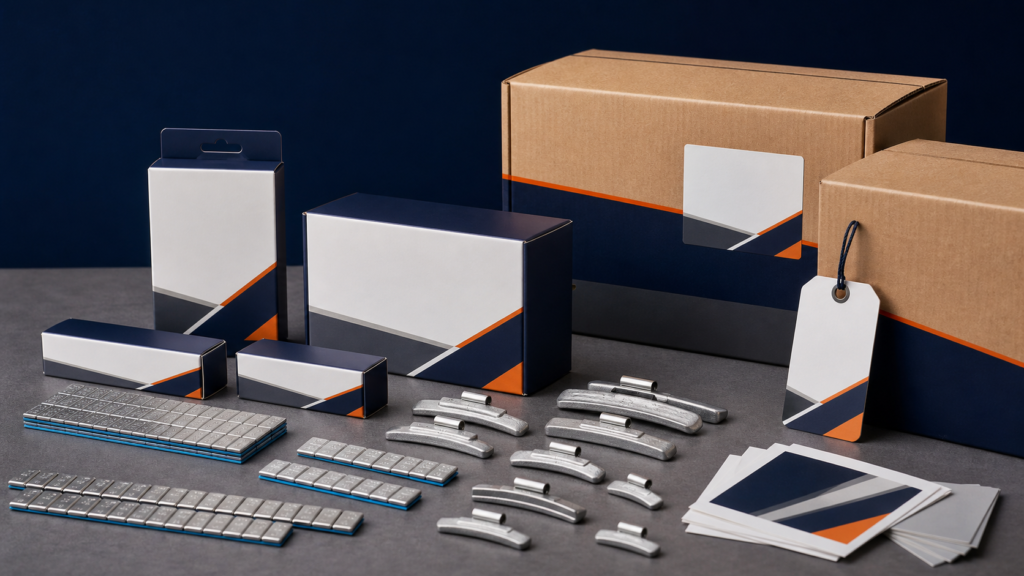
Private label wheel weights need more than a logo on a carton. A reliable program defines the exact wheel-weight format, material, unit system, label data, carton configuration, artwork approval, and batch record before production. That control keeps the branded range accurate across samples, the first shipment, and later repeat orders.
A brand launch can fail quietly when its packaging is treated as decoration rather than product information. A distributor may receive the right metal weights but the wrong unit markings, clip profile, carton count, or barcode placement. The most useful private-label process therefore starts with the product decision and ends with a repeatable approval record.
Table of Contents
- What does private label mean for wheel weights?
- Which SKU decisions must be made before artwork begins?
- What information belongs on wheel weight labels and cartons?
- How should buyers plan packaging levels and barcodes?
- What is a reliable private-label approval sequence?
- What should buyers check before production and repeat orders?
- How do suppliers and buyers control changes?
- Conclusion: Treat packaging as a controlled product record
- Frequently Asked Questions
- References
What does private label mean for wheel weights?
Private label wheel weights are approved wheel-balance products sold under the buyer's brand, with agreed packaging, labels, and commercial presentation. The product itself still has to meet the chosen fitment, material, size, and quality requirements; branding does not turn a generic part into an interchangeable one.
The scope can be modest: a buyer may use an existing carton size and add a controlled label. It can also be broader, with custom retail boxes, inner packaging, carton print, barcode requirements, mixed-SKU kits, and language variants. Neither approach is automatically better. The right choice follows the sales channel, order volume, warehouse workflow, and the level of differentiation the buyer can maintain across repeat orders.
Start with the product range rather than the visual identity. Before a brand owner selects colors or a carton layout, it needs to decide which clips, adhesive strips, materials, and weight systems will represent the range. The wheel-weight range decisions before artwork begins help the buyer avoid approving packaging for a selection that later changes in fundamental ways.
Private label also creates ownership questions. The buyer should clarify who owns artwork files, who gives final print approval, whether packaging remains exclusive, how obsolete material is handled, and which record controls the next order. Put those commercial answers in the purchase terms; do not assume a visual sample settles them.
Which SKU decisions must be made before artwork begins?
Artwork should begin only after every branded SKU has a stable specification. A carton can present the brand well, but it cannot correct an undefined product description or a confused unit system.
For each SKU, record the product type, attachment method, material, weight range or increment, unit system, finish, clip profile or tape specification, inner-pack quantity, and outer-carton quantity. For adhesive strips, state segment weight, strip format, tape and liner details, and the intended storage conditions. For clip-on products, state the rim-flange profile used for approval instead of relying on a vague “fits most wheels” claim.
The unit and increment choices that belong on the SKU record are especially important in branded programs. A 1 oz clip-on weight and a 25 g adhesive product may look close on a loose sales sheet, yet they differ in unit, application, and physical attachment. Separate SKUs prevent technicians, warehouse teams, and buyers from treating them as substitutes.
Use a simple master-SKU table before design work begins:
| SKU field | Example decision to freeze | Why it protects the brand |
|---|---|---|
| Product format | Clip-on or adhesive strip | Stops the wrong application from being packaged under one label |
| Mass and unit | 5 g segments or 1 oz pieces | Keeps product markings aligned with shop and balancer use |
| Material and finish | Steel with agreed coating; zinc where specified | Supports truthful material and appearance claims |
| Fitment or tape detail | Approved clip profile or tape/liner combination | Connects packaging to actual installation performance |
| Pack configuration | Pieces per inner box, inners per carton | Makes ordering, receiving, and replenishment predictable |
| Artwork revision | Controlled file name and approval date | Prevents an obsolete design from returning on a repeat order |
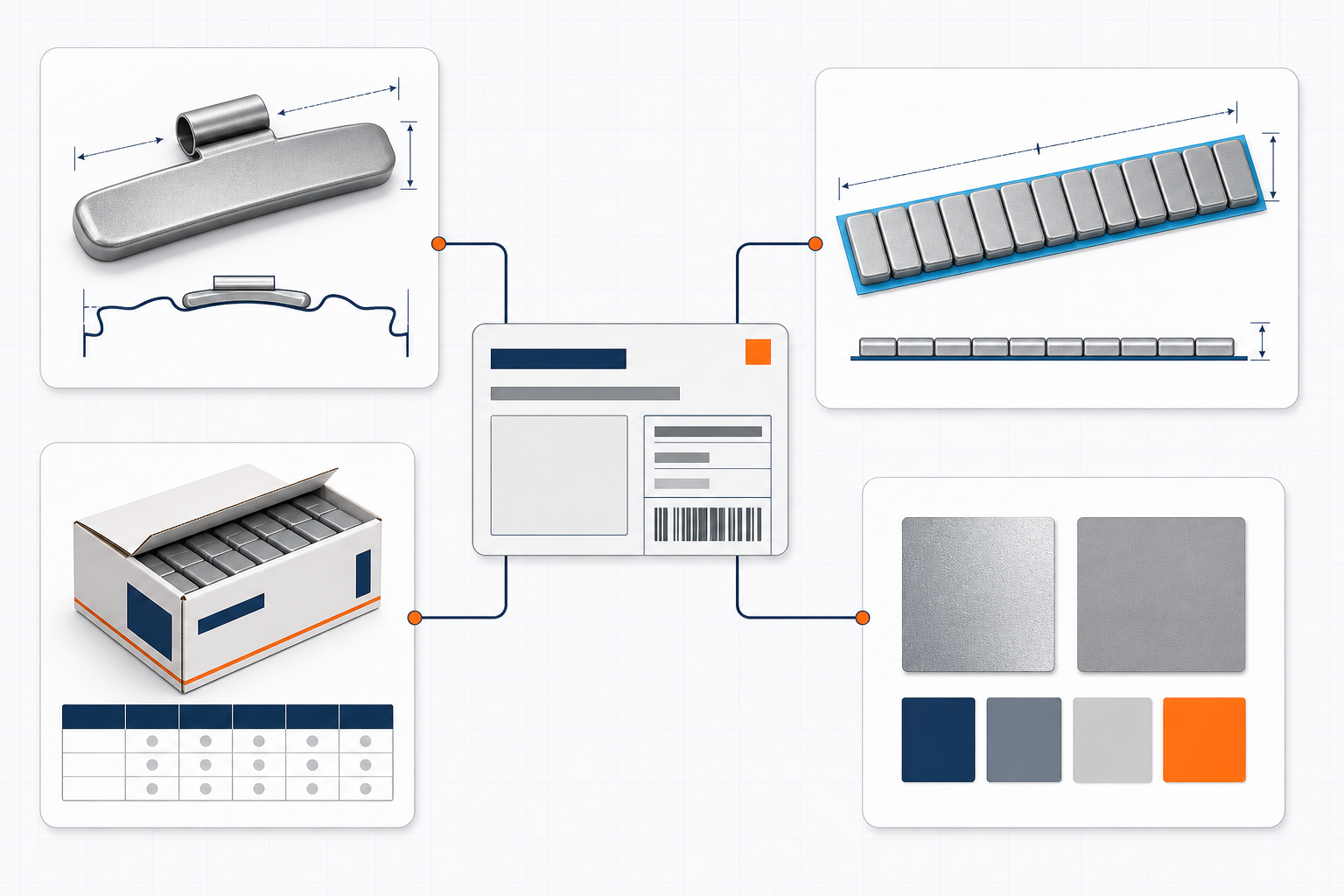
A private-label SKU record should align the wheel-weight format, unit, pack quantity, finish, and label data.
A buyer building a broader assortment can compare product formats to place in a branded assortment after the market and service applications are known. That comparison should produce a deliberate range, not a carton list copied from another distributor.
What information belongs on wheel weight labels and cartons?
Wheel weight labels and cartons should make the product identifiable at the point of receiving, storage, and use. They should carry the fields the channel needs to distinguish one SKU from another, while avoiding unverified claims or graphics that hide the essential product data.
Typical buyer-controlled information includes the brand, product description, part number, attachment type, material where relevant, unit and mass range, quantity, country-of-origin wording when required, batch or lot reference, handling or storage direction where applicable, and barcode data if the customer uses it. Language, warning, and regulatory text must be confirmed for the destination and customer; a label that works in one country is not automatically suitable in another.
Information needs differ by packaging level. A technician-facing inner box may emphasize the part number, weight system, and piece count. An outer carton needs clearer receiving and logistics information: SKU, carton quantity, gross and net weight if agreed, carton number, and a lot reference. A pallet label may need a shipment or logistics identifier. Do not force every field onto every surface; decide which team must identify the package at each handoff.
The design review should also protect legibility. Test the final print size, contrast, barcode quiet area if used, and placement on real packaging rather than only on a computer screen. Adhesive-strip cartons can be narrow, while mixed clip-on assortments may have more label real estate but greater risk of confusing similar sizes. A clear layout reduces selection errors more effectively than additional decorative artwork.
How should buyers plan packaging levels and barcodes?
Buyers should define each packaging level—individual retail unit, inner pack, outer carton, and pallet or logistics unit—before assigning barcode and label requirements. The hierarchy must match how the goods are ordered, invoiced, received, and resold, not merely how the factory finds it easiest to pack.
GS1 notes that cartons and outer cases commonly use a barcode encoding a GTIN, while logistics labels can use an SSCC to identify individual logistics units.1 That does not mean every wheel-weight program needs every GS1 identifier. It means that a buyer who requires standardized scanning should define the packaging hierarchy and data owner before artwork is released.
If a corrugated outer case is a trade item that will be scanned in warehousing or distribution, ITF-14 is one GS1 barcode option intended for outer-case packaging rather than retail point of sale.2 Confirm the barcode type, number source, print specification, scanning environment, and whether the code identifies a fixed SKU or a variable logistics unit. Never copy a barcode from a mock-up or ask the factory to create a new brand identifier without the brand owner's authorization.
For practical planning, define the carton quantity and SKU mix before the artwork dimensions are frozen. Buyers can use carton quantity and SKU mix behind a branded order to decide whether the program needs single-SKU cartons, assorted kits, or separate inner packs. The packaging plan should then show how a warehouse can identify every level without opening it.
What is a reliable private-label approval sequence?
A reliable approval sequence connects the product sample, packaging files, physical packaging sample, acceptance checklist, and production carton. Each step should have one named approver and a controlled revision, so the brand cannot be diluted by informal email changes.
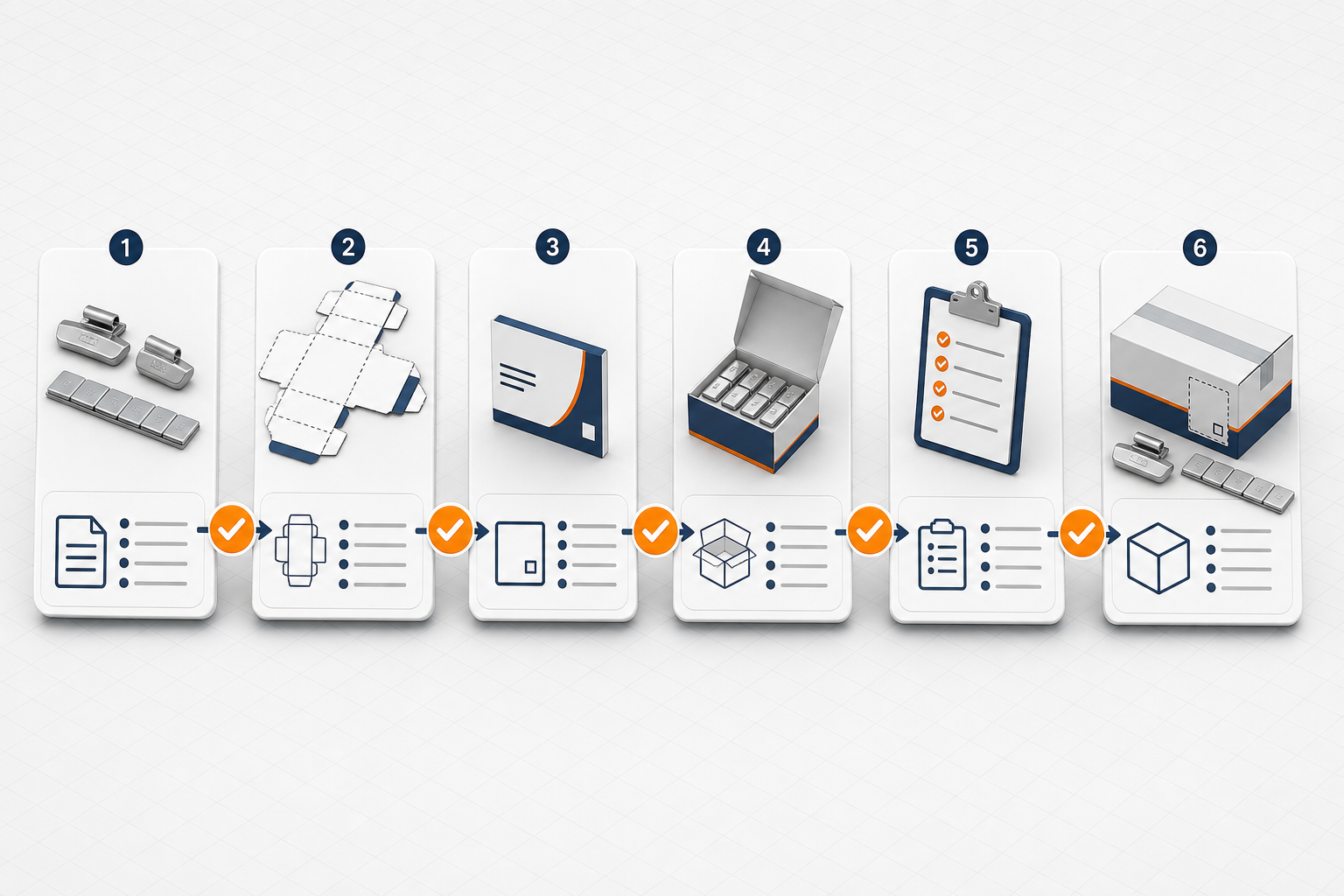
Private-label approval should connect the product specification, packaging artwork, sample, acceptance record, and repeat-order carton.
- Freeze the product specification. Confirm the SKU table, material, mass/unit, attachment method, fitment or tape details, and pack quantities.
- Prepare a dieline and artwork brief. State the packaging level, dimensions, color references, required fields, barcode ownership, languages, and print locations.
- Approve digital artwork. Check the exact text, part numbers, units, product images, claims, and revision code. Keep the signed or written approval with the production file.
- Review a physical packaging sample. Check board quality, opening method, print legibility, label adhesion, barcode scannability when used, and whether adhesive-strip or clip-on products are protected in transit.
- Approve the complete sample set. Review product, packaging, carton mark, and label together. A perfect box does not approve an untested product, and a good product sample does not approve a different carton.
- Lock the production and repeat-order record. Retain approved photos, the artwork revision, product specification, packaging configuration, and batch-label example for the next order.
The physical sample is the best point to catch a mismatch between commercial intent and warehouse reality. It reveals whether a strip tray is crushed, whether the product shifts inside a carton, whether labels are readable on a shelf, and whether the count on the outer carton matches the actual inner packs. For adhesive products, product and packaging should be reviewed together because handling and storage can affect the tape system; 3M's wheel-weight system, for example, emphasizes a conformable balancing material and automotive attachment tape as one application system.3
What should buyers check before production and repeat orders?
Before authorizing production, buyers should test the exact combination they plan to sell: product specification, label, carton, and commercial pack count. The buyer-oriented checklist below keeps a branded launch grounded in usable product control rather than just attractive packaging.
- Does every product image, part number, unit, material name, and attachment description match the approved SKU table?
- Are clip profiles or adhesive-strip details tied to the approved product sample rather than a generic catalog image?
- Are the inner-box, outer-carton, and pallet quantities consistent with the quote, purchase order, and warehouse plan?
- Does the label show the data needed by the receiving and service teams at the correct package level?
- Has the buyer approved the final printed or labeled physical sample, not only a PDF proof?
- Are destination language, origin-marking, material, barcode, and customer-program requirements confirmed by the appropriate buyer-side owner?
- Is there a clear approval revision and an approved reference photo for the factory and buyer teams?
For a private-label launch, price is only one readiness signal. Buyers comparing production controls that protect a branded program should also ask how the factory checks incoming artwork, separates revisions, verifies pack counts, and records the production lot. A factory that can reproduce a branded carton consistently is more valuable than one that can merely print a convincing first sample.
Before that record is released to production, the brand team should approve representative products, labels, and cartons as one supplied system. It should then specify carton-label and packing controls that keep the branded SKU identifiable in storage and receiving.
How do suppliers and buyers control changes?
Change control prevents a repeat order from quietly becoming a different product or package. The buyer should require advance notice before a change to material, coating, tape, liner, clip profile, weight increment, carton board, inner-pack count, artwork, label fields, or barcode data.
Not every change requires a full redevelopment. Some changes may only need a new artwork proof, while others require a fresh physical sample, updated specification, or re-check of market requirements. The decision should be documented: what changed, why, which SKU is affected, whether the existing approval remains valid, and who accepted the change.
Keep a repeat-order pack containing the approved artwork PDF, editable source-file ownership record, SKU specification, packaging dieline, labeled sample photos, carton configuration, and batch-label example. This record makes it possible to investigate an exception quickly and reduces the chance that an old logo, the wrong unit, or a retired carton quantity returns after several months.
Distributors considering a branded range should compare distributor requirements before a branded launch against their own sales channel, warehouse capability, and reorder volume. A restrained launch with a controlled SKU set and proven packaging often protects the brand better than a large catalog that cannot be governed consistently.
Conclusion: Treat packaging as a controlled product record
Private label wheel weights work when the branded presentation remains connected to the exact product the buyer approved. Define the SKU range first; then control the label data, packaging levels, physical sample, artwork revision, and batch record. That sequence makes the first shipment easier to receive and the next one easier to reproduce.
If you are preparing a branded wheel-weight range, start by sharing the target SKU list, sales channel, package levels, destination requirements, and preferred carton style. A discussion about private-label cartons, labels, and sample approval is most productive when it begins with those operational details rather than a logo file alone.
Frequently Asked Questions
Can a wheel weight supplier add my logo to an existing carton?
Often, yes, but the buyer should still approve the exact label or printed sample and confirm which product, package level, and carton quantity it represents. A logo label is not enough if the SKU, unit, material, or pack configuration is unclear.
Should every wheel weight package have a barcode?
Not necessarily. Barcode use depends on the sales channel and receiving process. If the program requires scanning, define the package level, code owner, barcode type, print quality, and the data the code represents before artwork approval.
What is the most important private-label approval sample?
Approve the product and its packaging together. The essential sample includes the actual wheel weights, correct inner pack, outer carton or label, approved artwork revision, and agreed quantity. Separating product approval from packaging approval creates avoidable gaps.
How can a buyer prevent the wrong artwork on a repeat order?
Use a controlled repeat-order pack: approved artwork revision, SKU specification, packaging configuration, signed or written approval, reference photos, and a change-notification rule. Require the supplier to reference that record before production.
References
[1] GS1. “GS1 Logistic Label Guideline.” n.d.
[2] GS1. “When can ITF-14 barcodes be used?.” 2024.
[3] 3M. “3M Universal Cutting Tool PN61479.” n.d.