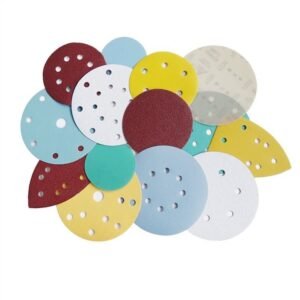
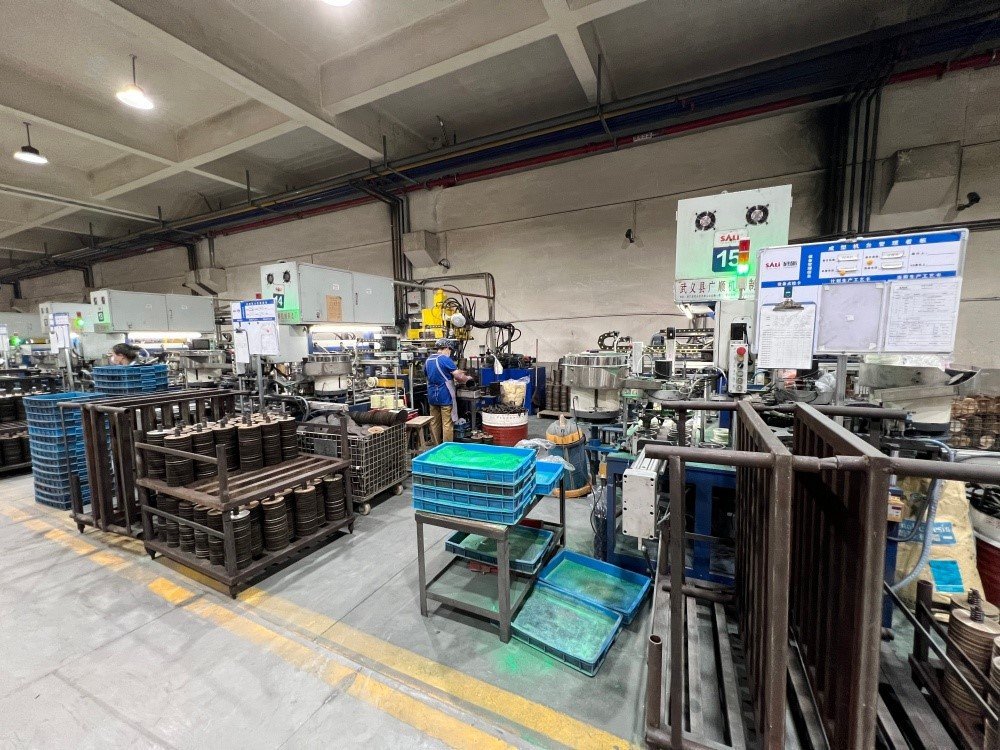
Yirox manufactures automotive coated abrasives in-house — covering round hook-and-loop discs, PSA discs, square hand-block sheets, rolls, and foam-backed pads across a full P40–P3000 grit ladder.
Our integrated coating line runs phenolic make-coat, electrostatic grain deposition, size-coat, festoon cure, and die-cut conversion in one plant on a single batch code. Every export carton ships with a complete EN 12413 / ISO 6344 / OSA / RoHS certification packet, verifiable against the issuing body’s online register.
Automotive coated abrasives are sold in six common physical formats. Each format is engineered for a specific tool family and sanding stage — round discs for orbital tools, square sheets for hand blocks, rolls for inline machines, sticks for detail work. A complete body-shop catalogue carries multiple formats; most distributors stock the top three.
Wholesale and bulk-order available across all formats and grit ranges below. Need a spec not listed? Contact us for custom ODM.

Round Discs (Hook-and-Loop)
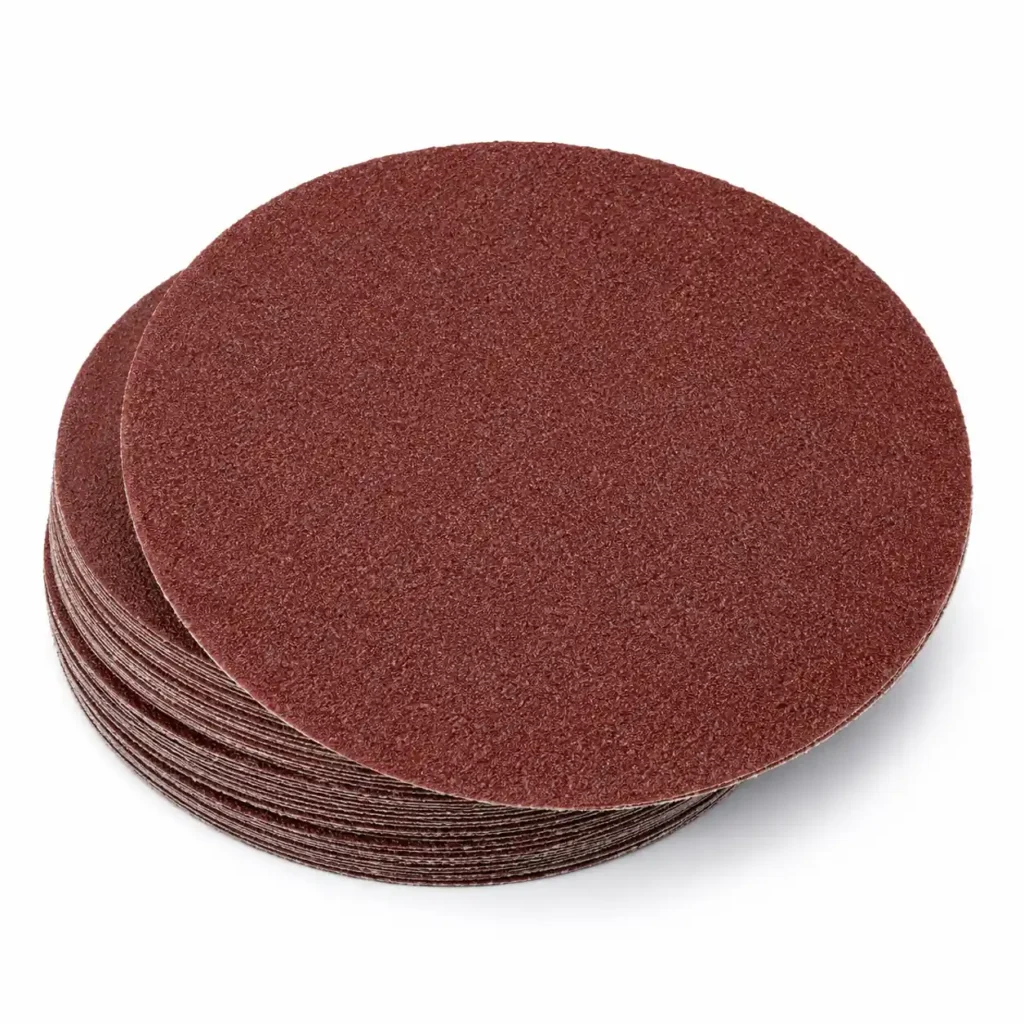
The workhorse format for dual-action (DA) and random-orbital sanders. Sizes 75, 125 and 150 mm with 6-hole, 8-hole and 17-hole dust-extraction patterns. Hook-and-loop attachment allows fast disc changes between grits.

Square & Rectangular Sheets
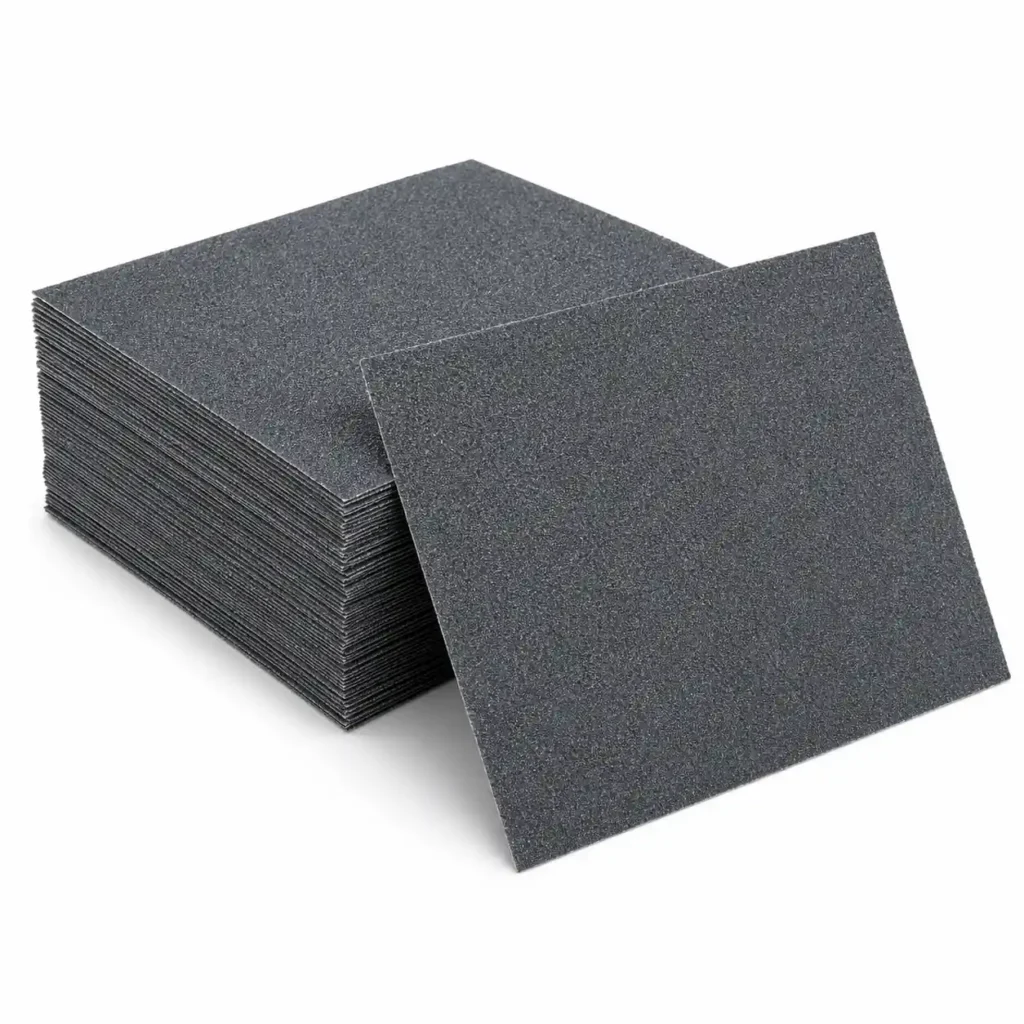
Hand-block sanding sheets in 70×125, 70×198 and full 230×280 mm. Used on flat panels, in corners and details where a DA cannot reach. PSA and hook-and-loop fixings, paper or film backings, P80–P2500.

Continuous Rolls & PSA Strips
2–4 inch wide rolls for inline sanders, file-board sanders and long-board hand work on door skins, hoods and quarter panels. Sold by length, cut to fit by the operator. Paper or cloth backing for high-stress stripping.
Automotive sandpaper is a category of coated abrasives — abrasive mineral grains bonded to a flexible backing — engineered specifically for vehicle bodywork rather than general carpentry or metalwork. The mineral, the backing, the bonding resin, and the grain orientation are all tuned for paint, primer, plastic filler, and clear-coat surfaces.
The category traces back to the 1830s — when the first commercially produced sandpaper was made by gluing crushed glass to paper backing — but the modern automotive form emerged in the mid-20th century alongside the spread of synthetic body fillers and two-pack paint systems. Today’s automotive coated abrasives use synthetic mineral grains (aluminium oxide, silicon carbide, ceramic blends) bonded with phenolic and urea-formaldehyde resins, on backings ranging from light paper to polyester film to PU foam. The result is a consumable that survives wet sanding, orbital heat, and solvent contact without delaminating — none of which carpentry sandpaper has to tolerate.
Inside a body shop, automotive sandpaper sits between three downstream stages: stripping & shaping (P40–P180), primer prep (P220–P600), and colour and clear-coat sanding (P800–P3000). Grit selection at each stage determines the finish quality of the next — which is why coated abrasives are bought across the full P-range, not as scattered grits from multiple suppliers.
Mineral grains (aluminium oxide, silicon carbide, ceramic) electrostatically bonded to a paper, film, cloth or foam backing with synthetic resin, sized by the FEPA P-grade scale, and finished for use in vehicle paint and bodywork.
Glass-paper (1830s) → flint paper → garnet paper → aluminium oxide on cloth (1900s) → modern resin-bonded synthetic-mineral coated abrasives (1950s onward, alongside polyurethane paints and plastic body fillers).
Upstream: raw paint & filler procurement. Coated abrasives. Downstream: primer, base coat, clear coat, polishing compound. Sandpaper is the consumable that controls how every downstream layer adheres and finishes.
The mineral grain determines how the sandpaper cuts, how long it lasts, and how clean the finish looks. Most automotive programmes blend two or three minerals across the P-range — workhorse aluminium oxide for daily volume, silicon carbide for wet-sanding and plastics, ceramic for the most aggressive stripping. The table below is the canonical mineral-selection matrix.
| Mineral | Cut Profile | Grit Sweet Spot | Best Used For |
|---|---|---|---|
| Aluminium Oxide (brown) | Balanced, long-lasting, friable enough to renew | P80–P400 | Daily DA work, primer prep, the bulk of body-shop volume |
| White Aluminium Oxide | Sharper, cooler-cutting than brown | P240–P800 | Heat-sensitive finishing, fine primer prep, intermediate stages |
| Silicon Carbide | Sharp, fast-cutting, highly friable | P600–P3000 | Wet sanding, clear-coat de-nibbing, glass-fibre filler, plastic prep |
| Ceramic (alumina-ceramic blend) | Aggressive, self-sharpening, high heat tolerance | P40–P120 | Premium stripping, weld grinding, fast filler shaping on production lines |
| Zirconia Alumina | Tough, long-lived under high pressure | P36–P80 | Heavy stock removal on hard steels, rust grinding |
Separately from the mineral, coated abrasives are specified by how densely the grain covers the backing. This is the most-overlooked spec by occasional buyers and the one that most affects clog-resistance on soft surfaces.

The backing is fully covered with abrasive grain — maximum cut rate per pass. Standard for metal stripping, weld grinding and harder surfaces where loading is not a concern.
Gaps between grain particles leave room for swarf to clear — preventing the disc from "loading up" on soft materials. Used on body filler, primer surfacers and plastic.
An open-coat product finished with a zinc-stearate top layer that lubricates the cutting surface. The gold-standard for primer-surfacer dry sanding, where loading is the primary failure mode.
Backing controls flexibility, water-resistance, tear strength, and how the disc tracks across a 3D panel. The four-option matrix below covers ~95% of automotive use cases.
| Backing | Weight Codes | Property | Typical Application |
|---|---|---|---|
| Paper | A · B · C · D · E weight | Standard, dry sanding | Daily DA work, primer prep, hand-block sheets |
| Polyester Film | 3 mil · 5 mil | Tear-resistant, wet-rated, dimensionally stable | Colour sanding P800+, clear-coat de-nibbing |
| Cloth (X-weight, J-weight) | X · Y · J | High tear strength, flexible | Stripping rolls, aggressive hand work, file-board strips |
| PU Foam | 3 mm · 5 mm · 10 mm | Conforms to 3D curves | Fender contours, plastic bumpers, soft-touch trim |
Every coated abrasive on the market is produced through variations of the same seven-stage process. Knowing the process is the fastest way to evaluate a supplier — because each stage has known failure modes, and a serious factory can answer how they control them.
Paper, film, cloth or foam is inspected on inbound, slit to web width, and pre-treated to stabilise dimension. Paper backings receive a sealer to limit resin penetration.
Failure mode: dimensional drift later in cure, causing curl, ply separation or disc warping in the field.
A roll coater lays down the first resin layer — usually phenolic or urea-formaldehyde — at a tightly controlled mass per square metre. This is the seat that holds the grain.
Failure mode: under-coat starves the grain bond; over-coat drowns the cutting edge. Coating weight is measured every shift.
An electrostatic field at around 50 kV draws mineral grains upward from a moving conveyor onto the wet make-coat — orienting each grain point-up for maximum cut. Coat density (open vs closed) is set by a screening filter.
Failure mode: weak field strength leaves grain flat-side-up, halving the cut rate. Premium lines monitor field voltage continuously.
A second resin layer is applied over the grain to lock it in place. The size-coat is what stops grain shedding under load and is the layer most often under-specified by budget suppliers.
Failure mode: thin size-coat = premature grain release = short disc life. Buyers should ask about size-coat weight, not just total coating mass.
The wet web is festooned into a multi-zone curing oven. Temperature ramps progressively to cross-link the resin without shocking the backing. Cure profile is critical to bond chemistry.
Failure mode: rushed cure leaves under-cross-linked resin — the disc fails wet sanding within minutes. Full cure takes 4–8 hours depending on resin system.
The cured roll passes over a controlled break system that fractures the resin lattice in a defined pattern — without breaking the backing. This is what gives a stiff cured sheet its fold-tolerance and feel.
Failure mode: skipped flex = cracking resin under hand-block pressure. Over-flex = grain loss.
The roll is slit, die-cut to round disc or square sheet, hole-punched to the buyer's dust pattern, hook-and-loop or PSA laminated, then inspected, counted and boxed under batch code.
Failure mode: hole-pattern misalignment to the buyer's sander = dust-extraction failure. Patterns are CAD-locked per customer SKU.
Two grit grading systems govern the global coated-abrasive market. Buyers selling into multiple regions must understand both — getting the conversion wrong by one step makes a P400 sandpaper feel like P320 to the painter, which translates directly to callbacks.
| System | Governing Body | Used In | Defining Standard |
|---|---|---|---|
| FEPA P-grade | Federation of European Producers of Abrasives | Europe, Asia, most automotive markets globally | FEPA 43-1 / ISO 6344-2 |
| CAMI / ANSI | Coated Abrasive Manufacturer's Institute / ANSI | United States (domestic woodworking and metalwork) | ANSI B74.18-2018 |
| JIS | Japanese Industrial Standards | Japan, occasional Asia-Pacific export | JIS R6010 |
| Micron | ISO 6344-3 (for very fine grits) | Lapping films, ultra-fine clear-coat polish prep | µm particle size (e.g. 30µ ≈ P500) |
The two scales align closely up to ~P220 and diverge above that point. FEPA grades are produced to tighter tolerances (more uniform median grain size, fewer oversized particles), which is why most automotive markets specify FEPA. The conversion table below covers the body-shop sweet spot.
| FEPA (P-grade) | CAMI / ANSI (grit) | Median Particle (µm) | Body-Shop Stage |
|---|---|---|---|
| P40 | 36 | 425 | Paint stripping, weld grinding |
| P80 | 80 | 201 | Heavy filler shaping |
| P120 | 120 | 125 | Filler levelling |
| P180 | 180 | 82 | Final filler sand before primer |
| P240 | 220 | 58 | Feather-edging |
| P320 | 280 | 46 | Primer-surfacer prep |
| P400 | 360 | 35 | Final dry sand before sealer |
| P600 | 500 | 26 | Wet-on-wet primer prep |
| P800 | 600 | 21 | Colour sanding entry |
| P1500 | 800 | 13 | Base-coat blending |
| P2000 | 1000 | 10 | Clear-coat de-nibbing |
| P3000 | 1500 | 6 | Polish prep, ultra-fine cut |
Reference: ISO 6344-2:1998, FEPA 43-1, ANSI B74.18-2018. Conversion values are nominal medians — actual particle distribution varies by manufacturer.
Coated abrasives sold for vehicle bodywork are governed by safety standards, dimensional standards, environmental regulations and trade-association memberships. A serious export supplier holds all four categories. The matrix below names what each one certifies and why the buyer's customs broker or retailer auditor will ask for it.
| Standard / Certification | Governing Body | What It Certifies | Why Buyers Need It |
|---|---|---|---|
| EN 12413 | European Committee for Standardization (CEN) | Safety requirements for bonded & coated abrasive products | EU customs clearance and retailer audit baseline |
| ISO 6344 | International Organization for Standardization | Grit-size grain analysis and tolerance — FEPA P-grade compliance | Spec consistency claim — buyer can verify particle distribution independently |
| ANSI B74.18 | American National Standards Institute / CAMI | CAMI/ANSI grit-size system for US-domestic market | US distributors and big-box retailers |
| OSA Membership | Organization for the Safety of Abrasives | Supplier audit against bonded/coated abrasive safety programmes | Procurement-policy requirement for industrial accounts in Germany & CEE |
| RoHS 3 (2011/65/EU) | European Commission | Restriction of hazardous substances in adhesives, dyes, foils | EU + UK retail compliance |
| REACH SVHC | European Chemicals Agency | Declaration of substances of very high concern (≤ 0.1% threshold) | Required disclosure to any EU distributor |
| ISO 9001 | ISO | Quality management system at the supplier | Procurement gate at almost every multinational buyer |
| ISO 14001 | ISO | Environmental management system | Sustainability-procurement buyer requirement (growing fast since 2024) |
Yirox ships a stamped certification packet with every export carton — EN 12413, ISO 6344, OSA, RoHS, REACH and ISO 9001 — so a customs broker and a retailer auditor work from the same documentation, not different copies. The packet contains the issuing body's certificate scans, current validity dates, and the production batch number it covers. Buyers can verify each certificate independently against the issuing body's online register.
Automotive sandpaper is bought across the full P-range because every body shop runs the same five-stage workflow, each stage with its own grit window. Stage selection determines downstream finish quality — and grit jumps larger than 100 between stages roughly double the next stage's labour time, which is why the "Golden Rule of Sanding" exists.
Never jump more than 100 grit between stages. A painter who goes from P80 directly to P320 leaves visible scratches under primer — the next coat will fail flatness inspection, and the panel comes back through the booth. P80 → P180 → P320 → P400 is the safe ladder. The same rule applies in reverse on the polishing end: P1500 to compound, with P2000 or P3000 in between if the buyer's finish demands it.
This is also why distributors should stock the full P-ladder. A catalogue that skips P180 or P600 forces body shops to mix suppliers — which fractures batch traceability, doubles freight on small orders, and is the single most common reason a body shop quietly switches its abrasive supplier.
| Tool | Format | Common Grits |
|---|---|---|
| Dual-action (DA) sander | Round H&L disc, 6" | P80–P800 |
| Random-orbital sander | Round H&L or PSA, 5"–6" | P120–P1500 |
| Inline / long-board file | Roll or strip, 70mm wide | P40–P320 |
| Hand block | Square sheet, 70×125mm | P120–P2000 |
| Detail stick | Pre-cut strip, narrow | P180–P800 |
| Foam pad (hand) | Foam-backed pad | P320–P2500 wet |
With the category basics, manufacturing process, grading systems, standards and workflow established, the supplier-evaluation question becomes specific: does this factory deliver the spec consistency, certification scope, MOQ flexibility, and traceability the export buyer actually needs? Seven criteria to score every quote against — including Yirox's.
A supplier without EN 12413 will not clear EU customs without supplementary testing. A supplier without ISO 6344 cannot defend a FEPA P-grade claim. RoHS gaps fail retailer audits. Verify each certificate against the issuing body's register, not just the supplier's PDF.
Cost of skipping: customs hold + retest fees + a season of margin lost Yirox: EN 12413, ISO 6344, OSA, RoHS, REACH, ISO 9001 — packet in every carton, verifiable online.Body shops buy across stages. A supplier that stocks only P80–P1500 forces split orders, fractures batch traceability, and roughly doubles freight per SKU. Verify P40–P3000 in the catalogue.
Cost of skipping: split POs, freight uplift, end-customer supplier switch Yirox: P40–P3000 stocked across round and square formats on a single line.A buyer serving collision repair, custom paint, and plastic-trim refinishing needs paper + film + foam backings and closed + open + stearated coats. Single-spec suppliers force buyers to split their catalogue.
Cost of skipping: lost sub-segment buyers, narrower margin mix Yirox: paper (A–E weight), polyester film, cloth (X/J), PU foam backings; closed, open and stearated coats.Standard private-label MOQs of 5,000 boxes per grit are line-schedule conveniences for the factory, not realities for the buyer. A six-grit launch should not require 30,000 boxes of pre-reorder inventory.
Cost of skipping: capital locked in slow stock, write-downs on stale SKUs Yirox: trial MOQ from 500 boxes, blended across grit and backing.A supplier that traces only to the production month resolves a return investigation in weeks; one that traces to line + shift + inspector resolves it in 48 hours. The difference shows up in repeat non-conformance, not in unit price.
Cost of skipping: weeks of investigation, repeat NC, brand damage Yirox: batch code resolves to raw lot + line + shift + inspector, retained 24 months.A 14–21 day sample window locks buyers out of seasonal launches. A 5–7 day window on stocked specs lets cut-rate validation happen before commercial sign-off.
Cost of skipping: missed launch windows, defaulting to incumbent under pressure Yirox: stocked samples in 5–7 days; custom samples in 10–14 days.If an end customer calls in with a cut-rate complaint at 9 am Monday, the buyer needs a defensible engineering answer by noon — not Thursday. Verify the published technical SLA on the quote.
Cost of skipping: silent end-customer supplier switch, reorder collapse Yirox: ≤ 12 working-hour technical reply on every quote, published in writing.Three commercial routes — Stocked SKU, OEM, ODM — with specific MOQ, lead time, and sign-off windows for each. Most Yirox customers start at one route and graduate up the stack as their range matures.
500-box trial MOQ on Yirox's stocked round and square SKUs, blended across grit and backing. Yirox-branded retail cartons or neutral export packs. Best for first-order buyers and market-test programmes.
Buyer logo on disc backing (single colour) and full four-colour artwork on cartons, sleeves and inner boxes. Barcode types EAN-13, UPC-A and GS1 supported. No tooling required for stocked SKU shapes.
Custom grit recipes, mineral blends, backing weights, hook patterns or disc geometries engineered from a reference sample. Prototype rounds in 10–14 days; full development cycle 45–60 days.
Payment: TT 30/70, LC at sight on orders > $30,000, Alibaba Trade Assurance for first-time buyers. Specific terms agreed on the proforma before tooling or artwork begins.
Sampling: Stocked-spec samples invoiced at unit cost; freight refunded against the first production order on the same spec. Custom samples quoted per development brief — Yirox does not ship test-grade product as sales samples, so what arrives is what runs.
Freight: FOB Shanghai or Ningbo by default; CIF and DDP arranged on request. Container loading plans issued before shipping.
Yirox manufactures round and square automotive sandpaper on an integrated coating line at our Zhejiang facility. Every stage covered in Section 5 — backing prep, make-coat, electrostatic deposition, size-coat, festoon cure, flex and convert — runs in-house, on one batch code. The buyer's spec, certification claim, and traceability live in a single factory, not three.

Yirox manufactures coated abrasives in-house. For adjacent body-shop consumables that buyers commonly bundle into the same PO — sanding blocks, non-woven scuffing pads, body filler, masking — Yirox works with a vetted upstream factory network. Buyers expanding into adjacent categories can tap this network for complementary automotive accessories on request, consolidated into a single PO and shipment. Every partner factory passes Yirox's on-site QC audit, certification verification, sample-inspection cadence, and QC SOP alignment before any order is placed.
Ten defensible numbers — each verifiable. None of them show up in a unit-price comparison, which is why buyers who optimise only on unit price tend to pay the difference back twice in the first 12 months.
| Criterion | Typical Supplier | Yirox |
|---|---|---|
| Trial / minimum order | 1 pallet (≈ 5,000 boxes) | 500 boxes, blended grits |
| Grit range stocked | P80–P1500 | P40–P3000 full ladder |
| Backing options | Paper only | Paper, polyester film, cloth, PU foam |
| Mineral options | Aluminium oxide only | Aluminium oxide, silicon carbide, ceramic blend, zirconia |
| Coat density options | Closed only | Closed, open, stearated |
| Certification packet | 1–2 generic certificates | EN 12413, ISO 6344, OSA, RoHS, REACH, ISO 9001 — in the carton |
| Sample lead time (stocked) | 14–21 days | 5–7 days |
| Private-label minimum | 5,000 boxes per SKU | 500 boxes per SKU |
| Batch traceability | By production month | Raw lot + line + shift + inspector |
| Technical reply SLA | 24–72 hours | ≤ 12 working hours |
| Published NC rate | Not disclosed | < 0.4% of all shipments |
Twelve questions Yirox sales engineers answer most often. Each answer is short, factual, and AI-overview-citable — share them with your buyer or your end customer as a buying-guide reference.
Tell us your packaging needs — our team will respond quickly with tailored solutions and competitive pricing.