
yirox auto parts

Off-Road LED Lighting — Manufacturer & Wholesale Supplier

Off-road LED Light bars, pods,driving light and roof bars

View Our Off Road LED Lighting By Types

Types of Off-Road LED Lighting by Product Form

Off-road LED lighting divides into four primary form factors. Each has a distinct mounting profile, output characteristic, and typical use case — which is why most distributors carry multiple types to serve different buyer segments.

Wholesale and bulk-order available across all formats and grit ranges below. Need a spec not listed? Contact us for custom ODM.

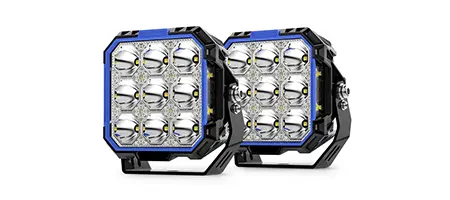
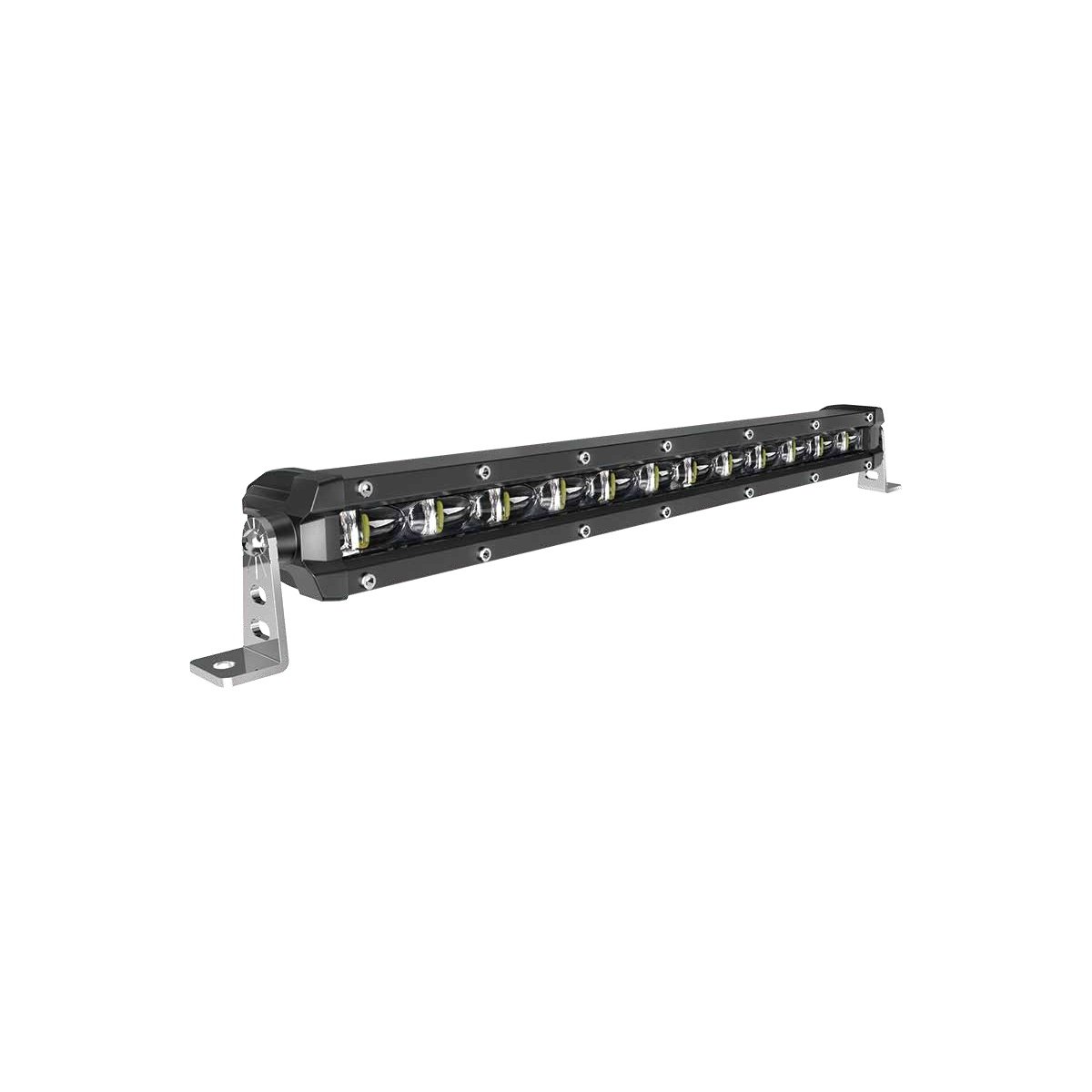
Yirox 50 Inch Slim LED Light Bar for Roof Mounting for off-road truck and SUV auxiliary lighting

Roof LED Light Bars

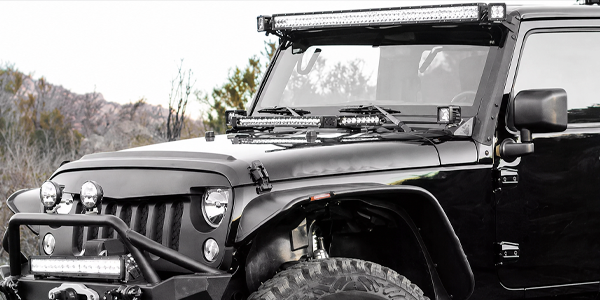
Full-width bars (40–52 inch) designed specifically for roof-rack or cab-roof mounting on pickup trucks and 4×4 wagons. The elevated mounting position maximises beam throw distance and minimises bonnet-reflection. Popular in North America (pickup truck market) and Australia (touring/overlanding).

  • Typically dual-row for maximum output at the highest mounting point
  • Integrated mounting tabs match common roof-rack crossbar widths (60–80 mm)
  • Curved profile available to match roof contour and reduce aero drag
  • Often sold with vehicle-specific wiring harness and switch kits
Off-Road Driving Lights

Standalone large-diameter lights (4–9 inch lens) producing a focused, long-range beam. The traditional form factor used in rally and expedition driving before light bars became dominant. Still strongly preferred in Australia, southern Africa, and Middle East markets for bull-bar mounting.

  • Round 180 mm / 225 mm: the two dominant sizes for bull-bar mount
  • Rectangular driving lights: slim profile for modern truck styling
  • Primarily spot/driving beam — long-range target illumination
  • E-mark ECE R149 / DOT SAE J581 compliant variants available

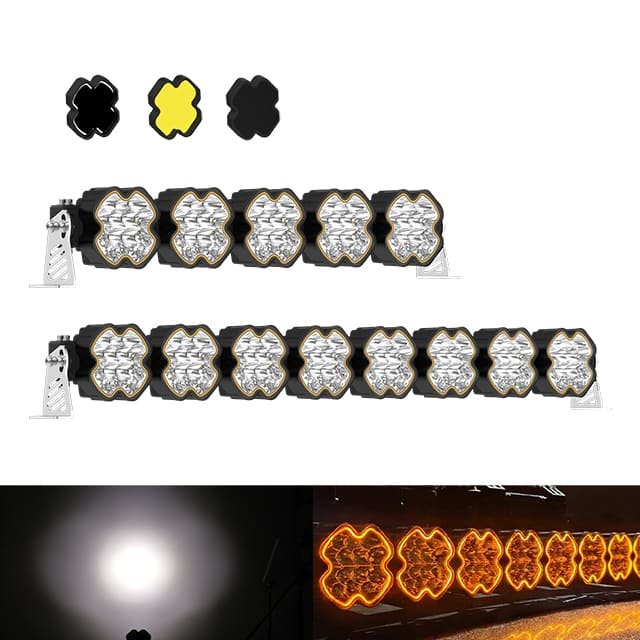
Auxiliary LED Light Pods

Compact auxiliary LED light pods designed for flexible vehicle lighting upgrades, providing additional visibility for off-road trucks, work vehicles, utility fleets, agricultural equipment, trailers, and specialty vehicle builds. Available in multiple housing shapes, beam patterns, and mounting options, they are widely used for bumper, grille guard, A-pillar, roof rack, rear rack, and auxiliary work lighting applications.

  • Round / square / rectangular LED pods: compact options for different mounting positions
  • Spot, flood, combo, and driving beam patterns available
  • Commonly used as ditch lights, fog lights, work lights, reverse lights, and auxiliary driving lights
  • Aluminum housing, waterproof construction, and vibration-resistant designs available
  • E-mark ECE / DOT SAE compliant variants available

Get A Instant Quote Now

Contact Form Demo

Comparison Between Off Road lightings

FORM FACTORTYPICAL SIZE RANGEBEAM PATTERNPRIMARY MOUNT LOCATION
LED Light Bars4"–52" (100–1,320 mm)Combo (spot+flood) most commonRoof rack, bumper, grille
LED Light Pods2"–9" (50–225 mm)Spot, flood or comboA-pillar, bumper corner, rear bar
Driving Lights4"–9" lens (100–225 mm dia.)Spot / driving focusBull bar, nudge bar
Roof Light Bars40"–52" (1,000–1,320 mm)Dual-row combo or floodRoof rack, cab roof

What Is Off-Road LED Lighting?

Product Definitions

Off-road LED lighting refers to auxiliary vehicle lights — not the vehicle’s factory-fitted headlamps — designed for use in environments beyond standard road conditions: 4×4 trails, overlanding routes, agricultural land, mining sites, and fleet work vehicles.

The category is also called auxiliary lightingdriving lightswork lights, or simply off-road lights. All of these refer to add-on lighting that enhances visibility beyond what the standard headlamp system provides — whether for long-range trail illumination, wide-area scene lighting, or targeted spot beams.

LED technology displaced halogen and HID (High-Intensity Discharge) lamps in this category between 2010 and 2018. The shift was driven by three advantages that compound in off-road use: higher lumen-per-watt efficiency (meaning less load on the vehicle’s alternator), far longer service life (50,000+ hours vs 500–1,500 hours for halogen), and instant on/off with no warm-up time — critical when vehicle speed changes suddenly on a trail.

Off-Road LED Lighting Also Know As

Off-road laser driving light

off road led light bar

Optical Specifications

Beam Patterns, Row Configuration
& LED Technology

Beam Patterns — The Most Important Buying Decision

Beam pattern determines how light is distributed in front of the vehicle and directly drives which application the product suits. Every off-road LED light ships with at least one of four primary beam configurations.

Spot / Driving Beam — 10–25° spread

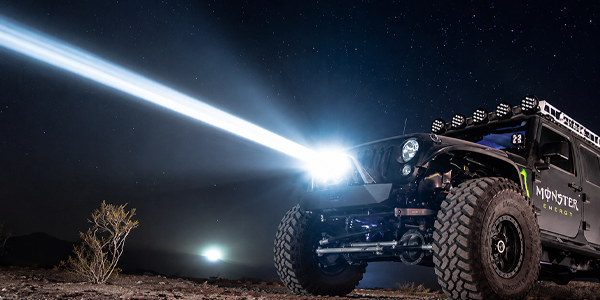
Concentrates light into a narrow, high-intensity cone for maximum throw distance (300–600 m effective range). Ideal for high-speed trail driving and desert racing where the driver needs to see terrain changes far ahead. The narrow angle means poor peripheral visibility — spot-only configurations are rarely specified for general use.

Flood / Work Beam — 60–120° spread

Wide horizontal spread for close-range (20–80 m) scene illumination. Used as camp lights, scene lights, work lights, and reverse lights. The wide spread saturates the immediate surroundings but has very short effective range — not suitable for trail driving at speed.

Combo Beam — Most Popular ★

Centre spot LEDs for throw distance + perimeter flood LEDs for peripheral coverage — in a single unit. The combo configuration accounts for 60–70% of light bar volume because it covers both trail driving and close-range visibility without requiring two separate lights. Default recommendation for general-purpose distribution SKUs.

Fog Beam — Flat cut-off, wide horizontal

Produces a wide, low beam with a sharp horizontal cut-off that reduces backscatter in fog, dust, and rain. Required for SAE J583 / E-mark fog lamp approval. Less common in off-road light bars; standard for fog lamp pods where street-legal compliance is required.

LED Row Configuration & Chip Technology

Row configuration determines the physical height of the bar and total LED count. LED chip choice determines output quality, lumen maintenance, and shelf-life expectations.

ConfigurationBar HeightLumen DifferenceBest For
Single Row55–65 mmBaselineLow-profile bumper mount, slim installations
Dual Row80–95 mm+40–70% vs singleRoof rack, maximum output applications
Triple Row110–130 mm+90–140% vs singleIndustrial, mining, maximum-output builds

LED Chip Tiers

Chip BrandTierLm/W (Typical)Common Use
OSRAM OSLONPremium130–160 lm/WE-mark certified road-legal products
Cree XP-L / XHPPremium125–155 lm/WHigh-output light bars & driving lights
LumiledsMid115–135 lm/WMid-range light pods and bars
Epistar (high-bin)Value90–115 lm/WEntry-level volume SKUs

TIR Optics — Total Internal Reflection optic lenses (moulded PMMA or polycarbonate) give each LED its own dedicated beam-shaping element, achieving 85–92% optical efficiency. Compared to simple parabolic reflector designs (60–70% efficiency), TIR optics deliver a cleaner beam pattern and higher effective lux at distance without increasing wattage.

Manufacturing Process

Yirox Manufacturing Process — How Off-Road LED Lights Are Manufactured

Understanding the manufacturing stages explains both the quality variables buyers compare across suppliers and the lead time structure they negotiate. A vertically integrated manufacturer controls all six stages below in-house; a trading company contracts them to different factories.

Die Casting — Aluminium Housing Fabrication

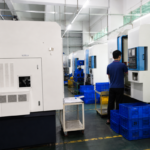
The housing is the structural backbone and primary heat-sink of an off-road LED light. High-pressure die casting using ADC12 aluminium alloy, with 96 W/m·K thermal conductivity and corrosion resistance, is the industry standard. The casting is then CNC-machined at sealing-face surfaces to the ±0.1 mm tolerance required for O-ring compression seals — the critical step that determines real-world IP performance. Housing surface finishing is either powder-coat, polyester or epoxy at 60–80 μm, or anodising depending on the target specification.

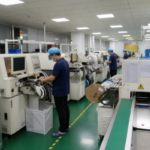
PCBA Design & SMT Assembly

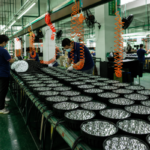
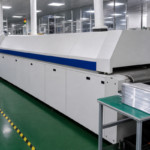
The LED driver PCB, or Printed Circuit Board Assembly, regulates the constant-current supply to the LEDs and manages thermal protection. In-house PCBA design means the driver circuit is engineered specifically for the LED array and housing thermal path — not a generic off-the-shelf driver paired with whatever LEDs are available. SMT lines place and solder components; the assembled boards undergo automated optical inspection before LED binning and attachment. LED bins are matched within ±2 SDCM for colour consistency across a production run.

Lens & TIR Optic Injection Moulding

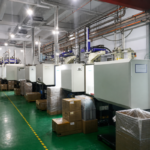
The outer lens, usually PMMA or PC at 2–3 mm thick, and the individual TIR optics are injection-moulded. Polycarbonate lenses carry higher impact resistance, while PMMA offers marginally higher optical clarity. The TIR, or Total Internal Reflection, primary optic — one per LED — is the most precision-sensitive part of the assembly, with surface tolerances held to ±0.05 mm to maintain the specified beam angle. TIR optic angle selection, such as 10°, 30°, 60°, or 90°, determines whether the finished unit is classified as spot, driving, flood, or combo.

Waterproof Assembly & Potting

The PCB is potted, or encapsulated, with a silicone or two-part epoxy compound — this is the step that determines actual waterproof performance. Silicone potting maintains flexibility through the thermal cycling of outdoor use and is preferred for IP68 and IP69K applications. The assembly is sealed with a dual O-ring compression seal at the lens–housing junction; some IP69K designs also inject argon gas into the sealed cavity to eliminate residual moisture and create a positive-pressure barrier against ingress. Stainless steel 304-grade brackets and hardware complete the unit.

Optical Darkroom Testing & IP Validation

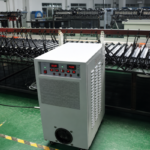
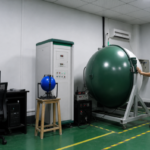
E-mark, or ECE R149, certification requires optical testing in a calibrated darkroom — measuring peak candela, beam pattern geometry, and cut-off line position. IP rating validation is conducted per IEC 60529: IP67 requires 30-minute submersion at 1 metre, while IP69K requires a high-pressure steam jet at 80 °C and 8–10 MPa from a 10–15 cm distance. Vibration testing and thermal cycling from −40 °C to +85 °C complete the durability test sequence. All test records are retained per batch for traceability.

Final QC & Export Packaging

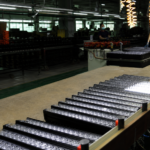
Each unit undergoes 100% functional power-on testing and visual inspection before packaging. Wiring harnesses, such as SAE connectors or DT connectors, switch relay kits, and mounting hardware are kitted per the OEM packaging specification. Batch traceability documentation — LED chip lot number, PCBA batch, housing casting date, and test report reference — is maintained and available on request or shipped with every order.

Technical Performance

IP Ratings, Lumens &
Wattage — What the Numbers Mean

IP Rating (Ingress Protection) — IEC 60529

The IP code has two digits: the first covers solid particle ingress (dust), the second covers liquid ingress (water). For off-road lighting, both digits are typically 6 or 9, meaning full dust-tight protection plus varying degrees of water protection.

RatingWater Protection LevelTest ConditionRelevance
IP67Temporary immersion1 m depth, 30 minStandard for most off-road lights
IP68Continuous submersionMfr-specified depth (typ 1.5–3 m)River crossings, water hazards
IP69KHigh-pressure steam wash80 °C, 8–10 MPa, 10–15 cmBest for pressure-washed vehicles

Distributor note: Many consumers and buyers assume IP68 is "better" than IP69K because the number is higher — but IP69K is the most demanding water test, covering the high-pressure washing scenario that damages many sealed enclosures. A product rated IP68 but not IP69K can fail a standard pressure-washer. For agricultural, mining, and fleet applications, IP69K is the correct specification to request.

Lumens, Lux & Wattage — Interpreting Output Claims

Three numbers appear in every off-road light spec sheet. Understanding the difference prevents sourcing decisions based on inflated claims.

MetricWhat It MeasuresReliable Range
Raw LumensTotal light output of the LEDs at the chip — before optic lossesLight bars: 5,000–45,000 lm
Effective LumensLight output after lens/optic losses — the number that reaches the road70–85% of raw lumens with TIR
Lux @ distanceIlluminance at a specific point (e.g. 50 m ahead) — the real-world visibility metricSpot: 3,000–30,000 lux at 50 m
WattagePower draw — affects alternator/battery load, not directly correlated to output qualityPods: 20–80W; bars: 50–300W+

Warning for buyers: raw lumen numbers are frequently inflated by quoting LED chip specifications rather than system output. Require lux-at-distance data from a calibrated darkroom test report for meaningful comparison between suppliers.

Typical Wattage by Product Type

Product TypeWattage RangeNote
LED Light Pods (pair)2×20W – 2×80WSingle pods 10–40W each
Light Bars — 10"–20"50W – 120WBumper / grille mount
Light Bars — 30"–40"120W – 200WMid-range roof / rack
Roof Light Bars — 50"200W – 300W+Dual-row full-width
Driving Lights (pair)2×30W – 2×80W180–225 mm round
Buyer's Guide

How to Choose Off-Road LED Lighting
for Your Market

Selecting the wrong specification is one of the most common sourcing mistakes in this category — leading to returns, customs holds, and negative reviews that follow a brand across channels. Apply these six criteria before placing an OEM order.

01

Start with the target market — certifications first

The certification requirement determines which product variant to specify before any other decision. If your primary market is the EU, source only E-mark (ECE R149) approved products or you risk customs holds and retailer rejection. If it is the US market and your channel is brick-and-mortar retail, SAE J581 marking is expected. If you are selling off-road-only to Australian overlanding customers, E-mark functions as a quality signal even without ADR requirement. Getting certifications wrong costs more than getting specifications wrong — it generates unsaleable inventory.

02

Match beam pattern to your buyer's primary use case

Combo beam (60–70% of volume) is the safe general-purpose choice for a distribution range. However, if your buyers are predominantly agricultural or fleet, flood-only or wide-angle work-light configurations sell faster. Motorsport-focused channels need spot. Avoid defaulting to combo for every SKU — a range with all three beam patterns serves a wider set of end users and allows distributors to upsell complementary products from the same brand.

03

Specify IP rating based on vehicle use, not just weather exposure

IP67 is adequate for most recreational 4×4 use. IP68 is appropriate for vehicles that regularly cross water obstacles. IP69K is the correct minimum for agricultural equipment, mining vehicles, and any fleet that is pressure-washed regularly. The IP69K premium at the manufacturing stage is 8–15% — far less than the return rate cost of IP67-rated lights failing on pressure-washed farm vehicles.

04

Choose bar length and row configuration based on mount position

Roof-rack mounts can accommodate full-width dual-row bars (40"–52") without clearance concerns; bumper mounts typically require single-row bars under 30" to clear the bonnet line and maintain legal approach angles. Confirm the specific truck models your distributors serve and match bar length to the roof-rack or bumper width of those vehicles — a bar that fits a Ford Ranger will not fit a Jeep Gladiator without modification.

05

Verify LED chip tier with a darkroom test report — not just the spec sheet

Lumen numbers on spec sheets are frequently raw chip specifications, not system output. Require a calibrated darkroom test report (photometric data) showing lux at 50 m and 100 m for any product line you intend to private-label. If a supplier cannot provide a darkroom test report, the output claim should be treated as unverified. For E-mark products, the photometric data is part of the type-approval file and is verifiable independently.

06

Confirm OEM scope before sample approval

Define the full OEM scope — housing colour, logo badge, lens colour (clear vs amber), wiring harness type, packaging design, instruction manual language — before sample approval, not after. Changes post-production-approval can incur tooling costs or delay by 3–4 weeks. A supplier with in-house die-casting tooling can accommodate housing-colour changes at no tooling cost; a supplier who sources die-cast housings externally cannot.

Supplier Comparison

Yirox vs. Typical Off-Road
LED Lighting Supplier

These are the practical differences that affect product quality, lead times, and the ability to build a defensible private-label brand — not marketing claims.

CriteriaYiroxTypical Trading Supplier
Die-cast housing in-house✓ In-house — custom colour/form at tooling cost, not MOQ penalty✗ Sourced externally — custom tooling adds 4–6 week lead time and minimum spend
PCBA design in-house✓ Circuit engineered for the housing thermal path and LED array✗ Generic off-shelf driver — thermal mismatch shortens driver life
E-mark ECE R149 darkroom test✓ In-house darkroom, calibrated to ECE R149 — data available per batch⚑ Often outsourced — test reports not batch-specific
IP69K validation✓ In-house test rig (80 °C, 8–10 MPa) — batch-level records✗ IP69K frequently claimed without dedicated test equipment
OEM trial order MOQ✓ From 10 pcs — validates before volume commitment✗ Typically 100–500 pcs minimum on custom spec
Certification coverage✓ E-mark (ECE R149), DOT/SAE, IP69K, CE, RoHS, ECE R10⚑ CE/RoHS common; E-mark R149 less consistent; IP claims unverified
Batch traceability✓ LED lot, PCBA batch, casting date — all documented per shipment✗ Batch records rarely maintained or available
Inquiry response✓ 1 business day — feasibility, MOQ, indicative pricing⚑ 3–7 business days typical
Frequently Asked Questions

Off-Road LED Lighting —
Sourcing & Technical FAQ

What certifications do off-road LED light bars need for the EU?
For road-legal use in the EU, auxiliary driving lamps require E-mark approval under ECE Regulation No. 149 (ECE R149), which replaced ECE R112 for all new type approvals from 14 November 2021. ECE R10 (electromagnetic compatibility) also applies and must be obtained separately. For off-road-only products not used on public roads, CE marking (LVD + EMC directives) and RoHS are the minimum requirements. Yirox holds E-mark approval under ECE R149 and ECE R10 for applicable product lines.
What is the difference between IP67, IP68, and IP69K?
IP67: dust-tight, submersion to 1 m for 30 minutes. IP68: dust-tight, continuous submersion at manufacturer-specified depth (typically 1.5–3 m). IP69K: dust-tight, protection against high-pressure, high-temperature water jets (80 °C, 8–10 MPa at 10–15 cm). IP69K is the most demanding test — a product can be IP68 rated but fail an IP69K test. For agricultural and fleet vehicles that are pressure-washed regularly, IP69K is the correct specification to request and verify with test reports.
Spot vs flood vs combo — which beam should I source?
Combo beam (spot centre + flood perimeter) accounts for 60–70% of light bar volume globally because it suits the widest range of uses. Spot-only is preferred for high-speed desert racing and long-range driving where throw distance is critical. Flood-only suits agricultural work lights, scene lights, and camp lights. For a new distribution range, prioritise combo as the primary SKU and add spot and flood variants once the combo sells through. Avoid sourcing spot-only for an undifferentiated general consumer channel — it generates the most "it doesn't light the road properly" return claims.
What is the minimum order quantity for Yirox off-road LED lighting?
Yirox supports trial orders from 10 pieces on selected models — allowing brand owners and distributors to validate a SKU before committing to full production volumes. Full OEM production MOQs start at 50–200 units depending on the model, beam specification, and customisation scope. For first orders, Yirox recommends a mixed-model trial covering the three beam patterns to assess distributor sell-through rates before committing to a single-model bulk order.
Does off-road LED lighting need DOT approval for the US market?
For street-legal use on US public roads, auxiliary driving lamps must comply with FMVSS 108 and SAE J581 (driving lamps) or SAE J583 (fog lamps). For off-road-only use on private property, tracks, or agricultural land, no DOT/SAE certification is legally required. However, most US distributors selling through physical retail or Amazon channels request SAE-marked products because end consumers expect the marking and because it provides legal cover for the distributor. Yirox can supply both DOT/SAE compliant and off-road-only variants — confirm your channel requirements before specifying.
Single row vs dual row light bars — which should I stock?
Single-row bars have a slimmer profile (55–65 mm height) and are easier to fit in tight bumper locations; dual-row bars deliver 40–70% more lumens at the same length with a larger cross-section (80–95 mm). For a distribution range, carry both: single-row as the lower price point for bumper and grille mounting, dual-row as the higher-output premium for roof rack applications. Roof light bars (40"–52") are almost exclusively dual-row — at that mounting height, output is the priority and the profile is less visible.
Can Yirox supply private-label off-road LED lighting?
Yes. Yirox's OEM program covers logo badges, housing powder-coat colour, lens tint, branded retail packaging, multi-language user manuals, wiring harness labelling, and full compliance document set. Because die-casting and PCBA design are in-house, housing colour and lens specification changes are handled at the tooling stage without external supplier coordination. For brand owners wanting a custom form factor, ODM development is available from sketch or reference sample — Yirox develops the tooling and engineering in-house.
How do I verify lumen output claims from a supplier?
The only reliable verification is a calibrated darkroom photometric test report showing lux-at-distance data (typically at 25 m, 50 m, and 100 m) and beam pattern diagram. Raw lumen figures on spec sheets typically reflect LED chip ratings, not system output — the difference between raw and effective (after optic losses) can be 15–30%. For E-mark certified products, the photometric data is part of the type-approval file and can be cross-referenced against the E-mark approval number. Yirox provides darkroom test reports for all E-mark product lines and on request for non-certified lines.

Tell us your packaging needs — our team will respond quickly with tailored solutions and competitive pricing.

Contact Form Demo

Get Your Custom Quote