






For a wheel weight shipment, prepare a commercial invoice, packing list, and the applicable transport document.1 Confirm any additional origin, material, packaging, or customer documents required for the destination and transaction.2 Before approval, match product descriptions, quantity units, package counts, measured weights, and shipment references across the files.
Table of Contents
- Which documents belong on a wheel weight shipment checklist?
- Who should prepare, review, and approve each file?
- How do you reconcile the invoice, packing list, and cartons?
- What must be checked for the destination market?
- Which document discrepancies should put the shipment on hold?
- When can transport documents be finalized?
- What should you send in a document request?
- How should you control revisions and keep the approved file?
- Conclusion: Approve a matched shipment file
- Frequently Asked Questions
- References
Which documents belong on a wheel weight shipment checklist?
Start with the commercial invoice, packing list, and bill of lading, sea waybill, or air waybill appropriate to the shipment. Add origin, insurance, permit, or declaration documents where required, plus the product acceptance records agreed in the order.12
| File group | Examples | What to establish before requesting it |
|---|---|---|
| Commercial and packing | Commercial invoice; packing list | Required fields, quantity basis, package hierarchy, and draft reviewer |
| Transport | Bill of lading, sea waybill, or air waybill, as applicable | Transport mode, issuing party, consignee instructions, and release arrangement |
| Conditional trade or market documents | Origin evidence, insurance evidence, permits, specified declarations | Requirement, correct issuer, product scope, format, and deadline |
| Buyer acceptance records | Approved specification, sample reference, agreed inspection report, label artwork | What the order requires and how the record links to the delivered items |
Mark each conditional item required, not applicable, or awaiting confirmation, with the reason. Confirm the required language, originals or electronic format, signatures, and legalization before commissioning the document.2
Keep customs documents and product acceptance evidence separate: a sample report doesn't constitute customs approval, and customs acceptance doesn't verify tape, clip fitment, or finish.
Who should prepare, review, and approve each file?
Typically, the seller prepares invoice and packing data, the importer coordinates destination review with its broker, and the forwarder coordinates transport documents with the issuer. Confirm these assignments against your contract; name the person authorized to approve each file and release a document hold.
Assign checks by function:
- Warehouse: Confirm actual contents, package numbering, weights, and dimensions.
- Purchasing: Check the ordered configuration, quantity unit, prices, and approved specification.
- Importer or destination reviewer: Confirm applicable documents, wording, and format.
- Forwarder and issuer: Confirm transport details and the issuance or release arrangement.
Record the agreed Incoterms rule, named place, and version. The rules allocate costs, risks, and obligations,3 while individual review assignments still need to be agreed. Resolve the wider arrangement through wheel weight shipping and Incoterms planning.
How do you reconcile the invoice, packing list, and cartons?
Match each SKU's description, quantity unit and count, inner-pack hierarchy, outer-package count, measured weights and dimensions, and shipment reference. The invoice and packing list should describe compatible contents despite their different purposes.1
Use a consistent description: item code, attachment format, body material, nominal increment or strip pattern, and finish. Distinguish a zinc body from a zinc finish on an FE body, and keep different configurations on separate lines.
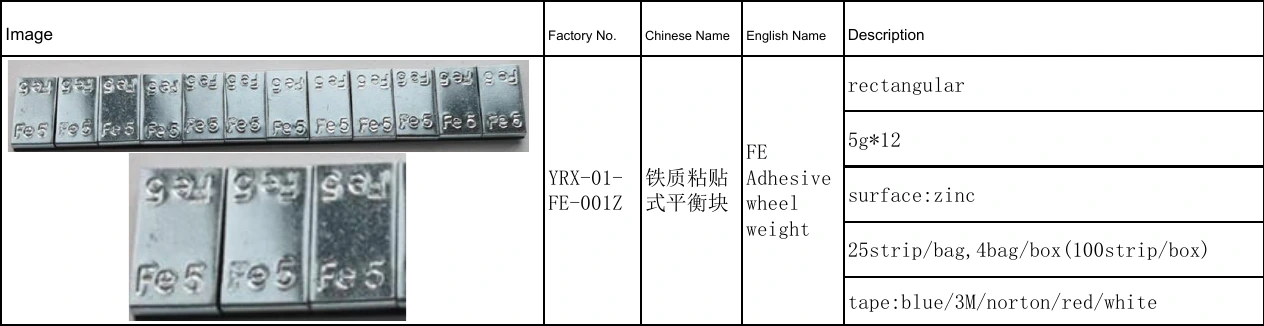
The Yirox catalog lists YRX-01-FE-001Z as an FE adhesive wheel weight with a zinc finish, 5g × 12 segments, and 25 strips per bag, four bags per box: 100 strips per box. These catalog fields aren't shipment measurements or proof of material compliance.
A worked quantity check using a catalog configuration
Illustration only: suppose an order contains ten catalog boxes, placed into two outer cartons with five boxes in each. The outer-carton arrangement is an assumption for this calculation, not the catalog's stated export pack.
| Record or calculation | Consistent illustrative entry |
|---|---|
| Order and invoice quantity basis | 1,000 strips of the identified configuration |
| Packing hierarchy | Two outer cartons × five boxes × 100 strips |
| Inner-pack cross-check | Ten boxes × four bags × 25 strips |
| Segment count, if needed | 1,000 strips × 12 segments = 12,000 segments |
| Nominal balancing mass cross-check | 1,000 × 12 × 5g = 60,000g, or 60kg |
| Actual shipping weights | Obtain measured net and gross values with agreed definitions; don't substitute the nominal calculation |
If the invoice says “1,000 pieces,” define whether a piece means a strip or a segment and correct the affected fields. Keep the sales quantity separate from transport package counts: this example has 1,000 strips and two outer cartons. If palletized, record the pallet arrangement and confirm the transport-document package count with the forwarder.
For mixed orders, repeat the calculation by SKU. Complete wheel weight catalog and SKU selection before drafting files if configurations remain undecided.
What must be checked for the destination market?
Confirm classification, origin, material, marking, filing, and packaging requirements with the importer or its designated adviser. For each applicable requirement, record the document or verification needed, its issuer, and the reviewer.
- Classification: Supply the description, body material, construction, use, and product images. Have the destination reviewer confirm the classification basis for the actual goods.
- Origin: Establish whether ordinary origin evidence or a preferential-origin claim is needed, and who may provide it. An invoice statement, chamber-issued certificate, and preferential-origin certification aren't interchangeable.
- Material evidence: Identify the item, represented sample or lot, applicable requirement, issuer, and supporting method or evidence. Request precise wording and scope rather than copying a generic “lead-free,” “REACH,” or “RoHS” label.
For example, Canada's regulations prohibit manufacture or import of wheel weights containing more than 0.1% lead by weight, subject to the permit provisions and stated exceptions. The text addresses transit, manufacture for export, and weights already installed on imported vehicles, and specifies conditions for laboratories performing lead analysis.5 Check which provisions apply to your shipment. Use the related lead-free wheel weight evidence review when supporting material information is missing.
For U.S. imports, APHIS requires regulated wood packaging material to be treated and certified under ISPM 15; alternatives such as plastic pallets and plywood aren't subject to that WPM regulation.4 Identify the actual pallet and dunnage materials before deciding what packaging evidence is needed.
Which document discrepancies should put the shipment on hold?
Hold approval when a discrepancy prevents identification of the goods, changes the commercial quantity, leaves a required document unresolved, or contradicts the packed shipment. Record the problem, responsible party, and evidence needed to close it.
| Discrepancy | Requested correction | Check before closing the hold |
|---|---|---|
| Invoice unit says pieces; order uses strips | Define the sales unit and correct affected quantity fields | Recalculate the pack hierarchy and compare the commercial quantity |
| FE body is described as a zinc body | Confirm the approved construction and correct the description | Compare the specification, packed-item identification, and revised files |
| Packing list has an unexplained carton-count difference | Reconcile final packing changes and package numbering | Match the physical package map and shipping instructions |
| Required declaration has no identified product scope | Obtain appropriate wording and supporting identification from the correct issuer | Have the designated reviewer accept its scope |
| Consignee or shipment details conflict | Confirm the correct instructions and request affected revisions | Check the revised documents against the accepted instructions |

If the goods have the wrong configuration or label, keep the hold open until the physical correction is verified through wheel weight pre-shipment inspection. Close the hold with the corrected revision, review date, and release approver recorded.
When can transport documents be finalized?
A transport document can be finalized when the issuer has confirmed the necessary shipment data and the issuing event has occurred. Confirm the timing for your document type with the carrier or forwarder; approve instructions before handover, review the draft when available, and check the final file after issue.
Use three review stages:
- Before handover: Reconcile packing data and approve consignee, notify-party, route, shipping-mark, and shipment-reference instructions.
- When the draft is available: Compare it with approved instructions and identify any pending carrier data.
- After issue: Check the final version, document type, and delivery or release arrangement.
If packing changes after approval, notify the owners of every affected file. For an issued transport document, obtain corrections through the issuer and retain the change record; editing a local PDF doesn't amend the issued document.
What should you send in a document request?
Send the order details, destination, transport plan, and required files, with each file's scope, reviewer, format, and deadline. Ask the supplier to flag missing information or unavailable documents.
- Order and products: PO reference, item codes, specification revisions, construction, quantity units, and counts.
- Destination: Importing country, delivery destination, importer, and broker or review contact.
- Transport: Mode, delivery rule and named place, booking contact, and consignee instructions.
- Core drafts: Invoice and packing list reconciled to the final packing record.
- Conditional files: Exact origin, material, packaging, insurance, permit, or customer documents, with their requirement and issuer.
- Timing and format: Deadline or due stage, reviewer, language, signatures or originals, and delivery method.
- Product evidence: Agreed sample, specification, lot, inspection, and label records linked to the shipment.
- Exceptions: Missing information, proposed alternatives, and the person responsible for resolution.
For the illustrative SKU, a focused line could read: “Please prepare invoice and packing-list drafts for YRX-01-FE-001Z, FE adhesive wheel weights, 5g × 12, zinc finish. State the quantity in strips and identify the inner-box and outer-carton counts separately. Confirm the current pack and measured shipping data; list any difference from the approved order.”
Add the confirmed destination requirements and document deadlines to this product-specific request.
How should you control revisions and keep the approved file?
Keep one document register linking each file to the order, revision, preparer, reviewer, due stage, and status. Preserve superseded files with clear labels and retain the approved and issued versions.
Use filenames such as PO-123_Invoice_Rev02.pdf and record the issuer's document number separately. Distinguish draft, correction requested, approved for issue, and issued and checked. Approval for issue doesn't mean the final file has been received.
Log related revisions: changing the sales unit may affect price presentation; repacking may affect package counts, shipping instructions, and receiving records. Link those changes to the relevant carton labels, batch codes, and supporting records. Set retention and access according to applicable requirements and the order agreement.
Conclusion: Approve a matched shipment file
Approve the shipment file after required documents, product descriptions, quantities, and packing data have been reconciled and open discrepancies resolved.
To request a Yirox quotation, send item references, quantity units, destination, transport plans, and the required document list. Ask the team to confirm current packing information and identify documentation gaps.
Frequently Asked Questions
Which documents are required for my shipment?
Start with the commercial invoice, packing list, and applicable transport document.1 Confirm additional origin, material, or packaging requirements for the destination, goods, and transaction with the importer or designated reviewer. Separate required, conditional, and not-applicable items before shipment.2
Should adhesive wheel weights be invoiced by strip or by segment?
Use the agreed sales unit and define it. For a twelve-segment strip, 1,000 strips equal 12,000 segments. Match the unit across the quotation, invoice, and packing records.
Can nominal wheel weight mass be used as the gross shipment weight?
No. Gross weight must reflect the measured packed shipment, including applicable packaging. Nominal balancing mass only provides a quantity cross-check.
Who should prepare the invoice and packing list?
The seller should supply confirmed commercial and packing data. Agree whether the seller, forwarder, or broker drafts each file, and name its reviewer; assistance with preparation does not remove the need to verify accuracy.12
What if a packing change happens after the shipping draft is approved?
Reconcile the new package map, notify affected document owners and the forwarder, and obtain revised files. Keep the change record with the current approved version.
References
[1] International Trade Administration. “Common Export Documents.”
[2] International Trade Administration. “Documents in an Export Transaction.”
[3] International Chamber of Commerce. “Incoterms 2020.”
[4] USDA Animal and Plant Health Inspection Service. “Wood Packaging Material.”
[5] Government of Canada, Justice Laws Website. “Prohibition of the Manufacture and Importation of Wheel Weights Containing Lead Regulations.”







