





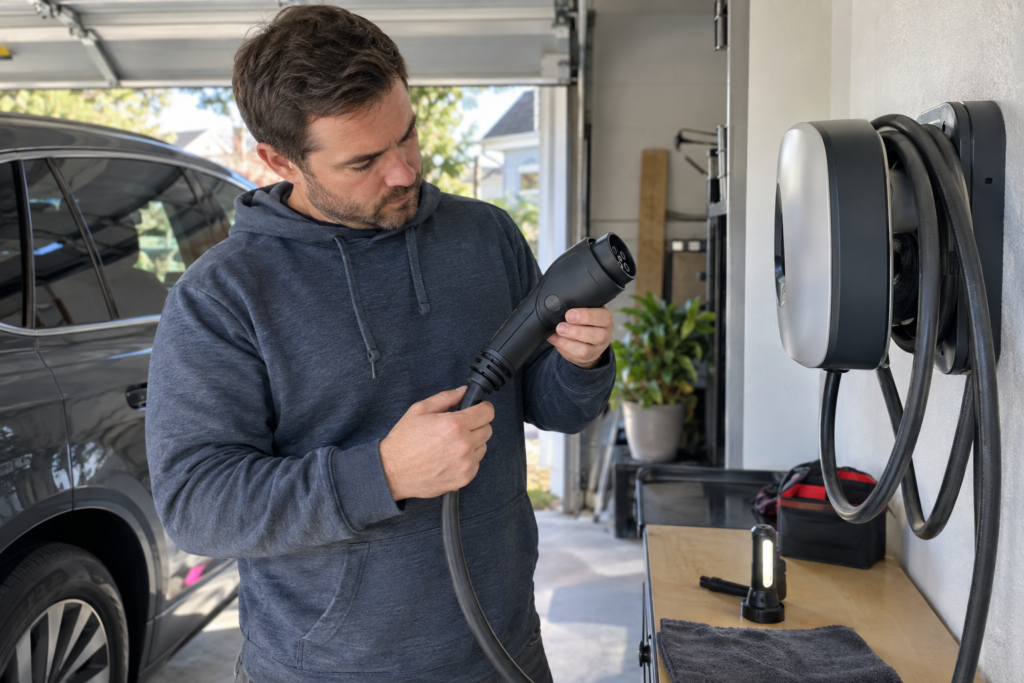
Stop using an EV charging accessory if it shows abnormal heat, burning odor, discoloration, arcing evidence, exposed conductors, cracked insulation, severe moisture intrusion, melted parts, or a loose or unreliable connection. Isolate the situation safely, follow the product or site procedure, and use qualified service support when electrical equipment or installation is involved.
An EV charging accessory can look acceptable while developing a problem at the cable jacket, connector face, latch, boot, cap, holder, wallbox, or vehicle interface. The goal of a warning-sign check is not to diagnose a live electrical fault from a photo. It is to recognize when normal use should stop, preserve useful evidence, and move the item into the right inspection or replacement process.
This guide is written for EV owners, installers, facilities teams, fleet operators, and buyers. It focuses on four practical signals: heat, physical damage, moisture or contamination, and poor fit. Always give the exact product manual, local electrical requirements, and qualified service instructions priority.
Table of Contents
- What Are the Most Important EV Charging Accessory Warning Signs?
- When Should You Stop Using an EV Charging Accessory Immediately?
- How Do Heat, Odor, Discoloration, and Arcing Evidence Change the Decision?
- What Do Cracks, Cuts, and Exposed Conductors Mean?
- How Should You Respond to Moisture and Contamination?
- What Does a Loose Fit or Failed Retention Tell You?
- How Should You Report, Quarantine, and Replace a Suspect Accessory?
- What Should Buyers Record in a Warning-Sign Inspection Checklist?
- Conclusion: Treat Warning Signs as Stop-Use Signals
- Frequently Asked Questions
- References
What Are the Most Important EV Charging Accessory Warning Signs?
The most important warning signs are abnormal heating, burning odor, visible discoloration or arcing evidence, cuts or cracks, exposed conductor, water or corrosion at an interface, and a connector or holder that no longer fits or retains reliably. One serious sign is enough to pause normal use while the condition is assessed.
| Signal | Examples | First decision |
|---|---|---|
| Heat | Handle, plug, coupler, cable end, or wallbox is unusually hot compared with normal operation; thermal warning appears | Stop the session according to the product or site procedure and do not dismiss repeated heat |
| Odor or discoloration | Burning smell, browned plastic, darkened contact area, melted surface, or a new glossy patch | Keep the affected configuration out of service and preserve the part for inspection |
| Arcing evidence | Pitting, carbon tracks, charring, melted contact surround, visible flash, or repeated fault during connection | Do not recreate the event; isolate and escalate |
| Physical damage | Cut, crushed, swollen, cracked, abraded, or sticky jacket; broken boot or housing | Do not tape, glue, file, or bend the part back into shape |
| Moisture or contamination | Water inside a connector or enclosure, corrosion, salt residue, conductive dirt, or trapped debris | Keep it disconnected and follow the exact drying, inspection, or service procedure |
| Poor fit | Connector will not seat, latch, release, or remain stable; holder or cap does not retain it | Do not force the interface or assume the part is universal |
| Support failure | Loose mount, broken fastener, sharp edge, cable dragging, or holder pulling on the connector | Prevent further handling until the support and cable route are corrected |
IEC 61851-1 covers EV supply equipment characteristics, operating conditions, connection, electrical safety, cable protection, markings, and user-manual information.[2] IEC 62196-1:2025 covers EV plugs, socket-outlets, vehicle connectors, vehicle inlets, and cable assemblies, including requirements related to latching and retaining means, mechanical wear, thermal stress, abuse, and contaminants.[3] These standards explain why the interface, cable, and protective features should be evaluated as a system rather than judged by appearance alone.
When Should You Stop Using an EV Charging Accessory Immediately?
Stop use immediately when there is a credible risk that the accessory can no longer maintain safe insulation, contact, retention, environmental protection, or mechanical support. Do not wait for a second symptom when the first sign is exposed conductor, melting, burning odor, water inside the interface, visible arcing evidence, or a connection that will not stay secure.
Use a simple three-level decision model:
| Condition | What it may look like | Action |
|---|---|---|
| Normal but recordable | Light dust, a secure connection, intact jacket, normal surface temperature, no warning message, and no unusual odor | Clean only according to the product instructions and continue routine inspection |
| Investigate before the next planned use | New scuff, minor cap deformation, intermittent latch feel, unusual but unconfirmed warmth, light corrosion outside the contact area, or a holder that has shifted | Keep the item available for controlled inspection, document the condition, and do not return it to shared use until the responsible person accepts it |
| Stop, isolate, and escalate | Exposed conductor, crack through insulation, melting, charring, burning odor, water inside, pitted contact, repeated thermal fault, failed latch, loose connection, or unsupported cable | Stop use, prevent reconnection, identify the item, and follow qualified service or approved replacement steps |
“Hot to the touch” is a useful user report, but it is not a universal temperature specification. Surface temperature depends on current, duration, ambient conditions, contact resistance, enclosure design, and the exact product limit. Treat a new or localized heat increase, especially with odor, discoloration, or a fault, as evidence for escalation rather than trying to establish a safe threshold by hand.
For home equipment, do not open a fixed wallbox or attempt live troubleshooting. For a workplace or depot, use the site’s isolation and lockout process if one applies. A user can safely report the symptom, location, time, charger or cable ID, and visible condition without taking apart the equipment.
How Do Heat, Odor, Discoloration, and Arcing Evidence Change the Decision?
Heat combined with odor, discoloration, pitting, or a fault is a stop-use signal because it may indicate a problem at a contact, termination, cable, connector, supply, or vehicle interface. Do not create a second charging session just to reproduce the symptom, and do not treat a wipe-down as a repair.
Check and record the following without probing the connector:
- Where is the heat? Note whether it is at the handle, contact face, cable end, strain relief, in-line control box, wallbox, plug, vehicle inlet, or a mounting point.
- Is the pattern new or localized? A single hot spot is different from a uniform warm enclosure, but both must be compared with the product instructions and normal operating behavior.
- Is there a smell or visible change? Burning odor, brown or black marks, softened plastic, blistering, melted edges, or a glossy contact surround increase the urgency.
- Is there evidence of an electrical event? Pitting, carbon tracks, a flash, repeated fault, flicker, or a melted contact surround should not be recreated as a test.
- What was the context? Record vehicle, charger, accessory SKU, current or charging mode if known, weather, duration, and whether the cable was supported or under tension.
IEC 62196-1:2025 includes additional requirements and tests for thermal stresses, mechanical wear and abuse, contaminants, and latching or retaining means.[3] That does not let an operator infer that one model’s normal warmth or discoloration is acceptable on another model. Ask for the product-specific operating limits, warning instructions, and inspection method.
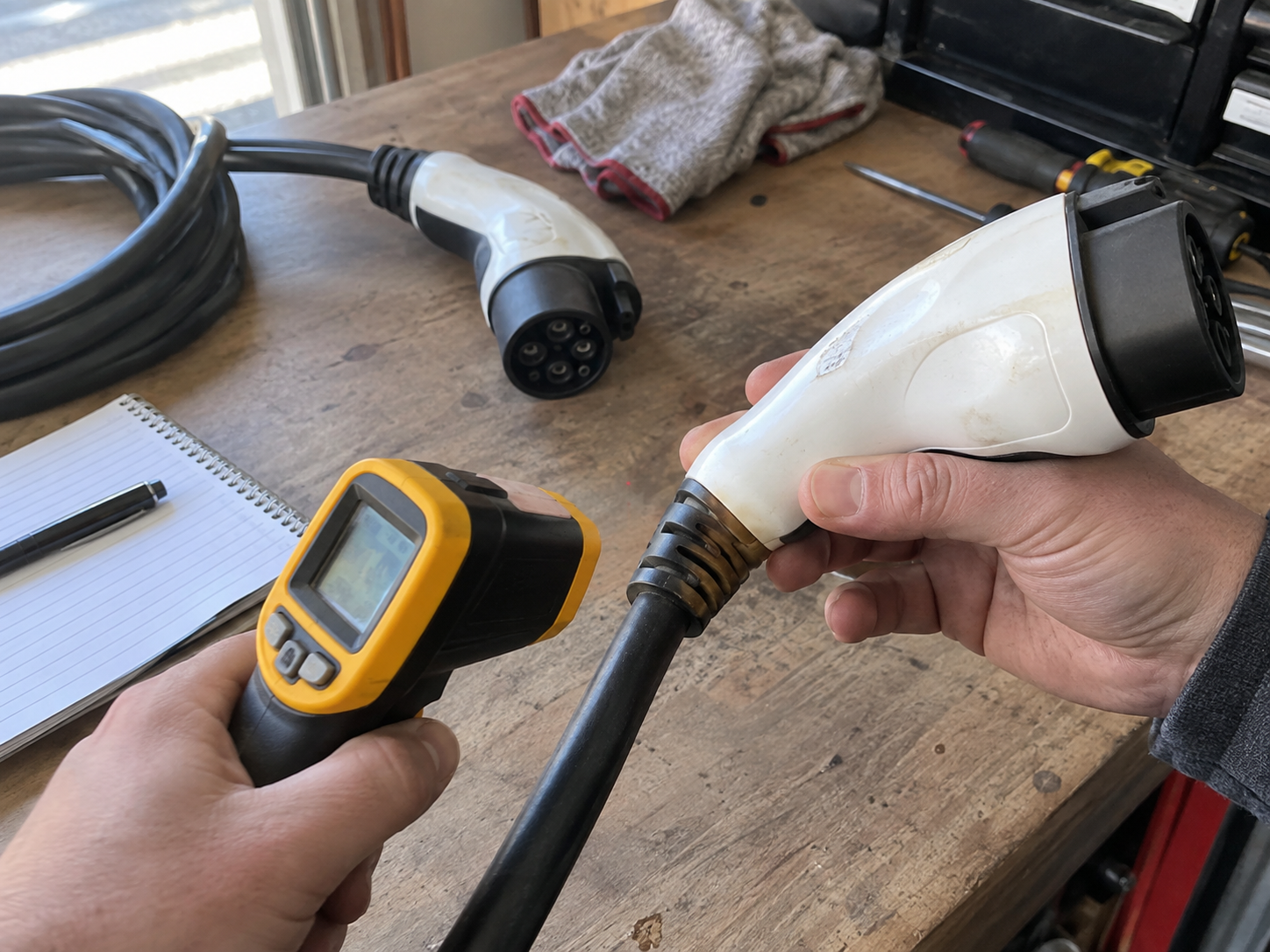
If heat is reported during a charging session, follow the equipment’s normal stop procedure if it is safe to do so. Do not yank a connector under load. Once disconnected or otherwise made safe according to the instructions, keep the accessory and the mating interface identified together for inspection. A replacement cable may not solve a problem that is actually at the vehicle inlet, charger, receptacle, or installation.
What Do Cracks, Cuts, and Exposed Conductors Mean?
Cracks, cuts, crushing, swelling, exposed conductor, or a broken connector housing mean the accessory may no longer provide the insulation, strain relief, environmental protection, or mechanical strength intended by its design. Surface damage should be classified by location and depth, but a conductor or internal layer that is visible is a clear stop-use condition.
Inspect these areas in a controlled, disconnected state:
- Cable jacket: Look for cuts, deep abrasion, flattening, swelling, sticky areas, heat marks, and repeated damage at the same bend point.
- Connector housing: Check for cracks around the face, latch, screws, handle, boot, and cable exit. A small crack can change when the connector is inserted or pulled.
- Boot and strain relief: Confirm that the boot is seated and that the cable does not move excessively where it enters the housing.
- Contacts and contact surround: Look for bending, pitting, corrosion, discoloration, foreign material, or a contact that sits at a different height. Do not straighten or scrape it yourself.
- Wallbox cable entry and cover: Check for pulled cable, shifted gland, broken cover, water marks, or a mounting condition that loads the cable.
Do not cover the evidence with tape, adhesive, paint, sealant, or a replacement sleeve before the responsible inspector has recorded it. Do not glue a cracked connector housing or file a damaged latch and then return it to service. The repair route must come from the product manufacturer or an authorized, qualified service process.
When a buyer needs a repeatable record for samples, incoming goods, or field returns, the EV charging cable quality inspection checklist helps connect physical condition with fit, durability, inspection evidence, and approval. A warning-sign article is a triage tool; it does not replace the test or repair decision for a specific product.
How Should You Respond to Moisture and Contamination?
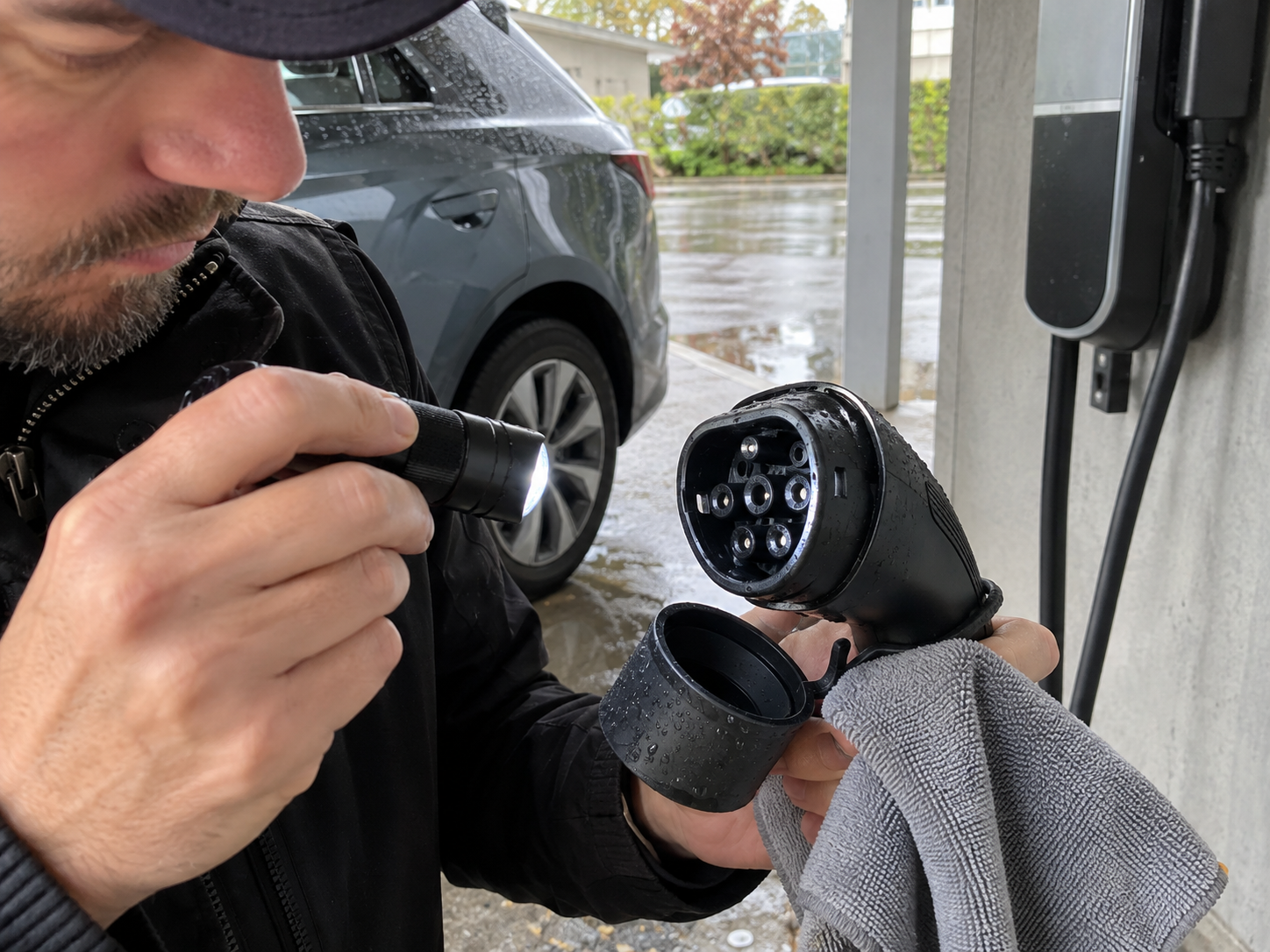
Treat moisture inside a connector, wallbox, cable entry, or vehicle interface as a condition to isolate until the product instructions define a safe inspection and return-to-service path. Surface rain on an outdoor-rated enclosure is not the same as water inside a contact cavity, and an IP rating does not make every wet accessory safe to reconnect.
Separate the observations:
| Observation | Why it matters | Safer response |
|---|---|---|
| Water droplets on an external enclosure | May be normal for an outdoor installation, depending on the product and conditions | Keep openings and seals intact; dry external surfaces only as instructed |
| Water, condensation, or a water line inside a connector or cap | The contact interface or seal may be compromised | Keep disconnected, do not blow high-pressure air or apply heat, and follow the manufacturer’s service or drying process |
| Mud, salt, conductive dust, or chemical residue | Can affect contact surfaces, seals, labels, and mechanical movement | Do not push contamination deeper; use the approved cleaning method or escalate |
| Corrosion, green or white deposits, pitting, or damaged plating | May indicate prolonged moisture or chemical exposure | Quarantine the part and request a product-specific evaluation or replacement |
| Water inside a fixed wallbox | May affect electrical safety and internal components | Do not open it as a routine user task; follow isolation and qualified service procedures |
The EV charging IP rating meaning explanation is useful for separating an ingress classification from the actual installation and care conditions. IEC 60529 defines the classification of protection provided by enclosures under a defined IP Code framework.[4] It does not by itself prove that a cable, connector, cap, wallbox, or label is suitable for every chemical, washdown pressure, orientation, seal condition, UV exposure, or repeated cleaning method.
For light external dirt, follow the EV charging accessory care and cleaning routine. Do not use a pressure washer, hose, sharp tool, unapproved solvent, or direct spray into the connector. If contamination is inside the interface or the accessory has a fault after wet exposure, cleaning is no longer the main decision; isolation, evidence preservation, and service guidance are.
Protection accessories can also fail quietly. A cap that no longer seats, a tether that pulls the cap sideways, a cover with a torn seal, or a holder that keeps the connector face pointing upward in the rain can increase exposure. The EV charging connector caps and covers guide helps buyers check fit, retention, protection, and maintenance together.
What Does a Loose Fit or Failed Retention Tell You?
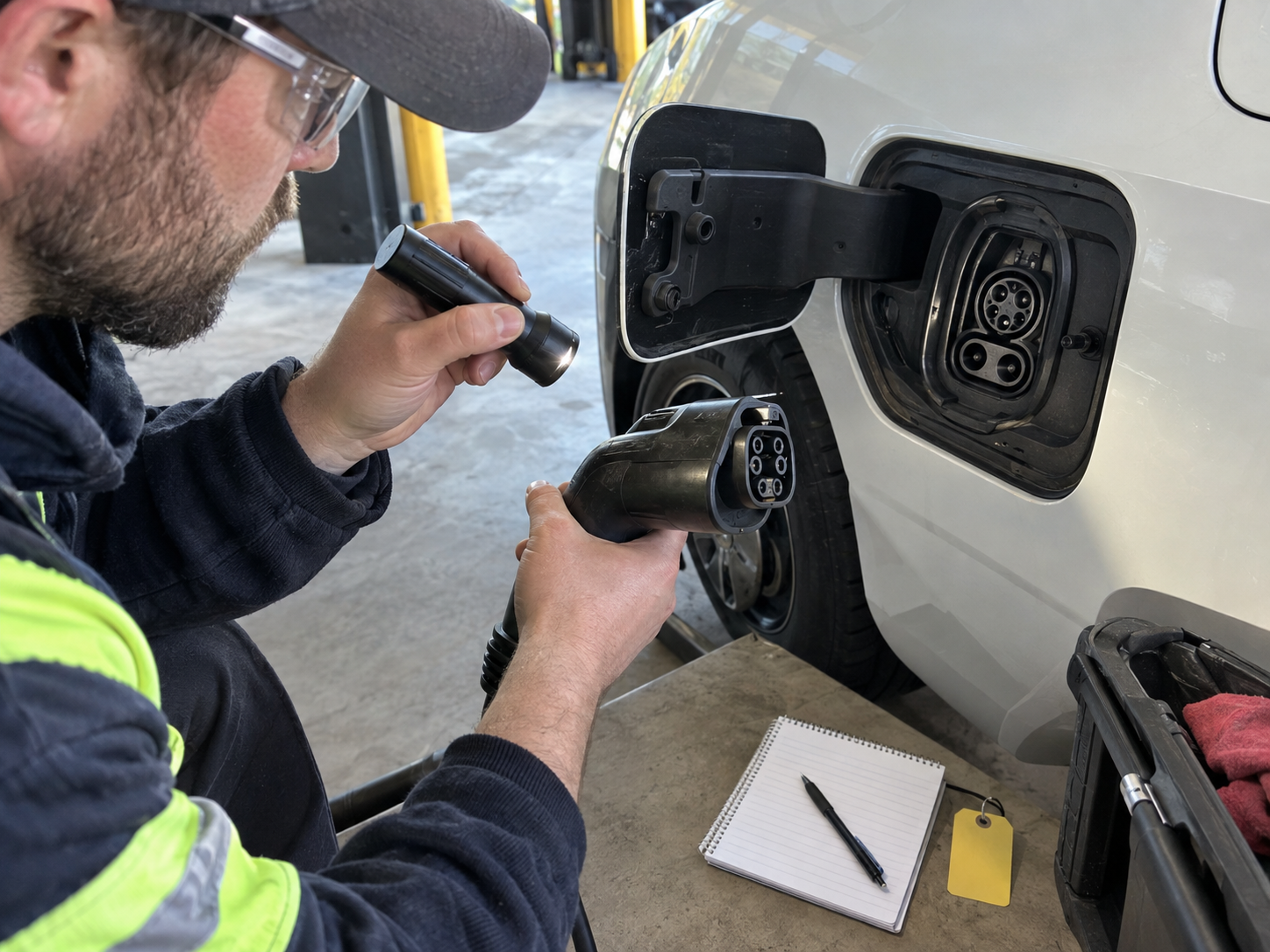
A loose or unreliable fit means the connector, vehicle inlet, charger-side socket, adapter, cap, holder, or locking feature may not be the exact intended interface, may be contaminated or damaged, or may be carrying a mechanical load it should not carry. Never force a connector into an inlet or accept a connection that can move, release, or lose retention during normal handling.
Look for these symptoms:
- the connector stops before it is fully seated;
- the latch does not engage, releases with little movement, or needs unusual force;
- the connection feels loose after insertion or shifts when the cable is supported normally;
- the connector only works when pushed, twisted, lifted, or held by hand;
- the cap or holster does not accept the connector without stretching, scraping, or forcing;
- a cable holder leaves the cable pulling sideways on the connector;
- a vehicle or charger fault appears only with one cable, adapter, or mating interface.
The EV charging connector locking mechanisms explanation helps distinguish a normal latch action from a retention problem. Retention is not the same as compatibility, power conversion, or proof that a connector is safe under load. The exact interface, dimensions, control features, and installation instructions still govern.
If the interface is uncertain, compare the exact connector and vehicle or station reference instead of relying on a similar-looking shape. The EV charging accessories compatibility checklist helps organize connector, vehicle, charger, electrical, market, and evidence fields before a replacement is ordered.
Do not test poor fit by repeatedly inserting and removing the part, pushing harder, adding lubricant, filing plastic, bending a latch, or using an adapter that has not been approved for the system. Photograph the interface in its disconnected state, record the part numbers, and hold the configuration until the fitment decision is clear.
How Should You Report, Quarantine, and Replace a Suspect Accessory?
Report a suspect accessory as a controlled event: identify the item, preserve the evidence, prevent accidental reuse, and route the decision to the responsible service or quality owner. Replacement should be based on the exact interface, electrical and environmental requirements, installation condition, and approved revision—not on a visually similar substitute.
Use this sequence for a home, workplace, or fleet setting:
- Stop the unsafe action. End the session and disconnect only through the normal product or site procedure. If the equipment cannot be safely disconnected, keep people clear and call qualified support.
- Make the status visible. Mark the accessory as out of service or quarantine it so another user cannot pick it up from a general spare bin.
- Record facts before cleaning or moving it. Capture photos of the cable, connector, mating interface, cap, holder, wallbox, and surrounding installation. Record date, location, asset ID, SKU, revision, vehicle or charger, and the observed symptom.
- Separate the accessory from the assumption. A hot cable may involve the cable, contact, vehicle inlet, charger, receptacle, supply, or installation. Do not declare a single component responsible without the appropriate evaluation.
- Request the approved disposition. The outcome may be return to service after a documented inspection, qualified repair, supplier review, replacement, or permanent retirement.
- Update the spare and purchasing records. Remove the failed SKU from available stock, identify the replacement revision, and retain the inspection or service evidence.
For fleet operations, include the asset ID, driver or shift, charger bay, vehicle group, connector type, event time, weather, current or mode if known, and whether a holder or cable route was involved. This information helps identify repeated problems rather than replacing the same part without correcting a mount, fitment, or operating condition.
Do not return an accessory to service because it passed a visual clean. The condition must meet the product instructions and the site’s approved acceptance criteria. If the intended replacement changes the connector source, material, latch, boot, cable diameter, cap fit, label, or revision, treat it as a controlled change and recheck the relevant evidence.
What Should Buyers Record in a Warning-Sign Inspection Checklist?
Buyers should record the warning sign, exact product identity, mating system, environment, evidence, and disposition in one checklist. This turns a vague report such as “the charger felt hot” into a traceable decision without pretending that a remote page can diagnose a live fault.
| Checklist field | Minimum information to capture |
|---|---|
| Event identity | Date, time, site, bay, asset ID, user or shift, weather, and operating context |
| Product identity | Accessory type, exact SKU, serial or batch if available, revision, connector family, cable length, and rating label |
| Mating system | Vehicle or inlet reference, charger or socket reference, adapter or extension used, and fit or latch behavior |
| Heat and electrical evidence | Location of heat, odor, discoloration, pitting, carbon mark, warning message, fault code, and whether the symptom repeated without deliberately recreating it |
| Physical condition | Jacket cuts, crush, swelling, cracks, exposed conductor, boot movement, broken housing, damaged cap, holder damage, mount movement, and sharp edges |
| Moisture and contamination | External or internal moisture, condensation, corrosion, salt, mud, chemical residue, cleaning history, drainage, and enclosure orientation |
| Fit and retention | Full seating, latch engagement, release action, connector movement, cable side-load, cap or holster fit, and whether the issue occurs with another approved configuration |
| Evidence pack | Photos before cleaning, label, datasheet, drawing, manual, declaration, test report, service record, and applicable revision |
| Disposition | Continue with monitoring, controlled inspection, qualified repair, supplier review, quarantine, replacement, or retirement |
| Supply follow-up | Approved replacement SKU, sample requirement, MOQ, lead time, spare quantity, packaging, labels, and change-control owner |
When a claim depends on certification, listing, test evidence, or an environmental rating, use the EV charging accessories certifications and test documents checklist to request the exact product and revision covered by the document. A general certificate name or a printed symbol is not enough to prove that the supplied configuration, market, installation, and accessory combination are covered.
Before setting a replacement or spare list, the EV charging accessories buying guide helps place the warning-sign decision in the wider sequence of fitment, electrical and communication limits, evidence, operations, and supply. The buyer’s checklist should make it harder to reorder an attractive but unverified substitute.
If you need to turn a reported symptom into a consistent site record, request a product-specific inspection checklist with the exact accessory type, connector references, vehicle or charger models, site exposure, handling frequency, and replacement policy. This page is not a remote diagnosis tool for live electrical faults.
Conclusion: Treat Warning Signs as Stop-Use Signals
Heat, damage, moisture, and poor fit are not cosmetic details when they affect insulation, contact quality, retention, environmental protection, or mechanical support. A safe response is to stop the unsafe action, isolate the configuration according to the product or site procedure, preserve the facts, and use qualified service or an approved replacement path.
The most useful inspection record connects the symptom to the exact cable, connector, vehicle, charger, cap, holder, mount, environment, and revision. That evidence helps owners use equipment responsibly and helps buyers prevent the same failure from returning through an unverified spare.
Frequently Asked Questions
Is an EV charging cable supposed to feel warm?
Some equipment can become warm during normal operation, but a new, localized, or increasing heat source should be treated cautiously. If warmth is accompanied by odor, discoloration, melting, a fault, or a loose connection, stop use through the normal procedure and request product-specific or qualified inspection. Do not establish a safe limit by hand.
What should I do if an EV connector smells hot or burnt?
Stop the charging session through the normal control procedure if it is safe, and do not recreate the event. Disconnect or isolate the equipment according to the product or site instructions, keep the cable and mating interface identified, record the odor and visible condition, and escalate to the manufacturer, site owner, or qualified service professional.
Can I keep using a cable with a small cut in the outer jacket?
Do not assume a cut is harmless. Keep the cable out of normal use until its depth, location, strain relief, and product requirements have been assessed. Exposed conductor, damaged insulation, swelling, melting, or a cut near a connector or repeated bend point are strong stop-use signals. Tape or glue is not an approved repair by default.
Is an outdoor EV connector safe if it gets wet?
Outdoor-rated equipment may be designed for specified weather conditions, but water outside an enclosure is different from water inside a connector, contact cavity, cable entry, or wallbox. Keep a wet or water-intruded interface disconnected and follow the exact product procedure. Do not rely on an IP number as a blanket permission to reconnect.
Why does my EV connector fit loosely?
A loose fit can result from the wrong connector or adapter, a damaged latch, contamination, a worn or damaged vehicle inlet, a deformed housing, or cable side-load from poor routing. Do not force, twist, lubricate, or repeatedly test it. Record the exact part references and have the configuration checked before reuse or replacement.
Can cleaning fix a poor EV connector connection?
Cleaning may remove light, accessible surface dirt when the product instructions allow it, but it cannot repair a cracked housing, bent contact, worn latch, damaged seal, heat mark, or incorrect interface. If the connection is loose, wet inside, discolored, or associated with a fault, stop use and follow the inspection or service process.
Should I replace the cable or the whole EV charger after a warning sign?
Not automatically. The warning may originate at the cable, connector, vehicle inlet, charger, receptacle, mount, supply, or installation. Isolate the configuration and have the responsible technical or service team identify the approved disposition. Replace only with an exact or formally approved compatible configuration and revision.
References
[1] U.S. Department of Energy, Alternative Fuels Data Center. “Charging Electric Vehicles at Home.” n.d.
[2] International Electrotechnical Commission. “IEC 61851-1:2017, Electric vehicle conductive charging system — Part 1: General requirements.” 2017.
[3] International Electrotechnical Commission. “IEC 62196-1:2025 CMV, Plugs, socket-outlets, vehicle connectors and vehicle inlets — Conductive charging of electric vehicles — Part 1: General requirements.” 2025.
[4] International Electrotechnical Commission. “IEC 60529:1989, Degrees of protection provided by enclosures (IP Code).” 1989.







