





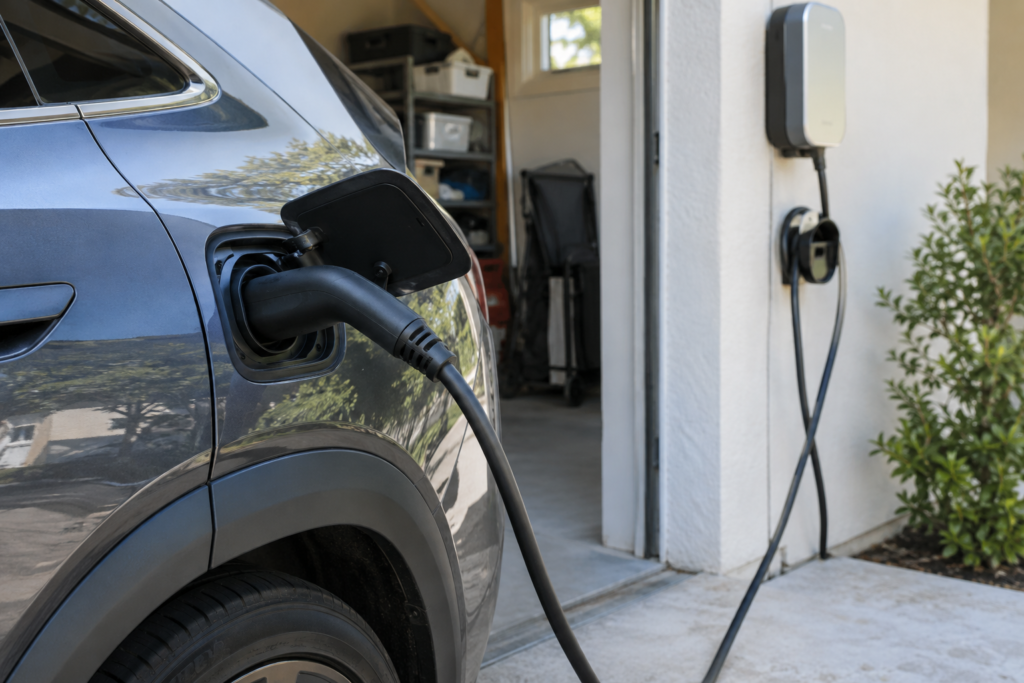
An EV charging connector locking mechanism keeps the plug seated during use or storage, but the exact design depends on the connector, vehicle inlet, charger, and accessory. A latch or locking feature should not be bypassed, forced, or treated as proof that an adapter is electrically compatible.
The word “lock” can describe several different things. A connector may have a molded latch, the vehicle inlet may have an actuator, an EVSE may use an electrical interlock, and a holster may retain the handle when the cable is parked. These parts can work together, but they do not perform the same job.
Understanding those roles helps owners and installers avoid two opposite mistakes: assuming a connector is unsafe because it has no visible padlock, or assuming a visible latch makes every cable, adapter, and vehicle combination acceptable. This guide explains the mechanism in plain language and turns it into a safe inspection and buying checklist.
Table of Contents
- What does an EV charging connector locking mechanism do?
- How do latch, lock, holster, and vehicle inlet work together?
- What is mechanical retention versus electrical interlock?
- How does cable strain cause accidental unplugging?
- How should you inspect and care for a locking connector?
- When should you replace a damaged lock or retention part?
- What should buyers verify before ordering locking accessories?
- Conclusion: Understand Retention Before Changing the Hardware
- Frequently Asked Questions
- References
What does an EV charging connector locking mechanism do?
An EV charging connector locking mechanism keeps a connector seated, aligned, or retained against the forces expected in its intended use. It may also help the vehicle or EVSE recognize that the connector is in the correct position, but the exact behavior depends on the product design.
At a high level, retention has four purposes:
- Keep the interface seated. The connector should remain fully engaged rather than backing out under normal handling or cable weight.
- Preserve alignment. A latch, key, guide, or locking geometry helps keep the contacts and housing in their designed position.
- Manage user action. Some systems require a button, lever, vehicle unlock command, or other release action before removal.
- Support a known state. The vehicle or charging equipment may use the connection state as part of its control logic.
Retention is not the same as theft prevention, power conversion, or universal compatibility. A connector can be mechanically retained while still being the wrong connector, rating, charging mode, or adapter for the system. IEC 62196-1 covers general requirements for plugs, socket-outlets, vehicle connectors, vehicle inlets, and cable assemblies, but the exact retention design remains product- and interface-specific 1.
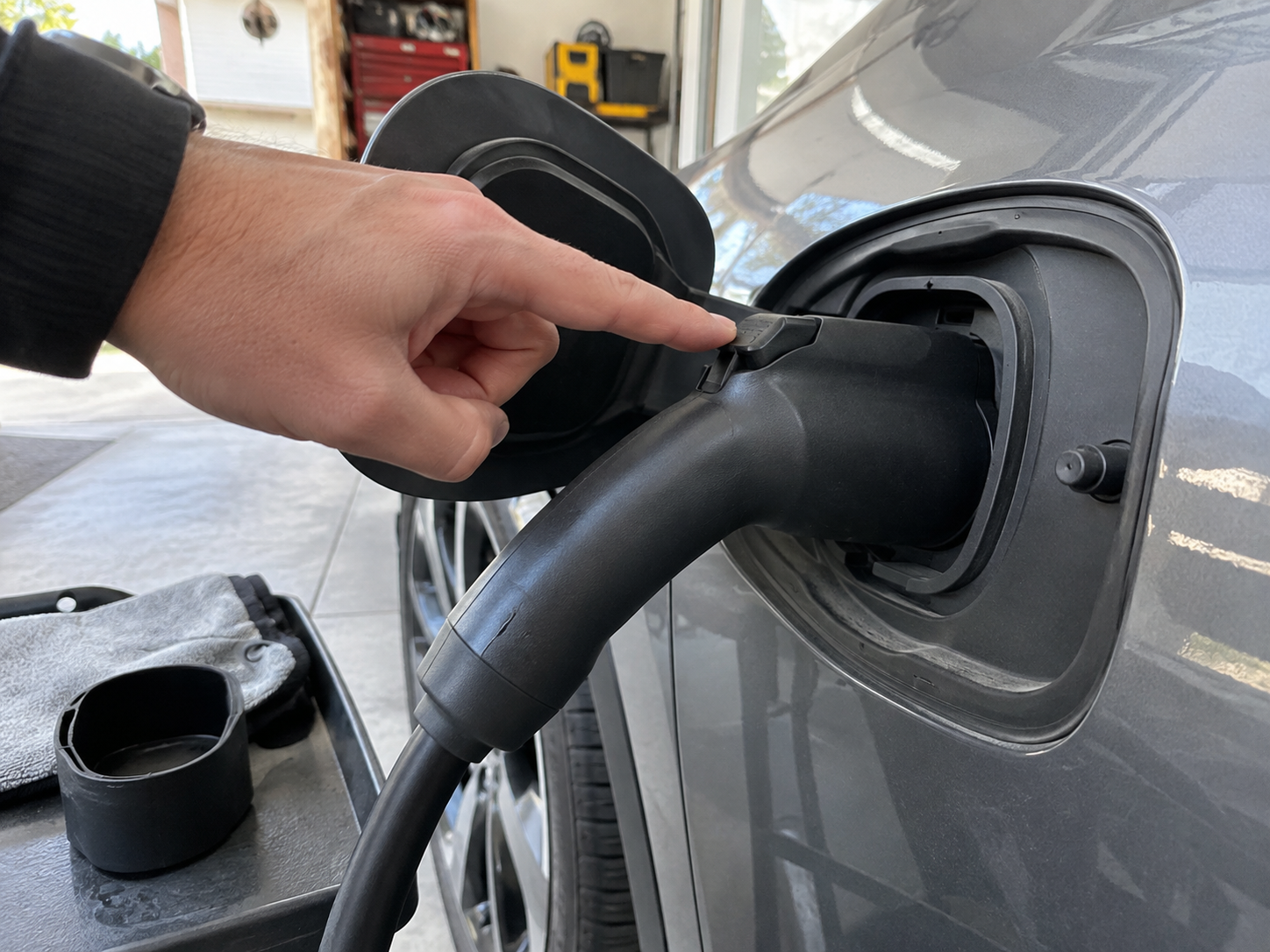
This is why a product description should identify the connector family, vehicle or station reference, latch or lock design, release method, and intended application. “Locking clip” by itself is not enough information for a replacement part.
How do latch, lock, holster, and vehicle inlet work together?
The connector latch, vehicle-inlet lock, holster, and cable support form different layers of the charging workflow. The connector holds the mating interface, the vehicle or equipment may control release, and the holster supports the connector when it is not connected.
| Part or feature | Main role | What it does not prove |
|---|---|---|
| Connector latch or release lever | Gives the user a mechanical retention and release point on the handle | That the cable is electrically or commercially compatible |
| Vehicle-inlet locking actuator or lock pin | May retain the connector at the vehicle interface during a charging session | That every replacement connector has the same geometry or actuator clearance |
| EVSE or station interlock | Uses connection or control state as part of managed charging behavior | That the connector can be pulled, bypassed, or modified safely |
| Holster or dock | Retains and supports the handle during storage | That it locks an energized vehicle connection |
| Connector cap or cover | Helps protect a disconnected interface from contamination or exposure | That it retains a live connector or changes the charging rating |
| Cable hook, reel, or support | Reduces hanging weight, side pull, and ground contact | That the cable can be bent or loaded beyond its specification |
The EV charging connector caps and covers guide is useful when the part being considered is a cap or cover. It helps keep environmental protection separate from mechanical locking. A cap may stay attached to a cable with a tether, but that does not make it a vehicle-inlet lock or an EVSE interlock.
The physical sequence is usually simple: align the connector, insert it fully, allow the latch or retention feature to engage, let the vehicle or EVSE complete its connection checks, and release it only through the method stated by the equipment manufacturer. Do not force an incomplete engagement or use a tool to defeat a latch.
What is mechanical retention versus electrical interlock?
Mechanical retention resists physical movement, while an electrical interlock is part of the control logic that permits, limits, or stops a charging state. They can cooperate, but one cannot be used as evidence that the other exists or is working.
| Question | Mechanical retention | Electrical interlock or control |
|---|---|---|
| What is sensed or controlled? | Physical seating, latch engagement, locking geometry, or handle position | Connection state, control signaling, permission, or protective sequence |
| What is the user likely to see? | Button, lever, latch, lock pin, or visible fit | Indicator, charging state, release behavior, or equipment response |
| What failure may look like? | Loose fit, incomplete seating, latch not returning, or connector falling from a holster | Charging not starting, stopping, refusing release, or reporting a fault |
| What should a buyer verify? | Dimensions, retention, release method, connector and inlet references | Product documentation, control behavior, charging mode, and approved system combination |
| What should not be done? | Do not force, shim, tape, or permanently defeat the latch | Do not bypass control or protective functions to make a connection work |
IEC 61851-1 addresses general requirements for conductive EV charging systems, including connection and electrical safety considerations 2. That does not turn every visible latch into a standard interlock, and it does not authorize a user to alter vehicle or EVSE control behavior.
An adapter is a good example of the boundary. It may provide a mechanical interface between two connector forms, but the EV charging adapter compatibility guide is still needed to check electrical limits, communication, vehicle and station references, environmental conditions, and permitted use. A satisfying click is not a compatibility test.
How does cable strain cause accidental unplugging?
Cable strain transfers force into the connector, latch, vehicle inlet, or mounting point. A cable that is too heavy, sharply bent, twisted, trapped by a door, or pulled sideways can create a retention problem even when the latch itself is correctly designed.
Common sources of strain include:
- The cable hangs from the connector instead of from a hook, holster, or support.
- The vehicle is parked too far away, leaving the cable under tension.
- A wheel, door, gate, or pedestrian route catches the cable.
- The cable is twisted at the connector or bent more tightly than specified.
- A wallbox or post is mounted so the cable exits directly into a side pull.
- A user pulls the cable instead of holding the connector handle during release.
The cable holder versus wall-mount site guide helps connect storage selection to these forces. A holder does not change the connector rating, but it can put the handle in a predictable position and keep the cable loop from loading the vehicle inlet.
For a site review, record cable length, outer diameter, weight, minimum bend radius, exit direction, mounting height, vehicle parking position, and the support points. A simple visual test is to check whether the connector rests naturally when connected and whether the cable can be returned to storage without twisting or dragging across a sharp edge.
Do not test retention by violently pulling on an energized connector. If a connection feels loose, fails to latch, releases unexpectedly, or shows damage, stop the session according to the equipment instructions and move to inspection or qualified service support.
How should you inspect and care for a locking connector?
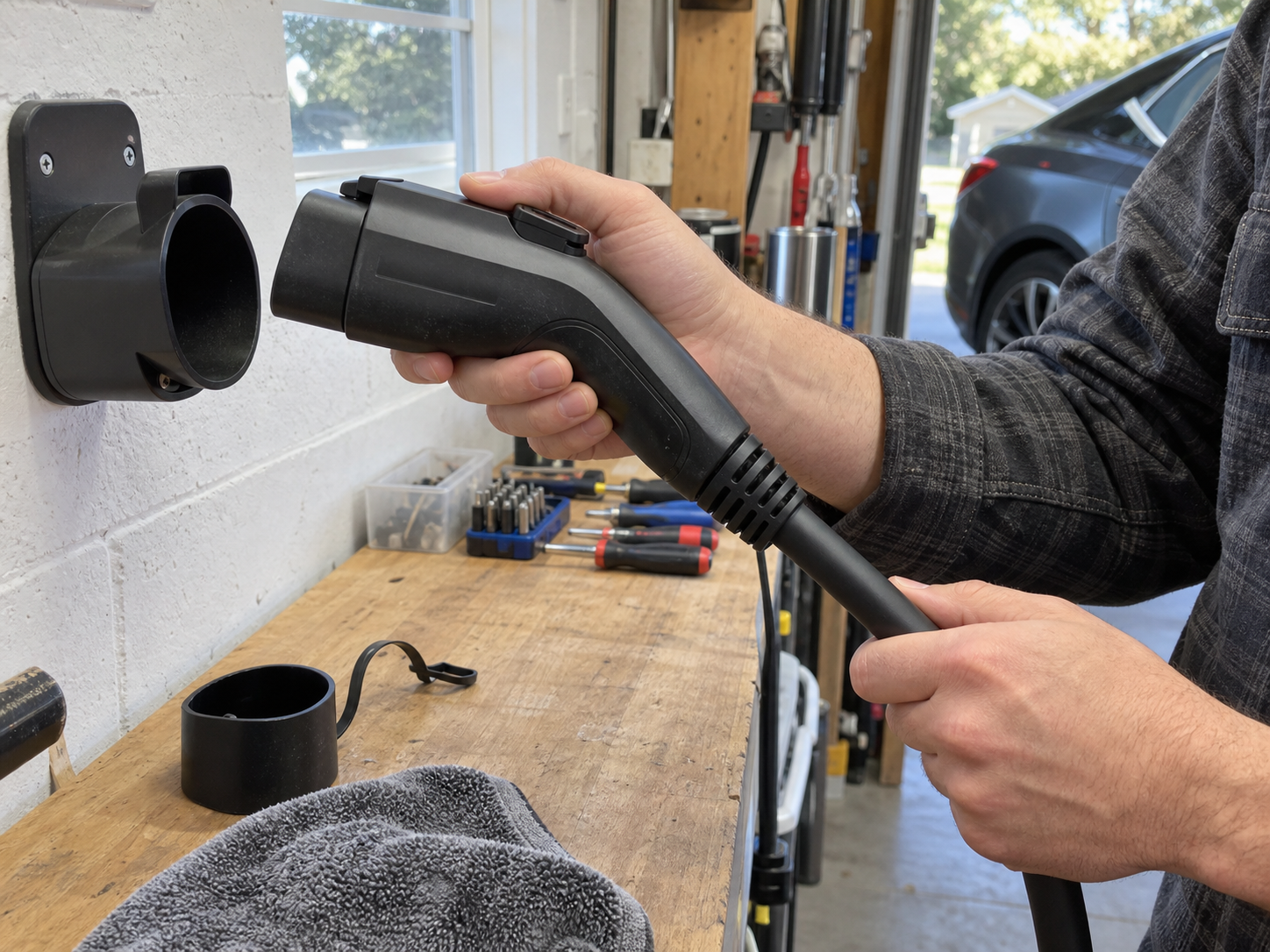
Inspect the connector, latch, inlet, release area, cable jacket, strain relief, cap, and storage point before relying on them. Cleaning and controlled storage can reduce contamination and handling damage, but neither replaces a product-specific inspection or repair process.
A basic visual routine includes:
- Check that the connector housing is not cracked, warped, melted, or heavily contaminated.
- Move the release button or lever only as the manufacturer permits. It should not feel jammed, loose, or permanently depressed.
- Look at the latch contact area and vehicle inlet for broken plastic, bent parts, debris, corrosion, or signs of incomplete seating.
- Check the cable jacket and strain relief for cuts, flattening, exposed conductors, severe kinks, or separation from the handle.
- Confirm that the holster, cap, hook, and mounting hardware support the connector without forcing the latch.
- Keep records for fleet or shared-site equipment, including date, SKU, serial or batch where available, condition, and action taken.
Follow the product manual for de-energization, cleaning materials, and release procedures. Do not push tools into contacts, apply unapproved lubricant, spray liquid into a connector, or open energized equipment. For home charging, the U.S. Department of Energy advises using equipment suitable for the intended outdoor conditions and consulting an electrician when installation capacity or site work must be assessed 4.
The EV charging cable quality inspection checklist can help turn these observations into a repeatable fit, condition, and sample-approval record. The same method is useful for a household replacement cable and for a fleet’s periodic inspection program.
When should you replace a damaged lock or retention part?
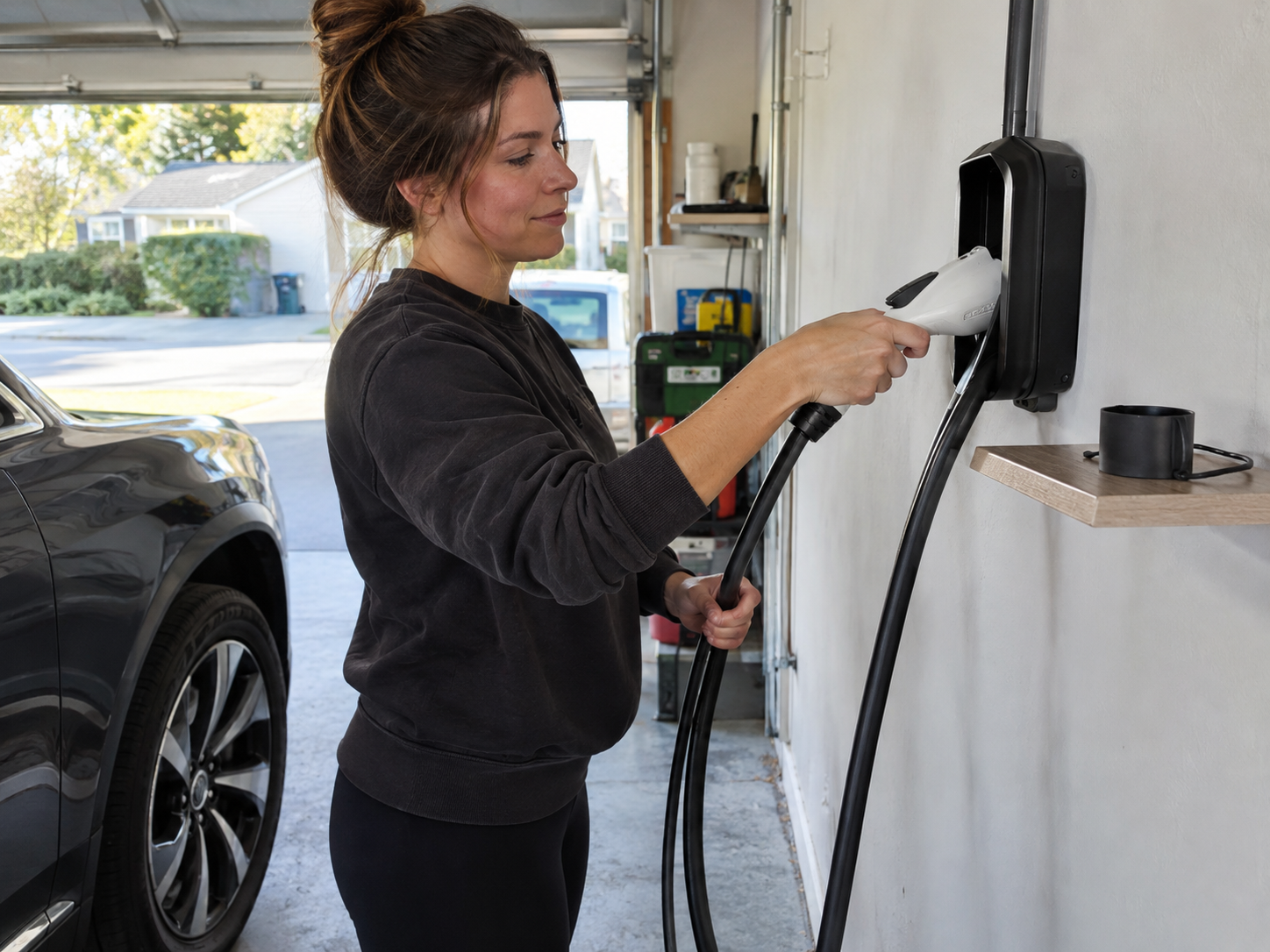
Replace or service a locking part when it no longer retains, releases, aligns, or returns to its intended position, or when surrounding damage could affect the connection. The correct remedy may be a connector, cable assembly, inlet, holster, or complete equipment replacement rather than a small clip.
| Observation | Safe next step |
|---|---|
| Latch is cracked, missing, stuck, or does not return | Stop relying on the connection and follow the manufacturer’s replacement or service path |
| Connector can be pulled out without the intended release action | Stop use and have the connector, inlet, and control behavior assessed |
| Connector feels loose after full insertion | Do not compensate with tape, shims, or force; verify the exact mating parts and inspect for wear |
| Heat discoloration, burning odor, melted plastic, or arcing evidence | Stop using the equipment and escalate through the site or manufacturer procedure |
| Water, corrosion, or debris is visible in the interface | Keep the equipment out of service until the prescribed inspection or service is completed |
| Holster or mount is broken but the connector is intact | Replace or repair the support so cable weight is not transferred to the connector |
Do not use a generic locking clip to “upgrade” an unknown connector. The replacement must match the connector design, vehicle or station interface, release method, electrical and communication requirements, and the product’s approved configuration. A stronger-looking latch can create interference, prevent the intended release, damage the inlet, or give a false sense of security.
When the concern is heat, visible damage, moisture, or a connection that no longer seats normally, the warning-sign checklist helps separate a locking-mechanism question from a stop-use or service decision.
What should buyers verify before ordering locking accessories?
Buyers should specify the exact interface and retention job before requesting a latch, lock, holster, cap, adapter, or replacement connector. A good request describes the vehicle or station, the charging mode, the physical and environmental conditions, and the evidence required for approval.
| Verification area | Questions to answer | Evidence to request |
|---|---|---|
| Equipment identity | What vehicle group, vehicle inlet, EVSE, charger, outlet, or station is involved? | Exact model references, photos, SKU, and compatibility list |
| Retention function | Is the requirement connector latch, vehicle-inlet lock, holster retention, cable support, or release control? | Mechanism description, drawing, release instructions, and use limits |
| Electrical and communication | Is the application AC or DC, and what voltage, current, phase, and signaling context apply? | Datasheet, manual, rating table, and system-use statement |
| Mechanical fit | What are the mating dimensions, latch geometry, cable diameter, bend radius, weight, and clearance? | 2D or 3D drawing, material details, sample, and fitment photos |
| Environment | Will the part see indoor/outdoor use, UV, rain, dust, corrosion, cleaning, heat, or cold? | Product-specific environmental claim and test or declaration evidence |
| Installation and storage | What surface, fasteners, support points, user traffic, and service access are expected? | Mounting instructions, load assumptions, and site layout |
| Quality and traceability | How will latch return, retention, visible damage, and batch consistency be checked? | QC checklist, inspection record, revision, batch or serial traceability |
| Commercial scope | What is included, and what are the sample, MOQ, warranty, spare-part, and change-control terms? | Exact quotation, bundle contents, packaging, labels, and revision process |
Use the EV charging accessories compatibility checklist when the buyer needs to connect vehicle, connector, charger, electrical, communication, and market references in one record. For broader accessory selection, the EV charging accessories buying guide can then turn the verified function into a site and sourcing decision.
Before approving a replacement, ask the supplier to return the exact SKU, drawing revision, connector or inlet coverage, release behavior, included hardware, test basis, and any exclusions. Approve the sample against the same conditions that will apply to the installed or stored product.
If you are choosing a connector cover, holster, adapter, latch-related part, or replacement cable, share the vehicle or station reference, connector ends, charging mode, cable diameter and weight, site exposure, storage arrangement, and the retention symptom or function you need to confirm. We can help organize a connector-fit and retention review without replacing the manufacturer’s instructions or qualified service assessment.
Conclusion: Understand Retention Before Changing the Hardware
An EV charging connector locking mechanism is a system of physical seating, release, support, and sometimes controlled connection state. The visible latch is only one layer. A holster stores the handle, a cap protects a disconnected interface, a cable support manages strain, and the vehicle or EVSE may control when release is permitted.
The practical rule is simple: identify the exact connector and inlet, understand the intended release sequence, support the cable, inspect before use, and verify electrical and communication compatibility separately. Do not force, bypass, tape, or modify a retention feature to make an uncertain combination work.
Frequently Asked Questions
How does an EV charging connector lock?
Usually, the connector is inserted fully into the vehicle inlet or equipment socket and a latch, lock pin, or retention geometry keeps it seated. Some vehicles or EVSE systems also control release through an actuator or electrical state. The exact sequence depends on the connector and equipment instructions.
Can I unplug a locked EV charging cable?
Stop or end the charging session and use the vehicle or equipment’s stated unlock or release procedure. Do not pull against the latch, use a tool, or bypass a lock. If the connector will not release normally, follow the manufacturer’s fault or service instructions.
Do all EV connectors use the same locking mechanism?
No. Latch geometry, release controls, vehicle-inlet locks, connector dimensions, and control behavior vary by connector, vehicle, charger, and market. A replacement latch, holster, cap, or adapter must match the exact approved configuration.
Does a holster lock an EV charging connector during charging?
Usually, a holster retains the connector when it is stored and disconnected. It is not automatically a vehicle-inlet lock or an electrical interlock. Confirm the holster’s intended function and avoid using it as evidence that a live connection is secured.
Can a locking clip make an adapter safe?
No. A locking clip may improve mechanical retention, but it does not prove electrical, communication, environmental, dimensional, or market compatibility. Verify the adapter and complete charging setup against the applicable product documentation.
References
[1] International Electrotechnical Commission. “IEC 62196-1:2022, Plugs, socket-outlets, vehicle connectors and vehicle inlets — General requirements.” 2022.
[2] International Electrotechnical Commission. “IEC 61851-1:2017, Electric vehicle conductive charging system — Part 1: General requirements.” 2017.
[3] U.S. Department of Energy, Alternative Fuels Data Center. “Electric Vehicles for Consumers.” n.d.
[4] U.S. Department of Energy, Alternative Fuels Data Center. “Charging Electric Vehicles at Home.” n.d.







