



EV charging accessory compatibility depends on the complete equipment combination, not connector shape alone. Confirm the vehicle inlet, charger-side connection, AC or DC mode, voltage, current, phase, communication and locking behavior, target market, and exact product revision before ordering, listing, or approving a sample.
A connector can look correct and still be the wrong choice for the charging mode, current range, communication behavior, vehicle revision, or destination market. That is why a compatibility review should be treated as a sequence of documented checks rather than a quick visual comparison.
Use this EV charging accessories buying guide when you need the broader selection process across cables, adapters, holders, caps, mounts, samples, and RFQs. This checklist focuses on the fitment decision: what to verify, what evidence to record, and when a product should be marked Pass, Hold, or Clarify.
Table of Contents
- What Does Compatibility Mean for EV Charging Accessories?
- How Do Vehicle Inlet and Charger-Side Connector Work Together?
- Which Connector and Charging-Mode Checks Come First?
- What Electrical, Mechanical, and Communication Details Matter?
- How Do Type 1, Type 2, CCS, and NACS Differ by Market?
- How Do You Build a Vehicle-to-Accessory Fitment Matrix?
- What Should Buyers Confirm Before Ordering or Listing an Accessory?
- EV Charging Accessories Compatibility Checklist
- Conclusion: How to Use the Checklist Before Approval
- Frequently Asked Questions
- References
What Does Compatibility Mean for EV Charging Accessories?
Compatibility means that an accessory is suitable for the complete intended combination of vehicle, charger or outlet, charging mode, electrical limits, physical interface, communication behavior, environment, market, and product revision. It does not mean only that two plastic housings can be connected.
The U.S. Department of Energy separates the charging port, sometimes called a charger or EVSE port, from the connector that plugs into the vehicle.1 That distinction is useful because an accessory may connect on the vehicle side, the equipment side, or between defined components. Each position creates a different compatibility question.
| Compatibility layer | What to confirm | Why it matters |
|---|---|---|
| Vehicle | Model, model year where relevant, inlet, charging capability, and manufacturer requirements | A connector family may exist in several vehicle configurations |
| Charger or outlet | Station model, fixed cable, socket-outlet, portable EVSE, or mains plug | The same vehicle may use different accessories with different equipment |
| Charging mode | AC, DC, charging level, and intended use | A physical adapter cannot automatically change the charging mode |
| Electrical | Voltage, current, phase, temperature, and cable construction | The accessory must stay within the exact operating boundary |
| Mechanical | Keying, orientation, clearance, locking, cable exit, and retention | Physical fit includes insertion, removal, support, and strain behavior |
| Communication | Signaling, control, temperature monitoring, and release behavior where applicable | A connection can be mechanically correct but functionally unsuitable |
| Market and revision | Destination, labels, manual, documents, SKU, and product revision | Approval in one market or revision does not prove approval everywhere |
When reviewing a EV charging accessories product range, treat each product as a candidate until these layers are matched. A category page helps you find possible cables, adapters, caps, holders, or mounts; it does not replace a product-specific fitment record.
How Do Vehicle Inlet and Charger-Side Connector Work Together?
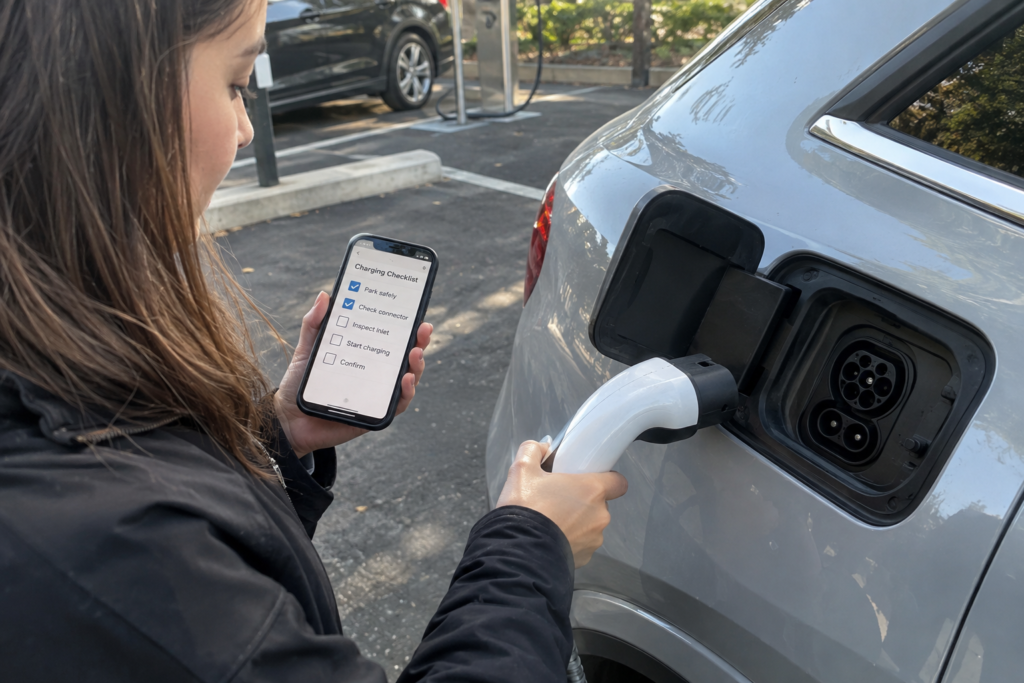
Start by recording both ends of the connection. A vehicle inlet identifies what the car can accept, while the charger-side connection identifies what the charging equipment provides. A cable or adapter must be suitable for the complete path between those two interfaces.
Vehicle inlet
Record the actual inlet from the vehicle documentation, physical inspection, or an approved vehicle database. Include the model year when an equipment revision, connector transition, or charging capability may differ. For a mixed fleet, create one row per vehicle group instead of writing “all fleet vehicles.”
Useful vehicle-side fields include:
- Vehicle make, model, model year, and trim when relevant
- Inlet family and whether the inlet supports AC, DC, or both through defined contacts
- Vehicle charging limit and manufacturer-approved accessories
- Inlet location and clearance if cable routing or a holder is involved
- Any adapter, authentication, or locking requirement stated by the vehicle maker
Charger or outlet side
Record what the accessory will connect to on the infrastructure side:
- Fixed cable on a wallbox or charging station
- Socket-outlet requiring a detachable cable
- Portable EVSE with a defined vehicle connector
- Household or industrial outlet on the supply side
- Workplace, fleet, or public charging station with a specific connector and control arrangement
Do not describe the charger side only as “Level 2 charger.” That label does not identify the connector, cable arrangement, current setting, or regional plug. A complete record names the charger model or station reference, the equipment-side connector, whether the cable is fixed or detachable, and the operating limits.
The connection path
Map the path in order:
Vehicle inlet → vehicle connector → cable or adapter → charger-side connector → charging equipment or outlet
For a fixed-cable station, some parts of this path are built into the equipment. For a socketed wallbox, the detachable cable becomes a separate compatibility decision. For a portable EVSE, the mains-side plug and the vehicle-side connector both need to be recorded.
Which Connector and Charging-Mode Checks Come First?
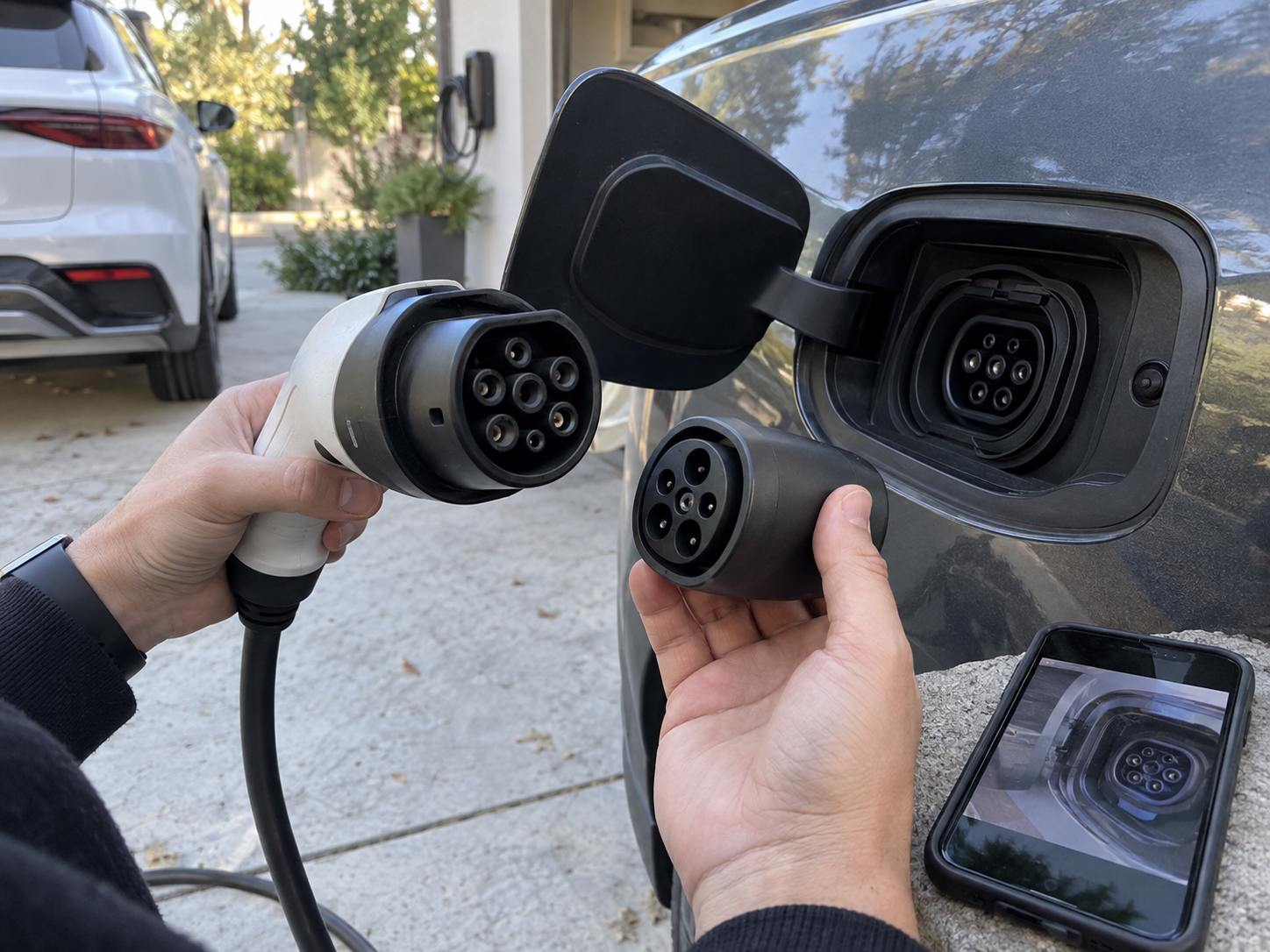
The first checks are connector location, charging mode, and direction. Confirm which end is vehicle-side, which end is charger-side, whether the use is AC or DC, and whether the accessory is a cable, passive adapter, active adapter, cap, or support product.
Connector name is only a starting field
Names such as Type 1, Type 2, J1772, CCS, NACS, and CHAdeMO help identify an interface family, but they do not fully specify a usable combination. Record the connector at each end and the direction of the connection. “Type 1 to Type 2” is incomplete unless the buyer also states which side connects to the vehicle, which side connects to the charger, and whether the use is AC or DC.
Charging mode must be explicit
AC charging normally involves the vehicle’s onboard charger, while DC fast charging supplies DC through a defined vehicle interface and control system. The same broad connector family may appear in different charging contexts, and some interfaces can support more than one mode. The U.S. Department of Energy lists J1772 and NACS for AC Level 1 or Level 2 contexts and CCS, CHAdeMO, and NACS among DC fast-charging connector families in the United States.2
Before approving a cable or adapter, write one of the following in the fitment record:
- AC charging only
- DC charging only
- Defined AC and DC use with separate ratings and approved combinations
- Passive protection or storage accessory with no power-transfer function
If the product description says “universal charging adapter” but does not state the mode, direction, rating, and approved equipment combination, mark it Clarify.
Plug-side checks
For portable charging equipment, the vehicle connector is only one end of the product. Also verify the supply-side plug, outlet type, voltage, phase, current setting, and destination-market plug convention. A vehicle can be compatible with the car-side connector while the portable unit is unsuitable for the available outlet or regional electrical system.
What Electrical, Mechanical, and Communication Details Matter?
After the connection path is identified, verify the operating boundaries. Compatibility is not complete until the accessory can be used within its electrical, mechanical, communication, and environmental limits.
Electrical details
Record:
- AC or DC mode
- Rated voltage and current
- Single-phase or three-phase use where relevant
- Cable length, conductor construction, and temperature range
- Charger output and vehicle acceptance limits
- Any derating, duty-cycle, or installation condition stated by the supplier
Do not select a cable or adapter because its current number is simply higher. The rating must belong to the exact configuration, including connector housing, cable length, terminals, cooling design, and intended use.
Mechanical details
Check the parts that determine whether the accessory can be connected, supported, and removed without damaging the system:
- Mating geometry and keying
- Contact or pin arrangement
- Housing clearance and orientation
- Locking and release mechanism
- Cable exit direction and strain relief
- Connector weight and cable diameter
- Bend radius and available routing space
- Cap, holder, or mount retention
For a holder or wall mount, mechanical compatibility is not the same as connector compatibility. The holder must support the cable and connector at the site without forcing a sharp bend or placing load on the vehicle inlet.
Communication and locking behavior
Some charging combinations depend on signaling, control-pilot behavior, temperature monitoring, proximity functions, or mechanical release conditions. A passive adapter may change the physical interface without providing the communication or safety functions that the vehicle and charger expect. Other adapter types may have their own defined controls.
Ask the supplier to state exactly what the product changes and what remains the responsibility of the vehicle, charger, cable, or installation. IEC 62196 covers conductive-charging plugs, socket-outlets, vehicle connectors, vehicle inlets, and cable assemblies as system interfaces rather than as isolated shapes.3
How Do Type 1, Type 2, CCS, and NACS Differ by Market?
Connector families are useful market clues, not automatic market approvals. Type 1/J1772, Type 2, CCS, and NACS/J3400 are common reference terms, but the supported vehicle, charging mode, infrastructure, document set, and product revision still need to be confirmed for the destination market.
| Reference family | Typical buyer use | What must not be assumed |
|---|---|---|
| Type 1 / J1772 | AC vehicle connection in many North American applications | It does not by itself confirm the charger-side plug, current rating, or DC capability |
| Type 2 | AC charging interfaces based on IEC dimensional configurations in many European and international applications | The connector name does not prove a particular vehicle, cable assembly, or market approval |
| CCS1 | DC charging combination built around a J1772-style vehicle interface | Physical fit does not prove charging communication, station support, or adapter approval |
| CCS2 | DC charging combination built around a Type 2-style vehicle interface | A Type 2 AC cable is not automatically a CCS2 DC cable |
| NACS / SAE J3400 | AC and DC charging coupler reference in North American applications | Vehicle model year, station support, adapter qualification, and current limits still matter |
IEC 62196-2:2022 addresses AC plugs, socket-outlets, vehicle connectors, and vehicle inlets with standardized pin and contact-tube configurations, while the applicable configuration and product scope still need to be matched.4 SAE J3400 is another example of why a market name should be tied to a defined standard and product specification rather than used as a loose sales label.
Regional fit also includes more than the connector. Add destination country, plug convention, language, label requirements, import documentation, vehicle or charger approval, and applicable local rules to the matrix. Do not state that an accessory is “global” or “universal” unless the supplier can list the exact supported combinations and exclusions.
A Type 1 vehicle and a Type 2 AC station socket are one specific combination. The Type 1/Type 2 cable selection checks cover connection direction, single-phase current and the limits of a detachable cable.
How Do You Build a Vehicle-to-Accessory Fitment Matrix?
A fitment matrix converts a broad product family into approved combinations. Each row should represent one vehicle group, charger combination, or accessory configuration, and each row should end with Pass, Hold, or Clarify.

Recommended matrix columns
| Matrix field | What to record |
|---|---|
| Vehicle group | Make, model, year, trim or fleet group |
| Vehicle inlet | Connector family, inlet photo or reference, AC/DC capability |
| Charger or outlet | Model, station, fixed cable, socket, or supply plug |
| Accessory SKU | Exact product code, revision, connector direction, and cable length |
| Charging boundary | AC/DC, voltage, current, phase, temperature, and approved use |
| Mechanical fit | Keying, clearance, locking, cable diameter, bend radius, and retention |
| Communication | Signaling, control, temperature, release, or adapter behavior where relevant |
| Market fit | Destination, labeling, manual language, documents, and approval boundary |
| Evidence | Datasheet, label, manual, declaration, test report, listing, and revision |
| Status | Pass, Hold, or Clarify, with owner and next action |
Complete Fitment / RFQ example
The following example shows how a buyer can turn a broad request into a supplier response that is specific enough for sampling. The rows are illustrative buying scenarios, not universal compatibility claims; replace the vehicle group with the buyer's verified model list before granting a final Pass.
| Project or use case | Vehicle-side reference | Charger or outlet-side reference | Accessory requested | Electrical and mechanical boundary | Market and evidence requested | Supplier response and decision |
|---|---|---|---|---|---|---|
| European home charging assortment | Type 2 / CCS2 vehicle group; exact model and year list required | Type 2 wallbox, socket outlet, or fixed cable stated per SKU | Type 2-to-Type 2 AC cable, 5 m and 7 m variants | AC, 3-phase, 32 A; cable diameter, bend radius, latch clearance, and temperature range required | EU destination; datasheet, label, manual, declaration, applicable test report, and revision traceability | Return exact SKU, included connector ends, cable length, ratings, model exclusions, and sample plan; Clarify until the model list and documents match |
| North American fleet adapter program | NACS vehicle inlets; vehicle model, year, and fleet list required | J1772 station-side outlet or fixed cable; station model list required | Defined NACS-to-J1772 adapter configuration | AC only; voltage, current limit, locking, temperature, enclosure, and approved direction required | U.S. or Canada; exact adapter evidence, model coverage, label, manual, listing or assessment status, and change-control record | Return adapter direction, exact vehicle and station combinations, conditions of use, and unresolved approvals; Hold until the tested configuration is verified |
| European dealer bundle | Defined Type 2 and CCS2 vehicle mix | Type 2 AC wallbox and approved storage position | AC cable, protective cap, wall holder, packaging, and spare SKU bundle | 3-phase, 32 A cable; cap retention, holder load, mounting surface, cable bend radius, and bundle exclusions | EU destination; variant matrix, manuals, barcode, label artwork, declaration, environmental claims, and sample photos | Return one controlled bundle BOM and one document index; Pass when each variant, label, and sample matches |
| U.S. home garage cable kit | J1772 vehicle group; exact vehicle references required | NEMA 14-50 supply context or specified Level 2 EVSE outlet | J1772 AC cable or defined portable charging accessory | AC, single-phase, 240 V, 32 A example; plug, cable length, strain relief, temperature, and storage requirements | U.S. destination; exact electrical boundary, product listing or assessment where applicable, manual, warning label, and sample test record | Return supply-side and vehicle-side ends separately, rating limits, installation exclusions, and exact SKU; Conditional until the outlet and product boundary are confirmed |
Do not fill a matrix with a connector name only. A useful row explains what is connected, how it is used, what evidence supports it, and what remains unresolved. If one field is unknown, preserve the uncertainty instead of converting it into a universal claim.
What Should Buyers Confirm Before Ordering or Listing an Accessory?
Before ordering or listing an accessory, buyers should confirm the exact fitment record, supporting evidence, market boundary, and product revision. A supplier response is ready for approval only when the product description, sample, documents, label, and quotation describe the same configuration.
Once the fitment and document scope is defined, freeze the sample ID, product revision, checked interfaces, and pass-or-hold criteria with an EV charging accessories sample order checklist so sample approval remains tied to the configuration being quoted and listed.
Product and document checks
Request:
- Exact SKU, revision, connector direction, and product photos or drawings
- Vehicle and charger-side compatibility statement
- AC/DC use, voltage, current, phase, cable length, and temperature limits
- Datasheet, label artwork, manual, declaration, applicable certificate or listing, and test report
- Communication, locking, adapter, or manufacturer-approval statement where relevant
- Destination-market label, language, packaging, and traceability information
For a market-specific evidence review, buyers can compare the exact product pack with product-specific certification and compliance support, but a general company page should not replace SKU-level verification.
Sample and listing checks
The approved sample should match the product that will be quoted, listed, packaged, and shipped. Confirm:
- Connector fit and insertion/removal behavior
- Current and voltage markings
- Cable jacket, terminals, strain relief, and housing condition
- Locking, release, and retention behavior
- Label, manual, warning, barcode, and package contents
- Test conditions and acceptance criteria
- Revision, batch, and change-notification process
If the buyer is comparing suppliers, the OEM EV charging accessories supplier overview can help frame the sourcing discussion, but the final decision should remain tied to the approved fitment row and evidence pack.
Once the fitment row is complete, use the EV charging adapter compatibility guide when an adapter is part of the connection path. It separates connector direction, AC or DC use, ratings, communication, locking, and approved-use limits. Then use the EV charging accessories certifications and test documents checklist and the EV charging accessories supplier checklist before approving a supplier or listing.
Common reasons to reject a “universal” claim
Mark an accessory Hold or Clarify when:
- The vehicle inlet is not identified by model, group, or verified interface
- Only one connector end is described
- AC or DC use is missing
- The current or voltage rating is not tied to the exact configuration
- Communication, locking, or adapter behavior is not explained
- The product revision does not match the document pack
- The target country or market is not named
- The sample, label, and quotation describe different versions
EV Charging Accessories Compatibility Checklist
Use this checklist before placing an order, publishing a product listing, or approving a sample.
Vehicle and equipment
- [ ] Vehicle make, model, year, and group are recorded
- [ ] Vehicle inlet is verified from a reliable reference or physical inspection
- [ ] Charger, outlet, station, or portable EVSE is identified
- [ ] Vehicle-side and charger-side connector ends are both recorded
- [ ] Fixed-cable versus socketed equipment is clear
Charging and electrical limits
- [ ] AC or DC use is stated
- [ ] Voltage, current, phase, and temperature limits are recorded
- [ ] Cable length, conductor construction, and any derating condition are clear
- [ ] The product does not claim to change charging mode without defined evidence
- [ ] Plug-side requirements match the destination electrical system
Mechanical and functional fit
- [ ] Keying, orientation, clearance, and mating geometry are checked
- [ ] Locking, release, retention, and strain relief are reviewed
- [ ] Cable diameter, connector weight, bend radius, and mounting space are suitable
- [ ] Communication, control, temperature, and adapter behavior are documented where relevant
- [ ] Caps, holders, or mounts fit the exact connector or cable configuration
Market and evidence
- [ ] Destination country, channel, labels, manual language, and import requirements are recorded
- [ ] Exact SKU and revision appear on the documents and sample
- [ ] Datasheet, manual, label, declaration, certificate or listing, and test evidence are matched
- [ ] Manufacturer or vehicle approval is checked when required
- [ ] “Universal” or “global” claims are replaced with a defined supported-combination list
Decision and follow-up
- [ ] Each matrix row is marked Pass, Hold, or Clarify
- [ ] The unresolved question has an owner and next action
- [ ] Representative samples are tested under the intended equipment combination
- [ ] Packaging, barcode, spare SKU, and replacement logic are recorded
- [ ] Any product, document, label, or packaging change triggers revalidation
Conclusion: How to Use the Checklist Before Approval
The reliable compatibility decision follows a simple order: identify the vehicle inlet, identify the charger-side connection, define AC or DC use, verify electrical and mechanical limits, review communication and locking behavior, then confirm the market, evidence, and product revision. A connector that fits is only an inquiry result until the rest of the row is complete.
For home use, the checklist prevents a cable, adapter, cap, or holder from being chosen from a photo alone. For fleets and dealers, the fitment matrix makes mixed connector groups, replacement SKUs, packaging variants, and unresolved assumptions visible before inventory is committed.
If you are preparing a purchase, product listing, or sample approval, request a vehicle-specific compatibility review with the vehicle or fleet group, charger reference, connector ends, AC/DC mode, rating, destination market, and target quantity. A complete input allows the supplier to return a defined compatibility matrix instead of a generic “fits most EVs” answer.
Frequently Asked Questions
Do EV charging accessories fit all electric vehicles?
No. Fit depends on the vehicle inlet, charger-side connection, charging mode, electrical limits, communication or locking behavior, market, and exact product revision. Physical connector fit is only one part of approval.
How do I check EV charging cable compatibility?
Record the vehicle inlet, charger or outlet, AC or DC mode, voltage, current, phase, cable length, destination market, and product revision. Compare those fields with the exact SKU datasheet, label, manual, sample, and supplier evidence.
Is Type 1 the same as J1772?
Type 1 is commonly used as a market name for the SAE J1772-style AC vehicle interface, but the label alone does not define the charger-side connection, current rating, vehicle approval, or complete cable assembly. Verify the exact equipment combination.
Is Type 2 the same as CCS2?
No. Type 2 commonly identifies an AC interface family, while CCS2 adds a defined DC charging interface below the Type 2-style upper section. A Type 2 AC cable should not be treated as a CCS2 DC cable without product-specific evidence.
Can an adapter make an incompatible EV charger work?
An adapter can change a physical connection between defined compatible equipment, but it does not automatically create compatible charging communication, current capacity, locking, or safety behavior. Confirm the adapter direction, AC/DC boundary, ratings, approved use, and exact vehicle-charger combination.
What should be included in an EV connector compatibility chart?
Include vehicle model or group, model year when relevant, vehicle inlet, charger-side connector, AC/DC mode, voltage, current, phase, cable length, communication or locking behavior, destination market, product SKU, revision, evidence, and Pass/Hold/Clarify status.
What does market fit mean for an EV charging accessory?
Market fit means that the product configuration, connector convention, electrical use, labels, manual language, documents, packaging, and approvals are suitable for the destination country and sales channel. It is not a claim that one accessory works everywhere.
When should a buyer mark an accessory Hold?
Mark it Hold when the vehicle or charger reference is missing, the AC/DC mode is unclear, the rating is not tied to the exact configuration, documents do not identify the SKU, communication or locking behavior is unknown, or the sample does not match the quotation and label.
References
[1] U.S. Department of Energy Alternative Fuels Data Center. “Electric Vehicle Charging Stations.” 2026.
[2] U.S. Department of Energy Alternative Fuels Data Center. “Electric Vehicles for Consumers.” 2026.
[3] International Electrotechnical Commission. “IEC 62196-1:2022 Plugs, Socket-Outlets, Vehicle Connectors and Vehicle Inlets.” 2022.
[4] International Electrotechnical Commission. “IEC 62196-2:2022 Dimensional Compatibility Requirements for AC Accessories.” 2022.
[5] International Electrotechnical Commission. “IEC TS 62196-7:2026 Vehicle Adapters.” 2026.