


The short answer: If you are a B2B buyer—whether a distributor, charge point operator, fleet manager, or brand owner—partnering with a dedicated OEM EV charging accessories manufacturer is the most efficient way to secure a competitive, certified, and scalable product line without the overhead of in-house R&D. This guide explains exactly how to do that, what to look for, and why Yirox Auto Parts is built for this purpose.
The transition to electric vehicles (EVs) is no longer a distant forecast—it is happening right now, at a pace that is reshaping global supply chains. For B2B buyers, this creates both an enormous opportunity and a pressing challenge: how do you build a reliable, compliant, and profitable EV charging accessories business when the market is moving so fast? The answer lies in choosing the right manufacturing partner.
In this comprehensive Pillar Page, we will walk through the entire landscape of OEM EV charging accessories—from market data and product categories, to certification requirements, customization workflows, and the specific criteria that separate great suppliers from mediocre ones.
Why Is the EV Charging Accessories Market Growing So Fast?
The numbers tell a compelling story. The global EV charging accessories market was valued at USD 3.4 billion in 2024 and is projected to reach USD 12.5 billion by 2033, representing a CAGR of approximately 15.6%. More specifically, the EV charging cable market alone is expected to surge from USD 1.48 billion in 2024 to USD 17.30 billion by 2034. The EV charging adapter market is even more dramatic, forecast to increase by USD 19.29 billion at a CAGR of 42.77% between 2023 and 2028.
These are not abstract projections. The International Energy Agency (IEA) confirmed that in 2024, more than 1.3 million public charging points were added globally, representing an increase of over 30% compared to the previous year. In the United States alone, more than 18,000 new DC fast-charging ports were added in 2025, the largest single-year expansion in U.S. history.
For B2B buyers, this growth trajectory means one thing: the window for establishing a strong market position in EV charging accessories is open right now. But the market is also becoming increasingly competitive. Buyers who secure reliable OEM partnerships today will have a significant first-mover advantage.
“EV charging is not just hardware. It involves electrical infrastructure, software systems, compliance and certification, and long-term service and support.” — Industry consensus among leading B2B procurement guides.
Who Actually Buys EV Charging Accessories in Bulk? Understanding the Target Audience
Before diving into products and processes, it is worth being honest about who this guide is written for. In our experience working with international buyers, the B2B demand for EV charging accessories comes from four primary customer segments:
1. Distributors and Wholesalers: Companies that purchase in volume and resell to retailers, installers, or end users. They need competitive pricing, consistent product quality, and reliable lead times. They often require private labeling to differentiate their offerings.
2. Charge Point Operators (CPOs): Businesses that own and operate public or semi-public charging networks. They need large quantities of standardized, certified cables and accessories that are interoperable with their OCPP-compliant charging stations.
3. Fleet Operators: Logistics companies, delivery services, and corporate fleets transitioning to electric vehicles. They need robust, high-cycle charging cables and adapters that can withstand daily, heavy-duty use.
4. Automotive Aftermarket Retailers and Brand Owners: Companies that sell automotive accessories and want to expand into the EV space under their own brand. They need OEM/ODM support to develop custom-branded products without investing in manufacturing infrastructure.
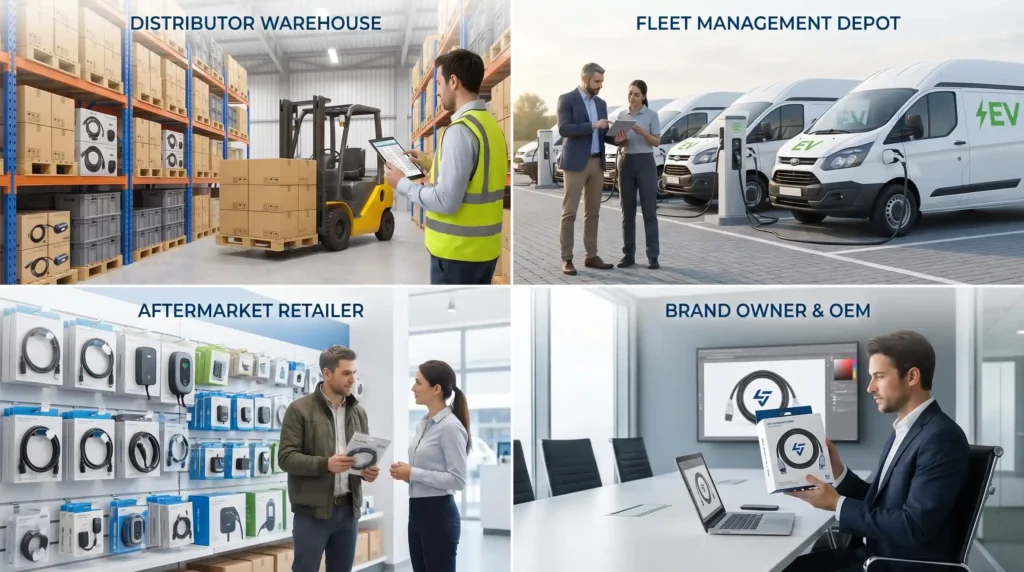
Understanding which segment you belong to is critical because it shapes everything from your MOQ requirements to the level of customization you need. A CPO sourcing 10,000 Type 2 cables has very different needs from a brand owner launching a private-label portable EVSE product.
What Products Does a Full-Range OEM EV Charging Accessories Manufacturer Offer?
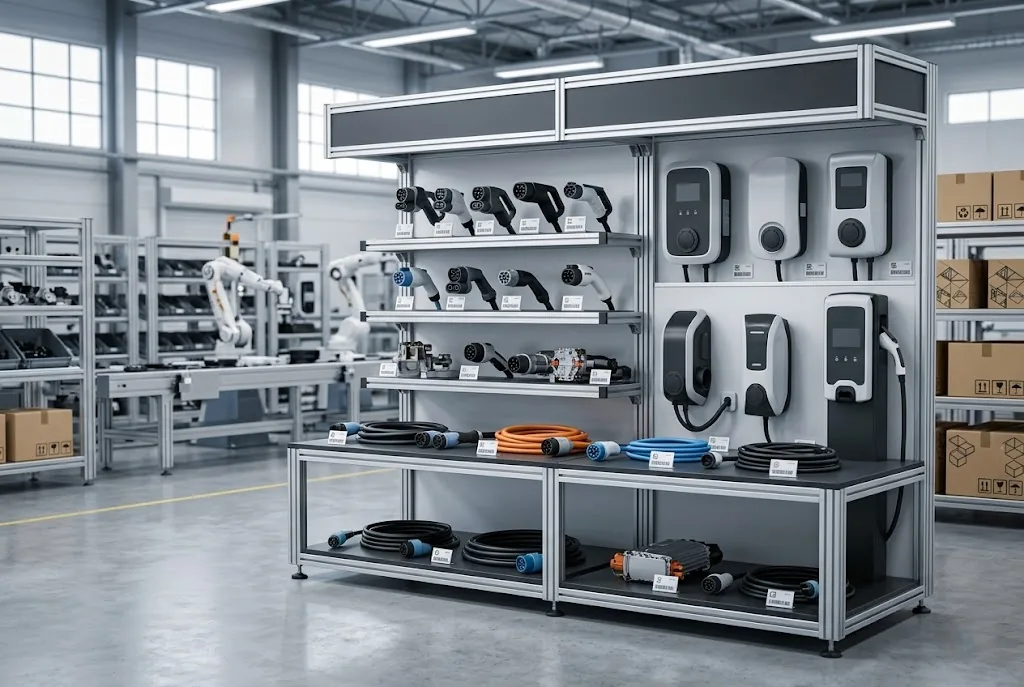
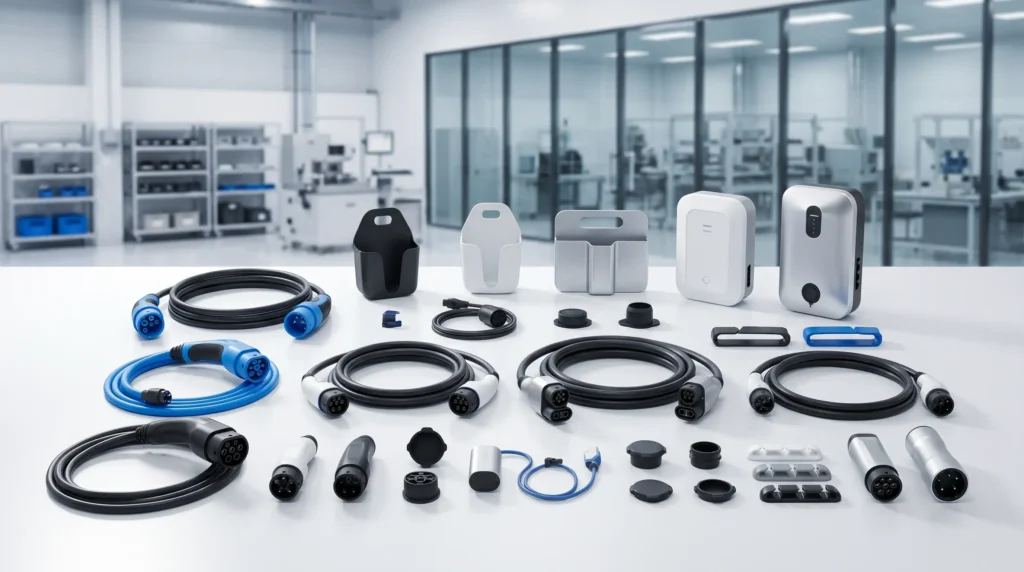
A truly full-range manufacturer should cover every component in the EV charging ecosystem. Here is a breakdown of the core product categories and what to look for in each:
What Types of EV Charging Cables Are Available?
EV charging cables are the most fundamental accessory in the ecosystem. The right cable depends entirely on the charging standard used in your target market. A qualified OEM manufacturer should offer the following:
- Mode 2 Portable Charging Cables (ICCB): These are in-cable control box (ICCB) cables that allow charging from a standard household outlet (Schuko, CEE7, or NEMA 5-15). They are the most common consumer-facing product and a staple of the automotive aftermarket.
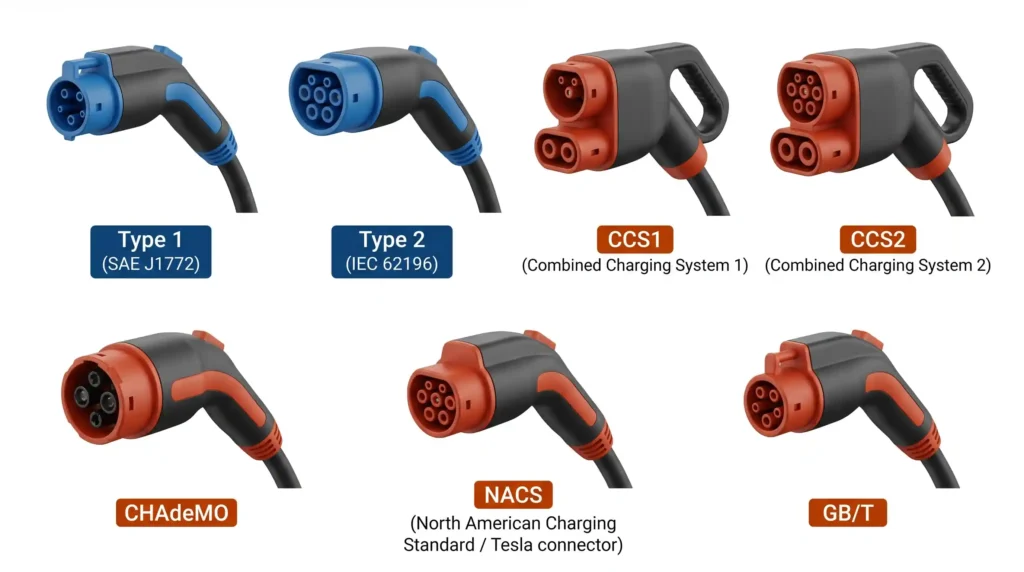
- Mode 3 AC Charging Cables (Type 1 / Type 2): Designed for dedicated EV charging stations (wallboxes). Type 1 (SAE J1772) is the standard in North America and Japan, while Type 2 (IEC 62196) dominates Europe and is increasingly adopted globally. These cables are available in tethered (fixed to the station) and untethered (carried by the driver) configurations.
- Mode 4 DC Fast Charging Cables (CCS1, CCS2, CHAdeMO, GB/T): These are high-power cables for DC fast chargers. They require more robust construction to handle currents of 100A, 200A, or even higher. CCS (Combined Charging System) is the dominant standard in Europe and North America, while GB/T is used in China and CHAdeMO is a legacy Japanese standard.
Key technical specifications to specify when sourcing cables include: conductor cross-section (e.g., 5×6mm² for 32A Type 2), cable length (5m, 7.5m, or custom), IP rating (IP44 minimum for outdoor use, IP65 or IP67 for harsh environments), and temperature range (-30°C to +50°C for cold-climate markets).
What Types of EV Charging Adapters Are in Demand?
Adapters are one of the fastest-growing product categories in EV charging accessories, driven by the fragmentation of global charging standards and the rapid adoption of the North American Charging Standard (NACS).
- NACS to CCS1 Adapters: As major automakers like Ford, GM, and Rivian adopt NACS (Tesla’s connector), drivers need adapters to use the existing CCS1 fast-charging network. This is currently one of the highest-demand adapter categories in North America.
- NACS to J1772 Adapters: Allows NACS-equipped vehicles to use the vast network of Level 2 AC chargers with J1772 connectors.
- CCS1 to CCS2 Adapters: Enables cross-regional compatibility for vehicles and charging stations.
- CHAdeMO Adapters: As CHAdeMO becomes a legacy standard, adapters allowing CHAdeMO vehicles to use CCS stations are increasingly relevant.
What Are Portable EV Chargers (EVSE) and Why Do B2B Buyers Need Them?
Portable Electric Vehicle Supply Equipment (EVSE) refers to compact, carry-anywhere charging units that allow EV drivers to charge from various power sources. For B2B buyers, portable EVSE is a high-margin, high-demand product category with several compelling use cases:
- Automotive Aftermarket Retail: Sold as a premium accessory alongside new or used EV purchases.
- Fleet Emergency Backup: Fleet operators keep portable EVSE units as backup charging solutions when a vehicle cannot reach a fixed charging point.
- Hospitality and Property Management: Hotels and Airbnb hosts offer portable EVSE as an amenity for EV-driving guests.
A quality portable EVSE should offer adjustable current settings (e.g., 8A, 10A, 13A, 16A), multiple plug adapters (Schuko, CEE7, NEMA), and a robust, weather-resistant housing.
What Other EV Charging Accessories Should Be in Your Product Portfolio?
Beyond cables, adapters, and portable chargers, a comprehensive product line should also include:
- Charging Cable Holsters and Organizers: Wall-mounted holders that keep cables tidy and protected at home or commercial charging stations.
- Connector Dust Caps and Protective Covers: Weatherproof caps that protect connector pins from dust, moisture, and damage when not in use.
- Cable Management Clips and Brackets: Accessories for routing and securing cables along walls or floors in commercial installations.
These ancillary products have high attachment rates—buyers who purchase cables often need organizers and protective covers as well—making them excellent additions to any EV charging accessories catalog.
What Certifications Are Mandatory for EV Charging Accessories?
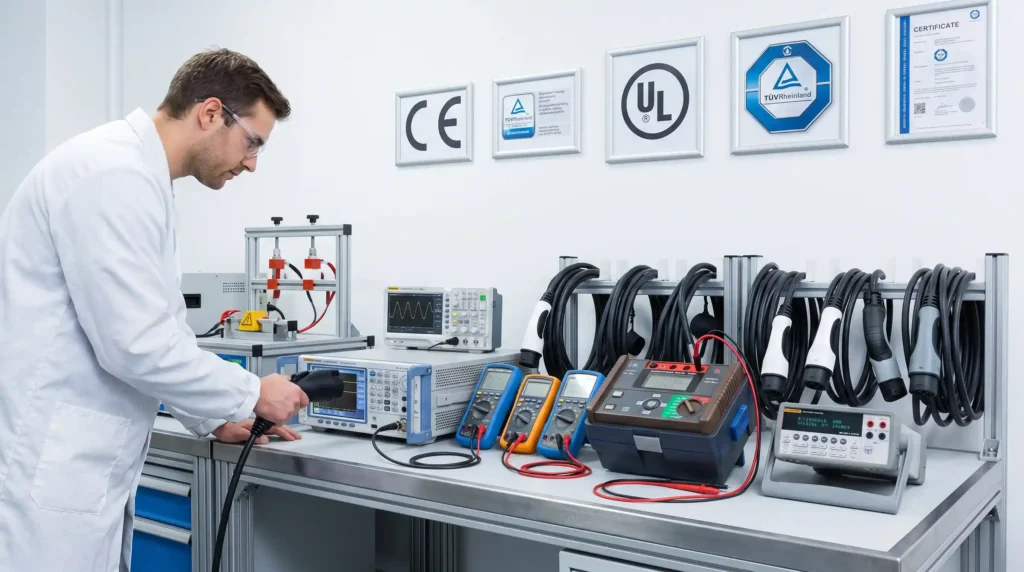
This is the question that separates professional B2B buyers from amateurs. Selling non-certified EV charging accessories in regulated markets is not just a legal risk—it is a safety risk that can result in product recalls, liability claims, and permanent damage to your brand reputation.
Here is a market-by-market breakdown of the key certifications:
| Target Market | Required/Recommended Certifications | Governing Body |
|---|---|---|
| European Union | CE marking (mandatory), TUV Rheinland (highly recommended), RoHS, REACH | European Commission |
| United States | UL 2594 (for EV supply equipment), FCC (for smart chargers), ETL | Underwriters Laboratories |
| United Kingdom | UKCA (post-Brexit equivalent of CE) | UK Government |
| Australia / New Zealand | RCM (Regulatory Compliance Mark) | ACMA / ERAC |
| China | CCC (China Compulsory Certificate) | CNCA |
| Global / Cross-Market | ISO 9001 (Quality Management), ISO 14001 (Environmental) | ISO |
When evaluating an OEM manufacturer, always request copies of their current certificates and verify them directly with the issuing body. A reputable manufacturer will have no hesitation in providing this documentation. Be particularly cautious of suppliers who claim certifications but cannot produce the actual certificates.
OEM vs. ODM: What Is the Difference and Which Model Is Right for You?
Many B2B buyers use the terms OEM and ODM interchangeably, but they represent fundamentally different business models. Understanding the distinction will help you choose the right approach for your product strategy.
OEM (Original Equipment Manufacturer) means the manufacturer produces a product based on your specifications and designs, which you then sell under your own brand. You own the design; the manufacturer executes the production. This model requires you to have a clear product concept and technical specifications.
ODM (Original Design Manufacturer) means the manufacturer has already developed a product design that you can adopt, customize, and sell under your own brand. The manufacturer owns the underlying design. This model is faster to market and requires less upfront investment in R&D.
For most B2B buyers entering the EV charging accessories market, an ODM approach with branding customization is the most practical starting point. You leverage the manufacturer’s existing, certified product designs, add your logo and packaging, and launch quickly. As your business grows and you develop a deeper understanding of your customers’ needs, you can transition to full OEM development for differentiated, proprietary products.
Yirox Auto Parts supports both models, allowing buyers to start with ODM and scale into OEM as their brand matures.
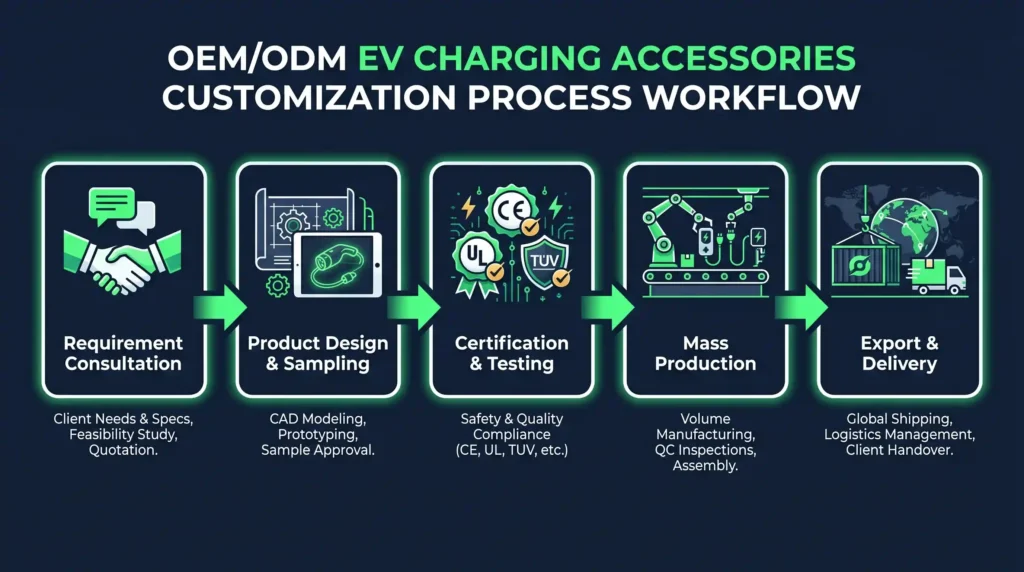
The OEM Customization Process: A Step-by-Step Walkthrough
One of the most common questions we receive from new B2B partners is: “What does the OEM process actually look like?” Here is a transparent, step-by-step breakdown of how a professional OEM engagement works:
Step 1: Requirement Consultation (Week 1-2)
The process begins with a detailed consultation to define your requirements. This includes: target market (which determines certification requirements), product specifications (connector type, cable length, current rating), branding requirements (logo, color, packaging design), and volume forecast (which determines pricing and MOQ).
Step 2: Product Design and Sampling (Week 2-6)
For ODM projects, the manufacturer presents existing product options that meet your specifications. For OEM projects, the engineering team develops CAD models and 3D renders for your approval. Once the design is finalized, physical samples are produced and shipped for your review and testing.
Step 3: Certification and Compliance Testing (Week 4-16)
This is the most time-intensive phase and the one that most buyers underestimate. Depending on the target market, the product must undergo electrical safety testing, EMC testing, and environmental testing. For CE marking in Europe, this involves preparing a technical file and issuing a Declaration of Conformity. For UL certification in the United States, the product must be tested by an accredited laboratory.
Step 4: Sample Approval and Mass Production Preparation (Week 8-18)
Once samples are approved and certifications are in progress, the manufacturer prepares for mass production. This includes sourcing raw materials, setting up assembly lines, and preparing quality control checkpoints.
Step 5: Mass Production and Quality Control (Week 10-20)
Production begins with rigorous inline quality control. For EV charging cables, this typically includes 100% electrical continuity testing, insulation resistance testing, and connector insertion/extraction force testing. A reputable manufacturer will provide an Inspection Report (IR) or Factory Acceptance Test (FAT) report upon request.
Step 6: Export Packaging and Logistics (Week 14-22)
Products are packaged according to your specifications (retail box, bulk carton, or pallet), and export documentation is prepared (commercial invoice, packing list, certificate of origin, and compliance certificates). The manufacturer coordinates with your freight forwarder or manages logistics directly.
How Do You Evaluate and Select the Right EV Charging Accessories Manufacturer?
With hundreds of suppliers claiming to be “professional OEM manufacturers,” how do you identify the ones that will actually deliver? Here is a practical evaluation framework based on the criteria that matter most to B2B buyers:
Does the Manufacturer Own Their Factory?
This is the single most important question. A manufacturer that owns its factory has direct control over production quality, lead times, and the ability to accommodate custom specifications. Trading companies, by contrast, outsource production to third-party factories and have limited ability to enforce quality standards or accommodate customization.
Ask for a factory audit report or request a virtual factory tour. A legitimate manufacturer will welcome this scrutiny.
What Is Their Track Record with International Certifications?
Request copies of current CE, UL, or TUV certificates and verify the certificate numbers directly with the issuing body. Ask specifically which products are certified—a manufacturer may have certification for one product but not for the specific variant you need.
What Is Their Quality Control Process?
A professional manufacturer should have a documented Quality Management System (QMS), ideally certified to ISO 9001. Ask about their incoming material inspection process, inline production testing, and final outgoing quality control (OQC). For EV charging cables, every unit should undergo electrical testing before shipment.
What Is Their R&D and Engineering Capability?
The EV charging standards landscape is evolving rapidly. NACS adoption, bidirectional charging (V2G), and new IEC standards are creating constant product development demands. A manufacturer with a strong R&D team can help you stay ahead of these changes rather than scrambling to catch up.
What Is Their Minimum Order Quantity (MOQ) and Pricing Structure?
MOQ varies significantly depending on the level of customization. Standard products with logo printing may have MOQs as low as 100-500 units, while fully custom ODM products requiring new tooling may require 1,000-5,000 units. Understand the pricing tiers and how unit costs decrease with volume.
| Customization Level | Typical MOQ | Lead Time | Best For |
|---|---|---|---|
| Standard product, no customization | 50-100 units | 2-3 weeks | Testing the market |
| Standard product + logo printing | 100-500 units | 3-4 weeks | Brand entry |
| Standard product + custom packaging | 200-500 units | 4-5 weeks | Retail launch |
| Custom color/cable length | 500-1,000 units | 6-8 weeks | Differentiated offering |
| Full ODM (new housing design) | 1,000-3,000 units | 3-5 months | Proprietary product |
| Full OEM (client-owned design) | 2,000+ units | 4-6 months | Market leadership |
Yirox Auto Parts: A Full-Range B2B EV Charging Accessories Manufacturer
At Yirox Auto Parts, we have built our business around one core mission: helping B2B buyers build reliable, market-ready EV charging product programs. Based in Wuxi, China, we are an automotive and new-energy vehicle product manufacturer and solution provider with multi-process manufacturing capabilities and an export-oriented service model.
Our EV charging accessories product line covers the full spectrum of what B2B buyers need:
- AC Charging Cables: Type 1 (SAE J1772), Type 2 (IEC 62196), and GB/T cables in Mode 2 and Mode 3 configurations, available in 16A and 32A ratings, with cable lengths from 3m to 10m.
- DC Fast Charging Cables: CCS1, CCS2, and CHAdeMO cables for high-power charging applications.
- Charging Adapters: A comprehensive range including NACS to CCS1, NACS to J1772, and CCS cross-compatibility adapters.
- Portable EVSE: Compact, adjustable-current portable chargers for consumer and commercial use.
- Cable Management Accessories: Holsters, dust caps, and cable organizers.
What sets Yirox apart is our commitment to traceable quality control. Every product in our EV charging accessories line undergoes documented testing before shipment, and we maintain full traceability from raw material sourcing to finished product. Our OEM/ODM service covers everything from initial product design and sampling to certification support and export-ready packaging.
For distributors and wholesalers looking to build a private-label EV charging brand, we offer flexible branding packages that include custom logo printing, color customization, and retail packaging design. For charge point operators and fleet managers requiring large-volume, standardized products, we offer competitive bulk pricing with consistent quality across batches.
To explore our full product range and request a catalog, visit our EV Charging Accessories page or contact our team directly.
Common Mistakes B2B Buyers Make When Sourcing EV Charging Accessories
Having worked with buyers across multiple continents, we have seen the same mistakes repeated. Here is what to avoid:
Prioritizing price over certification. The cheapest cable is rarely the best value. Non-certified products can fail market entry inspections, be seized at customs, or—worst of all—cause electrical fires. The cost of a product recall far exceeds any savings from choosing a cheaper, uncertified supplier.
Ignoring the connector standard evolution. The rapid adoption of NACS in North America caught many buyers off guard. Always ask your manufacturer about their roadmap for supporting new standards and their ability to pivot quickly.
Underestimating lead times for certified products. Many buyers assume they can place an order and receive certified products within a few weeks. In reality, certification testing for new products can take 2-4 months. Plan your inventory cycles accordingly.
Choosing a trading company over a direct manufacturer. Trading companies cannot provide the same level of quality control, customization, or technical support as a direct manufacturer. Always verify whether your supplier owns their production facility.
Neglecting after-sales support. EV charging accessories are safety-critical products. You need a supplier who will stand behind their products with warranty support, replacement parts, and responsive technical assistance.
Conclusion
The EV charging accessories market is one of the most dynamic and high-growth segments in the global automotive industry. For B2B buyers, the opportunity is significant—but so is the complexity. Navigating connector standards, certification requirements, OEM/ODM processes, and supplier evaluation takes expertise and experience.
The most important decision you will make is choosing the right manufacturing partner. A professional OEM EV charging accessories manufacturer does not just supply products—they become a strategic partner in your business growth, helping you stay ahead of market trends, maintain compliance, and scale your product line efficiently.
Yirox Auto Parts is built for exactly this role. With a comprehensive product range, proven OEM/ODM capabilities, and an export-oriented service model, we are ready to help you build a competitive EV charging accessories business. Request a product catalog today and let us discuss how we can support your specific requirements.
Frequently Asked Questions (FAQ)
What is the minimum order quantity (MOQ) for OEM EV charging cables?
The MOQ depends on the level of customization. For standard products with logo printing, MOQ typically starts at 100–500 units. For fully custom ODM products requiring new tooling or molds, MOQ is generally 1,000–3,000 units. Contact our sales team with your specific requirements for an accurate quote.
What certifications do your EV charging accessories carry?
Our products are designed and tested to meet the certification requirements of your target market. We can support CE (Europe), TUV Rheinland, UL (North America), UKCA (UK), and RCM (Australia). Please specify your target market when requesting samples, and we will ensure the appropriate certifications are in place.
Can you manufacture NACS-compatible charging adapters?
Yes. As NACS (the North American Charging Standard) becomes the dominant standard in North America, we offer NACS to CCS1 and NACS to J1772 adapters. All adapters are tested for electrical safety, connector durability, and compatibility with major EV models.
How long does the OEM/ODM process take from inquiry to delivery?
For standard products with custom branding (logo and packaging), the typical lead time is 3–5 weeks. For fully custom ODM projects requiring new designs and certifications, the timeline is 3–6 months depending on complexity. We recommend starting the process well in advance of your target launch date.
Do you offer private label packaging design services?
Yes. We provide comprehensive packaging support, including retail box design, instruction manual creation, and multi-language labeling. Our team can work with your existing brand guidelines or help develop a complete visual identity for your EV charging product line.
What is the difference between Mode 2 and Mode 3 EV charging cables?
Mode 2 cables are portable cables with an In-Cable Control Box (ICCB) that allow charging from a standard household outlet. They are slower (typically 8A–16A) but highly convenient. Mode 3 cables are designed for use with dedicated EV charging stations (wallboxes) and support higher currents (up to 32A or 63A) for faster charging. Both are essential products for a comprehensive EV charging accessories portfolio.
How do you ensure quality consistency across large production batches?
We maintain a documented Quality Management System aligned with ISO 9001 principles. Every production batch undergoes incoming material inspection, inline process control, and 100% final electrical testing. We provide Inspection Reports for each batch, and third-party factory audits are welcome.
References
1. LinkedIn. (2025). Global EV Charging Accessories Market Size, Share & Forecast.
2. Precedence Research. (2024). Electric Vehicle Charging Cables Market Size 2025 to 2034.
3. Technavio. (2024). EV Charging Adapter Market Size 2024-2028.
4. International Energy Agency (IEA). (2025). Global EV Outlook 2025 – Electric Vehicle Charging.
5. EV Connect. (2026). 2025 EV Charging Industry Report.