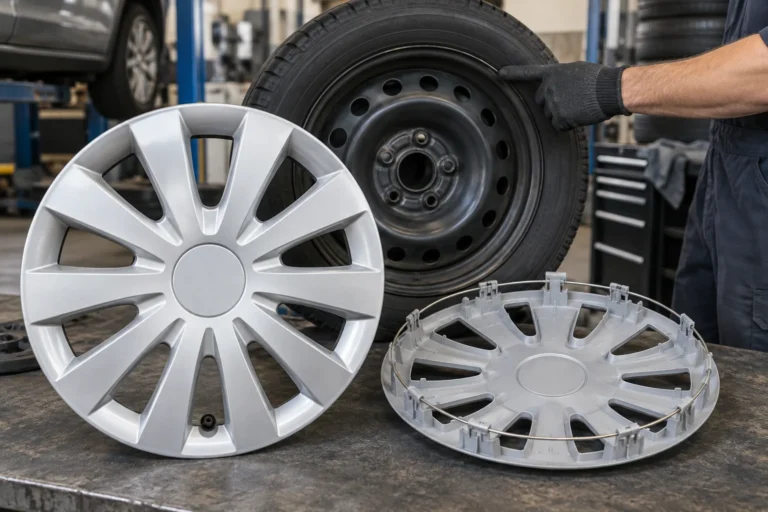




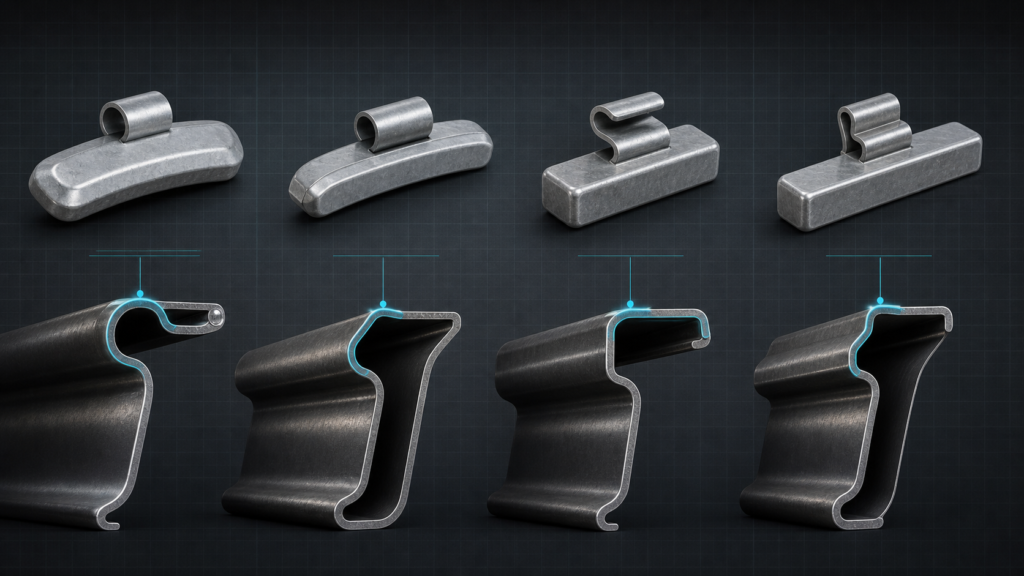
Clip-on wheel weight types use different spring-clip shapes to suit different rim flanges. P, C, T, and MC are common profile-family labels in wheel-weight catalogues, but no label alone proves compatibility. The right choice requires the supplier's profile drawing or application guide, the actual rim flange geometry, the approved mounting location, and a trial fit that confirms retention and finish protection.
These codes are useful because they give a workshop or distributor a shared way to organize an assortment. They become risky when they are treated as a universal vehicle lookup. Wheel construction, paint thickness, flange contour, and regional catalogue conventions can all change what a code means in practice. SAE and ISO standards frame clip balance weights around rim-flange configurations, installation, and retention—not around a single globally universal code list 1 2.
Table of Contents
- What are clip-on wheel weight types?
- Why do clip-on wheel weight profiles differ?
- What do P, C, T, and MC labels mean?
- What can a profile code tell you—and what can it not?
- How should a technician choose a clip type?
- When should a shop use adhesive weights instead?
- What should buyers check before ordering?
- How should distributors build a clip-profile range?
- Conclusion: Treat codes as a starting point
- Frequently Asked Questions
- References
What are clip-on wheel weight types?
Clip-on wheel weight types are families of balancing weights distinguished mainly by the shape and opening of the spring clip that engages the rim flange. The weight mass, material, coating, and unit system are separate choices from the clip profile.
The clip has to enter the flange, sit at the intended location, and hold the weight without damaging the wheel or interfering with adjacent features. That is why one product range can contain several clip families even where the weights all use the same material and gram or ounce increments.
For range planning, begin with the wheel applications, not the code names. The wheel-weight format and application choices help buyers separate attachment style, material, size system, and wheel use before they decide which clip families to carry.
When a profile code appears promising, a rim-flange application chart gives the dimensional checks needed before it is approved for a wheel family.
Why do clip-on wheel weight profiles differ?
Profiles differ because rim flanges differ in thickness, lip shape, gap, depth, contour, and finish. A clip that seats securely on one flange may ride high, bottom out, scratch the rim, or have poor retention on another flange that appears similar.
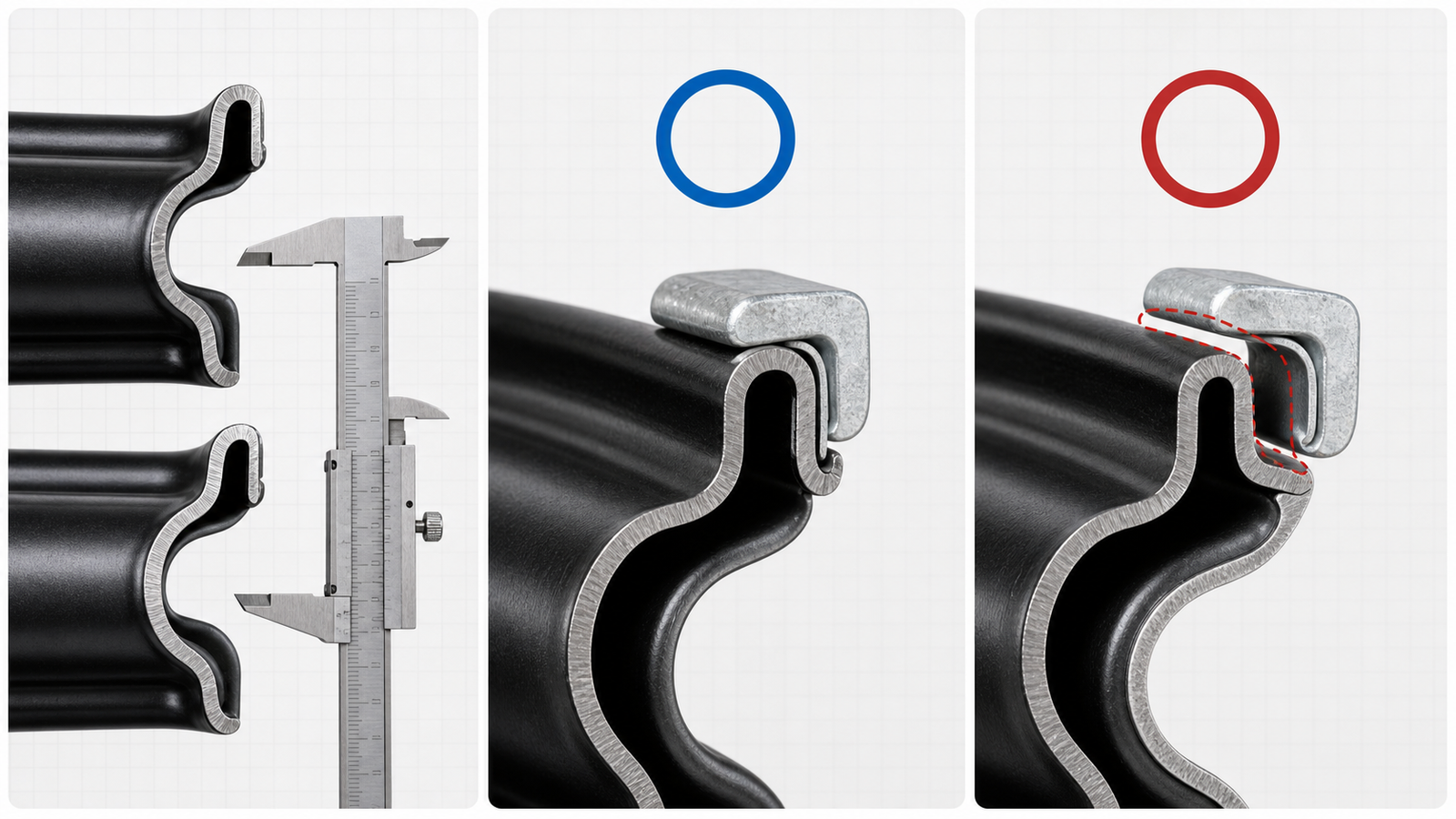
Two flanges can look alike at a distance, yet a small geometry difference can change whether a clip seats correctly or remains misaligned.
The design objective is not simply a tight grip. The clip must retain the weight while allowing correct installation at the balancing location. A clip that is too tight can damage a coating or deform during installation; one that is too loose can shift or detach. SAE J1986 addresses configurations and test procedures intended to support installation and retention on passenger-car, light-truck, and multipurpose-vehicle wheels 1.
This is especially important on painted, plated, or cosmetic wheels. A bare clip may be mechanically compatible yet inappropriate for the visible finish, while a coated version of a profile can be the better candidate. The profile family and the product construction must therefore be checked together.
What do P, C, T, and MC labels mean?
P, C, T, and MC usually identify distinct clip-profile families within a catalogue. They are useful shorthand for sorting inventory and discussing likely rim applications, but they are not a universal standard that guarantees the same geometry or vehicle coverage across every supplier and market.
Use the labels in this practical way:
| Profile label | What it normally does in an assortment | What buyers must verify | What not to assume |
|---|---|---|---|
| P | Separates one recurring passenger-wheel clip family from other families | Supplier drawing, intended flange shape, finish, and weight range | That every P-labelled weight has identical dimensions across catalogues |
| C | Groups another clip geometry used for a different flange relationship | Hook opening, seating depth, rim application list, and sample retention | That “C” means one worldwide wheel or vehicle group |
| T | Identifies a further profile family, often stocked separately because the engagement shape differs | Actual lip contour, clearance, and installed orientation | That a familiar T label can replace a rim measurement |
| MC | Distinguishes a clip family frequently seen in passenger-car service assortments | Manufacturer-specific definition, rim condition, coating, and trial fit | That the label alone confirms a fit on every steel or alloy wheel |
The table intentionally describes how codes should be used, not a proprietary universal mapping. A manufacturer may publish a detailed vehicle or wheel application guide for its own series, but another manufacturer's similarly named profile can differ. Perfect Equipment's OEM guide, for example, directs users to a rim-flange gauge when a listed series does not fit rather than treating a series name as final proof 3.
What can a profile code tell you—and what can it not?
A profile code can help identify a candidate clip family and organize stock, but it cannot by itself verify a rim's flange geometry, finish compatibility, approved weight location, or retention. The code is a lookup aid; the rim is the physical interface.
It can usefully answer questions such as: “Which samples should we request?” “Which family did the shop use on this recurring wheel?” or “Which bin should this approved SKU occupy?” It cannot safely answer: “Will this fit every 16-inch steel rim?” or “Can this go on any alloy flange?”
When a supplier's code, a vehicle application list, and a physical rim disagree, prioritize the actual wheel and the approved service procedure. Measure the flange at the planned location, check the candidate's profile drawing, and trial-fit the part. Keep the result by wheel family and SKU so later buyers do not repeat the same guesswork.
How should a technician choose a clip type?
Technicians should choose a clip type by confirming the wheel's approved clip-on location, matching the flange to a candidate profile, and checking installation and retention on the actual rim. The balancing machine determines the correction mass and location; it does not make an incompatible clip fit.
Start by removing assumptions created by old weights. An old clip may have been used on a different wheel, installed incorrectly, or selected because nothing else was available. Then inspect the flange for corrosion, bent edges, heavy paint, or a decorative lip that changes the interface.
For common steel-wheel service, steel-wheel rim and clip planning gives the relevant fitment context: accessible flange design makes clip-on weights practical, but profile, coating, increment range, and local wheel mix still matter. A rim gauge or caliper and a representative sample do more to prevent a return than visual code matching alone.
When should a shop use adhesive weights instead?
Adhesive weights are often the better choice when a wheel lacks a suitable approved clip-on location, has a visible or delicate rim finish, or needs an inner-barrel balancing position. An adhesive option moves the interface from the flange to a clean, dry barrel surface and brings its own placement and tape-validation requirements.
The choice between flange clips and adhesive weights becomes important when a code points to a marginal clip fit. Do not force a clip onto a rim simply to stay within an existing assortment. It is better to select an appropriate adhesive format, if the wheel and balancer program permit it, than to create a cosmetic or retention problem with an unsuitable clip.
Alloy wheels require particular caution. Some have approved clip-on locations and use a specified coated clip family; many are better served by an inner-barrel adhesive solution. Confirm wheel guidance, clearance, and the actual balancing plane before choosing either method.
What should buyers check before ordering?
Buyers should approve a labeled sample set against representative rim flanges, then document the accepted profile, finish, weight range, and packaging. This ties a code to a real application instead of leaving it as an untested catalogue label.
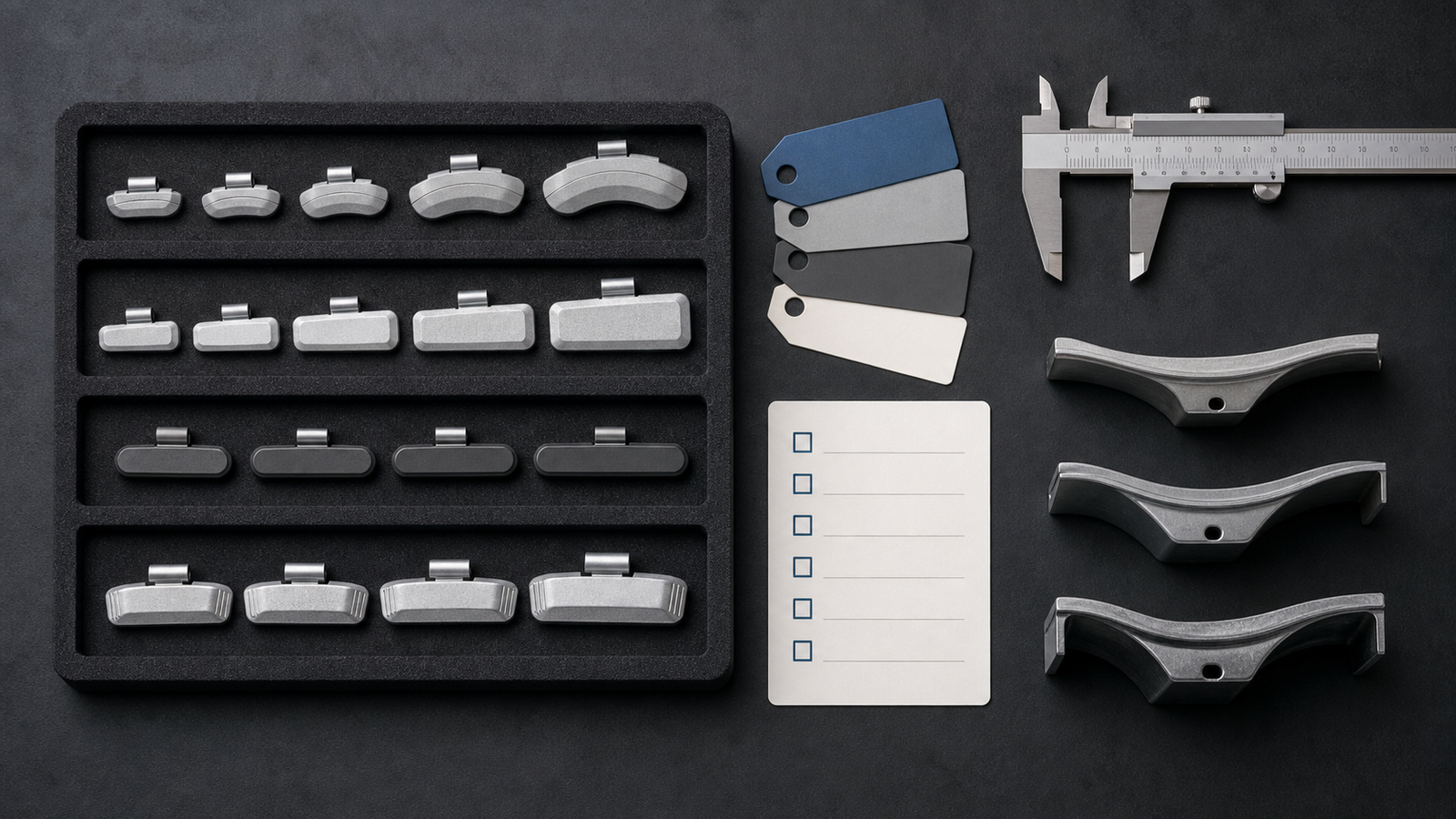
A good sample approval process keeps clip families, rim flange samples, measurements, and acceptance records together.
Use this buyer checklist:
- Request proposed profile samples with the product drawing or application reference that defines each family.
- Select representative wheel and rim samples from the vehicles or service channels that matter most.
- Measure the flange, install the sample with the correct tool, and inspect seating, clearance, retention, and finish contact.
- Verify actual mass markings, gram or ounce increments, clip material, coating, and corrosion-protection expectations.
- Keep accepted and rejected results with clear photos, measurements, SKU numbers, and wheel-family notes.
- Confirm trays and cartons make it hard to mix similar-looking profiles during receiving and service.
Once those checks are complete, buyers can request clip-on profile samples in the families that their wheel data supports. This creates a smaller, more reliable starting range than ordering every code in a general catalogue.
How should distributors build a clip-profile range?
Distributors should build the range around validated rim families and service demand, then use P, C, T, and MC labels as the inventory language for those approved profiles. The priority is coverage of real wheels, not the longest possible code list.
Group results by rim family, common vehicle or workshop channel, accepted profile, finish, size system, and usage frequency. Carry depth where a profile repeatedly solves normal jobs; hold limited samples for uncertain or low-volume applications. Review returns and fitment questions regularly, because they often expose an unvalidated flange family or mixed inventory.
Mixed service markets need more than clip-on weights. The appropriate blend may include steel-wheel clip profiles, coated options for selected applications, and adhesive strips for alloy or appearance-sensitive work. When setting the assortment, compare mixed clip-on and adhesive formats through the wheel mix and service workflow rather than treating one attachment method as universal.
Conclusion: Treat codes as a starting point
P, C, T, and MC are helpful clip-on wheel-weight labels because they organize distinct profile families. They do not, however, replace a rim-flange measurement, a supplier-specific drawing or application guide, a correct installation location, and a trial fit on a representative wheel.
The reliable selection sequence is simple: identify the wheel and approved location, use the code to choose a candidate profile, compare it to the flange, test seating and retention, and document the accepted SKU. Buyers who need to define their first range can request a labeled clip-profile sample set matched to their target rim families.
Frequently Asked Questions
What does MC mean on a wheel weight?
MC is commonly used as a profile-family label in clip-on wheel-weight catalogues. Its exact geometry and intended rim coverage depend on the manufacturer, so confirm the supplier's definition and trial-fit it on the actual rim.
Are P, C, T, and MC wheel weights interchangeable?
No. They represent different clip-profile families. Even where two profiles look close, their spring shape, hook opening, seating depth, or clearance can differ enough to change retention and rim-finish risk.
Can I identify the correct clip-on weight by looking at the old weight?
An old weight can suggest a starting point, but it is not proof. Confirm the current wheel's flange, the approved balancing location, and the candidate profile before installing a replacement.
Do all steel wheels use the same clip-on profile?
No. Many steel wheels are suitable for clip-on weights, but their flange geometry, coating, and local service requirements vary. Use a rim gauge or physical sample rather than assuming one profile fits every steel rim.
Why might a clip-on weight damage a rim?
Damage can occur when the clip is too tight, has the wrong shape, contacts a cosmetic finish, or is forced into place. The correct profile and installation tool reduce the risk, but the actual rim must still be verified.
Should a distributor stock adhesive weights as well as clip-on types?
Usually yes when the market serves both steel and alloy or appearance-sensitive wheels. The quantity and profile depth should follow validated wheel applications, balancing methods, and service demand.
References
[1] SAE International. “J1986_202510 Balance Weight and Rim Flange Design Specifications, Test Procedures, and Performance Recommendations.” 2025.
[2] International Organization for Standardization. “ISO 13988:2021 Passenger car and light truck vehicle wheels — Clip and adhesive balance weight and rim flange nomenclature, test procedures and performance requirements.” 2021.
[3] Perfect Equipment. “OEM Alloy Wheel Weight Application Guide.” 2024.