



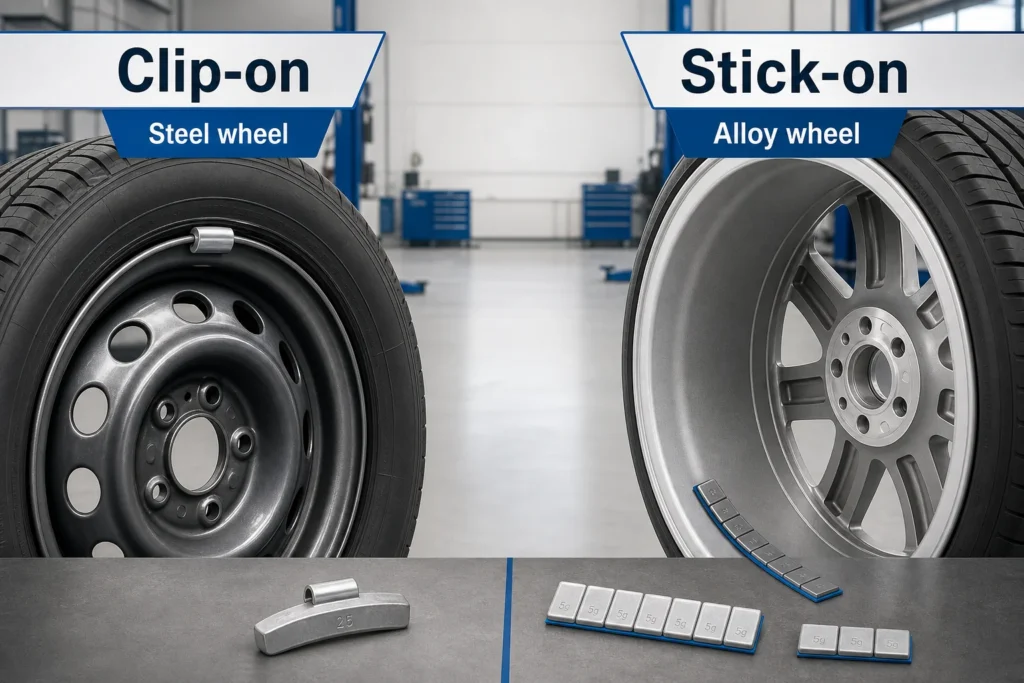
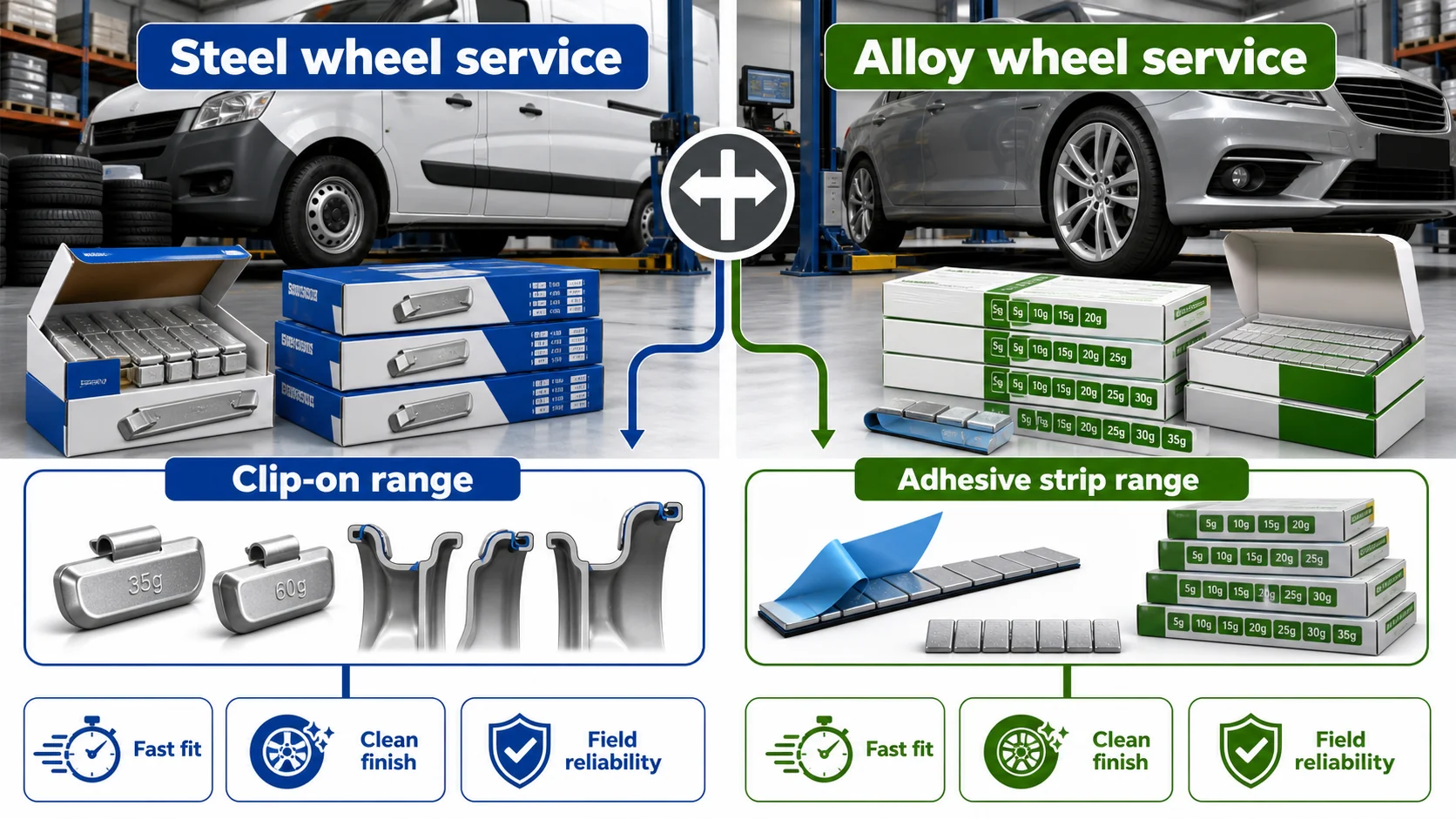
Clip-on wheel weights attach mechanically to the rim flange and are commonly used on steel wheels, trucks, and fast-service applications. Stick-on wheel weights use adhesive tape inside the wheel barrel and are usually preferred for alloy wheels where appearance and rim-finish protection matter. The right choice depends first on rim design, then on installation conditions and service workflow.
Both types do the same balancing job: they add precise correction mass where the balancing machine indicates. Their difference is not the balancing principle; it is how they attach, which wheels they suit, how they look, what can make them fail, and which product range a tire shop or distributor should keep available.
Table of Contents
- Which is better: clip-on or stick-on wheel weights?
- What are clip-on wheel weights?
- What are stick-on wheel weights?
- How do clip-on and stick-on wheel weights compare?
- Which type fits steel wheels, alloy wheels, trucks, and EVs?
- How do installation and failure risks differ?
- How do cost, appearance, and service speed compare?
- What should buyers stock for a mixed wheel market?
- Conclusion: Choose the attachment method around the wheel
- Frequently Asked Questions
- References
Which is better: clip-on or stick-on wheel weights?
Neither type is universally better. Clip-on wheel weights are usually the better mechanical fit for many steel wheels and certain commercial applications, while stick-on wheel weights are normally the better visual and surface-protection choice for alloy wheels.
The simplest selection rule is to start with the wheel rather than the weight. A steel wheel often has a rim flange that can hold a correctly matched clip securely. An alloy wheel commonly benefits from an adhesive strip hidden on the inner barrel, where it avoids marking the visible outer flange.
That rule still has exceptions. Some alloy wheels may have flange profiles that accept specific clip types, and some service programs may use adhesive weights on steel wheels for appearance or clearance reasons. The installer must follow the wheel design and balancing-machine instructions, not a one-line rule.
Attachment method is only one part of a usable service range. Buyers deciding how much clip-on and adhesive stock to carry can use planning coverage across wheel-weight formats to relate material, size systems, and wheel applications to the mix of vehicles their customers service.
What are clip-on wheel weights?
Clip-on wheel weights are balancing weights with an integrated metal clip that grips the rim flange. They are installed by positioning the correct profile on the rim and securing it with the appropriate tool, making them a familiar option in tire shops that service steel wheels and many commercial vehicles.
The clip is not a generic detail. Rim flanges vary in shape and thickness, so the clip profile must match the target wheel. A weight that looks close enough can still sit incorrectly, scratch the rim, lose holding force, or detach on the road.
Clip-on weights are commonly chosen when:
- the market has a high share of steel wheels
- fast mechanical installation is valued
- visible rim weights are acceptable
- the shop already knows the local flange profiles
- the service mix includes light trucks, vans, or commercial wheels
They are available in different materials and size systems. Steel clip-on weights are widely used in lead-free programs, while zinc and other materials may be selected for particular market requirements. Lead was historically common because it is dense and easy to form, but buyers should check destination-market and customer requirements before treating it as a default option 2.
What are stick-on wheel weights?
Stick-on wheel weights are segmented balancing weights with adhesive tape on the back. They are applied to a clean, dry inner wheel barrel, where they can be hidden from view and placed precisely without clamping onto the visible rim flange.
This attachment method is especially common for alloy wheels. The inner-barrel location preserves the appearance of the outer wheel face and avoids the risk of a clip rubbing or scratching a finished flange. The segments are often arranged in 5g or similar increments, so installers can cut or break the strip to match the balancer reading.
Stick-on weights are commonly chosen when:
- the wheel is alloy, aluminum, or appearance-sensitive
- the visible flange should not be scratched
- the installer needs flexible placement on the barrel
- a cleaner exterior appearance matters
- the service program uses modern passenger-car or EV wheel designs
Adhesion is the central performance question. The barrel must be cleaned and dried, and the tape should be pressed firmly at a suitable installation temperature. Brake dust, moisture, road film, cold surfaces, poor liner removal, and weak tape can all lead to lost weights.
For an alloy-wheel program, buyers evaluating tape quality, segment size, and packaging can review adhesive wheel weight strip options after they have defined the wheel sizes and service conditions they need to support.
How do clip-on and stick-on wheel weights compare?
Clip-on and stick-on weights solve the same imbalance problem, but their mechanical interface, visual result, installation preparation, and likely failure modes differ. The table below is a selection guide rather than a substitute for checking actual rim fitment.
| Factor | Clip-on wheel weights | Stick-on wheel weights |
|---|---|---|
| Attachment method | Mechanical clip on rim flange | Adhesive tape on inner barrel |
| Best-known use | Steel wheels, many truck and shop applications | Alloy wheels, passenger vehicles, appearance-sensitive wheels |
| Visible from outside | Often yes | Usually no when placed inside the barrel |
| Rim-finish risk | Can scratch or mark an unsuitable flange | Avoids flange contact but needs clean bonding surface |
| Main fitment check | Clip profile and flange thickness | Available barrel surface and adhesive compatibility |
| Installation speed | Fast when the correct clip is at hand | Fast after cleaning and positioning, but prep cannot be skipped |
| Main failure risk | Wrong clip fit, weak hold, flange damage | Tape failure from dust, moisture, cold, or poor pressure |
| Typical stock format | Individual weights or trays by clip profile and size | Segmented strips, rolls, or cartons by increment and tape type |
Both forms depend on a correct balancing measurement. A weight installed in the wrong location, or an accurate balancer reading applied with the wrong product, can still leave vibration. Tire balancing uses correction weights to counter uneven mass distribution in a rotating wheel and tire assembly 1.
Which type fits steel wheels, alloy wheels, trucks, and EVs?
Steel wheels generally favor clip-on weights, while alloy wheels generally favor stick-on weights. Trucks, vans, and EVs still require a wheel-by-wheel check because vehicle class alone does not determine flange shape, wheel finish, available barrel space, or the owner’s appearance expectations.
Steel wheels
Steel wheels often have a robust, accessible flange that can accept a correctly matched clip. For ordinary steel-wheel service, clip-on weights are fast, visible, and practical. The buying decision should focus on local clip profiles, corrosion protection, and the size range the shop uses most often.
Alloy wheels
Alloy wheels usually benefit from stick-on weights inside the barrel. This keeps the correction out of the driver’s line of sight, protects the visible flange, and gives the technician placement flexibility for dynamic balancing. The buyer decision shifts from clip profile to tape reliability, strip format, and clean application practice.
Trucks and commercial vehicles
Many truck and commercial programs continue to use clip-on weights because steel wheels and fast service remain common. However, wheel design, tire size, duty cycle, and fleet appearance standards still matter. Heavy-duty or specialty applications may also use internal balancing products, which are a different solution category rather than a direct replacement for every clip-on or adhesive program.
EVs and premium passenger vehicles
EVs and premium passenger vehicles often use alloy wheels where stick-on weights are a natural fit. Their higher vehicle mass or different tire design does not automatically require a different attachment method, but it can make reliable adhesion, weight accuracy, and clean wheel appearance especially important.
When a mixed fleet includes stamped steel rims, clip profile and rim-flange checks for steel wheels confirm that a clip-on decision is also a fitment decision. For alloy programs, adhesive strip requirements for alloy-wheel mounting clarify how tape, segment size, and mounting space shape the stick-on choice.
How do installation and failure risks differ?
Clip-on failures usually come from a mismatch between the clip and the rim flange. Stick-on failures usually come from poor surface preparation or weak adhesive bonding. In both cases, a lost weight can bring vibration back even when the original balance was correct.
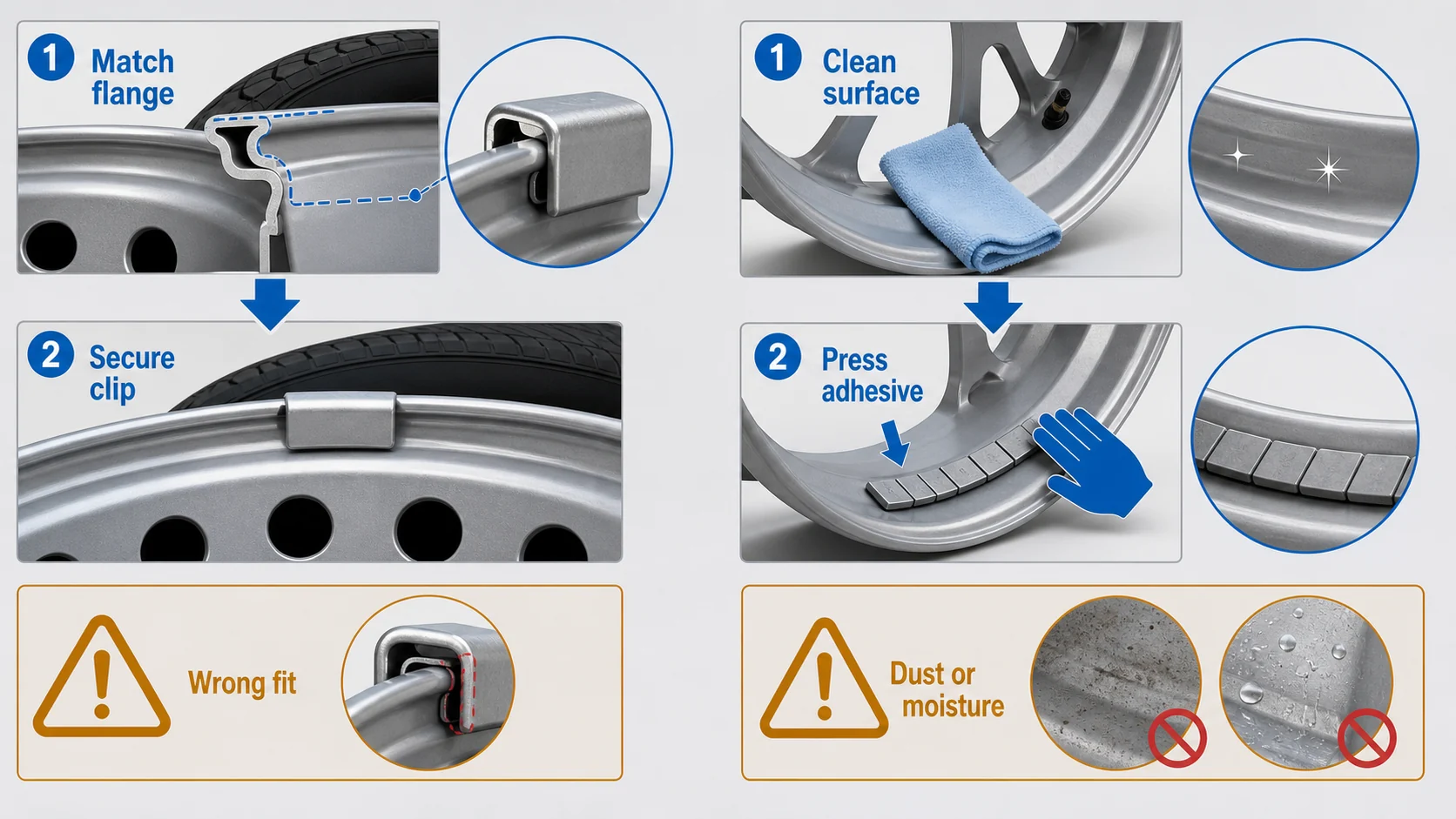
For clip-on installation, the technician should confirm that the flange is the intended profile, position the weight accurately, and use a suitable tool to secure it. Forcing the wrong clip onto the wheel can damage the coating, distort the clip, or create too little holding force.
For stick-on installation, the technician should remove old residue, clean the barrel, let the surface dry, and press the strip firmly. Cold weather, wet wheels, brake dust, tire dressing residue, and rushed installation can all compromise adhesive contact. Some shops also need to consider clearance to brake components or spoke design when selecting the exact placement.
Failure prevention belongs in the product program as well as the installation procedure. Clip-on buyers should verify flange fit across representative wheels. Adhesive-weight buyers should test tape performance on cleaned and real-world wheel surfaces, not only on a laboratory sample panel.
How do cost, appearance, and service speed compare?
Clip-on weights often win on straightforward mechanical installation, while stick-on weights often win on appearance and flange protection. The true cost comparison should include field failures, customer expectations, rework time, and the number of SKUs needed to cover the market, not only the cost per gram.
Clip-on weights can be quick to select and hammer on when a shop works with a familiar set of steel-wheel profiles. That speed can be valuable for high-throughput service. The trade-off is that the weight may remain visible and the wrong clip can damage a finished rim.
Stick-on weights often need a few extra seconds of cleaning and pressing, but they create a cleaner exterior result on alloy wheels. Their cost should be considered alongside adhesive quality and packaging. A low-cost strip that falls off after a wash, cold spell, or dusty installation can cost more in complaints and rebalancing than a stronger tape option.
For global buyers, material choice also affects the calculation. Steel and zinc are common lead-free alternatives, and the market requirements for lead can vary by destination and customer supply chain. The EPA identifies environmental concerns around lost lead wheel weights, while EU vehicle rules address restricted hazardous substances and exemptions that should be checked for the relevant application 2 3.
Once attachment is fixed, material trade-offs after the attachment method is fixed help a buyer evaluate density, finish, and destination expectations without confusing them with rim fit.
What should buyers stock for a mixed wheel market?
Buyers in mixed wheel markets should stock both clip-on and stick-on weights, then adjust the SKU depth to the local mix of steel wheels, alloy wheels, passenger vehicles, trucks, and service habits. A broad but poorly matched range can tie up inventory, while a narrow range can leave shops unable to finish common balancing jobs.
Start by asking practical questions:
| Market question | Why it changes the stock plan |
|---|---|
| Which wheels arrive most often: steel or alloy? | Determines whether clip-on or adhesive volume should lead. |
| Which vehicle types dominate? | Passenger cars, vans, trucks, fleets, and premium vehicles can use different wheel mixes. |
| Which size system do shops request? | Gram and ounce systems affect strip labels, carton mix, and installer habits. |
| Which clip profiles recur? | Prevents overstocking slow-moving clips and missing common flange fits. |
| What are the installation conditions? | Cold, wet, dusty, or high-volume service can change adhesive-tape requirements. |
| What packaging helps the shop work? | Clear labels, dispensers, trays, and carton counts can reduce selection mistakes. |
For steel-wheel service channels, buyers can compare clip-on wheel weight options around the flange profiles and weight increments that recur in their local rim mix. For alloy-focused service, the same range should be evaluated through adhesive strip format, tape behavior, and the inner-barrel space common to the wheels being serviced.
The goal is not to stock every possible part. It is to cover the wheels that shops actually see, with enough format, size, and material choice to complete balancing work without creating unnecessary inventory complexity.
A distributor that has defined its steel-wheel flange families can review clip-on formats for a defined rim-flange program as a product next step.
If you are choosing between clip-on and adhesive wheel weights, tell us the rim profiles, wheel finishes, clearance, size range, tape or clip requirements, and expected volume. We can help you compare representative samples before standardizing the range.
Conclusion: Choose the attachment method around the wheel
Clip-on and stick-on wheel weights perform the same basic balancing function, but they belong to different wheel and installation contexts. Clip-on weights are often the practical choice for steel wheels and flange-based service. Stick-on weights are often the cleaner choice for alloy wheels, where appearance and surface protection matter.
The right selection starts with the rim: flange profile or inner barrel, visible finish or hidden placement, mechanical clip or adhesive preparation. From there, buyers can choose a range that matches actual wheel mix, installer habits, local size systems, and expected service conditions. For a mixed market, a balanced clip-on and adhesive program usually makes more sense than forcing one format onto every wheel.
Frequently Asked Questions
Are clip-on wheel weights better than stick-on weights?
Neither is better for every wheel. Clip-on weights are commonly better for steel wheels with suitable flanges, while stick-on weights are commonly better for alloy wheels where the visible rim finish should remain untouched.
Can clip-on weights be used on alloy wheels?
Some alloy wheels accept specific clip-on profiles, but many alloy-wheel applications use adhesive weights to avoid scratching the visible flange. Always match the weight type to the actual wheel design.
Why do stick-on wheel weights fall off?
They can fall off when the barrel is dirty, wet, cold, oily, or not pressed firmly enough. Weak tape, poor surface preparation, and incorrect placement can all reduce adhesion.
Do clip-on weights damage steel wheels?
Correctly matched clip-on weights are commonly used on steel wheels. Damage risk increases when the clip profile is wrong, the wheel is already corroded, or the installer forces the weight into place.
Should a distributor stock both clip-on and stick-on weights?
Usually yes when the local market has both steel and alloy wheels. The depth of each range should follow the local wheel mix, common clip profiles, and the size system used by target shops.
Are stick-on wheel weights suitable for trucks?
They can be suitable when the wheel design and service procedure support adhesive installation, but many truck and commercial applications continue to use clip-on weights. Check the actual wheel, duty cycle, and installer preference rather than assuming by vehicle class.
References
[1] Wikipedia. “Tire balance.” 2025.
[2] United States Environmental Protection Agency. “Best Management Practices for Lead Wheel Weights.” 2015.
[3] EUR-Lex. “Directive 2000/53/EC on end-of-life vehicles.” 2000.