



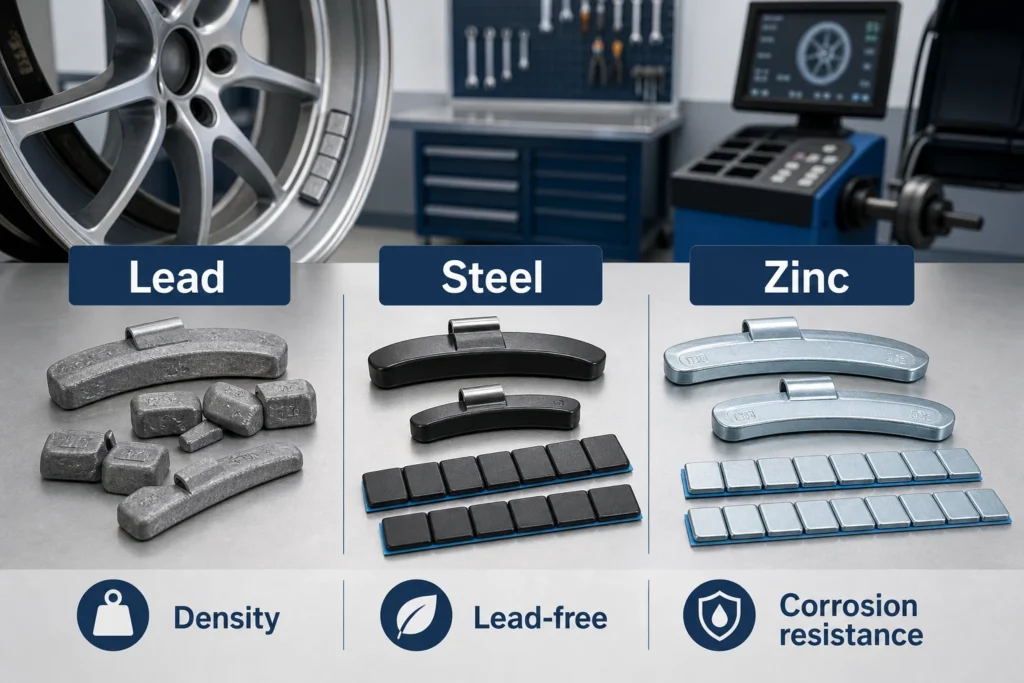
Lead, steel, and zinc wheel weights can all provide the same balancing correction when they carry the same mass and are installed in the correct position. The practical choice is about more than material: lead is the most compact option by reference density, steel is a common lead-free route, and zinc may suit a program with specific material or finish requirements. Before choosing, check the target market, wheel and attachment fit, finished-part protection, and supplier evidence. For available formats, start with the wheel-balancing weights range.
Table of Contents
- What is the practical difference between lead, steel, and zinc wheel weights?
- How much larger is a non-lead wheel weight at the same mass?
- Which material should you choose for your wheel-weight program?
- What are the advantages and trade-offs of lead wheel weights?
- Are steel wheel weights and zinc wheel weights the same thing?
- Does zinc always resist corrosion better than steel?
- What should you confirm before approving a sample or placing an order?
- Do attachment style and rim fit matter more than material?
- Frequently Asked Questions
- Conclusion: choose by specification, not shorthand
- References
What is the practical difference between lead, steel, and zinc wheel weights?
The material changes the physical volume needed to deliver a correction mass, the product's market and customer acceptance, and the protection or documentation a buyer may require. It does not change the balancing principle: a wheel balancer identifies how much correction is needed and where it should be placed; the selected weight must then match that mass and fit the wheel.
| Material route | Reference density of pure element | What that usually means for a buyer | Main item to verify |
|---|---|---|---|
| Lead | 11.3 g/cm³ 1 | The most compact material by this reference; useful where a small profile matters, if the market and customer allow it | Destination rules, customer policy, material declaration, and safe handling |
| Steel / iron-based | 7.87 g/cm³ for iron 2 | A lead-free route with product dimensions and protection determined by the actual steel design | Base material, coating, dimensions, clip or tape, and corrosion evidence |
| Zinc | 7.134 g/cm³ 3 | A solid-zinc product is less dense than lead and may be chosen for a defined material or finish requirement | Whether the body is solid zinc alloy or zinc-coated steel, plus fit and finish |
These are reference densities for pure elements, not guaranteed densities or dimensions of commercial wheel weights. Steel is an iron-based alloy; zinc weights may be alloys; and finished products can include coatings, clips, tape, or other components. Treat the figures as a way to understand relative scale—not as a substitute for a drawing or sample.
How much larger is a non-lead wheel weight at the same mass?
Density gives a useful first estimate: volume = mass ÷ density. For a theoretical 25 g sample made entirely from each reference material:
| Reference material | Approximate volume for 25 g | Comparison with lead |
|---|---|---|
| Lead | 2.21 cm³ | Baseline |
| Iron reference for steel | 3.18 cm³ | About 44% more volume |
| Zinc | 3.50 cm³ | About 58% more volume |
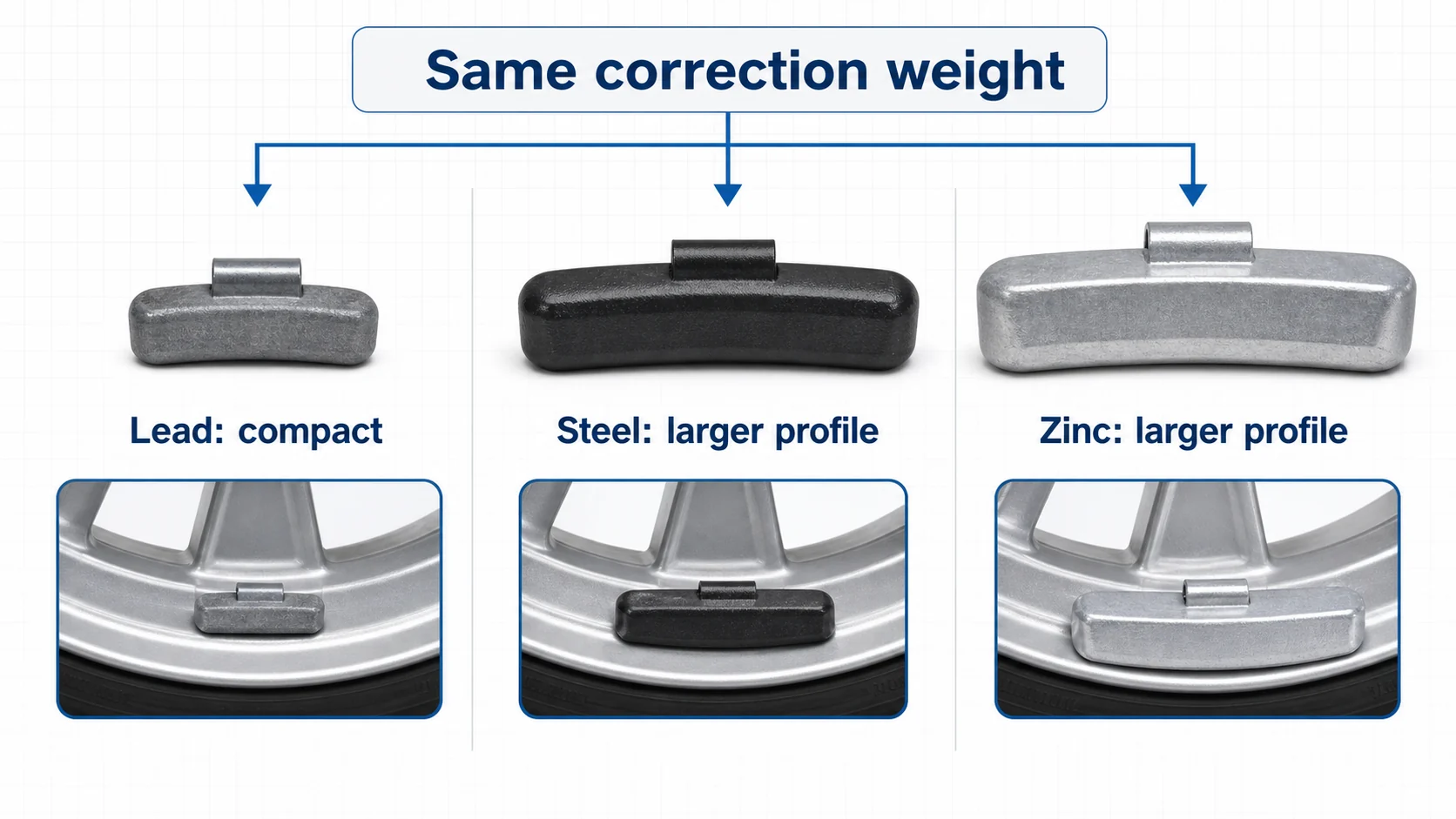
The values use the reference densities above and are rounded. They describe ideal solid material only. A real wheel weight's external size also depends on alloy composition, shape, cavities, unit increment, clip geometry, coating, and how the weight attaches. A 25 g steel product is not necessarily 44% larger in every dimension than a 25 g lead product.
This comparison is still useful when a fit is tight. If an equivalent non-lead product appears larger, check the actual drawing, profile height, width, and clearance against the wheel rather than rejecting it from a density estimate. For adhesive weights, compare strip width and thickness inside the wheel barrel; for clip-ons, compare the body profile and clip interface. When clearance is critical, approve the exact sample on the intended wheel.
Which material should you choose for your wheel-weight program?
There is no universally best material. Use the market and application to narrow the options, then compare equivalent finished parts. The examples below are decision patterns, not a claim that one material fits every vehicle or service channel.
| Program situation | Starting point | Why—and what could change the decision |
|---|---|---|
| Broad aftermarket range serving multiple customer types | Compare steel first, then validate the fitment and finish range | It can support a lead-free assortment, but the actual profile, coating, price, and customer specification still matter |
| A legacy application with a strict space or profile constraint | Measure an approved reference and compare alternatives at the same correction mass | Lead's density can help with compactness, but legal status and account rules may rule it out; a redesigned steel or zinc profile may still fit |
| Appearance-sensitive or corrosion-focused program | Compare finished zinc and coated-steel samples side by side | “Zinc” alone does not establish corrosion life, color, coating quality, or wheel compatibility |
| Export or private-label assortment | Build a market-by-market material matrix before adding SKUs | Import rules, retailer policies, declarations, labeling, and after-sales expectations differ |
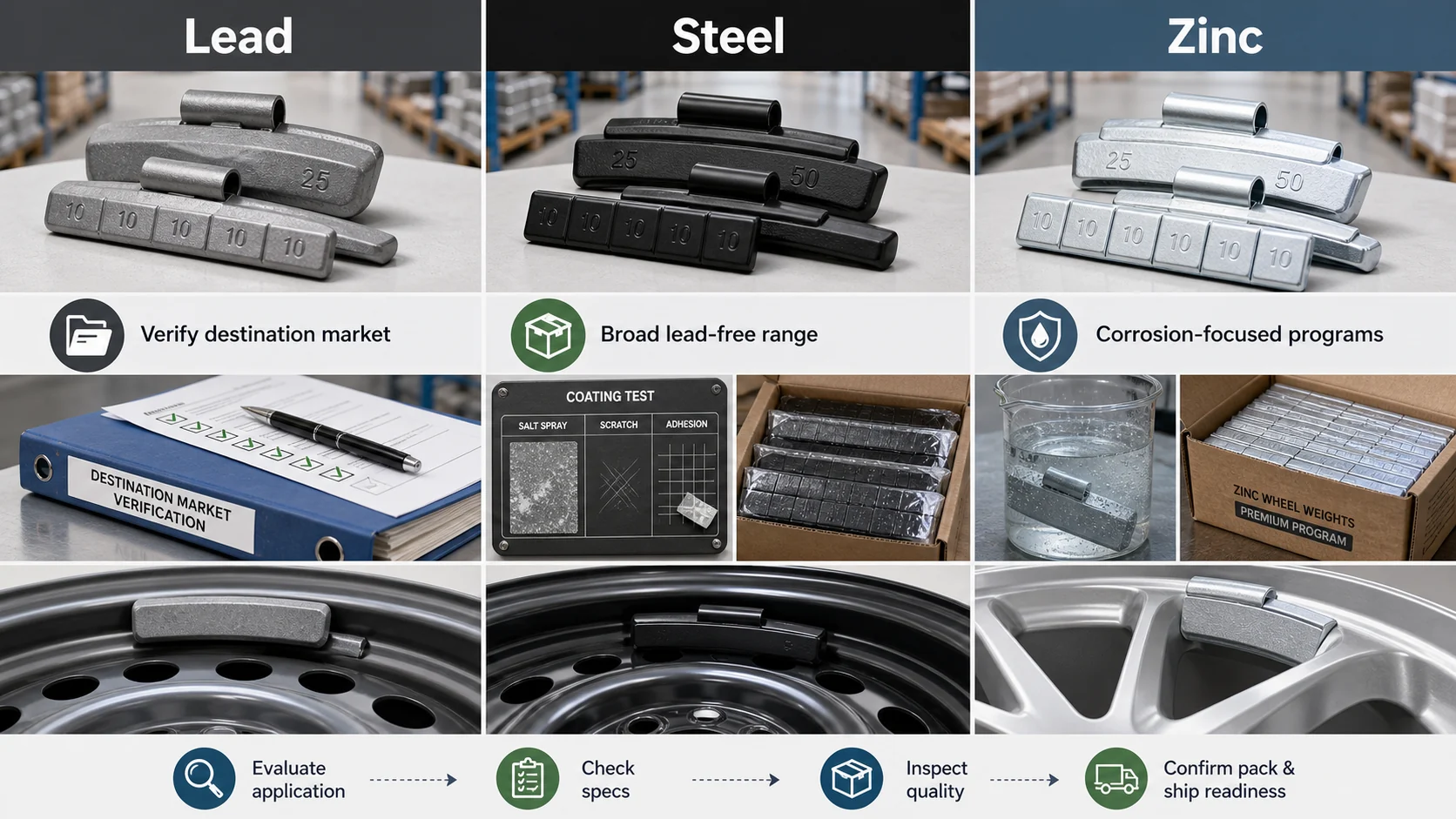
For example, a distributor serving general tire shops may standardize most of its range around a lead-free material to simplify its product story, but should still validate the assortment against the wheel mix and cost target. A shop servicing a narrow, known wheel application may prioritize the approved profile and available clearance. A premium label may ask for a zinc body, but that request should be written as a material requirement and checked against the finished sample—not inferred from a silver-colored surface.
For a steel-based lead-free route, the separate guide to Fe wheel weights covers material terminology and product-specific checks. This page focuses on the choice among material families rather than repeating that sourcing detail.
What are the advantages and trade-offs of lead wheel weights?
Lead's higher reference density allows a given mass to occupy less theoretical material volume than steel or zinc. Its softness and workability have also made it useful in weight applications. Those physical properties can matter if a specific service application has little room for correction weight.
The trade-off is that lead carries distinct human-health, environmental, and regulatory concerns. The Royal Society of Chemistry notes that lead can accumulate in the body and cause serious health problems 1. A buyer should therefore treat lead as a market-specific option—not as a default simply because a shop has historically stocked it.
Rules vary by jurisdiction and product context. As one concrete example, Canada's current regulation prohibits manufacturing or importing covered vehicle wheel weights containing more than 0.1% lead by weight, subject to the regulation's permits and stated exceptions; it separately identifies manufacture for export and import of weights already installed on vehicles 4. That is a Canada-specific rule, not a global threshold. In the EU, the End-of-Life Vehicles Directive sets a restriction framework for certain substances in vehicle materials and components and provides for Annex II exemptions and updates 5. Do not reduce that framework to a blanket statement that every lead wheel weight is prohibited across all markets or uses.
Before quoting or importing a lead-containing product, confirm the applicable product scope, destination-country rule, exemptions or permits, customer requirements, and required records with the responsible compliance professional. Do not assume that a product sold in one country can be supplied unchanged in another.
Are steel wheel weights and zinc wheel weights the same thing?
No. “Steel,” “Fe,” and “zinc” describe different things, and a finish can make them easy to confuse:
- Fe or steel wheel weight: an iron-based steel body. The specific alloy, dimensions, and finish still need to be declared.
- Solid zinc-alloy wheel weight: a body made from a zinc-based alloy. It is not the same as a steel body with a zinc-colored surface.
- Zinc-plated or galvanized steel weight: a steel substrate with a zinc-based protective coating. The base material remains steel.
Ask the supplier to identify the substrate and the surface finish separately. A basic magnet check may help screen a steel body if the magnet is placed on the body away from any steel clip, but it cannot identify an alloy or prove a regulated composition. A clip-on weight may contain a steel clip even when its body is made from another material. Color, weight in the hand, and a quick magnet check are not substitutes for a material declaration or an appropriately scoped laboratory analysis.
This distinction matters in purchasing documents. Instead of writing “silver zinc weight,” specify the body material, coating or finish, attachment style, nominal masses, dimensions, and any restricted-substance requirement. That reduces the risk of approving a zinc-plated steel sample when the purchase order requires a zinc-alloy body—or the reverse.
Does zinc always resist corrosion better than steel?
Not as a simple product-level rule. Iron can rust in damp air, while zinc has its own surface behavior; however, the wheel weight that reaches a customer is an engineered part, not a bare element sample. Steel coating type and coverage, zinc alloy composition, surface finish, edges, impact damage, storage, road exposure, and packaging all influence the finished product's performance.
For a fair comparison, ask suppliers to test the same finished configuration and document the method, sample preparation, exposure conditions, duration, inspection points, and pass/fail criteria. A reported number of test hours without the method and acceptance rule is not enough to compare two quotations. Nor should an accelerated corrosion test be converted directly into a promise of years in service.
Where appearance is important, specify acceptable color and surface variation alongside functional criteria. Where corrosion is important, define what counts as failure: for example, the area and location of corrosion, coating loss at functional edges, or a change that affects attachment. The buyer and supplier should agree these observations before production rather than after a dispute.
What should you confirm before approving a sample or placing an order?
Compare like with like. A steel adhesive strip should not be compared with a zinc clip-on weight and then treated as a pure material comparison. Keep the correction mass, attachment format, intended wheel, and finish requirement constant wherever possible.
Use this sample-approval sequence:
- Name the market and customer. List destination countries, retailer or fleet requirements, and any material restrictions that apply to the specific program.
- Define the job. Record clip-on or adhesive format, wheel type, correction range, nominal increments, and any profile or appearance constraints.
- Identify the construction. Ask for the base material or alloy family, coating, clip material, adhesive and tape details where relevant, and a signed material declaration if required.
- Compare drawings and samples. Check mass, dimensions, profile, clip geometry, segment design, and the actual wheel interface. Keep a retained sample as the approved reference.
- Agree finish and test criteria. Specify visual limits and, if needed, a corrosion test method with conditions and pass/fail rules for the finished part.
- Review evidence and commercial fit. Confirm batch traceability, labels, pack configuration, lead-time assumptions, and total cost for the usable range—not only the unit price of one weight.
- Control changes. Require review if material, supplier, coating, tooling, clip, adhesive, or packaging changes in a way that could affect fit or acceptance.
| Purchase-spec field | Example of what to record |
|---|---|
| Material identity | Steel/Fe substrate, zinc-alloy body, or lead-containing body; coating listed separately |
| Product configuration | Clip-on or adhesive, profile or strip format, finish, revision, and intended wheel context |
| Correction range | Unit system, nominal masses or increments, assortment mix, and agreed measurement method |
| Fitment evidence | Drawing, critical dimensions, sample ID, and wheel or fixture used for approval |
| Compliance file | Destination market, customer restriction, declaration or test report, and document owner |
| Quality and logistics | Acceptance criteria, lot identification, labels, packaging, carton quantity, and change notification |
The wheel-weight QC checklist provides a deeper inspection framework. For this material decision, the essential rule is to tie every claim to the exact approved SKU and finished configuration; a generic certificate for a supplier's material family may not describe the item in your shipment.
Do attachment style and rim fit matter more than material?
They are separate decisions that must be checked together. Material does not tell you whether a weight is clip-on or adhesive, which rim flange a clip fits, whether a tape suits the wheel surface, or whether the profile clears nearby components. Two weights made from the same material and carrying the same nominal mass can still be incompatible with each other’s applications.
For clip-ons, verify the wheel flange/profile, seating, retention, and clearance using the intended weight design. For adhesive weights, verify strip dimensions, tape specification, liner condition, surface preparation, application conditions, and clearance inside the barrel. Then confirm that the installed product supplies the correction mass called for by the balancing procedure.
If a material change also changes the part geometry, repeat the fitment review. The right order is: choose a candidate material that is acceptable for the market, select the attachment and profile for the wheel, then approve the finished product at the specified mass. This avoids treating material as a shortcut for fitment.
Frequently Asked Questions
Are steel wheel weights heavier than lead wheel weights?
At the same nominal mass, neither is heavier: a 25 g steel weight and a 25 g lead weight both add 25 g. The steel part generally requires more material volume because the iron reference density is lower than lead's; actual product dimensions depend on construction and shape.
Are zinc wheel weights better than steel wheel weights?
Not automatically. Compare the actual body material, profile, finish, corrosion evidence, fit, market requirements, and cost. A zinc-coated steel part is still steel-based, and the finish alone does not prove that a weight has a solid zinc-alloy body.
Are lead wheel weights banned everywhere?
No single global rule covers every country and application. Requirements vary. Check the current rule and customer policy for the exact destination and product; Canada's regulation is one example of a jurisdiction-specific restriction 4.
Can I identify the material with a magnet?
A magnet can be a rough screening aid for a steel body, but it cannot prove the material grade or lead content. On clip-on products, the clip itself may be steel. Request a written declaration or suitable laboratory analysis when the claim is important to compliance or contract acceptance.
Which material is usually the cheapest?
There is no reliable universal answer from the material name alone. Tooling, forming method, coating, product geometry, packing, order size, and market documentation all affect the quote. Compare suppliers using the same SKU definition, correction range, finish, pack, and delivery basis.
Conclusion: choose by specification, not shorthand
Lead, steel, and zinc can deliver the same balancing correction when the mass and placement are correct, but they are not interchangeable purchasing choices. Lead is more compact by reference density and brings distinct compliance and handling concerns. Steel is a common lead-free route whose dimensions and corrosion behavior depend on the finished design. Zinc may meet a specific body-material or finish requirement, but its name alone does not prove fit or corrosion performance.
Start with the target market and customer rule, compare equivalent finished samples, and record material, dimensions, attachment, finish, evidence, and change control in the specification. If you have a target wheel, mass range, and destination market, request a material and fitment review.
References
[1] Royal Society of Chemistry. Lead: Element Information, Properties and Uses.
[2] Royal Society of Chemistry. Iron: Element Information, Properties and Uses.
[3] Royal Society of Chemistry. Zinc: Element Information, Properties and Uses.
[4] Government of Canada. Prohibition of the Manufacture and Importation of Wheel Weights Containing Lead Regulations. Consolidated text current to July 21, 2026.
[5] European Parliament and Council. Directive 2000/53/EC on end-of-life vehicles.