



Lead-free wheel weights are balancing weights made without lead, usually steel or zinc, selected to meet a destination market's material expectations while retaining correct fitment and correction mass. For export buyers, the job is not simply choosing a non-lead alloy; it is verifying the market requirement, declared composition, attachment format, testing, and shipment documents.
The phrase sounds simple, but it can hide several different purchasing questions. A distributor may be replacing a lead range because local customers will no longer accept it. An importer may be trying to reduce material-risk exposure across several markets. A workshop group may simply need a steel or zinc range that balances the wheel types it sees every day. Those are related needs, but they do not produce the same product specification.
Table of Contents
- What does lead-free mean for wheel weights?
- Why do regulations and destination markets matter?
- What are the practical benefits and limits of lead-free wheel weights?
- Which lead-free material and attachment format should buyers choose?
- What should export buyers verify before ordering lead-free wheel weights?
- Which product checks matter after the material is approved?
- How should a buyer build a low-risk export specification?
- Conclusion: Treat lead-free as a verified specification
- Frequently Asked Questions
- References
What does lead-free mean for wheel weights?
For wheel weights, lead-free should mean that the supplied weight body is made without lead under a definition agreed by buyer and supplier. In practice, most lead-free ranges use steel or zinc, but the purchase order should state the material expectation, any permitted trace level or test method, the attachment style, and the products covered by the declaration.
Do not treat "lead-free" as a universal technical standard by itself. It is a commercial and compliance claim that needs a boundary. Does it apply to the weight body only, or to the clip, coating, adhesive, packaging ink, and accessory parts? Is the buyer asking for a supplier declaration, third-party analysis, or a destination-specific document set? A useful specification makes those questions explicit before production begins.
Lead-free does not automatically mean zinc. Steel is widely used in clip-on and adhesive balancing products, while zinc can also serve particular programs. The right choice depends on rim application, correction-weight format, corrosion exposure, finish, destination expectations, and the range of sizes a service channel needs to stock. Lead vs steel vs zinc wheel weights is a useful material comparison, but export readiness requires the additional verification steps below.
Why do regulations and destination markets matter?
Wheel-weight requirements are market-specific, and buyers should confirm the applicable rule before calling a product compliant. The compliance question may arise from environmental policy, vehicle-material rules, chemical-information duties, customer specifications, or a local restriction. The same steel or zinc product can be an appropriate option for one destination while another customer asks for a different declaration or test package.
The U.S. Environmental Protection Agency's best-management-practices document describes the environmental concern around lead wheel weights that can be lost from vehicles and enter the environment.1 It is useful background for a buyer moving a range away from lead, but it is not a substitute for checking the rule and customer requirement in the destination where the goods will be sold.
In the European Union, the End-of-Life Vehicles Directive establishes a general framework limiting certain heavy metals in vehicle materials and components, subject to the Directive's exemptions and updates.2 A buyer should not infer a final wheel-weight decision from a summary alone. Confirm the current text, applicable exemption status, product classification, and any customer-specific conditions with a qualified compliance contact before shipment.
Chemical-information obligations can also be separate from an end-of-life vehicle rule. The European Chemicals Agency maintains the Candidate List as a living reference, so buyers selling into the EU should verify the current list and assess whether any article-information obligations are relevant to their particular finished product and supply chain.3
The operational lesson is straightforward: write the destination into the inquiry. "Lead-free wheel weights for export" is too broad. "Zinc-coated steel adhesive strips for passenger-car alloy wheels, sold into [market], with a material declaration and sample approval" is a request a supplier can review and execute.
What are the practical benefits and limits of lead-free wheel weights?
Lead-free wheel weights can help a buyer align a range with market expectations, reduce dependence on lead-containing product lines, and make supplier-document review more consistent across customers. They can also support a clearer product story for distributors serving markets where technicians and fleet customers increasingly expect non-lead options.
Those benefits do not remove the normal balancing requirements. A wheel still needs the correct correction mass, position, attachment, and installer process. The material must be made to the agreed weight tolerance, and the clip or adhesive system must suit the rim. A poor-fitting clip-on steel weight or an adhesive strip with unsuitable tape is not rescued by a lead-free declaration.
| Potential benefit | What it can help with | What it does not prove |
|---|---|---|
| Material transition | Moving a product range away from lead-containing parts | That every destination accepts the product without further review |
| Clearer sourcing brief | Aligning declarations, samples, and labels with a defined market | That coating, tape, or clip fit meets the service application |
| Range consistency | Combining steel or zinc options in a planned assortment | That every weight increment and rim profile is covered |
| Customer communication | Explaining the material basis of the offered range | A legal or regulatory conclusion without destination verification |
The best buyer conversations separate these questions. First confirm the market and material expectation. Then confirm which wheel applications, attachment formats, increments, and pack configurations the customer needs. That sequence prevents a compliance request from turning into an incomplete product order.
Where steel is replacing a legacy lead program, what changes when steel replaces legacy lead stock explains why fitment, coating, and range planning must be reviewed together.
Which lead-free material and attachment format should buyers choose?
Steel and zinc are material choices; clip-on and adhesive are attachment choices. Buyers need both decisions because a material declaration does not tell an installer where the weight will fit or how it will stay attached.
Steel is commonly selected for a broad, practical range. Its lower density than lead can affect physical profile at the same correction mass, so weight geometry and wheel clearance deserve review. Coating quality matters because steel products may need durable corrosion protection in storage and service. Zinc may suit some markets or product programs, but buyers should confirm its fit, finish, and available increment range rather than treating it as a default replacement.
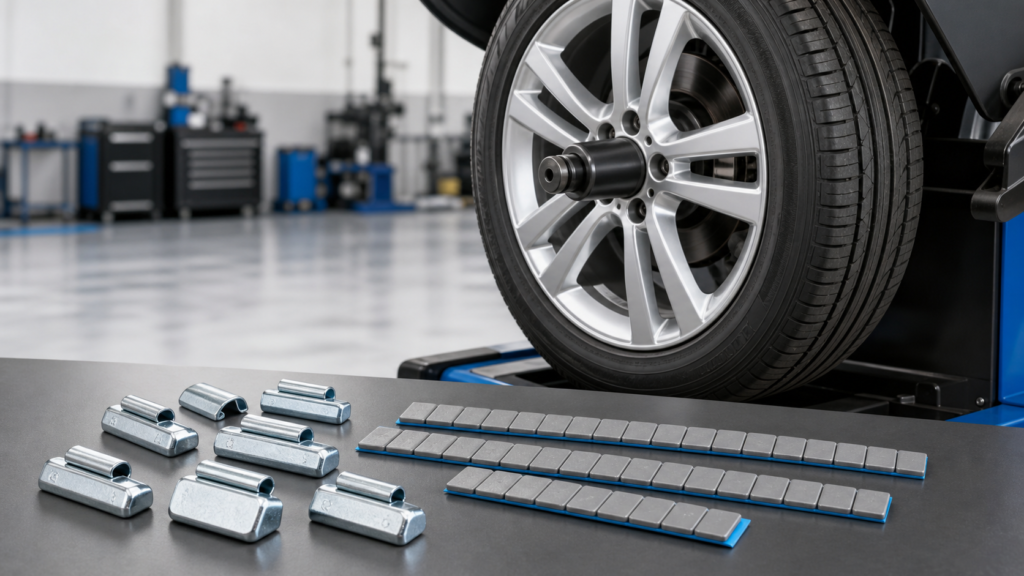
Clip-on weights require the correct rim-flange profile. They are often relevant for steel-wheel service, though actual fitment must follow the wheel design and the selected clip. Adhesive strips are common for alloy-wheel applications and depend on a clean, dry mounting surface plus tape performance appropriate to the installation conditions. Material, coating, tape, segment layout, and backing-liner handling all affect the final service result.
Before a buyer commits to a mixed export program, building a lead-free wheel-weight range can help connect material selection with gram or ounce coverage, attachment format, and the wheel applications served. That prevents the narrow question "Is it lead-free?" from displacing the more useful question "Will this range cover the work our customers actually do?"
A lead-free request still leaves a material decision. The material comparison behind a lead-free range helps buyers compare steel and zinc before attaching a compliance claim to the order. A non-lead material also does not select the attachment method; choosing a retention method separately from the lead-free material keeps rim fit and tape requirements visible in the same decision.
What should export buyers verify before ordering lead-free wheel weights?
An export order should turn the lead-free claim into a short, reviewable specification. The buyer does not need to demand every possible document for every market, but should define the evidence required for the destination and product line before approving production.
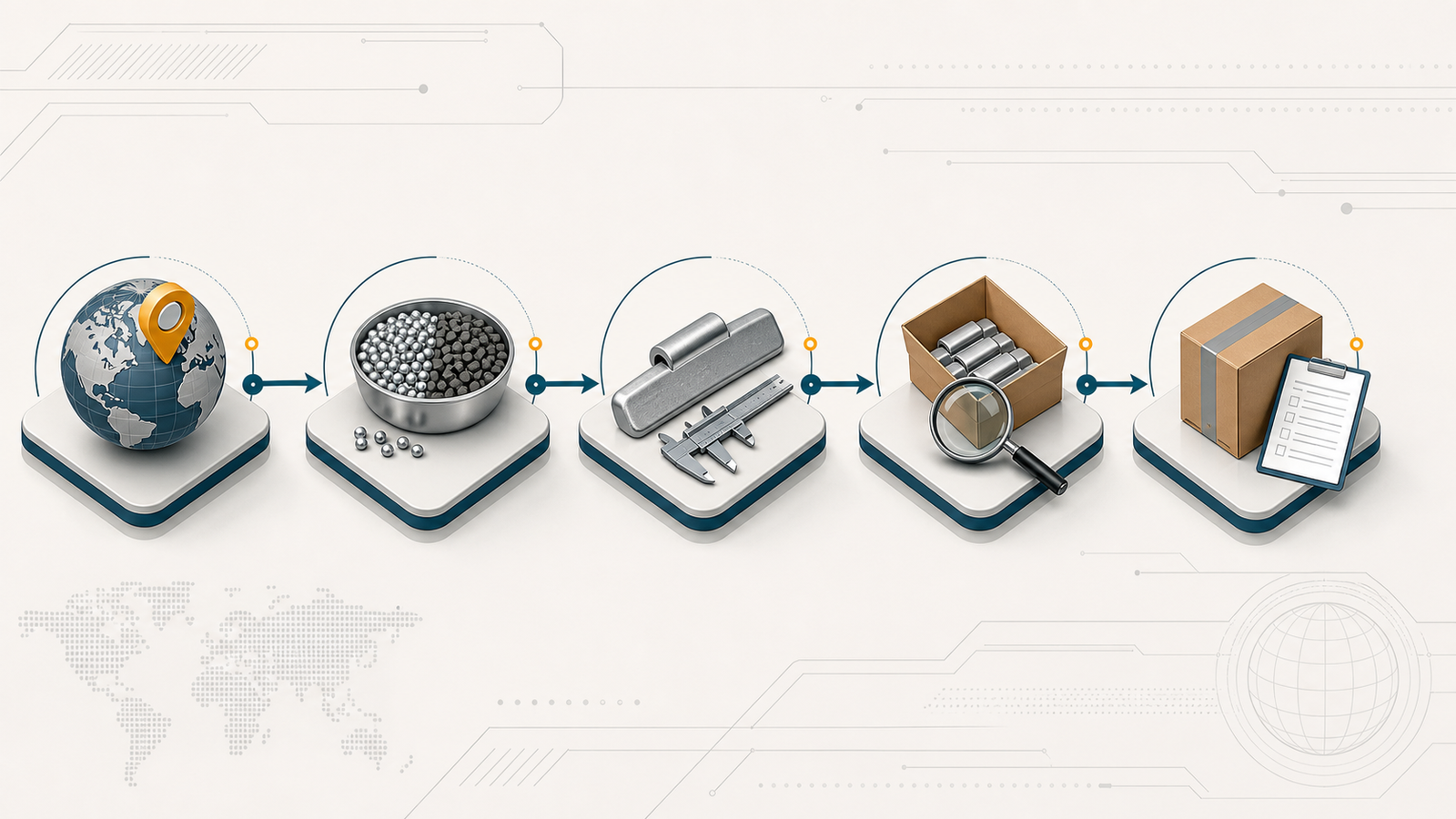
Use this checklist as a starting point:
- Destination and sales channel: Identify where the goods will be imported, resold, or fitted. Note whether the request comes from an aftermarket distributor, workshop group, fleet, vehicle program, or private-label customer.
- Material statement: State what "lead-free" means for the order. Ask for a product-specific material declaration that identifies the weight body material and the items it covers.
- Product configuration: Specify clip-on or adhesive format, rim or flange application, grams or ounces, segment layout, coating or surface finish, tape expectation, and package count.
- Evidence and samples: Agree which documents, inspection records, samples, or independent tests are required before mass production. Match the request to the destination rather than copying a document list from another market.
- Shipment control: Confirm product labels, carton marks, part numbers, lot traceability, and the document version that will travel with the order.
Once the destination, evidence level, and wheel mix are known, buyers can compare lead-free clip-on and adhesive weight formats against their required increments, rim fit, tape behavior, coating, and carton presentation. This is a product-range comparison, not a claim that the category page certifies a market's legal status.
Before shipment approval, buyers can use destination-specific compliance documentation to organize the declarations or records required by the customer and market.
Which product checks matter after the material is approved?
Material approval is the start of product validation, not the finish. A buyer should test the characteristics that can produce field complaints: correction-mass consistency, clip fit, coating condition, adhesive behavior, strip segmentation, packaging accuracy, and batch traceability.
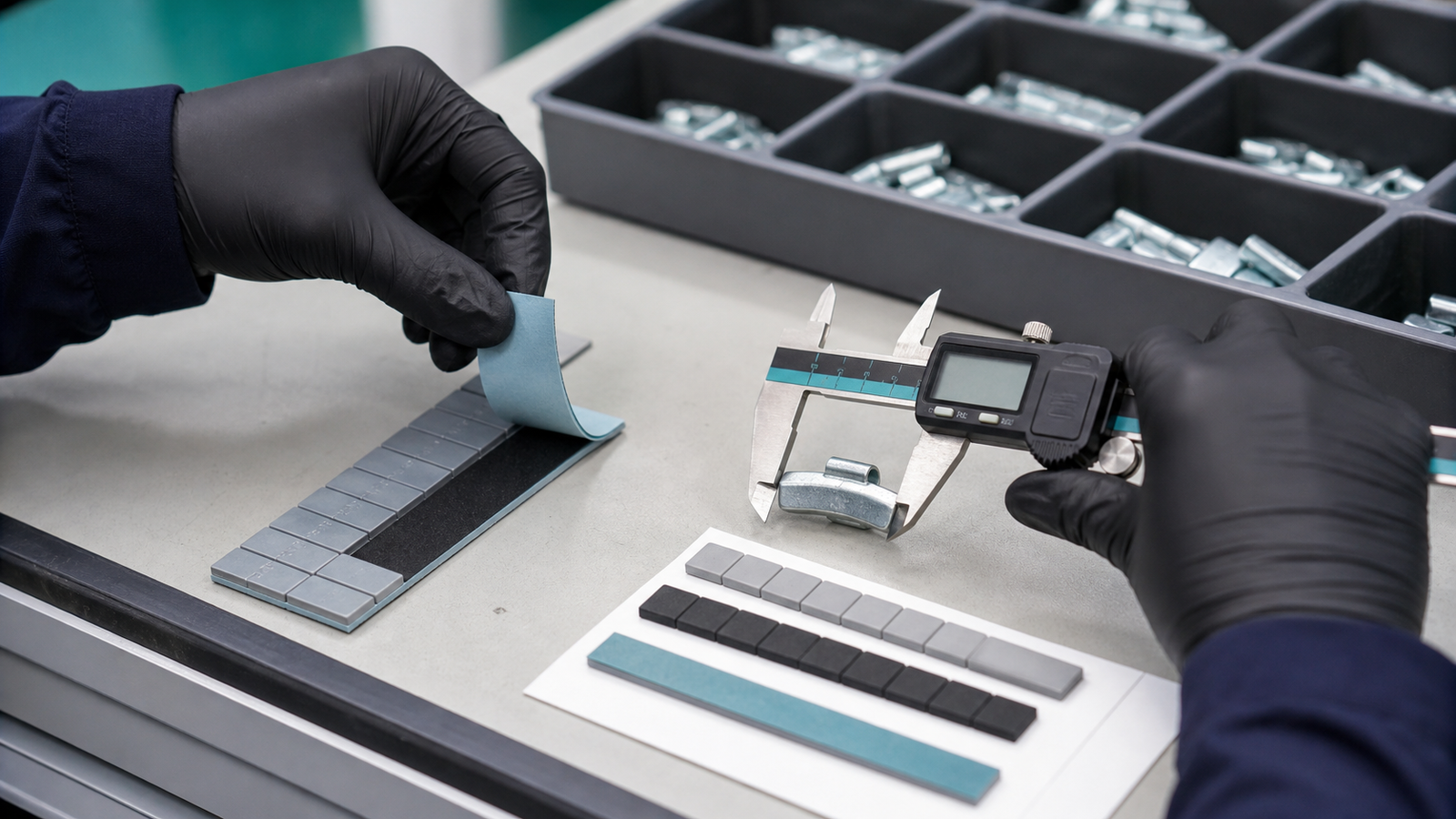
For adhesive products, agree a sample installation method that reflects the actual wheel surface and temperature conditions. A simple sample should confirm segment separation, liner removal, tape placement, and retention after the agreed dwell period. For clip-on products, send representative rim or flange information where possible, then inspect seating force, profile clearance, coating damage, and retention on the relevant wheel design.
Dimensional and weight checks also matter. A nominal 25 g marking is only useful when the actual product is controlled to the agreed tolerance. Carton and tray counts should match the order line, and labels should make it easy for a technician or warehouse team to distinguish material, format, increment, and part number. These are ordinary quality controls, but they make a lead-free program usable after it clears the material review.
Ask how the supplier separates material lots, production lots, and finished-goods labels. When a later customer asks for a declaration or a sample reference, traceability helps both sides identify which product and evidence belong together.
How should a buyer build a low-risk export specification?
A low-risk export specification gives the supplier enough information to quote the right product and gives the buyer a way to check the delivered goods. It should be concise, testable, and tied to the destination rather than written as a generic compliance slogan.
| Specification field | What to state | Why it matters |
|---|---|---|
| Destination | Import and resale market, plus intended customer type | Determines which rule, customer requirement, and document review may apply |
| Material claim | Defined lead-free expectation and requested evidence | Avoids assumptions about what the claim covers |
| Attachment and fitment | Clip profile or adhesive application, plus wheel type | Keeps material selection connected to actual installation |
| Weight range | Unit system, increments, and required part numbers | Ensures the range can correct the wheels in service |
| Finish and tape | Coating expectation, tape type, and sample conditions | Addresses corrosion and retention risks |
| Quality evidence | Sample plan, inspection points, and lot identification | Makes approval repeatable from first order to repeat orders |
| Packaging | Tray, box, carton count, labels, and private-label needs | Supports warehouse control and correct workshop selection |
The first request can be modest. Many buyers begin with a defined sample set, a material declaration, and a check of the dimensions and attachment method that matter most to their intended wheel mix. After that sample passes, the same approved specification can be used for a repeat order, a packaging discussion, or a larger range expansion.
Avoid two opposite mistakes. Do not ask a supplier to promise compliance with every market worldwide. And do not accept an unsupported "lead-free" label without agreeing what it means for the exact product being purchased. A clear destination, defined product scope, and proportionate evidence request protect both buyer and supplier.
Conclusion: Treat lead-free as a verified specification
Lead-free wheel weights can be a sound choice for export and aftermarket programs when the material claim is tied to a real destination, product format, and approval process. Steel or zinc may answer the material question, but a successful range still depends on fitment, weight coverage, coating, tape or clip performance, packaging, and traceability.
For a new market or private-label program, request lead-free material declarations together with representative samples and the documents required for the destination. That gives the buyer a practical basis for approving a range rather than relying on a broad label alone.
Frequently Asked Questions
Are lead-free wheel weights always steel?
No. Steel is a common lead-free choice, but zinc can also be used. The material should be chosen alongside rim fitment, attachment format, corrosion protection, available increments, and destination expectations.
Does lead-free automatically mean compliant in every country?
No. Requirements can vary by destination, product classification, customer specification, and current legal text. Treat lead-free as a defined material claim and verify the destination-specific requirements before shipment.
What document should I ask for when buying lead-free wheel weights?
Start with a product-specific material declaration that identifies the weight body and the relevant part numbers. Add samples, test records, or other evidence only to the level required by the destination, customer, and purchase specification.
Can adhesive wheel weights be lead-free?
Yes. Lead-free adhesive strips are commonly made with steel or zinc weight segments. Buyers should still verify adhesive performance, segment layout, surface preparation needs, and the material scope of the declaration.
What should be tested on a lead-free wheel-weight sample?
Check the agreed material evidence plus product performance: weight and dimensions, clip profile or tape retention, coating condition, segment separation, labels, packaging count, and lot identification. Use a representative wheel or installation method whenever possible.
References
[1] United States Environmental Protection Agency. “Best Management Practices for Lead Wheel Weights.” 2015.
[2] EUR-Lex. “Directive 2000/53/EC on end-of-life vehicles.” 2000.
[3] European Chemicals Agency. “Candidate List of substances of very high concern for Authorisation.” Accessed 2026.