





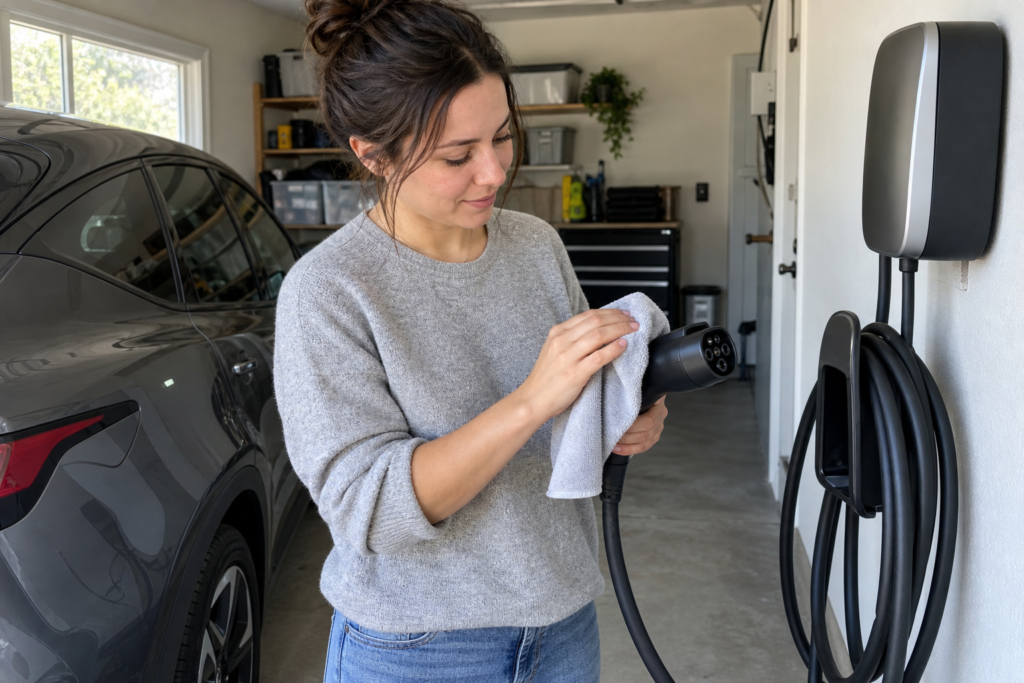
To understand how to clean EV charging accessories safely, stop the session and disconnect or de-energize the equipment as required by its instructions. Use a soft, suitable cloth on external surfaces, keep liquids and tools away from contacts, dry every part fully, and remove any cable, connector, cover, or holder from service when damage is found.
Cleaning is only one part of care. Dirt, moisture, poor storage, repeated pulling, and unreported impact can change how a cable, connector, cap, holder, or wallbox behaves. A clean-looking exterior also does not prove that insulation, seals, terminals, or internal protective functions are undamaged.
This guide gives homeowners, installers, facility teams, and fleet operators a product-agnostic routine. Always give the product manual and the local electrical requirements priority. If the manual does not allow a proposed cleaner or method, do not improvise.
Table of Contents
- What Is the Safe Way to Clean EV Charging Accessories?
- What Can Be Cleaned on an EV Charging Accessory?
- What Should You Do Before Cleaning an EV Charging Accessory?
- Which Tools and Materials Are Suitable?
- How Should You Clean EV Cables and Connectors?
- How Should You Care for Caps, Covers, Holders, and Wallboxes?
- What Cleaning Methods Can Damage EV Charging Accessories?
- How Often Should You Inspect and Maintain EV Charging Accessories?
- When Should You Stop Using or Replace an Accessory?
- What Should Buyers Put in a Cleaning and Care Specification?
- Conclusion: Clean for Inspection, Not Just Appearance
- Frequently Asked Questions
- References
What Is the Safe Way to Clean EV Charging Accessories?
The safe method is controlled, external cleaning after the charging process has stopped, the accessory is disconnected or otherwise de-energized as required, and the product instructions have been checked. Cleaning should remove surface dirt while preserving connector contacts, seals, cable insulation, latching features, and mounting integrity.
The exact routine depends on the product. A detachable cable can usually be inspected and wiped on a clean, dry surface. A fixed wallbox may require an owner to clean only the outside of the enclosure while a qualified person handles electrical isolation or service. A cap or holder may be removable, but it still needs to be cleaned in a way that preserves fit and retention.
For home installations, outdoor-rated equipment and local installation requirements still matter. The U.S. Department of Energy notes that outdoor EV charging installations require outdoor-rated equipment and that a qualified electrician can assess capacity and installation needs.[1] That is why an IP claim or a weather-resistant appearance should not be treated as permission to spray or pressure-wash an accessory.
What Can Be Cleaned on an EV Charging Accessory?
Routine care can cover accessible external surfaces, but it should not become an attempt to clean, repair, or modify energized electrical parts. Keep the boundary clear between wiping a molded handle and working on contacts, terminals, an opened enclosure, or damaged insulation.
| Component | Safe external focus | Stop and escalate when |
|---|---|---|
| Cable jacket | Remove dust, road film, and light marks with a suitable cloth | The jacket is cut, swollen, melted, sticky, flattened, or exposing conductor |
| Connector handle and boot | Wipe the molded grip, boot, latch area, and strain-relief exterior | The housing is cracked, the boot is loose, the latch does not work, or heat marks appear |
| Contact face or inlet | Keep it dry and remove only loose surface debris using the method in the manual | Contacts are bent, pitted, discolored, wet, contaminated, or loose |
| Connector cap or cover | Wipe the inside and outside without stretching or deforming the seal | The cap no longer fits, retains, seals, or stays attached as designed |
| Cable holder or wall mount | Clean the support surface and check for movement, sharp edges, and dirt traps | The mount flexes, pulls away, has a broken fastener, or creates a new cable bend |
| Wallbox exterior | Wipe the enclosure and visible cable entry area with the approved method | The enclosure is cracked, water is inside, alarms repeat, or service access is required |
IEC 61851-1 addresses EV supply equipment characteristics, connection, electrical safety, cable protection, markings, and user-manual information.[2] IEC 62196-1:2025 covers EV plugs, socket-outlets, vehicle connectors, vehicle inlets, and cable assemblies, including requirements and tests related to latching or retaining means, mechanical wear, thermal stress, abuse, and contaminants.[3] These standards provide system and accessory context; they do not turn an unknown cleaner into an approved maintenance method for every product.
What Should You Do Before Cleaning an EV Charging Accessory?
Before cleaning, make the equipment safe to handle, let hot parts cool, gather the product information, and decide whether the condition is suitable for cleaning at all. If the accessory is damaged, wet inside, unusually hot, or associated with a charging fault, inspection and service take priority over appearance.
Use this pre-cleaning sequence:
- Stop the charging session normally. Use the vehicle, charger, or site procedure to end charging. Do not pull a connector under load.
- Disconnect or de-energize as the instructions require. Unplug detachable equipment where the product permits it. Do not open a fixed charger or electrical enclosure unless the procedure is intended for a qualified person.
- Let the accessory cool and move it to a dry, stable surface. Do not clean a hot connector, a wet cable, or equipment sitting in standing water.
- Read the exact product instructions. Confirm the approved cleaner, cloth, brush, drying requirement, and any parts that must not be wetted.
- Record the identity and condition. For a shared site, note the SKU, cable or charger ID, location, date, and visible defects before wiping anything away.
- Separate clean and dirty tools. A cloth used on a greasy floor, brake dust, or corrosive residue should not be used on a connector face or cable boot.
- Set a no-go boundary. If you see a cracked housing, exposed conductor, burnt smell, melted area, water ingress, or repeated fault, label the item and follow the site’s quarantine process.
An IP code can help describe enclosure protection under defined test conditions, but it is not a universal cleaning instruction. The EV charging IP rating meaning explanation is useful when an outdoor accessory is being compared, because the practical question includes orientation, seals, drainage, UV, impact, temperature, and the condition in which the product is cleaned—not only the two IP digits.
Which Tools and Materials Are Suitable?
Use the least aggressive tool that removes the actual contamination, and use liquid only when the product instructions specifically permit it. For most external care, that means a clean lint-free cloth, a soft non-metallic brush for dry debris, and a manufacturer-approved cleaner when one is specified.
| Tool or material | Appropriate use | Control point |
|---|---|---|
| Clean lint-free cloth | Wiping cable jackets, molded housings, caps, holders, and enclosure exteriors | Use a separate clean section for each surface; do not leave fibers in contacts or seals |
| Soft dry nylon brush | Loosening light dust from external grooves, boots, and storage supports | Brush away from openings; never force bristles into contacts |
| Flashlight | Viewing the connector face, latch, boot, cap, cable entry, and mount | Use it for inspection, not as a reason to probe or scrape |
| Product-approved cleaner | Removing a residue that the manual identifies as cleanable | Confirm material compatibility and application method before use |
| Clean dry work surface | Supporting a disconnected cable while it is inspected | Keep the connector face away from grit, standing water, and metal swarf |
| Quarantine label or record | Identifying a failed item at a workplace or depot | Include asset ID, defect, date, and disposition owner |
Avoid treating a household cleaning product as automatically safe for charging plastics, elastomers, seals, labels, or cable jackets. Bleach, strong solvents, abrasive powders, silicone or oil-based products, and unapproved lubricants can change the surface or attack materials. If the manufacturer does not name a chemical, use a dry method or ask for written guidance before testing it on a production unit.
How Should You Clean EV Cables and Connectors?
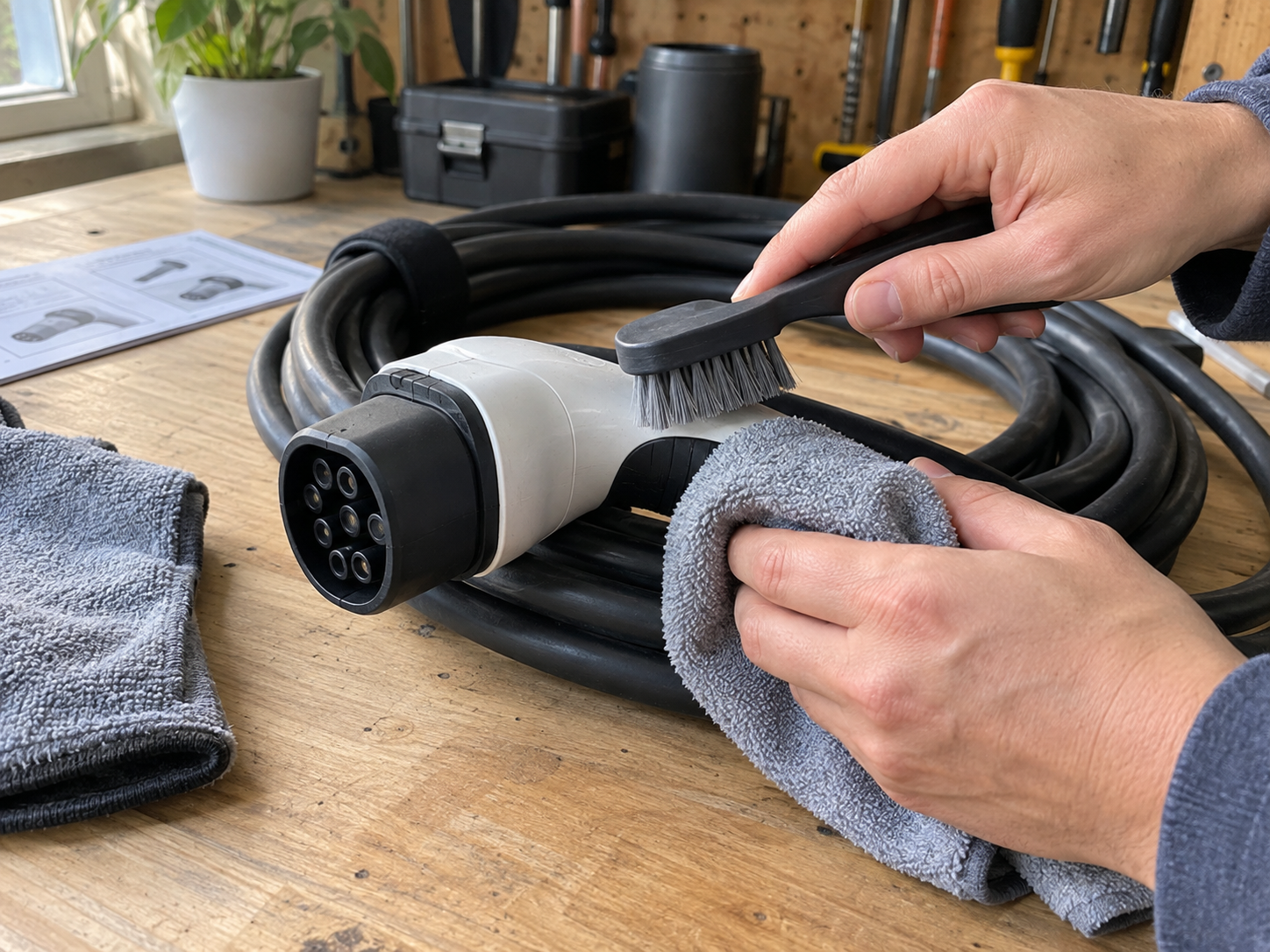
Clean the cable and connector from the outside in: first the jacket and handle, then the boot and latch area, and finally the connector face using only the product-approved method. Keep liquid, loose debris, and metal tools away from contacts, and inspect the part after it is dry.
1. Clean the cable jacket without changing its shape
Lay a detachable cable on a clean surface without creating a tight coil. Wipe along the jacket with a soft cloth, especially near the connector ends, vehicle contact points, floor-contact areas, and places where the cable touches a wall or holder. Do not drag the cable across concrete while cleaning it. Do not use the process to straighten a cable by forcing a twist or tight bend.
The cable’s routing still matters after cleaning. If a holder, hook, or storage loop repeatedly folds the same spot, dirt removal will not solve the underlying stress. Buyers and installers comparing support hardware can use the EV charging cable bend radius and strain relief guidance to connect cleaning access with the cable’s permitted path and strain-relief geometry.
2. Wipe the handle, boot, and latch area
Use a clean cloth on the grip and molded housing. Work around the boot and strain-relief area without pulling the boot away from the housing. Remove visible dust from the latch opening with a soft dry brush if the manual permits it. The latch should move only through its normal range; do not force it because a stiff latch may indicate contamination, deformation, or a damaged mechanism.
If the connector uses a retention or locking feature, check that it releases and seats as designed without unusual force. A latch that binds, misaligns, or carries cable load needs inspection; do not force it during cleaning.
3. Protect the contact area
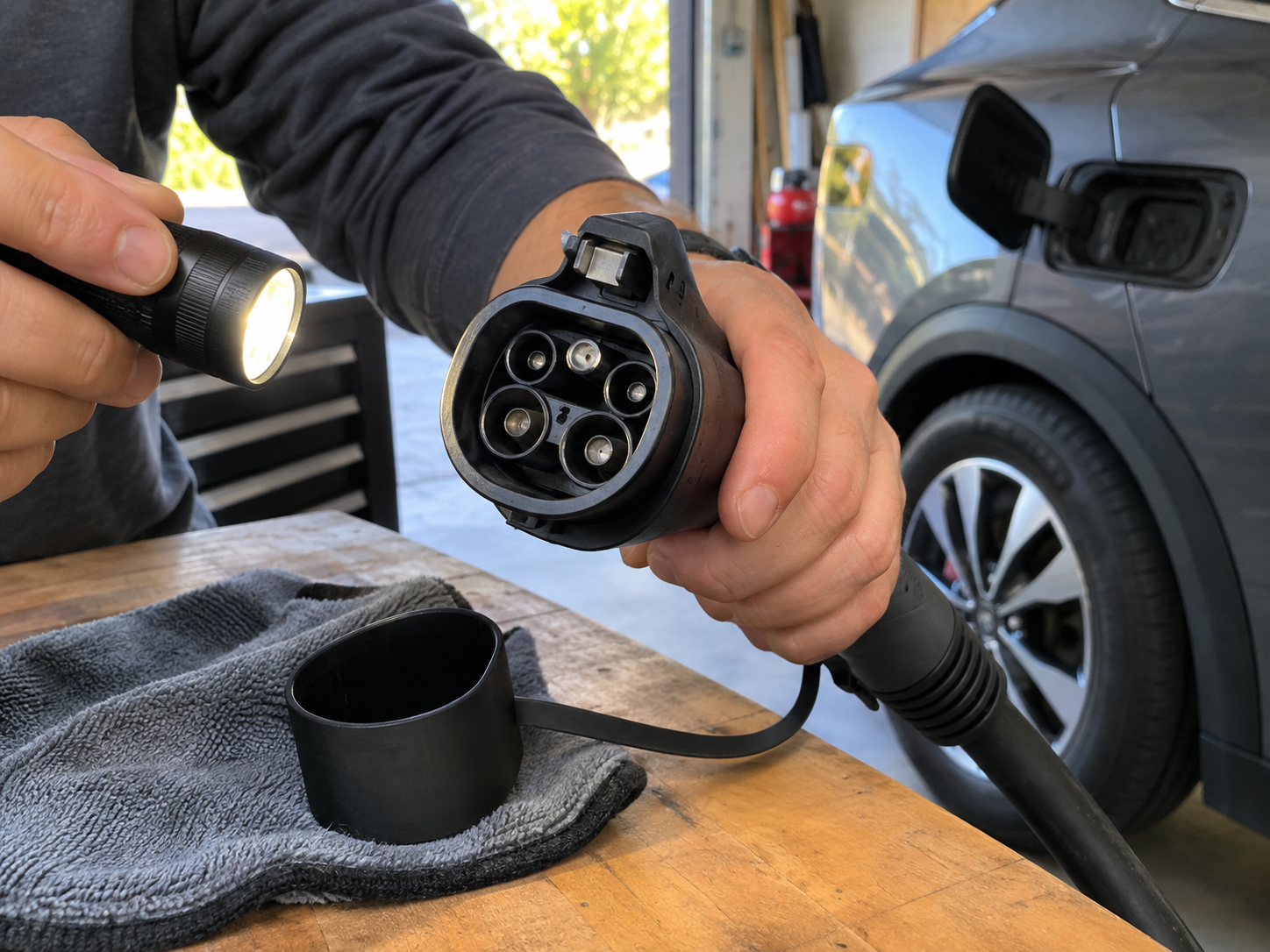
Keep the connector face pointed away from spray, dripping cloths, and loose dirt. Do not scrape contacts with a pick, knife, screwdriver, abrasive pad, or metal brush. If the instructions allow a specific contact-cleaning method, follow that exact method and drying requirement. Otherwise, keep the area dry, remove only loose accessible debris, and escalate visible contamination or damage.
The same rule applies to the vehicle inlet and any station-side socket: cleaning a surrounding trim surface is different from servicing a contact interface. A connector that looks clean but has pitting, discoloration, looseness, or repeated communication faults should not be returned to normal use without an appropriate technical check.
4. Clean caps and covers before they go back on
Wipe both sides of a disconnected cap or cover, including the rim, tether, seal, and retention point. Check that no cloth fiber or grit remains where the cap seats. Let it dry fully before installing it. A cap is useful only when it fits the intended interface and stays in the designed position; a stretched, cracked, or loose cap can create a false sense of protection.
How Should You Care for Caps, Covers, Holders, and Wallboxes?
Care for support and protection accessories as part of the charging path, not as decorative add-ons. Wipe accessible surfaces, keep drainage and sealing features clear, check fasteners and retention, and make sure the accessory still places the cable and connector in the intended position.
| Accessory | Clean | Inspect after cleaning |
|---|---|---|
| Connector cap or cover | Remove surface dust from the rim, seal, tether, and seating area | Fit, retention, seal continuity, tether attachment, cracks, deformation, and trapped grit |
| Wall holster or cable holder | Wipe the cradle, hook, lower support, and cable-contact surfaces | Connector seating, support load, sharp edges, movement, fasteners, and whether the cable hangs naturally |
| Wall mount or bracket | Clean the visible bracket and surrounding wall surface | Fastener tightness, corrosion, pull-away, edge damage, and clearance from the cable route |
| Cable gland or entry guard | Wipe only the accessible outside | Seal condition, cable movement, abrasion, water marks, and whether the gland has shifted |
| Wallbox enclosure | Use the approved exterior method and keep vents or openings clear | Cracks, water marks, heat discoloration, alarms, loose cover, and service clearance |
The EV charging connector caps and covers guide is helpful when a cover is being selected or replaced, because fit, retention, material, and maintenance all affect whether it protects the interface in the real storage position. For the holder decision, the EV charging cable holder versus wall-mount site guide connects support geometry with wall surface, cable weight, reach, and repeated handling.
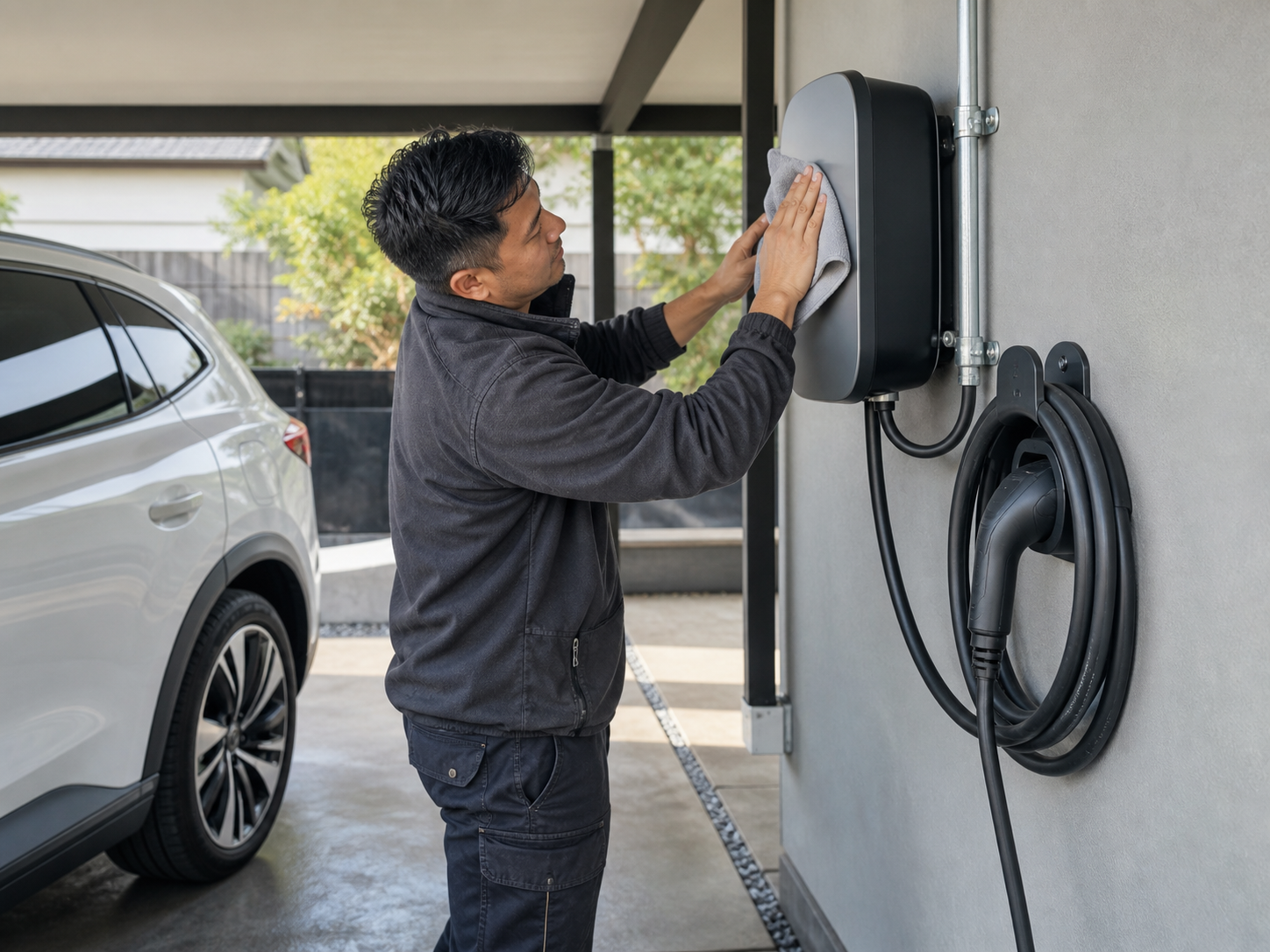
Do not remove a wallbox cover simply to make the inside look cleaner. Fixed EV supply equipment has system-level electrical and safety requirements, and the applicable manual or service procedure should define who can isolate, open, test, and return it to service.[2] Owners can normally report exterior damage, blocked access, moisture, heat marks, or repeated faults without attempting internal work.
The surrounding site deserves a quick check too. Look for puddles, grit, washdown residue, sharp curb edges, vehicle contact marks, and a cable route that has changed because a holder or mount moved. Set the inspection interval to match the actual exposure and handling frequency at that site.
What Cleaning Methods Can Damage EV Charging Accessories?
The highest-risk methods are those that force water, chemicals, heat, or mechanical force into a connector or enclosure. Avoid them unless the exact product documentation explicitly allows the method, defines the conditions, and identifies who may perform it.
- Pressure washing or hose spraying: Water can reach interfaces, vents, seals, cable entries, or connector cavities with more force than the product was designed to withstand. An IP rating is a classification of enclosure protection under defined conditions, not a blanket permission for pressure washing.[4]
- Spraying cleaner directly onto the accessory: Spray can travel into openings before the operator can control the amount. Apply only by the method stated in the instructions, often to a cloth rather than directly to the part.
- Unapproved solvents, bleach, abrasives, or polishes: A liquid that removes grease may also soften a cable jacket, cloud a window, swell an elastomer, remove a label, or reduce seal performance.
- Metal picks and abrasive brushes: Scraping can damage plating, seals, contact geometry, or molded surfaces and can push contamination deeper into a cavity.
- Forcing a latch or connector: Cleaning is not a substitute for correcting misalignment, a failed lock, a bent contact, or a connector that will not seat.
- Cleaning while connected or energized: A damp cloth, tool, or displaced debris can create a fault or unsafe condition. Follow the product’s isolation procedure first.
- Leaving moisture trapped under a cap or in a holder: A cover that is closed while wet can retain contamination at the interface. Drying and inspection are part of the return-to-service step.
- Opening fixed equipment without authorization: A tidy enclosure is not worth bypassing an electrical safety or warranty procedure. Use qualified service support where the manual requires it.
When in doubt, stop at external inspection and ask the manufacturer or a qualified service professional for the approved method. Product-specific instructions are stronger evidence than a generic “waterproof” or “washable” description.
How Often Should You Inspect and Maintain EV Charging Accessories?
Use condition-based maintenance with a documented site interval rather than one universal cleaning frequency. The right schedule depends on use cycles, rain and dust, road salt, washdown, vehicle traffic, cable storage, user turnover, and how quickly a damaged accessory must be removed from service.
The following is a starting policy, not a replacement for the product manual or site risk assessment:
| Site or use pattern | Quick check | Planned clean and inspection | Event-triggered check |
|---|---|---|---|
| Low-use indoor home garage | Before use or when the cable is handled | Monthly and after seasonal storage | After a spill, dropped connector, or charging fault |
| Outdoor home or small workplace | Before use or at each normal handover | Monthly, plus a deeper seasonal review | After rain intrusion, storm debris, snow, vehicle contact, or washdown |
| Shared workplace or public site | Operator or facilities check each shift or service round | Weekly or on the site’s documented service cycle | After impact, vandalism, complaint, overheating, or repeated fault |
| Fleet depot or service yard | Driver or shift check at return and issue | Weekly detailed check with a monthly trend review | After a vehicle strike, cable drag, contamination event, heat alarm, or failed session |
At every interval, check the cable jacket, connector face, handle, boot, latch, cap or cover, holder, mount, cable entry, labels, and signs of heat, water, contamination, or deformation. Record what was cleaned, what was found, who made the decision, and whether the item returned to service or moved to quarantine.
Fleet teams should make the routine easy to repeat across shifts. The EV charging accessories for fleets guide adds the stocking and replacement context needed when several cable configurations share a depot. For a more formal incoming or periodic check, the EV charging cable quality inspection checklist helps connect visual condition with fit, durability, evidence, and sample approval.
When Should You Stop Using or Replace an Accessory?
Stop using an accessory when cleaning cannot remove the risk or when the part shows a condition that may affect electrical safety, fit, retention, insulation, environmental protection, or mechanical support. Quarantine the item, identify it clearly, and follow the manufacturer’s or site owner’s replacement or service process.
| Warning sign | Immediate action |
|---|---|
| Exposed conductor, cut jacket, deep abrasion, swelling, melting, or softening | Remove from service and prevent reconnection |
| Cracked connector housing, broken boot, bent or pitted contact, or loose terminal | Quarantine and request qualified evaluation or approved replacement |
| Failed latch, cap, cover, tether, or holder that no longer retains the part | Do not rely on the accessory for normal storage or connection |
| Water visible inside a connector or enclosure, or corrosion at an interface | Isolate according to procedure and escalate; do not dry it by heat or resume charging by guesswork |
| Burning smell, heat discoloration, repeated thermal warning, or recurring fault | Stop using the affected configuration and investigate the charger, cable, connector, and vehicle interface together |
| Loose wallbox, bracket, fastener, gland, or mount | Keep the area out of normal use until structural support is restored |
| Label, rating, SKU, or revision is missing or conflicts with the installed configuration | Hold the item until identity and approval are confirmed |
Do not make a damaged cable “serviceable” by adding tape, filing a contact, gluing a cracked housing, forcing a latch, or fitting an unverified replacement cap. A temporary cosmetic repair can hide a condition that the next user or technician needs to see.
When cleaning reveals heat, exposed material, moisture inside an interface, or a loose fit, use the warning-sign and stop-use guide to decide when the item should remain quarantined for service or replacement.
What Should Buyers Put in a Cleaning and Care Specification?
Buyers should specify a care routine at the same time as the accessory, because a product that cannot be cleaned, inspected, identified, or replaced consistently can create avoidable downtime. The brief should describe the exact item, environment, approved method, stop-use criteria, evidence, and ongoing supply responsibility.
Include these fields in a request to a supplier or installer:
| Specification field | What the response should define |
|---|---|
| Exact product identity | SKU, connector or accessory type, revision, dimensions, material, and intended interface |
| Use and location | Home, workplace, public, depot, indoor/outdoor, vehicle groups, and expected handling frequency |
| Environmental exposure | Rain, UV, dust, salt, temperature, snow, washdown, cleaning chemicals, drainage, and impact risk |
| Cleaning method | Approved cloth or brush, approved chemical if any, application method, prohibited methods, and drying or return-to-service criteria |
| Inspection points | Cable jacket, contacts, latch, boot, cap, holder, fasteners, seals, cable entry, labels, and heat or water signs |
| Stop-use rules | Damage, contamination, water ingress, fault, overheating, loss of retention, or unclear identity that requires quarantine |
| Evidence | Datasheet, dimensional drawing, manual, material information, environmental claims, test basis, declaration, revision, and traceability |
| Sample check | Sample quantity, site simulation, cleaning cycles, storage cycles, handling conditions, inspection record, and approval authority |
| Replacement plan | Approved spare SKU, compatible revision, cap or cover availability, lead time, MOQ, packaging, and reorder trigger |
| Change control | Notice period, material or mold changes, connector-source changes, artwork or label changes, and reapproval requirements |
Ask the supplier to distinguish a tested claim from a general recommendation. For example, “IP-rated” does not automatically answer whether the installed part tolerates UV, salt, impact, detergent, repeated wiping, or a particular washdown process. IEC 60529 defines the IP classification framework, while the product documentation and test evidence should explain the actual conditions for the accessory.[4]
The EV charging accessories buying guide is useful when the care brief must be connected to the wider selection sequence: fitment, electrical and communication limits, evidence, operations, and supply. A maintenance field should not be an afterthought added after the first batch has already reached the site.
If you are turning this guidance into a home, workplace, or fleet routine, share the accessory types, connector references, site exposure, cleaning restrictions, inspection frequency, and replacement policy. We can help organize those details into a practical care checklist before you standardize parts or request samples.
Conclusion: Clean for Inspection, Not Just Appearance
Safe care for EV charging accessories is controlled handling, not aggressive washing. Stop the session, disconnect or de-energize as required, follow the exact product instructions, clean only accessible surfaces with suitable tools, dry everything fully, and inspect the connector, cable, cover, holder, wallbox, and mount as one working system.
The most important result is not a polished exterior. It is a known condition, a clear identity, a repeatable maintenance record, and a fast decision when a part should be quarantined or replaced. For shared and fleet sites, document the routine and keep approved spares tied to exact SKUs and revisions.
Frequently Asked Questions
Can I wash an EV charging cable with a hose?
Do not hose or pressure-wash a charging cable unless the exact product instructions explicitly allow that method and define the conditions. The safer default is to stop charging, disconnect as required, wipe external surfaces with a suitable cloth, keep connectors and openings dry, and escalate water ingress or damage.
Can I use alcohol or solvent to clean an EV connector?
Only use alcohol or another solvent when the product manufacturer approves it for the exact connector materials and application. An unapproved chemical can affect plastics, elastomers, seals, labels, plating, or cable jackets. If the instructions are silent, use a dry external method and request written guidance before testing a chemical.
How do I clean EV charging connector pins?
Do not scrape, polish, spray, or probe connector contacts as a routine cleaning step. Keep the contact area dry, remove only loose accessible debris using the exact approved method, and stop if contacts are bent, pitted, discolored, wet, loose, or associated with charging faults. Service support may be required.
Is an IP-rated wallbox safe to pressure-wash?
No. An IP rating describes enclosure protection under defined test conditions. It is not a blanket pressure-washing permission and does not cover every orientation, seal condition, chemical, temperature, impact, or maintenance method. Follow the wallbox manual and site procedure for cleaning and service access.
How often should I clean EV charging accessories?
Use the product instructions and a site-based schedule. A low-use indoor home setup may need a monthly visual clean and inspection, while shared, outdoor, or fleet equipment may need checks each shift or service round plus planned cleaning. Inspect after storms, spills, impacts, washdown, overheating, or repeated faults.
What damage means I should stop using an EV accessory?
Stop when you see exposed conductor, a cut or melted jacket, a cracked housing, damaged contacts, a failed latch, water inside the connector or enclosure, a burning smell, repeated thermal or charging faults, or a loose mount. Label and quarantine the item, then follow the approved service or replacement process.
References
[1] U.S. Department of Energy, Alternative Fuels Data Center. “Charging Electric Vehicles at Home.” n.d.
[2] International Electrotechnical Commission. “IEC 61851-1:2017, Electric vehicle conductive charging system — Part 1: General requirements.” 2017.
[3] International Electrotechnical Commission. “IEC 62196-1:2025 CMV, Plugs, socket-outlets, vehicle connectors and vehicle inlets — Conductive charging of electric vehicles — Part 1: General requirements.” 2025.
[4] International Electrotechnical Commission. “IEC 60529:1989, Degrees of protection provided by enclosures (IP Code).” 1989.







