






EV charging accessories for different parking sites depend on the parking environment, exposure, traffic, cable handling, user turnover, installation surface, and maintenance process. A home garage may prioritize convenience and storage, while a workplace, public site, or depot needs repeatable protection, signage, mounting, inspection, and spare-stock planning.
The connector and charger may be similar across sites, but the accessory decision is not. A homeowner may need a wall holster and a clean cable path. A public site may need impact protection, clear instructions, robust storage, and fast fault identification. A depot may need controlled issue and return, inspection records, and spare parts that match several vehicle groups.
This guide compares the four common parking environments so owners, installers, workplace managers, public-site operators, and fleet teams can start with the site rather than a generic accessory list.
Table of Contents
- What changes when EV charging accessories are chosen by parking site?
- Which accessories fit a home garage or carport?
- What does a workplace or shared parking site need?
- What changes at public and destination charging sites?
- Which accessories support an EV depot or fleet yard?
- How should buyers compare the four site types?
- What should a site survey record before ordering?
- Conclusion: Start With the Parking Behavior
- Frequently Asked Questions
- References
What changes when EV charging accessories are chosen by parking site?
The site changes the accessory priorities because it changes who handles the cable, how often the equipment is used, what can hit or contaminate it, and how quickly a problem must be found. Start with parking behavior, then choose storage, protection, mounting, signage, inspection, and replacement accessories around that behavior.
| Decision factor | Home | Workplace | Public or destination | Depot or fleet yard |
|---|---|---|---|---|
| Main users | One household or a small number of known drivers | Employees, visitors, or assigned users | Many unfamiliar drivers | Fleet drivers and maintenance staff |
| Typical dwell time | Overnight or daily routine | Several hours or a work shift | Shorter, less predictable turnover | Scheduled shifts, dispatch windows, or overnight parking |
| Main risk | Poor reach, cable clutter, door or tire pinch | Shared misuse, pedestrian movement, and inconsistent storage | Impact, vandalism, weather, and unclear user behavior | Repeated handling, missed inspections, and mixed vehicle fitment |
| First accessory question | Where will the connector rest? | Can every user return it safely? | How is the cable protected from traffic? | How will cables be issued, checked, and replaced? |
| Useful support | Wall holster, cable holder, connector cap, routing clips | Holder or pedestal support, bollards, labels, basic spare set | Heavy-duty storage, protection, signage, lighting, and inspection access | Multiple holders, identification, spare cables, cleaning tools, and records |
| Maintenance style | Owner visual check | Scheduled facilities check | Frequent operator or service inspection | Formal checklist tied to vehicle and charger records |
The table is a starting point, not a substitute for the charger, vehicle, connector, and local installation requirements. Home outdoor use, for example, still needs equipment suitable for outdoor installation, while a covered fleet yard may have lower rain exposure but much higher handling frequency.[1] The EV charging accessories buying guide gives the broader selection sequence when the site decision also includes fitment, documents, samples, and supply planning.
Which accessories fit a home garage or carport?
Home charging accessories should make the daily routine easy, keep the cable off the floor, and prevent the connector or cable from being pulled across a door, tire path, or sharp edge. The right choice is usually compact and simple, but outdoor home charging still needs weather-appropriate equipment and a site-specific installation review.
For a home garage, start with the actual parking position rather than the wallbox location alone. Check whether the vehicle can park slightly forward, backward, or off-center, and whether the garage door, storage shelves, bicycles, or another vehicle can contact the cable. A wall holster or cable holder should leave the connector easy to reach while supporting the cable body instead of making the vehicle inlet carry the hanging weight.
Home accessory priorities often include:
- a holder or holster matched to the connector shape, cable diameter, weight, and storage loop;
- a cable route that preserves the manufacturer’s bend-radius and strain-relief requirements;
- a protective cap or cover for a disconnected connector or inlet where the product is designed for that use;
- mounting hardware suitable for the wall material, fastener location, and expected pulling force;
- simple labels or a storage position that make correct return behavior obvious;
- cleaning and inspection instructions that the owner can follow without opening electrical equipment.
For a single-family garage, the decision is often between a compact wall mount and a larger holder with more cable capacity. Buyers can use the EV charging cable holder versus wall-mount site guide to compare reach, storage geometry, support load, and wall position. If the cable or connector will see rain, dust, or road spray, use the EV charging IP rating meaning explanation to separate an ingress claim from UV, temperature, impact, or salt evidence.
Outdoor home charging should not be treated as an indoor setup moved outside. The U.S. Department of Energy notes that outdoor installations require outdoor-rated equipment and that a qualified electrician can assess whether the home has adequate capacity for the chosen charging equipment.[1] The accessory plan should therefore include the fixed installation, cable entry, mounting surface, weather exposure, and user storage behavior.

What does a workplace or shared parking site need?
Workplace and shared parking accessories should support repeatable use by people who may not own the charger, know the cable history, or park in the same position every day. The priorities shift toward clear storage, protection from pedestrian and vehicle movement, simple instructions, and facilities access for inspection.
Before ordering, map the route from each charger to the likely inlet positions of the vehicles that will use it. A cable that works for one sedan may cross a pedestrian path when a taller vehicle or a different inlet position is present. Holders, hooks, or pedestal supports should keep the cable visible and supported without narrowing accessible routes or creating a trip hazard.
| Workplace condition | Accessory response | Verification question |
|---|---|---|
| Several vehicle types | Confirm connector, cable length, and support geometry across the group | Can the shortest and longest normal reach be handled without a sharp bend? |
| Drivers change daily | Use obvious return-to-storage points and simple labels | Can a first-time user see where the connector belongs? |
| Pedestrians cross the parking row | Keep cable slack and support hardware away from walking lines | What happens when the nearest space is occupied or the driver parks off-center? |
| Equipment is on a post or island | Check bollards, fasteners, enclosure clearance, and service access | Is the mount protected from door, bumper, cart, and snow-plow contact? |
| Facilities staff maintain the site | Keep inspection points visible and recordable | Can staff identify a damaged cable or loose holder without guessing? |
Workplace sites often need a modest spare set even when they are not full fleet depots. A spare connector cap, holder component, mounting fastener set, or approved replacement cable can reduce downtime when a part is damaged. The spares should be identified by exact model and revision rather than stored as “universal” parts.
Mounting decisions should account for surface construction, enclosure position, cable entry, protective posts, and maintenance clearance. The EV charging station mounting accessories buyer guide helps separate the charger’s structural installation from the cable storage and user-handling accessories that sit around it.
What changes at public and destination charging sites?
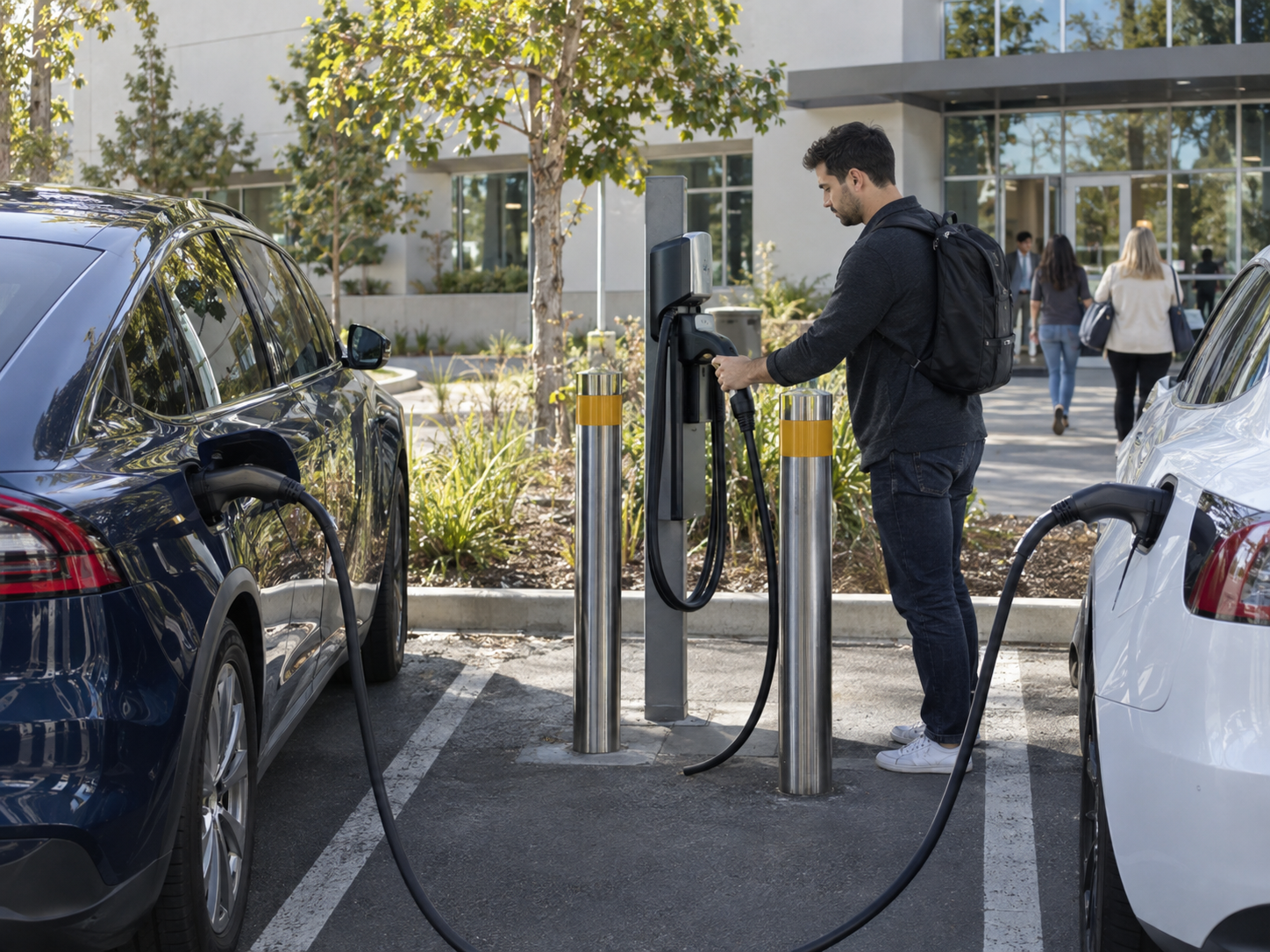
Public and destination charging sites need accessories that tolerate high user turnover, unclear handling habits, weather exposure, and more opportunities for impact or misuse. The objective is a predictable user path: approach, connect, charge, disconnect, return or hang the cable, and leave the parking space clear.
Public-site planning should cover:
- Vehicle approach: Can different vehicles reach the inlet without pulling the cable across another bay, curb, or pedestrian route?
- Cable storage: Does the holster or retracting support keep the connector off the ground when the session ends?
- Impact protection: Are bollards, islands, curb positions, and cable exits protected from reversing vehicles, carts, and service equipment?
- User clarity: Can a driver understand where to place the connector and how to report damage without relying on staff explanation?
- Weather and cleaning: Are covers, seals, materials, drainage, and cleaning instructions suitable for the actual rain, dust, UV, salt, or washdown exposure?
- Inspection access: Can an operator check the cable, connector, mount, and surrounding route without taking the site out of service unnecessarily?
The public environment magnifies small design problems. A loose hook can become a hanging cable. A missing cap can expose a connector to contamination. A cable that is technically long enough can still cross a pedestrian line if the holder position is wrong. A sign or label is useful only when the hardware makes the correct action easy.
Public, workplace, and fleet sites may also differ in charging levels, connector types, mounting style, and networking features. A U.S. Department of Energy/NREL installation guide describes public, workplace, and fleet charging as distinct use contexts and notes that installation costs and requirements vary with equipment, mounting, and electrical upgrades.[2] That distinction is useful for accessory planning even when the charger model is the same.
Do not specify a public accessory only from a product photo. Record the cable weight, connector boot dimensions, support load, fastener and surface requirements, weather conditions, expected use cycles, and replacement path. A higher-strength-looking mount can still be the wrong choice if it does not preserve the cable’s bend path or vehicle reach.
Which accessories support an EV depot or fleet yard?
Depot and fleet-yard accessories should make charging repeatable across shifts, vehicles, and inspections. The strongest depot plan is not simply a larger home setup; it is a controlled operating system for cable storage, identification, cleaning, damage reporting, spare stock, and replacement approval.
Start with the fleet groups and charging schedule. A light-duty van fleet parked overnight may need orderly AC cable storage and inspection. A mixed depot with rapid turnover may need more durable supports, protection from vehicle movement, clearer identification, and faster swap-out of damaged parts. Covered and open yards also have different exposure and drainage requirements.
| Depot need | Accessory or process response | Record to maintain |
|---|---|---|
| Many cable assemblies | Number or label storage positions and match them to charger or vehicle groups | Cable ID, connector type, length, and approved location |
| Repeated handling | Use supports that keep the connector and cable body off the ground | Condition check, support damage, and repeated wear points |
| Shift handover | Add a short return and damage-report routine | Date, user or shift, location, and action taken |
| Mixed vehicles | Separate compatible configurations instead of relying on appearance | Vehicle group, inlet reference, charger reference, and approved accessory |
| Outdoor exposure | Match enclosure, cover, material, drainage, and cleaning to the yard | Exposure notes, maintenance interval, and supplier evidence |
| Downtime pressure | Hold approved spares and define replacement authority | Spare SKU, quantity, reorder point, and change-control status |
Depot managers should check that the holder, hook, cap, wall mount, or replacement cable can be identified quickly after installation. If a part has no visible identity or the warehouse stores several visually similar versions, a correct replacement becomes slower and more error-prone.
The EV charging accessories for fleets guide is useful when the site needs a deeper stocking and replacement model. For incoming samples or periodic checks, add the EV charging cable quality inspection checklist so the physical condition, label, connector, jacket, and support points are recorded together.
Fleet teams should also define what makes a part non-serviceable. Examples include exposed conductor, severe jacket damage, a failed latch, heat discoloration, broken mount hardware, water ingress, or a support point that no longer keeps the cable on its intended route. Do not allow a damaged part to return to a general spare bin without a clear disposition.

How should buyers compare the four site types?
Compare sites by user behavior and operating consequence, not by the label “home,” “commercial,” or “fleet” alone. A private apartment car park may behave more like a public site, while a small business owner’s covered depot may behave more like a workplace installation.
Apartment and condo parking adds shared permissions, cable routing, ownership, and user-turnover questions. The apartment and condo parking guide helps teams assess those constraints before standardizing holders, covers, or mounting hardware.
| Selection axis | Home | Workplace | Public | Depot |
|---|---|---|---|---|
| Storage decision | Compact wall holster or holder | Shared, obvious return point | Durable, misuse-resistant support | Numbered, repeatable storage positions |
| Protection decision | Keep away from household objects and vehicles | Protect against pedestrians, doors, and carts | Protect against impact, weather, and vandalism | Protect against vehicle movement, handling cycles, and service activity |
| Mounting decision | Wall material and user reach | Wall, post, or island with accessible clearance | Structural protection and service access | Repeatable hardware across several bays |
| Documentation decision | Installation instructions and care notes | Approved configuration and facilities checklist | Product-specific evidence and site file | Revision control, inspection records, and spare list |
| Maintenance decision | Owner visual check | Scheduled facilities review | Frequent operator inspection and issue reporting | Shift or route-based inspection with replacement authority |
| Buying mistake to avoid | Choosing by connector shape only | Assuming every driver will store the cable correctly | Selecting the highest headline rating without site evidence | Treating all cables and vehicles as one configuration |
The decision can be reduced to a practical order:
- Map parking positions, inlet locations, cable path, traffic, and storage points.
- Identify the charger, connector, vehicle groups, cable length, weight, and exposure.
- Choose support and protection hardware that fits the surface and preserves the cable route.
- Add the minimum labels, caps, guards, or spare parts needed for the user group.
- Test the path in normal and inconvenient parking positions.
- Record inspection, cleaning, replacement, and supplier-change requirements.
This sequence prevents a common error: buying a holder or cover first and then discovering that the cable crosses a pedestrian route, the connector does not seat in the holster, the mount cannot take the surface load, or the outdoor claim does not cover the actual exposure.
What should a site survey record before ordering?
A site survey should record enough information for a supplier or installer to recommend an accessory without guessing the parking behavior. The most useful survey combines layout, users, hardware, environment, evidence, and maintenance in one short record.
| Survey field | What to capture |
|---|---|
| Site and user group | Home, workplace, public, depot, apartment, visitor, fleet, or mixed use |
| Parking layout | Bay dimensions, wall or post location, vehicle approach, inlet positions, walking routes, doors, curbs, and traffic |
| Equipment identity | Charger or wallbox model, connector type, vehicle groups, and station-side references |
| Cable details | SKU, length, diameter, weight, bend requirement, current and voltage rating, and storage method |
| Environment | Indoor or outdoor, rain, UV, dust, salt, temperature, snow, washdown, cleaning chemicals, and drainage |
| Mounting surface | Concrete, brick, steel, post, pedestal, wall finish, fastener limits, and service clearance |
| User behavior | Dwell time, turnover, shift pattern, first-time users, shared access, and expected handling cycles |
| Maintenance | Inspection owner, frequency, cleaning method, damage reporting, spare location, and replacement authority |
| Evidence | Datasheet, drawing, manual, label, test report, declaration, revision, and traceability |
| Commercial plan | Sample quantity, first order, reorder estimate, packaging, labels, MOQ, lead time, and change control |
For connector, charger, and vehicle fitment fields, the EV charging accessories compatibility checklist helps keep the site survey from becoming only a mounting exercise. For environmental claims, record the exact product and test scope. An IP number may be relevant, but it should be read with the installation state, orientation, material, cleaning, UV, corrosion, impact, and temperature requirements.
Buyers can copy this short brief into a supplier email:
> Site type and country or market: > Parking layout and vehicle approach: > Charger or wallbox model: > Vehicle groups and inlet references: > Connector, cable, holder, cap, cover, or mount required: > Cable length, diameter, weight, current, voltage, phase, and bend requirement: > Indoor/outdoor exposure, UV, rain, dust, salt, temperature, snow, washdown, and cleaning: > Mounting surface, fastener limits, protection posts, and service clearance: > User turnover, handling cycles, inspection owner, and spare-stock need: > Required documents, sample conditions, packaging, labels, MOQ, lead time, and change-control requirements:
If you are comparing accessories for a home, workplace, public, or depot site, share the parking layout, user group, exposure, cable length, connector references, mounting surface, and maintenance routine. We can help organize those inputs into a site-specific accessory shortlist before you request samples or a quotation.
Conclusion: Start With the Parking Behavior
EV charging accessories should be chosen around the parking site because the site determines how the equipment is reached, handled, exposed, protected, inspected, and replaced. Home setups usually emphasize convenient storage. Workplace and public sites need clearer shared-use behavior and stronger protection. Depots need repeatable operations, identification, inspection, and spare control.
The reliable method is to map the site, identify the charger and vehicle groups, confirm the cable and connector details, choose support and protection around the actual route, and document the maintenance process. Once those facts are clear, the accessory list becomes easier to compare and much less likely to create a fitment, safety, or downtime problem.
Frequently Asked Questions
Are home EV charging accessories different from public-site accessories?
They can be. The charger and connector may be similar, but public sites usually face higher user turnover, more impact exposure, unclear handling, and stronger inspection or signage needs. Home sites often prioritize compact storage, reach, and protection from household pinch points. Select by behavior and exposure rather than the site label alone.
Does every EV charging site need a cable holder?
Not every site needs the same holder, but every site should have a safe storage and support plan. A holder, holster, hook, reel, or designed charger storage point should keep the connector and cable away from ground contact, traffic, sharp edges, and unnecessary load at the vehicle inlet.
What accessories does an EV depot usually need?
An EV depot may need cable holders or holsters, connector caps or covers, mounting hardware, impact protection, identification labels, cleaning tools, approved spares, and an inspection record. The exact list depends on vehicle groups, charger type, cable length and weight, site exposure, shift pattern, and replacement policy.
Does an IP rating determine whether an accessory is suitable outdoors?
No. An IP rating addresses solid-object and water ingress under defined test conditions. Outdoor suitability may also require evidence for UV, salt, corrosion, impact, temperature, cleaning, drainage, mounting orientation, and the condition in which the cover or connector is used. Match the claim to the actual site exposure.
Should the same accessory be used at home, work, and a fleet depot?
Only when the exact product, load, fitment, exposure, mounting surface, and operating cycle are suitable for all three environments. A common part can simplify supply, but standardization should follow a documented site review rather than assuming that a home accessory will tolerate public or depot handling.
How many spare EV charging accessories should a site keep?
There is no universal spare ratio. Base the quantity on the number of chargers, cable configurations, handling cycles, failure history, supplier lead time, operating criticality, and whether a damaged part can be isolated without taking a bay offline. Keep spares identified by exact SKU and revision.
References
[1] U.S. Department of Energy, Alternative Fuels Data Center. “Charging Electric Vehicles at Home.” n.d.
[2] U.S. Department of Energy, Alternative Fuels Data Center and National Renewable Energy Laboratory. “Best Practices for Electric Vehicle Supply Equipment Installations in the National Parks.” 2019.
[3] International Electrotechnical Commission. “IEC 61851-1:2017, Electric vehicle conductive charging system — Part 1: General requirements.” 2017.







