





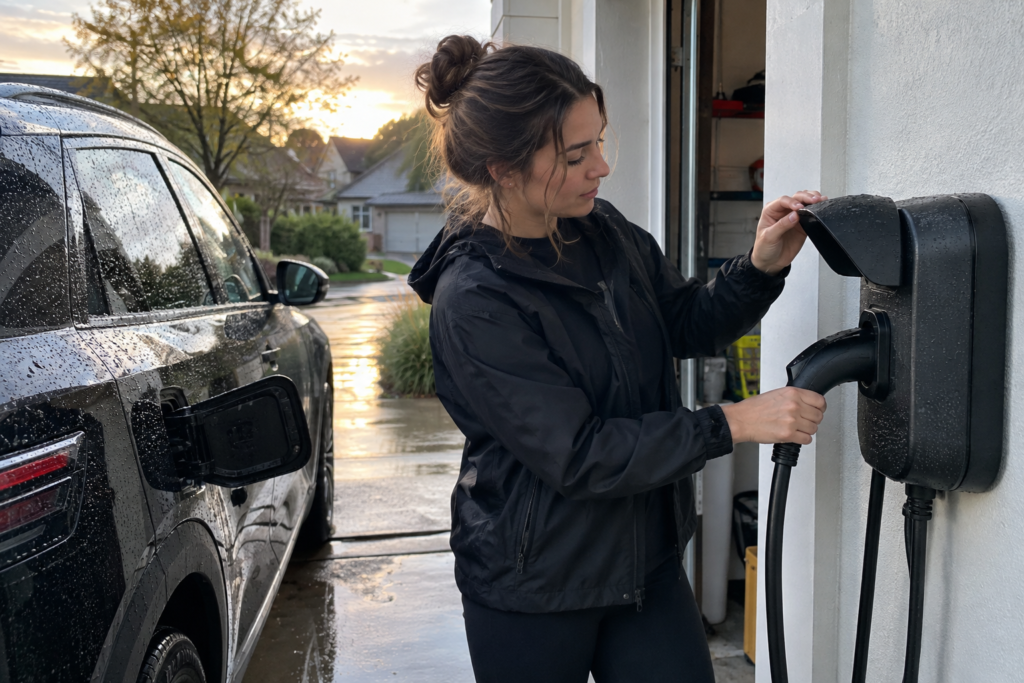
EV charging IP rating meaning starts with protection against solid objects and water under defined test conditions. An IP rating does not by itself prove UV resistance, salt-spray resistance, impact strength, temperature suitability, or safe use in every outdoor condition. Match the IP claim to the exact product, installation, and documentation.
When buyers see a claim such as IP54, IP65, or IP67 on a charging accessory, the two digits are useful—but only if they are read as a limited test result. The code helps compare ingress protection. It does not replace fitment checks, electrical ratings, installation instructions, or evidence for the environment where the accessory will operate.
This matters for connector caps, cable glands, wallbox covers, portable charging accessories, and station-side hardware. A product that performs well in a controlled test can still be a poor choice if its cover is left open, its seal is damaged, its cable entry is installed incorrectly, or its material is exposed to UV and salt that the IP test did not evaluate.
Table of Contents
- What does an IP rating mean for EV charging accessories?
- What does the first IP digit protect against?
- What does the second IP digit protect against?
- How should you read IP ratings in real charging locations?
- What does an IP rating not cover?
- How can buyers verify an IP claim before ordering?
- Conclusion: Treat IP as One Piece of the Site-Fit Decision
- Frequently Asked Questions
- References
What does an IP rating mean for EV charging accessories?
An IP rating is a two-character classification for the degree of protection an enclosure provides against access to hazardous parts and the ingress of solid foreign objects and water. The first characteristic numeral addresses solids and access, while the second addresses water. The system is defined by IEC 60529, not by a general marketing phrase such as “weatherproof.”[1]
The format is normally written as IPXY:
IPidentifies the ingress-protection code.Xis the first numeral, covering solid objects and access to hazardous parts.Yis the second numeral, covering water ingress.
If one characteristic is not declared, the corresponding position may be shown as X, such as IPX4 or IP6X. That does not mean the product has no protection at all. It means that characteristic was not classified in the claim shown. Ask the supplier what was tested before comparing an X claim with a complete two-digit claim.
The code belongs to a defined product and configuration. It may apply to a wallbox enclosure, an accessory housing, a mated connector, or a cover in a particular closed position. It may not apply to every cable entry, open connector, replacement cap, or installation arrangement. Treat the accessory function as a category choice, then check IP evidence against the exact part and use case.
What does the first IP digit protect against?
The first IP digit describes protection against access to hazardous parts and the ingress of solid foreign objects. In everyday EV charging use, it helps buyers think about dust, small particles, tools, fingers, and larger objects entering an enclosure, but it does not describe corrosion, abrasion, or the strength of the housing.
| First digit | Plain-language meaning | What a buyer should not assume |
|---|---|---|
| 0 | No stated protection | The enclosure is not suitable for exposed use |
| 1 | Protection against large solid objects and specified access | Smaller objects or dust are controlled |
| 2 | Protection against finger-sized access and specified objects | Fine particles are excluded |
| 3 | Protection against tools and larger solid objects | Dust-tight performance |
| 4 | Protection against small solid objects above the specified size | Dust cannot enter over time |
| 5 | Dust-protected under the test conditions | No dust can ever enter, or that cleaning is unnecessary |
| 6 | Dust-tight under the test conditions | UV, salt, impact, heat, or chemicals are covered |
The test level is not a measurement of how thick or durable the plastic feels in a hand. It describes the result for the tested enclosure and conditions. A connector cover may resist dust when closed but provide little protection when the connector is exposed, the seal is folded, or debris prevents the cover from seating.
For charging accessories, check the parts that users actually open and close. A cable gland, hinged lid, removable cap, connector boot, drain path, or fastener interface can become the practical weak point even when a product page displays a high first digit. Ask whether the claim applies to the whole assembly or only to a subcomponent.
What does the second IP digit protect against?
The second IP digit describes protection against water under defined test conditions. Higher numbers generally indicate more demanding water exposure, but the number does not mean that an accessory can be placed in any wet environment, submerged indefinitely, or operated safely with an open connector.
| Second digit | Plain-language meaning | Charging-site question |
|---|---|---|
| 0 | No stated water protection | Is the part strictly indoors and protected from splash? |
| 1 | Vertically falling drops | Can condensation or light overhead dripping occur? |
| 2 | Vertically falling drops when tilted within the test condition | Does the installed orientation match the test? |
| 3 | Water sprayed at the specified angles | Could wind-driven rain reach the accessory from another direction? |
| 4 | Water splashed from different directions | Will washing or vehicle spray reach the cover? |
| 5 | Water jets under the specified test condition | Is the site exposed to hose spray or washdown? |
| 6 | More powerful water jets under the specified test condition | Are pressure, distance, angle, and duration controlled? |
| 7 | Temporary immersion to the specified depth and time | Is temporary flooding a realistic site risk? |
| 8 | Continuous immersion to agreed conditions | What depth, duration, and installation limits were agreed? |
| 9 | High-pressure and high-temperature water exposure under the test condition | Does the claim use the correct standard and configuration? |
Do not treat IPX9 and IPX9K as interchangeable. The 9K notation is commonly associated with road-vehicle testing under a different test framework, while IEC 60529 uses its own IP code structure. If an EV accessory is marketed with 9K, request the governing standard, test method, sample configuration, and report rather than translating it into a higher or lower IEC number.
Water protection also depends on use state. A cap can have a strong rating when fully closed but not when the connector is inserted. A wallbox can be tested with its cover, glands, and fasteners correctly installed but lose practical protection if an installer leaves a cable entry open or damages the gasket. The product instructions and tested assembly matter as much as the digits.
How should you read IP ratings in real charging locations?
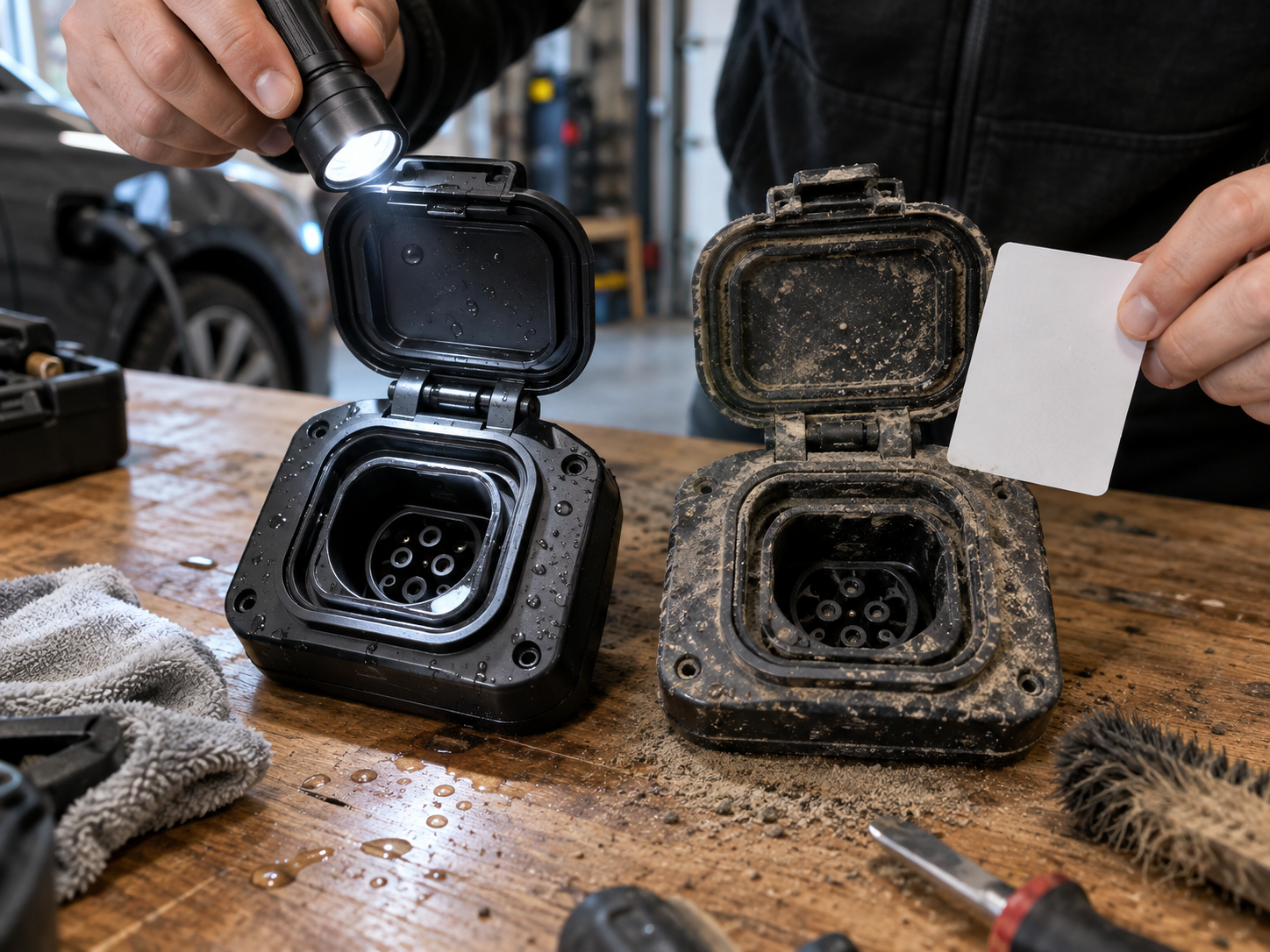
Read the IP code as a condition-specific result, then compare the result with the actual location, orientation, operating state, and maintenance routine. Indoor, covered outdoor, open outdoor, coastal, dusty, and washdown sites can require different evidence even when they use the same charging connector.
| Location or exposure | IP question | Additional evidence to request |
|---|---|---|
| Dry indoor garage | Could dust or cleaning spray reach the part? | Basic enclosure claim, cleaning instructions, and cable-entry details |
| Covered carport | Can wind-driven rain enter from the side or below? | Tested orientation, cover position, drainage, and outdoor-use instruction |
| Open residential driveway | Will rain, snow, sunlight, and temperature cycles occur? | IP report plus UV, temperature, material, and installation limits |
| Fleet depot | Will many users open, drag, clean, and reconnect the accessory? | Cycle or durability evidence, inspection criteria, spare-part plan, and training notes |
| Coastal or salted road environment | Can salt, moisture, and corrosion attack seals or fasteners? | Corrosion or salt-spray evidence, material details, and cleaning routine |
| Washdown or service area | Will a hose or pressure washer be used nearby? | Water-jet test basis, pressure limits, distance, angle, and prohibited cleaning methods |
The same IP number can therefore produce different buying decisions. A connector cap stored under a roof may need a different material and maintenance plan from a cap exposed to road spray and salt. A wallbox mounted on a sheltered wall may not face the same water path as one installed beside an open driveway. The indoor-versus-outdoor site selection guide helps compare sheltered and exposed installations, while the climate-specific accessory guide addresses cold, heat, coastal salt, snow, and UV conditions that an IP code does not describe.
Installation can change the result. Check whether the enclosure must be vertical, whether the cover must remain closed, how a cable gland is tightened, whether a drain hole must stay clear, and whether replacement fasteners or accessories preserve the seal. Charging Electric Vehicles at Home also emphasizes using equipment suitable for the intended location and having electrical work assessed by a qualified professional when required.[3]
Do not use a high IP number to justify an unsuitable site layout. The EV charging station mounting accessories buyer guide is helpful when the site decision involves enclosure orientation, mounting surface, cable entry, fasteners, and exposure together. The IP code answers one part of that installation question.
What does an IP rating not cover?
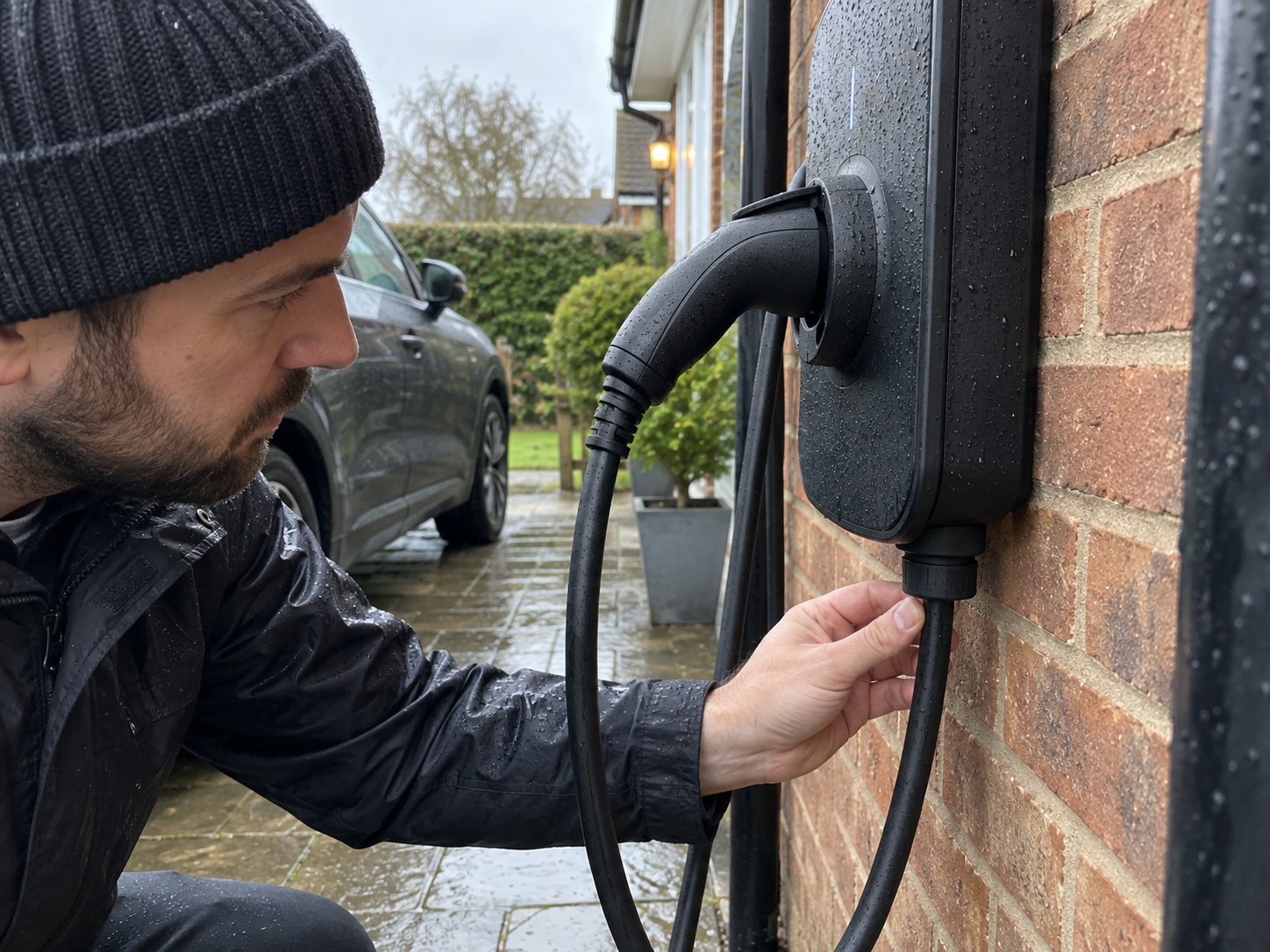
An IP rating does not, by itself, prove resistance to UV, salt spray, impact, abrasion, chemicals, temperature extremes, condensation, freezing, or repeated user handling. It also does not prove electrical compatibility, charging performance, connector fitment, mechanical load capacity, or compliance with every market requirement.
If a charging accessory shows water inside an interface, corrosion, a failed seal, or heat-related damage, use the warning-sign guide to identify stop-use and escalation steps rather than relying on the printed IP code.
Keep these limits visible when reading a product page:
- UV exposure: sunlight can embrittle or discolor some plastics and seals even when the enclosure resists water.
- Salt and corrosion: salt deposits can attack fasteners, contacts, springs, coatings, and seal interfaces. A water-ingress rating is not a salt-spray result.
- Impact: a high IP code does not mean the housing will survive a vehicle strike, a dropped connector, or repeated impact.
- Temperature: the test may not represent the full operating or storage temperature range. Cold can stiffen seals, while heat can change material behavior.
- Chemicals and cleaning: detergents, solvents, oils, tire products, and pressure washing can degrade surfaces or force water past a seal.
- Mechanical wear: hinges, latches, cable glands, and caps can lose fit through cycles even if the original sample passed an ingress test.
- Electrical safety: IP does not prove that the charging current, voltage, phase, communication, grounding, or connector configuration is correct.
- Market approvals: an IP claim is not the same as a certification, listing, declaration, or authorization for a particular market.
This distinction is especially important for connector caps and covers. A cover may protect a disconnected inlet from dust and rain, but it cannot correct a mismatched connector, replace an electrical interlock, or make a damaged cable safe. Before selecting one, compare the actual inlet dimensions, retention method, material, sealing interface, and storage conditions in the EV charging connector caps and covers guide.
How can buyers verify an IP claim before ordering?
Buyers should verify the exact IP claim, test basis, product configuration, installation conditions, and supporting evidence before treating a rating as a purchasing requirement. A claim such as “IP65 housing” is a starting point, not a complete specification.
| Verification area | Questions to send the supplier | Evidence to retain |
|---|---|---|
| Exact product | Which SKU, revision, material, and production version was tested? | Datasheet, label photo, revision, and batch or serial traceability |
| Code scope | Does the rating apply to the enclosure, cable assembly, mated connector, cap, or complete system? | Product drawing and written scope statement |
| Test standard | Was the test performed to IEC 60529 or another named standard? | Test report title, edition, laboratory, date, and report number |
| Configuration | Were covers closed, glands installed, cables connected, and drains configured as in the intended installation? | Test setup photos, instructions, and configuration notes |
| Orientation | Was the tested product vertical, horizontal, tilted, mounted, or free-standing? | Installation drawing and orientation limits |
| Water exposure | What pressure, flow, distance, angle, duration, temperature, depth, or immersion condition applied? | Test parameters and acceptance result |
| Environment beyond IP | What evidence covers UV, salt, corrosion, impact, chemicals, temperature, and cleaning? | Separate test reports, material data, and care instructions |
| Site fit | Does the wallbox, connector, cable gland, cap, and mounting surface match the application? | Fitment drawing, sample photos, and marked-up site layout |
| Ongoing condition | How should users close, clean, inspect, and replace seals or caps? | Manual, maintenance interval, spare-parts list, and stop-use criteria |
| Market file | Are declarations, listings, labels, and language requirements needed for the destination market? | Document pack and controlled revision record |
For a sample order, test the accessory in the state in which it will actually be used. Check the seal compression, hinge or latch alignment, cover closure, cable exit, fastener seating, and drainage. Photograph the product before and after the sample test, but do not describe an in-house splash check as an IEC certification unless a recognized test has actually been performed and documented.
When the rating is a deciding factor, the EV charging accessories certifications and test documents checklist helps separate a product label from the evidence needed for a market or customer file. For cable and connector condition, add the EV charging cable quality inspection checklist so seal damage, jacket wear, and contamination are recorded alongside the IP claim.
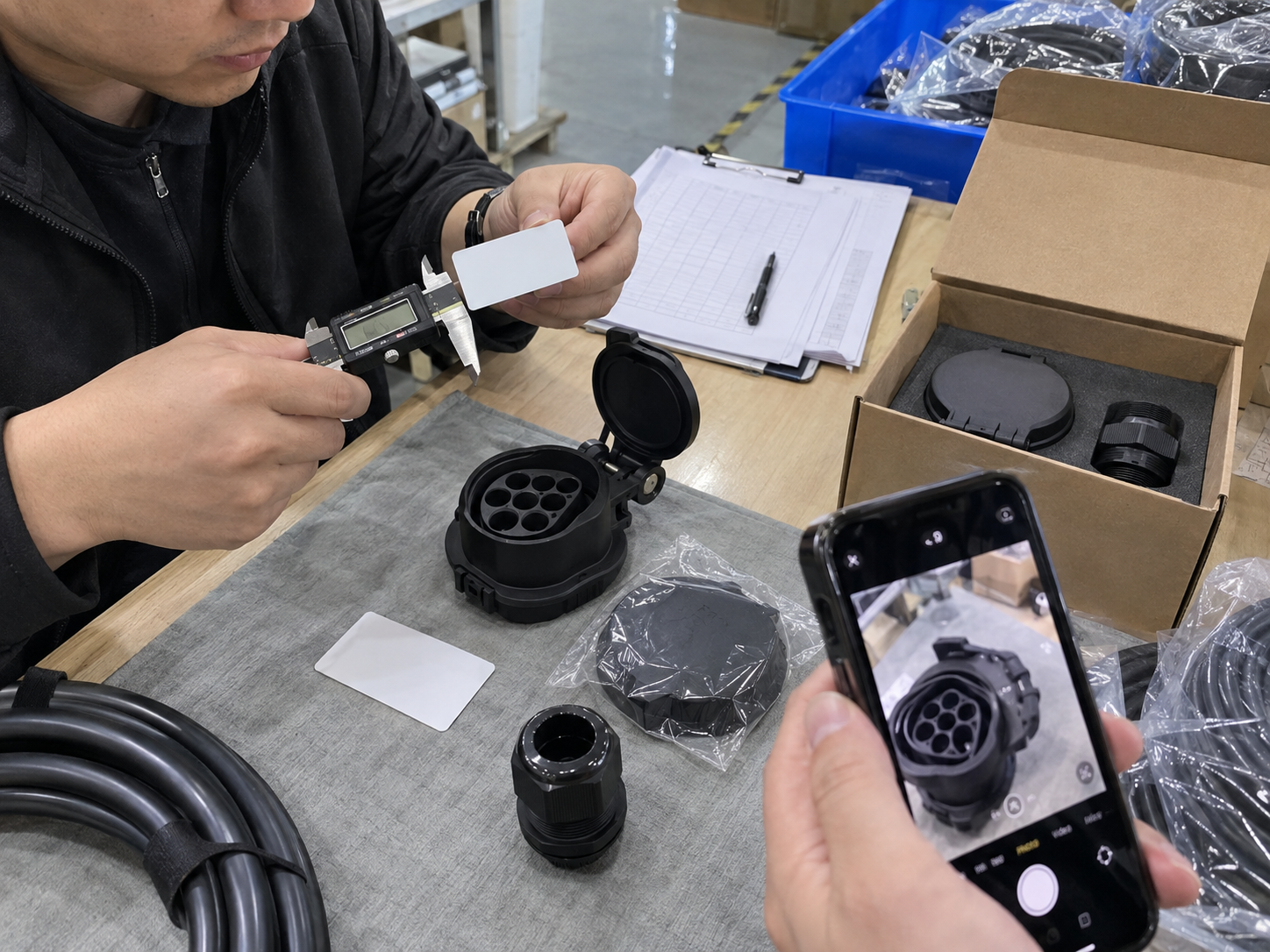
Use this short request when asking a supplier for clarification:
> Product and revision: > Claimed IP code: > Scope of claim: enclosure, connector, cap, cable assembly, or complete system: > Governing test standard and edition: > Mated or unmated state, cover position, cable entry, orientation, and mounting condition: > Water and dust test parameters: > Separate UV, salt, corrosion, impact, chemical, and temperature evidence: > Datasheet, manual, test report, declaration, label, and traceability documents: > Site exposure: indoor/outdoor, rain, washdown, dust, coastal salt, UV, temperature, and cleaning: > Supplier confirmation of inclusions, exclusions, change control, and quotation validity:
The goal is not to select the highest number. The goal is to select a claim that matches the actual exposure and can be supported by a controlled document set. If a supplier cannot state the tested configuration or provides only a badge with no product-specific evidence, keep the rating unverified and request clarification before ordering.
If you are comparing an EV charging accessory for indoor, outdoor, coastal, fleet, or washdown use, send the exact SKU, claimed IP code, installation state, exposure conditions, and required document list. We can help organize the claim into a product-specific IP review instead of treating one number as a complete site approval.
Conclusion: Treat IP as One Piece of the Site-Fit Decision
An EV charging IP rating is valuable because it gives buyers a common way to discuss solid-object and water ingress protection. Its value depends on the exact product, tested configuration, installation orientation, exposure, and supporting evidence. IP does not automatically cover UV, salt, impact, temperature, chemicals, mechanical wear, electrical compatibility, or market approval.
Use the code to ask better questions: What do the first and second digits cover? Was the tested state the same as the installed state? Which standard and edition were used? What evidence covers the environmental risks outside IP? Once those answers are documented, the rating becomes a useful part of a responsible charging-accessory decision.
When the site, product, and evidence are ready to compare together, the EV charging accessories buying guide organizes the broader selection around fitment, limits, evidence, operations, and supply.
Frequently Asked Questions
What is the difference between IP54 and IP65 for an EV charging accessory?
The first digit differs: 5 indicates dust-protected conditions, while 6 indicates dust-tight conditions under the applicable test. The second digit differs: 4 concerns splashing water, while 5 concerns water jets under the specified test condition. Neither code alone proves UV, salt, impact, temperature, or complete outdoor suitability.
Is IP65 waterproof?
“Waterproof” is too broad to be a safe interpretation. IP65 indicates protection against dust under the test condition and water jets under the applicable condition. It does not mean permanent submersion, pressure-washer resistance in every direction, or safe operation with an open cover or damaged seal.
Is IP67 better than IP65 for outdoor EV charging?
IP67 adds a temporary-immersion classification, while IP65 addresses water jets. “Better” depends on the exposure. A product can meet a particular water test and still need separate evidence for UV, salt, impact, temperature, installation orientation, or frequent handling. Match the test to the actual site risk.
Does an IP rating cover the EV charging cable?
Not automatically. The claim may apply only to an enclosure, connector when mated, cap, cable gland, or complete assembly in a defined configuration. Ask the supplier to identify the scope and check the cable jacket, connector boot, bend path, and entry point separately.
Can I use an IP-rated accessory in a coastal environment?
Only after checking evidence beyond the IP code. Coastal exposure adds salt, corrosion, UV, wind-driven rain, and cleaning requirements. Request material, coating, corrosion, UV, temperature, and maintenance information, then confirm that the exact installation and replacement parts preserve the sealing interface.
Does IP rating prove electrical safety or connector compatibility?
No. IP classification concerns ingress protection and access-related enclosure protection. It does not prove voltage, current, phase, communication, grounding, connector fitment, charging performance, or market certification. Those questions require separate product specifications, fitment checks, instructions, and evidence.
References
[1] International Electrotechnical Commission. “IEC 60529:1989, Degrees of protection provided by enclosures (IP Code).” 1989.
[2] International Electrotechnical Commission. “IEC 60529:1989+A1:1999+A2:2013, Degrees of protection provided by enclosures (IP Code), consolidated version.” 2013.
[3] U.S. Department of Energy, Alternative Fuels Data Center. “Charging Electric Vehicles at Home.” n.d.







