



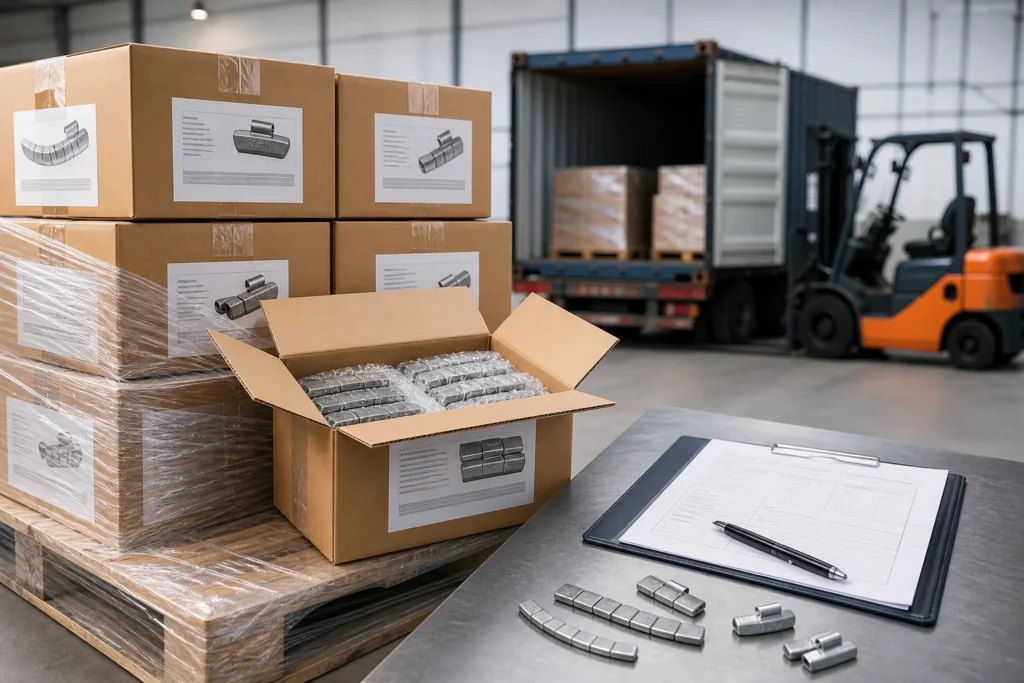
Wheel weight shipping should be planned from the confirmed SKU, carton, pallet, destination, Incoterms, documents, inspection point, and receiving process. Buyers need to clarify responsibility for freight, insurance, export formalities, and import clearance with their chosen provider rather than assuming a quotation covers every shipping cost or risk.
Table of Contents
- What should a wheel weight shipping plan define?
- How should buyers define shipping scope before a PO?
- How should buyers match Incoterms to responsibility?
- What carton and pallet data should buyers check?
- Which documents should be prepared before shipment?
- How should buyers plan inspection and receiving?
- Conclusion: make the handover and receiving plan part of the order
- Frequently Asked Questions
- References
What should a wheel weight shipping plan define?
A wheel weight shipping plan defines the goods, the pack, the handover point, the documents, and the destination workflow before the PO is released. It should tell every party what is moving, how it is identified, how it is protected, who arranges each leg, which records accompany it, and what the receiving team will check when it arrives.
The plan starts with the same product and packaging choices that have to survive the shipping plan that shape the order itself: adhesive or clip-on format, material, profile/increment or segment range, coating/tape, inner pack, master carton, labels, and pallet plan. A generic description such as "wheel weights, export packing included" does not give the importer enough information to book freight, prepare a warehouse, or compare delivery scope across suppliers.
It also needs to distinguish factory-ready from delivery. The milestones that separate factory-ready status from destination receipt are useful for this purpose. A factory-ready date means the approved goods are ready for a defined release; it does not, by itself, mean cargo has been handed to a carrier, departed, cleared at destination, or been received into the buyer's inventory.
| Shipping-plan field | Decision to confirm | Why the buyer needs it |
|---|---|---|
| Goods description | Buyer SKU, product type, material, units, pack count, quantity | Keeps PO, carton label, packing list, invoice, and receiving record aligned |
| Packaging hierarchy | Inner pack, master carton, pallet, wrap, and protection | Allows freight planning and protects adhesive liners, coatings, labels, and sorted SKUs |
| Delivery term | Incoterms version, named place/port, and contractual handover point | Clarifies the point that the parties mean by delivery in the contract |
| Transport scope | Pickup, export process, main carriage, insurance, destination handling | Prevents assumptions about who is booking or paying for a step |
| Documentation | Invoice, packing list, product/material records, transport data, destination-requested items | Lets importer and broker review requirements before goods move |
| Release and receiving | Inspection point, cargo handover evidence, warehouse checks, exception procedure | Connects the approved order to the cartons that actually arrive |
This is operational planning, not legal or customs advice. Import classification, taxes, permits, origin treatment, restricted-substance requirements, and clearance procedure vary by jurisdiction and product. Confirm current destination obligations and the appropriate trade term with the importer's customs broker, freight forwarder, and qualified advisers before shipment.
How should buyers define shipping scope before a PO?
Define shipping scope in the same detail as product scope. The buyer and seller should know the named place or port, the intended transport mode, who arranges pickup, who handles export formalities, who contracts the main carriage, whether insurance is required and by whom, who handles import clearance, and where the buyer wants the shipment considered complete for planning purposes.
Do not rely on shorthand such as "sea shipping included" or "door delivery." Those phrases do not reveal the delivery point, risk transfer, customs responsibility, carrier arrangement, terminal charges, insurance, or final unloading/warehouse activity. Record the exact commercial term and version if one is agreed, together with the named place or port and any additional logistics instructions.
| Scope question | Example of the needed clarity |
|---|---|
| Delivery point | State the named factory, carrier handover place, port, terminal, or destination point rather than a country name alone |
| Transport arrangement | Identify whether the buyer, seller, or a named logistics provider is responsible for booking each leg |
| Export process | State which party prepares/arranges export formalities and which documents the other party must provide |
| Main carriage and insurance | State who contracts/pays, what coverage is requested if any, and which handover evidence will be shared |
| Import and destination | State who appoints the broker, handles import clearance, pays destination charges, and receives the goods |
| Delivery evidence | Define the carrier record, transport reference, receipt, and claim-notification route needed by the buyer |
Ask every supplier to answer these fields against the same SKU and packout. This is the only dependable way to compare a factory-price offer with a port delivery, a terminal handover, or a destination delivery proposal. Total cost and delivery risk can move even when the product price is unchanged.
Payment should be planned with the same discipline: use payment milestones that match approval, inspection, and shipment evidence so deposits, balance payment, release, and shipment records correspond to events the buyer can actually verify.
How should buyers match Incoterms to responsibility?
Buyers should use an Incoterms rule only after they understand the operational responsibility it allocates and the exact named place at which it applies. The rule helps structure seller and buyer tasks, costs, and risk; it does not automatically define product specification, payment terms, title, transit duration, insurance adequacy, or every local customs obligation.
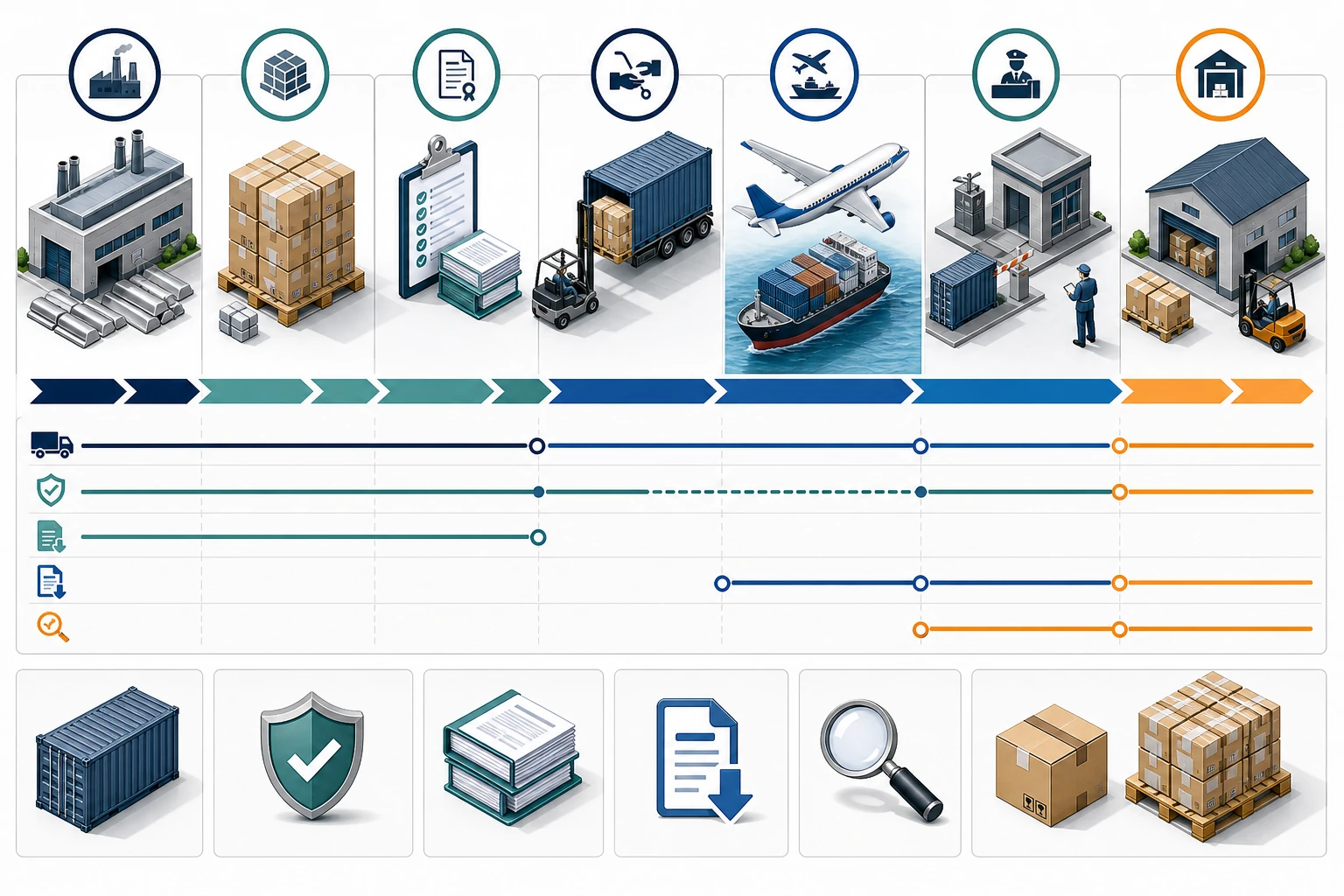
A delivery term only works when the named place and each party's operational responsibilities are written into the order plan.
ICC explains that the word "delivery" in an Incoterms context is tied to a defined point of risk transfer and may not mean the same thing as physical arrival at the buyer's warehouse. 1 This distinction is central to wheel-weight import planning: cargo can be delivered under the contract at one point while the buyer still has transport, import, or warehouse work ahead.
Use a responsibility matrix with the forwarder and seller rather than a generic term comparison:
| Responsibility area | Questions to resolve in the order plan |
|---|---|
| Packing and marks | Who provides the carton/pallet plan and buyer-required marks? Who approves label evidence? |
| Collection and handover | Where exactly does the carrier take charge, and who books pickup? |
| Export process | Who handles export formalities and supplies data to the forwarder? |
| Main carriage | Who selects and pays the carrier/route, and who receives milestone updates? |
| Insurance | Is insurance required by contract or buyer policy, and who arranges it? |
| Import clearance | Who appoints the broker, supplies documents, confirms classification, and pays applicable charges? |
| Final receiving | Who arranges local delivery, unloading, damage notice, and warehouse receipt? |
The ICC's Incoterms checklist highlights that the rules allocate costs and risks and require a precise chosen term/place in the sales arrangement. 2 Use that framework with a qualified provider. A term that is practical for one route, container arrangement, or importer may be unsuitable for another.
What carton and pallet data should buyers check?
Buyers should check carton and pallet data as part of the product specification because wheel weights are dense, often supplied in multiple close-looking SKUs, and may include adhesive liners or coated surfaces that need protection. The shipping plan should show how the goods stay sorted, identifiable, and stable from the factory through the buyer's receiving process.
For the product-level detail, use bulk carton and pallet details behind an import-ready order. It helps buyers connect the physical packout to the SKU mix and warehouse handling plan instead of asking only for a carton count.
| Packing level | Data to request | Wheel-weight risk it controls |
|---|---|---|
| Product/inner pack | SKU, material/unit, increment/profile or segment layout, pieces, protection/orientation | Prevents adjacent products from being mixed and protects strips, liners, or finish |
| Master carton | Inner-pack count, gross/net weight, dimensions, buyer SKU list, carton mark, lot field if agreed | Supports freight quote, handling, receiving, and claim investigation |
| Pallet | Cartons per layer/pallet, dimensions, gross weight, wrap/corner protection, label position | Supports loading plan, warehouse space, and handling stability |
| Shipping mark | Consignee/PO fields, carton/pallet identity, handling information, destination data as required | Links physical goods with shipment documents and receiving instructions |
Illustrative carton and pallet calculation
The following values are a planning example, not Yirox packing data or a freight quotation. Assume an order contains 480 master cartons. Each packed carton is reported as 20.5 kg gross and 38 x 28 x 16 cm. The buyer plans 40 cartons per pallet and uses 12 pallets weighing 22 kg each, with a loaded pallet envelope of 1.20 x 1.00 x 0.80 m.
| Shipping input | Calculation | Example result |
|---|---|---|
| Carton gross weight | 480 cartons x 20.5 kg | 9,840 kg |
| Loose-carton volume | 480 x 0.38 m x 0.28 m x 0.16 m | 8.17 m3 |
| Pallet count | 480 cartons / 40 cartons per pallet | 12 pallets |
| Pallet tare weight | 12 pallets x 22 kg | 264 kg |
| Palletized gross weight | 9,840 kg + 264 kg | 10,104 kg |
| Palletized envelope volume | 12 x 1.20 m x 1.00 m x 0.80 m | 11.52 m3 |
| Gross weight per loaded pallet | 40 cartons x 20.5 kg + 22 kg | 842 kg |
The loose cartons occupy about 8.17 m3, while the palletized shipment uses an 11.52 m3 loading envelope. A freight request that quotes only carton volume understates the space used by the planned pallet configuration. Conversely, wheel weights are dense, so gross weight and pallet handling limits may control the transport or warehouse plan even when the volume appears modest.
Ask the supplier to provide both loose-carton and final palletized data, then have the forwarder determine how the route will be rated. Confirm floor-loading limits, pallet and forklift capacity, carrier restrictions, and destination unloading capability rather than assuming that every 842 kg pallet is acceptable. For a mixed-SKU order, reconcile the 480 cartons by SKU before calculating totals so a correct shipment weight does not hide an incorrect assortment.
Ask to see a packed sample, carton drawing, or final packing photos before a first bulk shipment. Adhesive strips should remain flat enough for the intended installation and have liner edges protected from dust, crushing, and premature exposure. Clip-on weights should remain sorted by profile and increment, with surface finish protected from rubbing or water damage.
If raw-wood pallets, dunnage, or other wood packaging material will accompany the cargo, verify destination requirements with the broker and logistics provider. IPPC's ISPM 15 framework addresses phytosanitary risks associated with wood packaging material in international trade and uses an internationally recognized mark for treated material. 3 Whether a particular shipment needs wood packaging, the applicable treatment/mark, or an alternative must be confirmed for the destination; do not infer compliance from a pallet's appearance.
Which documents should be prepared before shipment?
Prepare documents while the goods are being packed, not after the carrier arrives. The exact set depends on the contract, delivery term, destination, product, and buyer/customer requirement. The working principle is consistency: the purchase order, product description, labels, packing list, commercial invoice, transport data, and any supporting product records should describe the same shipment.
Use product and shipping documents to prepare before cargo handover to create the product-specific file. It is most helpful once the buyer knows the intended SKU, destination, shipping term, and consignee requirements; it cannot replace importer/broker advice on current national customs rules.
| Record | Buyer check before cargo handover |
|---|---|
| Purchase order and approved SKU sheet | Material, format/profile, increments, pack count, labels, and revision match the final order |
| Commercial invoice | Seller/buyer details, agreed product description, quantity/value basis, and sales terms are correct |
| Packing list | Carton/pallet count, SKU quantities, weights, dimensions, and marks reconcile to the packed goods |
| Transport/booking data | Named handover point, consignee/notify details, pickup or booking reference, and route details are correct |
| Product/material or customer-requested record | Scope covers the ordered SKU and uses the agreed product description |
| Origin, insurance, or destination-specific records if required | Buyer/broker has confirmed whether they are needed and who supplies each item |
For warehouse and logistics identification, GS1 guidance distinguishes trade-item labels on cartons/outer cases from labels used for logistics units and explains how identifiers can connect physical movement with electronic records. 4 A wheel-weight importer does not need to apply every GS1 option. It should decide which barcode, SKU, lot, quantity, and pallet identifiers its receiving and customer systems actually require, then test them on the packed sample.
How should buyers plan inspection and receiving?
Plan inspection and receiving as two connected controls: the first confirms that goods ready to ship match the approval record; the second confirms that goods received match the expected shipment and arrived in acceptable condition. Neither replaces the other. A clean pre-shipment sample does not prove that a carrier or terminal did not damage a carton, and an intact pallet does not prove that the supplier used the approved product configuration.
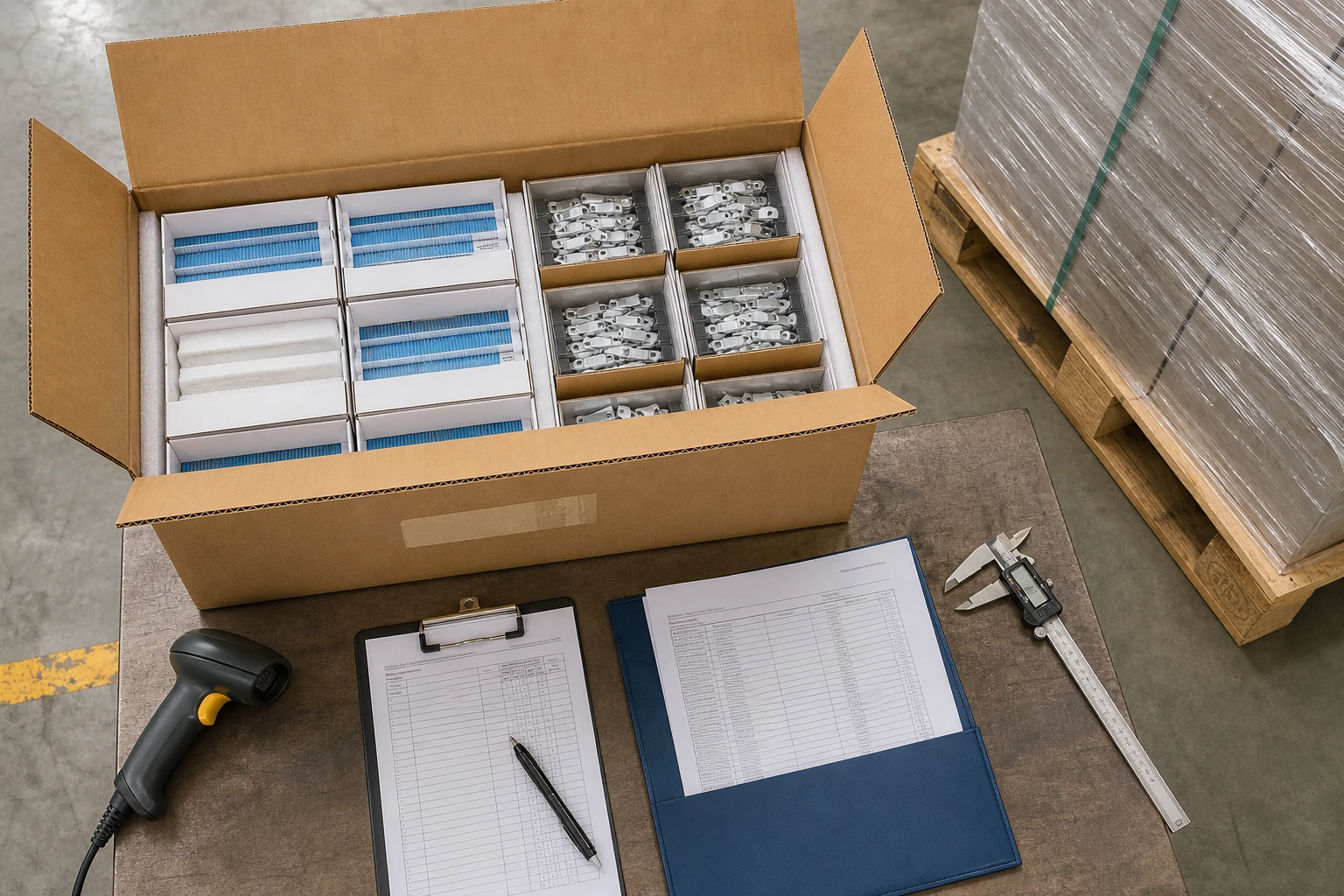
Receiving controls should connect the cartons and pallets that arrive with the SKU, quantity, lot, and documents that were approved.
Use pre-shipment checks that connect approved products to loaded cartons to define the factory-side release. Then prepare a receiving checklist for the importer or warehouse:
- Compare the delivery reference, pallet/carton count, and visible marks with the transport and packing records.
- Photograph damaged wrap, wet or crushed cartons, broken seals, or incorrect labels before the goods are redistributed.
- Check a sensible sample of inner packs for SKU, unit, quantity, product orientation, liner/finish condition, and lot field where used.
- Scan barcode/label data where the program uses it and reconcile it to the expected SKU and pack count.
- Isolate variances, preserve the related carton/pallet identity, and notify the appropriate seller, carrier, insurer, broker, or warehouse contact within the agreed process.
The right inspection point depends on risk and contract. A first order, private-label launch, mixed-SKU pallet, or adhesive product sensitive to liner/pack damage may justify more detailed inspection than a stable repeat order. Decide the scope before shipment and make sure it fits the carrier handover and any claim-notification requirement.
If you are planning an imported wheel-weight order, share the destination, Incoterm preference, carton details, documentation needs, and required delivery window. We can help you align the product, packing, handover, and receiving brief before quotation.
Conclusion: make the handover and receiving plan part of the order
Wheel weight shipping works best when the goods, packing, handover, documents, and receiving process are approved as one order plan. State the SKU and pack hierarchy clearly, use a precise delivery term/version and named place, confirm responsibilities with the forwarder and qualified advisers, and keep the document pack aligned with the cartons and pallets.
The goal is not to memorize Incoterms labels. It is to make the next handover and receiving event unambiguous for the people who must pack, book, clear, unload, and reconcile the shipment. Request packing and shipment data for the planned order once the buyer has a confirmed SKU list, destination, delivery basis, and receiving requirements.
Frequently Asked Questions
Does an Incoterms rule include every shipping cost and responsibility?
No. An Incoterms rule allocates defined delivery, cost, risk, and task responsibilities between seller and buyer, but the sales contract and logistics plan still need a precise named place, product/packing requirements, payment terms, insurance decisions, and destination-specific customs arrangements. Confirm the current interpretation with qualified advisers and the forwarder.
What information should be on a wheel weight master-carton label?
The label should contain the fields needed for the buyer's warehouse and customers to identify the product, such as buyer SKU, product description, material or unit where relevant, profile/increment or strip format, quantity, carton identity, and lot field if used. Confirm barcode, language, and destination fields before printing.
Do wheel weight shipments need wood pallets?
Not always. The carrier, warehouse, destination, load plan, and buyer handling requirements determine whether pallets are used. If wood packaging material is used, confirm current destination requirements, treatment/marking expectations, and acceptable alternatives with the broker and logistics provider.
When should import documents be reviewed?
Review the required information before production and again while packing is underway, not after cargo handover. This gives the supplier, buyer, broker, and forwarder time to correct product descriptions, carton counts, consignee information, and destination-specific requests before the goods move.
How can a buyer reduce damage and receiving disputes?
Approve a packed sample, define carton/pallet/label data, photograph the pre-shipment condition, record the handover reference, inspect shipment condition on arrival, and isolate/document any variance before stock is mixed into the warehouse. Those controls preserve the evidence needed for a practical claim discussion.
References
[1] International Chamber of Commerce. “Place of Delivery and Risk Transfer in International Trade Contracts.” 2025.
[2] International Chamber of Commerce. “Incoterms 2020 Checklist and Flowcharts.” 2024.
[3] International Plant Protection Convention. “Guide to Regulation of Wood Packaging Material.” 2023.
[4] GS1. “GS1 Logistic Label Guideline.” 2026.