



Choose a wheel weight manufacturer by matching a defined product requirement to an identifiable production source. Before shortlisting, ask for the exact configuration, suitable samples, packaging details, and written responsibility for quality and changes. Advance candidates that can support those requirements; clarify incomplete answers and reject unresolved mismatches before committing to an order.
An attractive sample and a low unit price leave several questions unanswered. The quote may cover a different finish, tape, increment, clip profile, or pack from the item you expect to receive. Choosing a source starts with making those differences visible, then deciding which candidates deserve a closer review.
The first decision is whether a candidate is worth pursuing. Factory verification, product testing, and final sample approval follow once the product and responsible parties are clear. Keeping those stages separate helps you request the right evidence without treating a catalog, certificate, or sales video as final approval.
Table of Contents
- What should you define before contacting manufacturers?
- How can you tell who is responsible for the product?
- What should a wheel weight product listing actually tell you?
- Which answers should advance, pause, or reject a candidate?
- How do you compare candidates without rewarding vague promises?
- What evidence belongs after the initial shortlist?
- What should you put in the first RFQ?
- When is it worth moving to a deeper factory review?
- Conclusion: Choose a source for an identified product
- Frequently Asked Questions
- References
What should you define before contacting manufacturers?
Define the application, attachment format, material, weight increments, and intended pack before requesting a price. If some details are undecided, identify them as questions instead of letting each candidate make a different assumption.
Start with the wheel and service use. A clip-on inquiry needs the intended rim-flange fitment or a reference sample that can be identified. An adhesive inquiry needs the strip format and a way to confirm available placement space and installation conditions. A general request for “car wheel weights” gives the recipient too much room to quote a convenient product rather than the one you need.
If you are still choosing between product families, compare the wheel weight formats and applications before asking several sources to price them. Then keep the initial requirement brief small enough to use consistently.
| Requirement | State it in the inquiry | If it is undecided |
|---|---|---|
| Application and attachment | Target wheel use; adhesive or clip-on; fitment reference where needed | Ask which configurations fit that application and what must be checked |
| Material and finish | Body material and surface finish as separate fields | Request identified alternatives with separate quotes |
| Increment and unit | Grams or ounces; segment pattern or clip-on sizes | Request a proposed size list before setting quantities |
| Packaging and quantity | Strips, pieces, bags, or boxes; required labels | Ask for the count hierarchy and carton data |
| Acceptance and changes | Required evidence and who approves substitutions | Ask the candidate to propose a written approval route |
Destination and customer requirements also belong in the brief. Ask which material and product documents are available for that destination, then have the applicable requirements checked before approval. A broad statement such as “suitable for export” does not identify what the quoted item actually satisfies.
How can you tell who is responsible for the product?
Ask who makes the quoted item, who controls each relevant outside process, and who handles a nonconforming delivery. A company label such as manufacturer, exporter, or trading supplier does not answer those questions by itself.
The initial response should connect the seller to a named production source for the requested product family. Ask for the legal seller, production location, and a short description of the work performed there. Where coating, tape conversion, or packing is outsourced, ask who controls the specification and accepts the incoming work.
A supply partner can coordinate a useful program, while a manufacturer can rely on outside processors. Evaluate the arrangement through its responsibilities and evidence. There is no need to reject a candidate solely because every step is not performed under one roof.
| Responsibility | First-stage question | Useful answer |
|---|---|---|
| Product source | Which site makes this quoted family? | Identified site and product route, with evidence available for later review |
| Specification | Who controls the drawing, material, finish, and tape version? | Named responsible function and an identifiable specification |
| Release | Who decides whether the finished lot can ship? | Defined release responsibility and a sample record available for review |
| Changes and complaints | Who approves changes and responds to a mismatch? | Written contact, approval route, and proposed remedy process |
Watch for contradictions: a quotation naming one company, a sample label naming another, and a certificate covering a third unrelated site. Request an explanation linking the parties and product. Pause if the relationship remains unclear, rather than treating an impressive document as proof of the quoted source.
What should a wheel weight product listing actually tell you?
A useful listing identifies the product well enough to request a matching quote and sample. It should separate the body material, nominal weight pattern, finish, attachment, and packing; missing performance details still need confirmation.
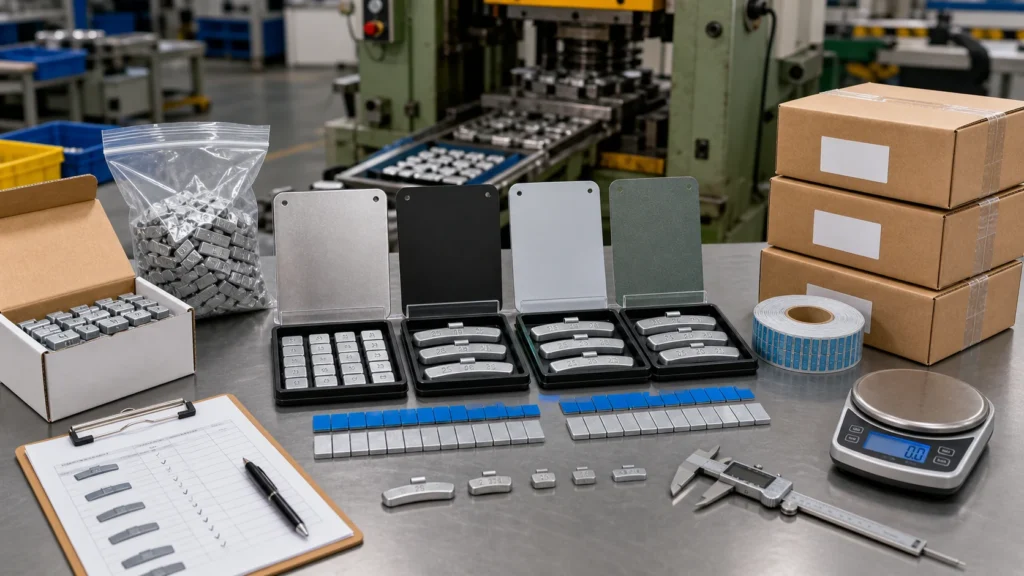
For a concrete catalog example, Yirox's YRX-01-FE-001Z is listed as a rectangular FE adhesive wheel weight with a zinc surface finish, 5g × 12 segments, and 25 strips per bag, four bags per box. Those fields describe one catalog configuration rather than every product in the range.
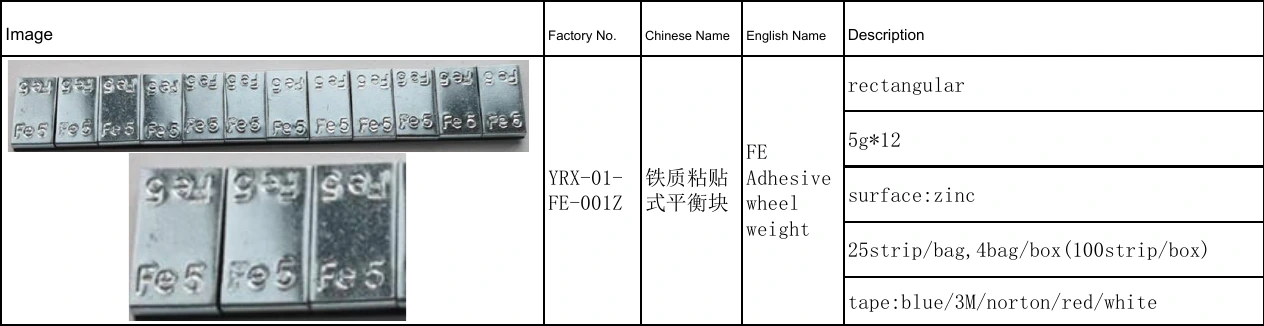
| Catalog field | Listed value | What still needs confirmation |
|---|---|---|
| Item identity | YRX-01-FE-001Z | Current quoted revision and matching sample identity |
| Body material | FE | Agreed material specification and supporting document |
| Nominal pattern | 5g × 12 | Measurement method and agreed acceptance limits |
| Surface | Zinc finish | Finish specification and any required test evidence |
| Packing | 25 strips/bag; four bags/box; 100 strips/box | Outer-carton count, gross weight, labels, and current packing offer |
| Tape | Catalog lists several options | Exact selected tape, liner, storage information, and application instructions |
Catalog values are not a batch inspection result. They do not establish measured weight accuracy, adhesive retention, corrosion performance, current MOQ, or delivery time. Request those details for the particular quotation.
The distinction between material and finish matters here: an FE body with a zinc finish is different from a zinc body. A quote that simply says “zinc wheel weights” leaves the construction ambiguous. Resolve that wording before comparing prices or approving a material statement.
The packing arithmetic also exposes a useful question. Twelve nominal 5g segments represent 60g of balancing mass per strip; 100 strips represent 6,000g of nominal balancing mass. That calculation is not the packed shipping weight. Ask for the actual gross weight and carton configuration separately.
To compare other configurations, use the wheel balancing weight range to identify a product family, then request the same level of detail. A photograph or a model code alone leaves important decisions open.
Which answers should advance, pause, or reject a candidate?
Advance a candidate when its answers connect the requested product, responsible source, samples, and commercial scope. Clarify a limited gap; hold a decision while important evidence is missing; reject a candidate when an unresolved contradiction or refusal prevents a meaningful comparison.
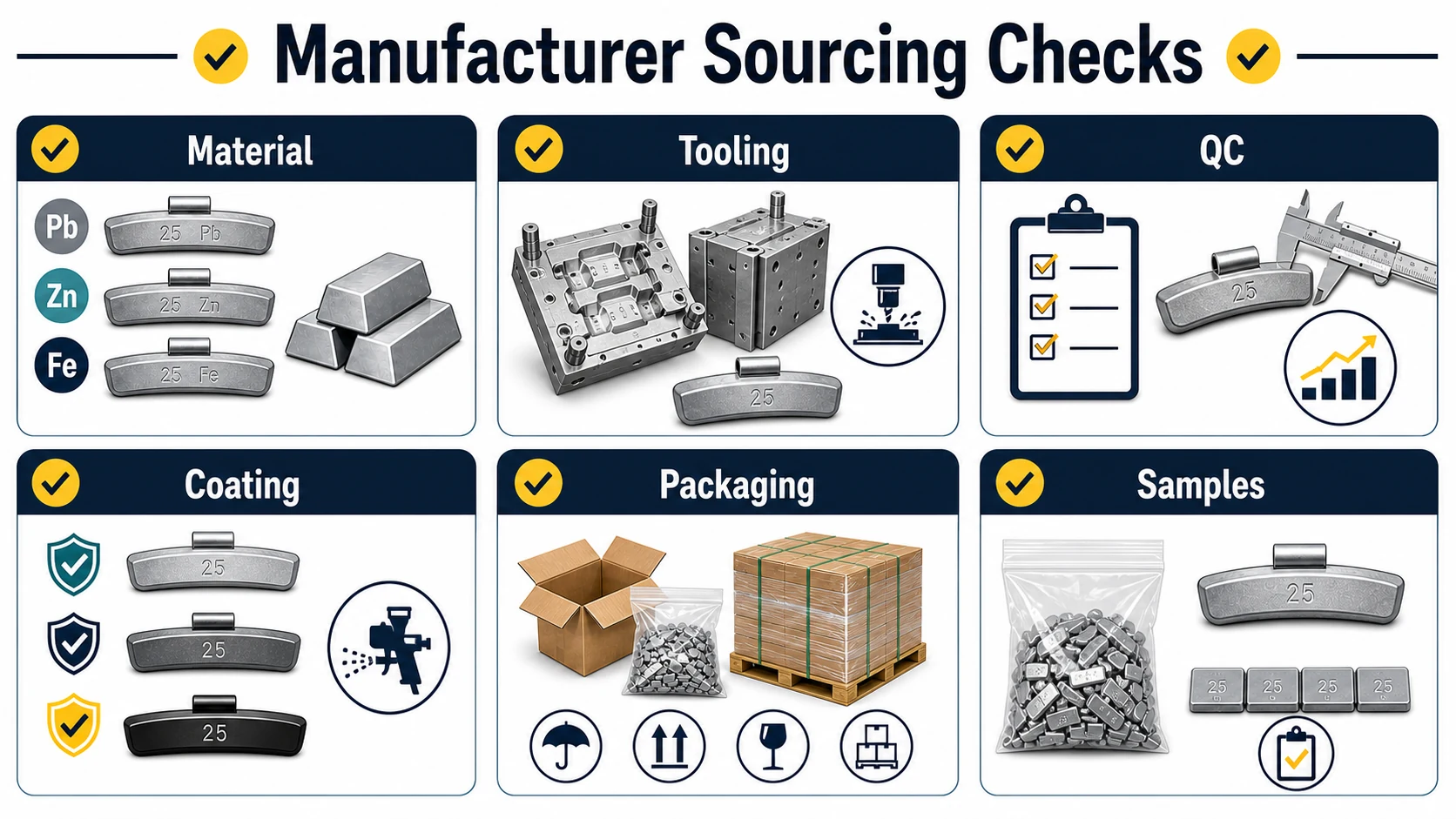
Use decision labels with a written reason. “Advance” means the candidate deserves the next qualification step, not that the factory or order is approved.
| Decision | Typical situation | Action |
|---|---|---|
| Advance | Quoted configuration matches the brief; source and responsibilities are identified; suitable samples and evidence can be requested | Agree the sample and evidence review |
| Clarify | One bounded issue remains, such as bag count or the finish name | Ask one specific question and record the corrected offer |
| Hold | Product identity, source relationship, sample version, or required evidence remains uncertain | Pause approval and commercial commitment until the gap is resolved |
| Reject | Candidate refuses necessary identification, leaves conflicting product claims unresolved, or proposes unapproved substitutions as acceptable | Record the reason and remove the candidate from this comparison |
A low price is a reason to check the quoted scope. Ask whether the material, tape, pack, label, inspection, and delivery terms match the other offer. If the differences are identified and acceptable, the quote remains useful. If the scope cannot be established, the price is not yet comparable.
Apply the same logic to a certificate or a polished sample. Both can justify further investigation, but neither fills an unrelated information gap. Keep the decision attached to the requested product and the evidence actually available.
How do you compare candidates without rewarding vague promises?
Use the same requirement version and record each candidate's evidence, unresolved gap, and next action. Keep price visible, but do not let a numerical score cancel a missing mandatory requirement.
A simple comparison sheet is often enough for the first shortlist:
| Comparison field | Record for every candidate |
|---|---|
| Quoted item | Model or temporary code; configuration; quotation revision |
| Responsible source | Seller, production site, relevant outside-process responsibility |
| Sample offer | What will be sent, how it is identified, and what stage it represents |
| Evidence offered | Named documents or records relevant to the requested item |
| Commercial scope | Quantity unit, packing, MOQ, sample or tooling costs, lead time, and delivery term |
| Open issue | Exact question, responsible contact, and expected response date |
| Decision | Advance, clarify, hold, or reject, with the reason |
Write “not yet provided” where evidence is missing. An unanswered question is different from a confirmed failure, and an offered report is different from one you have reviewed. This distinction keeps a cooperative sales response from becoming an approval by accident.
Keep alternative constructions on separate lines. If Candidate A quotes the catalog FE strip with a zinc finish and Candidate B offers a different tape or finish, ask whether B can quote the same requirement. If you decide to evaluate the alternative, give it a separate identifier and approval path.
What evidence belongs after the initial shortlist?
Shortlisted candidates should move to identified samples and product-specific evidence. Agree what will be checked before asking for a general bundle of certificates or signing off a sample.
ISO 9001 concerns quality management systems.1 Use a claimed certification as a prompt to check the holder, site, scope, and validity, then ask how the relevant product is controlled. A certificate does not replace an agreed specification or inspection result for the order you intend to buy.
For adhesive products, request the selected tape's application and storage information. 3M's wheel weight system instructions discuss surface preparation, positioning, application conditions, and pressurization for its system.2 That is a useful reminder to obtain product-specific instructions; its numerical conditions should not automatically be transferred to a different adhesive strip.
For coated products, ask for the method, conditions, acceptance criterion, and item represented by any test report. Avoid comparing two claimed test durations until those details are understood. For clip-on products, identify the intended rim interface and the proposed fitment checks before treating a familiar-looking clip as an approved match.
When the candidate is ready to supply identified samples, use a product-specific wheel weight QC checklist to define the inspection agreement. That next stage should record the sample identity, method, results, and disposition rather than repeat the first-stage company screen.
What should you put in the first RFQ?
The first RFQ should name the product you want, expose undecided choices, and request a quotation whose unit and scope are clear. It should also tell the recipient what evidence and samples you need before approval.
A copy-and-send inquiry format
- Application: State the wheel or service use and destination market. Attach a fitment reference or drawing where relevant.
- Product: State adhesive or clip-on format, requested model or reference sample, body material, finish, and weight increments.
- Quantity: Give quantities by item and define whether the unit is a strip, piece, bag, or box. Ask for MOQ per item and any mixed-order rule.
- Unresolved choices: List each open detail and request separately identified alternatives rather than silent substitutions.
- Samples: Ask for samples matching the quoted configuration, labeled with the item code and specification version.
- Packing: Request inner counts, outer-carton counts, dimensions, gross weight, label fields, and any private-label costs.
- Evidence: Request relevant material documents, inspection information, and instructions for the selected attachment system.
- Responsibility: Ask who controls the specification, releases the order, approves changes, and handles a mismatch.
- Commercial offer: Request itemized price, sample or tooling charges, lead time, payment terms, and delivery term.
For the catalog example, a focused opening could be: “Please quote YRX-01-FE-001Z, FE adhesive wheel weights, nominal 5g × 12, zinc finish, with 25 strips per bag and four bags per box. Confirm the current dimensions, selected tape and liner, MOQ, sample availability, outer-carton count, and gross weight. Identify any difference from that configuration.”
This wording fixes the known catalog fields while asking for the missing details. It does not invent an acceptance tolerance, assume a tape brand is included, or turn a historic catalog listing into a current commercial promise.
If the next decision is how much to order and how to distribute it across sizes, continue with bulk wheel weight order planning once the configurations are identified. Quantity planning is more useful when every line refers to a product you can recognize and approve.
For a Yirox quotation, include the item or sample reference, application, quantity unit, destination, and any unresolved specification choices. Those details give the sales team a clear basis to confirm the current product configuration and the evidence available for your order.
When is it worth moving to a deeper factory review?
Move beyond the initial shortlist when a candidate can answer the basic product and responsibility questions and the proposed order justifies further verification. Set the depth of review around the unresolved risks, rather than requesting the same factory tour for every item.
A standard catalog item may need focused sample and document checks. A new clip profile, changed tape, private-label pack, or unfamiliar production route creates additional questions to resolve. Identify those changes explicitly so the review can follow the requested item through the relevant process.
For candidates you cannot visit initially, remote factory screening is the next step for checking named facilities, product-specific records, identified samples, and process evidence. Reserve final production approval for the agreed qualification and acceptance work; an initial shortlist is a decision to investigate further.
Conclusion: Choose a source for an identified product
Choose a wheel weight source by connecting the quoted configuration, responsible production arrangement, suitable samples, and written approval path. Use the same brief for every candidate and record why each one advances, needs clarification, remains on hold, or is rejected.
A catalog entry can anchor that conversation, but its unanswered fields still need attention. Fix those gaps before comparing the final price, approving a sample, or planning the first order. The result should be a candidate you can evaluate against an identified product and a clear set of responsibilities.
Frequently Asked Questions
Should you choose one manufacturer for both clip-on and adhesive weights?
Only if the candidate can support both requested families with suitable configurations, samples, and evidence. Approval of one adhesive strip does not settle the fitment or inspection questions for a clip-on weight. Separate sources may be worth comparing when their strengths differ.
Is a catalog item code enough to place an order?
An item code is a starting reference. The quotation should still identify the current material, finish, attachment, increments, pack, and any agreed changes. Keep that written configuration with the approved sample so the code cannot conceal a substitution.
How do I check whether a wheel-weight supplier is a factory or a trading company?
Ask for the legal seller, named production site, and the processes performed there for the quoted item. Connect those details to identified samples and product-specific records before approval. A company label or a generic factory tour is only a starting point.
Is buying directly from a factory always the better deal?
No. Compare matched quotations before deciding. Keep the material, finish, tape or clip profile, packaging, quantity, and delivery scope the same, and identify who handles quality issues. Choose from the documented offer and responsibilities rather than the company label alone.
What should you do if the quotation changes after samples arrive?
Identify the changed field and ask whether the sample still represents the revised offer. Keep both revisions and request a matching sample or additional review where the change affects an approval requirement. Do not assume a previously approved sample covers a new construction or pack.
References
[1] ISO. “ISO 9000 family: Quality management.”
[2] 3M. “3M Wheel Weight System: Application Guidelines for Wheel Balancing and Equipment.” January 2026.