



An on-site wheel weight factory audit should verify how a shortlisted supplier actually controls materials, tooling, forming or assembly, coating, tape application, measurement, records, packaging, and corrective actions. It follows remote capability screening and tests whether product-specific claims can be observed, traced, and supported before final factory approval.
Use this audit only after the buyer has a defined product brief, a credible shortlisted candidate, and unresolved controls that justify a site visit. It should follow the actual clip-on or adhesive SKU through the factory rather than repeat company checks already completed during remote screening.
Table of Contents
- What is a wheel weight factory audit for?
- What should a wheel weight factory audit cover?
- How should materials tooling and process controls be verified?
- How should testing records and corrective actions be verified?
- How should packaging and traceability be verified?
- How should buyers close an audit before approval?
- Conclusion: audit the repeatable system
- Frequently Asked Questions
- References
What is a wheel weight factory audit for?
An on-site audit asks whether the factory can make and identify the approved configuration repeatedly, and whether it can investigate an issue when the buyer finds one. Its job is to verify selected claims from the remote screen through observation, records, operator responses, and a live trace exercise.
The audit scope should come from the buyer's product and application brief. The product and application requirements that define the audit scope determine which profiles, materials, finishes, tape systems, increments, and pack formats need evidence. Use a documented shortlist before deciding which candidates merit this deeper review.
What should a wheel weight factory audit cover?
Audit the route from incoming material to packed cartons, concentrating on the process and records that affect the requested SKU. The first-pass factory and product screen can establish whether a candidate is plausible; the audit confirms the control system behind it.
Begin with a short scope meeting. Put the exact SKUs, metal or material grade, fitment/profile, increment pattern, finish or coating, tape construction where applicable, label language, and agreed pack configuration on the table. Ask which items are made in-house, which are purchased, and what can change without customer notice. This prevents a factory from showing a strong line for one product while the quoted program follows a different route.
A direct product catalog can help anchor that scope. Perfect Equipment's catalog identifies wheel balancing weight families, grammages, materials, and ordering references; the audit lesson is to select a named configuration before entering the factory and then trace that same identity through tooling, process, inspection, and packing.4 A generic tour cannot verify a SKU that was never clearly identified.
The audit does not need to inspect every department with equal depth. Spend the most time where a variation could create a field, receiving, or customer-claim problem: the clip profile and retention for clip-on weights; the segment geometry and adhesive bond for strips; coating coverage for corrosion-sensitive programs; and product count, identification, and protection for every format. A small order with a standard SKU may only require a focused evidence review. A private-label, export, or multi-SKU program normally merits a deeper trace and packing check.
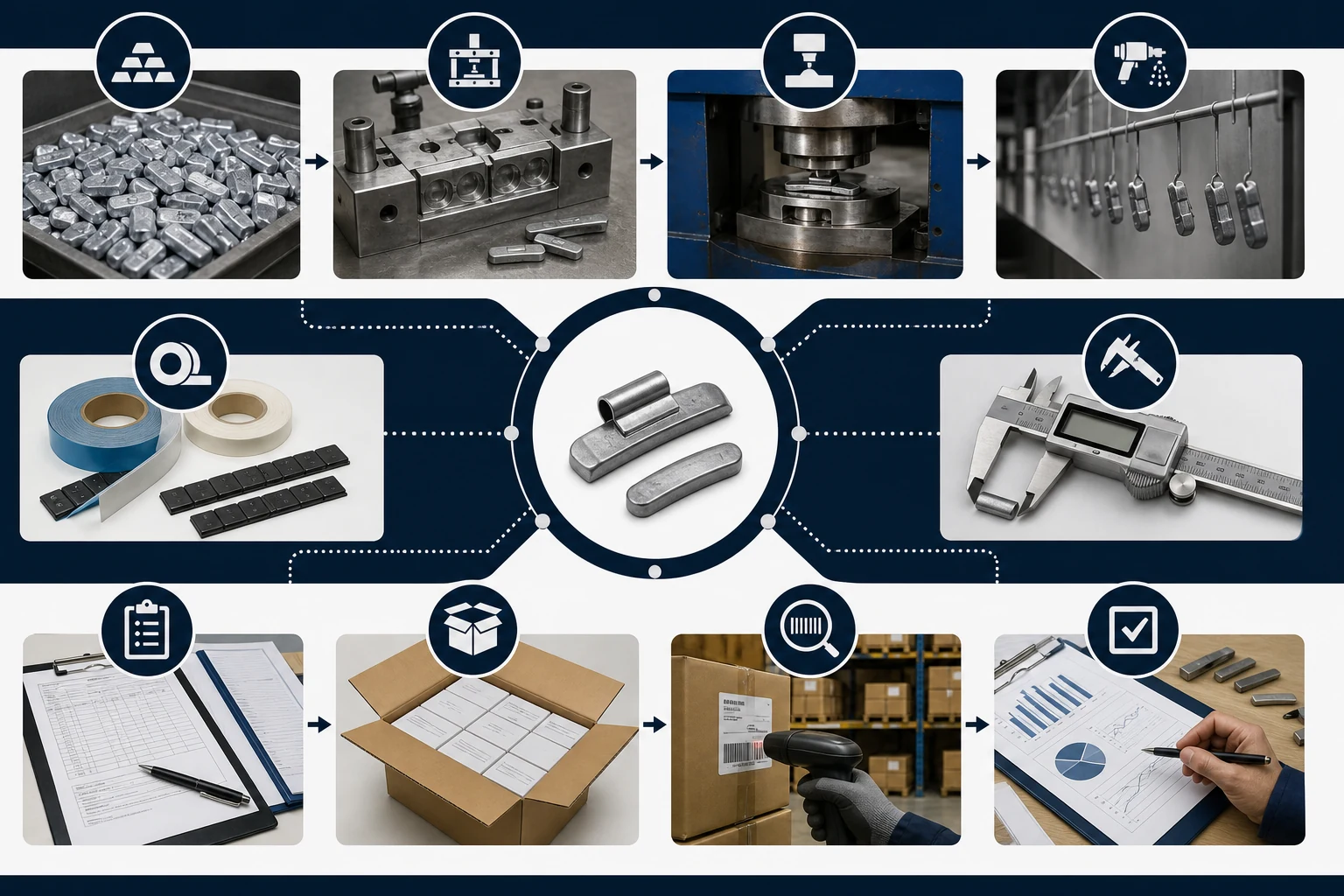
| Area | Buyer verification question | Useful evidence |
|---|---|---|
| Materials | How are relevant metal, tape, coating, clip, and packing inputs identified and accepted? | Lot identity, incoming checks, approved-component records |
| Tooling/process | Which steps are in-house and which are controlled outside processes? | Actual line or live video, work instructions, maintenance or change records |
| Measurement | How are mass, critical dimensions, clip or strip features, and pack counts checked? | Gauges, scales, records, reaction to a failed check |
| Packaging | How are inner counts, labels, cartons, and pallets controlled? | Pack samples, labels, count checks, packing records |
| Traceability | Can a packed lot be linked to product revision and relevant material/process data? | Lot fields and a sample trace exercise |
| Corrective action | What happens when an issue is found internally or by a customer? | Nonconformance record, cause/action/verification example |
How should materials tooling and process controls be verified?
Verify the control points that affect the quoted part, not merely whether the factory owns equipment. For clip-on weights, inspect how the chosen profile, material, finish, increment, and packing route are controlled. For adhesive strips, inspect how the body, coating, tape, liner, segmenting, storage, and pack route are defined.
The process stages to verify for the requested SKU help buyers ask precise questions. Outside coating, tape supply, or packaging is not an automatic failure; the audit should verify how the factory specifies, accepts, identifies, and controls those inputs.
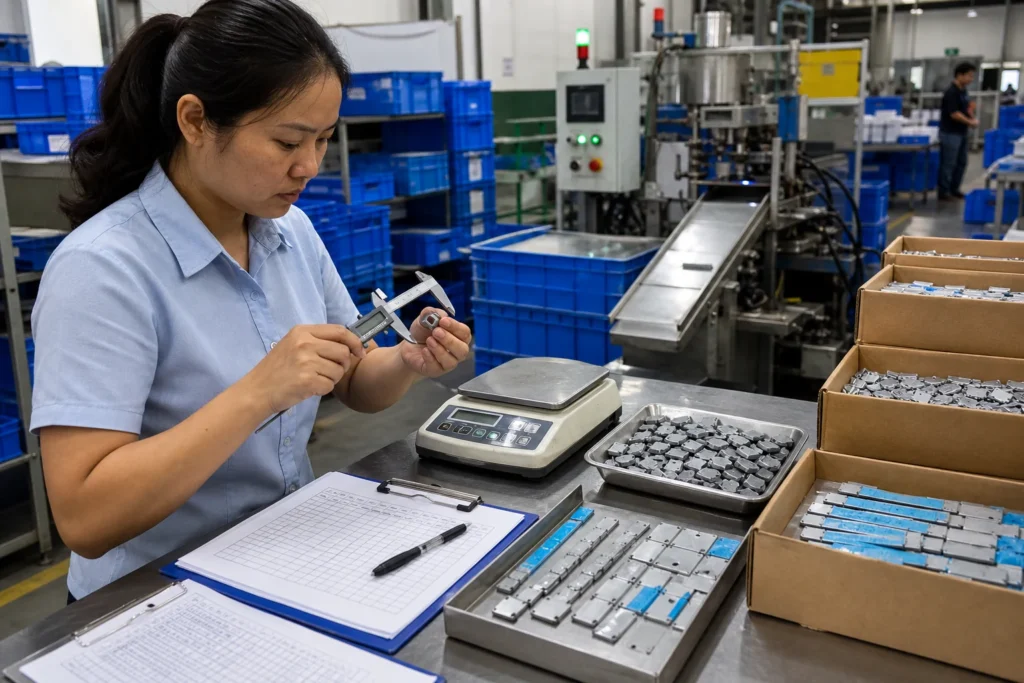
Ask to see one current or recent order move through the route. At receiving, a buyer should be able to see how a metal lot, clip, tape, liner, coating material, or carton is identified and released. At the line, compare the part being made with the drawing, approved sample, or specification sheet. At final inspection, ask what dimensions and mass are checked, at what frequency, by which gauge or scale, and where a failed result goes. A gauge sitting beside a machine is weak evidence if operators cannot show the check record or explain the reaction when a result is outside the limit.
What should an auditor observe on the line?
Observe whether the line has a clear product identity, current work instructions, controlled tooling, and a practical way to separate conforming from suspect material. For stamped or formed clip-on weights, check that dies and profile-specific tools are identified and that worn or changed tooling triggers a defined verification. For adhesive weights, inspect whether tape is applied to a clean, controlled surface and whether the liner, segment layout, cut quality, and storage condition match the approved construction.
Do not ask a factory to disclose proprietary dimensions or commercial agreements that are irrelevant to the order. Instead, ask it to demonstrate the control: a tool ID, a revision mark, a first-piece record, a maintenance entry, a material label, or an approved-component list. This keeps the audit commercial and proportionate while still revealing whether the system can distinguish one version from another.
Where coating is an application requirement, ask for the finish, sample identity, test method, duration, acceptance criterion, and revision tested. Coating and corrosion questions for audited wheel weight production help focus the review. ASTM B117 describes salt-spray apparatus operation, not a universal field-life promise, so audit whether the factory can explain the tested configuration and result.1
How should testing records and corrective actions be verified?
Verify that records are product-specific and usable to investigate a problem. Ask the factory to trace one identified sample or packed lot through the relevant material, process, measurement, and packing records.
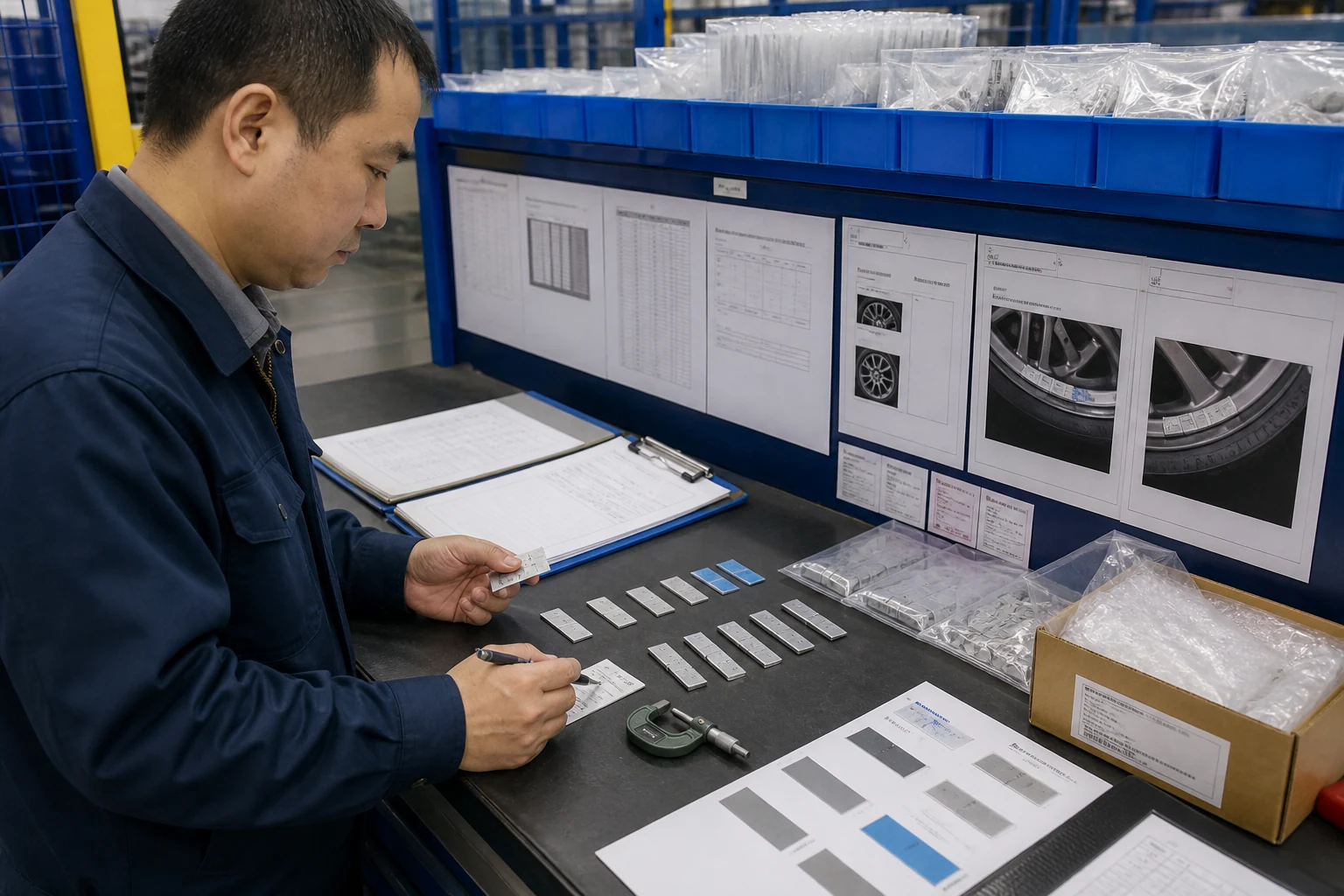
Check how the factory handles a failed dimension, mass, coating, tape, count, or label check. A credible response includes segregation, disposition, cause investigation, corrective action, and verification that the action worked. The IATF sub-tier requirements emphasize customer requirement flow-down, change control, and traceability; proportionately applied, they give buyers a basis for asking how a known issue is prevented from recurring.2
ISO 9001's documented-information principle supports keeping the specification, approval, inspection, and corrective-action records connected to the SKU instead of scattered across generic files.3
How should buyers run a trace exercise?
Choose a finished carton or an identified sample without allowing the factory to select the easiest example. Record its SKU, label version, lot or date code, and pack quantity. Then ask the factory to work backwards to the relevant finished-goods inspection, in-process checks, material or component lot, product revision, and packing record. Where the route includes outside processing, the chain should show how that service or component was identified and accepted.
Then reverse the exercise. Start with a recent nonconformance, customer complaint, or deliberately selected material lot and ask which finished goods could be affected and how they would be located. The aim is not instant perfection in every document. It is to learn whether the factory can contain a potential issue before unrelated stock is shipped. Note any manual spreadsheets, missing links, or dependence on one employee's memory as operational risks to close before approval.
Ask to see calibration or verification status for the scale, caliper, go/no-go feature gauge, or other measurement equipment used for the quoted part. A buyer need not prescribe one laboratory system, but the factory should know which measurements are critical, how the tool is checked, and what it does if the tool is overdue or damaged. Photograph only when permission is given, and record the evidence source in the audit report so later discussions refer to facts rather than recollection.
How should packaging and traceability be verified?
Verify packaging as a production control, because wrong counts, labels, cartons, or pallet identity can create the same commercial failure as a wrong product. Check inner and outer counts, label fields, carton protection, gross-weight and pallet controls, and how a lot can be recognized at receiving.
For repeat shipments, use packing and pallet controls for repeat export orders to compare audit evidence with warehouse and logistics needs. Ask the factory to perform a trace exercise: select a packed carton and show how its label or lot data leads back to the product revision and relevant records.
Physically open a representative carton where possible. Compare the count, net and gross weight, inner protection, barcode or item label, and carton markings against the approved packing specification. For adhesive strips, look for compression, bent segments, damaged liner edges, or conditions that could affect tape handling. For clip-on weights, check that dividers, bags, or trays prevent profiles and finishes from being mixed or damaged in transit. Pallet condition, wrap, corner protection, and label placement matter when the order will move through multiple warehouses.
Treat a packaging change as a product-system change when it can affect count accuracy, receiving, traceability, or transport damage. The factory should be able to state who releases a revised carton or label, how obsolete packaging is removed, and how the first packed lot is checked. This is particularly important when a distributor needs a stable carton count or barcode for inventory systems.
How should buyers close an audit before approval?
Close with a factual report: what was verified, evidence reviewed, gaps remaining, corrective-action owner, and what must be reconfirmed before first production or shipment. Do not call a factory approved merely because the visit was completed.
Classify findings as critical product/traceability gaps, corrections needed before production, and improvement opportunities. Then request clip-on and adhesive sample families that should match the audit scope if a revised sample or verification is needed. The final approval should name the product revision, pack version, inspection scope, and change-notification route.
Use three approval outcomes. "Approved" means the evidence supports the stated program and only routine monitoring remains. "Conditionally approved" means the factory may proceed only after named actions, such as a label correction, scale verification, tape-storage control, or repeat sample, are completed by an agreed date. "Not approved" means a material, process, traceability, or containment gap makes a purchase order premature. Keeping these outcomes separate stops a friendly factory visit from becoming an unclear commercial commitment.
Send the report promptly and give each finding an owner, due date, required evidence, and verification method. For a serious gap, request photos, revised records, a fresh sample, or a focused remote follow-up before releasing production. For a long-term supplier, repeat selected checks when the product, tooling, material, tape, coating, carton, or production location changes. Approval is a controlled decision about one defined program, not a permanent endorsement of every item a factory may offer.
If you are preparing to approve a wheel-weight factory, share the product scope, process risks, quality records, testing needs, and audit timing. We can help you request a factory-audit discussion focused on the system behind the approved sample.
Conclusion: audit the repeatable system
A wheel weight factory audit verifies whether the approved SKU can be controlled from material and tooling through process, inspection, packaging, traceability, and corrective action. Record the gaps and approve the supplier only when its evidence and corrections are proportionate to the order's risk.
When requesting an audit, provide the latest drawing or approved sample, the SKU list, critical fitment or performance points, label and carton requirements, target market, and any mandatory test documents in advance. That lets the supplier prepare relevant evidence and lets the buyer judge the same configuration that will appear on the purchase order.
Frequently Asked Questions
What should buyers audit at a wheel weight factory?
Audit inputs, tooling and process route, inspection, records, packing, lot identity, and corrective-action method affecting the requested clip-on or adhesive SKU. Focus on the approved configuration, not unrelated capability.
Does a factory audit require an on-site visit?
For the approval-stage audit described here, yes. Remote screening can verify company details, documents, catalogs, videos, and initial samples, but an on-site audit is used when the buyer needs direct observation of the quoted line, operator practice, physical segregation, records, and a trace exercise before final approval.
What is the most useful factory-audit record?
A trace exercise for one identified sample or packed lot is especially useful because it shows whether the factory can connect product revision, relevant materials/process, inspections, packaging, and corrective actions.
References
[1] ASTM International. “ASTM B117 Standard Practice for Operating Salt Spray (Fog) Apparatus.” 2026.
[2] International Automotive Task Force. “Minimum Automotive Quality Management System Requirements for Sub-Tier Suppliers.” 2017.
[3] International Organization for Standardization. “ISO 9001:2015 – Quality management systems – Requirements.” 2015.
[4] WEGMANN automotive. “Perfect Equipment Product Catalogue.” 2023.