


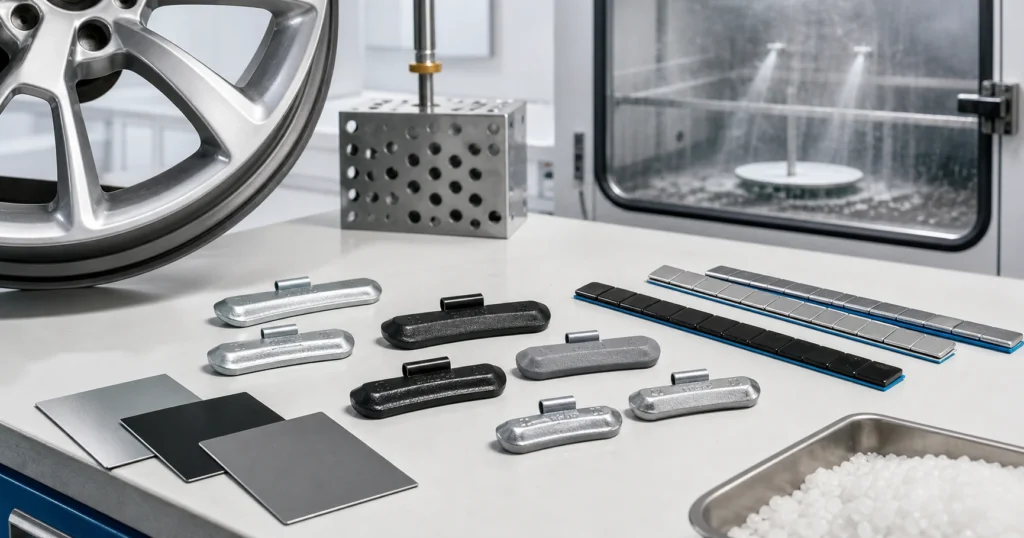
Coated wheel weights are balance weights with a protective surface finish such as zinc plating, paint, e-coat, or powder coating. The coating helps reduce rust, improves appearance, protects cartons during storage, and supports lead-free sourcing programs. Buyers should compare coating type, salt spray expectations, adhesion, tape compatibility, and packaging before approving bulk orders.
For importers, distributors, and wheel service brands, coating is not just a color choice. It affects how steel or zinc wheel weights look after warehouse storage, how much rubbing happens inside cartons, whether adhesive tape stays clean, and how confidently a buyer can offer lead-free alternatives in markets that restrict lead use. Before choosing a finish, buyers planning a complete assortment can use the wheel-weight range planning framework to connect coating decisions with material, attachment format, size coverage, and wheel applications.
Table of Contents
- What are coated wheel weights?
- Which coating decision should buyers make first?
- How do zinc plating, paint, e-coat, and powder coating differ?
- Why does corrosion resistance matter for wheel weights?
- What should buyers include in a coated wheel weight RFQ?
- How should samples be checked before bulk production?
- Which coated wheel weight fits steel wheels, alloy wheels, or export markets?
- Conclusion: coating is a specification, not decoration
- Frequently Asked Questions
- References
What are coated wheel weights?
Coated wheel weights are clip-on or stick-on balancing weights that receive a protective finish after forming, casting, or stamping. The finish may be metallic, painted, or powder-coated, depending on the substrate, appearance target, and corrosion-resistance requirement.
The reason coating matters is simple: wheel weights sit close to road moisture, brake dust, salt, wheel cleaners, and temperature changes. Even before installation, weights may spend weeks or months in cartons, warehouses, sea freight containers, and service vans. A poor coating can chip, stain, rust, transfer color, or make the product look old before a shop ever uses it.
Coating is especially important for steel wheel weights because steel is strong and cost-effective, but it needs surface protection. Zinc wheel weights naturally resist corrosion better than bare steel, but they may still use plating or surface treatment for appearance, labeling consistency, or customer requirements. Lead wheel weights, where still used, raise separate environmental and regulatory concerns, so many sourcing programs now focus on coated steel or zinc alternatives.
For a buyer, the best question is not "Which coating is best?" It is "Which finish matches my material, wheel type, storage conditions, visual expectations, and quality claim?" That question leads to a better RFQ than choosing black, grey, or silver by appearance alone.
Which coating decision should buyers make first?
Buyers should first define the product format, market, and expected service environment, then choose the coating around those conditions. A coating that works for boxed adhesive strips in a dry market may not be the same finish needed for clip-on weights sold into winter road-salt regions.
| Buying decision | Why it matters | Practical RFQ wording |
|---|---|---|
| Material | Steel, zinc, and lead-free alternatives need different corrosion and cost assumptions. | "Material: Fe or Zn, with coating sample and material marking confirmed." |
| Attachment type | Clip-on weights expose edges and clip areas; adhesive strips must protect the tape surface. | "Specify coating for clip-on body and clip; adhesive strip coating must not contaminate tape liner." |
| Finish appearance | Silver, grey, and black finishes fit different wheel styles and retail expectations. | "Finish: silver zinc plated / black painted / grey powder coated, sample approval before mass production." |
| Corrosion expectation | Buyers need a test method and acceptance criteria, not a vague "anti-rust" claim. | "Salt spray test requirement to be confirmed by agreed method and hours." |
| Packing method | Bulk vibration can rub coatings, chip edges, or mark adhesive liners. | "Packing must pass sample carton rub check after transport simulation." |
| Documentation | Export buyers may need material declarations, lead-free statements, or test reports. | "Provide material and coating documentation with sample shipment." |
This early checklist prevents a common mistake: comparing supplier quotes only by gram size and unit price. Two 5 g x 12 adhesive strips may look similar in a spreadsheet, but one may use a clean coating, stronger tape, better liner protection, and tighter carton packing. The difference appears later as fewer complaints, cleaner installation, and better shelf appearance.
Material choice also changes the coating conversation. If a buyer is still comparing Fe, Zn, and legacy Pb options, the material choice behind coated wheel weights helps separate density, cost, compliance, and corrosion considerations before the finish is finalized.
How do zinc plating, paint, e-coat, and powder coating differ?
Zinc plating, paint, e-coat, and powder coating protect the weight in different ways. Plating provides a metallic barrier, while paint and powder coating add a polymer surface layer that can improve color consistency, edge coverage, and visual appeal when the process is controlled.
| Coating type | Common use | Strengths | Buying cautions |
|---|---|---|---|
| Zinc plating | Silver steel clip-on weights, some steel adhesive weights | Metallic appearance, familiar finish, thin coating, good for standard silver programs | Check edge coverage, white corrosion, plating consistency, and carton rubbing. |
| Paint | Black or grey coated weights, cost-sensitive programs | Flexible color choice and simple appearance control | Check adhesion, scratches, odor, drying, and transfer to tape liners or cartons. |
| E-coat | More controlled painted coverage for complex parts | Better coverage into recesses than simple spray paint when well specified | Confirm process availability, coating thickness, and sample performance on clips and corners. |
| Powder coating | Black, grey, or textured finishes for steel weights | Durable surface feel, strong visual finish, useful for premium appearance | Check thickness consistency, edge chipping, clip fit, and whether coating changes critical dimensions. |
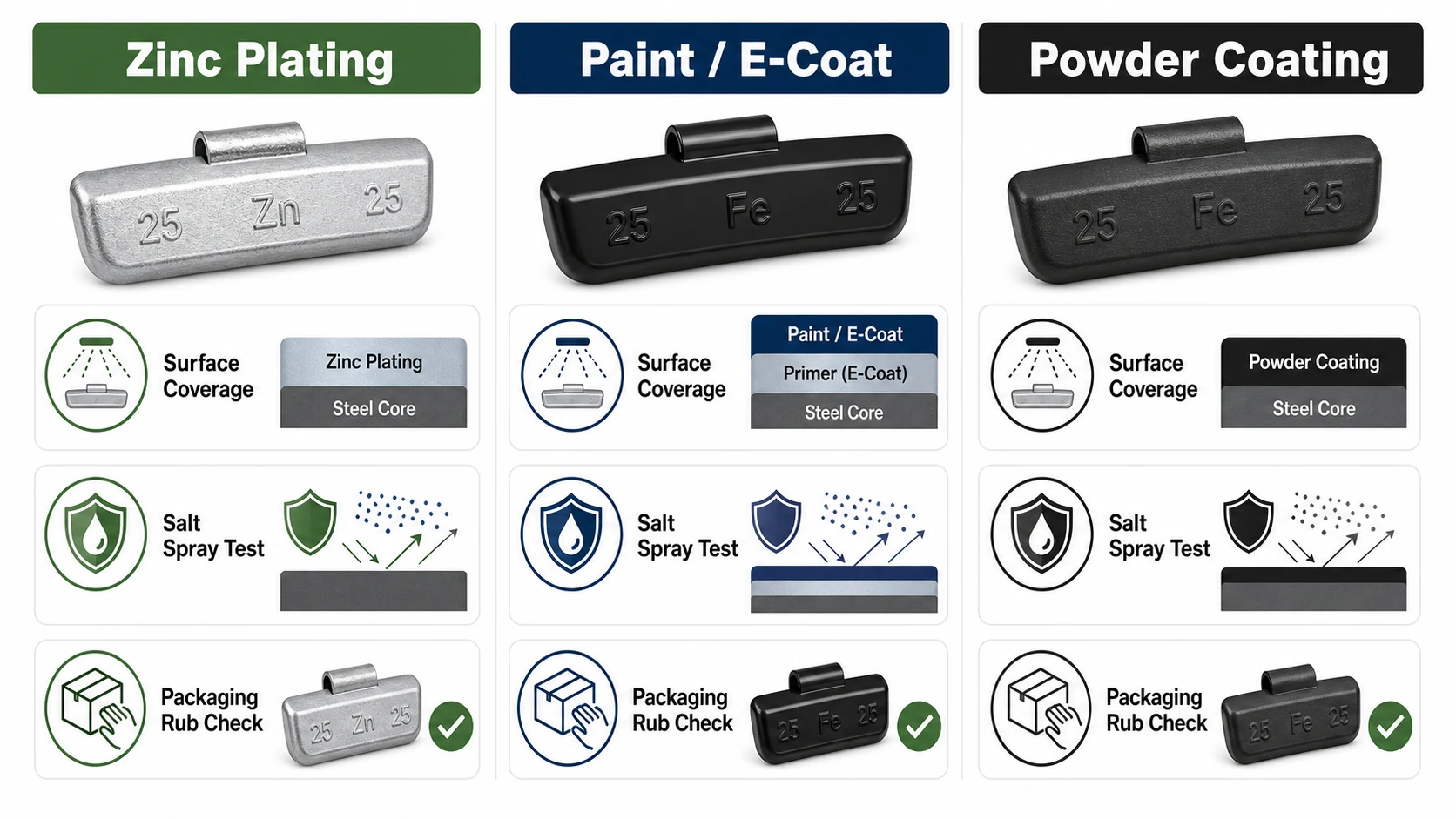
Zinc plating is often used when buyers want a bright, conventional appearance. It can be a practical choice for steel weights, but the quote should define the expected surface, not just say "zinc plated." Buyers should check whether the surface is uniform across the body, edge, and clip area; whether white oxidation appears after storage; and whether the finish remains clean after parts rub against one another in packaging.
Paint and e-coat are often chosen for black or grey wheel weights, especially when a darker finish suits alloy wheels or retail assortment design. E-coat can help cover more complex surfaces, but buyers should still verify the actual part, not rely only on a process name. A coating that looks good on a flat panel may behave differently on a stamped wheel weight with rounded corners, embossed gram markings, clip edges, or adhesive backing.
Powder coating can create a thicker and more durable-looking finish, but thickness is not automatically better. On clip-on wheel weights, too much coating around the clip may affect fit. On adhesive weights, coating texture and surface contamination must not interfere with tape application. When buyers need to understand where coating sits in the whole production process, the wheel weight coating and quality control workflow explains how stamping, surface treatment, tape application, inspection, and packaging connect.
Why does corrosion resistance matter for wheel weights?
Corrosion resistance matters because rust or coating failure reduces product appearance, creates customer complaints, and can weaken confidence in a lead-free steel program. It is also one of the easiest areas for buyers to overestimate if the RFQ only says "anti-rust coating."
Salt spray testing is commonly used to compare corrosion behavior under controlled laboratory conditions. ASTM B117 describes a salt spray fog apparatus practice, and ISO 9227 covers artificial atmosphere salt spray tests 1 2. These tests are useful for comparison, but buyers should avoid treating any single salt spray hour claim as a complete prediction of real road life. Real use involves road salt concentration, wet-dry cycles, brake dust, wheel cleaners, stone impact, installation damage, and storage conditions.
For wheel weights, corrosion risk starts before the product reaches the wheel. Cartons may face humidity during sea freight. Bulk packed parts can rub against each other. Clips may scratch adjacent weights. Adhesive strips can sit with liners pressed against coated surfaces. If coating, tape, and packing are not tested together, a sample may pass a visual inspection at the factory but arrive with marks, dust, or liner contamination.
This is why buyers should ask for both test information and practical sample checks. A salt spray report can support the coating claim, while a carton rub check, tape liner check, and sample installation check show whether the finished product works as supplied. For markets moving away from lead, corrosion performance becomes part of the buyer's lead-free acceptance story. The lead-free wheel weight export checks can help buyers decide which material statements, compliance documents, and sample approvals to request before shipping to regulated markets.
What should buyers include in a coated wheel weight RFQ?
A coated wheel weight RFQ should define material, coating type, color, test expectation, tape requirement, size range, packaging method, sample approval, and documentation. Without those details, suppliers may quote visually similar products that perform differently after storage and installation.
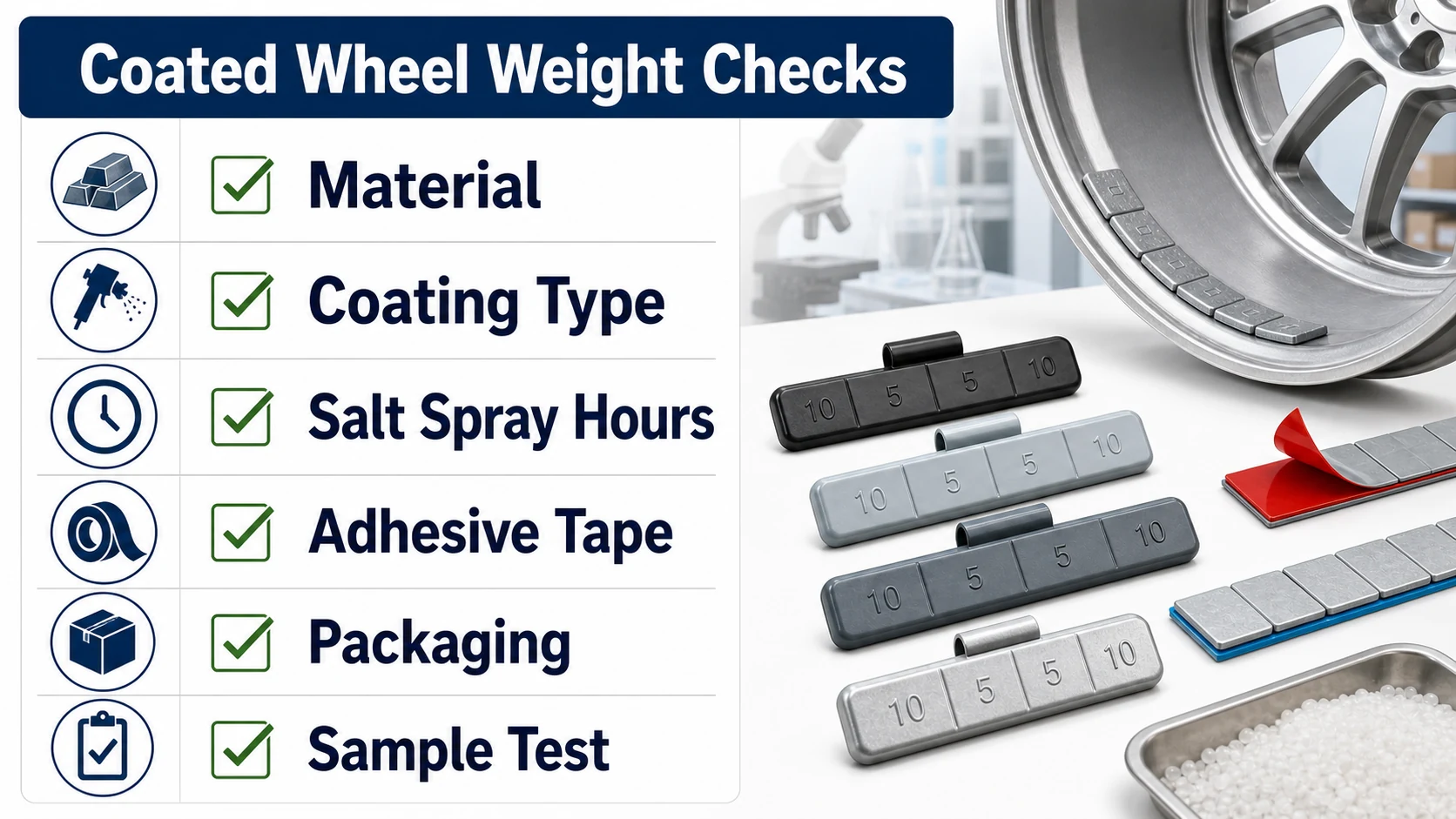
Use the RFQ to remove ambiguity before the price comparison begins:
| RFQ item | What to specify | Why buyers should care |
|---|---|---|
| Material | Fe, Zn, or other lead-free material; gram or ounce marking; material marking if required | Coating performance and part volume differ by substrate. |
| Coating type | Zinc plating, paint, e-coat, powder coating, or approved supplier equivalent | The finish affects appearance, corrosion resistance, and part handling. |
| Color and gloss | Silver, black, grey, matte, semi-gloss, or approved sample | Color consistency matters for retail packaging and alloy wheel visibility. |
| Corrosion test | Method, hours, sample quantity, and acceptance criteria | A vague "salt spray passed" claim is hard to compare. |
| Tape | Tape brand or equivalent grade, liner color, foam thickness, peel behavior | Adhesive products need coating and tape compatibility. |
| Packaging | Pieces per strip, strips per box, inner box, carton, labels, pallet requirement | Packing affects coating rub, liner cleanliness, and warehouse handling. |
| Sample approval | Pre-production samples, packed sample box, installation trial | The buyer should approve the finished part, not just a color chip. |
| Documents | Test report, material declaration, lead-free statement, packing photos | Documentation reduces friction for import, resale, and quality claims. |
For adhesive wheel weights, tape and coating should be treated as a system. Surface preparation affects adhesive performance, and 3M's VHB tape guidance emphasizes clean, dry, contaminant-free bonding surfaces 3. A coated strip may look acceptable, but dust, overspray, oil, or powder residue near the tape side can create installation failures later.
Buyers ordering adhesive strip formats should also connect coating with segment size, backing liner, tape color, and box layout. The adhesive strip format and tape options help buyers turn those details into a cleaner specification before they compare bulk quotations.
Once the material, finish, test target, tape, and packaging are clear, buyers can request coated steel and zinc wheel weight samples that match the actual RFQ instead of reviewing a generic showroom sample.
How should samples be checked before bulk production?
Samples should be checked as finished goods: coated, marked, taped if applicable, packed in the intended box, and inspected after handling. A loose sample from a sales desk is useful for first impression, but it does not show how the coating behaves in real packaging and installation conditions.
A practical sample approval process can include these checks:
| Sample check | What to inspect | Accept / reject signal |
|---|---|---|
| Visual finish | Color, gloss, coverage, edge appearance, embossed markings | Finish matches approved sample; no obvious stains, bubbles, bare edges, or heavy orange peel unless texture is specified. |
| Coating adhesion | Light scratch, bend area, clip area, or agreed tape-pull method | Coating should not flake easily during normal handling. |
| Clip fit | Clip profile, coating thickness around clip, installation feel | Coating should not make the clip too tight, too loose, or likely to chip during installation. |
| Tape condition | Liner cleanliness, tape bonding to weight, foam thickness, liner removal | Tape should stay attached to the weight and peel cleanly without coating dust. |
| Carton rub | Packed sample box after shaking or transport simulation | Parts should not show excessive rub marks, loose coating dust, or damaged liners. |
| Storage check | Short humidity or warehouse simulation where practical | No early rust, staining, odor, or adhesive liner transfer. |
Buyers should ask suppliers to send both loose samples and a packed sample box. Loose samples reveal finish and dimensional details; packed samples reveal the quality of the shipping configuration. If a product will be sold under a private label, the sample should also include the real inner box, carton label, barcode layout, and carton weight, because packaging can affect both coating condition and customer perception.
For clip-on weights, the highest-risk areas are edges, clips, and impact points where parts hit one another. For adhesive weights, the highest-risk areas are the coated face, tape edge, liner, and any place where coating dust may migrate. If the supplier offers several finish options, test them side by side rather than approving finish names from a catalog.
Which coated wheel weight fits steel wheels, alloy wheels, or export markets?
The right coated wheel weight depends on wheel type, attachment format, and market expectation. Steel wheel service channels often prioritize clip fit and durable handling, while alloy wheel programs may care more about low-visibility finishes, adhesive tape quality, and clean packaging.
For steel wheels, coated clip-on weights are common because the part must hold firmly on the rim flange and survive shop handling. Buyers should check clip profile, coating thickness around the clip, and whether installation leaves obvious coating chips. If the product is intended for high-volume tire shops, carton durability and clear size labels may matter as much as surface appearance.
For alloy wheels, adhesive coated weights are often preferred because they can be installed on the inner barrel with less visual impact. Black, grey, or low-profile finishes may be useful where the weight remains visible through open spoke designs. The coating should look clean, but the tape system is just as important. If the adhesive liner is dusty, wrinkled, or contaminated, a beautiful coating does not solve installation risk.
For export markets, coating decisions sit beside material and compliance decisions. Some regions and customers restrict lead wheel weights or prefer lead-free programs; EPA best management guidance has also encouraged moving away from lead wheel weights in the United States 4. Buyers should verify local rules, customer requirements, and documentation expectations rather than assuming one global requirement covers every destination.
The cleanest sourcing path is to define the target program first:
| Program type | Coating direction | Extra buying check |
|---|---|---|
| Economy steel clip-on range | Zinc plated or basic coated finish | Confirm clip fit, rust resistance, and carton rub. |
| Premium black clip-on range | Black e-coat, paint, or powder-coated finish | Confirm edge chipping and color consistency. |
| Alloy adhesive strip range | Silver, grey, or black coated strips with approved tape | Confirm tape liner cleanliness and installation trial. |
| Lead-free export range | Coated Fe or Zn with documentation | Confirm material declaration, coating report, and market-specific compliance request. |
| Private-label retail boxes | Finish approved with final box and label | Confirm rub marks after packed sample handling. |
This approach keeps the conversation practical. Instead of asking for "the best coating," the buyer asks for the coating that fits the intended wheel application, sales channel, and documentation requirement.
If coating performance is a buying requirement for your wheel-weight program, tell us the material, finish, corrosion expectations, application, and evidence you need. We can help you request samples and define the approval checks before comparing suppliers.
Conclusion: coating is a specification, not decoration
Coated wheel weights should be specified as a functional part of the product, not only as silver, black, or grey appearance. The best RFQ defines material, coating type, corrosion test expectation, tape condition, packaging layout, sample approval, and documentation before bulk production begins.
For buyers comparing suppliers, coating quality is easiest to judge when samples match the final order: same material, same finish, same tape, same markings, and same box. After those details are clear, requesting coated steel and zinc wheel weight samples is a useful next step because the sample can be checked against the actual program instead of a generic product photo.
Frequently Asked Questions
Are coated wheel weights better than uncoated wheel weights?
Coated wheel weights are usually better for appearance, corrosion resistance, and storage quality, especially for steel weights. Uncoated or poorly coated weights may rust, stain, or look aged quickly. Buyers should still compare the coating method, sample performance, and packaging quality before assuming one finish is better.
Is zinc plating the same as a zinc wheel weight?
No. Zinc plating is a surface finish applied to another material, often steel. A zinc wheel weight is made mainly from zinc alloy. Buyers should confirm both the substrate material and the coating or finish, because "zinc" can refer to either the material or the plating.
What salt spray hours should buyers request for coated wheel weights?
There is no single correct number for every market. Buyers should define the test method, target hours, sample condition, and acceptance criteria with the supplier. Salt spray testing helps compare coatings, but it does not fully predict real road exposure, storage conditions, or installation damage.
Do coated adhesive wheel weights need special tape checks?
Yes. Adhesive weights need coating and tape compatibility checks. Buyers should inspect liner cleanliness, tape bonding, foam thickness, and whether coating dust or oil can reach the adhesive surface. A good coating is not enough if the tape side is contaminated or poorly packed.
What documents should importers request for coated wheel weights?
Importers commonly request material declarations, lead-free statements where relevant, coating or salt spray reports, sample approval records, packing photos, and carton label details. The exact document set should match the destination market, customer requirement, and product claim.
References
[1] ASTM International. “ASTM B117-19: Standard Practice for Operating Salt Spray (Fog) Apparatus.” 2019.
[2] International Organization for Standardization. “ISO 9227:2022 Corrosion Tests in Artificial Atmospheres – Salt Spray Tests.” 2022.
[3] 3M. “Surface Preparation for 3M VHB Tape Applications.” 2019.
[4] United States Environmental Protection Agency. “Best Management Practices for Lead Wheel Weights.” 2015.