



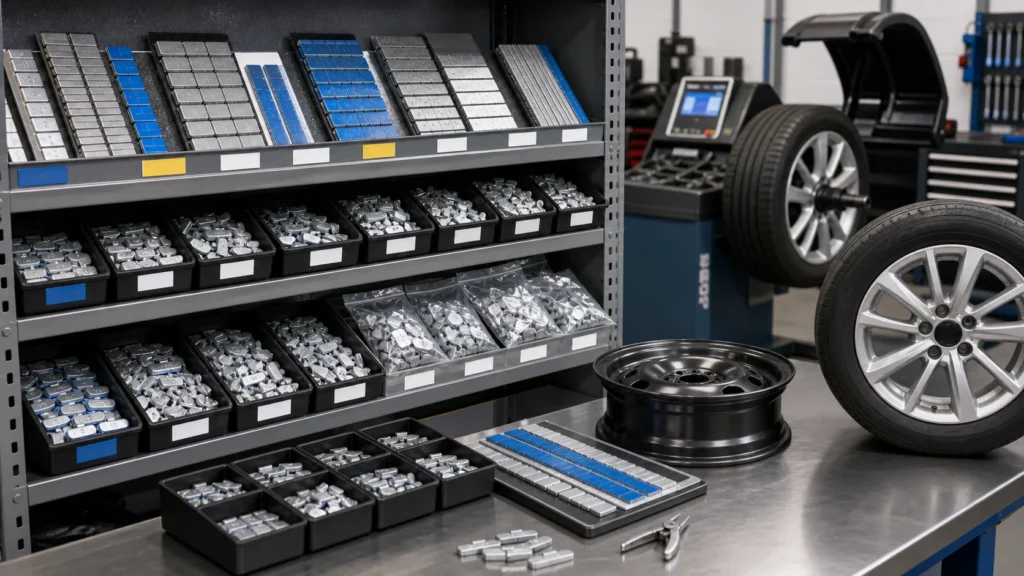
Tire shops should usually stock both clip-on and adhesive wheel weights, then size the range around the wheels they service most often. The core decision is not a universal list of grams or ounces; it is a service-ready mix of attachment formats, profiles, fast-moving increments, and a small reserve for less common corrections.
The right stock plan prevents two expensive failures: a technician stops a balancing job because one common weight is missing, or cash is tied up in sizes that rarely leave the bin. Start with actual wheel and job data, then connect the assortment to clear storage, reorder, and sample-approval rules. The wheel weight range planning framework is useful when the shop is building the wider category before setting quantities.
Table of Contents
- What wheel weight types should tire shops stock?
- Which stocking decisions should come first?
- What sizes should a tire shop keep on hand?
- How should shops split stock between clip-on and stick-on weights?
- How much stock should a shop keep?
- What should shops check before ordering?
- How should a shop organize wheel weight bins and replenishment?
- How should distributors build a shop replenishment range?
- Conclusion: stock what keeps the bay moving
- Frequently Asked Questions
- References
What wheel weight types should tire shops stock?
Most mixed-service tire shops need both clip-on and stick-on wheel weights. Clip-on products cover many steel-wheel and rim-flange applications, while adhesive products support alloy wheels, hidden placement, and appearance-sensitive work.
The useful way to divide the wheel-balancing weights range is by the job the part must complete:
| Shop service pattern | Priority stock | Reason to carry it |
|---|---|---|
| Steel-wheel, older-vehicle, or fleet work | Common clip-on profiles and increments | Fast installation when the profile matches the rim flange |
| Alloy-wheel passenger-car work | Adhesive segments or strips in core increments | Supports hidden placement and avoids an unsuitable visible clip |
| Performance or tight-clearance wheels | Lower-profile adhesive options and careful fit checks | Helps reduce clearance and appearance problems |
| Mixed passenger-car and light-truck work | Separate clip-on and adhesive core ranges | Prevents one customer group from consuming the other group’s stock |
| Lead-free customer or destination program | Approved steel or zinc route with documents | Keeps the material choice tied to the actual customer requirement |
Do not treat “clip-on” or “stick-on” as a complete product description. A clip still needs the correct profile and finish, and an adhesive strip still needs the right tape, liner, segment size, and application instructions. A shop that stocks only the attachment label is leaving the most important fitment fields open.
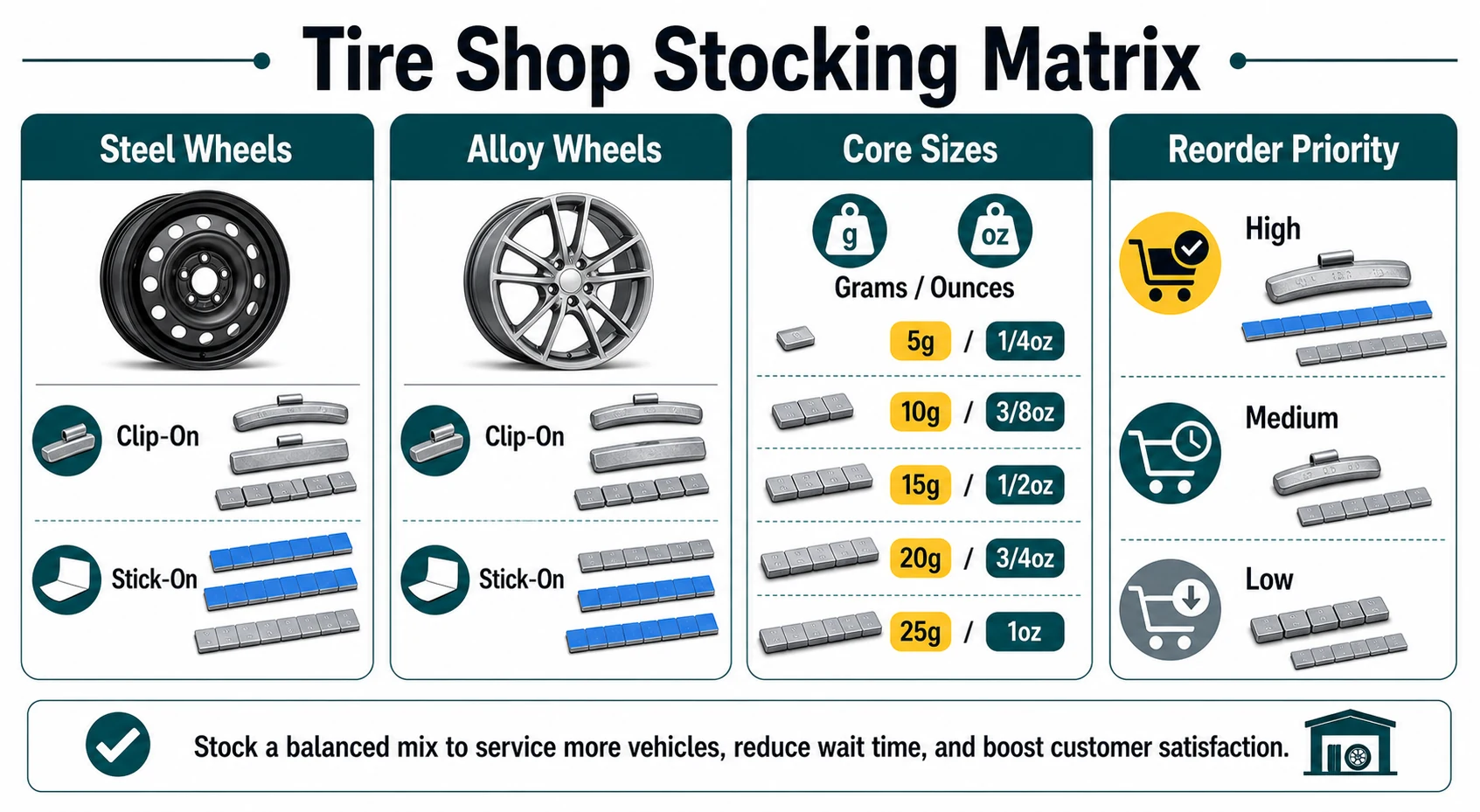
For a shop deciding between formats, the clip-on versus stick-on choice helps separate wheel compatibility from general preference. The correct mix is the one that lets the technician complete the next common job without forcing a poor fit or an improvised installation.
Which stocking decisions should come first?
Before deciding quantity, define the shop’s wheel mix, unit system, attachment formats, fast-moving increments, material policy, storage space, and supplier lead time. Quantity comes after these decisions because overstocking the wrong SKU does not solve a shortage at the balancing machine.
Use a short stock audit based on real work:
- List the wheels entering the bays. Separate steel wheels, alloy wheels, passenger cars, SUVs, light trucks, fleet vehicles, and specialty or performance wheels.
- Map each job to the installed weight. Record whether the technician used a clip-on piece, adhesive segment, strip, or another approved format.
- Record the actual unit system. Keep grams and ounces separate in the stock file, labels, and bin layout. Do not assume a supplier’s pack unit is the shop’s working unit.
- Mark the high-frequency SKUs. A size used repeatedly each week deserves different shelf depth from a size used only for occasional heavy corrections.
- Define exceptions. Note special profiles, low-clearance wheels, fleet requirements, lead-free requests, or customer-specific packaging that should not be mixed with the core range.
A new shop can start with a narrower core assortment and adjust after usage appears. An established shop can use invoices, job cards, bin counts, or purchase history. The data does not need to be perfect; it needs to be better than guessing from a catalog.
The same record can support a supplier conversation. Instead of asking for “all wheel weights,” give the supplier the wheel types, attachment methods, unit system, core increments, special profiles, pack requirements, and expected reorder pattern. That makes the first sample and the first quote easier to compare.
What sizes should a tire shop keep on hand?
Tire shops should hold the small and medium corrections that move through routine balancing work, then add a smaller reserve for heavier or unusual corrections. The exact sizes depend on the local unit system, wheel mix, balancing equipment, and customer base.
For planning, a shop may group the range into three layers:
| Stock layer | What it contains | How to manage it |
|---|---|---|
| Core | The increments used repeatedly in normal passenger-car work | Keep visible, easy to reach, and protected from substitution |
| Reserve | Heavier or less frequent increments needed to finish less common jobs | Keep enough to avoid a service delay without giving it core-bin space |
| Special | Profiles, low-profile formats, fleet items, or customer-specific packs | Buy and replenish against known demand rather than broad assumptions |
Gram-based shops often begin by reviewing small increments such as 5 g, 10 g, 15 g, 20 g, and 25 g. Ounce-based shops may review 1/4 oz, 1/2 oz, 3/4 oz, and 1 oz. These are planning examples, not universal stocking rules. A shop should confirm which increments its balancer, technicians, and local service vehicles actually use.
The wheel weight size chart can help translate grams, ounces, strips, and pack formats into a stock list. Use one controlled naming convention in the bin label, supplier quotation, purchase order, and inventory software. A technically correct part becomes operationally wrong when a technician cannot tell whether a label refers to one segment, one strip, or a complete pack.
Do not measure only total kilograms purchased. A carton can contain the right total mass while the fast-moving increments are missing. Track pieces or segments by SKU, and treat mixed assortments as mixed assortments rather than as a single weight value.
How should shops split stock between clip-on and stick-on weights?
The split should follow the shop’s wheel mix and actual installation method. A steel-wheel and fleet-heavy shop will usually need deeper clip-on coverage, while an alloy-heavy shop needs more adhesive formats, clean storage, and disciplined surface preparation.
Clip-on weights are efficient when the profile matches the rim flange and the technician can install them without damaging the wheel or coating. SAE J1986 is a useful reference for balance-weight and rim-flange features, retention testing, and relevant performance requirements; use the current applicable revision and the target wheel context rather than treating one profile as universal 1.
Adhesive products are more dependent on handling conditions. The shop must protect the liner and tape from dust, oil, crushed packaging, and unsuitable storage, then clean the wheel surface and apply the segment with the required pressure and dwell. Guidance from 3M identifies surface preparation, contact pressure, and dwell as parts of pressure-sensitive adhesive application 2; the production tape and wheel finish still require product-specific validation.
For alloy-wheel service, the adhesive weights for alloy-wheel service helps buyers compare segment format, tape behavior, profile height, and installation conditions. Keep adhesive and clip-on stock in separate labeled areas even when both products use similar nominal sizes.
The right question is not which attachment type is better in general. Ask which format fits the wheel, the balancer program, the technician’s process, the customer’s appearance expectation, and the shop’s storage conditions.
How much stock should a shop keep?
A shop should keep enough stock to cover normal usage during supplier lead time, plus a defined safety reserve for demand variation or delayed delivery. The useful quantity comes from consumption and replenishment data, not from a standard starter-kit number.
One simple planning formula is:
Reorder point = average usage per week × supplier lead time in weeks + safety stock
Apply the formula by SKU or clearly defined product group. If a shop consumes a size in pieces but buys it in cartons, convert the reorder point into cartons only after confirming the pieces per carton. For adhesive strips, record whether one inventory unit is a segment, a strip, or a box; otherwise the calculation will look precise while measuring the wrong thing.
For a new shop, use a conservative core range, mark minimum bin levels, and review movement frequently. For a busy shop, use separate reorder points for high-turnover core sizes and slower reserve sizes. For a distributor, the bulk reorder planning page helps connect shop usage to carton quantities, MOQ, and shipment planning.
Lead time is more than factory production time. Include approval time for a new sample, packaging or label confirmation, transport, receiving, and any inspection hold. A supplier that quotes a short production time but cannot provide the required pack or evidence may still create a long service delay.
Avoid equal quantities across every size. Equal buying is easy to place but rarely matches how a tire shop consumes stock. A focused core range with a visible reserve is usually easier to count, train, reorder, and explain to a distributor.
What should shops check before ordering?
Before ordering, a shop should verify fitment, size identity, attachment performance, material policy, packaging, storage needs, and the supplier’s ability to repeat the same configuration. A low unit price is not useful if the weight does not fit, the tape cannot be applied reliably, or the parts arrive mixed in an unworkable pack.
Check the order in five steps:
- Confirm the wheel application. Send representative rim or wheel information for the clip profiles and adhesive surfaces the shop actually services.
- Confirm the working unit. State grams or ounces, piece or segment, strip or roll, pack quantity, and the label fields the technician needs.
- Approve the attachment. Test clip seating and retention on the relevant rim profile. For adhesive products, test the actual tape and liner with the intended cleaning and application process.
- Review material and finish. If a customer or destination program requires lead-free stock, verify whether the route is steel, zinc, or another approved material and request the supporting documentation. The lead-free material checks help keep the requirement tied to the destination rather than to a vague sales claim.
- Check the pack before the bulk order. Confirm carton labels, inner-pack separation, barcode or SKU fields, quantity, protection, and how opened stock will be returned to the correct bin.
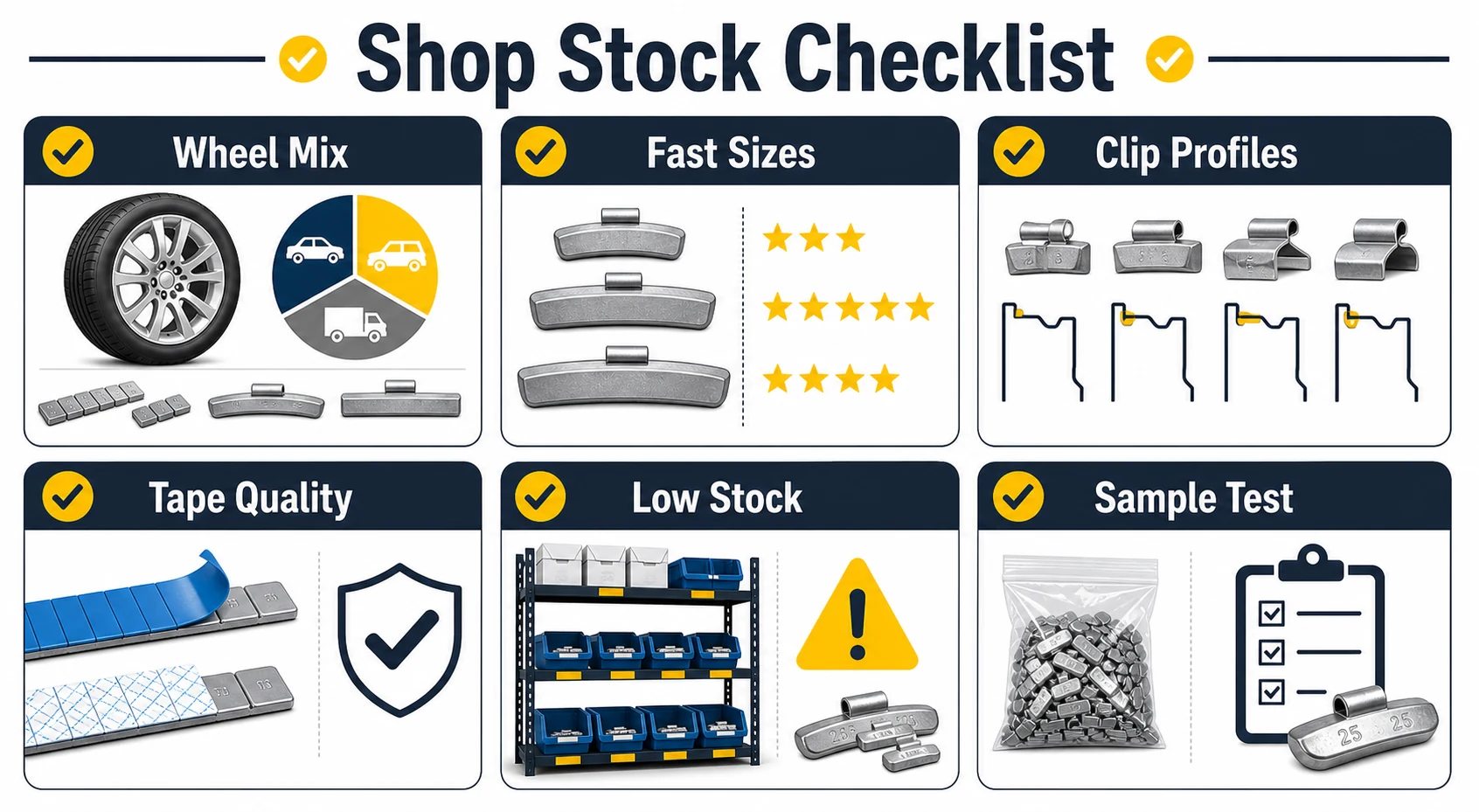
Use the wheel weight QC checklist when a shop, chain, or distributor needs a written record for mass, increments, retention, tape, finish, labels, packaging, and batch evidence. Sample approval should happen before the reorder quantity is enlarged; otherwise the shop is scaling an assumption.
How should a shop organize wheel weight bins and replenishment?
The bin layout should mirror the technician’s decision path: attachment type first, then profile or format, then unit system and increment. A shop should be able to identify the correct part without opening several cartons or relying on a memory-based color code.
Use these operating controls:
- Keep clip-on profiles in separate, clearly marked bins. Do not combine similar-looking profiles because they share a nominal weight.
- Keep adhesive products flat, clean, and protected from dust, oil, heat, and crushed cartons. Keep liners intact until application.
- Put grams and ounces in separate visual zones, with the unit printed in large type on each label.
- Record the supplier SKU, shop SKU, attachment format, increment, material, and pack quantity on the bin card.
- Mark a minimum level for fast-moving items and review reserve stock on a fixed schedule.
- Return opened stock to its original labeled location before starting the next vehicle.
- Quarantine damaged, unlabeled, wet, contaminated, or mixed stock instead of guessing its identity.
The service-bay test is simple: can a trained technician select the right part in seconds, understand the unit, apply it using the correct method, and return the unused stock without creating a new mix-up? If not, the problem is not only inventory quantity. It is SKU naming, packaging, storage, or training.
A distributor supplying several shops can use the same fields across cartons and replenishment lists. That creates a cleaner handoff from factory pack to warehouse bin to service bay, and it makes complaints easier to trace to a product, lot, and shop.
How should distributors build a shop replenishment range?
Distributors should build a replenishment range from the SKUs shops actually reorder, then add optional extensions for alloy-wheel, fleet, truck, low-clearance, or lead-free programs. The range should be easy to buy again and easy for a shop to store, not merely large on a product spreadsheet.
Start with a core service assortment: common clip-on profiles, common adhesive strips, clear gram or ounce labels, and packaging that fits the shop’s shelves. Add special profiles and slower sizes only when shop usage or a defined customer segment supports them.
The distributor should separate three commercial questions:
- What does the shop install? Wheel type, attachment, profile, unit, and increment.
- What does the shop reorder? Pieces, segments, strips, cartons, and movement by period.
- What can the supplier repeat? Approved sample, packaging, label, batch record, quality evidence, MOQ, and lead time.
Do not call a broad assortment “complete” when it leaves the buyer with untested profiles, unclear units, or slow stock. A starter assortment plus a replenishment list is easier to pilot. After the first reorder cycle, quantities can be adjusted around the sizes that actually move.
If a shop or distributor is changing supplier, request loose samples and packed samples together. Compare the physical part, label, carton, and records as one system. Then request a shop assortment review with the vehicle mix, attachment formats, size range, usage volume, material policy, and reorder priorities.
Conclusion: stock what keeps the bay moving
Wheel weights for tire shops should be selected around real service demand: the wheels entering the bays, the attachment formats technicians use, the sizes that move, the material policy, the storage conditions, and the time required to replenish. There is no universal starter list that can replace those inputs.
The practical sequence is to map the wheel mix, separate clip-on and adhesive products, define the core and reserve sizes, test representative samples, label the bins clearly, and set reorder points by SKU. That turns a product catalog into a service-ready inventory system.
If you are preparing a new shop range or distributor replenishment program, request a shop assortment review with the target wheel types, unit system, attachment formats, expected usage, packaging needs, and destination requirements.
Frequently Asked Questions
What wheel weights should a tire shop stock first?
Most shops should start with common clip-on profiles, common adhesive strips, and the small or medium increments used in routine balancing work. The exact mix should follow the shop’s wheel base, unit system, attachment method, and service volume.
Do tire shops need both clip-on and stick-on wheel weights?
Most mixed-service shops do. Clip-on weights cover many steel-wheel and rim-flange applications, while adhesive weights support alloy wheels, hidden placement, and appearance-sensitive work. A shop with a very narrow customer base may carry one format more deeply, but that decision should come from job data.
What sizes of wheel weights are used most often?
Small and medium correction sizes often move fastest in routine passenger-car service. Gram-based shops may prioritize increments such as 5 g to 25 g, while ounce-based shops may review 1/4 oz to 1 oz. These are planning examples, not universal stocking rules.
How should a shop store adhesive wheel weights?
Keep adhesive strips clean, dry, flat, and protected from dust, oil, heat, crushed cartons, and liner damage. Store them in labeled bins and prepare the wheel surface according to the tape supplier’s instructions before application.
When should a tire shop reorder wheel weights?
Reorder when a high-turnover SKU reaches its defined minimum, not only when the bin is empty. Use average usage, supplier lead time, and safety stock to set the reorder point, then adjust it when the shop’s service pattern changes.
Are lead-free wheel weights better for tire shops?
Lead-free stock may be required by a customer or destination program, but the shop should verify the applicable requirement and material documentation before changing inventory. Steel and zinc are common lead-free routes, and their fit, size, finish, and pack still need approval.
References
[1] SAE International. “J1986: Balance Weight and Rim Flange Design Specifications, Test Procedures, and Performance Recommendations.” 2016; check current revision.
[2] 3M. “General Installation Techniques for Pressure-Sensitive Adhesives.” 2024.