


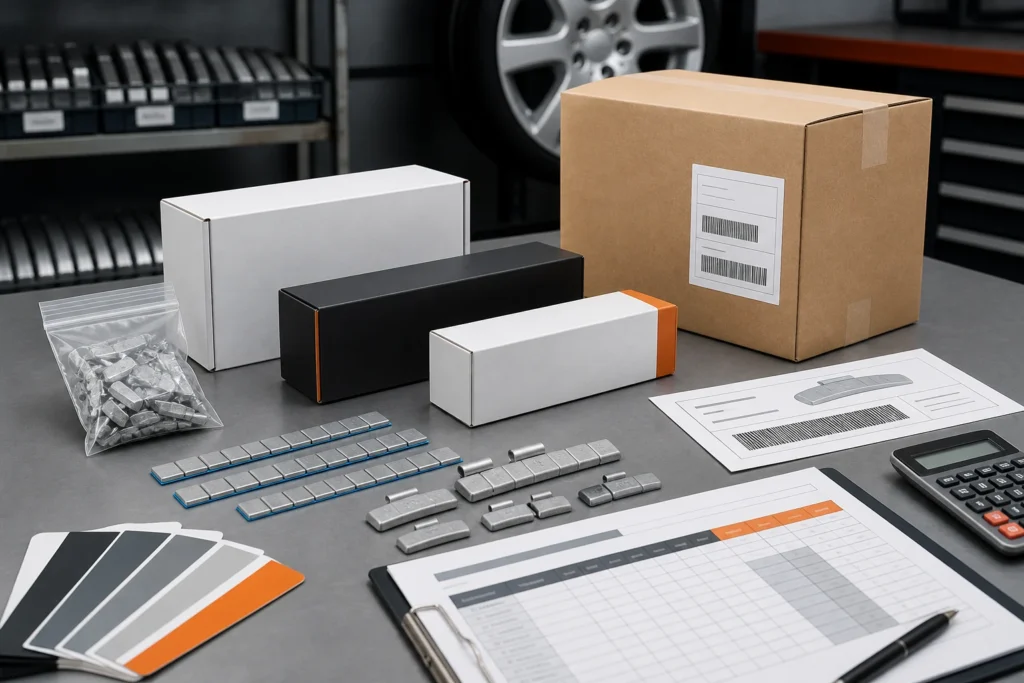
Private label wheel weights MOQ and pricing depend on the standard product selected, the number of SKUs, packaging design, carton and label requirements, artwork readiness, and production setup. Buyers can lower launch risk by keeping the first branded program focused on proven formats with a clear approval and reorder plan.
Table of Contents
- What should a private-label launch plan include?
- What should be standard and what should be custom?
- Which choices drive private-label wheel weight MOQ?
- How should buyers forecast first-order pricing?
- How should buyers set a first-order SKU plan?
- What should a buyer approve before placing a repeat order?
- Conclusion: launch a repeatable branded range before expanding it
- Frequently Asked Questions
- References
What should a private-label launch plan include?
A private-label wheel-weight launch plan should combine the selected product range with the commercial and operational choices that make it repeatable: SKU scope, product configuration, packaging hierarchy, artwork ownership, label data, MOQ basis, approval samples, quote inclusions, and reorder trigger. A logo file alone is not a launch plan.
The first question is whether the buyer is branding a proven wheel-weight configuration or asking the factory to develop a different product. Those are different projects with different cost drivers, lead times, and approval risk. Keeping that boundary clear protects the buyer from receiving a low-looking private-label quote that later excludes a new clip profile, special tape, altered segment layout, or separate packaging minimum.
Start by setting the wheel-weight range decisions before a brand launch is costed. Decide the target customer, wheel application, attachment format, material, unit system, core increments, and packaging channel. Once those choices are visible, the buyer can separate standard product costs from genuinely custom work.
| Launch element | Buyer decision | Why it affects commercial planning |
|---|---|---|
| Core product | Adhesive strips, clip-on profiles, material, increments, finish | Determines the product and sample that the supplier must repeat |
| SKU count | Number of unique profiles, sizes, formats, and pack counts | More SKUs can create more minimums, artwork versions, and slow stock |
| Brand presentation | Box, label, carton, barcode, color, and language scope | Creates artwork, prepress, print, and change-control work |
| Packaging hierarchy | Inner pack, master carton, pallet, and shipping mark | Changes pack quantities, warehouse handling, and freight readiness |
| Approval gates | Product sample, label proof, packed sample, and pre-shipment record | Prevents the bulk run from drifting away from what the buyer approved |
| Reorder logic | Forecast, stock cover, and artwork/version control | Determines whether the first launch can become a stable program |
The launch plan should also name a single buyer owner for product specification and a single buyer owner for artwork/label approval. Those roles may be in the same team, but the record should show who approves each change. A strip dimension change is not the same as a logo-color correction, even when both appear on the same SKU sheet.
What should be standard and what should be custom?
Keep the first program as standard as the market allows. Standard product configurations usually have clearer production history, easier sample comparison, and less commercial uncertainty. Reserve customization for elements that genuinely change customer recognition, warehouse operation, or the target application.
The private-label packaging and approval workflow explains how a branded program should align product, labels, cartons, and approvals. This article uses that workflow to make the commercial decision: which elements can reuse a supplier's established configuration, and which require buyer-specific setup.
| Usually standardizable for a first launch | Often buyer-specific | Why the distinction matters |
|---|---|---|
| Proven weight material and common increments | Brand name, logo, color system, language, and sales wording | Artwork changes can require proofs, print setup, and revision control |
| Established adhesive strip or clip-on profile | Buyer part number, barcode, and customer carton label | Data fields must remain consistent across label, carton, invoice, and reorder |
| Existing inner-pack structure | Custom box dimensions, inserts, display packaging, or unusual count | Structural packaging can increase MOQ and sampling work |
| Standard coating or tape option | New product geometry, clip profile, tape construction, or special finish | Product changes need development and validation, not only a print quote |
| Factory standard export carton | Destination-specific marks or retailer routing labels | These can add operational requirements without changing the product itself |
When the buyer changes the product body, attachment design, tape, coating, or fitment, use product-development requirements that should not be hidden inside a packaging request. That keeps an engineering decision from being disguised as a private-label request and makes MOQ/price conversations more honest.
For a first branded release, a practical approach is often: use a proven adhesive strip or validated clip-on configuration, select a small group of high-turnover SKUs, use buyer-specific inner-box graphics and carton labels, and defer special display packaging or structural changes until reorders demonstrate demand. That approach does not make the brand less real; it reduces the number of variables that can fail at once.
Which choices drive private-label wheel weight MOQ?
MOQ is driven by the configuration the supplier must make, pack, identify, and repeat. The number displayed on a quote may apply to a product SKU, an inner-box print run, a master carton, a material/tape batch, an artwork version, or the order as a whole. Buyers should ask which minimum applies to which level.
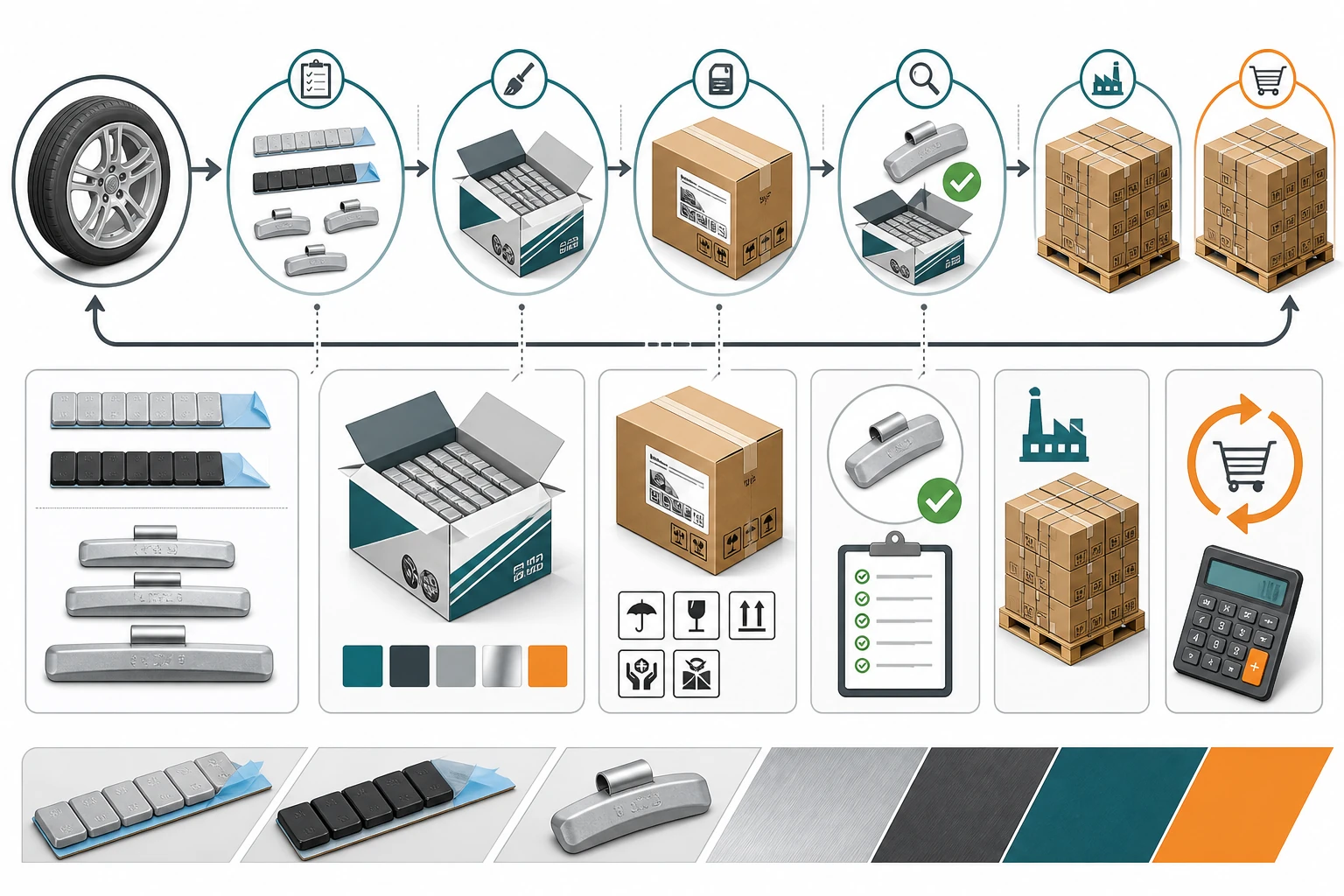
The least risky launch keeps the first product scope stable while controlling artwork, packaging, approval, and reorder decisions.
Use MOQ drivers behind the selected product and packaging scope to turn a supplier's headline MOQ into a workable order plan. A quote for "3,000 units" is incomplete until the buyer knows whether that means total strips, individual weights, inner boxes, cartons, one SKU, or a mix across several SKUs.
| MOQ driver | How it can raise the minimum | Question to put in the RFQ |
|---|---|---|
| Product SKU | Each profile, increment, material, tape, or finish may need its own run | Is the MOQ per SKU, per profile family, or across the total assortment? |
| Inner-box artwork | A unique printed box may have a separate print minimum | Can one standard box structure support several SKUs with controlled labels? |
| Carton artwork | Custom outer cartons can require a dedicated run or plate setup | Is a printed carton required, or can a standard carton plus approved label work at launch? |
| Label data | Barcodes, language versions, and retailer fields can multiply versions | Which labels vary by SKU, market, or shipment? |
| Packaging inserts | Custom dividers, leaflets, or display elements may need separate production | Is the insert essential to the first customer channel? |
| Product change | New geometry, tape, finish, or clip can require development and test samples | Is this a branded standard item or a development project? |
Small initial orders are possible in some circumstances, but buyers should not assume that a supplier's general low MOQ applies once they add multiple custom boxes, different carton prints, special labels, or new product features. The useful negotiation is not "Can the MOQ be lower?" It is "Which requirement creates the minimum, and what can be standardized without weakening the launch?"
How should buyers forecast first-order pricing?
Forecast first-order pricing by separating recurring per-unit costs from one-time or order-level costs. The buyer should ask suppliers to show those lines individually, then allocate one-time launch costs across the planned first order only for planning purposes. Do not treat the resulting figure as a permanent repeat-order price.
Use total-cost fields that should be standardized across quotes after the launch scope is set. The price comparison is only fair when every supplier is quoting the same product, inner pack, artwork version, carton, documentation, inspection, and delivery basis.
Illustrative first-order model
The following is a planning example only. It is not an offer, market benchmark, or supplier price. Assume a buyer launches two existing adhesive wheel-weight SKUs in a total of 3,000 inner boxes with buyer-specific inner-box graphics and standard export cartons.
| Cost line | Example planning value | Cost type |
|---|---|---|
| Standard product, SKU A: 2,000 boxes x USD 2.90 | USD 5,800 | Recurring product cost |
| Standard product, SKU B: 1,000 boxes x USD 3.20 | USD 3,200 | Recurring product cost |
| Buyer-specific printed inner boxes: 3,000 x USD 0.32 | USD 960 | Recurring packaging cost |
| Standard export cartons and labels | USD 420 | Recurring/order packaging cost |
| Artwork adaptation and print setup | USD 650 | One-time launch cost |
| Packed samples, approval changes, and inspection allowance | USD 470 | One-time/order control cost |
| Illustrative subtotal before freight, duty, and tax | USD 11,500 | Planning total |
In this example, the planning subtotal divided by 3,000 boxes is USD 3.83 per box. If the buyer looked only at the product lines, the weighted product average would be USD 3.00 per box. The USD 0.83 difference is not a hidden product-price increase; it is the effect of branded packaging and launch/control costs in the first order.
The same model becomes more useful when the buyer keeps one-time lines visible:
First-order planning cost per box = (recurring product + recurring packaging + one-time setup + order controls) / planned boxes
Repeat-order planning cost per box = (recurring product + recurring packaging + repeat-order controls) / planned boxes
Freight, insurance, duty, local tax, destination handling, and currency exposure are deliberately excluded from the illustration because they depend on the agreed Incoterm, route, destination, and time. Compare those separately in a landed-cost model.
How should buyers set a first-order SKU plan?
Set the first order around proven customer demand, not the full theoretical range. The initial branded program should carry enough variety to be useful, but not so many profile, increment, or pack variations that MOQ and artwork costs are spread over slow stock.
Use three categories:
| SKU category | First-order role | Commercial treatment |
|---|---|---|
| Core sellers | High-confidence format and increments for the main customer base | Highest share of initial volume and fastest path to reorder |
| Supporting items | Needed to make the range credible, but lower turnover | Smaller, controlled quantity or shared packaging where appropriate |
| Exceptions | Niche applications, special finish, rare profile, or new customer request | Quote/sample separately until demand is confirmed |
For example, a distributor with mostly passenger-car alloy-wheel service may begin with a compact adhesive strip range and an approved inner-box system. It can add special low-profile strips, alternative materials, unusual packaging, or additional languages after the first sales cycle establishes a credible forecast. A clip-on program should take the same approach: validated core profile families first, special rim cases later.
The SKU plan should connect to a simple stock model. Record expected monthly sales, desired inventory cover, lead time, carton quantity, and reorder point for each core SKU. Then check whether the supplier's MOQ creates too much stock cover on any slow item. If it does, reduce the SKU count, revise the pack structure, or agree an exception path rather than forcing an uneconomic assortment into the launch.
What should a buyer approve before placing a repeat order?
Approve the record that makes the first order repeatable: the product sample, the packaging/label proof, the packed sample, and the agreed identifiers. Repeat orders become risky when the original approval cannot tell the supplier which tape, finish, segment, profile, label version, carton count, or barcode was accepted.
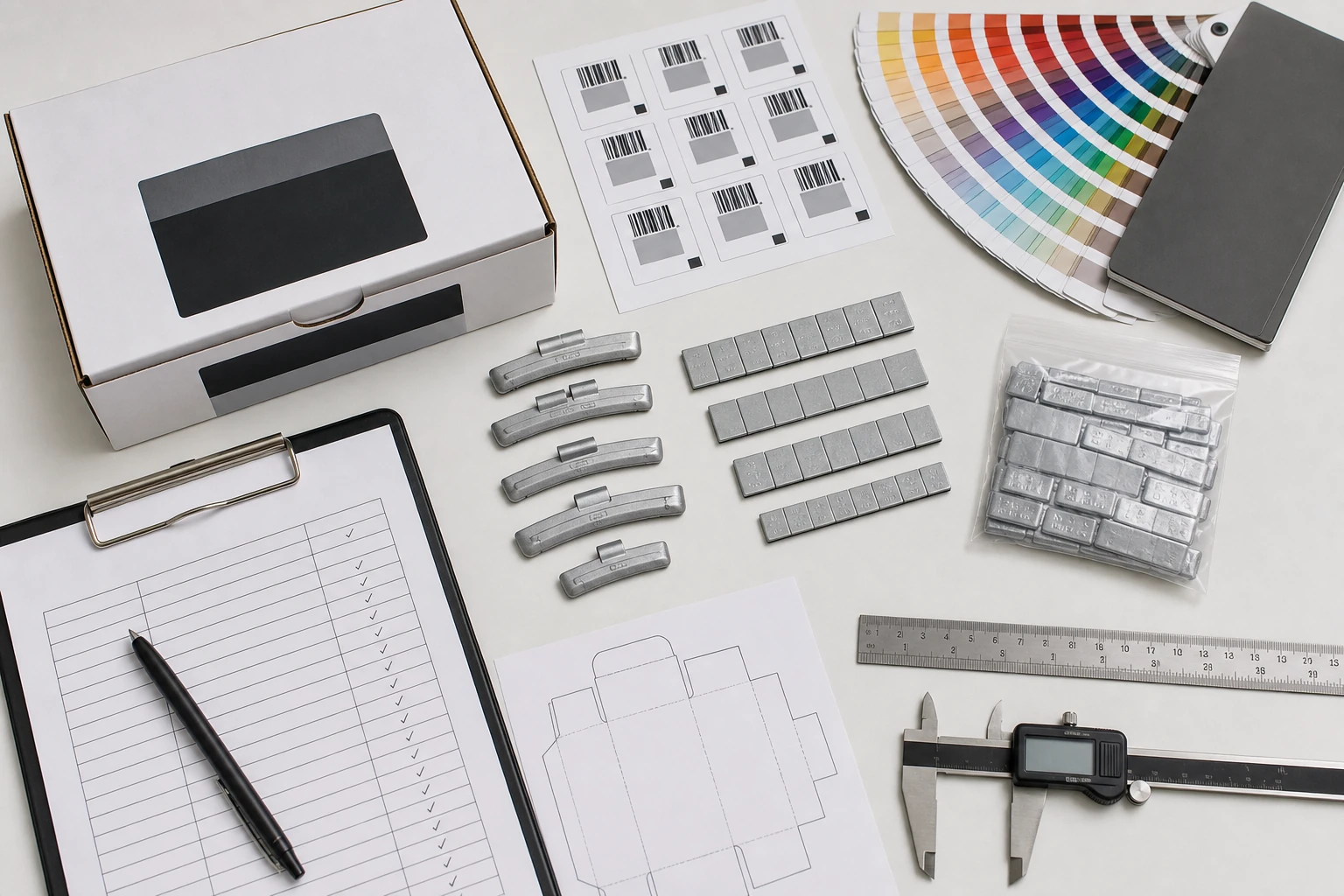
Private-label approval needs the product, inner pack, outer carton, label data, and change record to agree before bulk production.
| Approval item | What should match | Why it protects the buyer |
|---|---|---|
| Product reference | Buyer SKU, format/profile, material, increment, finish, tape or clip requirement | Stops a branded carton from hiding a different product configuration |
| Artwork proof | Version, brand assets, language, claims, and barcode data | Prevents outdated or unapproved print from recurring |
| Packed sample | Inner-box count, product orientation, carton quantity, labels, and protection | Confirms warehouse and customer-facing reality before bulk packing |
| Commercial record | MOQ basis, quoted inclusions, change costs, and delivery terms | Makes repeat quotes comparable to the approved launch |
| Traceability field | Lot or batch link, as agreed, on product/pack/shipment records | Supports receiving, claims, and controlled replenishment |
GS1's logistics-label guidance explains why physical identification matters in multi-party supply chains: logistics units need to be identifiable, and carton/outer-case information may use identifiers appropriate to the trading process. 1 A private-label buyer does not need to impose every GS1 feature on every wheel-weight carton, but it should decide which SKU, barcode, lot, quantity, and destination fields are needed by its own warehouse and customers.
GS1 also notes that traceability systems can link identification keys with trade items at packaging levels such as inner packs, cases, and pallets. 2 In practice, that means label data should be confirmed before bulk printing and preserved with the buyer's approval record. A barcode that scans but identifies the wrong SKU, pack count, or artwork version is still an operational failure.
For cartons and outer cases, GS1 describes ITF-14 as a barcode suitable for corrugated materials, while GS1-128 can carry additional identification data when the buyer's process calls for it. 3 The buyer should select the barcode and data fields with its trading partners rather than copying a label format that the warehouse cannot scan or reconcile.
Before the repeat order, review actual launch performance: returns, customer questions, stock turn, artwork errors, carton damage, sample-to-bulk consistency, and changes requested by sales channels. Then change one variable at a time where possible and issue a revised approval record. This is cheaper than treating every reorder as a fresh, undocumented launch.
If you are planning a private-label wheel-weight launch, share your brand requirements, initial SKU range, MOQ target, packaging, labels, and launch timing. We can help you shape a manageable first program before you expand the range.
Conclusion: launch a repeatable branded range before expanding it
Private-label wheel-weight MOQ and pricing become manageable when the buyer distinguishes standard product from custom packaging and product-development work. Keep the first branded launch focused on proven formats, limit the first SKU list to demand-backed items, show one-time setup separately from recurring costs, and approve the product/pack/label record before bulk production.
The goal is not the lowest possible first-order minimum. It is a branded range that can be quoted, received, sold, and reordered without losing control of the configuration. Discuss a private-label launch plan and target MOQ once the target range, packaging channel, and first-order forecast are clear.
Frequently Asked Questions
What usually creates the MOQ for private-label wheel weights?
MOQ can be driven by the product SKU, material, tape or clip configuration, inner-box printing, outer-carton printing, labels, inserts, and total order volume. Ask the supplier to state the minimum for each level rather than giving one undifferentiated number.
Can buyers use standard wheel weights with custom packaging?
Often, yes. Using a proven product configuration with buyer-specific graphics, labels, or cartons can reduce development risk compared with changing the product and packaging at the same time. Confirm which packaging components still have separate print or setup minimums.
How should first-order private-label pricing be compared?
Compare product, per-unit packaging, one-time artwork/setup, samples, inspection or approval controls, and delivery scope on separate lines. Confirm the exact SKU mix and box/carton quantities before comparing the subtotal or per-box figure.
Should artwork and barcode approval happen before production?
Yes. Approve the correct version of the artwork, data fields, barcode, product description, and pack count before bulk printing and production. Keep the approved proof with the product sample and PO record so repeat orders use the same reference.
When should a buyer add more private-label wheel-weight SKUs?
Add SKUs after the first range demonstrates demand and the buyer understands its stock turn, carton handling, and reorder pattern. New materials, formats, languages, or structural packaging should be treated as separate commercial decisions with their own sample and MOQ review.
References
[1] GS1. “GS1 Logistic Label Guideline.” 2026.
[2] GS1. “GS1 Global Traceability Standard.” 2026.
[3] GS1. “One-dimensional Barcodes for Retail General Distribution Healthcare and Logistics.” 2026.