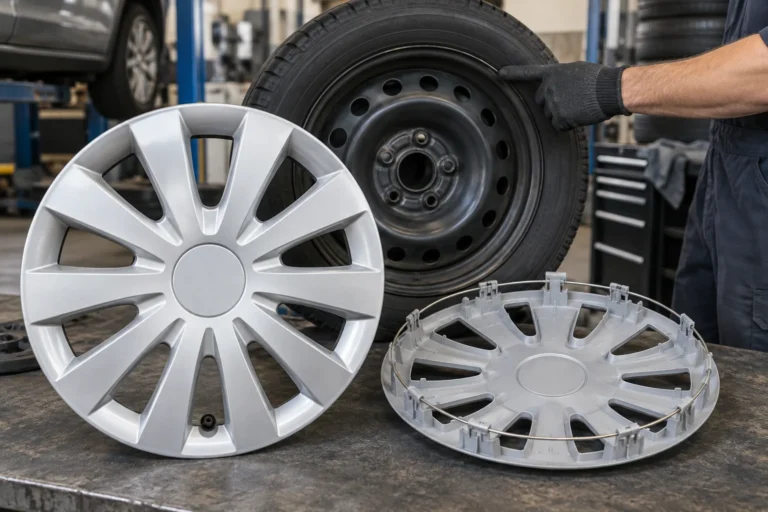




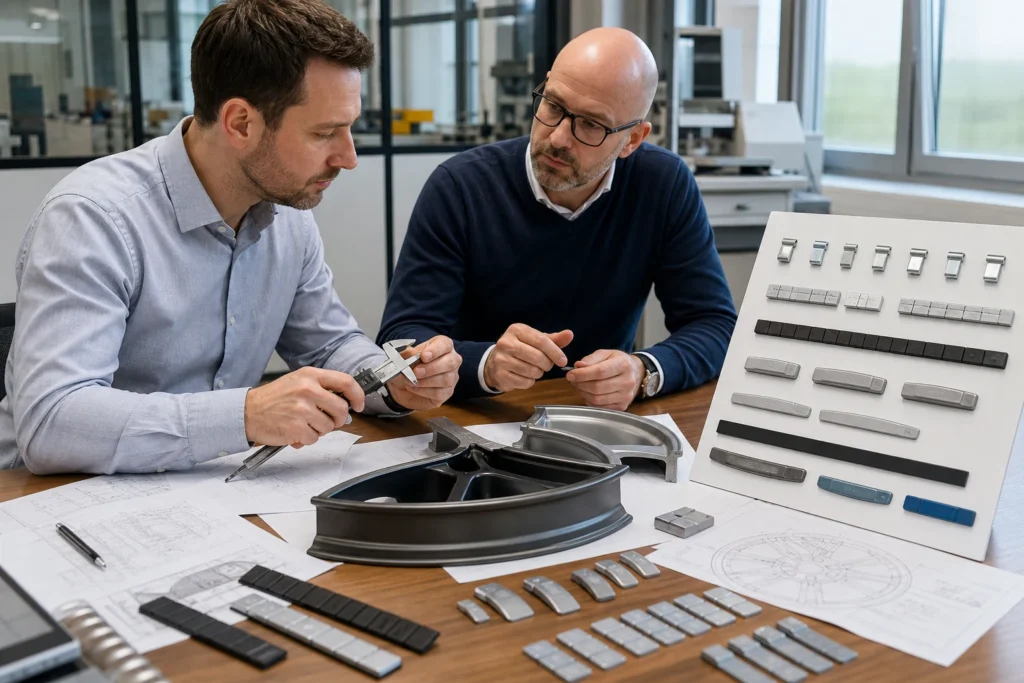
Custom wheel weights should be specified around the wheel application, attachment method, material, unit system, fitment, finish, packaging, labels, and validation method. Buyers should separate a true functional requirement from a cosmetic preference so development work, tooling, samples, and approval steps remain proportionate to the opportunity.
“Custom” can mean a new clip profile, an adhesive strip geometry, a material or coating requirement, a controlled assortment, or simply a buyer-branded pack. These changes do not carry the same engineering or commercial consequences. A useful development program begins by identifying the change that is necessary for the wheel application, then records the evidence required before the supplier makes samples or commits custom material and packaging.
Table of Contents
- What does a custom wheel weight program require?
- How should the wheel application be defined first?
- What is product customization and what is private label?
- Which custom wheel weight features need to be specified?
- What drawings samples and records should buyers request?
- How should buyers validate samples and control changes?
- How can buyers keep custom development proportionate?
- Conclusion: define the approved configuration before development
- Frequently Asked Questions
- References
What does a custom wheel weight program require?
A custom wheel weight program requires a defined application, a written product configuration, an agreed validation path, and a record of what will be approved before production. It does not begin with a factory choosing what “custom” might mean from a photo, a broad performance request, or a packaging concept.
The first brief should state the target wheels and channel, attachment method, material and finish, balance-value unit, expected pack, and the reason each nonstandard feature is needed. Buyers can use the application and product-range choices that form the custom brief to turn a market need into inputs a technical and commercial team can both review.
| Development question | What the buyer should state | Why it matters |
|---|---|---|
| Application | Target vehicles, wheel type, service channel, and representative rim or wheel sample | Determines whether fitment, appearance, corrosion exposure, or workshop workflow drives the program |
| Attachment | Clip-on profile, adhesive strip, or both; intended installation surface | Sets the fitment and retention problem before a material or pack is chosen |
| Product requirements | Material, finish, dimensions, increment system, geometry, and non-negotiable limits | Prevents a sample from being approved without a repeatable definition |
| Commercial requirements | Forecast, launch quantity, package level, label need, and destination | Shows which requests can use standard supply and which require separate commitments |
| Validation | Physical fit, mass and dimension checks, tape or finish checks, packing review, and acceptance owner | Gives development a measurable finish line |
| Change control | Revision owner, sample identification, approval date, and change-notice method | Protects repeat orders from silent substitutions |
The brief is not a substitute for engineering expertise. It is the buyer's way to make the engineering conversation efficient and to separate actual requirements from preferences that can be left standard.
How should the wheel application be defined first?
Define the wheel application with enough detail to establish fitment and installation conditions before asking for a new profile, strip, finish, or material. The most expensive development mistake is to customize a product around an assumed wheel use that was never verified against real rims or workshop practice.
For a clip-on program, identify the rim material and flange shape, wheel population, expected clip position, service equipment, finish sensitivity, and any known profile being replaced. For an adhesive program, identify the wheel surface, available mounting area, spoke clearance, desired strip position, installation conditions, cleaning method, and expected storage and use environment.
Buyers deciding whether the request needs rim retention or tape-backed installation can use the attachment choice before a clip profile or adhesive strip is developed to make the attachment decision before committing a custom feature. The destination helps the buyer distinguish a wheel-surface need from a rim-flange need, which prevents a visually appealing but unsuitable concept from entering development.
Provide representative physical parts where feasible: a rim section, wheel, profile sample, or a precise drawing. A photograph can communicate context, but it is rarely sufficient to prove flange geometry, clearance, surface condition, or the way a technician accesses the placement area.
What is product customization and what is private label?
Product customization changes the wheel weight itself or its required performance path; private label changes how an approved product is identified and presented. The two can occur together, but treating them as one request makes cost, MOQ, samples, and accountability harder to control.
Examples of product customization include a new or modified clip profile, different strip geometry, requested material or coating, an unusual increment set, a changed tape system, or a controlled mixed assortment designed for a particular service market. These changes may need fit checks, material or process review, samples, drawings, and an approval record.
Private-label work can range from a controlled label on a standard carton to custom inner boxes, artwork, barcode fields, and branded assortment packs. Buyers planning branding can use packaging and artwork controls for a branded range to keep product approval, label data, carton design, and repeat-order control distinct from a true product-development request.
| Request type | Typical example | Usually needs product validation? | Usually needs packaging approval? |
|---|---|---|---|
| Standard product, standard pack | Existing adhesive strip in a regular carton | Yes, for application fit if new to the buyer | No change beyond receiving checks |
| Standard product, buyer label | Existing clip-on SKU with controlled label fields | Product sample may be sufficient | Yes, label and carton proof |
| Product configuration change | Different clip geometry, tape, finish, or segment design | Yes, with a stated test and acceptance path | Only if pack changes too |
| New development | New profile or geometry, special material route, new tooling | Yes, engineering and production validation | Often, but should be scoped separately |
This separation also keeps development proportionate. If the goal is market recognition rather than different wheel fitment or performance, a standard product plus controlled packaging may be the better first program.
For a branded program that needs repeat production rather than a one-off custom sample, define OEM wheel weight manufacturer responsibilities for a repeatable branded program alongside the product brief so tooling, approval records, packaging, change control, and reorder support are assigned before development begins.
Which custom wheel weight features need to be specified?
Specify every feature that affects wheel fitment, balance function, installation, durability, identification, packaging, or approval. A request does not need unnecessary manufacturing detail, but it must give the supplier enough information to quote, sample, and reproduce the intended configuration.
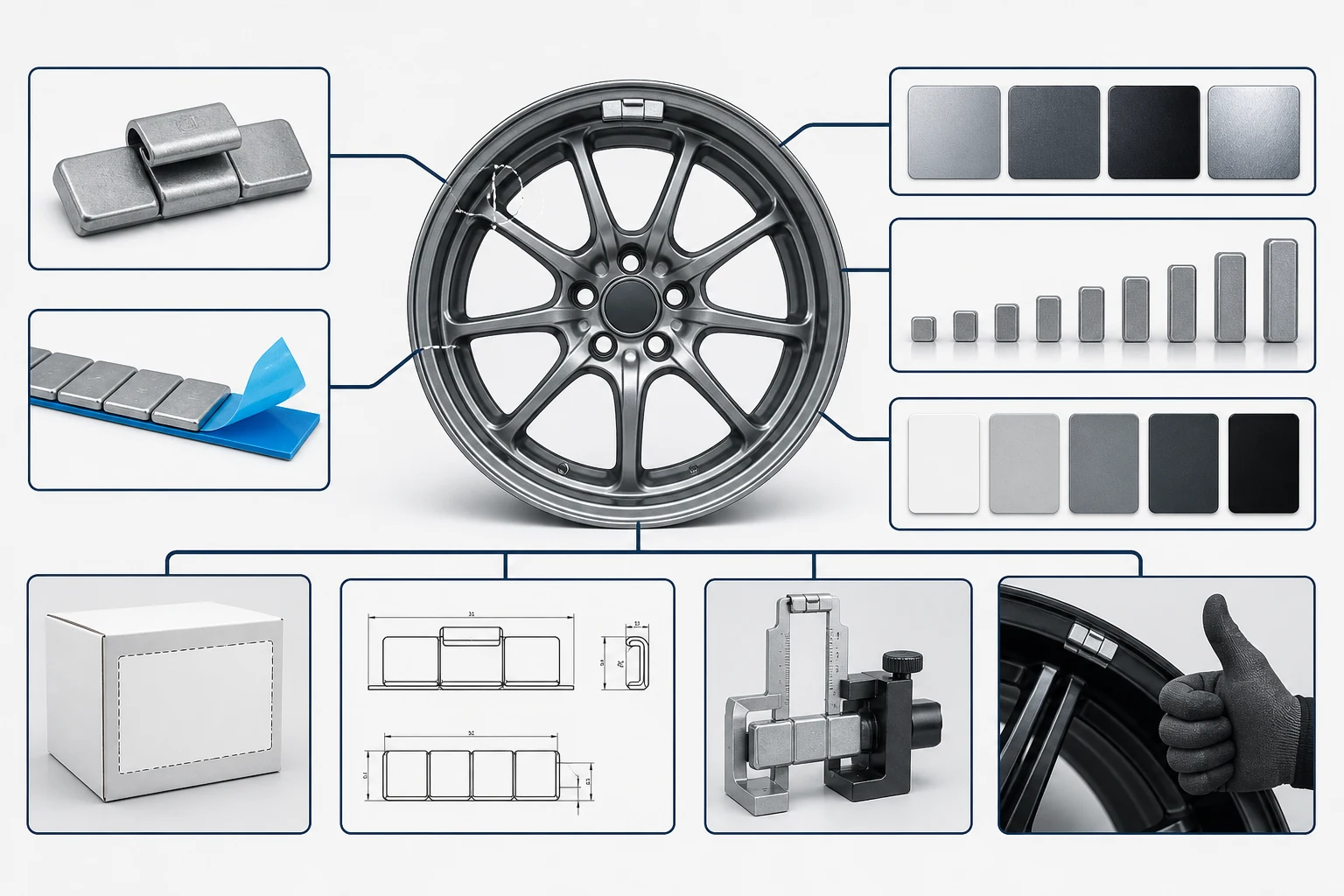
Start with the functional hierarchy. Fitment-critical details come first, followed by balance value, attachment performance, material/finish, package and label requirements, then visual preferences. Do not allow a secondary color or carton preference to obscure a clip profile, strip thickness, tape, or increment requirement that determines whether the product can be used.
| Specification area | Useful fields | Buyer caution |
|---|---|---|
| Wheel and fitment | Rim type, flange geometry, wheel surface, clearance, intended placement | Confirm with a representative physical wheel or agreed drawing, not an image alone |
| Attachment | Clip profile, body geometry, tape, liner, strip thickness, segmentation | State what must remain fixed and what may be proposed as a standard alternative |
| Material and finish | Agreed material option, coating or plating, corrosion or appearance expectation | A finish claim should lead to an agreed test basis rather than a broad promise |
| Balance units | Grams or ounces, individual values, segment pattern, assortment ratio | Use the unit and increment coverage before a custom assortment is defined to verify real service coverage |
| Dimensions and tolerances | Critical width, thickness, height, clip opening, strip length, mass, and break points | Mark which dimensions are functional and how they will be checked |
| Packaging and labels | Inner/outer count, carton strength, labels, barcode fields, pallets, language | Keep product and packaging revisions identifiable |
The production route should inform the brief as well. The production controls affected by a custom wheel weight specification help a buyer see why changes to stamping, coating, tape application, measurement, and packing cannot be treated as decoration. For an adhesive line, use tape and strip variables that need approval for an adhesive program to define the tape, liner, strip, and installation variables before samples are compared.
What drawings samples and records should buyers request?
Request drawings, samples, and records that identify the version being evaluated and the checks used to approve it. The goal is not to collect paperwork for its own sake; it is to stop an approved sample from becoming detached from the quoted or produced product.
A practical development package may contain a buyer brief, a supplier drawing or configuration record, sample identifiers, a check list, photographs of relevant fitment or pack tests, and a written approval decision. For a new clip profile or geometry, a drawing with critical dimensions and an agreed test rim is usually more useful than broad product photography. For an adhesive strip, a configuration record should state material, finish, segment design, tape, liner, and the sample's pack format.
Ask each sample to be identified by revision and date. Record what it represents: visual concept, fit prototype, engineering sample, packaging proof, or proposed production configuration. Without that distinction, teams may approve an early concept and later assume it proves the final tool, tape, coating, or carton.
How should buyers validate samples and control changes?
Validate samples against the agreed functional requirements, then lock the accepted configuration with a named record and change process. A sample should prove what it was designed to prove, not be used as a blanket approval for every later material, tooling, package, or process choice.
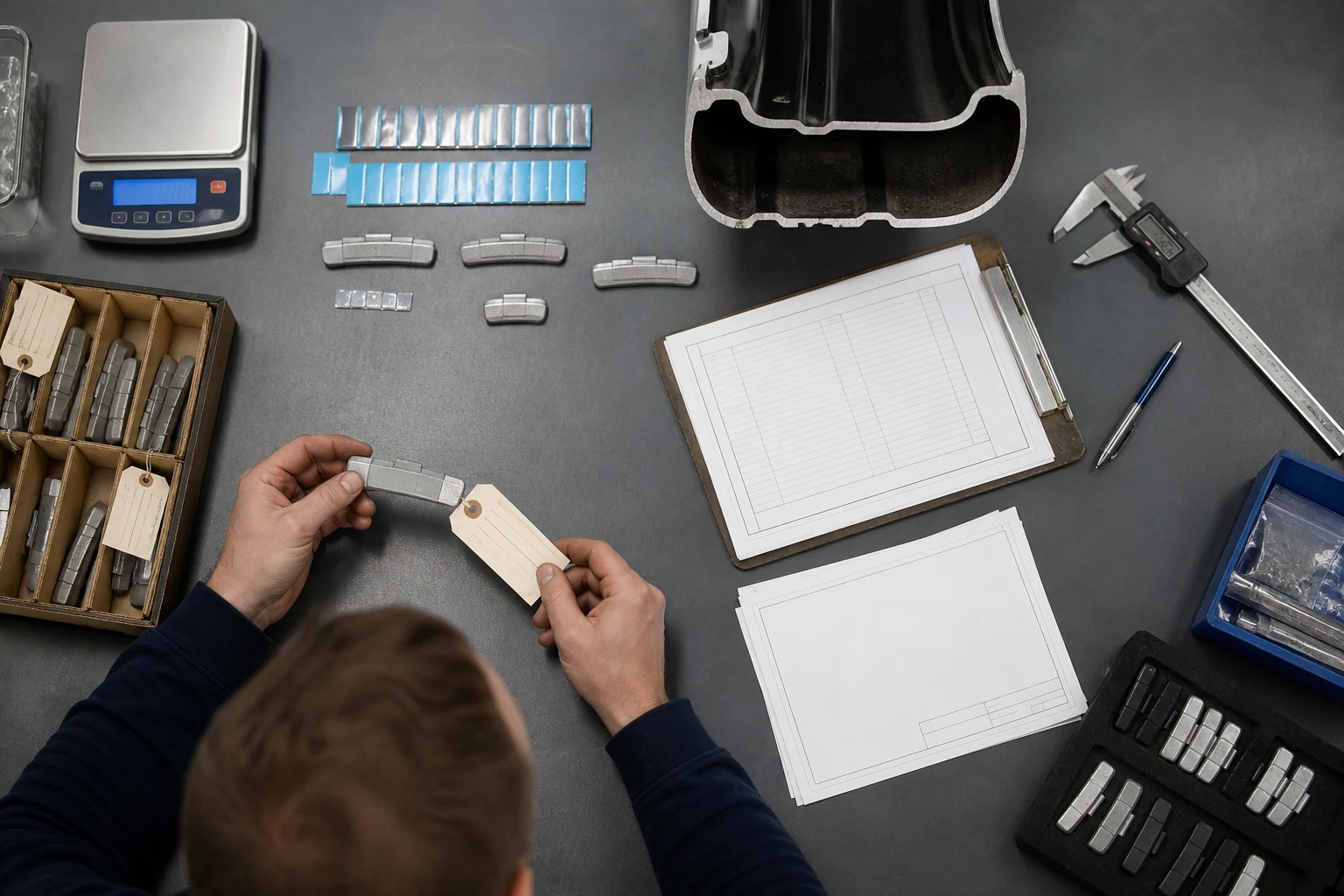
Create a short acceptance table before testing. It can include fitment on the agreed rim or surface, mass and critical dimensions, strip segmentation or clip geometry, finish appearance, tape or installation checks where relevant, package count, label fields, and sample identification. If corrosion resistance is required, state the method, duration, acceptance criterion, and exact sample version; ASTM B117 describes salt-spray apparatus operation but does not by itself predict universal field life.1
The International Automotive Task Force's sub-tier requirements emphasize flowing customer requirements and controlling changes through the supply chain. Applied proportionately, that means the buyer and supplier should know which configuration was approved, who may authorize a change, and how the buyer will be told before a different material, tape, coating, label, or pack reaches production.2
Use this sequence:
- Confirm the development brief and identify functional versus optional features.
- Review the supplier's proposed drawing, configuration, and any standard alternative.
- Receive identified samples and test only against the agreed use case and acceptance checks.
- Review the sample pack and labels when packaging is part of the program.
- Issue a written approval, rejection, or conditional approval tied to the revision.
- Hold a change record for any later material, process, tape, finish, drawing, or packaging update.
ISO 9001's treatment of controlled documented information supports this practical approach: the specification, sample decision, and revision record should remain connected rather than being scattered across emails and photographs.3
For an efficient start, request standard clip-on and adhesive samples to use as a development baseline when the custom request may be solved by an existing configuration. A standard sample can establish the real gap before the buyer asks for a new tool or custom component.
How can buyers keep custom development proportionate?
Keep development proportionate by customizing only features that solve a real fitment, performance, regulatory, service, or market need, and using standard options where they already meet the requirement. This reduces development time and commercial exposure without weakening the product brief.
Rank every requested feature as fitment-critical, performance-critical, compliance-critical, service-critical, brand-critical, or optional. A special profile that fits a target rim may be essential; a different carton texture may be optional for a first order. Request separate commercial alternatives where appropriate: existing product with standard pack, existing product with buyer label, approved product configuration change, and full new development.
Before committing, ask the supplier which feature drives drawing work, tooling, special material purchasing, tape or coating setup, sample timing, packaging MOQ, and repeat-order control. The answer should make the custom program more precise, not turn it into an opaque “custom MOQ.”
If you are planning a custom wheel-weight program, share the target wheel applications, material, attachment format, size range, branding, testing, and volume assumptions. We can help you turn the brief into a reviewable development and sample plan.
Conclusion: define the approved configuration before development
Custom wheel weights work best when the buyer defines the wheel application, attachment, material, unit system, fitment, finish, packaging, labels, and validation method before a supplier begins development. Separate true functional changes from private-label presentation and optional visual preferences, then approve the product through identified drawings, samples, and records.
Discuss the specification, drawing, and sample path for a custom program only after the non-negotiable requirements are clear. That gives the supplier a fair basis to propose an existing solution or a controlled development route, and gives the buyer a configuration it can repeat on later orders.
Frequently Asked Questions
What can be customized on wheel weights?
Wheel weight programs can potentially customize attachment profile or strip geometry, material, finish, increments, tape or liner, packaging, labels, and assortment logic. The buyer should first identify which of those changes are needed for fitment or performance and which are presentation preferences.
Is private label the same as custom wheel weights?
No. Private label usually concerns the approved product's cartons, labels, artwork, barcode fields, and commercial presentation. Custom wheel weights change the product configuration or its required validation path. A program can include both, but they should be quoted and approved separately.
Do custom wheel weights require new tooling?
Not always. An existing profile, strip, or process may satisfy the specification. New or modified geometry, special materials, or nonstandard process requirements can require drawing work, tooling, or separate setup. Ask the supplier which requested feature causes the development commitment.
What should be approved before custom wheel weight production?
Approve the identified product configuration, application fit, critical dimensions and mass, attachment details, material and finish, relevant tape/liner or clip details, packaging and labels, sample evidence, and the change-control method. The approval should refer to a revision or record that can be used for repeat orders.
How do buyers prevent unapproved changes on repeat orders?
Keep the approved drawing or configuration record, sample decision, packaging version, and order requirements together. Ask the supplier to notify the buyer before changing material, tape, coating, geometry, label, carton, or other agreed product element, then document the acceptance of any change.
References
[1] ASTM International. “ASTM B117 Standard Practice for Operating Salt Spray (Fog) Apparatus.” 2026.
[2] International Automotive Task Force. “Minimum Automotive Quality Management System Requirements for Sub-Tier Suppliers.” 2017.
[3] International Organization for Standardization. “ISO 9001:2015 – Quality management systems – Requirements.” 2015.