



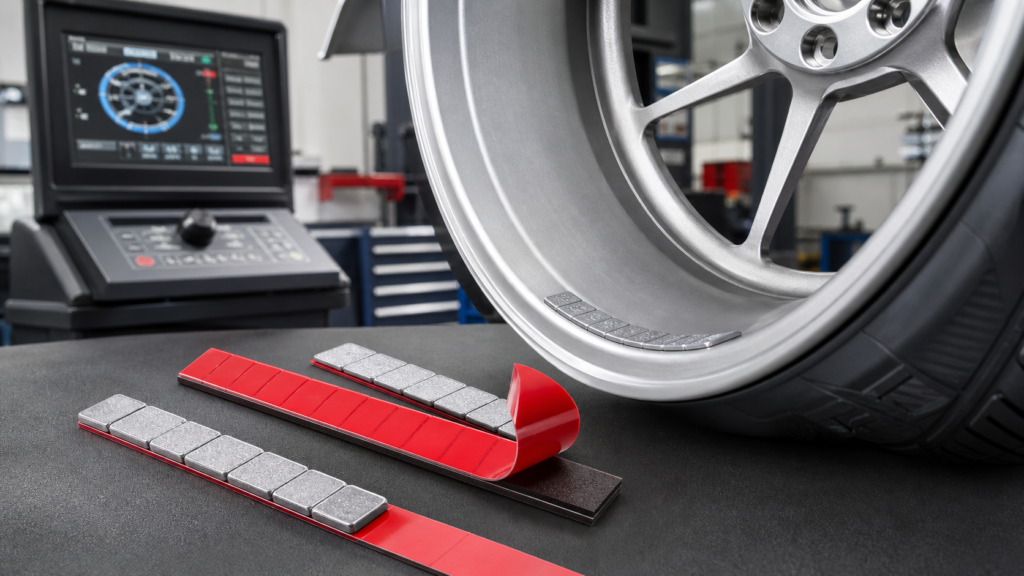
Adhesive wheel weights are segmented balancing weights with pressure-sensitive tape on the back, usually installed inside the wheel barrel to correct imbalance without clipping onto the rim flange. They work well when the strip size, tape system, surface preparation, installation pressure, and wheel clearance all match the service environment.
For buyers, the important point is that an adhesive wheel weight is not only a piece of metal with tape. It is a small assembly that combines correction mass, material, coating, foam or adhesive layer, liner, segment design, and packaging. A good RFQ should make those fields clear before samples are approved.
Table of Contents
- What are adhesive wheel weights?
- Where are adhesive wheel weights used?
- How does adhesive wheel weight tape work?
- Which adhesive wheel weight sizes are common?
- How should adhesive wheel weights be installed?
- Why do adhesive wheel weights fail or fall off?
- What should buyers confirm before requesting adhesive wheel weights?
- What quality checks reduce adhesive wheel weight problems?
- Conclusion: specify adhesive weights as a tested system
- Frequently Asked Questions
- References
What are adhesive wheel weights?
Adhesive wheel weights are stick-on balancing weights that bond to the inner wheel barrel with tape instead of fastening to the rim flange with a clip. A balancing machine identifies the correction mass and position; the adhesive strip supplies that mass at the selected location.
Most adhesive weights are supplied as segmented strips. The technician separates or cuts the required number of segments, removes the liner, places the strip at the balancer-indicated position, and presses it firmly onto a clean wheel surface. The same idea can be used in gram-based and ounce-based markets, but the product markings must match the service channel.
The format is common because it solves several practical problems. It keeps the visible wheel face cleaner, reduces the need to match many clip profiles, and gives installers flexibility when working with alloy wheels. It also creates its own risks: tape performance, wheel-surface condition, installation temperature, and profile clearance must be controlled.
For a buyer building a full tire-service range, adhesive strips need to be compared with clip-on profiles, material choices, unit coverage, and packaging. The range planning across wheel-weight formats, materials, and sizes helps buyers connect adhesive strips with the rest of the wheel-weight assortment before they turn it into a stock list.
When the wheel mix is still unclear, the first decision is not size or tape. It is attachment method. Buyers can use when adhesive weights are the right attachment choice to separate alloy-wheel appearance needs from steel-wheel flange-fit needs before they approve adhesive products.
Where are adhesive wheel weights used?
Adhesive wheel weights are most often used on alloy wheels, aluminum wheels, premium passenger vehicles, and other applications where a visible clip-on weight may be unsuitable. They are also useful when the wheel design provides a suitable inner-barrel mounting area and the installer can prepare that surface correctly.
The usual placement is inside the wheel barrel rather than on the outer flange. That hidden location helps preserve wheel appearance and avoids forcing a clip onto a finished rim edge. It can also support dynamic balancing procedures where the machine identifies inner and outer correction planes.
The wheel still decides the answer. A deep barrel with a clean, flat mounting area is more adhesive-friendly than a narrow, highly curved, dirty, or textured surface. Spoke design, brake clearance, barrel curvature, and existing finish all affect whether the strip can sit flat and remain secure.
For alloy-focused programs, alloy-wheel tape and barrel-fit checks help buyers connect adhesive choice with the actual wheel surface, not just the catalog description. A strip that works well on one alloy wheel can be inconvenient on another if the profile is too thick or the usable flat area is limited.
Adhesive weights may also appear in mixed service markets that handle both alloy and steel wheels. In those cases, buyers should avoid treating adhesive strips as a universal replacement for clip-on weights. A practical assortment may need adhesive strips for alloy wheels and verified clip-on profiles for steel wheels, with different carton logic for each line.
How does adhesive wheel weight tape work?
Adhesive wheel weight tape creates a pressure-sensitive bond between the back of the strip and the wheel barrel. The bond depends on surface contact, cleanliness, dryness, temperature, pressure, and time after application. General tape guidance emphasizes surface preparation and pressure because tape cannot compensate for contamination or poor contact by itself.1
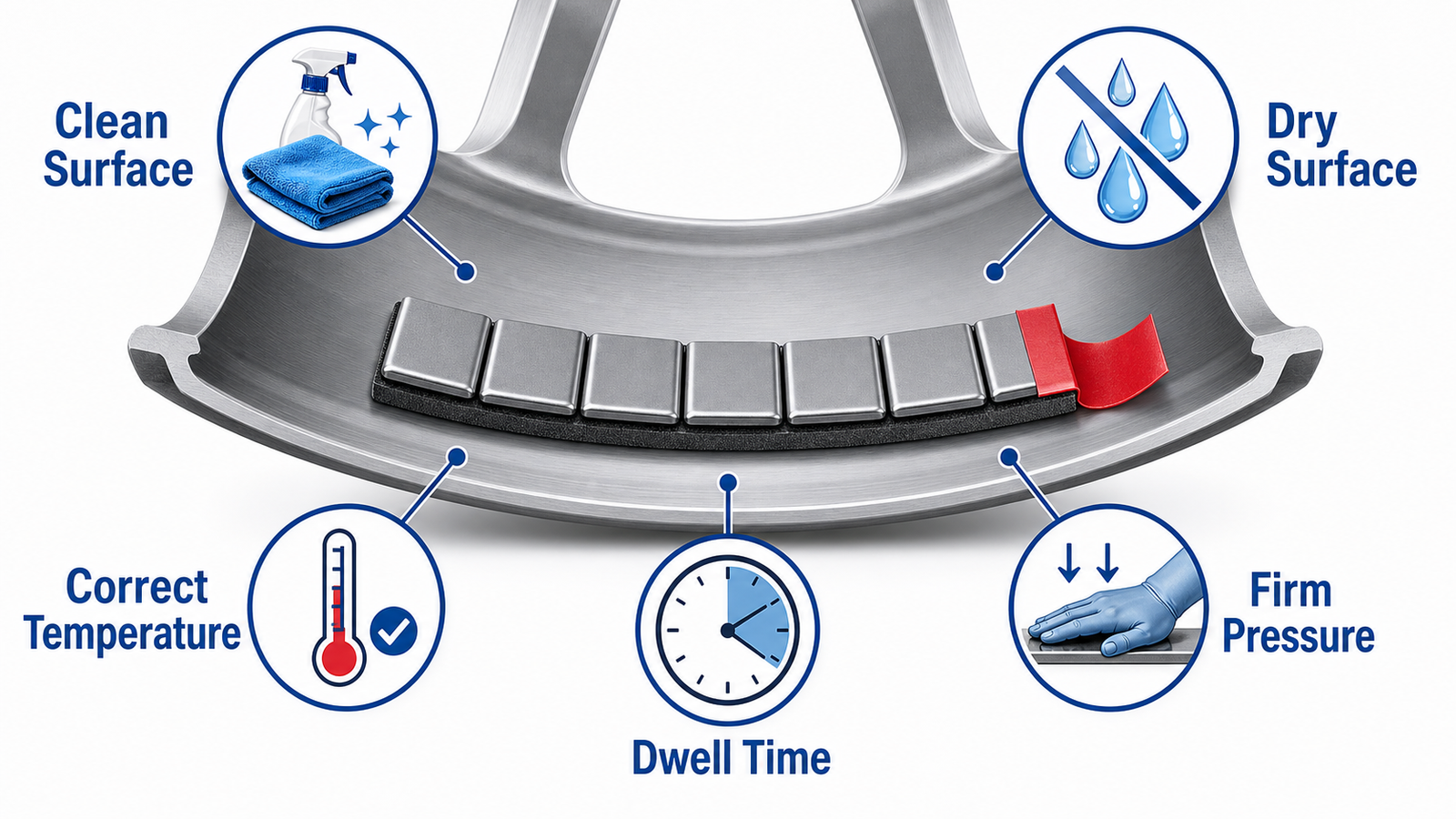
The tape needs to wet out across the wheel surface. That means the adhesive must make close contact with the barrel rather than sitting on dust, brake residue, water, tire lubricant, old adhesive, or detailing chemicals. Even a strong tape can fail if the bond area is dirty or if the strip is pressed only at the center.
Temperature also matters. Cold tape and cold wheels can reduce initial tack, while hot, dusty, or oily conditions may introduce other risks. Buyers should ask for the supplier’s application guidance and then test samples under the conditions their target installers actually face. A heated tire shop, a mobile service van, and a cold warehouse installation process do not represent the same use case.
The liner is part of the product experience. A good liner should protect the adhesive before installation and release cleanly when the technician is ready to apply the strip. If the liner tears, lifts the tape, leaves residue, or is hard to remove with gloves, the product may slow the shop down even if the adhesive itself is acceptable.
The foam or tape layer also changes how the strip sits on the barrel. A flexible tape can help contact mild curvature, but it does not make an unsuitable surface suitable. The strip profile, segment length, and tape width should be evaluated together.
Which adhesive wheel weight sizes are common?
Adhesive wheel weight sizes are usually planned around gram or ounce increments, with segmented strips that let technicians build the correction mass shown by the balancing machine. The best size range is the one that covers common corrections without creating too many slow-moving SKUs or confusing labels.
Many gram-based programs use small segments such as 5 g increments, while ounce-based programs may use fractional ounce formats. The exact range varies by market and customer habit. What matters is that the segment markings, carton labels, and balancer units agree. Mixed unit systems can create errors when technicians work quickly.
| Size field | What to specify | Buyer reason |
|---|---|---|
| Unit system | Grams, ounces, or clearly controlled dual marking | Prevents mismatch between balancer output and product label |
| Segment mass | Weight per segment and break-point design | Lets technicians build the required correction mass |
| Strip total mass | Total weight per strip, roll, tray, or box | Helps plan shop use and inventory replenishment |
| Segment dimensions | Width, length, thickness, and edge shape | Affects barrel fit, clearance, and handling |
| Material | Steel, zinc, or customer-approved lead-free option | Changes density, strip size, coating need, and documentation |
| Packaging | Pieces per strip, strips per box, carton quantity, lot mark | Supports warehouse receiving and repeat ordering |
Buyers who need to turn balancing-machine values into a purchase range can use adhesive strip increments in grams and ounces to define unit coverage before they request samples. The goal is not to list every possible weight; it is to cover the corrections target shops see often.
Size should also be checked physically. A compact strip may be easier to hide, while a longer or thicker strip may be harder to fit in a narrow barrel. A heavier correction value can require several segments, so buyers should test common high-use sizes on representative wheels before approving cartons.
How should adhesive wheel weights be installed?
Adhesive wheel weights should be installed only after the wheel is balanced, the placement area is identified, the barrel surface is clean and dry, and the strip has been checked for clearance. The technician should remove the liner carefully, place the strip once, and press firmly across the full length.
A practical installation sequence is:
- Balance the wheel and identify the correction point. Use the balancing machine result to decide the required mass and placement area.
- Inspect the mounting surface. Check the inner barrel for dirt, old adhesive, coating damage, curvature, and clearance.
- Remove residue carefully. Old tape, road film, brake dust, moisture, and tire lubricant can reduce bond strength.
- Clean and dry the area. Use a cleaning method suitable for the wheel finish and the selected tape system.
- Prepare the strip mass. Separate only at intended segment breaks so the installed mass remains accurate.
- Dry-fit before exposing adhesive. Confirm that the strip sits flat and will not interfere with brakes, spokes, or other components.
- Remove the liner and apply the strip. Avoid touching the adhesive surface, then place the strip accurately.
- Press across the full length. Apply firm pressure over each segment, including the edges.
- Recheck balance and seating. Confirm the correction and inspect for lifting or poor contact.
This process is short, but it is not optional. Skipping cleaning or pressure to save a few seconds can create more rework later. A lost weight may bring back vibration, create a customer complaint, or force a repeat balance.
Installers should also avoid stacking strips unless the application, clearance, and supplier guidance allow it. A stacked weight changes profile height and may reduce contact reliability. If the balancer calls for a larger correction than the location can handle cleanly, the wheel or tire condition should be checked rather than forcing an awkward adhesive placement.
Why do adhesive wheel weights fail or fall off?
Adhesive wheel weights usually fail because the bond was compromised before it had a chance to perform. The common causes are contamination, moisture, cold application conditions, weak pressure, unsuitable tape, rough wheel finish, poor liner handling, or a strip profile that does not match the wheel barrel.
The failure can look simple: the weight is missing. The cause is often more specific:
| Failure symptom | Likely cause | What to check |
|---|---|---|
| Weight falls off soon after installation | Dirty or wet surface, low pressure, cold surface, poor initial contact | Cleaning process, installer pressure, temperature, dwell time |
| Edges lift but center stays attached | Incomplete pressure or curved barrel mismatch | Segment profile, tape width, barrel curvature |
| Tape stays on wheel but metal segment detaches | Bond between tape and weight body is weak | Tape lamination, coating, production control |
| Liner is hard to remove | Liner/tape mismatch or storage issue | Liner release, humidity exposure, carton condition |
| Strip does not sit flat | Profile too thick, segment too long, surface too curved | Strip dimensions and wheel sample fit |
Storage can also affect performance. Adhesive products should be protected from heat, moisture, dust, and crushed packaging. A strip that arrives with damaged liner edges or contaminated tape may create trouble before a technician ever installs it.
Buyers should treat failures as data. Ask where the weight was installed, how the surface was cleaned, what temperature the shop worked in, how long after installation the issue appeared, and whether the tape remained on the wheel or separated from the strip. Those details reveal whether the problem is installation, tape selection, wheel surface, or product construction.
What should buyers confirm before requesting adhesive wheel weights?
Buyers should confirm tape type, segment size, material, coating, packaging, samples, and compliance documents before requesting adhesive wheel weights. A supplier can quote more accurately when the RFQ describes the wheel application and test conditions, rather than asking only for a general “stick-on wheel weight” price.
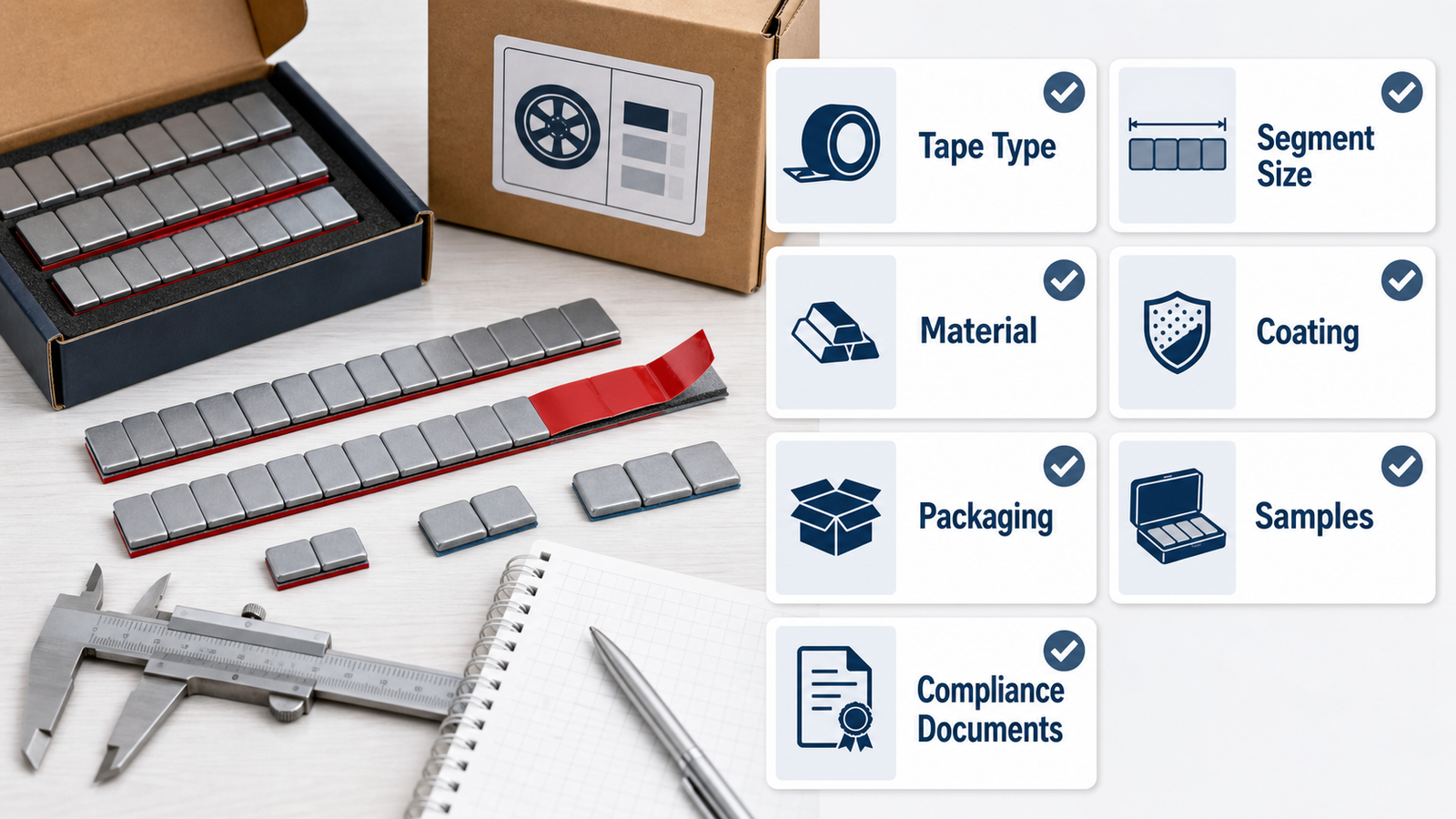
Use this RFQ checklist before sample approval:
| RFQ item | What to confirm | Why it matters |
|---|---|---|
| Wheel application | Alloy wheels, passenger cars, SUVs, EVs, mixed service, or distributor stock | Defines barrel clearance, appearance expectations, and likely size range |
| Tape type | Tape construction, liner, application guidance, and target conditions | Adhesion is the central performance factor for stick-on weights |
| Segment size | Segment mass, dimensions, strip total weight, and break points | Determines correction flexibility and barrel fit |
| Material | Steel, zinc, or lead-free requirement by destination market | Affects density, coating, compliance expectations, and customer approval |
| Coating | Finish color, corrosion resistance expectation, and appearance standard | Important for storage, wheel appearance, and complaint reduction |
| Packaging | Strip count, tray, roll, box, carton mark, barcode, private label, pallet need | Supports warehouse receiving and fast shop selection |
| Samples | Quantity, sizes, tape version, wheel surfaces, test temperature, dwell period | Turns approval into a repeatable test rather than a visual check |
| Documents | Material declaration, lead-free statement, RoHS/REACH where requested, customer files | Helps importers and distributors satisfy market or account requirements |
Once those fields are clear, buyers can compare adhesive wheel weight samples that match the approved tape and segment specification instead of browsing a product category without knowing which tape, strip size, or packing format they need.
Material and documentation should be handled early, especially for export or distributor programs. Environmental concerns around lost lead wheel weights have been noted by the U.S. Environmental Protection Agency, and many buyers now request non-lead options or lead-free declarations before approval.2 Importers who need a tighter destination-market decision can use lead-free material and document checks for export orders before they finalize the adhesive range.
What quality checks reduce adhesive wheel weight problems?
Useful quality checks connect the product to real installation behavior. Buyers should check mass accuracy, tape coverage, liner release, segment separation, coating, edge condition, packaging accuracy, and sample performance on representative wheel surfaces.
Start with physical checks. Weigh segments and strips against the stated unit. Inspect whether break points separate cleanly. Check for sharp edges, coating chips, inconsistent tape placement, exposed adhesive, liner wrinkles, and cartons that crush the strips. None of these require advanced equipment, but they often catch problems that lead to workshop complaints.
Then test installation behavior. Apply samples to cleaned representative wheels under the agreed conditions. Check how the liner removes, how the strip conforms to the barrel, whether edges lift, and how the bond behaves after the agreed dwell period. Keep the accepted sample and packaging label as a repeat-order reference.
For repeat supply, lot control matters. Cartons should identify material, size, unit, quantity, product code, and production lot. This allows a distributor to trace complaints and confirm whether a later shipment matches the approved sample. A technically correct strip can still create buyer frustration if the outer carton is vague or if similar SKUs are easy to mix.
Buyers setting repeat-order standards can review tape, coating, and packing controls behind repeatable wheel weights before writing final inspection points. The value is not only knowing how the parts are made; it is knowing which process details deserve checks in a purchase specification.
Conclusion: specify adhesive weights as a tested system
Adhesive wheel weights work best when buyers treat them as a system: correction mass, material, coating, tape, liner, segment profile, installation surface, pressure, dwell time, and packaging. A low unit price cannot fix a strip that does not fit the barrel, loses adhesion, or arrives in cartons that technicians cannot identify quickly.
Before placing a bulk order, define the wheel applications, unit system, segment size, tape expectations, installation conditions, material route, and packaging format. Then request samples that match those fields and test them on representative wheel surfaces. That is the clean path from an adhesive wheel weight inquiry to a range that tire shops can install, reorder, and trust.
Frequently Asked Questions
Are adhesive wheel weights the same as stick-on wheel weights?
Yes. Adhesive wheel weights and stick-on wheel weights usually refer to the same product type: segmented balancing weights with tape on the back, installed inside the wheel barrel instead of clipped to the rim flange.
What tape is used on adhesive wheel weights?
Adhesive wheel weights use pressure-sensitive tape systems, often with foam or similar backing constructions. Buyers should request the tape type, liner details, application guidance, and sample testing conditions rather than approving tape by appearance alone.
What sizes do adhesive wheel weights come in?
They commonly come in gram or ounce-based segmented strips. The exact size range depends on the market, balancer units, vehicle mix, and packaging format. Buyers should specify segment mass, total strip weight, dimensions, and labeling.
Why do adhesive wheel weights fall off?
They usually fall off because the bonding surface was dirty, wet, cold, oily, or poorly pressed. Other causes include unsuitable tape, rough wheel finish, damaged liner, weak tape-to-weight lamination, or strip profile mismatch.
Can adhesive wheel weights be used on steel wheels?
They can be used when the wheel design, surface, clearance, and installation process support adhesive placement. Many steel-wheel programs still use clip-on weights, so buyers should decide by wheel application rather than assuming one format fits every rim.
Should buyers test adhesive wheel weight samples before bulk orders?
Yes. Samples should be tested on representative wheel surfaces under realistic cleaning, temperature, pressure, and dwell-time conditions. The approved sample should define the repeat-order specification for tape, segment size, material, coating, and packaging.
References
[1] 3M. “Surface Preparation for 3M VHB Tape Applications.” 2019.
[2] United States Environmental Protection Agency. “Best Management Practices for Lead Wheel Weights.” 2015.