



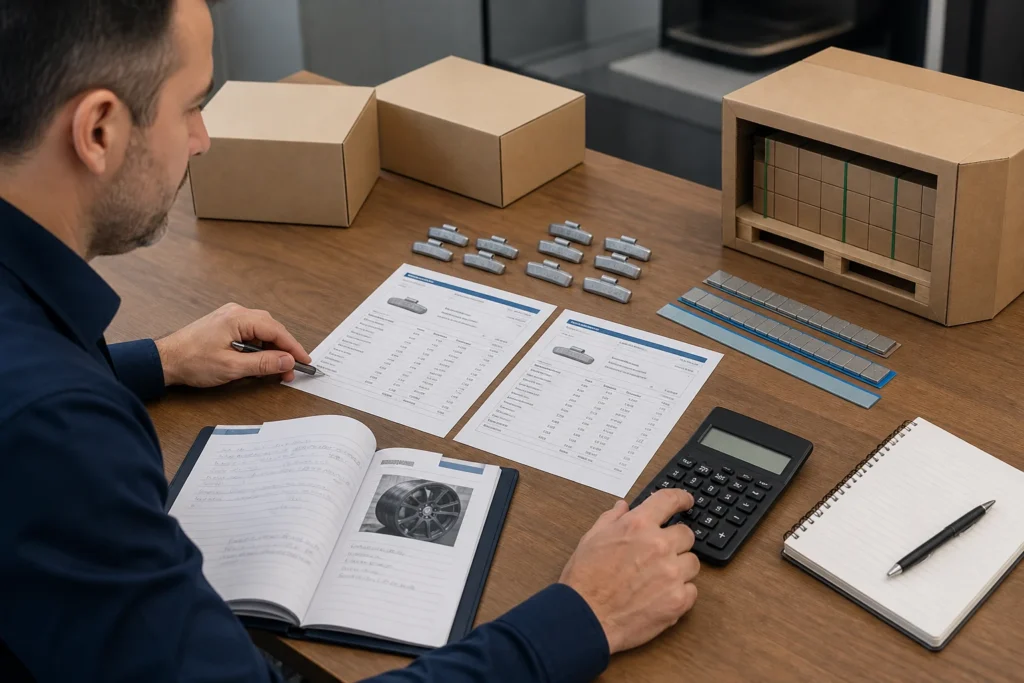
Wheel weight price should be compared as a total specification and service cost, not as a headline unit figure. Material, clip or tape construction, coating, packaging, documents, MOQ, inspection, and destination requirements can make two apparently similar prices commercially different.
That is why a public “price per piece” rarely answers a distributor's or importer's actual question. One quote may cover a standard steel clip-on weight in a plain carton at the factory gate. Another may include an adhesive strip, private-label packs, inspection records, export pallets, and a named delivery term. The useful comparison begins when both offers are translated into the same product, unit, package, and delivery scope.
Table of Contents
- What does wheel weight price actually mean?
- What can a headline wheel weight price leave out?
- How do material and components affect the quoted price?
- Why do packaging documents and delivery terms change total cost?
- How do MOQ and order structure affect the commercial comparison?
- How can buyers calculate landed cost for a wheel weight order?
- How should buyers compare total cost before choosing a quote?
- What should be in a total-cost RFQ?
- Conclusion: compare a defined order, not a price fragment
- Frequently Asked Questions
- References
What does wheel weight price actually mean?
Wheel weight price means the cost assigned to a particular, defined supply scope. It is only useful when the buyer knows the product version, the quantity unit, what packaging and service are included, which destination costs are excluded, and who carries responsibility at each handover point.
A supplier may quote per piece, per strip, per roll, per carton, per kilogram, or per mixed assortment. Each can be valid. The problem starts when a buyer compares those figures as though they all describe the same quantity and the same finished product. A low per-kilogram number for unboxed weights, for example, is not automatically comparable with a per-carton price for labeled, mixed, palletized packs.
Start by fixing the product range before asking anyone to price it. The product-range decisions that should be fixed before price is requested help a buyer connect the intended wheel applications to the attachment formats, materials, increments, and package logic that belong in a real request. After clicking, the buyer can reduce the number of undefined variables before a supplier turns them into assumptions.
Use this baseline when collecting a price:
| Price field | What to record | Why it changes the comparison |
|---|---|---|
| Product identity | Clip-on or adhesive, profile or strip design, material, finish, increment system, and intended application | Prevents a different product family from being priced as a substitute without notice |
| Price unit | Piece, segment, strip, roll, kilogram, inner pack, carton, or order | Gives the buyer a common basis for calculation |
| Quantity scope | Quantity per SKU, product family, carton, or full order | Shows whether a quoted price depends on a particular mix or minimum |
| Packaging scope | Inner count, carton count, labels, pallets, and protective materials | Identifies what the buyer receives and what it must source or pay for later |
| Evidence and service | Samples, inspection, material statement, test evidence, artwork check, or loading support | Shows whether product-control work is included, optional, or absent |
| Delivery scope | Factory collection, port delivery, named Incoterm, freight, insurance, duty, local delivery, or other charges | Prevents an apparently cheaper offer from excluding the next unavoidable cost |
The goal is not to force every supplier to offer the same service. It is to name the differences so the buyer can choose them knowingly.
What can a headline wheel weight price leave out?
A headline price can leave out the product details, packing, verification, and handover costs that determine what actually reaches the buyer. It may also conceal a different unit, a different order quantity, a different material, or an unspoken delivery assumption.
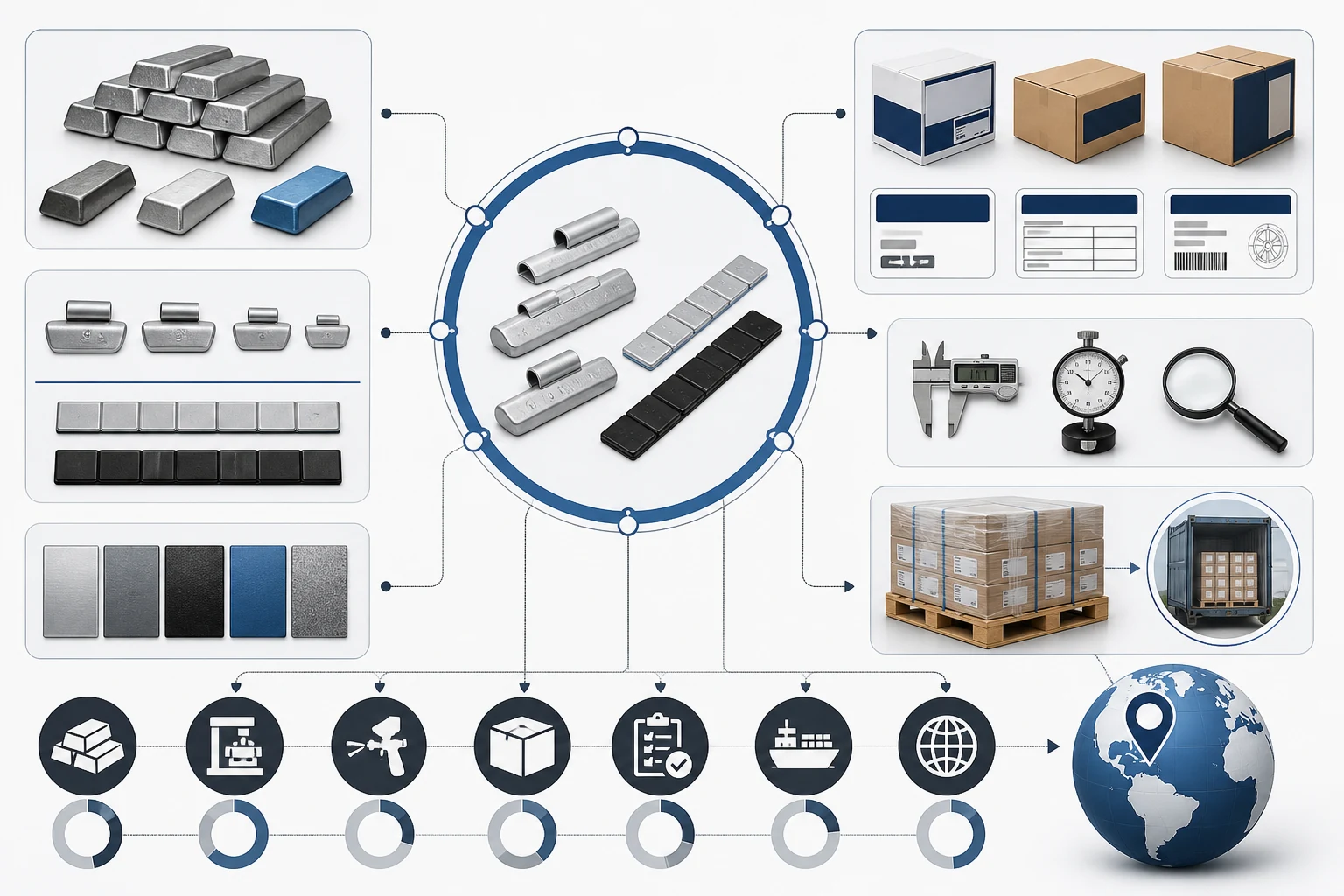
Before comparing numbers, ask what the number is attached to. Is it for a bare standard weight, a tape-backed strip with an identified liner, a finished coated clip-on part, or a carton that the distributor can put into stock? Is the quantity a few samples, one full carton, a per-SKU minimum, or a repeat container program? A price without those answers is a starting signal, not a purchasing decision.
Common omissions include:
- A different material, coating, clip, tape, liner, increment spread, or strip thickness than the buyer intended.
- Packaging that is plain, loose, unmarked, or supplied in a different inner and outer count.
- Sample, inspection, label review, documentation, or pre-shipment work charged separately or not offered.
- Freight, export handling, insurance, duty, tax, local clearance, or final delivery outside the named price.
- A MOQ that applies per SKU or printed package instead of to the whole order.
- A currency, payment term, validity period, or exchange-rate assumption that makes later comparison unstable.
Unit conversion deserves special care. Buyers comparing grams and ounces, individual weights and breakable strips, or carton quantities and kilograms can use the unit and increment checks before a price is normalized to make sure the underlying balance-value coverage remains comparable. A lower price for a strip with fewer usable segments or an unsuitable increment range is not a like-for-like saving.
Do not turn this into an endless request for detail before an initial conversation. A useful first quote can show standard scope and options. The buyer simply needs each option identified so a later “all-in” calculation does not mix one supplier's standard product with another supplier's upgraded pack or delivery service.
How do material and components affect the quoted price?
Material and component choices affect price because they determine what is bought, processed, controlled, and packed into the finished SKU. A quote should identify those choices clearly enough for the buyer to decide whether a lower price comes from a legitimate standard configuration or from a different product.
For clip-on weights, meaningful price variables can include the body and clip material, clip profile, weight shape, coating or plating, increment mix, and carton arrangement. For adhesive weights, relevant variables can include the weight material, finish, strip dimensions, segment pattern, tape, liner, and format in which the strip is packed. A generic term such as “wheel weight” cannot carry these differences by itself.
Material changes can also bring document requirements. When a buyer serves a destination or customer moving away from lead, it should align the requested material, any declaration, and the price scope from the first inquiry. The material and document scope for a lead-free wheel weight program helps a buyer identify what it must verify before treating a steel or zinc alternative as commercially equivalent to a quoted lead-based or unspecified line.
Product format can change the economic unit as well as the product price. 3M identifies one wheel-weight roll as 11.0 meters long and 12.32 pounds, designed to be cut to exact weight and replace multiple individual sizes.4 A roll quote therefore should not be compared with a strip, box, or clip-on assortment only by kilograms; the buyer also needs usable balancing output, waste, equipment, labor, and inventory implications.
The process behind the component matters too. Buyers who need to understand why two otherwise similar parts carry different commercial terms can use process and quality-control steps behind a repeat product price to see where stamping, coating, tape application, measurement, and packing control create real work. This is not an argument that a more complex process is always worth more; it is a way to ask whether the price includes the required configuration and controls.
| Product element | Comparison question | Why a lower offer may differ |
|---|---|---|
| Material | What exact material option is quoted, and is it supported by the requested statement? | A different metal or unconfirmed material can change compliance, mass behavior, and cost |
| Clip profile or strip geometry | Is the same profile, thickness, segment pattern, or intended wheel application being offered? | Tooling, fit, and usable balancing coverage may not match |
| Coating or finish | What finish is included and what is the agreed performance basis, if required? | “Coated” can describe different processes and batch controls |
| Adhesive system | Is tape, liner, storage, and application expectation the same? | A visually similar strip may use a different tape or conversion method |
| Increment coverage | Which values, pieces, segments, or rolls are in the price? | A cheaper mixed pack may omit the values that drive real service demand |
The right response to an unclear quote is not to assume poor quality. Ask the supplier to name the configuration and state an alternative separately. That makes negotiation more precise and more respectful of both parties' time.
Why do packaging documents and delivery terms change total cost?
Packaging, documents, and delivery terms change total cost because they affect how the product is received, counted, traced, protected, moved, and cleared. They are not add-ons once the order crosses a warehouse or a border; they are part of the operational result the buyer is paying for.
A retail-ready inner pack, a controlled outer carton, a pallet plan, and a handling label may cost more than loose product, but can reduce repacking, receiving errors, damage, or stock confusion. GS1's logistic-label guidance treats the handling unit's identity as a logistics requirement, which is a useful reminder that an outer carton and pallet label must be clear enough for the party receiving it.1
For branded programs, separate the base product cost from packaging development and approval. Buyers can use separate approval and packaging costs in a branded wheel weight order to identify what belongs to the normal SKU, what is a one-time artwork or sample task, and what must repeat with every carton. That avoids penalizing the base product price for a launch cost that should be shown independently.
Order structure matters in the same way. The carton, pallet, and SKU-mix choices in a bulk wheel weight order help buyers see whether a price uses a useful carton count, a workable pallet, and a mix that matches actual demand. A less expensive carton may be costly to handle if it is too heavy, combines unrelated SKUs, or forces a distributor to break and re-label every unit.
Delivery terms are especially important in export buying. Incoterms rules allocate tasks, costs, and risks between buyer and seller at defined points; the named rule and named place belong on the quote, rather than a vague claim that “shipping is included.”2 The buyer should also identify costs that may still sit outside the Incoterm, such as import duty, tax, broker fees, local storage, or final-mile delivery, depending on the chosen term and destination.
Ask each supplier to show:
- Price currency, validity period, payment term, and the quoted unit.
- Inner-pack and carton counts, net and gross weights, carton dimensions, pallet pattern, and labels.
- Sample, artwork, inspection, test, and document charges or inclusions.
- Named Incoterm and named location, plus whether freight, insurance, export clearance, or loading is included.
- Any one-time tooling, setup, packaging, or administration charge separately from recurring unit price.
How do MOQ and order structure affect the commercial comparison?
MOQ and order structure affect the comparison because they determine the quantity at which a quoted unit price is available and how much unwanted stock, packaging, or working capital the buyer must carry. A lower unit price at a larger or more fragmented minimum may have a higher first-order cost than a slightly higher price for a balanced, replenishable assortment.
At minimum, record whether the quantity is per SKU, per product family, per material and finish, per printed carton, or for the whole order. Then record which values may be mixed, which need separate cartons, and what happens to unused custom labels or packaging. This is particularly important when a supplier offers a compelling total price but requires equal quantities of slow-moving increments or adds a per-SKU pack minimum that was not shown in the headline.
The buyer should compare two views:
- First-order cash requirement: product, special packaging, samples, inspection, freight, insurance, and all other costs needed to launch the chosen assortment.
- Repeat-order operating cost: recurring product and packing price, normal freight and handling, stock turn, likely replenishment quantities, and the cost of carrying variants that do not move.
Do not use a simplistic formula that pretends every risk can be reduced to a precise number. Instead, state what is known, make options visible, and keep a notes column for assumptions. A supplier willing to quote a standard configuration and a customization separately often gives a buyer more decision value than a lower-looking price with no scope detail.
How can buyers calculate landed cost for a wheel weight order?
Calculate landed cost by adding every nonrecoverable cost required to move the defined wheel weight order into usable warehouse stock, then divide that total by the same commercial unit used for inventory and sales. Keep taxes, duties, and charges that depend on the destination in separate rows so they can be replaced without rebuilding the comparison.
A practical model is:
Landed cost = goods + recurring packaging + one-time charges + inspection + export handling + freight + insurance + duty + nonrecoverable tax + broker/port charges + inland delivery
Do not assume the named Incoterm supplies every number after the handover point. Obtain freight, duty, tax, broker, storage, and destination delivery inputs from the responsible provider for the actual route. If tax is recoverable, keep it out of the economic landed cost but show it separately in the cash-flow plan.
Worked landed-cost example
The following numbers are illustrative only. Assume both suppliers quote the same 1,000-carton adhesive wheel weight order, with four boxes per carton. The example uses an assumed 4% duty solely to demonstrate the calculation; the buyer must replace it with the applicable classification, customs value, destination rate, and tax treatment.
| Cost line | Supplier A | Supplier B |
|---|---|---|
| Goods | $24,000 | $23,000 |
| Packaging/setup | $600 | $1,500 |
| Inspection | $300 | $300 |
| Export handling | $700 | $700 |
| Freight and insurance | $2,400 | $2,900 |
| Illustrative customs value used for duty | $27,000 | $27,400 |
| Duty at assumed 4% | $1,080 | $1,096 |
| Broker and port charges | $620 | $620 |
| Inland delivery | $900 | $900 |
| Total landed cost | $30,600 | $31,016 |
| Landed cost per carton | $30.60 | $31.02 |
| Landed cost per box | $7.65 | $7.75 |
Supplier B starts with a goods price that is $1,000 lower, but the stated assumptions produce a landed total $416 higher. This does not make Supplier A universally better: Supplier B may offer a stronger tape, more useful packaging, better payment terms, or lower failure risk. It shows why the buyer should separate measurable landed cost from qualitative supplier risk instead of treating the factory-gate price as the final answer.
Run a sensitivity check on the uncertain rows. For example, change freight, exchange rate, duty, storage, or carton utilization and observe which quote becomes more expensive. Also calculate the first order separately from a repeat order when tooling, artwork, or packaging setup will not recur.
How should buyers compare total cost before choosing a quote?
Buyers should normalize quotes to the same SKU brief, price unit, package plan, delivery term, and evidence scope before they choose. The comparison is fair only after differences are either eliminated or stated as deliberate alternatives.

Create one comparison sheet for each supplier. List the requested specification in the first column, then copy only the supplier's stated response into the next columns. Do not silently fill missing values with what another supplier quoted.
| Comparison area | Normalize this field | Decision question |
|---|---|---|
| Product | Attachment type, material, finish, profile or strip construction, increments, and intended application | Is every supplier quoting the same usable product? |
| Quantity | Unit price basis, requested quantity, SKU minimum, permitted mix, and total order quantity | Does the stated price apply to the actual order plan? |
| Packaging | Inner pack, carton count, dimensions, labels, pallets, and branded components | Can the product enter the buyer's warehouse and sales channel as quoted? |
| Quality and evidence | Sample identity, inspection scope, documents, test basis, and change notification | What product-control work is included before and after the order? |
| Delivery | Currency, payment term, Incoterm and named place, freight, insurance, and local costs | Where does the seller's price stop and the buyer's cost begin? |
| Commercial risk | Quote validity, lead time, custom-material balance, re-order terms, and exceptions | What changes if demand, design, or shipping conditions move? |
Quality documentation should be treated as a stated scope, not a magic certificate. ISO 9001 addresses controlled documented information; for a buyer, the useful implication is to tie the quotation, approved sample, inspection requirement, and packaging version to an identifiable SKU. That reduces the chance that a low first price is later matched to an unclear or changed product.3
Once every supplier is priced on the same commercial basis, use the supplier comparison factors beyond the headline wheel weight price to judge range coverage, packing readiness, documents, quality control, and reorder stability alongside the cost calculation. After clicking, a distributor can make a buying decision that considers how the quotation will work in the real stock program.
When the normalized figures still leave competing offers difficult to compare, use a quotation comparison process for price, scope, evidence, and delivery risk to record what each supplier has included, omitted, or proposed as an alternative before approval.
For the initial evaluation, request clip-on and adhesive sample formats for a specification-matched quote rather than an unspecified sample assortment. The physical samples should match the SKU scope under comparison, including the relevant profile, strip format, finish, and packaging where these matter.
What should be in a total-cost RFQ?
A total-cost RFQ should give every supplier the same product and delivery brief, then ask each supplier to identify its assumptions and alternatives. It is not a demand for a fixed public price; it is a method for turning a commercial inquiry into an informed choice.
Include:
- The target market, wheel applications, and required clip-on or adhesive product families.
- Material, finish, profile or strip construction, increment system, and any application-critical requirements.
- Quantity by SKU or the permitted mixed-assortment ratio, plus desired launch and repeat-order volumes if known.
- Price unit, currency request, quote validity, and payment-term request.
- Required inner pack, carton, pallet, labels, private-label components, and destination port or place.
- Sample, inspection, material statement, document, artwork, and change-control expectations.
- Request for the named Incoterm, named place, lead time, one-time charges, and all exceptions to be shown separately.
This brief gives suppliers a practical way to propose a viable standard alternative when the buyer's first choice would cause an unnecessary MOQ or packaging minimum. It also lets the buyer send a specification for a comparable total-cost quotation without pretending that every supplier must structure its offer in the same way.
If you are comparing the total cost of wheel-weight quotes, share the product specification, volume, packaging, freight assumptions, payment terms, and quality requirements. We can help you build a comparable cost brief before choosing a supplier.
Conclusion: compare a defined order, not a price fragment
Wheel weight price becomes meaningful only when the quoted product, quantity, packaging, evidence, and delivery scope are visible. Material, clip or tape design, coating, increments, inspection, documents, branded packaging, MOQ, and named delivery terms can all change the commercial result even where two headline unit prices appear close.
Fix the application-critical specification, normalize the unit and order structure, and ask each supplier to state its service scope and exceptions. Then compare the first-order cash requirement and the repeat-order operating cost side by side. That is the sound basis for a comparable total-cost quotation.
Frequently Asked Questions
Why is there no single public wheel weight price?
Wheel weight prices depend on the product configuration, material, attachment type, increments, packaging, order quantity, evidence, and delivery scope. A public figure without those details can mislead a buyer because it may describe a different product or exclude costs that are necessary for the intended order.
Should I compare wheel weights by price per kilogram or price per piece?
Use the unit that matches the product and commercial decision, then normalize the comparison with net weight and pack content. Price per kilogram can be useful for material-intensive products, while price per piece, strip, or carton may better reflect a workshop or distributor assortment. The product configuration must still be the same.
What should I ask a supplier to include in a wheel weight quote?
Ask for the exact product description, material, attachment, finish, increment coverage, price unit, quantity scope, inner and outer packaging, samples and inspection, documents, currency, payment term, quote validity, lead time, and named delivery term and location. Ask all alternatives and one-time charges to be shown separately.
Does a lower MOQ always mean a better wheel weight price?
No. A lower MOQ can reduce first-order exposure, but the product may have a higher unit price, a less suitable SKU mix, or limited packaging and service scope. Compare the required first-order cash and the expected repeat-order costs against the actual market need.
How do I compare freight in two wheel weight quotations?
First identify the named Incoterm and named place in each quote. Then list what is included up to that point and estimate the remaining cost to the same destination. Do not treat “shipping included” as enough detail, because freight, insurance, export handling, duty, tax, and local delivery may be allocated differently.
References
[1] GS1. “GS1 Logistic Label Guideline.” n.d.
[2] International Chamber of Commerce. “Incoterms 2020 Rules.” 2020.
[3] International Organization for Standardization. “ISO 9001:2015 – Quality management systems – Requirements.” 2015.
[4] 3M. “3M Wheel Weight PN61403 (TN4715P).” 2026.