



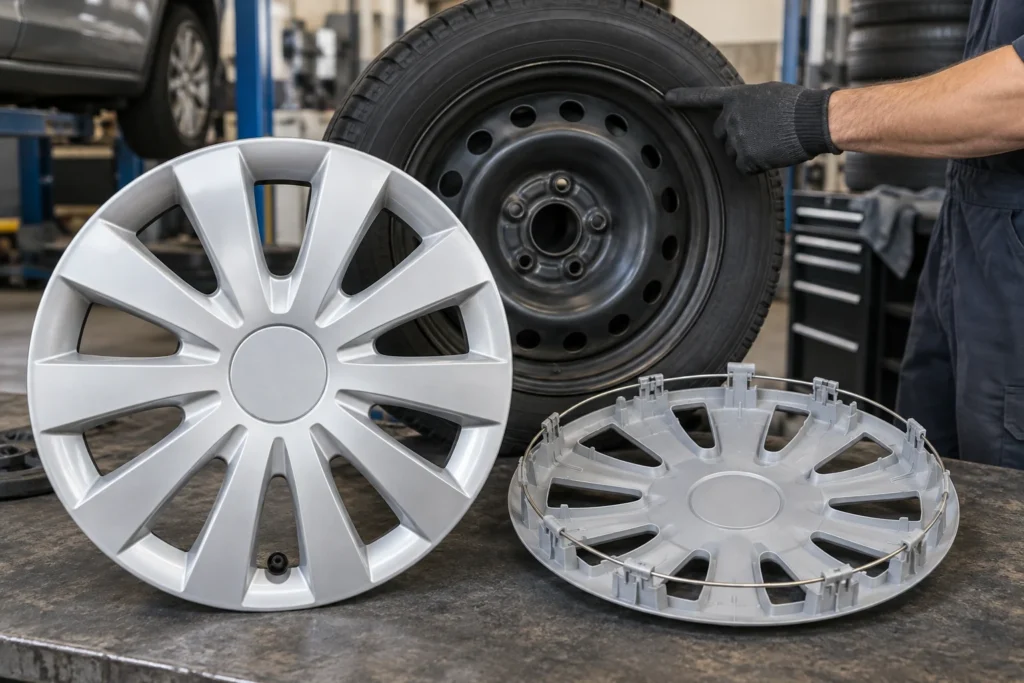
Hubcaps and rims are not the same thing. The rim is part of the wheel itself: the outer edge that holds the tire bead. A hubcap is a separate decorative cover that clips or bolts onto the wheel. Hubcaps can be removed and replaced cheaply; rims cannot be removed from the wheel. Today “hubcap” usually means a full wheel cover for a steel wheel, while “rims” is everyday slang for the whole wheel, especially alloy wheels.
This guide explains the terms, compares hubcaps with alloy wheels, and shows what to check before buying replacement covers, whether you need one cover for your own car or a range for a shop or distribution business.
Table of Contents
- Hubcaps vs rims: what is the difference?
- Hubcap, center cap, wheel cover and rim: terms explained
- Hubcaps on steel wheels vs alloy wheels compared
- Can you put hubcaps on any wheel?
- How do hubcaps attach, and why do they fall off?
- How do you choose the right replacement hubcap?
- What should shops and distributors check before ordering wheel covers?
- Frequently Asked Questions
- References
Hubcaps vs rims: what is the difference?
A rim is a structural part of the wheel. A hubcap is a cosmetic accessory fitted over the wheel. If you remove a hubcap, the car can still be driven; the rim carries the tire and the load and cannot be left off.
| Question | Hubcap (wheel cover) | Rim / wheel |
|---|---|---|
| What is it? | A separate cover that clips, rings or bolts onto the wheel face | The outer edge of the wheel that holds the tire; in everyday speech, the whole wheel |
| Is it structural? | No. It is cosmetic and protects the wheel face from dirt | Yes. It carries vehicle load and seals the tire bead |
| Typical material | Molded plastic such as ABS or PP, sometimes painted or chrome-plated; older designs used steel | Pressed steel or cast/forged aluminum alloy |
| Usually fitted to | Steel wheels on base trims, fleet vehicles and spare-wheel setups | Every vehicle; alloy wheels are usually designed to be seen without a cover |
| Can the owner replace it? | Yes, usually by hand or with basic tools | Replacing a wheel needs tire work, balancing and correct fitment data |
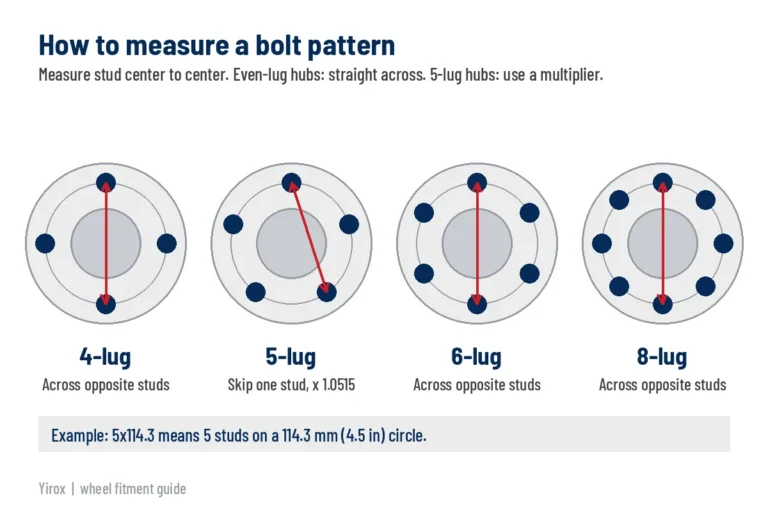
| What sizing matters? | Wheel diameter, wheel face and edge profile, retention type, valve-stem position | Diameter, width, bolt pattern (PCD), center bore, offset, load rating |
| Relative cost | Low; sold singly or in sets of four | Much higher per wheel, plus mounting and balancing |
So “hubcaps vs rims” is often really a choice between keeping steel wheels with covers, or upgrading to alloy wheels that are styled to be shown without a cover.
Hubcap, center cap, wheel cover and rim: terms explained
The words overlap in everyday use, which causes many wrong orders. Use the precise term when you ask a seller for a part.
- Hubcap (original meaning): a small cap covering only the wheel hub and lug-nut area. Many people now use the word for any wheel cover.
- Center cap: a small cap that fits the center bore of a wheel, usually an alloy wheel, and often carries a brand badge. It does not cover the spokes.
- Full wheel cover: a disc that covers the whole face of a steel wheel and grips the rim edge with clips and often a metal wire ring. This is what most buyers mean by “hubcaps” today.
- Wheel overlay / wheel skin: a cover shaped for one specific alloy-wheel design, often bonded or clipped. It is vehicle- and wheel-specific.
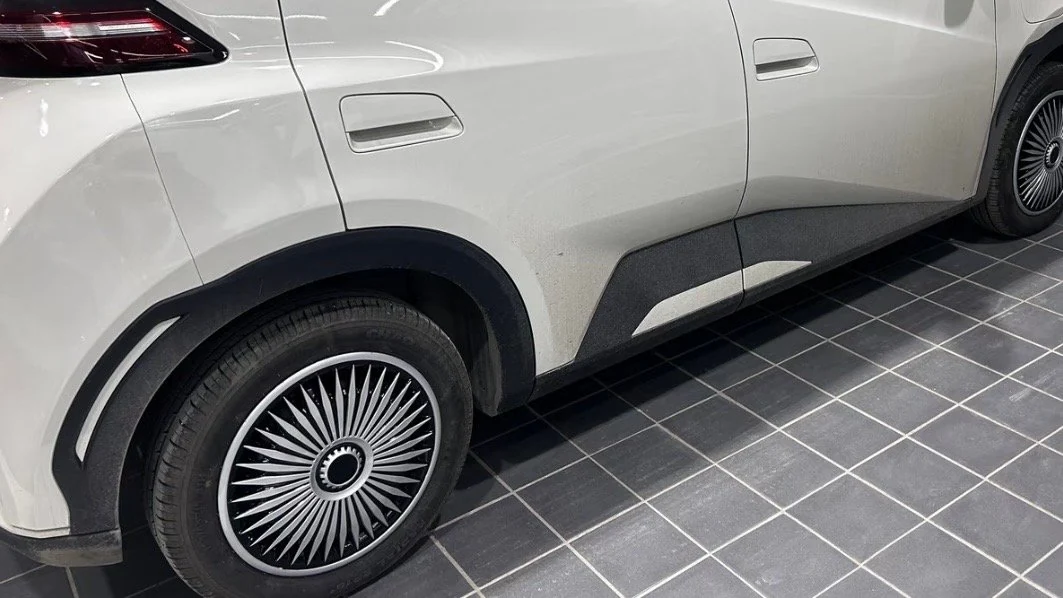
- Aero wheel cover: a cover used on some EVs and hybrids, mounted with a vehicle-specific clip or fastener system.
- Rim: technically the outer barrel and flange of the wheel where the tire bead seats. “Rims” is also slang for aftermarket alloy wheels.
Hubcaps on steel wheels vs alloy wheels compared
Steel wheels with covers and alloy wheels each fit different priorities. Neither is automatically better; the right choice depends on budget, use and how the vehicle is driven.
| Factor | Steel wheel + hubcaps | Alloy wheels |
|---|---|---|
| Upfront cost | Lower; damaged covers are cheap to replace | Higher per wheel; cosmetic damage needs refinishing |
| Durability | Steel wheels bend rather than crack and can often be straightened | Lighter and stiffer, but curb damage can be costly |
| Appearance | Changed easily by swapping covers | Fixed design; styles chosen when buying |
| Weight | Steel wheels are usually heavier | Usually lighter, which can help ride and handling |
| Winter or fleet use | Common for winter sets and fleets | Used, but road salt and potholes are a concern |
| Typical problems | Covers can rattle, crack or come off | Center caps can go missing; finish corrosion |
One reason fewer new cars use hubcaps is that alloy wheels became standard on more trims. Covers remain common on base models, commercial vans, winter wheel sets and some EVs where a cover is part of the original design.
Can you put hubcaps on any wheel?
No. A snap-on full cover is designed to grip the edge of a steel wheel of a matching diameter. Most alloy wheels have no edge or mounting points for a ring-and-clip cover, and forcing one on can scratch the wheel or come loose at speed.
Before you buy, check these points:
- Wheel diameter. In a tire marking such as 205/55R16, “16” is the wheel diameter in inches 1. A 16-inch cover only fits a 16-inch wheel, and only if the wheel shape matches too.
- Wheel type. Confirm whether you have steel wheels meant for covers or alloys with center caps.
- Edge and face profile. Look at the lip depth, flange shape and how far the wheel face stands out. Ask the seller for rear photos of the cover.
- Valve stem position. The cover’s opening must line up with the valve stem without pushing it.
- Clearance. Check around lug nuts and any wheel balance weights on the rim, which can stop a cover from seating evenly.
- Front and rear. Some vehicles use different wheels front and rear.
How do hubcaps attach, and why do they fall off?
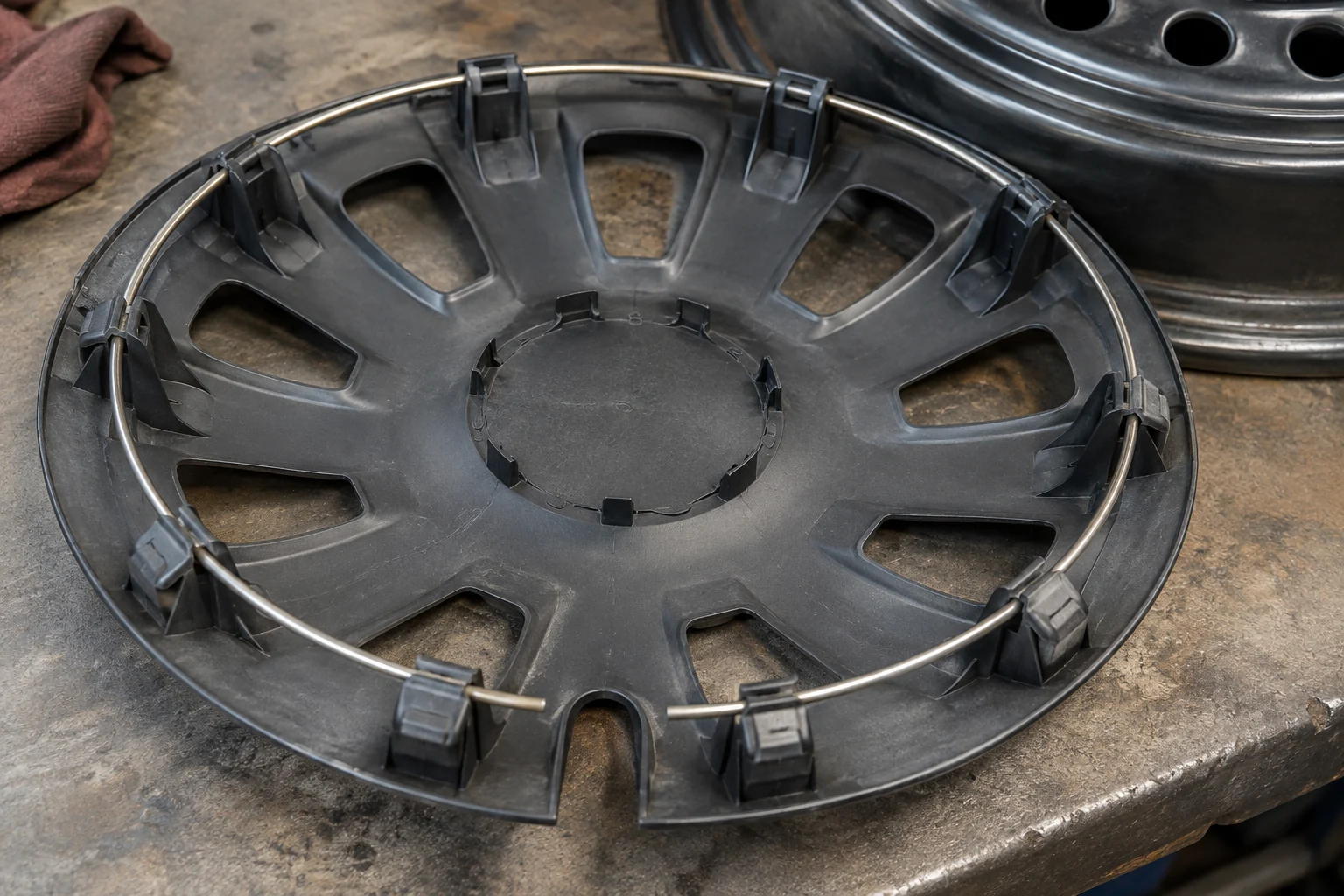
Most full covers snap on: plastic clips press against the inside of the wheel edge, and a metal wire ring behind the clips adds tension. Others are held by lug nuts, special bolts or a vehicle-specific clip system, as on some EV covers 3.
A typical snap-on install: align the ring’s indent and the cover’s opening with the valve stem, press at the points the instructions specify, then check that the cover cannot be pulled off too easily by hand 2. Look around the whole circumference; one raised section usually means a clip is not engaged.
| What you notice | Likely cause | What to do |
|---|---|---|
| One edge stands away from the wheel | Valve-stem misalignment, a clip off the edge, or a balance weight in the way | Remove and re-seat; do not hammer it flush |
| Cover moves easily by hand | Missing or loose wire ring, broken clip, wrong wheel profile | Replace the ring or cover, or confirm the fit |
| Cover rattles while driving | Incomplete seating or worn clips | Inspect clips and ring; replace damaged covers |
| Cover keeps falling off | Wrong cover for the wheel, or a bent wheel edge | Stop refitting the same cover; confirm wheel size and type |
Never use extra force to make a wrong cover sit flat. A cover that comes off at speed is a road hazard.
How do you choose the right replacement hubcap?
Start from the back of a surviving cover, not a front photo. A molded part number, clip pattern, ring shape or maker’s mark narrows the search far faster than the vehicle name.
| Option | When it makes sense | Confirm before paying |
|---|---|---|
| One matching cover | Only one is missing and the others are in good condition | Same size, attachment, face design and finish |
| Set of four aftermarket covers | An exact match is unavailable, or you want a new look | Fit on your actual wheels, retention parts included, return terms |
| Genuine original part | You want the manufacturer-specified part | Part number, market application, included hardware |
| Used original cover | The design is no longer sold new | Clips, ring, cracks and finish condition |
A single new cover may look slightly different in gloss from three aged ones. If appearance matters, a matching set is often the simpler choice.
What should shops and distributors check before ordering wheel covers?
For a retail or wholesale range, wrong-fit returns are the main cost. Build each listing around verified wheel data rather than a vehicle name alone.
| Check | Why it matters |
|---|---|
| Wheel diameter and steel-wheel profile per SKU | Covers fit a wheel shape, not just a size number |
| Supported vehicle and wheel list, plus exclusions | An exclusion list prevents as many returns as a fit list |
| Retention type (ring and clips, bolt-on, vehicle-specific) | Each type needs different instructions and spare parts |
| Material and finish (ABS, PP, painted, chrome-plated) | Affects impact behavior, appearance and cleaning advice |
| Fitment sample on real wheels | Confirms seating, valve-stem clearance and retention before bulk |
| Packaging and set contents | Clip and ring protection in transit; clear labels for size and style |
Typical production for plastic wheel covers involves injection molding the face and clips in ABS or PP, then painting or plating, fitting the retaining ring, and checking appearance, clip retention and fit on a reference wheel. Ask suppliers which of these steps they run themselves and what fit evidence comes with a sample.
For product options, see our wheel covers and hubcaps range and the wider wheel and tire accessories category. If you are planning a range across several categories, our sourcing solutions page explains how samples and low MOQ on selected items work.
Frequently Asked Questions
Are hubcaps and rims the same thing?
No. The rim is part of the wheel and holds the tire. A hubcap is a removable cosmetic cover fitted over the wheel. People often say “rims” when they mean alloy wheels.
What is the difference between hubcaps and wheel covers?
Originally a hubcap covered only the hub area, while a wheel cover covers the whole wheel face. Today most sellers use both words for full covers that fit steel wheels.
Do hubcaps just snap on?
Many do, using plastic clips and a metal wire ring that grip the steel wheel’s edge. Some are held by lug nuts or vehicle-specific clips, so follow the instructions for the exact cover.
Can you put hubcaps on alloy wheels?
Generally no. Snap-on covers are designed for steel wheels. Alloy wheels use center caps, or in some cases a cover designed for that specific wheel.
Why don’t people use hubcaps anymore?
Alloy wheels became standard on many trims, and they are designed to be seen without a cover. Hubcaps are still common on base trims, fleet vehicles, winter wheel sets and some EVs.
Are hubcaps universal?
No. A cover must match the wheel diameter, the wheel edge profile and the retention type. “Universal” covers still fit only certain steel-wheel shapes.
References
[1] Tire Rack. “How Do I Read My Tire Size On My Sidewall?“
[2] Tire Rack. “How Do I Install Wheel Covers / Hub Caps?“
[3] Tesla. “Removing and Installing Wheel Covers.“