



Os pesos de balanceamento de rodas são pequenos pesos metálicos fixados a um aro de roda ou colocados dentro de um pneu para corrigir a distribuição irregular de massa no conjunto pneu e roda. Eles ajudam a roda a girar suavemente, reduzem a vibração, protegem os pneus e as peças da suspensão e dão aos instaladores uma maneira precisa de balancear as rodas após a montagem, reparo, rotação ou substituição.
Para os motoristas, os pesos de roda geralmente são invisíveis até que o volante comece a tremer em velocidade de estrada. Para lojas de pneus e distribuidores, eles são uma pequena categoria de produto com um número surpreendentemente grande de decisões: de encaixe ou adesivo, aço ou zinco, gramas ou onças, ajuste ao flange do aro, qualidade da fita adesiva, resistência à corrosão, restrições locais ao chumbo, embalagem e consistência de lote.
Este guia explica a categoria de pesos de balanceamento de rodas em um nível prático, desde o propósito básico e tipos comuns até escolhas de material, sistemas de tamanho, ajuste, verificações de qualidade e decisões de fornecimento para compradores globais.
Índice
- O que são pesos de balanceamento de rodas e por que são usados?
- Como acontece o desequilíbrio de pneu e roda?
- Quais são os principais tipos de pesos de balanceamento de rodas?
- Como se comparam os pesos de roda de chumbo, aço e zinco?
- Por que os pesos de roda sem chumbo são importantes para os mercados de exportação?
- Qual peso de roda se ajusta a rodas de aço, rodas de liga leve, caminhões e VE?
- Quais tamanhos e especificações de pesos de roda mais importam?
- Como são feitos e verificados os pesos de balanceamento de rodas?
- O que os compradores devem verificar antes de encomendar pesos de balanceamento de rodas?
- Conclusão: Construa a categoria em torno de ajuste, conformidade e fornecimento repetível
- Perguntas Frequentes
- Referências
O que são pesos de balanceamento de rodas e por que são usados?
Os pesos de balanceamento de rodas são pesos de correção usados depois que um conjunto pneu e roda é medido em uma máquina de balanceamento. A máquina identifica onde o conjunto está muito pesado ou muito leve, então o técnico aplica pesos nas posições necessárias para que o conjunto rotativo funcione de forma mais uniforme.
Um pneu e um aro podem parecer perfeitamente redondos, mas a massa ao redor do conjunto raramente é distribuída com simetria perfeita. Espessura da borracha, tolerâncias de fundição da roda, hastes de válvula, reparos, padrões de desgaste e pequenas diferenças de fabricação podem todos deslocar a massa para longe do centro de rotação. Em baixa velocidade, um pequeno desequilíbrio pode passar despercebido. Em velocidade de estrada, esse mesmo desequilíbrio pode criar vibração, tremor no volante, desgaste irregular dos pneus e estresse extra nos componentes da suspensão.
Os pesos de roda resolvem isso adicionando uma quantidade precisa de massa em um local preciso. Os leitores que primeiro precisam da peça física explicada podem usar como os pesos de correção funcionam em um conjunto balanceado antes de compararem formatos ou materiais. Em uma oficina, o processo geralmente funciona assim:
A terminologia também afeta a clareza do catálogo e do RFQ. Os compradores que comparam a linguagem dos fornecedores podem revisar como os pesos de aro se relacionam com os pesos de balanceamento de rodas antes de padronizar nomes de produtos, rótulos e campos de cotação.
- O pneu é montado no aro.
- O conjunto é colocado em um balanceador de rodas.
- O balanceador gira o conjunto e mede o desequilíbrio.
- A máquina mostra a quantidade e a localização do peso necessário.
- O técnico instala pesos de encaixe, adesivos ou outra solução de balanceamento.
- O conjunto é girado novamente para confirmar o resultado.
Para um consumidor, o resultado visível é uma condução mais suave. Para um comprador ou distribuidor, o requisito do produto é mais detalhado: o peso de roda deve se ajustar à roda alvo, atender às regras locais de material, permanecer fixado, resistir à corrosão, corresponder ao sistema de tamanho local e chegar em embalagens que as lojas de pneus possam usar sem confusão.
É por isso que os pesos de balanceamento de rodas não devem ser tratados como um SKU genérico. Uma boa linha de produtos geralmente inclui vários incrementos de peso, dois sistemas de unidades, mais de um tipo de aplicação e uma estratégia de material que se ajusta ao mercado-alvo.
Como acontece o desequilíbrio de pneu e roda?
O desequilíbrio de pneu e roda acontece quando a massa do conjunto rotativo não é distribuída uniformemente ao redor do eixo de rotação. Quando essa massa irregular gira, ela pode criar forças periódicas que se manifestam como vibração, perturbação da condução ou tremor no volante, especialmente à medida que a velocidade aumenta 3.
Existem duas ideias básicas por trás do balanceamento:
- Desequilíbrio estático: O conjunto tem um ponto pesado em um plano. Se não for corrigido, pode causar um salto ou vibração de cima para baixo.
- Desequilíbrio dinâmico: O conjunto é irregular ao longo da largura da roda. Isso pode criar oscilação de um lado para o outro ou vibração no volante.
Os balanceadores de rodas modernos geralmente detectam a quantidade e a localização do desequilíbrio tanto para os planos interno quanto externo. É por isso que um veículo pode exigir pesos em diferentes lados do aro, não apenas em um local externo visível. Em muitas rodas de liga leve, os instaladores preferem pesos adesivos colocados dentro do barril da roda porque a face visível do aro permanece limpa e sem danos. Quando uma oficina está planejando sua linha de consumíveis, separar o serviço de balanceamento do peso usado nele ajuda a distinguir a capacidade da máquina dos produtos físicos que devem ser estocados.
As causas comuns incluem variação de fabricação, peso da haste de válvula, desgaste irregular da banda de rodagem, reparos de pneus, impacto contra guias, deformação da roda, pesos antigos caindo, montagem inadequada ou detritos presos à roda ou ao pneu.
Para os compradores, ajuda separar pesos de roda de balanceamento de pneus. O balanceamento de pneus é o processo de serviço; os pesos de roda são os produtos físicos de correção usados durante esse processo. Essa distinção importa ao comparar a demanda da oficina, a embalagem do produto, os hábitos dos instaladores e o tipo de produto que um distribuidor deve estocar.
Como o método de balanceamento e o programa da máquina afetam o posicionamento?
A medição da máquina vem antes da escolha do formato do peso. Compradores e técnicos que precisam entender requisitos de balanceamento de um plano e dois planos podem ver por que uma correção pode ser solicitada em um local ou em planos interno e externo separados. Essa decisão então determina posicionamento de peso liderado pela máquina no aro, em vez de deixar o instalador copiar a posição de um peso antigo ou escolher uma superfície conveniente.
O programa selecionado também importa. Um modo de balanceador e plano de montagem aprovado deve estar de acordo com o design real da roda para que as instruções de correção da máquina possam ser executadas com um formato adequado de clip-on ou adesivo. Para uma gama de serviços, isso significa que as decisões de stock devem seguir os tipos de rodas e localizações que a oficina pode genuinamente balancear, não uma lista genérica de tamanhos de pesos.
Quais são os principais tipos de pesos de balanceamento de rodas?
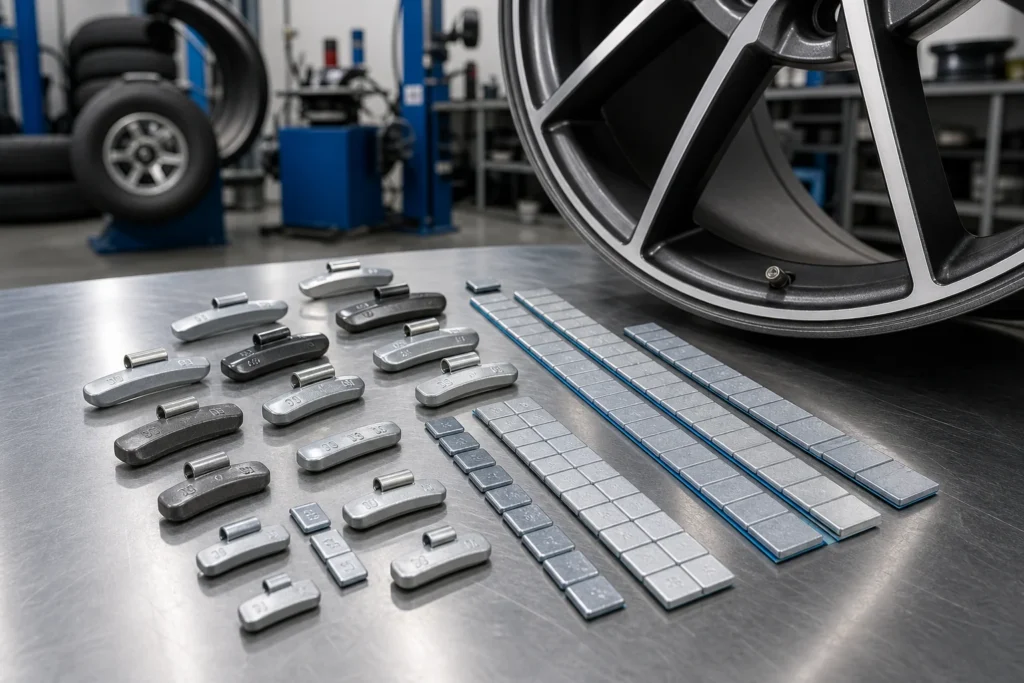
As três soluções comuns de balanceamento são pesos de roda clip-on, pesos de roda adesivos e esferas de balanceamento. Os pesos clip-on fixam-se a uma flange do aro, os pesos adesivos fixam-se ao interior do barril da roda com fita adesiva, e as esferas de balanceamento ficam dentro do pneu para criar um efeito de balanceamento dinâmico auto-ajustável.
O método de fixação é apenas o ponto de partida para uma decisão de compra. Os compradores que constroem um sortimento de serviço misto podem usar um mapa de fixação e aplicação para tipos de pesos de roda para ligar os formatos clip-on e adesivo com a geometria do aro, requisitos de aparência, localização de balanceamento, escolha de material e o fluxo de trabalho da oficina que precisam suportar.
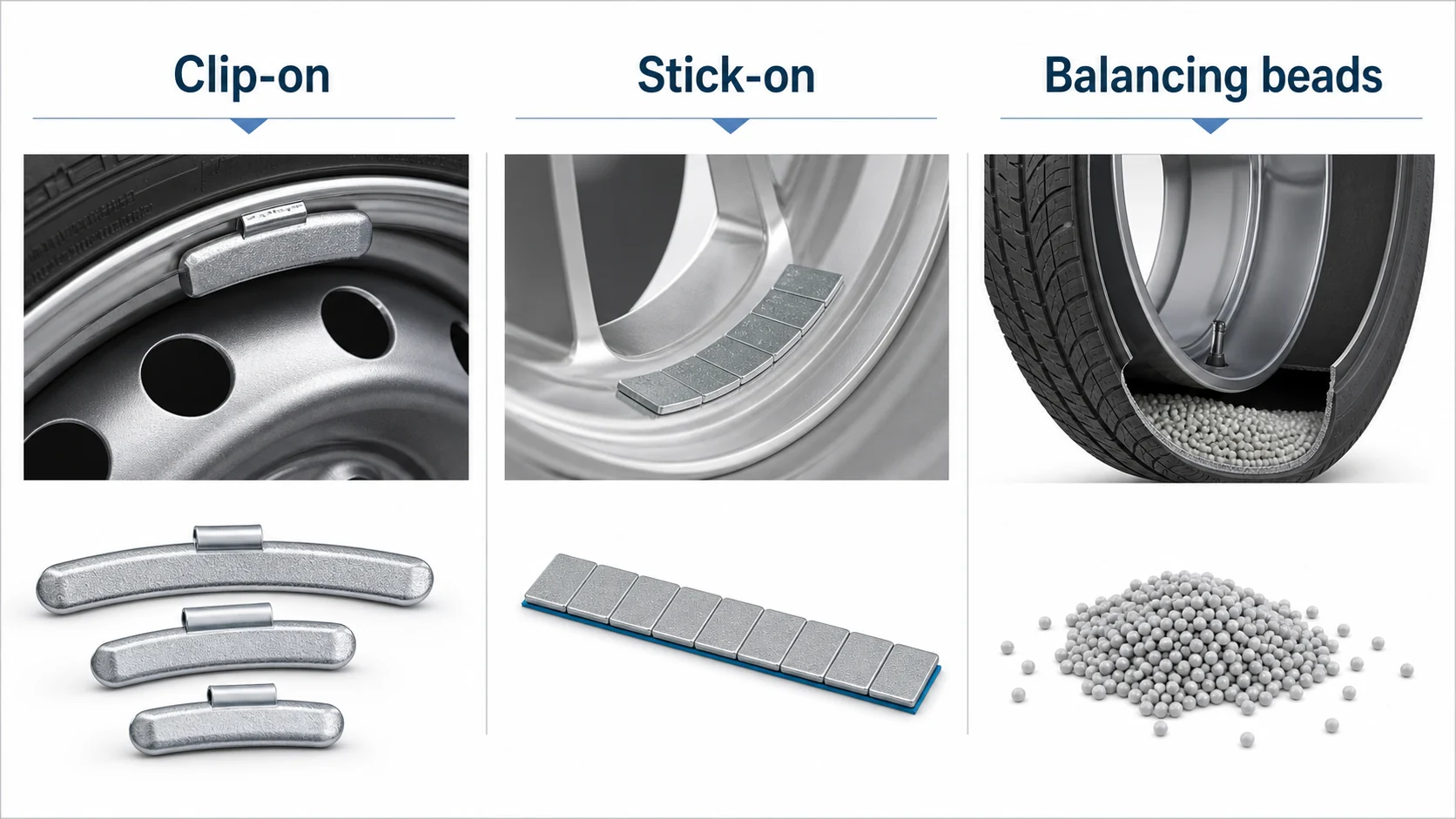
Pesos de roda de encaixe
Os pesos de roda clip-on usam um clipe metálico para se fixarem à flange do aro da roda. São rápidos de instalar e são comuns em rodas de aço, veículos comerciais e aplicações de serviço de pneus sensíveis ao custo. O ponto-chave é a compatibilidade da flange. Um clipe que não corresponde ao perfil do aro pode instalar-se mal, perder força de retenção ou danificar o acabamento da roda. Os compradores que já confirmaram uma aplicação de flange do aro podem rever opções de pesos de roda clip-on para essa aplicação como próximo passo da família de produtos.
Uma vez que um comprador selecionou um formato clip-on, a próxima questão é se o perfil proposto assenta seguramente no aro real. Um processo de correspondência de flange do aro compara o rebordo da flange, folga, profundidade e superfície de montagem acessível antes de um pedido ser aprovado. Os rótulos podem organizar um sortimento, mas os compradores também precisam de interpretar os rótulos de clipe P, C, T e MC como pontos de partida para validação de amostras em vez de alegações universais de ajuste a veículos.
Para procura recorrente de rodas de aço, os compradores podem construir um sortimento grossista clip-on em torno de perfis validados, incrementos, material e lógica de cartonagem em vez de selecionar um catálogo amplo sem corresponder às aplicações de flange do aro que realmente servem.
Os pesos clip-on são úteis quando:
- o mercado-alvo ainda usa muitas rodas de aço
- as oficinas querem instalação rápida
- pesos visíveis são aceitáveis
- os perfis de flange do aro são conhecidos
- o custo unitário mais baixo importa
A limitação é a aparência e o risco de superfície. Em rodas de liga leve, um clipe metálico pode riscar o revestimento do aro, razão pela qual muitas aplicações de automóveis de passageiros e rodas premium usam pesos adesivos.
Pesos de roda adesivos
Os pesos de roda adesivos, também chamados pesos de roda autocolantes, usam fita pré-aplicada no verso de uma tira metálica segmentada. São tipicamente instalados no interior do barril de rodas de liga leve. A instalação parece mais limpa, evita apertar na flange visível e permite aos instaladores cortar ou partir a tira na quantidade de peso necessária. Onde uma instalação limpa no interior do barril foi especificada, formatos de pesos de roda adesivos para esse método de montagem dão aos compradores uma rota de produto relevante depois de os requisitos de fita e segmento estarem claros.
Para programas grossistas de adesivos, os compradores devem comparar fita, forro, formato da tira, embalagem e condições de amostra antes de definir o sortimento a granel. Isto mantém o desempenho do adesivo e as condições de instalação dentro da decisão de sourcing em vez de os tratar como problemas pós-entrega.
Os pesos adesivos são úteis quando:
- a roda é de liga leve ou alumínio
- a aparência importa
- a flange do aro não deve ser riscada
- o instalador precisa de colocação flexível do peso
- a linha de produtos serve automóveis de passageiros, VE ou rodas premium
O maior risco é a adesão. A qualidade da fita, limpeza da superfície, humidade, baixa temperatura, pó de travão e lavagem com pressão podem todos afetar o desempenho. Um comprador que compara pesos adesivos deve perguntar sobre o tipo de fita, forro de suporte, instruções de preparação da superfície e embalagem que mantém o adesivo limpo.
O que torna uma instalação adesiva fiável?
A retenção do adesivo é um resultado da instalação, não uma alegação apenas da fita. Os compradores que precisam de diagnosticar perda de pesos adesivos em serviço devem verificar a superfície da roda, temperatura, pressão de aplicação, manuseamento do forro e se a tira se conforma à área de montagem pretendida. Quando uma substituição é necessária, os técnicos devem remover resíduos de pesos antigos antes da reinstalação para que óleo, silicone, sujidade ou fita restante não comprometam a nova ligação.
Antes de aprovar um programa autocolante para um mercado ou acabamento de roda específico, os compradores devem validar amostras adesivas sob condições de serviço locais. Testar contra o revestimento real da roda, método de limpeza, intervalo de temperatura, pressão e tempo de permanência cria uma decisão de aprovação mais útil do que uma demonstração genérica de força da fita.
Para programas de rodas de liga leve, o lado adesivo da gama de produtos merece mais detalhe do que uma simples etiqueta "autocolante". Os compradores que comparam pesos de roda adesivos deve-se observar o tipo de fita, o revestimento de suporte, a preparação da superfície, a temperatura de instalação e a proteção da embalagem. Se o mercado utiliza formatos segmentados, tiras de pesos de roda também devem ser comparadas por tamanho do segmento, peso total da tira, largura da tira e rotulagem da caixa.
Quando o mercado utiliza diferentes formatos de fornecimento de adesivo, os compradores podem escolher entre rolos de pesos de roda e tiras pré-cortadas com base na velocidade de instalação, controle de segmento, embalagem, manuseio de estoque e o tipo de lojas de pneus que atendem.
Algumas rodas de liga leve, rodas de VE e aplicações premium também precisam de formatos mais finos. Nesses casos, pesos de roda de baixo perfil ajudam os compradores a resolver problemas de folga e aparência que as tiras adesivas padrão podem não lidar bem.
Esferas de balanceamento
As contas de balanceamento são pequenas contas de cerâmica ou vidro instaladas dentro do pneu. À medida que o pneu gira, as contas se movem dinamicamente e podem ajudar a combater o desequilíbrio. São mais comuns em aplicações de caminhões, ônibus, fora de estrada e serviços pesados do que no serviço de varejo de automóveis de passeio comuns.
As contas de balanceamento podem ser úteis para pneus pesados sem câmara, intervalos de serviço longos, preocupações com a aparência externa e aplicações que se adequam ao balanceamento interno dinâmico.
Elas não são um substituto universal para pesos de roda. Elas exigem o tipo de pneu correto, método de instalação e expectativas de serviço. Para muitas aplicações de veículos de passeio e lojas de pneus, os pesos de encaixe e adesivos continuam sendo os produtos de uso diário normais.
Para a maioria das linhas de produtos, a primeira questão real de seleção é escolher entre fixação por encaixe e adesiva. Os pesos de encaixe servem para muitas aplicações de rodas de aço e comerciais, enquanto os pesos adesivos são geralmente melhores para rodas de liga leve, resultados visuais mais limpos e posicionamento flexível dentro do aro da roda.
Como se comparam os pesos de roda de chumbo, aço e zinco?
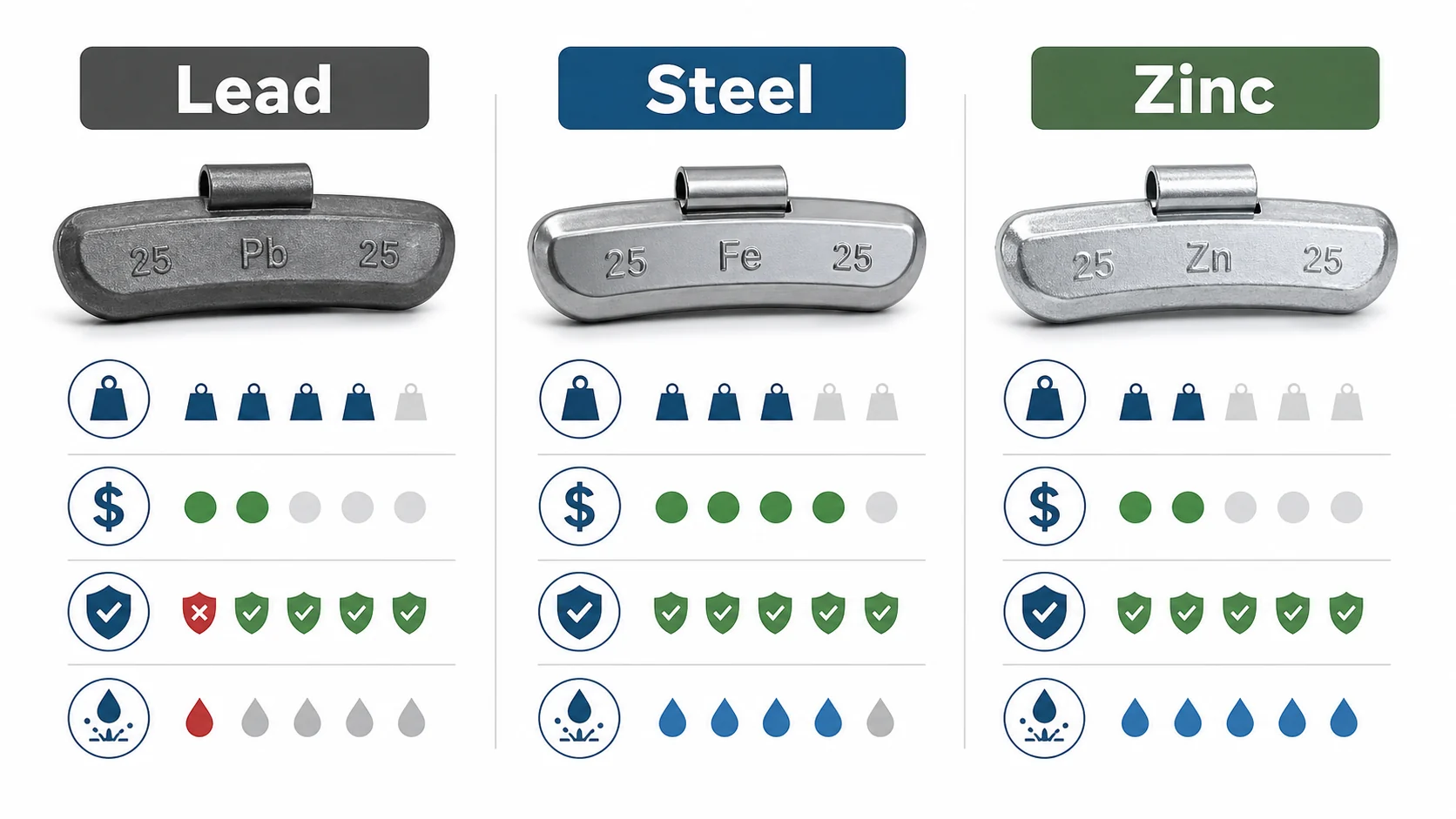
Os pesos de roda de chumbo, aço e zinco diferem em densidade, custo, comportamento de corrosão, perfil de conformidade e aplicação-alvo. O chumbo é denso e compacto, mas restrito ou desencorajado em muitos mercados. O aço é a opção econômica sem chumbo mainstream. O zinco é uma opção de custo mais elevado, frequentemente usada onde aparência, resistência à corrosão ou posicionamento premium importam. Para uma decisão de linha em vez de uma substituição de produto único, trade-offs de material em uma linha de pesos de roda ajudam os compradores a comparar as opções antes de especificar alternativas de Fe, zinco ou chumbo legado.
| Vidro traseiro lateral / pilar C | Principal vantagem | Main limitation | Ajuste comum do comprador |
|---|---|---|---|
| Chumbo (Pb) | Alta densidade, tamanho compacto, fácil conformação | Preocupação ambiental e regulatória em muitos mercados | Apenas mercados legados ou limitados; verificar regras antes de encomendar |
| Aço (Fe) | Sem chumbo, econômico, reciclável, fornecimento estável | Volume maior que o chumbo; precisa de revestimento contra ferrugem | Amplo mercado de reposição, distribuidores, lojas, linhas de produtos amigáveis para exportação |
| Zinco (Zn) | Boa resistência à corrosão e aparência premium | Custo mais elevado que o aço; densidade ligeiramente inferior ao aço | Rodas de liga leve premium, programas estilo OEM, mercados sensíveis à corrosão |
Pesos de roda de chumbo
O chumbo era historicamente comum porque é denso, macio e fácil de moldar. Um peso de chumbo de 25g pode ser menor que um peso de aço ou zinco de 25g, o que facilita a instalação onde o espaço é apertado. Essa era uma vantagem real quando o mercado se preocupava principalmente com ajuste e produção de baixo custo.
O problema é que o chumbo é um metal pesado. Quando os pesos de roda caem, os detritos da estrada podem entrar no meio ambiente. A Diretiva Europeia de Veículos em Fim de Vida aborda substâncias perigosas em veículos e identifica o chumbo entre as substâncias a serem restringidas, com isenções e revisões do Anexo II 1. Nos Estados Unidos, as restrições a pesos de roda de chumbo não são uma regra federal uniforme, mas vários estados e participantes do mercado se afastaram do chumbo. Os compradores devem confirmar a jurisdição-alvo antes de encomendar.
Para compradores globais, a conclusão prática é simples: não tratar o chumbo como material de exportação padrão. Se o destino for a Europa, América do Norte, uma cadeia de suprimentos OEM ou um varejista com requisitos ambientais, confirme o material aceito antes da compra.
Pesos de roda de aço
Os pesos de roda de aço são agora a opção workhorse para muitos programas de reposição e exportação. O aço é sem chumbo, amplamente disponível, reciclável e de custo estável em comparação com materiais mais especializados. O trade-off é a densidade. O aço é menos denso que o chumbo, então o mesmo peso geralmente precisa de mais volume.
Esse trade-off é gerenciável na maioria das aplicações. Um peso de roda de aço bem projetado pode funcionar efetivamente quando a forma da peça, revestimento, resistência do clipe e suporte adesivo são combinados com o caso de uso. Produtos de aço normalmente precisam de proteção contra corrosão, como zincagem, revestimento de pintura ou outro tratamento de superfície. Sem acabamento adequado, o aço exposto pode enferrujar em ambientes úmidos, salinos ou costeiros.
Para distribuidores substituindo uma linha de material legado, por que o aço está migrando para programas de substituição de chumbo explica as verificações de ajuste, revestimento, documentação e planejamento de estoque por trás dessa mudança. Uma vez que a rota do aço é aprovada, os compradores podem revisar opções de pesos de roda Fe para uma linha baseada em aço juntamente com os incrementos necessários e formatos de fixação.
Para compradores que usam códigos de material em cotações, Fe geralmente se refere a uma opção de peso de roda à base de ferro ou aço. Um dedicado Pesos de roda Fe guia ajuda a esclarecer quando o aço é a rota sem chumbo correta, quais detalhes de revestimento importam e por que o mesmo peso nominal pode parecer maior que um produto de chumbo legado.
O aço é uma escolha forte para:
- distribuidores que precisam de ampla cobertura
- lojas de pneus que atendem carros de passeio e caminhões leves mistos
- compradores substituindo chumbo em programas convencionais
- mercados de exportação onde o fornecimento sem chumbo é esperado
- linhas de produtos sensíveis a custo
Pesos de roda de zinco
Pesos de roda de zinco ocupam uma posição diferente. O zinco tem boa resistência natural à corrosão e pode produzir uma aparência limpa e premium, especialmente para rodas de liga leve e aplicações no estilo OEM. Geralmente é mais caro que o aço, então nem sempre é a melhor escolha para uma linha econômica ampla.
O zinco faz sentido quando:
- o produto é voltado para rodas de liga leve premium
- a resistência à corrosão é um forte argumento de venda
- a aparência importa
- o comprador quer uma opção sem chumbo de maior valor
- o mercado-alvo aceita a diferença de custo
Para um catálogo de produtos, aço e zinco não devem competir como se um fosse sempre melhor. O aço é frequentemente a escolha de volume. O zinco é frequentemente a escolha premium ou focada em corrosão. Um programa de compras forte pode incluir ambos. Quando a linha exige zinco em vez de aço, os compradores podem comparar opções de pesos de roda de zinco para a rota de material aprovada com os mesmos requisitos de encaixe e unidade.
O zinco deve ser tratado como uma escolha de material premium, e não como um substituto padrão para todos os mercados. Compradores comparando pesos de roda de zinco devem observar a resistência à corrosão, as expectativas de acabamento, a tolerância de custo e se o cliente-alvo valoriza a aparência o suficiente para justificar o custo maior do material.
Por que os pesos de roda sem chumbo são importantes para os mercados de exportação?
Pesos de roda sem chumbo importam porque muitos compradores não podem depender de produtos com chumbo em todos os mercados de destino, canais de varejo e cadeias de fornecimento no estilo OEM. Mesmo onde o chumbo não é proibido nacionalmente, os importadores ainda podem precisar de alternativas de aço ou zinco para atender leis locais, políticas de clientes, requisitos de sustentabilidade e expectativas de documentação.
O quadro europeu ELV é uma das razões pelas quais os compradores prestam atenção às restrições de materiais. O Artigo 4 da Diretiva 2000/53/EC exige que os Estados-Membros garantam que os veículos colocados no mercado após 1 de julho de 2003 não contenham chumbo, mercúrio, cádmio ou cromo hexavalente, exceto nas isenções e condições listadas 1. A mesma fonte também mostra que o chumbo em pesos de balanceamento foi um item explícito considerado no processo de revisão de isenção do Anexo II 1.
Para os Estados Unidos, o cenário é diferente. Houve orientação da EPA incentivando melhores práticas de gestão em torno de pesos de roda de chumbo, e vários estados promulgaram suas próprias restrições ou eliminações progressivas, mas os compradores devem evitar dizer "os Estados Unidos proíbem pesos de roda de chumbo" como uma declaração geral. Isso seria amplo demais. Uma posição mais segura para o comprador é: verifique os requisitos do estado, do cliente e do canal antes de fornecer pesos de roda contendo chumbo.
RoHS é outro termo que os compradores às vezes mencionam. RoHS é principalmente uma diretiva de equipamentos elétricos e eletrônicos, não uma regulamentação de pesos de roda. Ainda assim, os compradores podem solicitar declarações de materiais no estilo RoHS como parte de uma revisão mais ampla de substâncias restritas. A resposta correta é fornecer documentação clara de materiais e confirmar o que o mercado do comprador realmente exige 4.
Para o fornecimento B2B, isso cria três regras práticas:
- Não presuma que o chumbo é aceitável só porque o comprador não perguntou. Pergunte ao mercado de destino.
- Não presuma que um certificado cobre todas as regulamentações. Combine os documentos com o requisito real do comprador.
- Não venda conformidade de materiais como slogan. Forneça documentação de material, revestimento e testes quando necessário.
Para compradores de exportação, requisitos sem chumbo que devem ser verificados por destino são frequentemente o ponto de partida mais seguro quando o mercado, o canal de varejo ou a política do cliente não estão claros. As opções de aço e zinco facilitam a construção de uma linha de produtos que pode atender mais mercados sem redesenhar repetidamente embalagens, documentos e linguagem de catálogo. Uma vez que o requisito do produto esteja claro, documentação de conformidade para o destino e requisito do cliente ajuda os compradores a organizar as declarações ou registros que precisam solicitar.
O fornecimento sem chumbo deve ser apoiado por evidências em nível de produto, não por uma alegação genérica. Compradores comparando os controles de materiais e documentação de um fornecedor de pesos de roda sem chumbo devem combinar declarações de aço ou zinco, etiquetas, registros de lote e requisitos do mercado de destino antes de emitir aprovação comercial.
Para uma decisão mais ampla sobre materiais, os compradores podem comparar opções de pesos de roda sem chumbo para aço, zinco e compras de exportação com as regras de destino, densidade, proteção contra corrosão, custo e a faixa de aplicação que precisam atender.
Qual peso de roda se ajusta a rodas de aço, rodas de liga leve, caminhões e VE?
O peso de roda correto depende primeiro do tipo de roda, depois do material, revestimento, sistema de tamanho, método de instalação e ambiente de serviço. Rodas de aço geralmente aceitam bem pesos de encaixe, rodas de liga leve frequentemente usam pesos adesivos, caminhões podem usar pesos de encaixe ou esferas de balanceamento, e EVs geralmente precisam de produtos limpos sem chumbo com encaixe e aparência confiáveis.
Para o serviço de automóveis de passageiros, planejamento da gama de automóveis de passageiros e aprovação de amostras transforma os valores de correção registrados em uma gama de SKUs testável sem recorrer a suposições de caminhões ou veículos comerciais.
Rodas de aço
Rodas de aço são a aplicação clássica para pesos de encaixe. A aba do aro pode fornecer um ponto de fixação mecânica forte, e o peso visível geralmente não é uma questão importante de estilo. Para os compradores, o essencial é combinar o perfil do clipe e a espessura da aba.
Verificações comuns de compra incluem:
- tipo de aba do aro
- incrementos de peso
- sistema de gramas ou onças
- revestimento para prevenção de ferrugem
- força de retenção do clipe
- embalagem por tamanho de peso
Para compradores que atendem oficinas de reparo, correspondência de flange de aro para serviço com contrapeso de clipe em roda de aço deve ser especificado por estilo de clipe, sistema de unidades, revestimento e contagem de embalagem. Um preço baixo não é útil se o clipe não prender corretamente no perfil do aro local.
Rodas de liga leve
Rodas de liga leve geralmente favorecem contrapesos adesivos porque a face visível é mais importante e o revestimento do aro pode ser danificado por clipes. Contrapesos adesivos podem ser escondidos dentro do aro, proporcionando uma aparência mais limpa.
Os compradores devem se concentrar em:
- desempenho da fita adesiva
- formato do segmento, como 5g x 12 ou tiras de 1/4 oz
- cor e acabamento do revestimento
- qualidade do liner de suporte
- embalagem que previne contaminação por poeira e umidade
- instruções de instalação para limpeza e temperatura
Para compradores que atendem carros de passeio, VEs ou rodas premium, escolhas de fita e segmento para programas de rodas de liga leve devem ser avaliadas pela qualidade da fita, flexibilidade da tira, acabamento do revestimento, limpeza do liner e desempenho real de instalação após a superfície da roda ser limpa.
Caminhões e veículos comerciais
Aplicações em veículos comerciais podem envolver contrapesos mais pesados, conjuntos de rodas maiores e diferentes expectativas de serviço. Contrapesos de clipe ainda são comuns, mas contas de balanceamento também podem ser consideradas para certas aplicações de caminhões tubeless, ônibus e off-road.
A pergunta do comprador não é "qual é o melhor?" É "qual modelo de serviço o cliente usa?" Um distribuidor que vende para lojas de pneus pode precisar de tamanhos de caminhão com clipe. Um comprador que atende frotas pode perguntar sobre soluções de balanceamento interno. Uma linha de produtos mista pode exigir ambos.
Aplicações em caminhões geralmente precisam de um caminho de seleção separado porque os conjuntos de rodas são maiores, as condições de serviço são mais pesadas e os requisitos de estoque podem diferir dos programas de carros de passeio. Compradores comparando contrapesos de roda para caminhão devem confirmar faixa de peso, compatibilidade com o aro, durabilidade do revestimento e se o cliente usa contrapesos de clipe, formatos adesivos ou soluções de balanceamento interno.
Para frotas, ônibus e canais de serviço mais pesados, a questão se expande de um único SKU de caminhão para uma faixa completa de aplicação. Contrapesos de roda para veículos comerciais devem ser revisados por tipo de veículo, fluxo de trabalho de serviço, clareza da embalagem, exposição à corrosão e consistência de lote, porque tempo de inatividade e reclamações de oficinas são mais caros na manutenção comercial.
VEs e veículos de passeio mais novos
VEs não exigem uma tecnologia separada de contrapeso de roda, mas intensificam as expectativas em torno de baixa vibração, resistência à corrosão, aparência limpa, linguagem de sustentabilidade e posicionamento sem chumbo. Rodas de liga leve e estilo premium são comuns, então contrapesos adesivos de aço ou zinco geralmente se encaixam melhor do que contrapesos de clipe visíveis. Para programas relacionados a VEs, confirme material da roda, visibilidade após a instalação, documentação sem chumbo, branding e necessidades de embalagem. Os compradores podem avaliar folga e ajuste adesivo para programas de rodas de VEs quando espessura de tira de perfil baixo, espaço interno do aro, locais de balanceamento aprovados e desempenho da fita precisam ser avaliados no design real da roda.
Quais tamanhos e especificações de pesos de roda mais importam?
Especificações de contrapesos de roda geralmente começam com sistema de unidades, incremento de peso, tipo de produto, material, revestimento e ajuste. Mercados métricos comumente usam gramas, enquanto os Estados Unidos e alguns canais norte-americanos frequentemente usam onças, então uma faixa pronta para exportação pode precisar de ambos os sistemas.
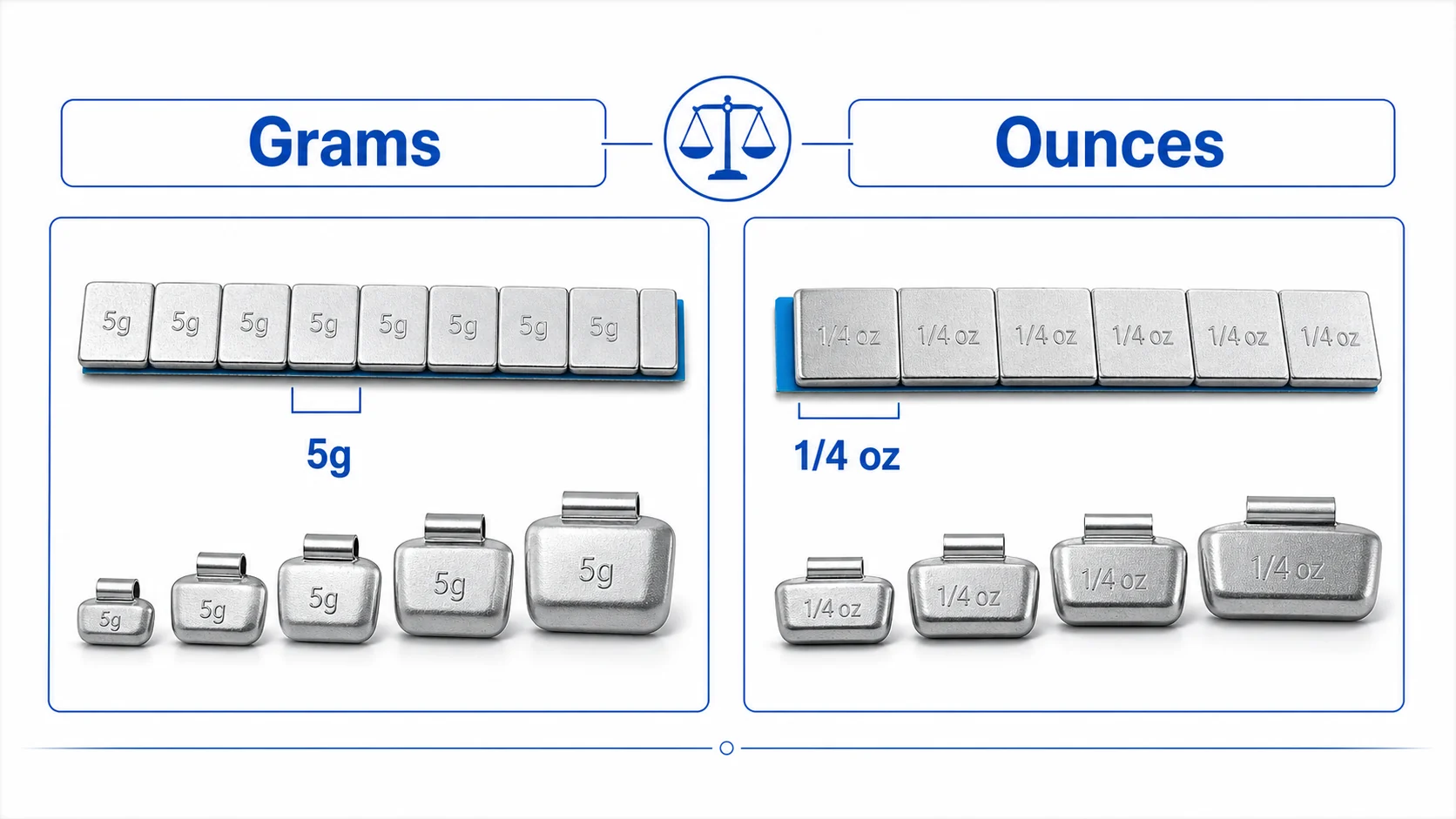
Sistema métrico em gramas
Contrapesos de roda métricos são comuns na China, Europa e muitos mercados internacionais. Contrapesos individuais comuns incluem 5g, 10g, 15g, 20g, 25g, 30g, 35g, 40g, 50g e 60g. Tiras adesivas frequentemente usam segmentos repetíveis, como 5g x 12 peças para uma tira de 60g ou formatos mistos de 5g e 10g.
Programas métricos são úteis quando:
- o mercado-alvo usa balanceadoras de roda baseadas em gramas
- o produto é vendido internacionalmente
- as oficinas querem segmentação fácil
- embalagem e etiquetas precisam de identificação clara de tamanho
Sistema imperial em onças
Contrapesos de roda baseados em onças são comuns nos Estados Unidos e Canadá. Tamanhos típicos incluem 1/4 oz, 1/2 oz, 3/4 oz, 1 oz, 1,25 oz e 1,5 oz. Um comprador que atende lojas de pneus norte-americanas não deve assumir que etiquetas em gramas são suficientes.
Referências de conversão úteis:
| Tamanho em onças | Gramas aproximados |
|---|---|
| 7 g | 7,09g |
| 14 g | 14,17g |
| 21 g | 21,26g |
| 1 oz | 28,35g |
Essas conversões ajudam os compradores a comparar sistemas, mas a seleção do produto ainda deve seguir a saída da balanceadora e a linguagem normal de pedido do mercado.
Especificações de ajuste de contrapeso de clipe
Os pesos de encaixe precisam de mais do que o tamanho do peso. O formato do clipe deve corresponder à aba do aro. Se o comprador não tiver certeza, deve enviar amostras do aro, medições da aba ou informações do veículo alvo antes de confirmar pedidos em massa.
Especificações da tira adesiva
Os pesos adesivos precisam de um conjunto diferente de detalhes:
- tamanho do segmento
- peso total da tira
- tipo de fita
- cor da fita
- largura e espessura da tira
- cor do revestimento
- quantidade de embalagem
- condições de armazenamento do forro e do adesivo
Para o trabalho de pedido, usar gramas, onças e incrementos de tira para construir a cobertura ajuda os compradores a comparar os rótulos das caixas com a forma como as lojas locais realmente solicitam estoque de reposição. O gráfico deve ser tratado como uma referência de compra, não apenas como um apêndice técnico.
Como são feitos e verificados os pesos de balanceamento de rodas?
Os pesos de balanceamento de rodas são comumente fabricados por meio de inspeção de material, conformação ou estampagem, corte, tratamento de superfície, rebitagem de clipe ou laminação de fita adesiva, inspeção de qualidade e embalagem. Para os compradores, as verificações mais importantes são precisão do peso, durabilidade do revestimento, força do adesivo, retenção do clipe e rotulagem consistente.
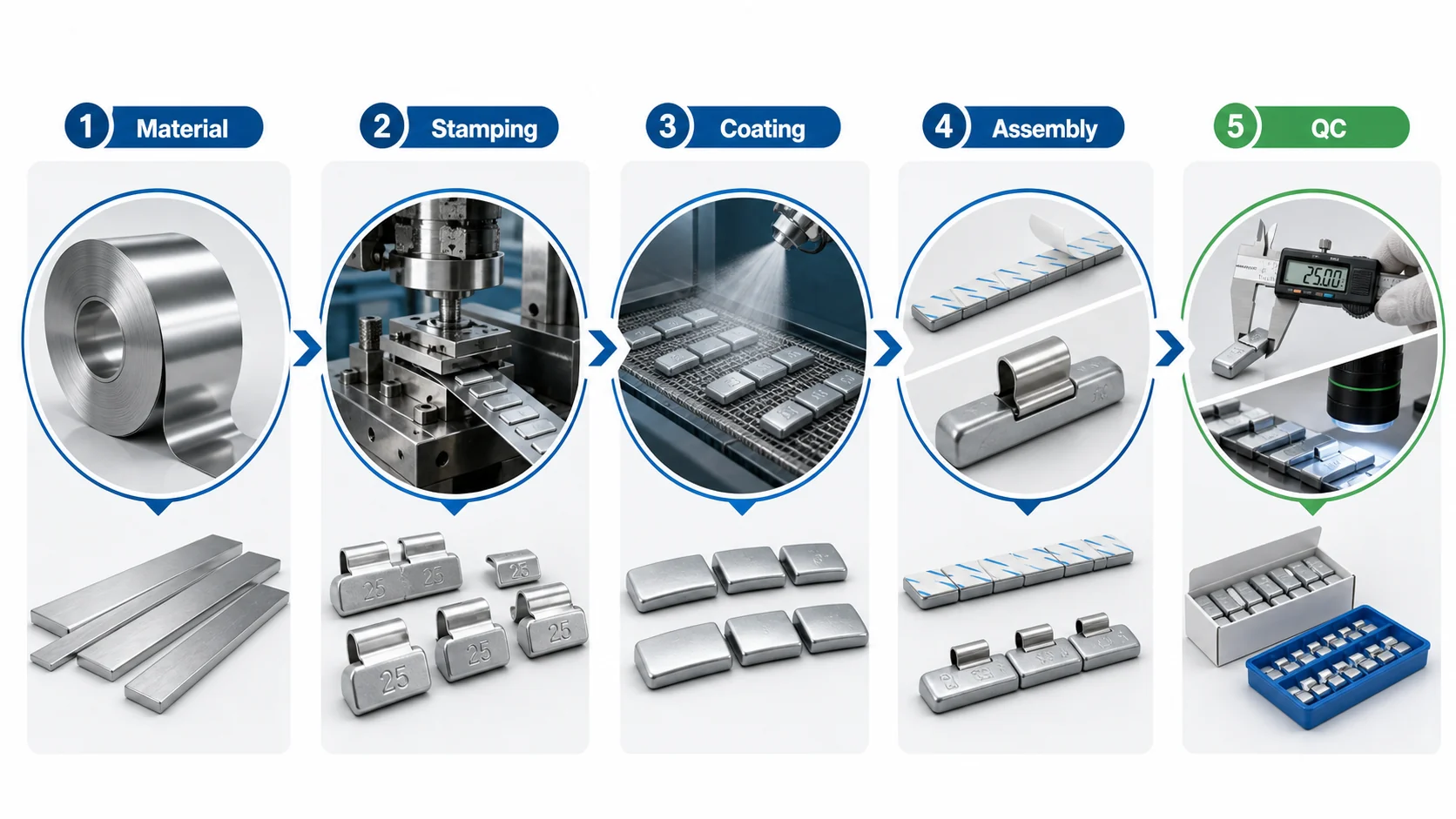
Matéria-prima e conformação
Os pesos de roda de aço geralmente partem de tira de aço ou blanks de aço. O material deve ser suficientemente consistente para estampagem, conformação e produção em longa escala. Os pesos de zinco podem ser fundidos sob pressão ou formados de outra maneira, dependendo do projeto. Em todos os casos, o objetivo é a repetibilidade: o mesmo peso nominal deve permanecer dentro da tolerância de lote para lote.
Corte e acabamento de superfície
Após a conformação, as peças podem precisar de corte, rebarbação ou limpeza de bordas. Rebarbas afiadas não são apenas uma questão estética. Elas podem afetar o manuseio, a embalagem, o contato com o aro e a qualidade percebida.
O tratamento de superfície é mais importante para pesos de aço. Os acabamentos comuns incluem zincagem, revestimento por pintura ou revestimentos tipo epóxi, dependendo do produto e do mercado-alvo. O acabamento deve proteger contra corrosão sem interferir na função do clipe ou na adesão do adesivo.
O acabamento de superfície não é apenas um detalhe estético. Para pesos de aço, a qualidade do revestimento afeta a resistência à corrosão, o manuseio, o armazenamento e a percepção do cliente após a instalação. Compradores que comparam pesos de roda revestidos devem verificar se o acabamento corresponde ao clima alvo, à exposição ao sal de estrada, ao método de embalagem e à vida útil esperada.
Montagem de clipe e fita
Os pesos de encaixe exigem conformação ou rebitagem do clipe que se mantenha de forma confiável durante a instalação e o serviço. Uma geometria de clipe ruim pode gerar devoluções mesmo quando o peso metálico em si está correto.
Os pesos adesivos exigem laminação de fita adesiva. É aqui que muitos produtos de baixa qualidade falham. Os compradores devem se preocupar com a consistência da fita, a remoção do forro, a limpeza da superfície adesiva e se a tira se dobra adequadamente para corresponder ao tambor da roda.
Controle de qualidade
Verificações úteis de QC incluem precisão do peso, acabamento visual, controle de rebarbas, retenção do clipe, adesão do adesivo, resistência à corrosão quando relevante, contagem de embalagem e precisão do rótulo.
Como os compradores devem aprovar o desempenho antes da produção?
Uma amostra bem-sucedida deve se tornar um padrão de produção por escrito, não apenas uma referência visual. Antes de confirmar um pedido maior, os compradores podem aprovar amostras representativas de pesos de roda com base em critérios de encaixe, fita, acabamento e embalagem para que os produtos testados reflitam a mistura de SKUs que será realmente fornecida.
Para produtos de aço revestido, o processo de aprovação também deve estabelecer como a proteção de superfície será avaliada. Compradores que precisam de evidências adequadas ao seu ambiente de armazenamento e serviço podem comparar especificações de revestimento e condições de teste de corrosão antes de aceitar pesos de aço em vez de confiar em uma alegação geral de resistência à ferrugem.
Uma vez que a amostra e os critérios de desempenho sejam acordados, eles devem ser traduzidos em pontos de inspeção repetíveis para a produção. Uma clara lista de verificação de aceitação para tolerância de peso, retenção, fita, acabamento, rótulos e registros de lote ajuda a manter a amostra aprovada conectada a cada lote de produção.
Antes de solicitar um conjunto de amostras maior, os compradores devem definir os SKUs representativos, aplicações de roda, documentos e evidências de embalagem a solicitar. Uma solicitação focada mantém o teste de amostras conectado à linha que pode realmente ser encomendada.
A consistência de fabricação tem valor comercial direto. Um distribuidor pode aceitar um preço unitário ligeiramente mais alto quando o produto reduz reclamações da oficina, falhas de instalação, caixas mal rotuladas e lotes inconsistentes. Por esse motivo, os controles de produção por trás de pesos de roda repetíveis devem fazer parte da comparação de fornecedores, não uma reflexão tardia.
A avaliação de fornecedores deve ser separada da simples comparação de produtos. Um fabricante de pesos de roda deve ser avaliado por controle de material, consistência de revestimento, qualidade do adesivo ou clipe, precisão de embalagem, suporte de documentação e fornecimento repetível por lote.
Compradores que precisam de uma visão mais ampla do mercado de reposição podem comparar linha de produtos e verificações de qualidade de fornecedores de pesos de roda automotivos antes de restringir a lista final a uma fábrica específica ou modelo de fornecimento.
Como os compradores devem escolher uma rota de fornecimento antes de comparar cotações?
Antes de comparar empresas individuais, os compradores devem decidir se o pedido precisa de controle direto da fábrica, coordenação de fornecimento mais ampla ou suporte de estoque local. A comparação de modelos de fornecimento para fabricantes, empresas comerciais e distribuidores ajuda a definir essa rota antes de construir uma lista final.
Quando produção repetida, especificações personalizadas ou embalagem controlada forem importantes, os compradores devem avaliar a capacidade do produto e do processo por trás de uma fábrica de contrapesos de roda em vez de assumir que todo vendedor tem o mesmo controle técnico. Um estruturado scorecard de fornecedores para adequação do produto, evidências, suporte comercial e risco de entrega então torna a lista final comparável antes das cotações começarem.
Uma auditoria é o próximo passo depois que um fornecedor entra na lista final. Os compradores podem usar uma lista de verificação de auditoria de fábrica para materiais, ferramentas, controles de processo, registros, embalagem e ações corretivas para verificar que um produto aprovado pode ser reproduzido e investigado quando discrepâncias ocorrerem.
O que os compradores devem verificar antes de encomendar pesos de balanceamento de rodas?
Os compradores devem verificar mercado-alvo, tipo de roda, sistema de peso, material, revestimento, método de instalação, embalagem, certificações e desempenho de amostras antes de fazer um pedido maior. Um contrapeso de roda é uma peça pequena, mas a seleção errada cria reclamações na oficina, problemas de encaixe, problemas de corrosão e risco regulatório.
Comece pelo mercado e aplicação:
- Mercado de destino: O comprador precisa de aço ou zinco sem chumbo, e existem regras locais ou políticas de clientes?
- Tipo de roda: A aplicação principal é rodas de aço, rodas de liga leve, caminhões, VEs ou serviço de aftermarket misto?
- Installation method: O cliente prefere clip-on, stick-on ou esferas de balanceamento?
- Sistema de unidades: A oficina faz pedidos em gramas ou onças?
- Material e acabamento: O programa é econômico, mainstream sem chumbo, premium, galvanizado, pintado ou estilo epóxi?
- Qualidade de fixação: A fita ou o clipe permanecerá fixado em serviço real?
- Embalagem e documentos: Os pesos estão classificados, rotulados, encaixotados e apoiados por documentos obrigatórios de material ou conformidade?
- Amostras: O comprador testou a instalação antes de encomendar volume total?
Como os compradores devem construir um programa de SKU e embalagem pronto para o mercado?
Uma linha de produtos deve refletir a mistura de rodas e o fluxo de trabalho de serviço do mercado-alvo, não simplesmente o catálogo mais longo do fornecedor. Os compradores podem construir uma mistura prática de SKUs em torno do tipo de roda, formato de fixação, material e cobertura em gramas ou onças antes de decidir quantidades de caixa ou solicitar uma cotação.
Para um programa de marca, a decisão do produto deve se estender até a caixa. Equipes preparando um lançamento OEM ou de distribuidor devem definir arte de marca própria, conteúdo do rótulo, aprovações e controles de pedidos repetidos antes de imprimir a embalagem.
A especificação final de embalagem deve tornar tipo, tamanho, material, quantidade e detalhes de lote fáceis para equipes de armazém e lojas de pneus verificarem. Os compradores podem definir requisitos de rótulo de caixa e embalagem que protejam os contrapesos de roda e simplifiquem o manuseio de SKUs antes da produção começar.
Nem toda linha precisa de um caminho de desenvolvimento personalizado. Quando um requisito funcional não pode ser atendido por um SKU padrão, os compradores devem separar requisitos genuínos de aplicação de personalização cosmética antes do desenvolvimento começar. Proprietários de marca que precisam de especificação repetível, embalagem, documento e controle de revisão também devem definir as responsabilidades do fabricante por trás de um programa OEM de contrapesos de roda antes de tratar uma amostra inicial como aprovação final.
A economia de marca própria deve ser estimada antes que a arte e a embalagem sejam finalizadas. Os compradores podem planejar MOQ e preços para um lançamento de marca própria em torno da contagem de SKUs, configuração de embalagem, arte e produtos padrão versus personalizados antes de se comprometer com uma linha de marca que seja ampla demais para o primeiro pedido.
Como os compradores devem transformar uma linha aprovada em um primeiro pedido?
Uma variedade aprovada ainda precisa de uma estrutura comercial antes de se tornar um pedido. Os compradores podem usar um catálogo de contrapesos de roda para comparar formatos disponíveis, incrementos, materiais e campos de embalagem identificar quais produtos pertencem à solicitação e quais detalhes permanecem incertos.
Para programas de distribuidores, planejamento de pedidos por atacado e em grandes volumes conecta essa lista de SKUs às quantidades por caixa, à lógica de reposição e à cobertura de mercado. Os compradores devem então confirmar qual produto, embalagem, perfil e escolhas de personalização determinam o MOQ antes de tratar uma quantidade inicial baixa como comercialmente realista.
Para leitores que estão montando ou renovando uma linha de produtos, os formatos de pesos de roda que correspondem a uma especificação aprovada tornam-se úteis depois que tipo, material, sistema de tamanho e documentos de mercado foram definidos. Isso proporciona ao comprador uma análise focada do produto antes de solicitar um catálogo ou cotação.
Para pedidos maiores, a seleção de produtos deve estar conectada à quantidade por caixa, à composição de SKUs, à aprovação de amostras e aos requisitos do mercado de destino. Um pesos de roda em grandes volumes pedido não deve ser construído apenas em torno do menor preço unitário; ele deve corresponder aos tipos reais de roda do comprador, ao sistema de gramas ou onças, ao estilo de embalagem e ao padrão de reposição.
Se o comprador atende oficinas de reparo, a lógica de estocagem é ligeiramente diferente. Pesos de roda para lojas de pneus devem ser organizados em torno das necessidades diárias de serviço: cobertura de clipe para rodas de aço, tiras adesivas para rodas de liga leve, etiquetas claras para os técnicos e uma faixa de tamanhos prática que evite o excesso de estoque de SKUs de baixa rotação.
Os pesos de roda são uma parte de um programa de serviço mais amplo. Compradores que planejam suprimentos de balanceamento de pneus para uma linha mais ampla de produtos da loja podem incluir formatos de pesos junto com os outros consumíveis, ferramentas e decisões de estocagem que apoiam o trabalho diário de balanceamento.
A compra por atacado adiciona outra camada além da seleção de produtos. Compradores que comparam pesos de roda por atacado devem verificar MOQ, composição de SKUs, embalagem, aprovação de amostras, opções de material sem chumbo e se a cotação reflete o mercado de destino real em vez de uma lista de preços genérica.
Como os compradores devem comparar ofertas comerciais sem perder a especificação?
Um valor cotado só é útil quando o escopo por trás dele é comparável. Os compradores devem comparar o custo total dos pesos de roda considerando material, fixação, revestimento, embalagem, inspeção e requisitos de destino em vez de usar um preço unitário de destaque como decisão.
Depois que a mesma lista de requisitos for enviada a cada candidato, um processo de comparação de cotações para preço, escopo, evidências e risco de entrega torna as omissões visíveis antes que o comprador se comprometa com o fornecedor que pareceu mais barato primeiro.
Como os compradores devem controlar prazos, envio e risco de pagamento?
Depois que o escopo do produto e a cotação forem acordados, os compradores devem separar o tempo de produção da fábrica do tempo de trânsito e desembaraço. Planejamento de prazo de produção para pesos de roda ajuda a conectar aprovação de amostras, embalagem, capacidade, inspeção e datas de reposição.
Os termos de envio devem então definir quem controla frete, seguro, formalidades de exportação, desembaraço de importação e responsabilidades de recebimento. Os compradores podem usar uma estrutura de Incoterms e planejamento de importação para remessas de pesos de roda antes de tratar uma cotação como um custo total entregue.
Os marcos de pagamento devem corresponder às etapas de aprovação e evidência do pedido. Uma estrutura de condições de pagamento para gerenciar o risco de pedidos de pesos de roda ajuda os compradores a conectar depósitos, aprovação de amostras ou artes, inspeção, evidência de embarque e pagamento final sem tratar as condições de pagamento como um detalhe comercial isolado.
O que deve ser confirmado antes que as mercadorias sejam liberadas para embarque?
A qualidade do pedido ainda pode ser comprometida após a produção se produtos adesivos, revestimentos, etiquetas ou caixas forem manuseados de forma inadequada no armazenamento. Os compradores devem confirmar condições de armazenamento e controles de validade para fita adesiva, revestimentos e estoque etiquetado como parte do processo de fornecimento acordado.
Cada caixa também deve ser rastreável ao produto aprovado e ao registro de produção. Um sistema prático usa códigos de lote, etiquetas de caixa e COAs para conectar amostras, lotes de produção e tratamento de reclamações em vez de depender de uma descrição genérica de SKU.
Antes do carregamento, o comprador ou parceiro de inspeção deve verificar se a remessa corresponde às amostras aprovadas, quantidades de SKU, marcações, embalagem e registros de lote. O conjunto final de documentos deve então ser verificado em relação ao destino e ao requisito do cliente, usando uma lista de verificação de documentos de exportação com foco em importação para especificações, declarações de material, registros de embalagem e evidências de suporte.
Para o trabalho prático de sourcing, a conversa mais útil com o comprador é específica. Os compradores podem usar uma planilha copiável de RFQ de contrapesos de roda cobrindo produto, aplicação, embalagem, documentos, amostras, inspeção, destino e prazos para enviar ao fornecedor uma lista controlada de requisitos cobrindo:
- mercado-alvo
- tipo de produto
- preferência de material
- lista de tamanhos
- estilo de embalagem
- volume mensal esperado
- necessidades de certificado ou relatório de teste
- detalhes do pedido de amostra
Essas informações reduzem o vai e vem e evitam cotar um produto que parece barato, mas não se encaixa no mercado real.
Conclusão: Construa a categoria em torno de ajuste, conformidade e fornecimento repetível
Contrapesos de balanceamento de roda parecem simples porque cada peça é pequena. A decisão de compra não é simples. Uma linha de produtos útil deve corresponder ao tipo de roda, método de instalação, expectativa de material, regulamentações locais, sistema de tamanhos, necessidades de revestimento, estilo de embalagem e fluxo de trabalho da oficina.
Para compradores globais, o objetivo não é apenas encontrar um preço unitário baixo. O objetivo é construir uma linha de contrapesos de roda que se ajuste aos veículos-alvo, atenda às expectativas do mercado, instale-se de forma limpa e chegue de forma consistente de lote para lote.
Se o próximo passo for a seleção do produto, comece pelo tipo de roda e pelo mercado-alvo. Se o mercado exigir fornecimento sem chumbo, compare opções de aço e zinco antes de discutir preço. Se o cliente atende rodas de liga leve, preste muita atenção à fita adesiva e ao formato em tira. Se o cliente atende rodas de aço ou veículos comerciais, confirme o perfil do clipe e o encaixe na flange antes de escalar um pedido.
Para compradores preparando um novo pedido, a solicitação mais útil é clara: peça o catálogo de contrapesos de balanceamento de roda, opções de material Fe/Zn, peças de amostra, lista de tamanhos, detalhes de embalagem e documentos de conformidade exigidos pelo mercado de destino.
Perguntas Frequentes
Para que servem os contrapesos de balanceamento de roda?
Os contrapesos de balanceamento de roda são usados para corrigir a distribuição irregular de massa em um conjunto de pneu e roda. Ao adicionar peso preciso na posição necessária, eles ajudam a reduzir vibração, tremor na direção, desgaste irregular dos pneus e estresse nos componentes da suspensão.
Pesos de roda são o mesmo que balanceamento de pneus?
Não. O balanceamento de pneus é o processo de serviço que mede e corrige o desequilíbrio em um conjunto montado de pneu e roda. Os contrapesos de roda são os produtos físicos usados durante esse processo para adicionar o peso de correção necessário.
Contrapesos de roda com clipe ou adesivos são melhores?
Nenhum tipo é sempre melhor. Contrapesos com clipe geralmente são melhores para rodas de aço e instalação rápida em oficina, enquanto contrapesos adesivos geralmente são melhores para rodas de liga leve porque podem ser escondidos dentro do aro da roda e evitam riscar a superfície visível da borda.
Qual é o melhor material para contrapesos de roda?
O aço costuma ser o melhor material convencional sem chumbo porque é econômico, reciclável e adequado para muitos mercados de exportação. O zinco é uma boa opção premium quando resistência à corrosão e aparência importam. O chumbo só deve ser usado após confirmar que o mercado-alvo o permite.
Contrapesos de roda de chumbo são ilegais?
Depende do mercado. A UE tem regras rigorosas sobre substâncias perigosas no âmbito do quadro de Veículos em Fim de Vida, e vários estados dos EUA restringiram ou eliminaram gradualmente os contrapesos de roda de chumbo. Os compradores devem verificar o mercado de destino em vez de assumir uma regra global única.
Em quais tamanhos os contrapesos de roda vêm?
Contrapesos de roda métricos comumente usam tamanhos em gramas como 5g, 10g, 15g, 20g, 25g, 30g, 40g, 50g e 60g. Mercados baseados em onças comumente usam tamanhos como 1/4 oz, 1/2 oz, 3/4 oz e 1 oz.
Por que os contrapesos de roda adesivos caem?
Contrapesos de roda adesivos geralmente falham por limpeza inadequada da superfície, umidade, baixa temperatura de instalação, fita fraca, poeira, resíduo de freio ou lavagem por pressão perto da área adesiva. Os compradores devem avaliar a qualidade da fita e a embalagem, não apenas o preço do peso metálico.
O que os importadores devem perguntar antes de encomendar contrapesos de roda?
Os importadores devem perguntar sobre material, status sem chumbo, sistema de tamanhos, revestimento, perfil do clipe, fita adesiva, embalagem, disponibilidade de amostras, documentos do mercado-alvo e consistência entre lotes. Uma especificação clara evita erros de cotação e reduz reclamações após o embarque.
Referências
[1] EUR-Lex. (2000). Diretiva 2000/53/EC do Parlamento Europeu e do Conselho relativa aos veículos em fim de vida.
[2] Agência de Proteção Ambiental dos Estados Unidos. (2015). Melhores Práticas de Gestão para Pesos de Roda de Chumbo.
[3] Colaboradores da Wikipedia. (2025). Equilíbrio de pneus.
[4] EUR-Lex. (2011). Diretiva 2011/65/EU sobre a restrição do uso de determinadas substâncias perigosas em equipamentos elétricos e eletrônicos.