





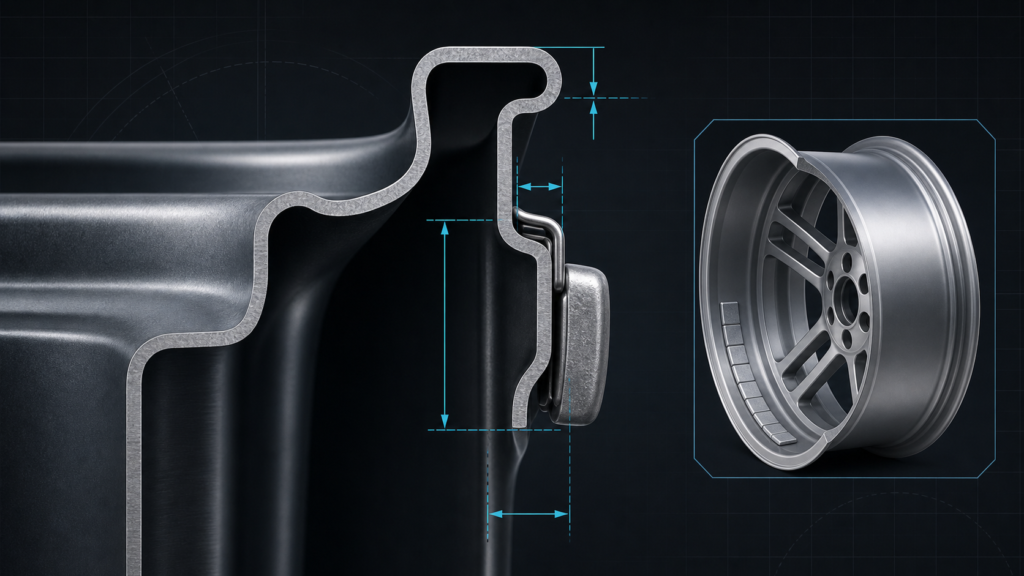
A wheel weight application chart matches a clip-on weight to the geometry of a wheel rim flange: its lip thickness, engagement gap, depth, offset, and accessible mounting surface. It is a starting point, not a universal guarantee. Nonstandard, damaged, coated, or appearance-sensitive wheels need physical measurement and a trial fit before a buyer orders production quantities.
An application chart is valuable because clip labels alone do not describe every wheel. A profile that is secure on one steel rim can sit high, mark the finish, or lose retention on another rim that looks similar from a distance. Standards for passenger-car and light-truck wheel weights address the relationship between clip configurations, rim flanges, installation, and retention 1 2.
Índice
- What does a wheel weight application chart show?
- Which rim-flange dimensions matter for clip-on weights?
- How should a rim flange and clip be checked?
- How do common wheel cases change the decision?
- When is adhesive weight the safer choice?
- What should buyers confirm before ordering a clip-on range?
- How can distributors turn fitment findings into an assortment?
- Conclusion: Use the chart to begin validation, not end it
- Perguntas Frequentes
- Referências
What does a wheel weight application chart show?
A wheel weight application chart connects a rim-flange shape with a compatible clip profile and a suitable installation location. It reduces guesswork, but it does not replace the wheel maker's guidance, a rim gauge, or a physical retention check.
The chart's purpose is practical: it helps a technician or buyer move from “this is a steel or alloy wheel” to “this flange has geometry that may accept this specific clip.” It should separate at least four decisions:
| Chart question | What is being matched | Por que é importante |
|---|---|---|
| Rim material and finish | Steel, painted steel, coated alloy, or cosmetic alloy | A clip that fits mechanically can still be unsuitable for a finish. |
| Flange geometry | Lip, gap, depth, and offset | The clip must engage rather than perch or bottom out. |
| Clip construction | Spring shape, hook opening, body clearance | Similar-looking profiles can load the flange differently. |
| Service requirement | Balancer mode, correction location, appearance, speed | The approved mounting plane may favor clip-on or adhesive format. |
For a buyer building a full range, the wheel-weight format and application planning provides the wider context: material, size system, attachment method, and vehicle mix have to work together. This chart narrows the question to one critical link in that chain—the actual rim flange.
After a chart identifies a likely clip family, P, C, T, and MC profile-code guidance helps buyers understand what the catalogue label can and cannot confirm before a physical trial fit.
Which rim-flange dimensions matter for clip-on weights?
The key dimensions are the ones that determine whether the clip can enter, seat, and retain without damaging the wheel: lip thickness, engagement gap, flange depth, local offset, and clearance around the intended position. A wheel diameter or vehicle model alone is not enough to establish clip compatibility.
Start at the mounting location specified by the balancing method. Measure only a clean, undamaged section of the flange; corrosion, bent lips, old adhesive, or a thick repair coating can create a misleading reading. Then record the geometry rather than relying on a photograph:
| Measurement or observation | O que procurar | Fitment risk if ignored |
|---|---|---|
| Lip thickness | The material thickness where the clip grips | Too tight can mark or deform the rim; too loose can reduce grip. |
| Engagement gap | The space that accepts the clip's hook or spring | A closed or shallow gap can prevent full seating. |
| Flange depth | How far the clip can travel into the profile | A shallow flange may leave the weight unstable or proud. |
| Offset and contour | Curves, humps, decorative features, or nearby ridges | The weight body can rock, bridge a feature, or sit out of position. |
| Clearance | Brakes, covers, spokes, wheel trim, and balancer location | A mechanically secure weight can still interfere with nearby parts. |
These fields make a chart transferable across a buying team. Instead of asking a supplier to guess from “15-inch steel rim,” the team can provide a rim photo, the measured flange profile, and the proposed balancing location. This is consistent with the standards' emphasis on configurations, installation, and retention rather than a single generic part description 1.
How should a rim flange and clip be checked?
Check the rim and proposed clip as a small validation sequence: measure the flange, compare the clip shape, seat the sample at the approved location, and inspect retention and clearance. The sequence must be repeated on representative wheels because a catalogue code is an index, not proof of fit.
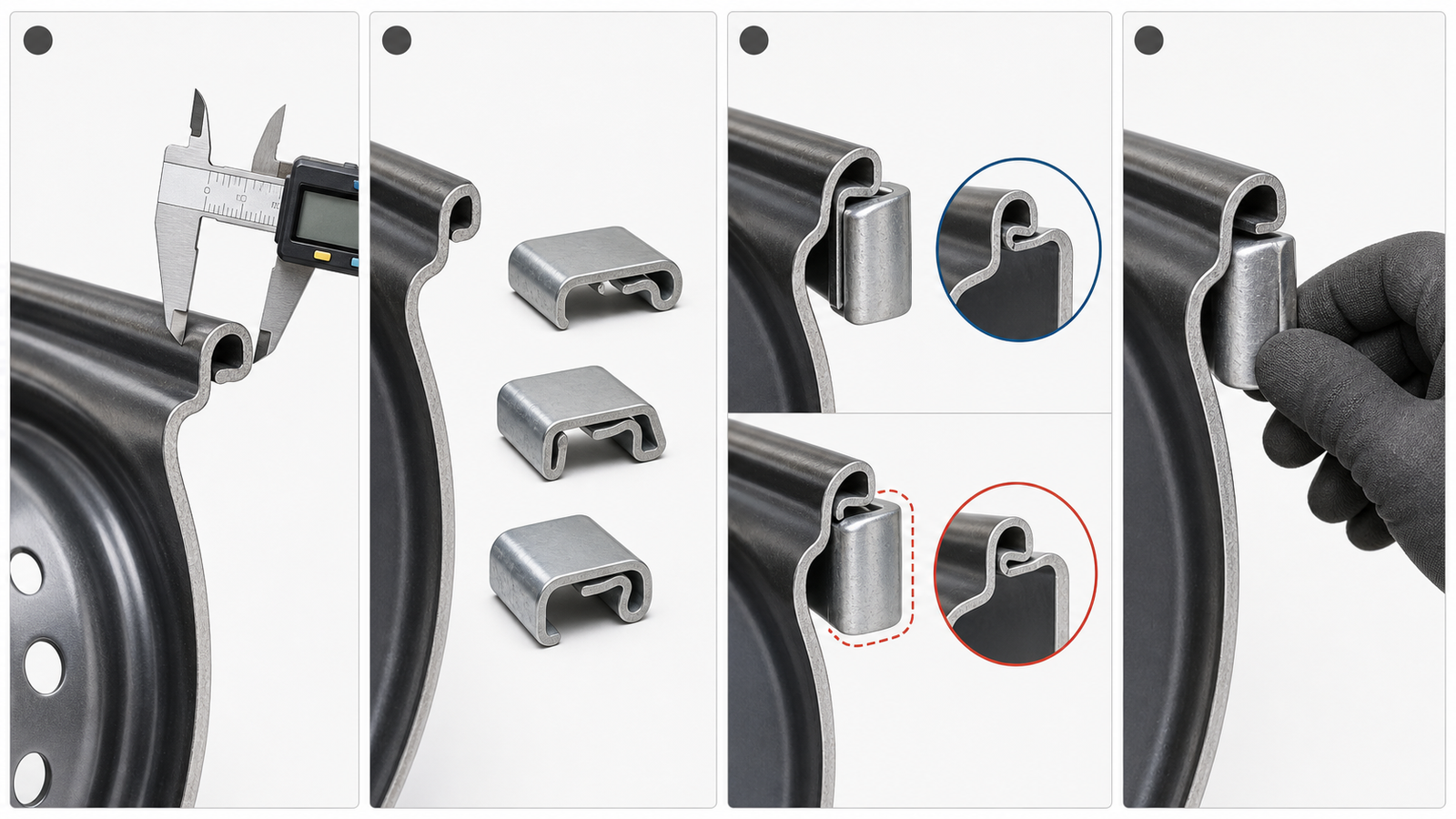
Measure the flange, compare the profile, check full seating, then validate retention on the actual wheel before using a fitment result for a range decision.
First, use a rim gauge or caliper to document the flange where the weight will sit. Next, place the proposed clip against the profile without forcing it. A proper candidate follows the flange and allows the body to sit in its intended orientation. If the clip sits on an edge, needs excessive force, or leaves the body visibly tilted, treat it as a mismatch.
Then install the sample with the correct tool and inspect it from more than one angle. The clip should engage the intended surface; the weight should not rock, bridge a ridge, or touch a feature that prevents full contact. A light controlled retention check is a validation step, not a substitute for the product's specified test procedure. The current SAE recommended practice covers minimum retention-performance requirements for balance weights on passenger-car, light-truck, and multipurpose-vehicle wheels 1.
Finally, record the wheel identification, flange measurements, proposed clip family, material, finish, location, and result. This gives purchasing and service teams a usable record rather than a one-time workshop memory. An OEM application guide likewise treats a rim flange gauge as the tool to determine the correct application when the default series does not fit 3.
How do common wheel cases change the decision?
Steel wheels often offer accessible flange locations for clip-on weights, while alloy wheels demand more caution around finish, profile, and approved mounting locations. Neither category is a one-profile rule, and some service programs intentionally use adhesive formats on steel wheels.
Conventional steel wheels
Conventional steel wheels are often the most straightforward clip-on application because the flange is visible and designed for service access. Even so, shops should validate the recurring flange families rather than treating all stamped-steel rims as identical. For a focused view of local rim use, steel-wheel flange and clip requirements help buyers link their reference samples to coating, size, and vehicle application.
Painted or coated steel wheels
Painted wheels can add thickness and may be more vulnerable to cosmetic damage. The check is not just “does the clip go on?” It is whether the specified clip fits without chipping the finish or creating a seating issue. Use samples from the production finish, not only an unfinished rim section.
Alloy and appearance-sensitive wheels
Some alloy rims have an approved flange location for a particular coated clip, but many do not. The visual surface, contour, and corrosion behavior all matter. Do not select a clip-on profile simply because it seems to grip; confirm the wheel's approved balancing location and actual clearance.
Wheels with covers, trim, or limited clearance
Wheel covers, styled lips, brake clearance, and nearby design features can remove an otherwise valid clip-on location. The resulting decision can be a different clip family, a different balancing plane, or an adhesive option. This is why a reference chart should accompany—not replace—the balancer program and wheel-specific instruction.
When is adhesive weight the safer choice?
Adhesive weights are often safer when the wheel has no approved clip-on flange location, the visible finish should not be contacted, or the approved balancing plane is inside the barrel. They are not a universal workaround: the inner barrel must still offer suitable surface condition, space, curvature, and clearance.
A attachment-method decision is especially useful when a team is deciding whether a marginal clip fit should become an adhesive application. An adhesive choice avoids a flange-mounted clip, but it moves the validation to tape preparation, installation temperature, pressure, and the available barrel surface.
For alloy-wheel, EV, and cosmetic-wheel service, record the weight's height and length as well as its position. A strip that fits the surface can still conflict with a spoke pattern or brake component if it is placed outside the approved area. Conversely, a steel wheel may use adhesive weights when appearance, clearance, or a selected balancer mode makes that format more appropriate.
What should buyers confirm before ordering a clip-on range?
Buyers should confirm representative flange fit, clip retention, surface compatibility, weight increments, markings, and carton identification before approving a clip-on range. A single good-looking sample is not enough if its clip profile, coating, or packaging differs from the production SKU.
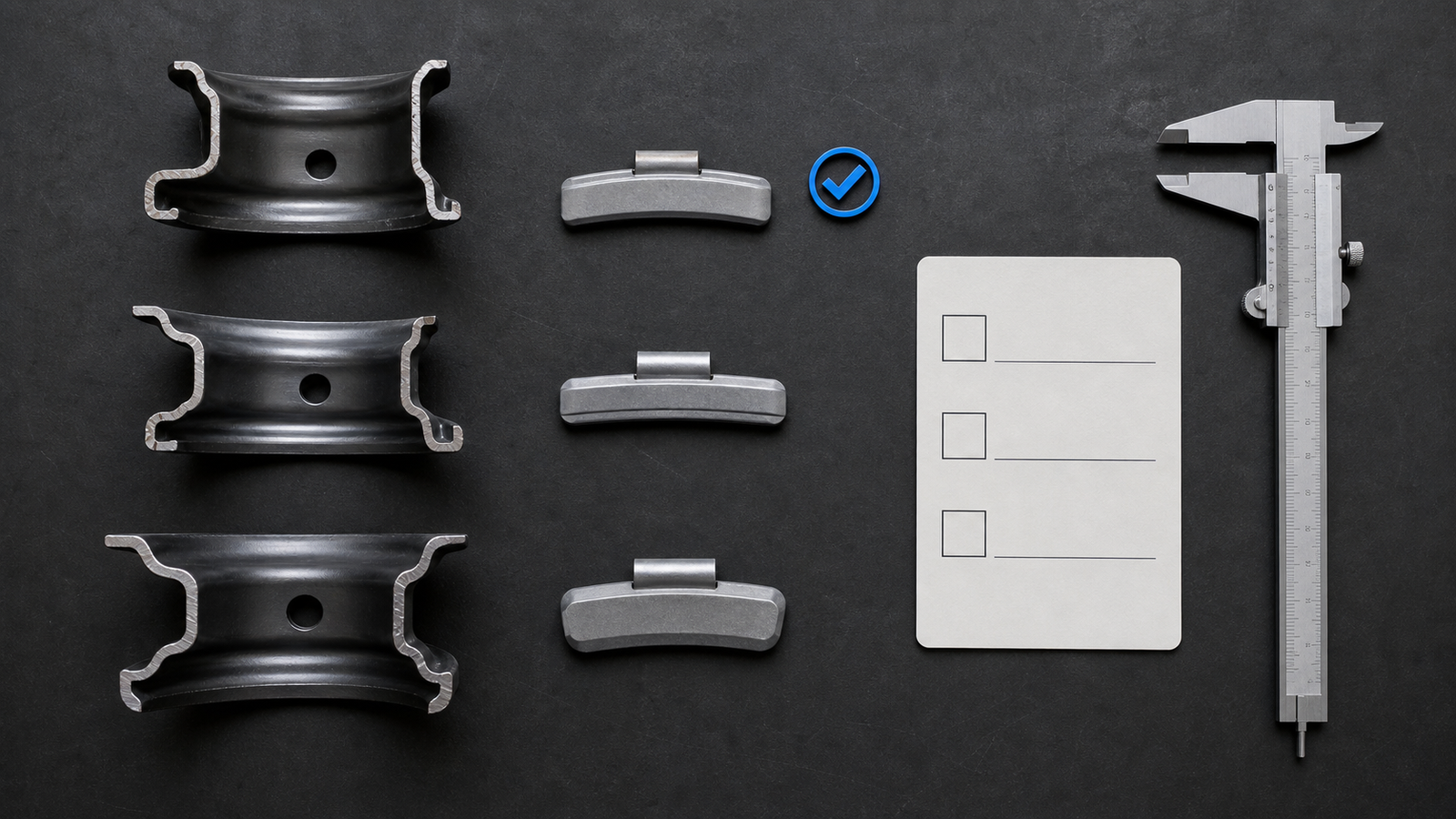
A useful approval set pairs real flange samples and caliper measurements with the proposed clip profiles and a documented result.
Use a sample plan that covers the wheels the buyer actually services:
- Collect the highest-turn steel and alloy wheel families, not only one easy flange.
- Test each proposed clip profile on the corresponding representative rim.
- Confirm that the weight sits at the intended balancing location and does not interfere with trim or brake components.
- Inspect clip forming, coating coverage, sharp edges, marked weight, and visible finish after installation.
- Keep a photo and measurement record with the accepted SKU and wheel family.
- Check carton and tray labels so technicians cannot mix visually similar clips.
When the flange families are clear, buyers can compare clip-on profile options by the profiles and increments they genuinely need, rather than ordering a broad assortment of unknown overlap. For mixed service channels, the wider wheel-weight formats for mixed service work can then be reviewed through the split between validated clip-on SKUs and adhesive formats.
How can distributors turn fitment findings into an assortment?
Distributors should group validated results by recurring flange family, then assign clip profiles and weight increments to the wheels that account for actual service volume. This makes the application chart a stocking tool instead of a static technical document.
Begin with a simple matrix: one row per validated rim family, one column for the accepted clip, size system, common correction range, coating or finish requirement, and trial-fit record. Link every group to an SKU that a receiving team can identify from its label. Keep unvalidated profiles separate from approved stock; otherwise a broad range can create workshop mistakes rather than coverage.
Review the matrix after seasonal wheel changes, new vehicle programs, or recurring return reasons. If a profile is used only once in a sample but never appears in normal service, it may not deserve deep inventory. If a recurring rim family has no approved clip result, the next action is a new sample and measurement check—not a forced substitute.
If you need to match wheel-weight clips to real rim flanges, share the wheel profiles, vehicle applications, weight increments, coating, and expected service volume you need to cover. We can help you request a fitment-focused sample range.
Conclusion: Use the chart to begin validation, not end it
A wheel weight application chart is most useful when it turns a visual rim into a documented fitment decision. Match the flange geometry to the clip's engagement shape, confirm the approved mounting location, install a representative sample, and retain the result with the corresponding SKU.
That process protects both service quality and inventory accuracy. Start with the wheel, not the clip code; use adhesive weights where the wheel's surface, finish, or approved location makes them the better choice; and build inventory only around profiles that have passed a representative fit check. Buyers can send rim dimensions or a representative wheel sample to discuss the right clip-on format before committing to a range.
Perguntas Frequentes
What is a wheel weight application chart?
It is a reference that helps match a clip-on wheel-weight profile to a rim flange. It should consider flange geometry, wheel finish, mounting location, and the proposed clip shape, then be confirmed by a trial fit on the actual wheel.
Can I choose a clip-on wheel weight by vehicle model alone?
No. Vehicle model information can narrow the search, but wheel designs, finishes, and flange profiles can vary. Measure the actual rim or use a verified application guide and representative sample before ordering.
Which rim measurements matter most for a clip-on weight?
Lip thickness, engagement gap, flange depth, contour or offset, and clearance at the intended mounting point are the most useful starting measurements. They show whether the clip can enter, seat, and retain correctly.
Are all steel wheels compatible with the same clip-on profile?
No. Steel wheels commonly use clip-on weights, but their flange geometry and coatings still vary. Validate recurring wheel families rather than assuming that all steel rims use the same clip.
When should I use adhesive weights instead of clip-on weights?
Use adhesive weights when the wheel has no suitable or approved clip-on location, when the visible flange should not be contacted, or when the balancing program calls for an inner-barrel position. Confirm surface condition and clearance before installation.
Does a correct sample fit guarantee every production wheel will fit?
No. A sample fit should be documented and paired with agreed production controls. Buyers should use representative wheels and keep clip profile, finish, and packaging requirements consistent between approval and production.
Referências
[1] SAE International. “J1986_202510 Especificações de projeto de flange de aro e peso de balanceamento, procedimentos de teste e recomendações de desempenho.” 2025.
[2] Organização Internacional de Normalização. “ISO 13988:2021 Rodas de veículos de passageiros e caminhões leves — Nomenclatura de flange de aro e peso de balanceamento por clipe e adesivo, procedimentos de teste e requisitos de desempenho.” 2021.
[3] Equipamento Perfeito. “Guia de aplicação de peso de roda de liga OEM.” 2024.







