





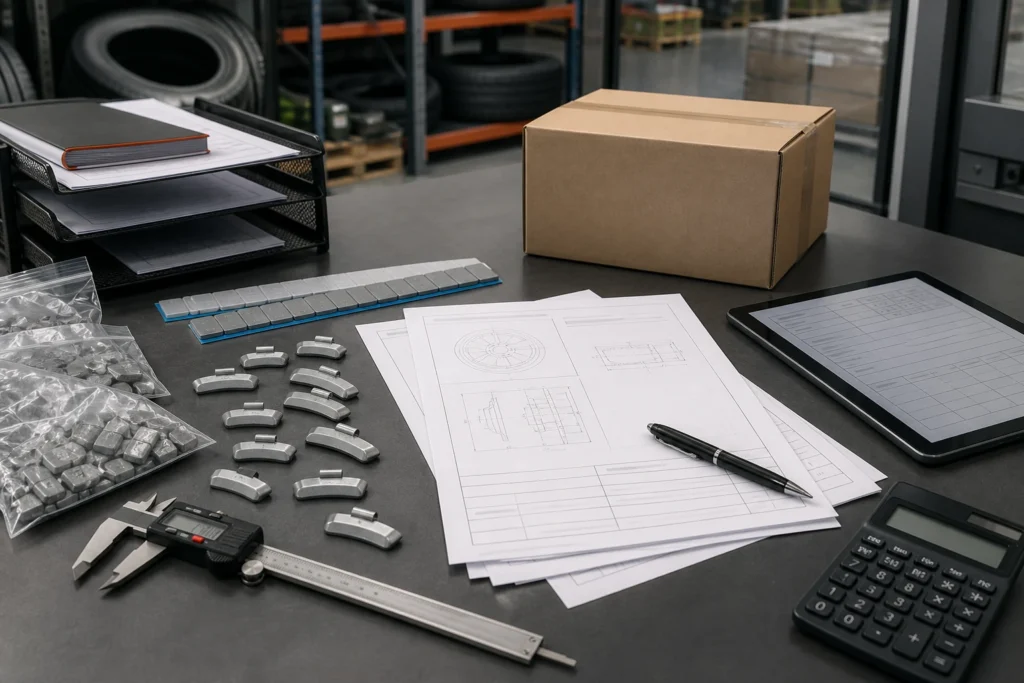
Um modelo de RFQ para pesos de roda deve capturar o tipo de produto, material, incrementos, perfil do clipe ou detalhes da fita adesiva, acabamento, etiquetas, embalagem, quantidade, destino, documentos, necessidades de amostra, expectativas de inspeção e prazo desejado. Uma lista de requisitos copiável torna as respostas dos fornecedores mais comparáveis antes de o comprador começar a avaliar as cotações.
Índice
- O que um modelo de RFQ para pesos de roda deve incluir?
- Quais campos de produto impedem que os fornecedores cotem produtos diferentes?
- Como os compradores devem indicar aplicação, incrementos e unidades?
- Quais campos de embalagem e documentos pertencem à consulta?
- Como os compradores devem indicar quantidade, destino e prazo?
- Como os compradores devem solicitar amostras e informações de inspeção?
- O que é uma planilha copiável de RFQ para pesos de roda?
- Como os compradores devem usar as respostas da RFQ?
- Conclusão: envie uma consulta clara antes de comparar cotações
- Perguntas Frequentes
O que um modelo de RFQ para pesos de roda deve incluir?
Uma RFQ deve dar a todos os fornecedores o mesmo ponto de partida comercial e técnico. Ela não precisa ser um longo desenho de engenharia para cada consulta, mas deve eliminar as suposições que, de outra forma, produziriam cotações para materiais, sistemas de fixação, embalagens ou escopos de entrega diferentes.
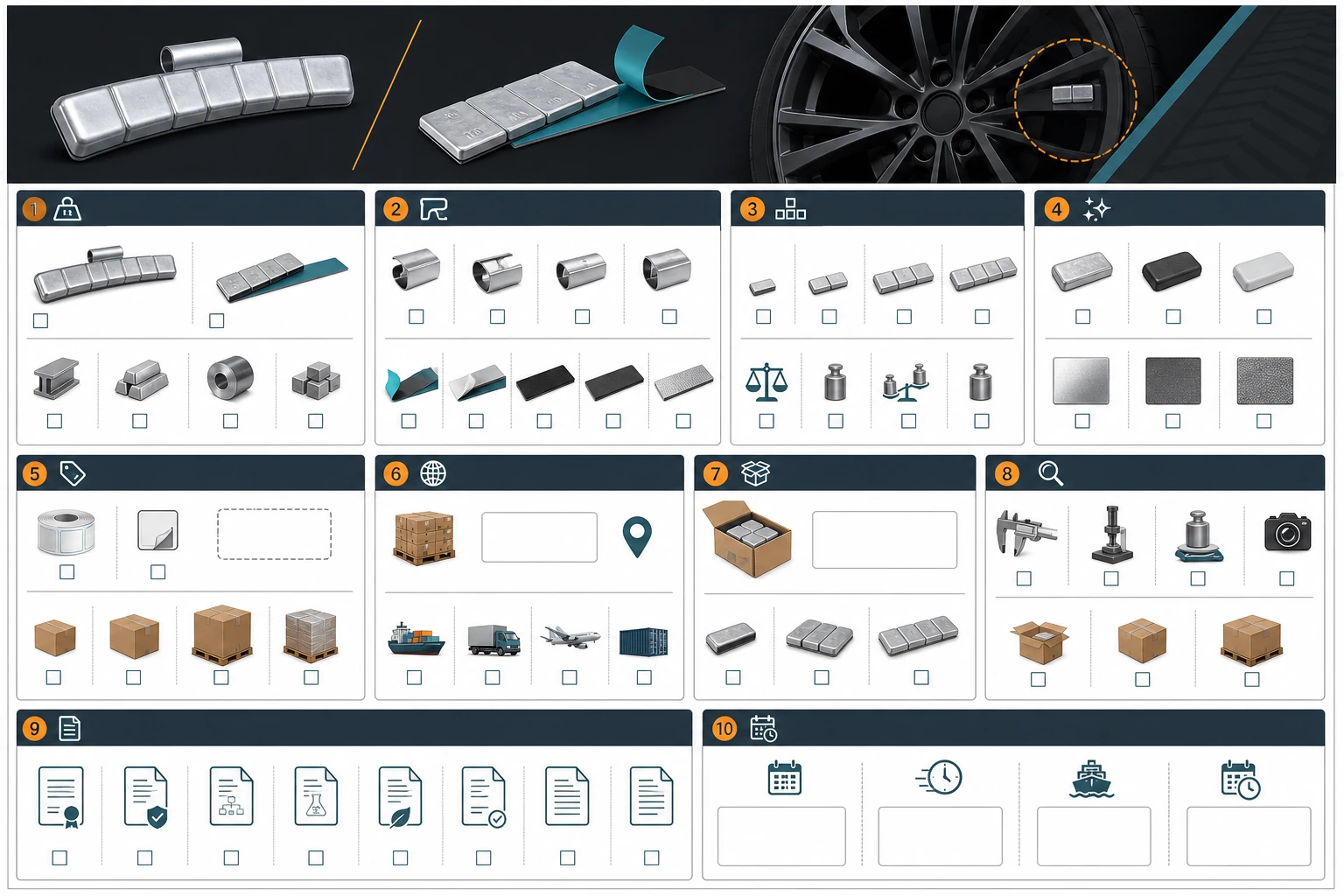
Para pesos de roda, organize a planilha em torno de oito decisões: formato do produto, material e acabamento, aplicação e incrementos, embalagem e etiquetagem, quantidade e destino, documentos exigidos, expectativas de amostra e inspeção, e prazo. Essa ordem espelha como o fornecedor deve montar uma cotação. Ela também informa ao comprador quais lacunas são decisões reais e quais podem ser deixadas para o fornecedor propor.
Comece decidindo se a consulta é para um SKU definido, uma linha existente ou uma solicitação de alternativas. Compradores que planejam uma linha de serviço podem usar a estrutura de planejamento de linha de pesos de roda para material, fixação e aplicação para separar essas escolhas antes de pedir aos fornecedores que as precifiquem. Isso evita que uma solicitação de "pesos de roda" retorne uma cotação para pesos de encaixe de aço, outra para fitas adesivas de zinco e uma terceira para um kit misto sem base comum.
| Grupo de campos da RFQ | Por que ele pertence à consulta | O que acontece se for omitido |
|---|---|---|
| Identidade do produto | Define o que o comprador está pedindo ao fornecedor para cotar | Fornecedores selecionam formatos ou materiais diferentes |
| Aplicação e unidades | Vincula o item à roda e ao sistema de estoque do comprador | Um perfil pode não servir, ou gramas e onças podem ser misturados |
| Embalagem e etiqueta | Permite que os fornecedores precifiquem a unidade vendável real e a caixa de exportação | O preço unitário exclui uma caixa, código de barras ou embalagem interna necessária |
| Quantidade e destino | Estabelece o volume, a base logística e o caminho de entrega | Suposições de MOQ, frete e prazo de entrega não podem ser comparadas |
| Amostra e inspeção | Declara como o comprador verificará o programa | Fornecedor e comprador esperam evidências de aprovação diferentes |
| Documentos e prazo | Torna registros e datas exigidos visíveis desde cedo | Documentos de transporte ou conformidade aparecem como extras tardios |
Quais campos de produto impedem que os fornecedores cotem produtos diferentes?
A seção de produto deve identificar um peso de roda bem o suficiente para que um fornecedor possa precificá-lo exatamente ou sinalizar um detalhe ausente. Uma frase genérica como "pesos de balanceamento de roda, 5 g a 60 g" não estabelece se a solicitação é para fitas adesivas, perfis de encaixe, rolos, barras segmentadas, uma alternativa de material ou uma linha de varejo.
Para cada linha solicitada, inclua um SKU do comprador, se existir, o formato do produto, material, aplicação pretendida na roda e acabamento solicitado. Em seguida, declare se alternativas são bem-vindas. Este último ponto importa: se alternativas forem bem-vindas, peça ao fornecedor para mostrá-las em linhas separadas em vez de substituir silenciosamente por um produto diferente.
Campos úteis de produto incluem:
- Formato de fixação: encaixe, fita adesiva, rolo adesivo ou um formato de kit especificado.
- Material: aço/Fe, zinco, alternativa sem chumbo ou outro material declarado. Não escreva "sem chumbo" como se descrevesse um único material.
- Geometria do perfil ou da fita: perfil do clipe e faixa de aro para produtos de encaixe; largura, altura, layout dos segmentos e comprimento total da fita para produtos adesivos.
- Acabamento e proteção: revestido, galvanizado, pintado, sem acabamento ou o sistema de proteção contra corrosão proposto pelo fornecedor.
- Informações da fita para pesos adesivos: marca/especificação da fita solicitada, se fixada, ou uma solicitação para o fornecedor identificar a construção da fita e as evidências fornecidas.
- Formato visual e comercial: loose bulk, tray, box, roll, blister, service kit, or private-label pack.
The format must match the stock strategy. Buyers can use the catalog fields that turn a product range into an RFQ SKU list to decide which formats, increments, and packages belong on separate inquiry lines. One broad inquiry line may look efficient, but it often produces a blended price that cannot be assigned to the actual SKUs the buyer intends to buy.
If a physical sample, photo, drawing, or prior order exists, attach it and label it as "reference only" or "must match". A supplier should not have to guess whether an image is showing the preferred profile, the required carton, or merely an example of the market. State the revision date and file name in the RFQ, and ask the supplier to identify any feature it cannot match.
Como os compradores devem indicar aplicação, incrementos e unidades?
Fitment and unit fields prevent technically valid wheel weights from being commercially unusable. The RFQ should say where the product is meant to be used and how the buyer measures, labels, stocks, and sells the weight increments.
For clip-on weights, state the intended wheel material and rim or flange profile where known. A clip that is suitable for one steel or alloy rim shape may not seat correctly on another. If the buyer is building a mixed market assortment rather than sourcing one known profile, ask the supplier to list the profile code, intended application, dimensions, and supported increment range for each option.
For adhesive weights, state the wheel surface context and the available clearance. Include the requested segment increment, strip or roll arrangement, total piece count, and whether a low-profile construction is necessary. When tape performance is important, the RFQ should describe the intended surface preparation, storage conditions, temperature range, or test method that matters to the buyer. Do not request "strong tape" without saying what application condition it must withstand.
Use one primary unit system in the purchase organization and state any secondary unit that must appear on packs. For example, an inquiry can request 5 g segments while asking the supplier to state equivalent ounce coverage in a separate column for a market that sells in ounces. Ask suppliers not to convert by rounding the physical segment weight unless that is explicitly acceptable.
A simple line-item structure makes the requirement visible:
| Campo | Example of a clear entry | Why the supplier needs it |
|---|---|---|
| Intended application | Passenger-car alloy wheel, adhesive position | Determines attachment choice and clearance concern |
| Incremento | 5 g segments, 12 segments per strip | Defines the physical unit and stock count |
| Formato | 60 g segmented strip, liner between sections | Defines the dispensing and packing format |
| Perfil | Clip code and rim flange range, if clip-on | Prevents a visually similar but incompatible clip |
| Finish or tape | Black coating; supplier to identify tape specification | Makes the performance requirement reviewable |
| Pack label unit | Grams on inner pack; grams and ounces on outer carton | Aligns the quote with the resale and warehouse label |
Quais campos de embalagem e documentos pertencem à consulta?
Packaging and documents should be requested before the supplier prices the order, because they affect labor, material, carton dimensions, and export handling. They also determine whether the product can be received, stored, and sold without relabeling or repacking.
Specify the sellable unit first: number of strips, rolls, clip-on pieces, or mixed increments per inner pack. Then state the outer-carton quantity, carton marking, barcode requirement, language, private-label artwork status, pallet preference, and any constraint on carton weight or dimensions. If the buyer does not yet know the final carton count, ask the supplier to propose an inner-pack and carton configuration, with the assumption clearly marked as supplier-proposed.
The document request should be specific without pretending that every market requires the same paperwork. Common shipping records can include a commercial invoice, packing list, transport document, and certificate of origin when applicable. Export document practices vary by destination and product, so importers should confirm their own market and broker requirements; the International Trade Administration notes that export packing lists are more detailed than ordinary domestic packing lists 1.
In the RFQ, list which of these are required, optional, or to be confirmed:
- Product specification or data sheet.
- Material, coating, tape, or compliance declarations needed for the destination.
- Test reports or lot-related quality records where relevant.
- Commercial invoice and packing-list format requirements.
- Certificate of origin, origin statement, or other destination-specific documents.
- Carton labels, pallet labels, barcode format, and language.
- Photo evidence of final packing, palletizing, or container loading if requested.
Avoid requesting certificates by name unless the buyer knows they apply to the product and market. A better RFQ question is: "Please identify the documents you can provide for this product and note any documents you cannot provide for the stated destination." That yields comparable evidence without inviting a supplier to promise a document it cannot support.
Como os compradores devem indicar quantidade, destino e prazo?
Quantity, destination, and timing turn a product inquiry into a commercially usable request. A supplier cannot give a reliable MOQ, packing proposal, freight basis, or production window if the buyer has not said whether the quantity is a one-off sample, an initial container program, or a monthly replenishment estimate.
List quantities by SKU and by pack, not only as a total order weight. A request for 2,000 kg can conceal a practical problem if it includes twelve low-volume SKUs, branded cartons, and separate tape constructions. State whether the quantities are forecast, firm, or a request for the supplier's MOQ recommendation. If the buyer wants a mixed container or mixed carton program, ask the supplier to show MOQ and price by line item as well as the combined total.
Before treating a low minimum as a better commercial offer, buyers should understand the MOQ drivers behind a mixed-SKU inquiry. Tooling, material changeovers, tape or coating batch sizes, custom artwork, inner packs, and carton print runs can all alter the minimum for each individual SKU. Asking the supplier to explain the constraint produces a better planning answer than simply asking for "the lowest MOQ."
For destination, state the country, city or port when known, desired Incoterm if the buyer has selected one, and whether the buyer needs a factory-ex works figure, a named-port figure, or another commercial basis. Do not compare a factory pickup price to a delivered price as if both answer the same question. For timing, include the requested sample date, artwork approval deadline, target ex-works or handover date, and desired arrival window if the buyer is planning inventory.
The RFQ should also ask the supplier to separate:
- Product lead time after final sample or artwork approval.
- Time needed for packing materials, labels, or private-label printing.
- Inspection booking or rework allowance, if required.
- Validity period of the quotation.
- Assumptions that would change the stated lead time.
This makes the supplier's reply usable for both purchasing and replenishment planning. It also prevents a supplier from quoting an attractive lead time that starts only after approvals the buyer has not scheduled.
Como os compradores devem solicitar amostras e informações de inspeção?
Sample and inspection fields should state what decision the buyer needs to make, rather than merely asking for "free samples" or "quality assurance." The request must connect the sample to the bulk SKU, the intended use, and the evidence expected before shipment.
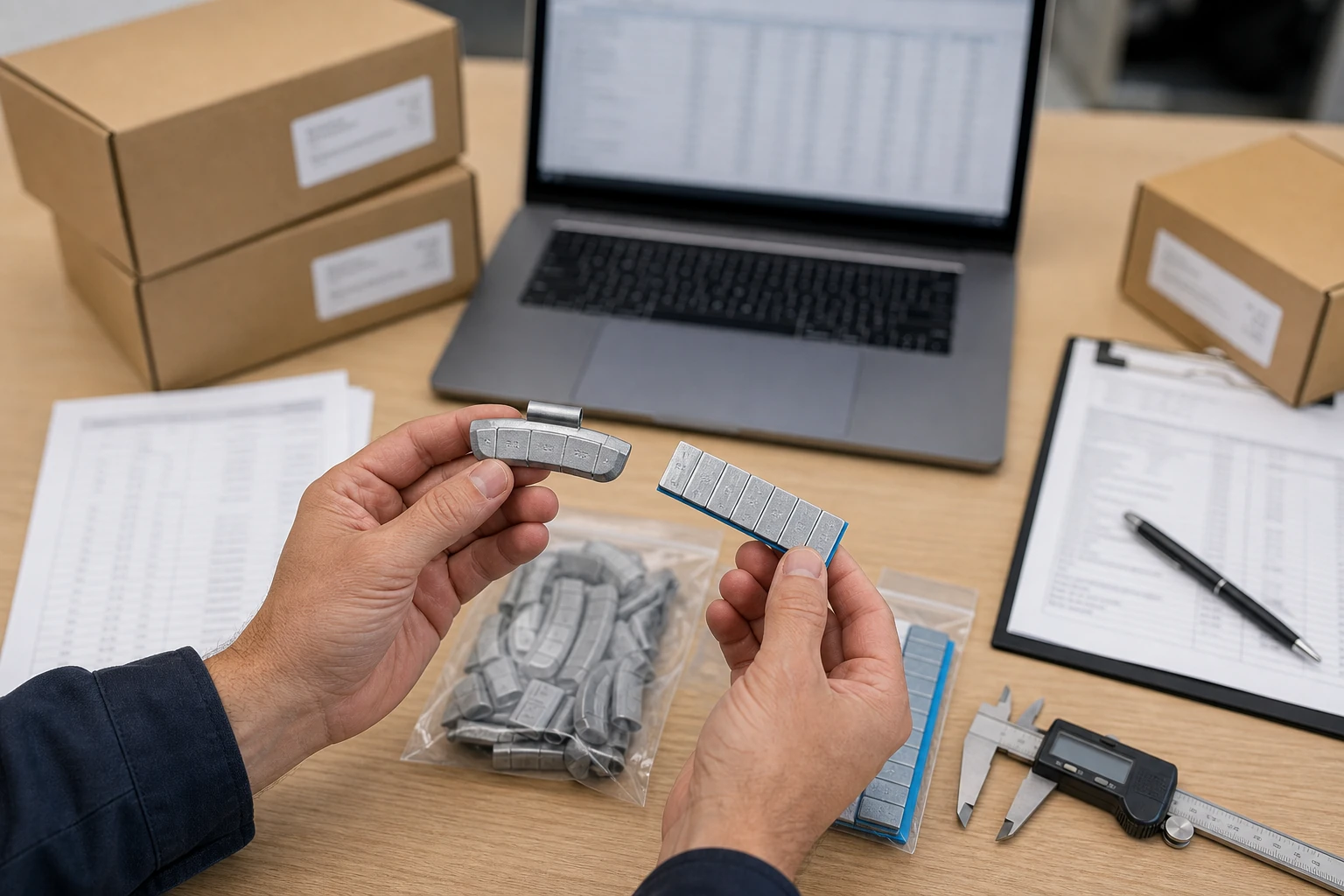
For samples, identify the exact formats and increments required, the number of samples or sample packs, any fitment or adhesion observation the buyer plans to run, and who pays for sample preparation and freight. Ask the supplier to label the sample with product details and revision information. If the buyer is testing a tape or clip profile, say which conditions will be reviewed so the supplier can flag an unsuitable construction before a bulk quotation is accepted.
For inspection, state whether the buyer expects a supplier self-check, a third-party inspection, photo evidence, or a combination. Name the visible checks that matter: quantity, increments, profile, finish, tape/liner condition, pack count, label accuracy, carton condition, pallet pattern, and lot identification. ISO 2859-1:2026 describes acceptance-sampling systems for lot-by-lot inspection by attributes 2; the RFQ does not need to select an AQL plan on its own, but it should say whether the buyer will later provide a sampling standard, defect definitions, or an inspection brief.
Ask how a nonconformity is recorded and handled. A useful response identifies the responsible contact, notification timing, rework or replacement process, and whether the supplier can provide an updated inspection record. This is less dramatic than a generic warranty request, but far more useful when a label or carton count is wrong at the point of shipment.
O que é uma planilha copiável de RFQ para pesos de roda?
The worksheet below is designed to be copied into an email, spreadsheet, or supplier portal. Replace bracketed items, delete sections that do not apply, and ask each supplier to answer in the same structure rather than rewriting the requirement in its own terminology.
Buyer and inquiry details
- Buyer company: [company]
- Contact and email: [contact]
- RFQ reference and date: [reference / date]
- Quote currency requested: [currency]
- Quote validity requested: [number of days]
Product line(s)
- Buyer SKU or line reference: [SKU]
- Product format: [clip-on / adhesive strip / adhesive roll / kit]
- Material: [steel/Fe / zinc / other specified material]
- Intended wheel application: [steel wheel / alloy wheel / vehicle segment]
- Clip profile or rim flange range: [if applicable]
- Strip or roll dimensions and layout: [if applicable]
- Weight increment and range: [for example, 5 g segments and required range]
- Primary and secondary units on pack: [g / oz / other]
- Finish, coating, plating, or tape requirement: [requirement or supplier proposal]
- Reference sample, photo, drawing, or prior SKU: [file name and revision]
- Alternatives allowed: [yes/no; list separately if yes]
Embalagem e rotulagem
- Sellable unit: [pieces / strips / rolls / kit contents]
- Inner-pack configuration: [required or supplier proposal]
- Outer-carton configuration: [required or supplier proposal]
- Carton weight or size limitation: [if any]
- Label, barcode, language, and artwork requirement: [details]
- Private-label status: [not required / artwork attached / artwork to follow]
- Pallet or loading requirement: [details]
Quantidade e destino
- Quantity by SKU and pack: [table or list]
- Order status: [sample / forecast / initial order / repeat order]
- Required MOQ response: [show MOQ by SKU, pack, and mixed order]
- Destination country and named city or port: [destination]
- Requested price basis or Incoterm: [basis]
- Target sample date: [date]
- Target production handover date: [date]
- Desired arrival window: [date or period]
Documents, samples, and inspection
- Documents requested: [specification, declarations, packing list, origin documents, other]
- Sample request: [SKU, quantity, test purpose, delivery address]
- Inspection expectation: [self-check / third party / photos / inspection brief to follow]
- Checks to report: [quantity, increments, finish, tape/liner, labels, pack count, cartons, pallets]
- Lot or batch traceability required: [yes/no; detail]
- Deviation process requested: [contact, notification timing, written approval]
Supplier response requested
- Unit price and currency by line: [supplier to complete]
- Tooling, artwork, packing, testing, or other charges: [included / excluded / separate]
- MOQ by SKU and reason for any constraint: [supplier to complete]
- Production lead time and starting assumption: [supplier to complete]
- Packing proposal and gross/net weights: [supplier to complete]
- Documents available and any exceptions: [supplier to complete]
- Quotation assumptions or substitutions: [supplier to complete]
Keep the completed worksheet with the original supplier reply. It becomes the record used to resolve whether a later quote, sample, carton proof, or inspection report matches the inquiry. If a field is unknown, write "supplier proposal requested" rather than leaving it blank; a blank is easy to overlook, while a proposal request prompts a visible response.
Como os compradores devem usar as respostas da RFQ?
RFQ responses should first be checked for completeness, then compared for price. A lower number is not a lower cost if it excludes the tape construction, carton format, document set, sample freight, inspection support, or delivery basis that another supplier has included.
Create one response table that repeats the original RFQ fields. Mark each cell as confirmed, supplier-proposed, not offered, or unclear. The scope-normalization method for supplier replies helps buyers identify omissions before treating quotations as comparable. Use it after the RFQ; it is not a replacement for making the initial requirement clear.
Then review commercial outcomes in the right order. Use total-cost checks that belong after the RFQ has a common scope to distinguish unit price from packing, freight, duty, inspection, and other order costs. After the products and commercial assumptions are normalized, use the evidence-based supplier shortlist after the product requirement is clear to evaluate capacity, responsiveness, quality evidence, and risk rather than choosing only the lowest bidder.
An RFQ is successful when it makes a supplier's exception visible early. A supplier may legitimately propose a different carton count, a higher MOQ for branded inner packs, or a different tape construction. That is useful information if it is named. It becomes a sourcing risk only when the difference is hidden inside a quote that appears comparable.
Conclusão: envie uma consulta clara antes de comparar cotações
Use the worksheet to describe the physical wheel weight, its intended fitment, the increments and units, packaging, quantity, destination, documents, samples, inspection, and timing. Send the same completed version to each supplier, keep proposed alternatives on their own lines, and compare replies only after their assumptions are visible.
When the required formats and pack details are known, request adhesive and clip-on wheel weight samples for the selected formats alongside the completed worksheet. That gives the supplier a concrete product basis and gives the buyer a traceable path from inquiry to sample, quotation, and bulk order.
Perguntas Frequentes
Should an RFQ include target pricing for wheel weights?
It can, but label it as a target or budget rather than an instruction to match an undefined price. A useful RFQ still asks the supplier to state its unit price, commercial basis, included scope, MOQ, and assumptions by line item. The buyer can then see whether a price gap comes from a different product or from a genuine commercial difference.
What should buyers attach to a wheel weight RFQ?
Attach any approved sample photo, drawing, SKU list, carton artwork, label artwork, test notes, prior packing list, and destination-specific document requirement that the supplier must follow. Give each attachment a file name and revision date, and state whether it is a mandatory match or a reference example.
Can one RFQ cover clip-on and adhesive wheel weights?
Yes, provided each format has separate line items and fields. Clip profile and flange fit are important for clip-on weights, while strip dimensions, segment layout, tape, liner, and wheel-surface context are important for adhesive weights. Combining the products under one vague description prevents clear comparison.
How should a buyer ask about MOQ in the RFQ?
Ask suppliers to state MOQ by SKU, pack, and any mixed-order total, then explain the constraint behind each minimum. This reveals whether the limit comes from metal processing, tape or coating batches, printed cartons, inner-pack labor, or a commercial policy.
Does an RFQ need to define an inspection standard?
For a first inquiry, it can state the expected inspection method and the checks to report, then ask suppliers to identify their standard process. Before a bulk order, the buyer should agree the sampling basis, defect definitions, acceptance criteria, and documentation required for that program.
Referências
[1] International Trade Administration. “Common Export Documents.” 2026.
[2] Organização Internacional de Normalização. “ISO 2859-1:2026 Sampling procedures for inspection by attributes.” 2026.







