



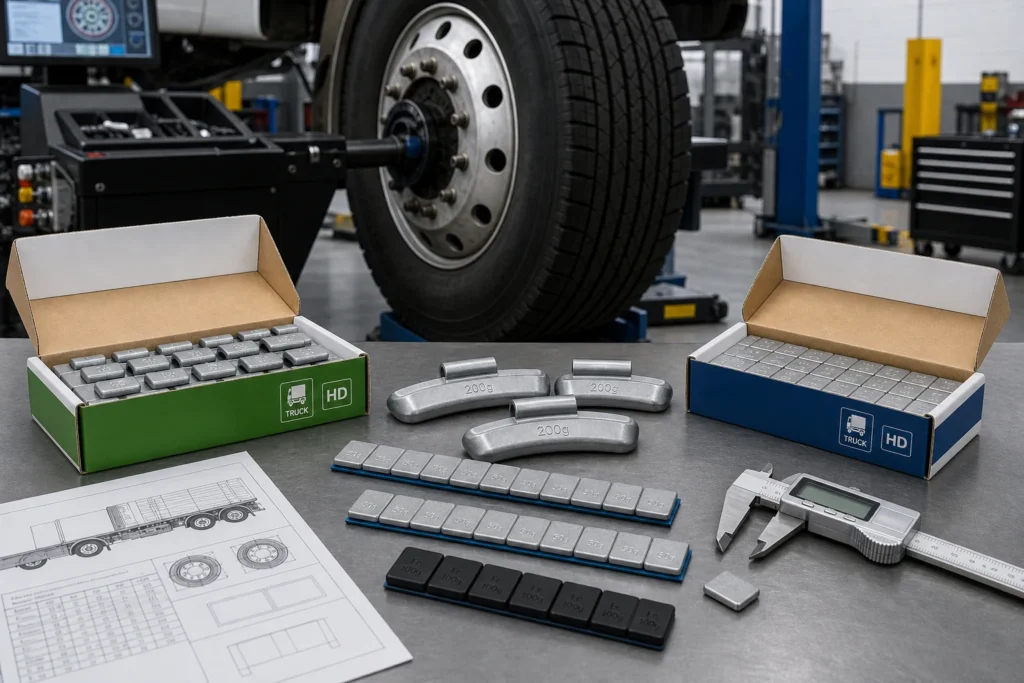
Truck wheel weights are balancing weights designed for commercial vehicle wheel and tire assemblies. They may be clip-on, adhesive, steel, zinc, coated, or another specified material, but the correct choice depends on the wheel profile, axle position, balancing method, clearance, operating environment, and service channel—not simply on using a heavier weight.
The practical difference between a passenger-car range and a truck range is the number of conditions that must remain true after installation. A tire shop needs a weight that fits the rim and can be applied consistently; a fleet needs repeatable service across many wheel positions; a distributor needs a clearly documented SKU that does not turn every model variation into a return.
Table of Contents
- What Are Truck Wheel Weights?
- Why Do Truck Wheel Weights Need a Separate Fitment Process?
- Which Truck Wheel Weight Types Are Commonly Used?
- How Should You Match Weights to Wheel, Axle, and Service Method?
- Which Materials and Coatings Make Sense for Truck Service?
- What Specifications Should a Truck Wheel Weight RFQ Include?
- How Can Tire Shops and Fleets Build a Practical Stocking Range?
- What Should Buyers Check Before Approving a Truck Wheel Weight?
- Which Claims and Shortcuts Create Returns?
- Conclusion: Build the Range Around the Real Wheel-Service Application
- Frequently Asked Questions
- References
What Are Truck Wheel Weights?
Truck wheel weights add corrective mass to a wheel and tire assembly so a technician can bring the rotating assembly into balance. The purpose is familiar, but the service conditions are different: commercial vehicles can use larger assemblies, carry higher loads, run longer duty cycles, and encounter more water, dirt, salt, brake dust, and road impact than many passenger vehicles.
A weight is only useful when its mass is placed in the correct location and remains attached through the intended service life. 3M describes tire balance as dependent on correctly located and attached weights, which is why attachment and placement belong in the product specification rather than being left to the installer’s assumption. 1
Truck wheel weights can be supplied as:
- Clip-on weights that grip a defined rim flange or edge.
- Adhesive weights or segmented strips applied to a cleaned wheel surface.
- Steel, zinc, lead-free composite, or other material options selected for the customer’s market and wheel application.
- Pre-counted pieces, mixed service assortments, rolls, or cut-to-weight formats.
These are product families, not universal fitment statements. A clip must match the flange, and an adhesive strip must match the landing surface and service process. The broader wheel balancing weights guide covers the category; truck applications need evidence for the complete wheel, tire, axle, and service process.
Why Do Truck Wheel Weights Need a Separate Fitment Process?
Truck wheel weights need a separate fitment process because the visible wheel and the hidden service conditions both vary. A medium-duty truck, bus, trailer, heavy van, and long-haul tractor may all be described as commercial vehicles, but they can use different wheel materials, flange shapes, tire sizes, load conditions, and maintenance routines.
Separate mass selection from interface selection. The balancer determines the correction required; the wheel and product determine where and how it can be attached. A heavier weight does not fix a wrong clip profile, poor clearance, contaminated surface, or unsuitable coating.
| Fitment layer | Questions to answer | Failure if skipped |
|---|---|---|
| Vehicle and service | What truck class, tire assembly, axle, and duty cycle are involved? | Range is too narrow for the real service mix |
| Wheel | Is the wheel steel, aluminum, coated, painted, or another profile? | Clip does not retain or adhesive landing area is unsuitable |
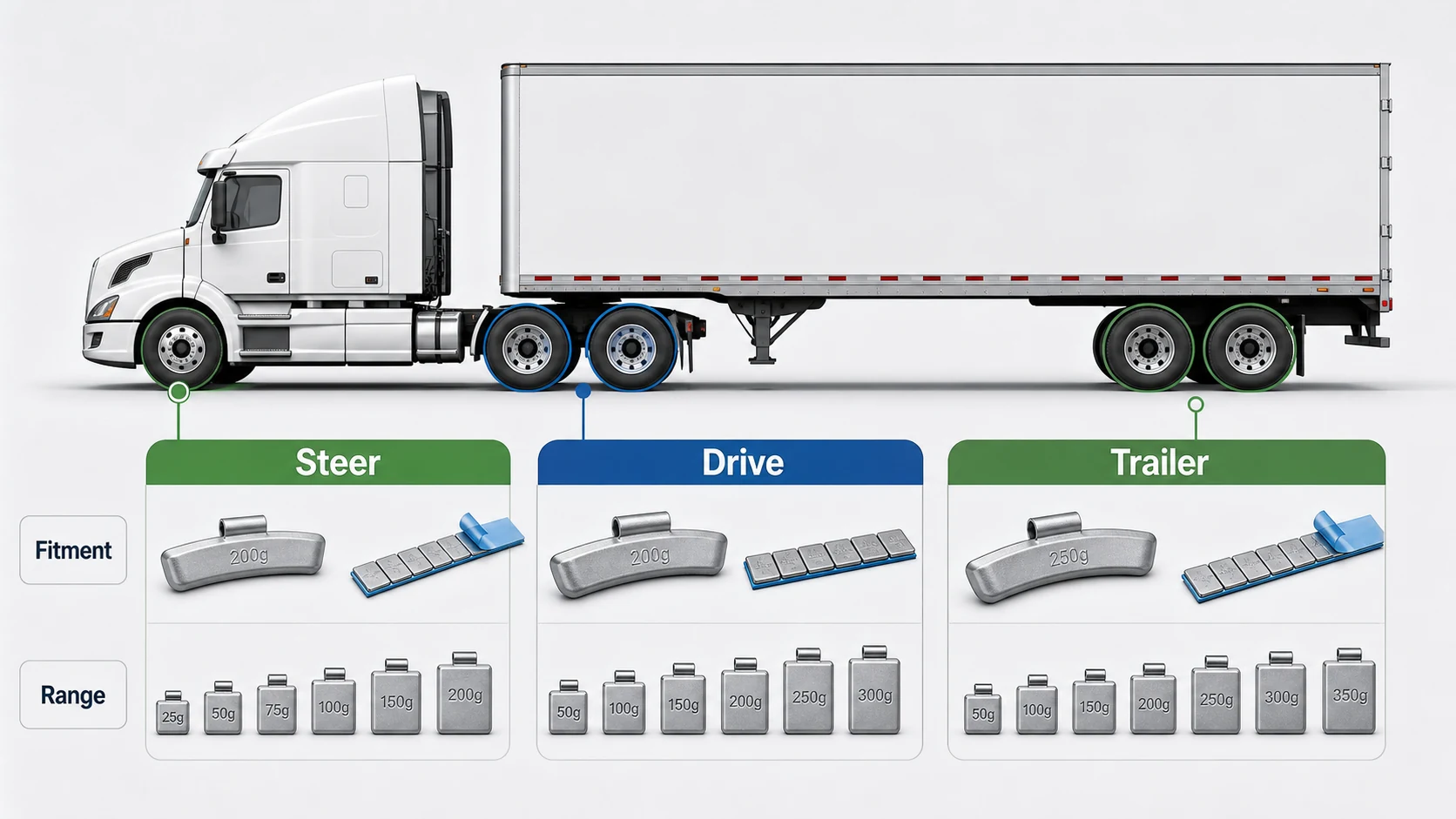
| Position | Is the correction on an inner or outer plane, steer axle, drive axle, or trailer wheel? | Weight conflicts with brake, suspension, or wheel clearance |
| Balancing method | Is the shop using static, dynamic, or a machine-specific procedure? | Corrective mass is placed in the wrong plane |
| Environment | What water, salt, temperature, dust, and cleaning exposure occur? | Corrosion or attachment loss appears in service |
| Service channel | Is the range for a tire shop, fleet, distributor, or private label? | Packaging, replenishment, and SKU logic do not match the user |
A fitment record should identify the exact wheel or a representative sample, not only the truck brand. Replacement wheels may use a different profile, so read the wheel weight size chart alongside the wheel and service details.
Which Truck Wheel Weight Types Are Commonly Used?
Clip-on and adhesive weights are the two main formats buyers compare, but each format contains several profiles and service assumptions. The right choice is the one that meets the wheel’s mechanical or adhesive interface and can be applied correctly by the intended operator.
| Weight type | Where it can fit | Main advantage | Main risk to verify |
|---|---|---|---|
| Clip-on for steel wheel | A defined steel rim flange or edge | Fast repeatable attachment when the clip matches the flange | Wrong clip geometry, excessive force, wheel damage, or poor retention |
| Clip-on for alloy or coated wheel | A specified flange with a compatible protective clip | Convenient service where a clean clip-on location exists | Contact with the wheel finish, clearance, and profile mismatch |
| Adhesive strip or segment | A clean, suitable landing surface on the inner wheel | Flexible placement and a low-profile installation | Contamination, cold surface, poor pressure, wrong tape, or insufficient wet-out |
| Roll or cut-to-weight material | Service counters or controlled production processes | Less inventory of individual weight pieces | Cutting accuracy, equipment compatibility, storage, and operator process |
| Mixed assortment | Tire shops serving several wheel and vehicle groups | Faster response to varied service work | Slow-moving pieces, mislabeled bins, and weak replenishment data |
An adhesive system is not just a metal or composite strip with tape attached. Surface condition, tape handling, pressure, temperature, wheel coating, and placement all affect the result. 3M’s application guidance calls out wheel cleaning, avoiding contamination of the adhesive, and consistent pressure as part of the application process. 2 3
For clip-on products, specify the clip shape, base width, insertion direction, retention, contact area, coating, and approved wheel flange. If installation requires hammering or bending, review the product and wheel interface before standardizing it.
Choose adhesive weights when the wheel provides a suitable clean landing area and the service process can control preparation. Choose clip-on weights when the rim profile supports a secure, repeatable mechanical grip and the application permits the required clearance. If both methods are used in the range, label them as separate SKUs rather than presenting one as a universal replacement.
How Should You Match Weights to Wheel, Axle, and Service Method?
Match the weight to the wheel interface first, then confirm the balancing position and service method. The balancing machine’s reading tells the technician the correction requirement; it does not identify the correct clip, adhesive, material, or package for the job.
Use this sequence at a tire shop, fleet workshop, or sourcing desk:
- Identify the assembly: record truck class, tire size, wheel diameter, wheel material, axle position, and whether the wheel is original or replacement.
- Inspect the wheel profile: photograph the flange or landing area, note coating and damage, and measure the interface when the profile is unfamiliar.
- Confirm the balancing procedure: record whether the machine uses static or dynamic correction and where the technician is allowed to place the weight.
- Check clearance: look at brake, suspension, valve, hub, and adjacent component clearance through the full wheel rotation.
- Select the product family: choose the clip profile or adhesive construction before selecting the piece or segment weight.
- Validate application: perform a representative fit and balance, then record retention, appearance, removal behavior, and any interference.
The same sequence applies to a mixed commercial fleet. Do not create a range from the first truck that enters the workshop and assume it covers every wheel in the fleet. Group the fleet by wheel profile and service method, then identify the smallest practical set of SKUs that covers the high-volume applications without forcing technicians to improvise.
For a distributor, the key document is a fitment matrix with one row per application. Useful columns include wheel material, wheel profile, axle or position, weight format, approved mass units, inner or outer placement, clearance note, surface preparation, test sample, and status. Mark incomplete rows as Hold or Clarify instead of converting them into a broad “truck compatible” claim.
Which Materials and Coatings Make Sense for Truck Service?
There is no single material that is best for every truck wheel. Steel, zinc, lead-free composite, and other options should be compared against density, shape, coating, handling, customer requirements, environmental exposure, and the intended attachment system.
| Material route | Useful evaluation point | Questions for the buyer |
|---|---|---|
| Steel | Compact, familiar, and available in clip-on or adhesive formats | Does the coating protect the intended wheel environment, and does the form meet the required correction range? |
| Zinc | Commonly evaluated for clip-on applications and specific market programs | Does the alloy, coating, clip, and local requirement match the wheel and service channel? |
| Lead-free composite | Can support flexible or cut-to-weight approaches in defined systems | Is the density, roll equipment, adhesive, storage, and operator process suitable? |
| Coated or painted version | Appearance and corrosion behavior may matter for visible positions | Does the coating survive handling, clipping, cleaning, and the customer’s environment? |
3M presents a flexible, conformable, lead-free wheel weight system that can be cut to the required weight and used with attachment tape. That is a specific system claim, not evidence that every lead-free material or every tape works on every truck wheel. 1
Compare corrosion behavior at the whole-product level. A material may resist corrosion while a clip, cut edge, backing, or coating defect becomes the weak point. Request exposure or handling evidence when the service environment makes that risk relevant.
Surface preparation is especially important for adhesive products. Brake dust, tire lubricant, oil, water, skin contact, and residue can reduce the usable contact area. 3M’s surface-prep instructions state that contamination can adversely affect tape performance and recommend cleaning the wheel landing surface before application. 2
Do not turn a material preference into a regulatory promise. If a customer requests lead-free or a particular coating, record that as a market or purchasing requirement and request the supplier’s material declaration, test evidence, and labeling information for the exact SKU. The FE wheel weights page is a useful comparison point for buyers evaluating iron-based options, but the truck application still needs its own fitment and service validation.
What Specifications Should a Truck Wheel Weight RFQ Include?
An RFQ should describe the wheel-service application before it describes the desired piece price. A supplier cannot select a reliable truck weight from “heavy-duty” alone because that phrase does not identify the flange, plane, clearance, material, or service process.
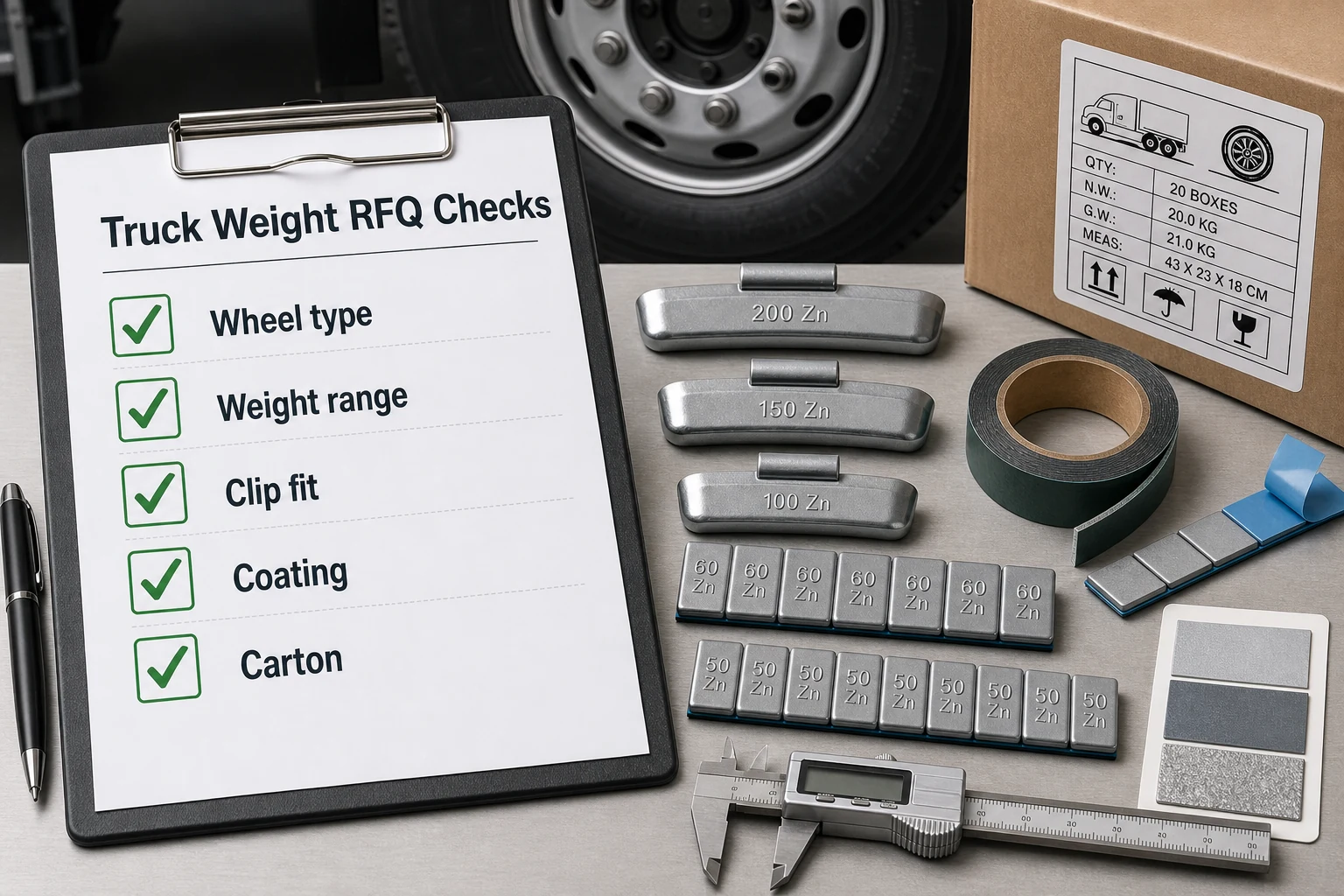
| RFQ field | Minimum information to provide |
|---|---|
| Vehicle service | Truck, bus, trailer, heavy van, or mixed fleet; duty cycle and main markets |
| Wheel | Steel, alloy, coated, painted, diameter, width, flange profile, photos or drawing |
| Position | Steer, drive, trailer, inner, outer, or other defined service position |
| Balance method | Static or dynamic process, machine type, placement limits, and target units |
| Weight format | Clip-on, adhesive, strip, roll, cut-to-weight, pieces per segment, or assortment |
| Material and finish | Steel, zinc, FE, composite, coating, color, corrosion or appearance requirement |
| Attachment | Clip geometry, tape type, liner, surface preparation, pressure, removal expectation |
| Environment | Water, salt, dust, brake heat, cleaning chemicals, temperature, outdoor exposure |
| Quality evidence | Dimensional drawing, mass tolerance, clip retention, adhesive test, batch traceability |
| Commercial terms | Sample quantity, MOQ, carton count, labels, mixed cartons, lead time, change notice |
Add a drawing or rim-flange photo for a clip-on product, and landing-surface dimensions and coating information for adhesive weights. If the profile is unknown, send a wheel or weight sample instead of guessing from the vehicle name.
Specify how pieces are counted and labeled. “500 pieces” may mean individual segments, strips, or a mixed carton. State mass per piece, pieces per strip, strip length, unit system, net and gross weight, and carton dimensions.
Ask for sample approval before a repeat order. Tie the sample to the drawing, material, coating, tape, clip, label, and revision; reopen approval when any of those change.
When the range requires private-label packaging, repeat-order control, or several truck clip profiles, the wheel weights manufacturer page is a useful next step for comparing the production and documentation requirements.
How Can Tire Shops and Fleets Build a Practical Stocking Range?
Build the range from service demand and failure cost, not from the number of possible truck models. A tire shop usually needs fast access to the common wheel profiles in its region; a fleet workshop needs repeatability and low service interruption; a distributor needs an assortment that can be described and replenished without confusion.
For a tire shop, group recent work orders by clip profile, wheel material, weight unit, and correction range. Keep fast-moving items accessible, separate similar clips, and label bins by wheel application rather than only by supplier part number.
For a fleet, map the vehicles and replacement wheels in service. One truck model may have several wheel suppliers, axle configurations, or replacement generations. Keep one approved sample and fitment record for each distinct interface.
For a distributor, classify products into a small number of clear families:
- Truck steel-wheel clip-on profiles.
- Defined alloy or coated-wheel clip-on profiles.
- Adhesive segments for specified inner-wheel landing areas.
- Lead-free or FE options where customer and market requirements support them.
- Shop assortments, rolls, or private-label packs with documented contents.
Do not merge families merely because the weights have similar dimensions. A clip profile, tape backing, coating, or piece count can change the use case. The wheel weight QC checklist provides a useful next step for turning those product differences into receiving and approval checks.
Packaging is part of the service product. Record inner pack, master carton, net and gross weight, carton dimensions, labels, units, and mixed-carton rules before a bulk order.
If the shop or distributor is building a wider wheel-service assortment, the wheels and tire accessories category can help place weights alongside the related service items customers may order together.
What Should Buyers Check Before Approving a Truck Wheel Weight?
Approval should test the complete product and application, not only the weight on a scale. A useful sample review has four stages: identity, dimensional fit, service behavior, and batch or documentation control.
| Approval stage | What to inspect | Pass evidence |
|---|---|---|
| Identity | SKU, material, coating, mass unit, clip or tape version | Label and sample match the quotation and drawing |
| Dimensions | Length, width, height, clip opening, segment spacing, cable or backing where relevant | Measurements stay within the agreed tolerance |
| Fitment | Wheel flange or landing area, insertion force, retention, clearance, removal | No interference, damage, or unexpected movement |
| Balance service | Placement, machine result, correction repeatability, technician handling | Assembly reaches the required balance using the defined process |
| Environment | Water, dirt, cleaning, temperature, corrosion, repeated handling as relevant | No unacceptable loss of attachment or coating behavior |
| Documentation | Test record, material evidence, revision, traceability, packaging | Evidence identifies the exact approved product |
For clip-on weights, inspect the clip opening and contact points before and after application. The clip should fit the defined flange without forcing the wheel, slipping during handling, or creating a clearance issue. For adhesive weights, inspect surface preparation, liner removal, placement, pressure, contact area, and edge lift. 3M’s application guidance uses pressure and wet-out as part of evaluating adhesive contact, which illustrates why “the tape feels sticky” is not a sufficient acceptance test. 3
Record the sample’s wheel or assembly identity, machine setting, placement, ambient conditions, operator, test date, and product revision. Repeat the check after handling or cleaning when relevant; the record defines the application for which the SKU is approved.
Use a simple decision state:
- Pass: the exact product fits, balances, remains attached, and has matching documentation.
- Hold: a safety, fitment, material, or test result is missing or contradictory.
- Clarify: the sample may be suitable, but the wheel profile, service position, rating, or packaging requirement is not defined.
- Reject: the product fails the interface, clearance, retention, balance, or documentation requirement.
Keep the approved drawing and sample photo with the purchase order so receiving staff can detect a changed clip, tape, finish, unit, or carton label.
Which Claims and Shortcuts Create Returns?
The most common shortcut is “fits all trucks.” It hides the required wheel profile, axle position, material, service method, and model range. Replace it with a documented application and exclusion list.
Selecting by weight number alone also fails. The balancing correction belongs to the rotating assembly, while attachment geometry and clearance belong to the wheel. Evaluate steel, zinc, FE, or lead-free options as complete products, not as material names that prove retention, tape performance, accuracy, or batch consistency.
Adhesive approval without surface control is another source of returns. Brake dust, lubricant, moisture, cold conditions, and operator contact can change attachment, so define cleaning, temperature, pressure, and placement steps. Separate similar clips by family, wheel use, unit, and approved application.
Finally, do not copy a passenger-car product into a truck catalog without a sample check. The wheel balancing weights category can organize the range, but truck fitment claims must remain narrower than the evidence.
If you are selecting truck wheel weights for a tire shop, fleet, distributor, or private-label range, share the wheel material, flange or landing-surface photo, truck or trailer application, axle position, clip or adhesive preference, weight units, environment, packaging needs, and expected volume. We can help turn those details into a fitment matrix, sample request, and inspection checklist. You can also request a truck wheel weight review with the available wheel information.
Conclusion: Build the Range Around the Real Wheel-Service Application
Truck wheel weights are not defined by a larger number on the scale. They are defined by the complete service application: wheel material and profile, axle and placement, balancing method, clearance, attachment system, environment, packaging, and repeat-order controls.
The reliable process is to identify the wheel, choose the correct clip or adhesive family, specify material and coating, test a representative assembly, document the result, and keep approved SKUs separate from unconfirmed alternatives. That gives tire shops and fleets faster service while giving distributors a range they can describe and replenish without promising universal fitment.
Frequently Asked Questions
What are truck wheel weights used for?
Truck wheel weights add corrective mass to a commercial vehicle wheel and tire assembly so the technician can balance the rotating assembly. The correct amount comes from the balancing process, while the correct product depends on wheel profile, placement, clearance, and attachment method.
Are truck wheel weights different from car wheel weights?
They can be. Truck applications often involve different wheel profiles, larger assemblies, heavier service conditions, and commercial maintenance routines. Do not assume a passenger-car clip or adhesive weight fits a truck wheel without a representative fitment check.
Should truck wheels use clip-on or adhesive weights?
Use clip-on weights when the defined wheel flange supports secure retention and the clearance is acceptable. Use adhesive weights when the wheel has a suitable clean landing area and the service process can control preparation, pressure, temperature, and placement. The wheel and service method decide the format.
What material is best for truck wheel weights?
There is no universal best material. Compare steel, zinc, FE, lead-free composite, or other options by density, shape, coating, corrosion behavior, customer requirements, handling, and the exact wheel application. Approve the complete SKU rather than choosing by material name alone.
What should a truck wheel weight RFQ include?
Include the vehicle or service type, wheel material and profile, axle or placement position, balancing method, clip or adhesive format, material and coating, mass units, environment, drawing or photos, sample requirements, packaging, MOQ, lead time, traceability, and change-notification rules.
How should tire shops organize truck wheel weight inventory?
Separate products by clip family or adhesive application, wheel use, unit, and approved range. Label bins clearly, track usage by work order, and keep similar profiles apart. A smaller documented assortment is easier to service than a large mixed carton with unclear fitment.
References
[1] 3M. “Wheel Weights for the Service Market.” 2026.
[2] 3M. “Wheel Weight Surface Prep 2000.” 2026.
[3] 3M. “Wheel Weight System Application Guidelines.” 2026.