



Build a passenger-car wheel-weight range from recorded balancing jobs, then approve each proposed SKU on the actual wheel before placing a repeat order. The useful record is not just a total number of grams: it identifies the vehicle and wheel, the balancer’s correction at each plane, the allowed attachment location, and the product format that can deliver that correction.
This page is limited to passenger-car range planning and sample acceptance. Use the wheel-weight range and format overview for the wider category, the wheel-weight unit conversions and nominal increments for grams and ounces, and the rim-flange application chart when a clip-on sample must match a flange.
Table of Contents
- What should a passenger-car wheel-weight range cover?
- How do real balancing records turn into a usable sample range?
- Which Yirox passenger-car models should you sample first?
- What should a passenger-car wheel-weight sample approval card include?
- How do you decide whether a passenger-car sample passes?
- How should the approved sample become a repeatable range?
- Conclusion: approve the wheel, correction, and SKU together
- Frequently Asked Questions
- References
What should a passenger-car wheel-weight range cover?
A useful passenger-car range covers the correction values workshops actually see and the wheel locations where those values can be installed. It should not be copied from a generic “passenger-car” weight list: two passenger cars can use different wheel materials, flange profiles, inner-barrel clearances, and approved balancing planes.
Start with a sample of recent balancing tickets or machine records from the shops the range is meant to serve. For each job, capture:
- Vehicle make, model, model year, and service location if available.
- Wheel make or part number, diameter, width, material, finish, and axle position.
- Tire size and balancing machine mode, including whether the machine reports grams or ounces.
- The correction requested for the inner and outer planes separately, not only a combined wheel total.
- The correction method used: clip-on, adhesive, or another approved location.
- The product SKU and actual pieces or segments used to reach the machine’s requested value.
- The final re-spin result and any repeat complaint, clearance issue, or visible wheel damage.
Then group the jobs by wheel and attachment conditions before grouping by weight. A 25 g correction on a suitable steel-wheel flange and a 25 g correction on an adhesive location are the same mass but not the same stock line. The first range decision is therefore “which passenger-car wheel applications recur?”; the increment decision comes after that.
Separate frequent corrections from edge cases. The frequent values should be easy to build from stocked increments without awkward combinations. Rare high corrections should remain visible in the sample and replenishment plan, but one unusual job should not automatically become a deep-stock SKU. If the machine output is in ounces, retain the original record and use the size chart for conversion rather than rounding the value silently.
How do real balancing records turn into a usable sample range?
A published Hometyre service report describes a Mercedes S-Class that still vibrated after another garage had balanced its wheels. The technician found no visible wheel buckle, but the balancing machine showed 35 g, 40 g, 30 g, and 70 g out of balance across the four wheels. After correcting all four and road-testing the car, the vibration was gone.1
Those readings give a real starting point for a passenger-car sample request. If the shop wants to test a 5 g increment, the four recorded values require 7, 8, 6, and 14 increments respectively: 35 increments in total, or 175 g across the four recorded corrections. That gives the buyer a repeatable way to test how each format builds the recorded values and covers the upper end of the range without awkward combinations.
For range planning, the useful pattern is four passenger-car corrections from 30 g to 70 g. Treat 30, 35, 40, and 70 g as sample test points, then compare the formats against the correction values and mounting methods that recur in the shop’s own service records.1
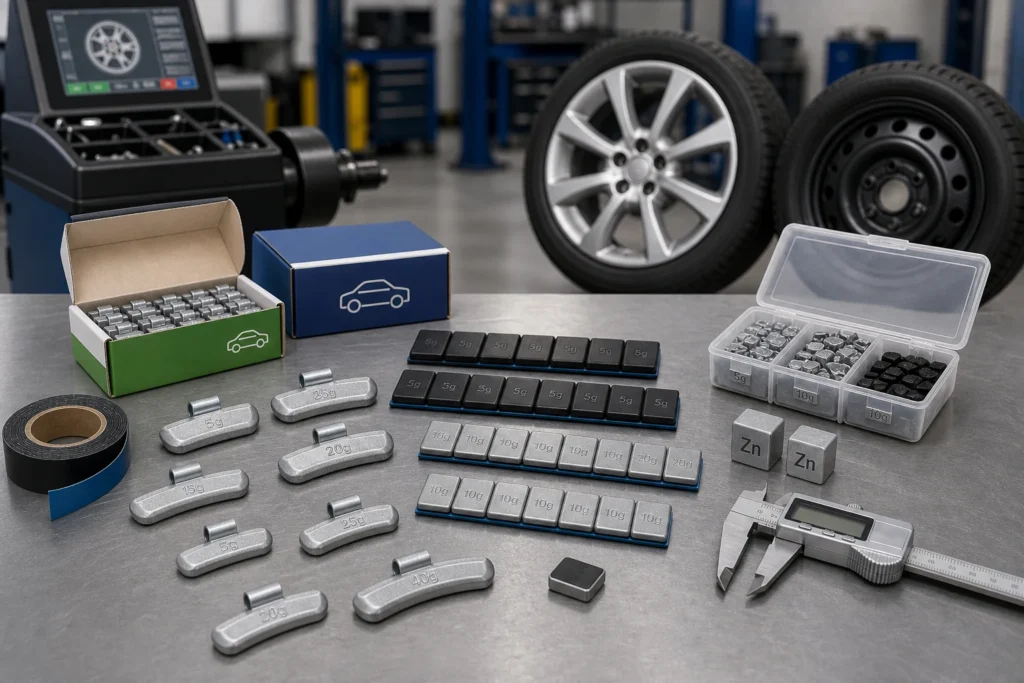
At Yirox, we’d turn a service pattern like this into a focused sample comparison. For a 5 g adhesive increment, the four readings map to 7, 8, 6, and 14 units, making the YX-WW-055 5 g roll a practical first sample for shops using adhesive weights. We’d compare the YX-WW-061 pre-segmented strip where installers prefer ready-made sections, and include the YX-WW-072 zinc clip-on in a steel-wheel fit trial. The sample card records each format against the buyer’s wheel, correction value, clearance, and final balance reading; repeated service patterns then guide the stocking range.
For a workshop using adhesive weights, the YX-WW-055 5 g roll makes the four recorded values easy to test in 5 g steps: 35, 40, 30, and 70 g require 7, 8, 6, and 14 increments respectively. Use the shop’s monthly wheel volume and the agreed roll or pack quantity to turn that test into a repeat-order estimate.2
The YX-WW-061 steel adhesive strip offers a pre-segmented alternative for installers who want ready-made sections. Its listed notation, “(5+10 g) × 4,” gives a nominal 60 g per strip.3 The 30–40 g readings sit within that nominal total, while the 70 g reading is a useful upper-range test: compare the strip layout and any approved combination against the shop’s actual correction method.
For steel-wheel service, the YX-WW-072 zinc clip-on adds a coated zinc clip format to the comparison. Yirox lists it for steel-wheel applications.4 Include a representative steel rim in the trial, compare the clip format with the correction sizes the shop uses most, and record fit, retention, and clearance on the sample card.
Which Yirox passenger-car models should you sample first?
These three models give buyers a clear starting comparison across adhesive rolls, pre-segmented strips, and steel-wheel clips. Choose the first samples around the shop’s wheel mix and balancing records, then use the sample card to document the result for each application.
| Yirox model | Format | Sample decision point | What to record during the trial |
|---|---|---|---|
| YX-WW-055 | Grey steel adhesive roll; 5 g format | Does the shop use adhesive corrections in 5 g steps? | Corrections tested, adhesive position, clearance, final balance |
| YX-WW-061 | Fe steel adhesive strip with blue tape; “(5+10 g) × 4” | Do installers prefer ready-made segments for their recurring correction values? | Segment layout used, installation process, clearance, final balance |
| YX-WW-072 | Coated zinc clip-on for steel wheels | Does the shop’s steel-wheel work call for a clip-on format? | Target wheel, clip fit and retention, clearance, final balance |
For a program centered on alloy wheels and adhesive placement, compare YX-WW-055 with YX-WW-061 on the shop’s most common correction values and wheel clearances. For steel-wheel service, include YX-WW-072 and test it on a representative rim. This keeps the range organized by the way each shop actually works, rather than treating all passenger-car applications as one stock line.
What should a passenger-car wheel-weight sample approval card include?
Use one card for each SKU and each representative wheel application. Keep the completed card with the approved drawing, sample photos, balancer printout, and quotation revision so purchasing can reorder the same product instead of a similar-looking substitute.
Passenger-Car Wheel-Weight Sample Approval Card
| Field | Record |
|---|---|
| Buyer / shop / program | ______________________________ |
| Sample card number and revision | ______________________________ |
| Date / inspector | ______________________________ |
| Supplier / sample lot or batch | ______________________________ |
| Target market | ______________________________ |
| Vehicle make / model / year | ______________________________ |
| Wheel maker / part number | ______________________________ |
| Wheel size / material / finish | ______________________________ |
| Axle and corner tested | ______________________________ |
| Tire size | ______________________________ |
| Balancer make / model / mode / unit | ______________________________ |
| Initial correction — inner plane | ______ g / oz; position: __________ |
| Initial correction — outer plane | ______ g / oz; position: __________ |
| Proposed Yirox SKU / specification revision | ______________________________ |
| Weight material / format / segment mass | ______________________________ |
| Clip profile or adhesive location | ______________________________ |
| Tape / coating / finish specified | ______________________________ |
| Approved drawing or written specification | ______________________________ |
| Installation instruction revision | ______________________________ |
| Required acceptance limit and source | ______________________________ |
| Sample check | Pass / Fail / N/A | Evidence, value, or photo number |
|---|---|---|
| SKU, material, weight marking, and sample match the approved specification | ______ | ______________________________ |
| Individual mass and segment/strip layout match the approved drawing | ______ | ______________________________ |
| Clip profile seats on the specified flange without damaging the wheel | ______ | ______________________________ |
| Adhesive sample fits the approved barrel location and clears the brake assembly | ______ | ______________________________ |
| Installation follows the supplier instruction for surface preparation and application | ______ | ______________________________ |
| Retention check meets the written customer or product specification | ______ | Method/result: __________________ |
| Re-spin result meets the recorded machine, vehicle-maker, or customer limit | ______ | Final inner: ______; outer: ______ |
| Pack label, quantity, barcode, and lot identification match the approved SKU | ______ | ______________________________ |
| Photos, balancing record, drawing, and sample lot are attached to this card | ______ | File/reference: ________________ |
| Disposition | Entry |
|---|---|
| Decision | ☐ Approved ☐ Conditional ☐ Rejected |
| Open issue / corrective action / due date | ______________________________ |
| Buyer approval name / signature | ______________________________ |
| Supplier acknowledgement / date | ______________________________ |
How do you decide whether a passenger-car sample passes?
Agree the acceptance limits before testing. There is no single universal clip-retention force, adhesive peel value, or final balancer tolerance that can be applied to every wheel and workshop. Put the governing drawing, wheel-maker instruction, customer requirement, or product test method in the card’s “required acceptance limit and source” field.
For a clip-on sample, fit it to the target rim and record its seating, retention result, and clearance using the agreed test method. The steel-wheel clip fitment guide is a useful next reference when matching clip style to a steel-wheel application.
For an adhesive sample, use the exact wheel finish, approved location, tape, and supplier installation instructions. Record surface preparation, application conditions, and any dwell or test interval required by the agreed method. Check brake clearance and the final machine reading after installation. Plombco’s installation instructions likewise treat the wheel surface and installation sequence as part of the application rather than a detail to improvise.5
Reject or hold the sample if its stated mass layout, product marking, finish, clip profile, adhesive specification, or package identity differs from the approved submission. Also hold it if the test wheel is not representative or if no one has written down the pass limit. That makes the decision reproducible for the next sample lot and for incoming inspection.
If the unresolved question is the general choice between attachment types, use the focused guide to clip-on and adhesive installation differences. This page keeps the final decision tied to the passenger-car wheel, the recorded correction, and the sample being approved.
Share the vehicle and wheel details, balancer readings, target format, and completed sample card when requesting a passenger-car range review. The exact record helps us confirm which Yirox sample should be checked before a repeat order.
How should the approved sample become a repeatable range?
After approval, freeze the accepted configuration as a controlled SKU record: model, material, mass options, segment layout, clip profile or adhesive system, surface finish, package quantity, label, and specification revision. Keep the approved sample card and reference photos attached to the purchase specification.
Use the service records to mark each line as core, secondary, or exceptional. A core line should map to repeated passenger-car corrections and recurring wheel applications. A secondary line can cover lower-frequency values or an important wheel family. An exceptional value should remain a documented sample request unless usage justifies permanent stock.
Before the purchase order is released, reconcile the supplier quotation, approved card, product drawing, and carton label. The part number and revision must match across all four. If the supplier changes tape, coating, clip shape, segment layout, or pack count, treat it as a new sample approval—not as an invisible substitution.
Conclusion: approve the wheel, correction, and SKU together
Passenger-car wheel-weight ranges become useful when a real balancing record drives the available increments and a representative wheel confirms the attachment. The Mercedes S-Class service record shows why the upper correction value matters; the Yirox comparison shows why roll, strip, and clip-on SKUs need different evidence before they enter one range.
Record plane-specific machine values, check how each SKU builds those values, fill in the sample card, and preserve the approved revision for repeat purchasing. Where the public specification omits a roll quantity, segment layout, clip profile, or mass series, request it before approving the sample.
Frequently Asked Questions
Are 30 g to 70 g standard passenger-car wheel-weight sizes?
No. The values above are readings from one published Mercedes S-Class service report, not a universal passenger-car range. Build the assortment from the wheel and balancing records of the shops or market it will serve.
How should a shop compare YX-WW-061 with a 5 g roll?
Compare the pre-segmented YX-WW-061 strip with the YX-WW-055 roll on the shop’s representative wheel and common correction values. The strip suits teams that prefer ready-made sections; the roll gives a 5 g format to test in smaller increments. Record installation time, clearance, and final balance on the sample card.
When should a shop sample YX-WW-072?
Sample the YX-WW-072 zinc clip-on when the service program includes steel wheels and clip-on corrections. Include a representative rim and recurring correction values in the trial, then record fit, retention, clearance, and final balance before setting the replenishment range.4
What acceptance limit should I write on the card?
Use the applicable wheel-maker, customer, or approved product specification and identify its revision. If an adhesive retention or clip test method is required, record the method and limit before testing; do not substitute an assumed universal number.
References
[1] Hometyre. “Electronic Wheel Balancing on a Mercedes S Class.” n.d.
[2] Yirox. “Grey Steel Adhesive Wheel Weights 5g Roll (YX-WW-055).”
[3] Yirox. “Steel Adhesive Wheel Weights 5g+10g Blue Tape (YX-WW-061).”
[4] Yirox. “Zinc Clip-On Wheel Balancing Weights for Steel Rims (YX-WW-072).”
[5] Plombco. “Installation Instructions.”