



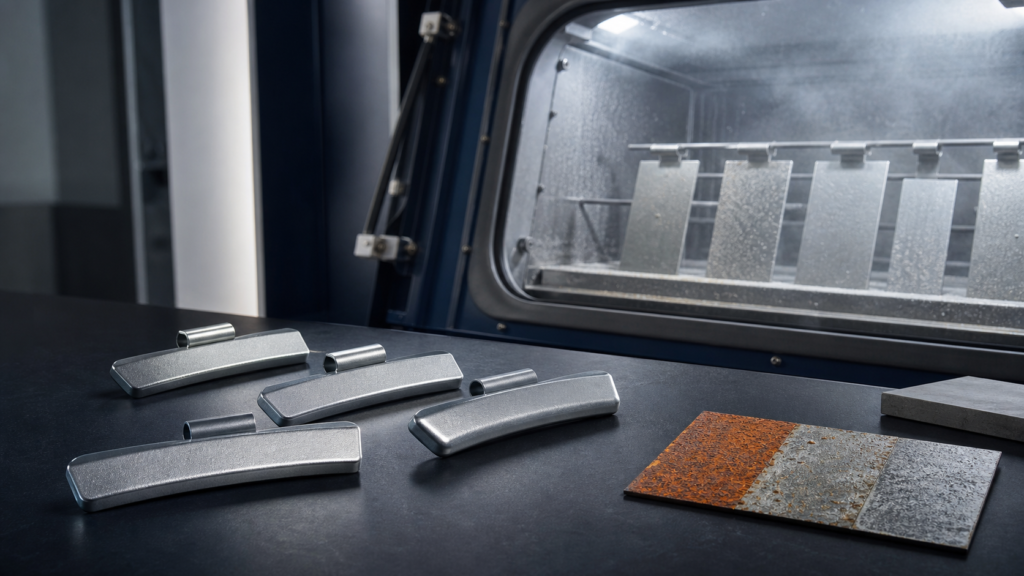
Wheel weight corrosion testing should compare coated steel samples under defined conditions and agreed acceptance criteria. Buyers should identify the coating, specimen preparation, test method, exposure duration, inspection points, and report scope before comparing results. A salt-spray hour count alone is not a universal prediction of on-vehicle life.
Coated steel can be a practical wheel-weight material, but a credible corrosion discussion needs more than the word “rust resistant.” The useful question is whether the evidence describes the exact product and whether another supplier’s result was produced and judged on comparable terms. That discipline helps importers avoid approving a glossy sample on the basis of an impressive but non-comparable report.
Table of Contents
- What does corrosion testing assess for wheel weights?
- Why is comparable evidence more useful than a single salt-spray number?
- What should a corrosion test report state?
- How should buyers compare coated steel samples?
- What acceptance criteria should be agreed before testing?
- How do coating, geometry, packaging, and handling affect the result?
- What should buyers request before approving a supplier?
- Conclusion: Make corrosion evidence comparable
- Frequently Asked Questions
- References
What does corrosion testing assess for wheel weights?
For coated steel wheel weights, corrosion testing assesses how a defined specimen behaves in a controlled corrosive environment and how that specimen is evaluated afterward. It can reveal coating discontinuities, vulnerable edges, surface staining, blistering, underfilm attack, or red-rust development, depending on the test and the agreed inspection rules. It does not automatically certify a universal service life.
This distinction matters because wheel weights are small parts with several exposure-relevant features: formed edges, clip interfaces, cut ends, coating thickness variation, and places where installation can mark the finish. A flat coupon can be useful for comparing a coating process, while an actual clip-on weight can show how the process performs around its geometry. Buyers should decide which question they need each sample to answer.
Start by defining the product in the same terms used for purchase approval. The wheel weight material and attachment choices should distinguish clip-on from adhesive formats, steel from other materials, the relevant weight range, and the surface finish. “Steel wheel weights” is too broad if one quoted product has a painted coating, another is electroplated, and a third uses a different clip or forming route.
ASTM B117 describes apparatus, procedure, and conditions for maintaining a salt-spray environment; it does not prescribe a specimen type, an exposure period for a particular product, or the interpretation of the result.1 That scope is useful to buyers: the method name alone is not the complete approval requirement. The buyer still needs to state what is tested and what counts as acceptable.
Why is comparable evidence more useful than a single salt-spray number?
A reported number of salt-spray hours can be a useful data point, but only alongside the test method, product identity, sample state, exposure details, and acceptance criterion. Without those details, two reports with the same hour count may describe very different tests. A buyer should avoid ranking suppliers simply by the largest number printed on a sales sheet.
For example, a report may concern a flat coated panel rather than the finished wheel weight. It may examine only a broad face while another program evaluates edges, hooks, or deliberately prepared damaged areas. One sample may have been cleaned and handled under a defined procedure; another may have been touched, scratched, or packed after exposure. Those differences can change what the observation means.
The standard itself cautions that salt-spray results, used alone, have seldom correlated with natural-environment performance, and that reproducibility depends strongly on specimen type, evaluation criteria, and control of operating variables.1 This is not a reason to ignore laboratory testing. It is a reason to use it as comparative evidence within an agreed program, not as a shortcut to a blanket durability promise.
Buyers comparing coated wheel weight options can ask each supplier the same short set of questions: What product and coating were tested? What method was used? How were samples prepared and positioned? How long were they exposed? Which surfaces were inspected? What observations caused a pass or fail? Consistent answers are more valuable than a loosely stated claim.
What should a corrosion test report state?
A buyer-ready report should let a reviewer understand what was actually exposed and how the result was reached. It does not need to disclose proprietary process settings, but it should not force the buyer to guess about the sample, method, or pass/fail logic. If the document is from a third-party laboratory, check that the submitted sample description still corresponds to the product being quoted.
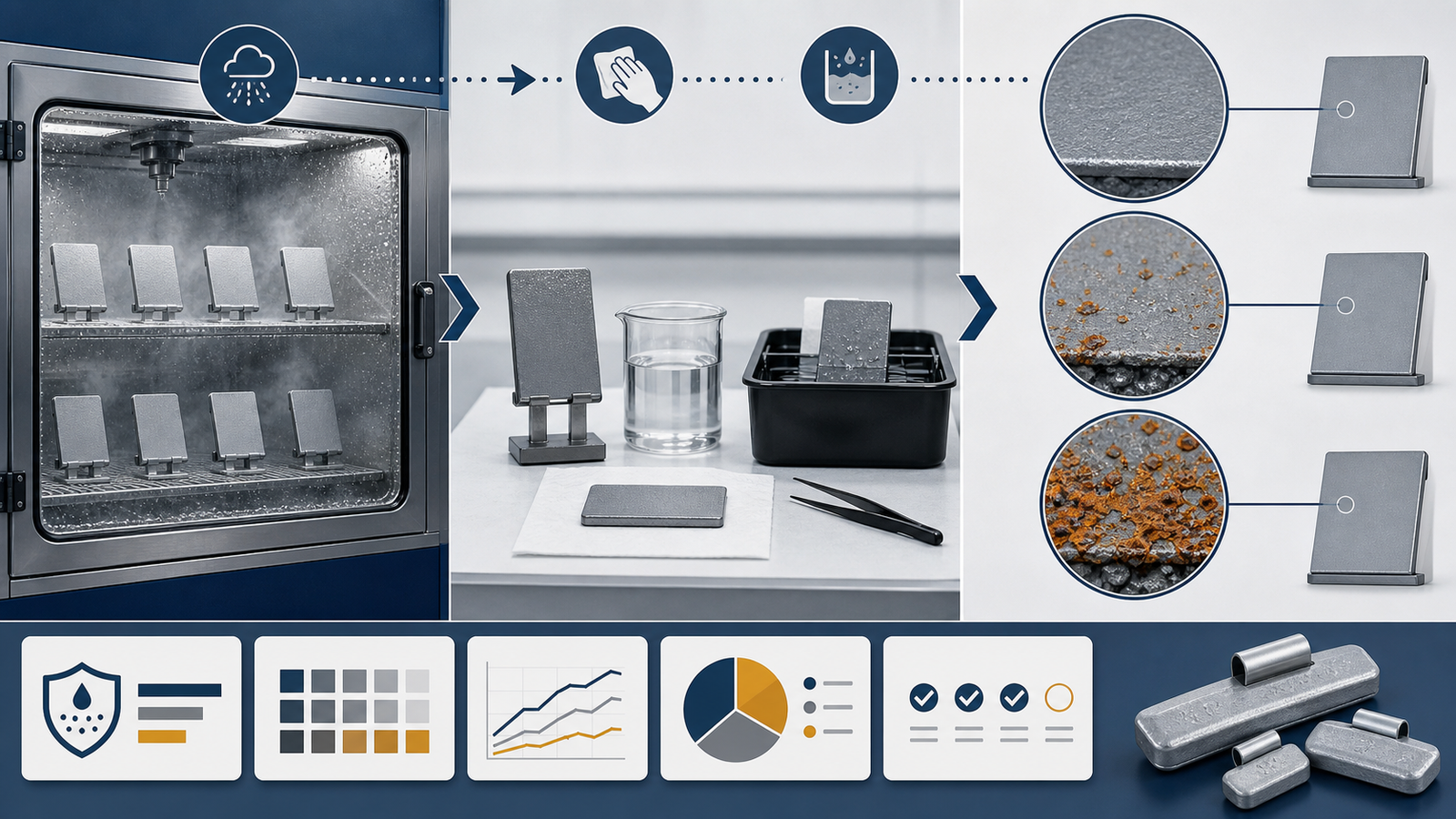
A report should make the exposure setup and the way the specimen was evaluated understandable to the buyer.
Ask for the following information before treating a report as comparable evidence:
| Report element | What the buyer needs to know | Why it changes interpretation |
|---|---|---|
| Product identity | SKU, material, form, coating or finish, and sample quantity | Confirms that the report covers the quoted wheel weight rather than a generic panel. |
| Test method and version | The named practice or customer method used | Identifies the controlled environment and makes comparisons possible. |
| Specimen preparation | Cleaning, handling, masking, edge condition, scratches, and mounting | Surface condition and exposed areas can materially affect an outcome. |
| Exposure record | Start/end, duration, interruptions, chamber controls, and sample positioning | Shows whether the stated exposure is meaningful and repeatable. |
| Evaluation method | Inspection timing, surfaces judged, photographs, and defect definitions | Turns a visual statement into an agreed decision rule. |
| Result scope | Which samples passed, failed, or differed, plus report date and issuer | Prevents one favorable observation from being applied to an entire range. |
Photographs are helpful when they are tied to specimen identifiers, condition before exposure, and the inspection stage. A close-up image without context can show a defect but cannot prove when it appeared, whether it was in the exposure zone, or whether it belongs to the quoted product. Request the original report or controlled summary rather than a cropped image embedded in a quotation.
Preparation and evaluation are not minor paperwork details. ASTM lists G1 as a practice for preparing, cleaning, and evaluating corrosion test specimens.3 For a buyer, that reinforces a practical principle: explain the specimen condition before exposure and the evaluation after exposure. It is difficult to compare results when either end of the process is undefined.
How should buyers compare coated steel samples?
Compare like with like. Use finished wheel weights when the concern is product geometry, formed edges, clip contact, or coating appearance on the actual item. Use equivalent coupons only when the buyer understands that they represent a coating-process comparison rather than the complete installed product. In either case, retain an approved sample and record what it represents.
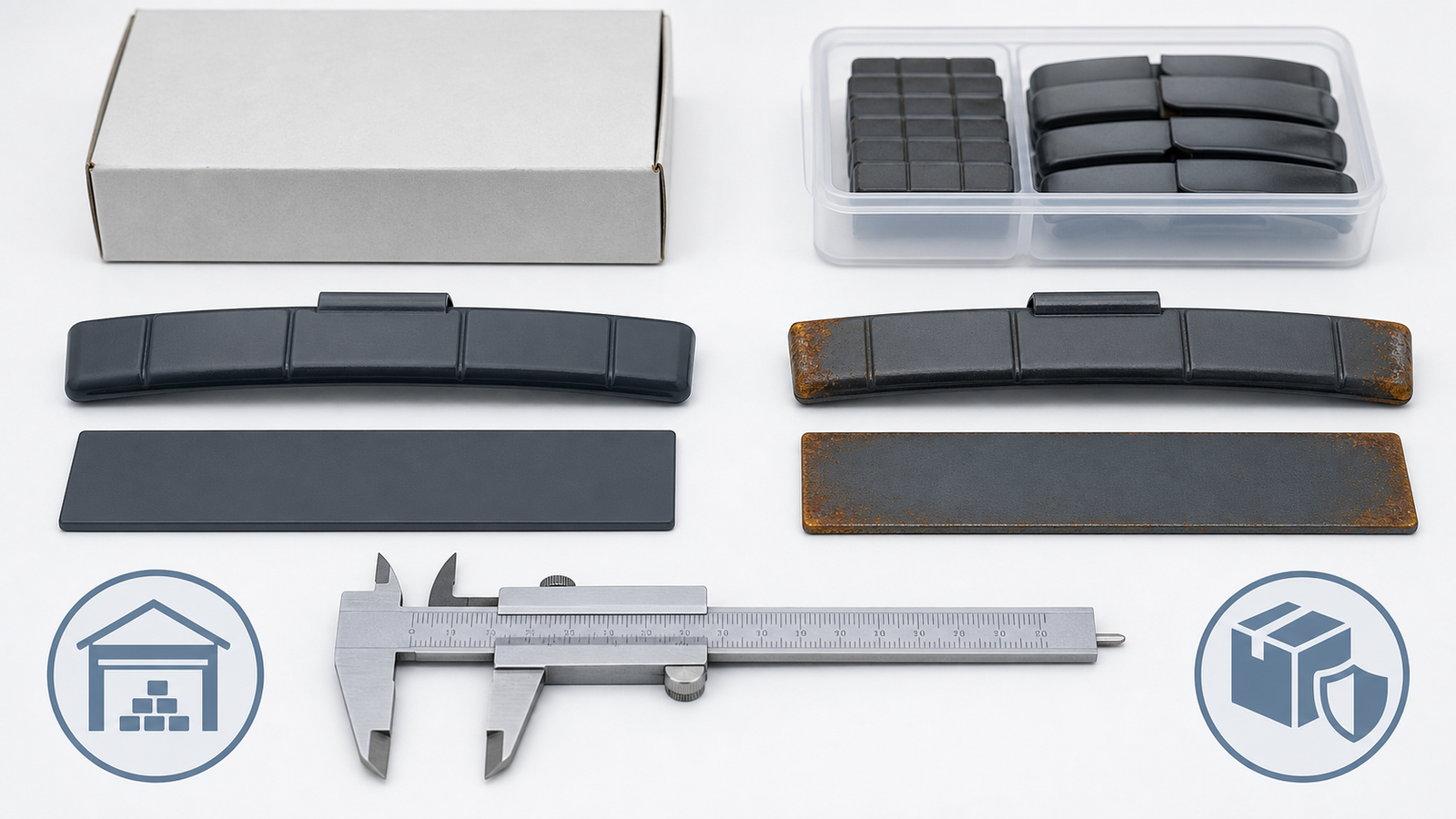
Compare equivalent samples and judge the agreed surfaces and edges, rather than treating one photograph or an unexplained hour count as a conclusion.
Set up a simple side-by-side comparison. Specify the same product form, coating family, sample count, preparation condition, test method, exposure duration, mounting approach, and evaluation points. If a customer requirement includes an intentional scribe, cut edge, or installation-related mark, define it exactly and include it in every supplier comparison. Do not add a scratch to only one sample and then call the result a coating ranking.
The wheel balance weight formats matter here. A clip-on weight has a different geometry and installation interface from a stick-on segment. A flat coupon may have no equivalent of a clip bend or a cut end. The test plan should therefore identify whether it is evaluating coating-process consistency, finished-product appearance, installed-part retention, or a combination of those questions.
Buyers should also protect comparison samples from accidental mix-up. Photograph them before exposure, assign a neutral sample identifier, keep their packaging and production records, and document who handled them. A sound comparison is a chain of evidence, not a tray of parts with an after-the-fact explanation.
What acceptance criteria should be agreed before testing?
Agree the acceptance criteria before the test begins, ideally in the specification or sample-approval record. A statement such as “no rust” is often too vague. Does it mean no red rust anywhere? No corrosion on a defined visible face? No blistering beyond an agreed rating? Are intentionally exposed edges included or excluded? Is temporary white residue relevant? The parties should resolve those questions before viewing the result.
| Decision area | Example of an agreement to make | Buyer benefit |
|---|---|---|
| Specimens | Number, SKU, coating version, and whether finished parts or coupons are used | Prevents a report from being applied to an unrelated configuration. |
| Exposure | Method, duration, orientation, permitted interruptions, and test facility | Establishes one comparable basis for all submitted samples. |
| Surfaces evaluated | Broad faces, edges, clip region, cut surfaces, and any prepared damage | Focuses inspection on the areas that matter for the program. |
| Defect terms | Definitions for red rust, blistering, delamination, staining, or coating loss | Avoids arguing over a photograph after the test. |
| Pass/fail | Allowed condition, rating system if used, and disposition of marginal samples | Makes the commercial decision repeatable. |
| Evidence package | Report, sample photos, retained sample, and test date or batch reference | Connects approval to a retrievable record. |
The pass/fail rule should fit the intended market and service environment, not an arbitrary maximum number. If a customer provides a written requirement, use that as the starting point and clarify any gaps. If no requirement exists, agree a practical screening plan and state that it is a comparative supplier-approval test rather than a prediction of every road, climate, wash chemical, or installation condition.
There is also a separate functional question: a wheel weight must be compatible with the rim and remain properly installed. SAE J1986 addresses balance-weight and rim-flange configurations, including retention test procedures and performance recommendations for passenger-car, light-truck, and multipurpose-vehicle applications.2 Corrosion evidence should sit beside—rather than replace—product-fit and retention evaluation.
How do coating, geometry, packaging, and handling affect the result?
Corrosion resistance begins with the coating system, but the buyer should look at the whole product path. Surface preparation, coating coverage, curing, part geometry, clips, packaging, shipping exposure, warehouse humidity, and installation handling can all affect what reaches the wheel. A good chamber result does not correct damage introduced after the sample leaves the lab.
Ask the supplier to identify the coating or finish in commercially usable terms and to explain which product surfaces receive it. Then compare the approved sample with production sample appearance, including sharp corners, formed bends, hooks, and interfaces. The point is not to demand confidential formulation details; it is to ensure that the tested and supplied finishes are not silently different.
Manufacturing context helps a buyer recognize where variation can arise. Review how wheel weights are made alongside the sample: forming and handling occur before packing, and any process change that alters the part or finish may justify renewed comparison. A supplier should have a way to tell the buyer when coating, material, or processing has changed from the approved version.
Packaging and storage deserve the same attention. Keep cartons dry, intact, and off wet floors; inspect cartons that show water damage or prolonged uncontrolled storage. Record the lot or batch where available. These are basic bulk wheel weight receiving controls, but they prevent a warehouse condition from being mistaken for a production-coating conclusion.
What should buyers request before approving a supplier?
For a new coated-steel program, request enough evidence to make an informed, repeatable decision. The exact package should match the order value and customer risk, but it normally includes a representative finished sample, product specification, coating description, current test report or agreed test plan, and clear acceptance criteria. Ask whether the report covers the exact SKU or a related coupon, and record that distinction.
Use this short approval sequence:
- Define the product, application, surface finish, packaging, and customer requirement.
- Approve a retained finished sample and note the areas that will be inspected.
- Agree the method, sample preparation, exposure, evidence package, and pass/fail criteria before testing.
- Review the full report and photos against the agreement, not against a marketing claim.
- Confirm change notification for material, coating, process, geometry, or packaging changes.
- At receiving, compare production product and packaging with the approved sample and retain the batch reference where supplied.
Ask a prospective supplier how it controls those steps as part of wheel weight manufacturer evaluation. A clear answer is usually more revealing than an unsupported promise of “long-life” coating. For recurring orders, ask for the same evidence format so the buyer can compare revisions over time instead of recreating the approval process from memory.
Agreed corrosion criteria should become part of the production inspection rules for finish, tolerance, retention, and records. Buyers can then check the shipment against the approved coating evidence before release instead of discovering a changed finish at receiving.
Conclusion: Make corrosion evidence comparable
Wheel weight corrosion testing is most useful when buyers treat it as a controlled comparison: same product definition, known coating, documented specimen condition, named test environment, agreed exposure, and explicit inspection criteria. That approach makes reports easier to review and gives suppliers a fair, repeatable approval target.
Before releasing an order, request the coating specification, representative sample, corrosion-test evidence, and the acceptance rule that applies to the exact product. Keep those items with the approval and receiving records. The result is a practical basis for evaluating coated steel wheel weights without turning one salt-spray number into a promise it cannot support.
Frequently Asked Questions
Is a salt-spray hour rating enough to approve coated steel wheel weights?
No. It is only one item of evidence. Compare the actual product or coupon, coating, test method, specimen preparation, duration, sample positioning, and agreed inspection criteria. ASTM B117 does not prescribe the exposure period or the interpretation for a particular product.1
Should buyers test a flat coupon or a finished wheel weight?
Use a finished wheel weight when geometry, edges, clips, and actual product appearance matter. A coupon can compare a coating process, but it does not automatically represent every feature of a formed wheel weight. Record what the selected sample is intended to prove.
Does a corrosion test predict every vehicle environment?
No. Laboratory exposure creates controlled comparative evidence. Road salt, humidity cycles, washing, debris, storage, wheel design, and installation conditions can differ from a chamber. Use the test with product-fit, retention, and receiving controls.
What should happen if production coating differs from the approved sample?
Hold the approval decision, identify the change, and compare the revision against the agreed specification. Depending on the difference, obtain a new finished sample and repeat or update the agreed evidence before release. Do not assume a similar-looking finish is equivalent.
References
[1] ASTM International. “ASTM B117-26: Standard Practice for Operating Salt Spray (Fog) Apparatus.” 2026.
[2] SAE International. “SAE J1986: Balance Weight and Rim Flange Design Specifications, Test Procedures, and Performance Recommendations.” 2006.
[3] ASTM International. “ASTM G1: Standard Practice for Preparing, Cleaning, and Evaluating Corrosion Test Specimens.” 2025.