



A car grille is the screen that covers the opening at the front of a vehicle, letting cooling air reach the radiator while keeping stones and debris out. The main car grille types are mesh, honeycomb, slatted bar, billet and OEM-style. Choose by fitment first, then by sensor compatibility, material and the look you want.
Scope: this guide compares grille patterns, materials and fit routes for passenger cars, SUVs and light pickups, and explains the radar and camera checks that matter on newer vehicles. Tubular grille guards and bull bars that mount in front of the grille are covered in our bull bar vs grille guard guide, and the bumper shell around the grille is explained in bumper cover vs bumper.
What is a car grille, and what does it do?
A grille is a perforated or slatted panel that closes the front opening of the body while still letting air through. On most cars the upper grille sits just below the hood edge, and one or more lower grilles sit in the bumper cover below it. Behind them are the radiator, the A/C condenser and, on turbocharged engines, often an intercooler. The grille has to pass enough air to those heat exchangers while stopping stones, leaves and insects from bending their fins.
The grille also does a styling job that is out of proportion to its size. It is the part people read as the “face” of the car, and many brands use one grille shape for decades so their vehicles are recognizable at a distance. That is why grille swaps are one of the most popular exterior upgrades: a different pattern or finish changes the whole front view without touching the bodywork.
A third job is newer. On many late-model vehicles the grille area also hides driver-assist hardware: a millimeter-wave radar behind the emblem or lower grille, a front camera, and parking sensors set into the bumper. That turns a cosmetic part into one that can affect safety systems, which is covered in the sensor section below.
Names vary by market and seller. You will see grille insert (the patterned center that fits inside a surround), grille shell or surround (the outer frame, sometimes chrome), upper grille, lower grille or bumper grille, and small corner grilles at the outer ends of the bumper. When you compare listings, check which of these pieces is actually included.
What are the main types of car grilles?
Most aftermarket and replacement grilles fall into five types: mesh, honeycomb, slatted bar, billet and OEM-style. They differ in pattern, typical material, how they fit and how easily they clear sensors. The table compares them.
| Type | What it looks like | Typical material | Fit route | Sensor and emblem risk | Best for |
|---|---|---|---|---|---|
| Mesh | Diamond or woven wire pattern, fine and even | Molded ABS, or aluminium and stainless wire mesh | Full replacement grille, or mesh sheet fitted behind an existing opening | Metal mesh in front of a radar is a known problem; check the radar location | Clean sporty look, older cars, custom builds |
| Honeycomb | Hexagon cells, often gloss black | Injection-molded ABS or ASA | Model-specific replacement grille | Needs correct sensor holes, camera mount and emblem carrier | “Performance trim” look on sedans and hatchbacks |
| Slatted bar | Horizontal or vertical bars | ABS or PP, chrome or painted | OEM-style replacement or overlay | Lowest when it copies the factory part | Factory look, trucks and SUVs |
| Billet | Thick flat aluminium bars | Machined or extruded aluminium | Bolt-over onto the factory grille, or replacement insert | Metal bars can block radar paths; confirm before ordering | Classic and pickup styling |
| OEM-style | Same shape and pattern as the factory grille | Same polymer family as the original, usually ABS or PP | Direct replacement using factory clips and brackets | Lowest if the radar emblem or cover is carried over or matched | Collision repair, fleet and replacement parts |

The table shows why “type” is only half the choice. A honeycomb grille designed for one bumper and sensor package can be a perfect fit, while a honeycomb grille sold as “universal” usually means trimming and gaps. Universal grille mesh does exist, sold as flat sheets in plastic or metal, but it is a custom-fabrication material rather than a bolt-in part. It suits older vehicles with no front radar and owners who are comfortable cutting and fixing it behind an opening. Vehicle-specific grilles start from the car or the original part; see how we use 3D scanning and reverse engineering for fitment.
Two more variants appear in listings. Overlay grilles clip or bolt over the factory grille to change its finish without removal. Grille inserts replace only the patterned center and keep the original surround. Both are quicker to fit than a full shell but are limited by the shape underneath. If you want to see molded examples, our ABS mesh front grille for an older Civic and a Type R style honeycomb grille set show the two most common patterns.
Mesh vs honeycomb grille: what is the difference?
Mesh and honeycomb are both open-cell patterns, but mesh uses thin crossing strands while honeycomb uses thicker hexagon cells. In practice the difference is less about airflow and more about look, stiffness, cleaning and how the part is made.
- Look: mesh reads as fine texture and suits a subtle or retro build. Honeycomb reads as bolder and is the pattern most buyers associate with performance trims.
- How it is made: honeycomb grilles are almost always one-piece injection moldings. Mesh grilles can be molded in plastic or built from woven or expanded metal mesh fixed to a frame.
- Stiffness: molded honeycomb walls make a rigid panel. Thin metal mesh can dent from stone strikes or a careless pressure washer, and plastic mesh with very thin strands can crack if it is flexed during fitting.
- Cleaning: small mesh cells trap insects and road film. Larger hexagon cells are easier to rinse and brush. Either way, use a soft brush and a car-safe cleaner rather than a degreaser that can haze gloss black plastic.
- Airflow: what matters is the total open area and how the grille seals to the radiator ducting, not the cell shape alone. A dense mesh with small holes can pass less air than an open honeycomb, and the reverse is also possible.
For most daily drivers, choose the pattern you like on a part that is made for your exact bumper. If two options are equal on fit, honeycomb is usually the more robust molded part, while metal mesh gives the most freedom for custom work.
OEM-style vs custom grilles: which route fits your car?
OEM-style grilles copy the factory part so they fit the original clips and keep factory features; custom grilles change the look and accept more fitting work. The industry usually splits grilles into these two families, and the right one depends on why you are replacing the grille.
OEM-style is the default for collision repair, rental and fleet vehicles, and anyone who wants the car to look stock. A good OEM-style grille matches the factory shape, mounting tabs and emblem position. It is also the route most likely to keep radar, camera and sensor hardware working, provided the radar-related parts are carried over or matched (see the next sections). Our front bumper and grille replacement set is an example of this route: the grille is supplied as part of a model-specific front-end set.
Custom grilles cover everything else: honeycomb conversions, mesh or billet upgrades, blacked-out versions of chrome factory grilles, and styles borrowed from higher trims. There are three common fit routes:
- Bolt-over: the new grille or billet insert fastens over the factory grille. No cutting, quick to reverse, but the factory part stays underneath and limits the design.
- Insert replacement: the patterned center is removed from the factory surround and the new insert is fitted. This often needs trimming of the old center and is harder to reverse.
- Full replacement shell: the whole grille is swapped. This gives the cleanest result when the part is model-specific, and it is the route where sensor holes, camera mounts and emblem carriers must match exactly.
If your goal is simply to remove chrome, a full grille swap is not the only option. Wrapping or overlay pieces may be enough; our chrome delete guide compares those methods. For a wider view of factory versus aftermarket exterior parts, see OEM vs aftermarket exterior accessories.
Which materials and finishes are used for grilles?
Most modern grilles are injection-molded plastic, with metal used mainly for mesh, billet and heavy-duty truck grilles. The material decides weight, stiffness, finish options and, on radar-equipped cars, whether the grille can sit in the sensor path at all.
| Material | Why it is used | Watch-outs | Common finishes |
|---|---|---|---|
| ABS | Rigid, holds fine detail like honeycomb walls, paints and plates well | Needs UV-stable paint or coating outdoors; thin sections can crack on impact | Gloss black, matte black, chrome plating, paint |
| ASA | Weather-resistant styrene for exterior parts that stay unpainted | Fewer plating options than ABS | Molded-in black or color, textured |
| PP / TPO | Tough and flexible; common for lower grilles in bumper covers | Needs adhesion promoter before painting | Textured black, primer for paint |
| Aluminium | Light, stiff, used for billet bars and wire mesh | Metal in front of a radar can block or reflect signals | Polished, anodized, powder-coated |
| Stainless steel | Corrosion-resistant wire mesh for custom grilles | Heavier; same radar caution as aluminium | Polished, black-coated |
For molded grilles, typical production in this category involves injection molding the grille in ABS, ASA or modified PP, trimming and deburring the gates, then applying the finish: piano black paint, chrome plating, or leaving a molded-in texture. Clips, brackets and emblem carriers are then fitted and the part is test-fitted against a reference car or fixture. You can read more about the base polymers on our ABS and ASA material pages.
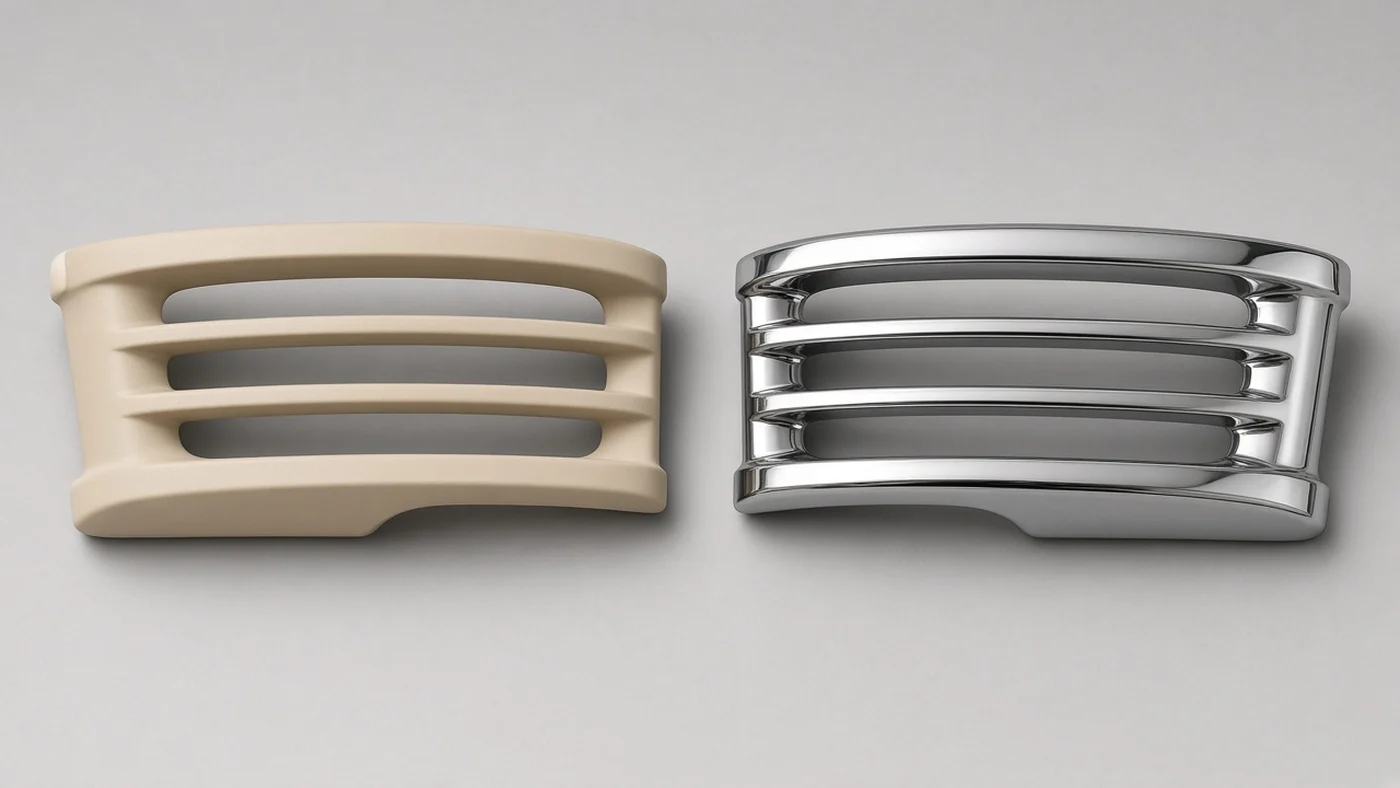
Finish is where many cheap grilles fail first. Gloss black shows swirl marks and stone chips quickly, matte black hides them but can stain, and chrome plating on plastic needs a properly prepared substrate to resist peeling. Plated grilles go through a multi-layer process; our chrome plating page explains the typical steps and checks. On radar-equipped cars, ask whether the finish is approved for the sensor path, because paint build and metallic layers can matter there.
Does grille design change airflow and cooling?
Yes, but only through open area and sealing, and most well-designed replacement grilles do not change cooling in normal driving. The radiator, condenser and fan are sized with the factory grille opening, so a replacement with similar open area behaves much the same. Problems start when a dense pattern, a closed-off badge area or a solid billet plate reduces the opening, or when air leaks around the grille instead of passing through the radiator.
Car makers now control grille airflow actively. Active grille shutters (AGS) are vanes behind the grille or lower opening that close when little cooling is needed and open when the engine or A/C needs air. In an SAE study of an SUV with AGS, closing the shutters gave a maximum drag benefit of 9 counts, with most of the gain near the fully closed position, and fuel use on the WLTC cycle fell by 2% compared with shutters held fully open 6. That is a useful reminder that the space behind the grille is part of the cooling and aero system.
For buyers this means two checks. First, if the vehicle has shutters, the new grille must leave room for them to move and must not block the shutter module. Second, if you tow, idle in heat or drive a turbocharged engine, avoid grilles with much less open area than stock. Battery-electric cars need less front cooling air, which is why many use closed or mostly decorative grilles. A replacement for those models should copy the factory open and closed areas rather than adding openings.
Will a new grille affect radar, cameras or parking sensors?
It can, and on driver-assist vehicles this is the most important grille check. Many cars place a millimeter-wave radar behind the grille emblem or lower grille. The parts in front of it are designed to let radar waves through, so a grille that looks right can still blind the sensor.
Honda’s collision repair position statement gives a clear example. On certain models from the 2014 (Acura) and 2015 (Honda) model years, the Collision Mitigating Brake System radar senses through the grille upper molding or the grille emblem. Those parts are specially designed to prevent radar interference, and installing the wrong grille parts turns on the system indicator and sets a trouble code 1. Forum reports describe the same pattern on other brands: an aftermarket grille arrives with a non-radar emblem, the dash shows a “radar dirty” type message, and adaptive cruise stops working.
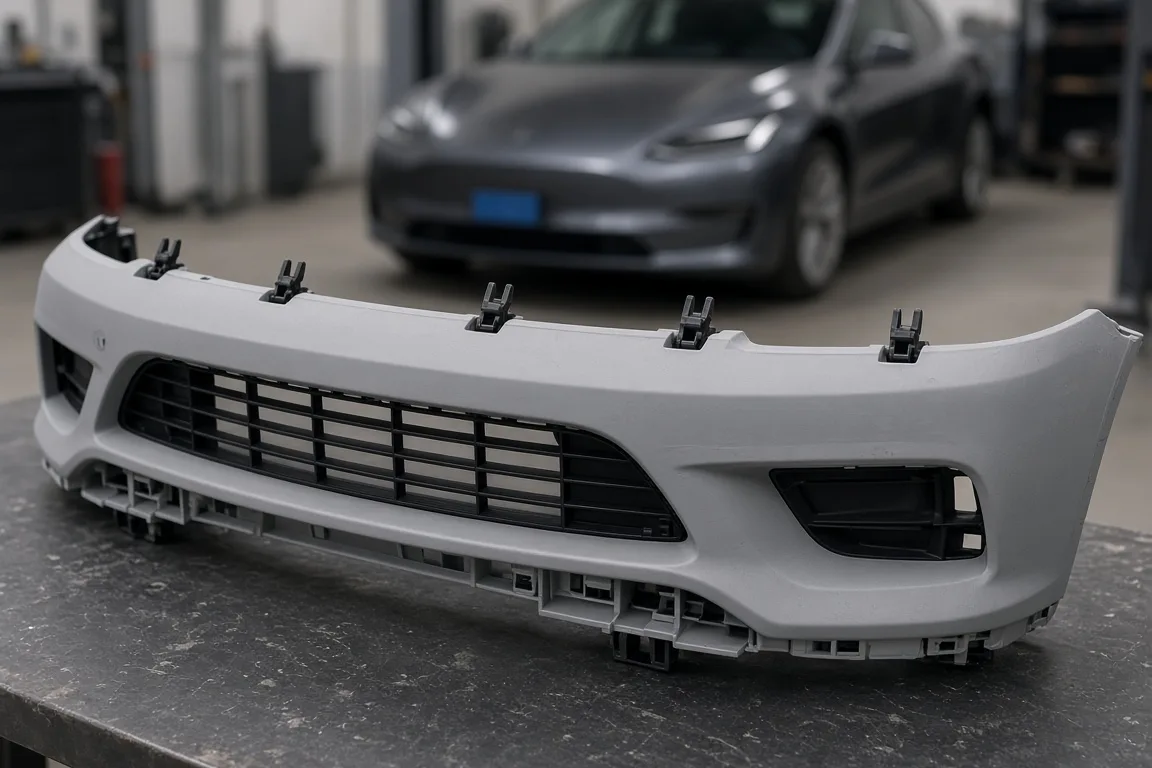
Other automakers say similar things. Ford’s 2026 collision position statement lists grilles in a sensor’s field of view as ADAS-related parts, and warns that aftermarket bumper covers or grilles can differ in thickness and composition and interfere with radar signals; it also notes that extra paint layers can weaken or deflect radar 2. GM’s statement says aftermarket parts in sensor areas, including the front grille and the area below it, are not recommended because they can degrade driver-assist functions 3. For radar-equipped bumper fascias, GM limits repairs to topcoat refinish with a maximum refinish thickness of 13 mils 4. Nissan states that front radar recalibration is mandatory after any front repair that shifts, removes or reinstalls the radar 5.
Use this checklist before you buy or fit any grille on a vehicle with driver assistance:
- Find the radar location in the owner’s manual or service information: behind the emblem, behind the lower grille, or elsewhere in the bumper.
- If the radar looks through the grille or emblem, keep or match the radar-transparent emblem or cover. Do not put metal mesh, billet bars or chrome badges in that path.
- Check that the grille has the right holes and mounts for front parking sensors and any front camera, at the factory angle.
- Plan for a radar or camera calibration if the brand requires one after removal and refit.
- Keep the factory grille and emblem so you can return the car to stock.
Warranty worries are common too. Under the federal warranty rule, a car maker cannot void a warranty simply because a non-brand part was used, but it can deny coverage for damage it shows was caused by that part 7. Shops should also remember that commercial installers must not knowingly make required safety equipment inoperative 8.
How do you check fitment and install a grille?
Confirm the exact vehicle first: year, model, trim, bumper type and factory equipment, then compare mounting points before any tools come out. Grilles change during model generations. A facelift can move the emblem, reshape the bumper or alter clip positions, and a sport bumper may use a different grille from the base bumper on the same car.
A practical fitment and install sequence looks like this:
- Check the listing against your car: generation, pre- or post-facelift, bumper style, sensor package, camera, shutters and emblem type.
- Compare the new grille with photos of the back of your factory grille: clip count, tab positions, screw bosses and emblem carrier.
- Find out whether the grille comes out from the front or needs the bumper cover removed. On many cars the bumper must come off.
- Release clips with trim tools, not screwdrivers. Plastic tabs on older grilles become brittle and break easily.
- Transfer sensors, camera, emblem and any brackets. Test-fit and check gaps to the hood, fenders and bumper before fully fastening.
- Reconnect everything, clear any fault codes, and complete a calibration if the brand requires it.
Owners often underestimate step 3. Forum threads about honeycomb swaps describe hours of work, broken tabs and fault codes from unplugged bumper sensors. If the job needs bumper removal on a car with driver assistance, a shop with the right scan tool is usually the better choice. For how the bumper cover, beam and absorber fit together, see our bumper cover guide.
After fitting, care is simple. Rinse insects off before they dry, use a soft brush in mesh or honeycomb cells, and keep pressure-washer nozzles back from thin strands and edges.
How to choose a grille: a quick decision checklist
Choose in this order: fit, safety systems, use, material, then style. The look matters, but it is the last filter, not the first.
- Exact fit: is the grille listed for your generation, facelift and bumper? If not, skip it.
- Driver assistance: does your car have front radar, camera or parking sensors? If yes, choose OEM-style or a model-specific grille that carries over the radar emblem or cover and sensor mounts.
- Use: towing, hot climate or turbocharged engine? Keep open area close to stock and avoid solid billet plates.
- Material and finish: molded ABS or ASA for daily drivers, metal mesh or billet for custom and older vehicles, and matte or textured finishes if you want easier care.
- Route: bolt-over or overlay if you want something reversible, full replacement for the cleanest look.
- Style: mesh for subtle texture, honeycomb for a sporty face, slatted or OEM-style to stay factory.
If two grilles pass every line, pick the one with clearer fitment information and better photos of the back of the part. That usually signals a supplier who designed it for the vehicle rather than adapting a near fit.
What should B2B buyers put in a grille RFQ?
For distributors, body shops and private-label brands, the specification decides whether a grille sells once or keeps coming back. Most returns come from the wrong generation, missing sensor holes, a non-radar emblem carrier or finish damage in transit.
Include these points when you request quotes or samples:
- Vehicle data: year range, generation and facelift, bumper variants, market (left- or right-hand drive), and photos or part numbers of the factory grille.
- Equipment matrix: which versions have front radar, camera, parking sensors or active shutters, and whether the emblem carrier must accept the factory radar emblem.
- Design: OEM-style copy or styling variant (honeycomb, mesh, blacked-out), and whether the grille is a full shell, insert or overlay.
- Material and finish: ABS, ASA or PP; gloss black, matte, chrome or primer; color and gloss targets; weathering expectations for outdoor use.
- Mounting: clip map, tab positions, screw bosses and any brackets supplied.
- Sample approval: try-fit photos on the vehicle or a fixture, gap checks to hood, fenders and bumper, and confirmation that sensors and camera sit at the factory position.
- Packaging: protective film on gloss or chrome surfaces, corner protection and bagged hardware.
For new models without a factory drawing, development usually starts from a scanned reference part or vehicle. Our vehicle-specific development service page describes that path.
Conclusion
A car grille protects the radiator and frames the face of the car, and the five common types (mesh, honeycomb, slatted bar, billet and OEM-style) mostly differ in pattern, material and how they mount. Mesh gives a fine texture and the most room for custom work, honeycomb gives a bolder molded look, and OEM-style keeps the factory appearance with the least fitting risk.
On newer vehicles, the grille is also part of the driver-assist system. Radar often looks through the emblem or lower grille, so the safest upgrade is a model-specific part that keeps the radar path clear: one that keeps the radar-transparent emblem or cover, the sensor mounts and room for active shutters. Get those right and the choice of style, material and finish becomes a matter of taste and upkeep rather than risk.
Next step
Write down your vehicle’s generation, bumper type and sensor package, then compare grille options in our front bumper and grille range or the wider body kits and aero parts category. Yirox molds grilles and other front-end parts in its own injection molding factory and checks your vehicle list, drawings and mounting details with you before sampling. Send your list through sourcing solutions or our contact form.
Frequently asked questions
Is it a car grill or a car grille?
The correct spelling for the part on a car is grille. Grill refers to cooking, although many sellers and shoppers use both spellings.
Can I drive without a front grille?
It depends on the vehicle, but without a grille the radiator and condenser are exposed to stones and debris. On cars with radar behind the grille or emblem, driver-assist features may also stop working until the correct part is refitted.
Does a honeycomb grille reduce airflow compared with mesh?
Not by itself. Airflow depends on total open area and how well the grille seals to the radiator ducting, so a dense mesh can pass less air than an open honeycomb.
Is there a universal car grille mesh?
Yes, flat mesh sheets in plastic or metal are sold for custom fitting. They need cutting and fixing, and they are not suitable in front of a radar sensor.
Will an aftermarket grille void my car warranty?
Not simply because it is aftermarket. A car maker can deny coverage only for damage it shows was caused by the part, so keep the factory grille and emblem and follow calibration requirements.
Can I paint my factory grille black instead of replacing it?
Often yes, but paint build matters if radar looks through the grille or emblem. Some car makers limit refinish thickness in sensor areas, so check service information before painting.
References
- American Honda Motor Co. — Position statement: Driver assist / safety systems may fail unless OE parts used (2018), including CMBS grille differences.
- Ford Motor Company — Collision position statement: ADAS integrity and technical imperatives (May 2026).
- General Motors — Important advanced driver assistance systems considerations (OEM position statement, OEM Repair Information copy).
- General Motors — ADAS bumper fascia repair guidelines.
- Nissan Canada — Collision repair position statements (Radar calibration post-repair).
- Yan, J. et al. — Thermal management and energy consumption balanced design for active grill shutter control, SAE Technical Paper 2022-01-0187.
- 16 CFR § 700.10 — Prohibited tying (Magnuson-Moss Warranty Act interpretations), U.S. Government Publishing Office.
- 49 U.S.C. § 30122 — Making safety devices and elements inoperative (Legal Information Institute).